Showing posts with label FBI. Show all posts

Tuesday, October 27, 2009

PT35 MOVE CLAIMS, pt. two

THURMAN AND PT/35(b): ”MONTHS” WITH THE “REAL THING”
[Pan Am 103 Series]
Adam Larson / Caustic Logic
October 27 2009
last update/edit 11/5


Shuttling: The First 17 Months
Part one of this series covered the 2008 interviews revealed in Tegenlight: Lockerbie Revisited, which showed a contradiction in whether the fragment of circuit board, PT/35(b) was taken to the United States. FBI SCOTBOM chief Richard Marquise and identifying FBI agent James “Tom” Thurman both told interviewer Gideon Levy that the fragment was brought to Washington and examined there, whereas British authorities and Marquise (after a short-lived change of memory) refuted the claim, insisting it stayed in the UK. This part will cover the entanglement of this evidence and agent Thurman throughout the Lockerbie case and beyond, drawing largely from the writings of Marquise. The special emphasis is on clues about whether Thurman worked from a photograph of the evidence or from the real item, as he told the documentary.

A 1991 Miami Herald article reported that Thurman was first sent to Lockerbie, on behalf of the FBI SCOTBOM investigation, two days after the December 21 explosion to help in “combing the countryside for clues." He worked right through Christmas, and in “about two months at the scene,” the article continues, he “pored over thousands of pieces of evidence.” [1] According to FBI task force chief Richard Marquise, however, the intrepid special agent had returned from Scotland by Jan 19 1989, when he gave a briefing to the FBI confirming prior assumptions that a bomb was responsible. [2, p.35]

Thurman returned to Lockerbie several times, shuttling across the Atlantic and even further out into the field, as initial clues converged on a PFLPGC attack perhaps involving Jordanian agent and bomb-maker Marwan Khreesat. Marquise reveled that “Thurman had been part of the team that interviewed Khreesat” in Jordan, November 1989. [2, p.60] This special interview, carried out with CIA brokerage, and its (reportedly ambiguous) results were kept from Scottish investigators, causing some tensions later.

On Jan 10 1990 new Senior Investigating Officer Stuart Henderson (who replaced John Orr) presented at a meeting in the UK. He did not mention the timer fragment to all, but off to the side told Marquise and FBI’s ASAC John Kelso about it. They showed interest in helping find a match, but Henderson insisted on going it alone. “This decision cost us six months,” Marquise writes. [2, p.58]

On Cloud Nine: June1990-November 1991
Actually it was five months delayed; it was at an investigator’s conference in Virginia on June 11 when Marquise relates how the Scottish authorities finally made their puzzlement over the fragment known to all – 55 companies checked to no avail. Thurman “approached Henderson and asked if he could take photographs of PT-35 and attempt to identify it. Henderson, who believed the Scots had done all they could do, agreed.” [2, p 60] This passage is crucial to move claims, and rather ambiguous. It seems to read that Thurman, in Arlington, was allowed to take a picture of evidence Henderson had there with him. It could also mean a request to retain one of the photo-prints there, or to take a picture of the single photo they brought, or fly to Scotland to photograph PT/35(b). The last option seems out, given the mechanics of identification that followed. I remain agnostic on the reading here, and on its value as one of Mr. Marquise’s sometimes confused recollections.

The Herald decided after talking with Thurman that he “meticulously compared the picture of the fragment to hundreds of other devices,” a lengthy-sounding process. [1] The agent told the show Air Crash Investigation (in early 2008?): “I spent, uh, months, literally, looking through all about the files of the FBI on other examinations that we had, uh, conducted over many many many years. […] After a period I just ran out of leads” and was forced to look “outside the physical FBI laboratory.” [3]

But Marquise said “what Thurman did yielded fruit within two days. […] Henderson and his colleagues were on an airplane headed back to Scotland;” having just left from the Virginia conference, and the discovery “would turn Henderson around quicker than he ever imagined,” putting them back stateside within 24 hours of the discovery. Further evidence against Thurman’s months claim is his own well-memorized “day that I made the identification,” recalling it as one would a wedding anniversary: June 15 1989. He had four days tops to get this grueling season of cross-checking out of the way.

What Thurman did, Marquise sums up, is know where to look. He took the photo to a CIA explosives expert “Orkin” (real name unknown), who helped locate files on a possible fit – a circuit board style found in an unclear number of timers confiscated, by the CIA, in African nations Togo and Senegal in 1986 and ‘88 respectively. The Senegal timer had somehow gone missing, although there was a photo of its circuit board, but the Togo timer was physically available for Thurman to look at the board inside. Upon confirming the similarity, “within a few minutes, literally, I started getting cold chills,” he told Air Crash Investigation, a feeling that still haunts him since he “can still see that moment so vividly in my mind.” [3] That he got these chills only after getting access to the CIA’s special stores is proof the Agency is right to claim much of the credit, for the discovery, as they have in places: “the CIA’s most important contribution in helping secure the conviction” was “when a CIA engineer was able to identify the timer […] shifting the focus of the probe from a Palestinian terrorist group to Libya.” [4]

Later a marking saying MEBO, scratched out, was identified on the Togo timer’s board. Thurman has claimed he and others labored over this, contacting manufacturers trying to identify “M580” for some time before accepting that it was Mebo, the name of a Swiss firm supplying timers to rogue governments, including Libya. Thurman said they had “some inkling that’s what it was from the beginning, but we didn’t want to say okay, it’s Mebo’s exclusive, anything else, until we were absolutely certain” that the letters on there were indeed M-E-B-O. [5] Then they decided it was definitely Mebo’s exclusive for Libya only and only usable by Libyans and unable to fall into anyone else’s hands. Except the CIA, but they can still account for 50% of the ones they’ve been known to intercept.

Marquise later enthused how Thurman’s immaculate forensic work “quickly put us on a new track leading to the eventual solution,” a solution that shaped up into the indictments of al Megrahi and Fhimah on Nov 13 1991. This was Thurman’s prime-time moment and he seized it, doing his now-famous Nov 15 interview with ABC News, followed by other moppings-up of public adoration, like that Miami Herald article (Nov 30), where he sounded like a laid-off Don Henley lyricist: "We're the blacksmiths of the FBI. The nuts and bolts. We get extremely dirty, actually, filthy dirty. … your adrenalin is pumping. You can't sleep." Driven by “his curiosity, coupled with a sense of duty and empathy for the victims … he didn't stop until he linked the bomb to the Libyan government.” [1] Once he had done so with “conclusive proof,” he told ABC, what he felt was "absolute, positively euphoria. I was on cloud nine." [6]

After the High: 95 to Present
This euphoric winning streak continued for Thurman, and he went on to big things, like pursuing the domestic terrorists behind the Oklahoma City bombing in 1995. But somehow, extended highs like this are often followed by a crash; starting in autumn 1995 charges were publicized that agent Thurman and his explosives unit “routinely” manipulated findings to favor the prosecution in at least two cases, including OKC. A 1997 Justice Department Inspector General investigation found Thurman to have no expertise in explosives at all, being a political scientist, not forensic, by training. After this he was formally barred from working in the crime lab or giving expert testimony in trials, and then “retired” from the bureau. [7]

This casts new light on his statements to ABC in '91; upon the match, “I knew at that point what it meant. Because if you will I‘m an investigator as well as [read political scientist instead of] a forensic examiner. I knew where that would go.” He told them the board pattern similarity “really just jumps out at you … when you look at it under a microscope.” It is always startling the first time you look into one, isn’t it? Upon leaving the bureau, Thurman went on to teach explosives investigation at East Kentucky University - sort of an honorarium it seems.

It was there that the now-bearded professor accepted an interview from the BBC program Dispatches. Aired for the 10th anniversary in December 1998, the interviewer challenged him, as Levy later would: “I’m surprised that you only worked from a photograph. Umm, this can’t be ideal, um, an ideal way (inaudible).” [8] Considering with real physical evidence you can examine it in 3-D, measure its layering composition, and the nature of blast damage (gas pitting, etc.), this is a rather good point. But Thurman, missing that completely, responded quite differently than he would ten years later: “Actually, in a case like this it’s much better than the actual item. Because the photograph enlarged it, how many times? Uuuh… a number of times. So you can see the detail with the naked eye in that photograph, that you can’t see on the actual item, without the aid of a microscope.” [8]

Later he told the interviewer “See, the only thing I have is the photograph.” When challenged “but you said a photograph’s as good as the fragment,” he said “yeah, but at the same time, you can’t - it’s difficult to make an actual measurement through - through here (tapping pictures)” [8] There is so, and it’s called “scale.” What you can’t tell is things beyond the surface pattern similarities - the actual forensic details. All he did was look at a photo and a model timer and decided they were the same pattern, as any six-year-old and some dogs could do. Questioning his credentials in this area seems a little disingenuous, to say the least.

Then of course we have his 20th anniversary story shown in Lockerbie Revisited, where he told Levy “I did the real thing ... I had the real piece of evidence. … The photograph was the first thing, then the real piece of evidence was brought over … It wasn’t just a photograph.” He’s done too many interviews, giving us many points to analyze patterns. The guy clearly has a penchant for emphasizing the reality, the intensity, of things in a way suggesting some underlying dissociation. (eg, heavy use of “actually,” “literally,” “physically,” and absolutes: “absolutely,” “positive,” “certain,” “forensic,” etc. ) He seems to harbor few, but loud memories that like to exaggerate themselves. They change over time in detail, but not in volume or the tone of self-congratulation for his own rigorous diligence. Or are these really memories?

Sources:
[1] Roser, Ann. “'Nuts and Bolts’ Work Pays Off in Lockerbie Probe.” The Miami Herald. Published November 30, 1991. Link.
[2] Marquise, Richard. SCOTBOM: Evidence and the Lockerbie Investigation, Algora Publishing. Sept. 1, 2006. 268 pages. Google Books.
[3] Air Crash Investigation: Lockerbie. Season 6, episode one. Aired 2008. Youtube link.
[4] http://www.afio.com/sections/wins/2001/2001-06.html
[5] The Maltese Double Cross - Lockerbie. Film, Hemar Enterprises, 1994, 156 minutes. Written, produced, and directed by Allan Francovich. Wikipedia page - Google video (1hr, 6 min in)
[6] Biewen, John and Ian Ferguson. “Shadow Over Lockerbie: Mass Murder Over Scotland.” American Radio Works, National public Radio. March 2000. http://americanradioworks.publicradio.org/features/lockerbie/story/printable_story.html
[7] Peirce, Gareth. “The Framing of Al Megrahi.” September 24 2009. London Review of Books. http://www.lrb.co.uk/v31/n18/peir01_.html
[8] Dispaches: The Lockerbie Trial. Reporter: David Jessel. A Just television production for Channel Four Television. Aired December 1998. Video (MP4)

Thursday, October 8, 2009

A DILIGENT PROGRAMMER

ERAC AND HER PRINTOUT: DIFFERENT STORIES
[Pan Am 103 Series]
Adam Larson / Caustic Logic
October 8 2009
last update 10/9


LUGGAGE LINK
Collectively, the evidence used to convict Abdelbaset Al Megrahi for the bombing of Pan Am 103 indicates a Libyan-made bomb, placed by the "Libyan intelligence operative" into a specially packed brown Samsonite suitcase at Luqa airport onto Air Malta flight KM180, tagged to be transferred unaccompanied onto Pan Am 103 to blow up right around the Scottish coastline. The results could only be approximately controlled, given potential delays between thee planes and three airports.

To date the only positive evidence such a bag was even on the first of the three alleged planes is the tenuous conclusion that it later left that plane onto the second and third. The case linking back to Libya via Malta (Libya’s “backdoor to the West”) is entirely based on circumstantial clues, starting with the clothing of Maltese make, apparently packed around the bomb, followed by the timer fragment found to boldly point to Libya. Eventually some testimony was bought/mangled from witnesses like Gauci and Giaka to support the middle link of a loose bag from Malta traceable to Libyan *super-spook* al Megrahi. But this wasn’t pursued until after they had secured some kind of evidence for the bag itself.

In between Malta and the fields of southern Scotland, there might have been, and probably should have been, nothing but speculation to flesh out the official story. As it turns out, or so we’re told, Frankfurt Airport, which had supplied a feeder flight to 103, routinely destroyed its computerized luggage tracking records after a short period of just one week. Unless this means an office-fridge-style cleanout (say, every Friday at 5:00) we can presume a logical 7-day storage – enough time to retrieve anything in a special situation like this. But no one retrieved it in time, even for Pan Am 103, which had been loaded with passengers and luggage partially at that airport and was all over the news well within 24 hours for having blow the heck up.

Not that it mattered; apparently, no attempt was even made to look at such records in the first months after the incident. But by luck and fate an anomalous copy did surface, fairly early in the (looong) investigation, and made its own way to the German police and thence onto the FBI SCOTBOM investigation. It showed just the bag that the other points could later lean against to strengthen the case that emerged. “That was a key part of the investigation, which allowed us to link a bag from Malta to Frankfurt, through London and then obviously on to Lockerbie,” FBI SCOTBOM chief Richard Marquise has said [CF 6:50]. And it’s a half-decent clue, just far from conclusive and perhaps not even honest.

VERSION ONE: GATHERING EVIDENCE
This was provided, primarily, by Bogomira Erac, a computer programmer and baggage handler there on the fateful day. Her paperwork and testimony were pivotal to the prosecution case when brought before the Scottish Court at camp Zeist. Scottish revisionist Ian ferguson claims she “testified at the original trial under the pseudonym Madame X.” [IF] I can find no support for that, and the final verdict (opinion of the Court, issued Jan. 2001) referred to her by name.

Having “realised that PA103A had departed during her period on duty,” the Court summarized therein, Erac “was interested in the amount of baggage on the Frankfurt flight, and on the following morning she decided to take a printout of the information as to baggage held on the computer.” She was looking for "any useful information," but "did not at once identify any.” [OC, point [30]] She could not likely know what this data did or didn’t say without other data sources, and she did not hand it over to those who could put it in context, so its vital clues lingered unrealized.

Investigative journalist Paul Foot, one of the few people to sit through the whole Lockerbie trial, came away with about the same impression as the court, in that Erac had printed this out herself for informational purposes. Referring to the record, he wrote in his seminal 2001 report Lockerbie: The Flight from Justice:
“This was printed out on the day after the Lockerbie bombing by Bogomir Erac, who was in charge of the software for the baggage system at Frankfurt. She recovered the print-out in case it revealed anything interesting about the luggage loaded on to flight 103A to Heathrow, which linked to the separate and doomed flight 103.” [PF 18]
FBI SCOTBOM chief investigator Ricahrd Marquise, in his 2006 book, took a different view of Bogomira’s interest in the facts; “more for curiosity than anything else, she kept it in her desk for about three weeks. She was later asked by her supervisor to look for baggage records in the computer, but they were purged every week.” [RM 210] But apparently this request came after these three weeks, showing up this unnamed supervisor as both a sluggish thinker and epically ignorant of their own storage policies to bother pursuing this avenue so late. Luckily there was still the paper copy, again no thanks to procedure.

VERSION TWO: OUT OF MEMORY
Mrs. Erac told the BBC in a 2008 video interview (see left) that not only was the data deleted, their paper backups were tossed in short order as well. “We usually destroyed all the printouts. And I was just about ready to do that with this one,” the “diligent” Mrs. Erac told the camera sent for The Conspiracy Files. [CF 5:42] Had she simply forgotten that she had specifically printed this one for factual reference? But of course she didn’t clear out this deadwood; “on the spur of the moment, I just picked it up and put it on the table,” perhaps remembering why it existed. She then decided to hold onto it for sentimental reasons “in memory of the people who were on the plane." With moist eyes scanning towards Gott in Himmel she recalls this, “and then I threw it in my locker.”

In this version, it wasn’t until much later that she changed gears on the issue; “the weeks went by and to Bogomira’s surprise, no one came to ask for the printout,” the video’s narration runs. “Realizing it could be useful, she eventually went to her supervisor.” Having reversed the initiative for the meeting from that reported above, Erac next has the supervisor protesting “but the baggage list doesn’t exist anymore!” When she handed it over, “he was very, very surprised.”

THE FIRST OF FOUR KEYS
So sometime in January 1989 these two were aware of this list’s existence but presumably not its implications. The unnamed supervisor then turned it over to the BKA German Federal Police who in turn sat on it awhile before handing it over to the Lockerbie investigation sometime in August 1989, at least seven months after they’d started work. [CF 4:45]

It was a breakthrough in the case, as FBI chief Marquise wrote in his 2006 book SCOTBOM, “her printout was the only record. This was as much a key to the solution of the case as Tony Gauci or the Mebo chip.” [RM 210] He neglected to mention a fourth key, the damning testimony of witness Giaka. In fact, the evidence from Frankfurt is crucial in that without it they had no evidence (aside from Giaka) for the bomb being anywhere but Heathrow to Lockerbie. And like these other key points (aside from Giaka), which all came after the printout, there are question marks over this evidence.

1) No backup records: Deleting all copies of the data in question sounds like a dubious policy. That this one list is just good luck is itself a bad sign. That the policy was not abridged in the case of this flight, with a copy saved for investigators, is just bizarre or untrue.
2) Corollary lack of interest in looking for such records: officially the bomb in the biggest terrorism investigation in ever got on PA103 via Frankfurt, Even with a week and all the world's investigating agencies to think about it, no one checked the relevant records to see if that might be the case? The official story here, that no one checked and were dismayed by the lack of records is itself dismaying. I’m not at all sure this is really the case.
3) Conflicting stories: Did the supervisor ask Erac to look up info, or did he presume it was gone until she approached him? Did she print this out herself, or save a regular print-up? Did she save it as a memento, for personal research, or for the investigation? Time is obviously a factor, but is it the main one in these shifting details?
4) Long delays: They add up – three weeks, a few moths, and collectively, the time from unknown to openly known stretches into something like a year. Coincidentally, this could provide time to track down the info desired, to run through possible cases and scenarios and implications, and for what was desired to settle into place. If the FBI worked that way. Politically.

The printout timeline thus bears a strangely parallel course to that of the MST-13 timer chip; first found in January 89, realized as evidence in May, and puzzled over for a full year, documented with well-spaced memos, before identified as “Libyan.”

Questions about its provenance aside, the paperwork is not as clear as made out and far less decisive. Showing only a bag originating at a certain place (station 206 of “V3”) at a certain time (13:07GMT) before being put on the feeder to London. Other records would have to be called on, linking KM108 and its bags to this station 206 in order to form the full Air Malta-Pan Am link that emerged. Apparently these more obscure records, not directly touching PA103A, were not routinely destroyed, and were made available to the prosecution with no luck cited. What all these airport records say and what they can’t say will be the subject of another post.
---
Sources:
[CF] The Conspiracy Files: Lockerbie. BBC Two. Aired 31 August 2008. Prod/Dir Guy Smith, Ex Prod Sam Anstiss, Narr Caroline Catz. Youtube posting, part 3, time stamps indicated above.
http://www.youtube.com/watch?v=J55ryLvGEE4&feature=related
[IF] Ferguson, Ian. "The judges got it wrong" From the Sunday Times, Malta. May 10 2009. Reposted at Robet Black's blog: http://lockerbiecase.blogspot.com/2009/05/from-sunday-times-malta.html
[OC] Lords Sutherland, Coulsfield, MacLean, Case No: 1475/99. OPINION OF THE COURT delivered by LORD SUTHERLAND
in causa HER MAJESTY’S ADVOCATE v ABDELBASET ALI MOHMED AL MEGRAHI and AL AMIN KHALIFA FHIMAH. Delivered January 31 2001. PDF file available at: http://www.scotcourts.gov.uk/library/lockerbie/index.asp
[PF] Foot, Paul. Lockerbie: The Flight From Justice. PDF, 32 pages, published 2001, Private Eye. 6 Carlisle Street, London, W1D 3BN. Available for purchase (5£) https://secure2.subscribeonline.co.uk/PEYE/digital_downloads.cfm
[RM] Marquise, Richard. SCOTBOM, 2006.

Sunday, October 4, 2009

MST-13 COMPARATIVE GRAPHICS no. 1

INVESTIGATORS’ VIEWS, 1989-90
[Pan Am 103 Series]
Adam Larson / Caustic Logic
October 5 2009
last update/edit 11/2/09


In this post I will relate all direct visual evidence, gathered from different sites, relating to the circuit board fragment found in the evidence of the Lockerbie bombing. These should be official photographs and documents, mostly from the British side of the investigation. My sources are a few, but mostly websites run by Mebo, the board’s manufacturers and confusing advocates in the trial and its controversies. At the risk of accepting bad evidence, I will accept these as accurte, if not the commentary, and simply lay them out in approximated chronological order with some of the available information on them.
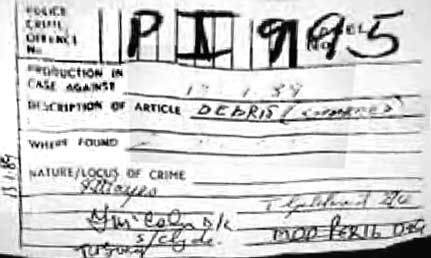
The fragment was allegedly first gathered by DCs Gilchrist and McColm, unseen within a piece of cloth logged in mid-January 1989 as item PI/995, “Cloth (charred).” Anomalously, the label was later changed with “debris” written right over “cloth.” In the 2000 trial, Gilchrist was asked about the overwriting; the judges found his explanations "at worst evasive and at best confusing," but found no "sinister connotation" in this (and neither do I, in particular). Note also how the date (13/1/89 as on the left side) seems faintly penciled in for "introduction in case against," and the loaction found line seems written over with invisible ink. The resolution on these is not good - here I took the full tag and a clearer zoom-in (original images page) and merged them for the best effect.

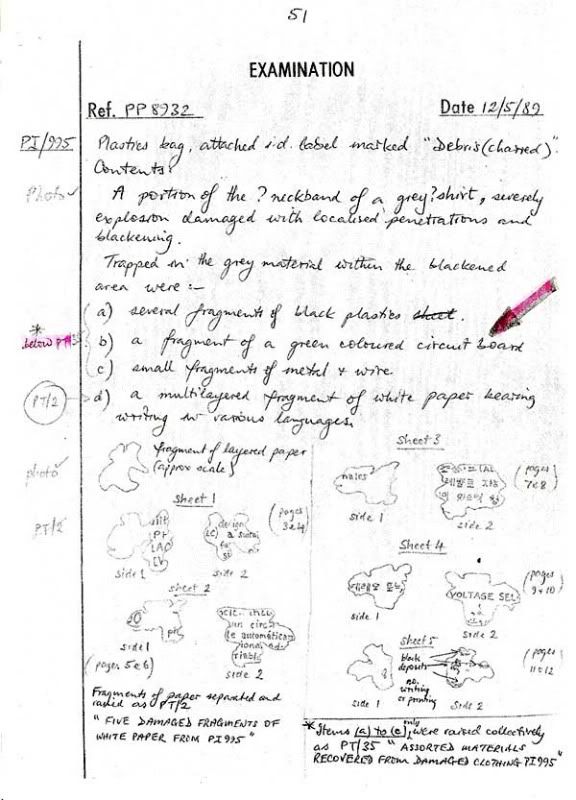
One signature on this cluttered tag seems to be Dr. Thomas Hayes [wiki] of RARDE (Royal Armament Research and Development Establishment), who analyzed this material more closely on May 12, 1989, according to his lab log (on page 51, left - r-click new window for readable view). This was the first mention anywhere of the pivotal timer fragment, as item b) at left. Reportedly, the pages following this in Hayes’ journal were renumbered, which he was unable to explain in later testimony. This could well mean this page was inserted after the fact, as widely speculated, to introduce a backdated paper trail for a later plant. It's a little sloppy to my eyes, and doesn’t add much detail to the record; there is nothing about the board other than a simple note of “a fragment of green coloured circuit board." He offers no drawing, no details. Note that the paper fragments, carefully re-sketched here (five sheets, 2 sides each, lower half of page), were identified early and given the evidence no. PT/2. The exploded electrics of items a-c, on the same page here, are "raised" collectively as PT/35 “assorted materials RECOVERED from clothing PI995.” (caps in original) I think this means 31 pieces of evidence were catalogued between these identifications allegedly noted on the same day.

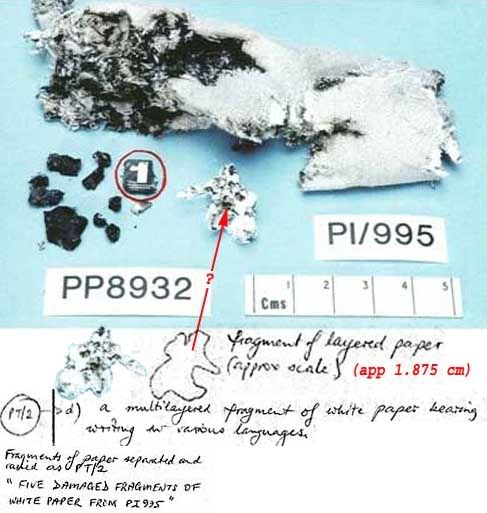
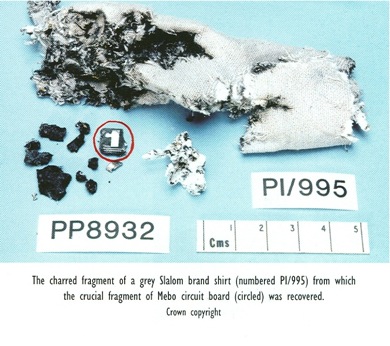
The first photograph to be taken of the fateful fragment was reportedly taken, on or around September 12 1989, by Hayes, or by “RARDE photographer Heines.” according to different web pages sponsored by Mebo, the board’s confusing makers. (Hayes version, Heines version). This is three days prior to the September 15 Feraday letter (see below), leading some to suspect he took the picture then. Its acual date of capture seems to be prior to Hayes' May 12 entry, as the lumpy shape to the right of the fragment seems to be the paper fragments prior to being separated and drawn therein. The famous photo shows the shirt collar and all the evidence taken from it, with the circuit board chunk circled in red in the publicly available version. Considering the quality of blow-ups possible from this (see below) it is presumably 35mm, and not one of the "polaroids" mentioned below. (Original Image)

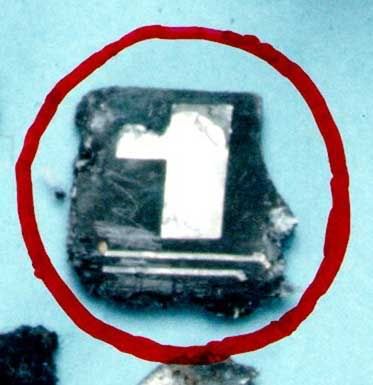
At left is the best blow-up of this available, from a higher resolution original than is up anywhere on the Internet. Here can be noted the “1” shaped touch pad, twin solder lines beneath this, the intact top edge, rounded corner, crumbly edges. The "etched" sideways “M" and "scratches" beneath it have been called clues of forgery, but likely are fibers of fabric like those clustered on the left side. The color of this board's coating plastic, described as green by RARDE people, and as evidently BROWN by Mebo missives, seems to me no particular color, but more precisely off-black or muted dark gray-blue with a slight greenish hue. It's probably supposed to be burnt, so green-blue seems closer than brown. (source)

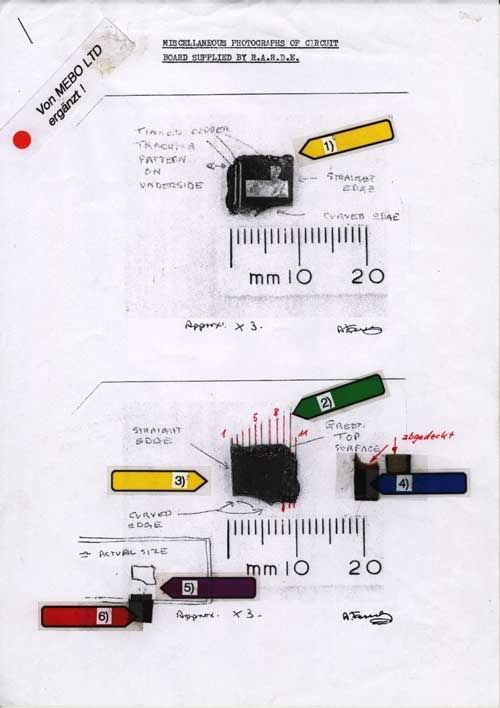
Another to take a crack at this fragment was Alan Feraday [wiki] the director at the time of DERA (Defense Evaluation and Research Agency), who at some point made a study using another shot, straight on, with another view of it flipped over on its back. Using enlarged photos (“approx X 3”), perhaps photocopied on paper, he added notes around the mirror-flipped dark shapes - the following are my best reading:
"straight edge" pointing to the straight top edge.
"curved edge" pointing to curved edge
"trimmed copper" pointing to solder lines. ("track pattern on underside" added)
"Green top surface" pointing to back view.

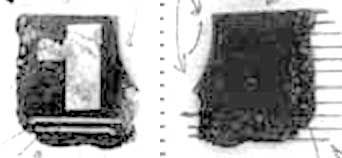
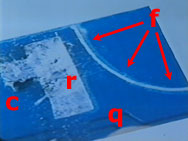
There isn’t much resolution here to work with, but that back view is totally unique. So I used a separate layer with maxxed out contrast to pop out all details (below, right). There seems to be a small bump corresponding to the middle of the touch pad, and some roughness (fracture? bubbling?) around the edges, quite a ways in at bottom and right. Otherwise little can be seen. image source

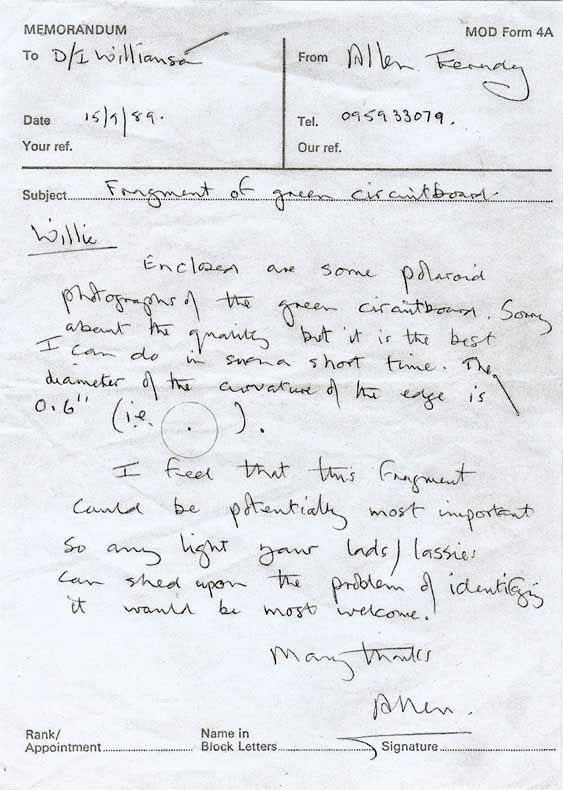
On September 15 1989, judging by the header, Feraday sent a memo to Detective Inspector William Williamson, a counterpart in the Dumfries and Galloway police (along with the FBI, they were the official investigators). This was to explain “some Polaroid photographs of the green circuit board,” which he found "potentially most important," depending on what ID the D&G could come up with. Feraday apologized for the quality of these pictures, noting “it is the best I can do in such a short time.” Some have presumed he was sending the circled photo above, but the use of plural photographs, could mean what he sent was the analysis above, having two photos in it. It’s not entirely clear what the rush was all about or why that precluded better pictures. (source)

Following this is a long gap in the timeline of what I've sorted out, from later '89 into early 1990. Investigators analyzed the fragment (though not for explosives residue), searched for matching board patterns, and so on. According to a Mebo site, on February 8, 1990 “a needle-thin section” was removed from the evidence, apparently for forensics work, “by Mr. French from CIBA-Geigy." Four days later, the site continues,
“Mr. Roderick MacDonald, withness no. 589, had been called into Strathclyde police-station to take some photographs of an allegedly Lockerbie-recovered MST-13 timer fragment with the allocated no: PT/35 (evidence: production no:1754) According to Court-documents, the alleged MST-13 timer fragment PT/35 was at that time no longer in its orginal condition and in one piece!” (source)

For a good trans-Atlantic, Anglo-American (sorry, Scots-American) investigation, it only seems appropriate to bring in some expertise from across the pond. Investigator Paul Foot (Flight from justice, PDF, page 11) reports a July 1990 call from FBI forensic authority and political scientist James "Tom" Thurman [wiki] offering a lead to DCI Williamson on the fragment Feraday told him of. Reportedly Feraday and Williamson both went to Virginia to meet him. Although some have said this fragment was physically taken there, and the controversy recently upped with Levy’s Lockerbie Revisited video, the preponderance of testimony suggests to me, so far, that it was just a photo. I may sort it out in a separate post.

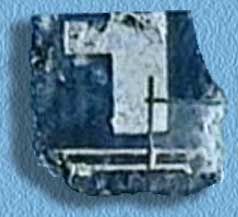
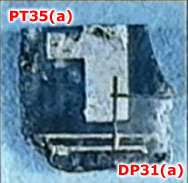
At any rate, Thurman was able to get pictures also of a captured Libyan MST-13 timer and, on June 15 as he recalls (not July as Foot reported) found a perfect match to the fragment from Scotland. He kept some photos on file to show reporters later, including a giant blow-up, heavily blue-tinted, of the fragment, perhaps MacDonald's view. This is shown alongside a comparison board with unfilled solder lines and some odd spatterings off the touch pad. (this Mebo photo seems to be the same board Thurman compared to, here in odd color, a different angle, and labeled). The image at left also is from a Mebo graphic, with the backdrop only altered by me for aesthetic reasons. (Original Image) This is the earliest view I know of showing he top sliver missing, as well as the lower right corner cut out or at least deeply scored. Otherwise, it appears to be the same piece, if perhaps a bit bluer, probably due to photo tinting. Also note, the “M” is missing, supporting the idea it was a transitory fiber since cleaned off.

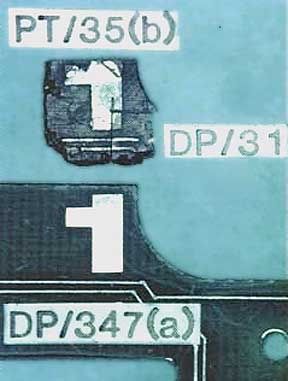
I’m still vague as to when the famous trial photo below was taken. Showing evidence PT/35(b) and, apparently, the separated corner labeled DP/31, compared to model DP/347(a), an intact MST-13 timer. This might seem the photo taken by MacDonald on Feb 12, which would leave one wondering why the trip to America if they already knew what to put it alongside. It may have been after Thurman’s ID in June, as a verification with cleaner sample, and done in 3-D. Or as some have stated, this side-by-side was done by Thurman himself, with access to both real items. Whenever, wherever, and by whomever it was captured, again with intense blue tinting of the whole evidence photo. Here I’ve color-corrected to the best (app) nexus of natural whites, standard blue backdrops, and fragment plastic color. I’m not sure where this model is from, but it’s clearly different from the one Thurman used for comparison.

In the end, counter-claims aside, the fragment looks the same throughout, other than the noted diminishings, so if any planting happened it was at the beginning, which could be later than the paperwork suggests. But the case was made and handed to us thusly: this was from the wreckage, near the bomb, perhaps part of it. It was handled carefully by trained and diligent professionals leaving a clear paper trail. It was rigorously matched, with photos AND microscopes, to a style used by Libyan operatives. And it all came down to a fragment of circuit board, and wound up appealing to the kind of late-90s popular TV fiction mentality needed to win crucial public/political support for the indictment. As agent Thurman bragged to the TV news just after the 1991 indictment, "when that identification was made, of the timer, I knew that we had it." Whether by accident or staging, it was brilliant theater.