[Pan Am 103 Series]
Adam Larson / Caustic Logic
October 5 2009
last update/edit 11/2/09
In this post I will relate all direct visual evidence, gathered from different sites, relating to the circuit board fragment found in the evidence of the Lockerbie bombing. These should be official photographs and documents, mostly from the British side of the investigation. My sources are a few, but mostly websites run by Mebo, the board’s manufacturers and confusing advocates in the trial and its controversies. At the risk of accepting bad evidence, I will accept these as accurte, if not the commentary, and simply lay them out in approximated chronological order with some of the available information on them.
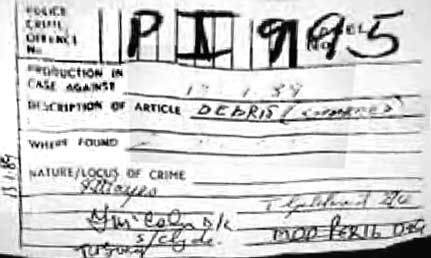 The fragment was allegedly first gathered by DCs Gilchrist and McColm, unseen within a piece of cloth logged in mid-January 1989 as item PI/995, “Cloth (charred).” Anomalously, the label was later changed with “debris” written right over “cloth.” In the 2000 trial, Gilchrist was asked about the overwriting; the judges found his explanations "at worst evasive and at best confusing," but found no "sinister connotation" in this (and neither do I, in particular). Note also how the date (13/1/89 as on the left side) seems faintly penciled in for "introduction in case against," and the loaction found line seems written over with invisible ink. The resolution on these is not good - here I took the full tag and a clearer zoom-in (original images page) and merged them for the best effect.
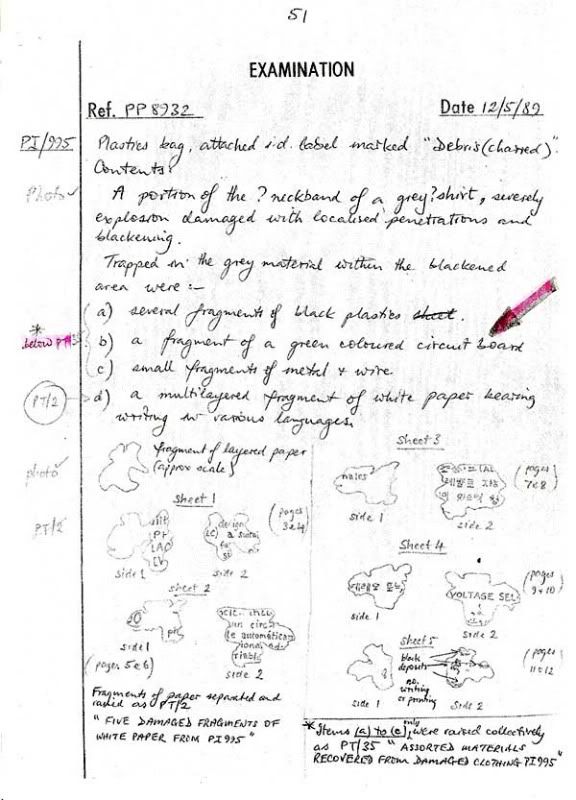 One signature on this cluttered tag seems to be Dr. Thomas Hayes [wiki] of RARDE (Royal Armament Research and Development Establishment), who analyzed this material more closely on May 12, 1989, according to his lab log (on page 51, left - r-click new window for readable view). This was the first mention anywhere of the pivotal timer fragment, as item b) at left. Reportedly, the pages following this in Hayes’ journal were renumbered, which he was unable to explain in later testimony. This could well mean this page was inserted after the fact, as widely speculated, to introduce a backdated paper trail for a later plant. It's a little sloppy to my eyes, and doesn’t add much detail to the record; there is nothing about the board other than a simple note of “a fragment of green coloured circuit board." He offers no drawing, no details. Note that the paper fragments, carefully re-sketched here (five sheets, 2 sides each, lower half of page), were identified early and given the evidence no. PT/2. The exploded electrics of items a-c, on the same page here, are "raised" collectively as PT/35 “assorted materials RECOVERED from clothing PI995.” (caps in original) I think this means 31 pieces of evidence were catalogued between these identifications allegedly noted on the same day.
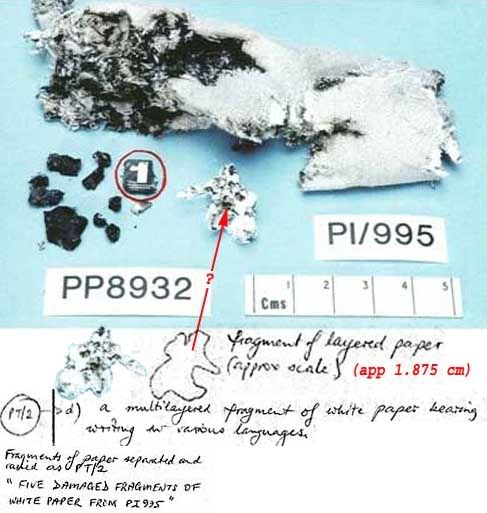
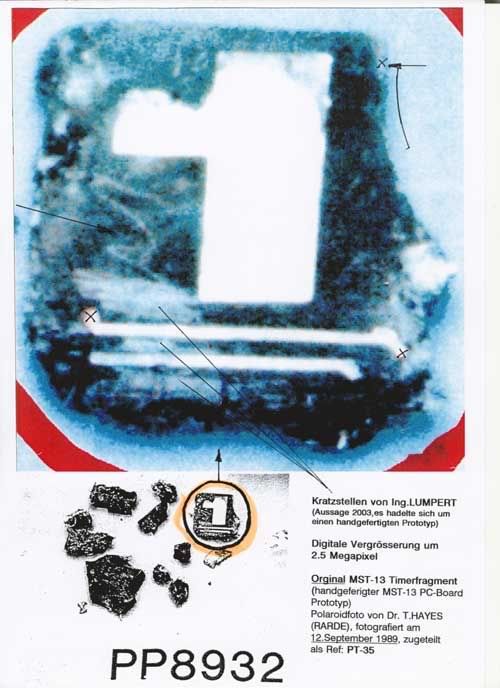
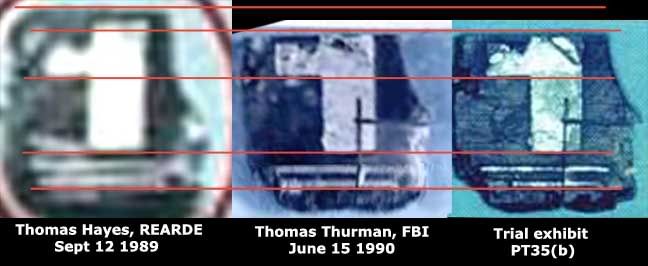
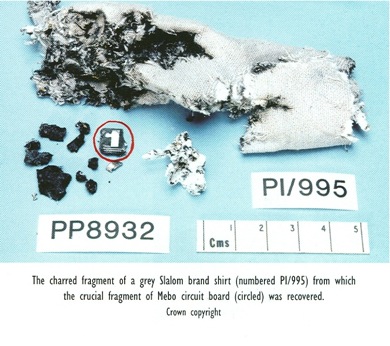
The first photograph to be taken of the fateful fragment was reportedly taken, on or around September 12 1989, by Hayes, or by “RARDE photographer Heines.” according to different web pages sponsored by Mebo, the board’s confusing makers. (Hayes version, Heines version). This is three days prior to the September 15 Feraday letter (see below), leading some to suspect he took the picture then. Its acual date of capture seems to be prior to Hayes' May 12 entry, as the lumpy shape to the right of the fragment seems to be the paper fragments prior to being separated and drawn therein. The famous photo shows the shirt collar and all the evidence taken from it, with the circuit board chunk circled in red in the publicly available version. Considering the quality of blow-ups possible from this (see below) it is presumably 35mm, and not one of the "polaroids" mentioned below. (Original Image)
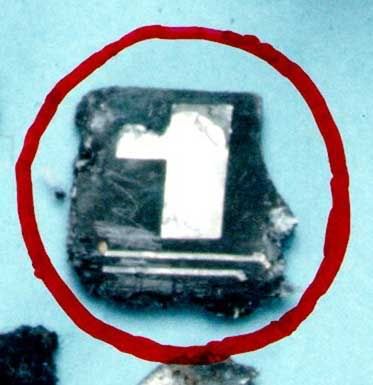 At left is the best blow-up of this available, from a higher resolution original than is up anywhere on the Internet. Here can be noted the “1” shaped touch pad, twin solder lines beneath this, the intact top edge, rounded corner, crumbly edges. The "etched" sideways “M" and "scratches" beneath it have been called clues of forgery, but likely are fibers of fabric like those clustered on the left side. The color of this board's coating plastic, described as green by RARDE people, and as evidently BROWN by Mebo missives, seems to me no particular color, but more precisely off-black or muted dark gray-blue with a slight greenish hue. It's probably supposed to be burnt, so green-blue seems closer than brown. (source)
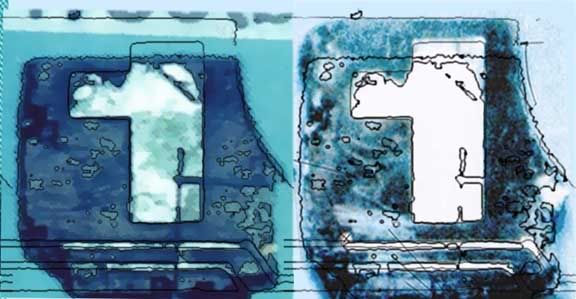
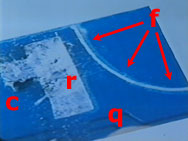
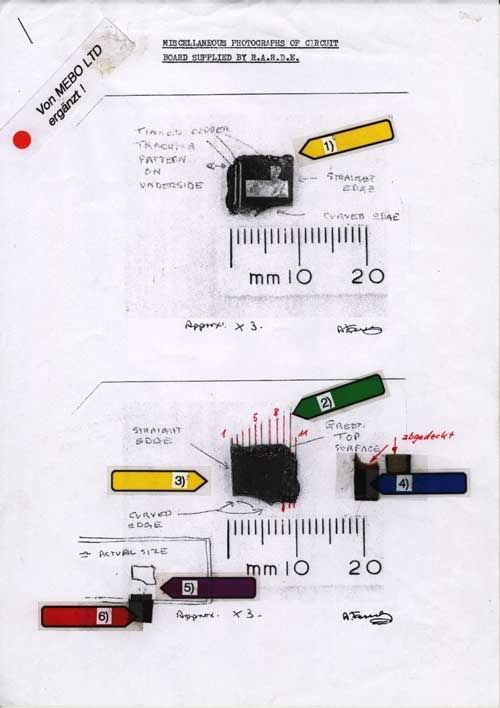 Another to take a crack at this fragment was Alan Feraday [wiki] the director at the time of DERA (Defense Evaluation and Research Agency), who at some point made a study using another shot, straight on, with another view of it flipped over on its back. Using enlarged photos (“approx X 3”), perhaps photocopied on paper, he added notes around the mirror-flipped dark shapes - the following are my best reading:
"straight edge" pointing to the straight top edge.
"curved edge" pointing to curved edge
"trimmed copper" pointing to solder lines. ("track pattern on underside" added)
"Green top surface" pointing to back view.
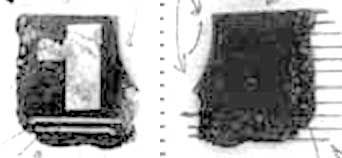
There isn’t much resolution here to work with, but that back view is totally unique. So I used a separate layer with maxxed out contrast to pop out all details (below, right). There seems to be a small bump corresponding to the middle of the touch pad, and some roughness (fracture? bubbling?) around the edges, quite a ways in at bottom and right. Otherwise little can be seen. image source
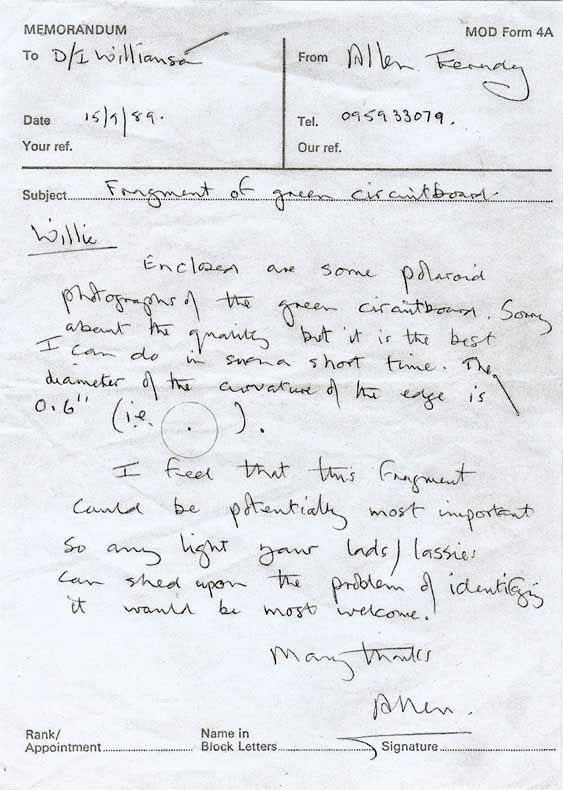 On September 15 1989, judging by the header, Feraday sent a memo to Detective Inspector William Williamson, a counterpart in the Dumfries and Galloway police (along with the FBI, they were the official investigators). This was to explain “some Polaroid photographs of the green circuit board,” which he found "potentially most important," depending on what ID the D&G could come up with. Feraday apologized for the quality of these pictures, noting “it is the best I can do in such a short time.” Some have presumed he was sending the circled photo above, but the use of plural photographs, could mean what he sent was the analysis above, having two photos in it. It’s not entirely clear what the rush was all about or why that precluded better pictures. (source)
Following this is a long gap in the timeline of what I've sorted out, from later '89 into early 1990. Investigators analyzed the fragment (though not for explosives residue), searched for matching board patterns, and so on. According to a Mebo site, on February 8, 1990 “a needle-thin section” was removed from the evidence, apparently for forensics work, “by Mr. French from CIBA-Geigy." Four days later, the site continues,
“Mr. Roderick MacDonald, withness no. 589, had been called into Strathclyde police-station to take some photographs of an allegedly Lockerbie-recovered MST-13 timer fragment with the allocated no: PT/35 (evidence: production no:1754) According to Court-documents, the alleged MST-13 timer fragment PT/35 was at that time no longer in its orginal condition and in one piece!” (source)
For a good trans-Atlantic, Anglo-American (sorry, Scots-American) investigation, it only seems appropriate to bring in some expertise from across the pond. Investigator Paul Foot (Flight from justice, PDF, page 11) reports a July 1990 call from FBI forensic authority and political scientist James "Tom" Thurman [wiki] offering a lead to DCI Williamson on the fragment Feraday told him of. Reportedly Feraday and Williamson both went to Virginia to meet him. Although some have said this fragment was physically taken there, and the controversy recently upped with Levy’s Lockerbie Revisited video, the preponderance of testimony suggests to me, so far, that it was just a photo. I may sort it out in a separate post.
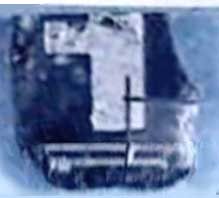
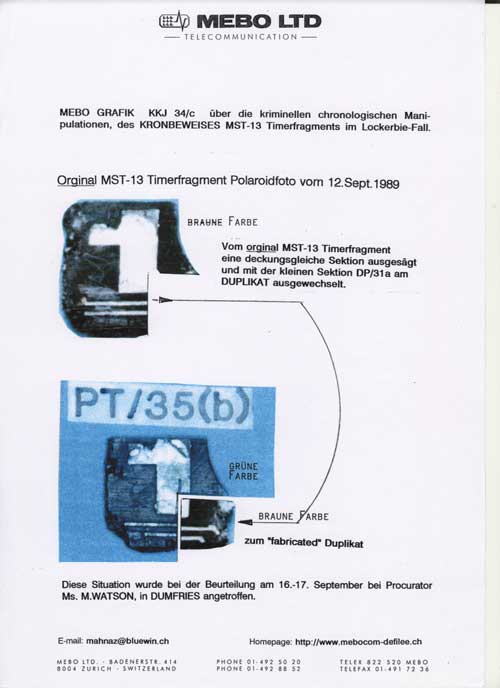
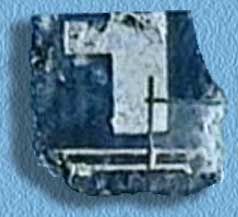 At any rate, Thurman was able to get pictures also of a captured Libyan MST-13 timer and, on June 15 as he recalls (not July as Foot reported) found a perfect match to the fragment from Scotland. He kept some photos on file to show reporters later, including a giant blow-up, heavily blue-tinted, of the fragment, perhaps MacDonald's view. This is shown alongside a comparison board with unfilled solder lines and some odd spatterings off the touch pad. (this Mebo photo seems to be the same board Thurman compared to, here in odd color, a different angle, and labeled). The image at left also is from a Mebo graphic, with the backdrop only altered by me for aesthetic reasons. (Original Image) This is the earliest view I know of showing he top sliver missing, as well as the lower right corner cut out or at least deeply scored. Otherwise, it appears to be the same piece, if perhaps a bit bluer, probably due to photo tinting. Also note, the “M” is missing, supporting the idea it was a transitory fiber since cleaned off.
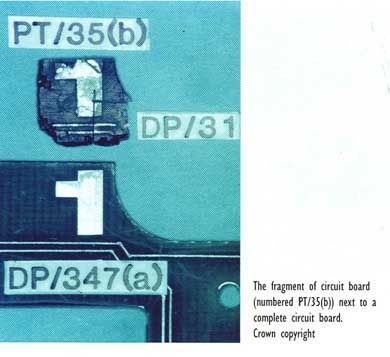
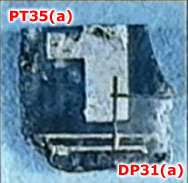
I’m still vague as to when the famous trial photo below was taken. Showing evidence PT/35(b) and, apparently, the separated corner labeled DP/31, compared to model DP/347(a), an intact MST-13 timer. This might seem the photo taken by MacDonald on Feb 12, which would leave one wondering why the trip to America if they already knew what to put it alongside. It may have been after Thurman’s ID in June, as a verification with cleaner sample, and done in 3-D. Or as some have stated, this side-by-side was done by Thurman himself, with access to both real items. Whenever, wherever, and by whomever it was captured, again with intense blue tinting of the whole evidence photo. Here I’ve color-corrected to the best (app) nexus of natural whites, standard blue backdrops, and fragment plastic color. I’m not sure where this model is from, but it’s clearly different from the one Thurman used for comparison.
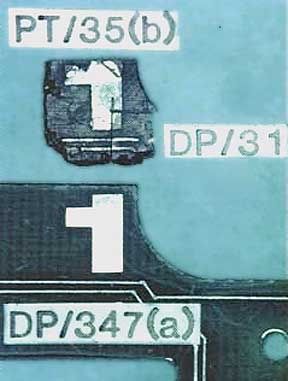
In the end, counter-claims aside, the fragment looks the same throughout, other than the noted diminishings, so if any planting happened it was at the beginning, which could be later than the paperwork suggests. But the case was made and handed to us thusly: this was from the wreckage, near the bomb, perhaps part of it. It was handled carefully by trained and diligent professionals leaving a clear paper trail. It was rigorously matched, with photos AND microscopes, to a style used by Libyan operatives. And it all came down to a fragment of circuit board, and wound up appealing to the kind of late-90s popular TV fiction mentality needed to win crucial public/political support for the indictment. As agent Thurman bragged to the TV news just after the 1991 indictment, "when that identification was made, of the timer, I knew that we had it." Whether by accident or staging, it was brilliant theater.