Monday, February 23, 2009

THE CARRIERS CONTROVERSY

THOUGHTS ON WHERE, WHEN, AND WHY
Adam Larson / Caustic Logic
The 12/7-9/11 Treadmill and Beyond
Feb 23 2009
last update 3/29


Protection for Projection?
As of December 1941, the Pacific Fleet stood depleted, a victim of Atlantic-heavy deployment in solidarity with Great Britain. A scant three aircraft carriers were left between Japan and the west coast: USS Enterprise, USS Lexington, and USS Saratoga. There had been four, until the USS Yorktown was among the quarter of the Pacific fleet transferred to the Atlantic. With the depleted Pacific portion of the Fleet permanently based in Hawaii throughout 1941, these were generally stationed at Pearl Harbor, but when the attack of December 7 came, none of the three was there to be harmed.

As the dawn rose red, USS Enterprise was the closest, just over 200 miles west and on a return journey from Wake Island. The Lexington was much further out, en route to Midway; both were ferrying fighter jets to the islands (see below ). The Saratoga was 2000 miles east and far too busy to help cover their shifts; She had undergone modernization in Bremerton from January to April, "participated in a landing force exercise in May and made two trips to Hawaii between June and October as the diplomatic crisis with Japan came to a head," a Navy history explains. "When the Japanese struck at Pearl Harbor on 7 December 1941, Saratoga was just entering San Diego after an interim drydocking at Bremerton," for unspecified reasons. [1]

While there are apparent reasons for all these movements, the coincidence that Pearl Harbor would be left with absolutely no carriers at just the time of Japan’s sneak attack remains worthy of note and one of the prime areas of controversy in the ongoing debate over what happened and why. While this apparent coincidence cannot provide solid proof of foreknowledge, as a supplement to the already large body of evidence, it's worth an examination.

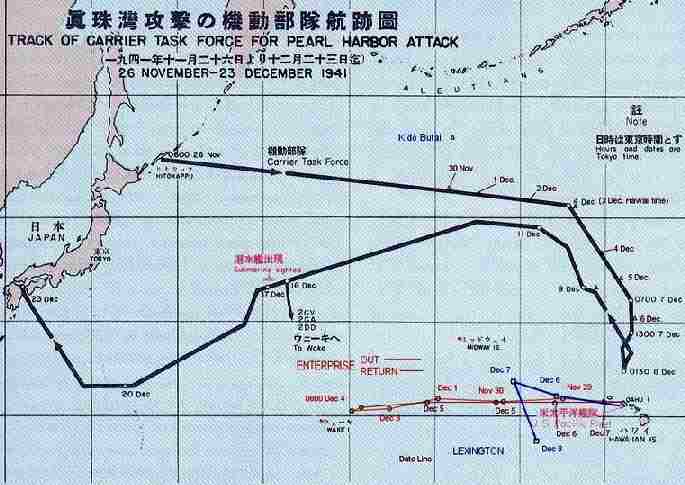
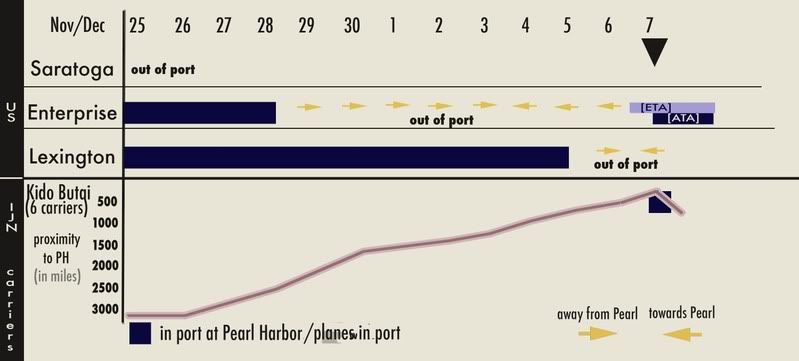
The much-re-posted “Pearl Harbor Myths” mini-article sums up this myth “The US carriers were hustled out of port just before the attack, to "save" them for a war that FDR already knew would be dominated by the flattop.” [2] While piece doesn’t do so, many have tackled this myth by arguing that the value of the aircraft carrier for naval warfare was not known at the time. Whatever someone may have claimed to recognize or not at one point or another is immaterial. The carrier in fact became the dominant weapon in the Pacific war, starting with the six that Japan’s Imperial Navy had sent towards Hawaii just before the US blithely sent its remaining two away from there on errands. graphic: timeline of carrier activity in and near Pearl Harbor 11/25-12/7 1941. Whichever country supplied them ,there was nearly always at least on carrier nearby. [r-click, new window for larger view
Any analyst worth his weight in Styrofoam should have foreseen the craft’s potential value in projecting air power, and any decision-makers involved in any provocation would have access to these views and choose to either ignore to act on them. Whatever was decided and by whatever means, the carriers were given special consideration and put in a special place, out of the harbor during the attack, and in fact projecting air power – just in the wrong direction.

Becoming a Way Station
There was a method to this madness, if it did ultimately prove a flawed and boneheaded method. The increasing likelihood of war with Japan in the second half of 1941 had caused the US War cabinet to look west and further west, right past Hawaii and the relatively exposed Pacific Fleet, to the distant Philippines, as the most likely flash point. There was a decision to pursue a deterrent bombing capability built up there, to turn the strategic liability into more of an asset, and a serious check on Japan's southward plans. [3] It involved suspending the normal and correct belief that the Philippines were indefensible, and this attitude was circumvented at just the right time to leave Hawaii as a neglected rear area rather than the critical front line.

What was lacking, ultimately, was enough planes to both defend the Philippines and offer a meaningful deterrent to other moves. This paradigm was still being pursued up until December 7, and in the process, Hawaii was neglected and treated, as Kimmel’s intel chief Edwin Layton put it, as ”only a way station to ferry B-17s to build up MacArthur’s forces” on Luzon. [4] When war looked more imminent, the pace of this process only quickened, while the military's joint board “resolved to reject the State Department’s hard-line proposals,” Layton explains, and “opposed “the issuance of an ultimatum to Japan,”” at least until the “imperfect threat" of the buildup was brought up to strength. [5]

Meanwhile, as the US military urged a façade of negotiation to cover their buildup against Japan's ambitions, Washington was shocked to learn of Japanese faux-diplomacy covering for a military build-up against US, UK and Dutch interests. What exactly this information was is a little uncertain, and will get a post of its own. But it became known in DC early on November 26, causing secretary of State Hull to “kick the whole [diplomacy] thing over” with an ultimatum they could not accept, and which he probably knew would spark the war. [6] This was the point when the US effectively decided to switch from talking to military preparations. Immediately after this, during November 26/27, the war council conferred and had warnings sent to all Pacific commanders pointing to possible Japanese attacks almost anywhere but Hawaii. And the two remaining aircraft carriers in Hawaii were requested to boost everything west of there “as soon as possible.” [7]

On November 28, Adm. Kimmel complied and sent the Enterprise, commanded by Admiral Halsey, and its accompanying warships to ferry 12 Grumman F4F-3 Wildcats to Wake Island. The task force began its return journey on December 4, and the following day, Lexington and its retinue set off towards Midway with 18 Vought SB2U-3 Vindicators. [8] These planes were to defend the Islands against Japanese moves and/or provide regional cover for 48 more B-17s to be flown trough there en route to the Philippines on December 7. [9] It's impossible to say if this bombers west strategy was purely a genuine military strategy or, at least in part, a smoke screen to give reason to the neglect of Hawaii - but it served the purposes of the latter, and the former was a miscalculation at best, with that final batch of bombers in fact helping mentally short-circuit radar defense at Pearl Harbor on just the wrong morning!

The Enterprise ETA Rebuttal
That attention seems thus drawn away from Pearl Harbor could be seen as supporting the “conspiracy theory” interpretation that Hawaii’s vulnerability was engineered. Further, it only makes sense to suspect the carriers’ locations would be worked into any such plans, and if so, then their absence seems to have been desired during the attack. There are arguments against this, and the best is the Enterprise; as the Pearl Harbor Myths pieces further explains:
“Enterprise was doing her best to get back into Pearl. Her first ETA was Saturday evening, but a storm delayed her. The next time set was 7 AM, 55 minutes before the attack started, but that proved too optimistic as well.”
When you’re dealing with high-stakes illusion, as we may be, a time written on paper does not a real plan make. The science of meterology was nothing then like it is now, but weather prediction was possible. I propose this ETA was fudged with a false presumption of clear sailing but knowing a storm would delay real arrival to (plus six, carry the five…) just after dawn on “X-day.” But the point gets a little better, that article explains, since the 12/6 arrival was scheduled back in August, well before anyone could have known about the Japanese plans to barely avoid:
"What really crushes the "carriers hustled out of port" myth is the fact that Enterprise was scheduled to be in port on Dec. 6th and 7th, as shown in the Employment Schedule promulgated in August, '41. No orders were ever recieved to change this. The mission to Wake was planned to coincide with the original schedule so that it would not be known that the island had recieved additional air support. The trip was kept secret, even the loading of the planes had a "cover story".
If it turns out the arrival time was set well in advance, then Dec 6 is a close coincidence that may then have been fudged upward similar to the above but with shove-off time set hours late, again wrongly presuming clear sailing, to get the carrier arriving back no earlier than the Japanese. Twice the estimates proved “too optimistic” for reality, and these erred guesses, apparently on Halsey's part, are all that gives the sense that one carrier was supposed to be back in time to join the party. But the reality, of course, is it just missed it, and reality is what matters to me.

Thrift or Thrown Game?
While I admit this fudged ETA business is quite speculative, it would serve to make the carrier absence look less suspicious, and give a hand to those who'd like to explain away these clues. That it does look dubious is testified by conspiracy theorists latching onto the “myth,” a natural impression which may have been predicted as a down-side to mitigate. If they knew it would look off, this raises the fair question of why the planners would risk such a move in the first place - carriers were valuable and scarce at the time, but ultimately expendable and easily replaceable in the post-attack climate. Given their utility alone it hardly seems worth the risk to have all of them out when at least one lost would look more natural. Thus “saving’” all three could hardly have been simple thrift, and this is likely only a secondary explanation. *

An obvious primary reason to consider, in keeping with the general thrust of this investigation, is to deplete Pearl Harbor's defenses. Minus the carriers and their decks full of fighting planes, the Japanese raiders quickly decimated almost all the remaining ground-based aircraft, which had been bunched to avoid against dread sabotage. The Enterprise returned 12 planes lighter but still holding most of its own fighters and bombers, which were close enough as the attack unfolded that they actually took part in the latter half of the defense. What kind of role they’d have played if fully in port is unsure; as it was, it seems Enterprise planes only took down one Japanese bird of the 29 lost in the attack, while losing several to enemy and understandably jumpy friendly fire. [10]

The people in the know seem to feel this carrier movement impeded the defense. Fleet intel chief Layton later summed up the effect of the carriers’ departure in that accidentally ironic way that could, with the slightest shift of view, mean exactly its opposite :
“That Stark, as well as Marshall, agreed to reduce the fighter strength at Pearl Harboor by half, and to run the risk that “there will be nothing left at Hawaii until replacements arrive,” was in itself evidence that whatever warning of Japan’s war moves had been received in Washington, it contained no hint of an attack on Pearl Harbor.” [11]

Prophecy Fulfilled
So with the defense aspect of carrier placements duly rendered ambiguous, let's return to the earlier point about the understood role of the carrier; if it was not seen prior to 12/7, it surely was after, and early probing into its potential can be seen in the curious “Doolittle Raid” of April ’42. It was just two weeks after December 7 that the President first told his war cabinet he wanted Japan proper bombed as soon as possible - partly to boost US morale but more so to shake Japan’s, and specifically as an answer to Pearl Harbor. ‘Sure, you can hit us in Hawaii,’ the message seemed to be, ‘but we can hit you at home.’ Lacking land bases close enough this early in the war, the raid was to be launched from a carrier, itself a move widely thought impossible for the larger bombers that would be needed. But after months of practice with B-25s and simulated carrier decks, they made it work, launched and rained some token destruction on Tokyo, and gave Japan its first hint of their grim future before crash-landing in or near free China. The just-completed carrier USS Hornet provided the deck for the raid, and the USS Enterprise showed up on time for its assigned escort duty on this symbolic revenge mission. [12]

By the time the raid was being planned, the ‘derelict’ Adm. Kimmel had been sacked and replaced with new Pacific Fleet commander Adm Chester Nimitz, the prophet and eventual hero of Pacific carrier warfare. Nimitz was destined for the spot, and seems to have foreseen more about the Pacific War than flat-top dominance. Earlier in 1941, he was tapped for command of Pacific Fleet, but perhaps on good advice from, say, Adm. Richardson (the outgoing CinCPAC to be replaced), turned it down, leaving the spot open for Kimmel. According to Nimitz’ son, in a 1996 History Channel documentary, the admiral said at the time:
"It is my guess that the Japanese are going to attack us in a surprise attack. There will be a revulsion in the country against all those in command at sea, and they will be replaced by people in positions of prominence ashore, and I want to be ashore, and not at sea, when that happens.” [13]

---
* To add to the thrift reason, we must consider not only the carriers but their escorts. I did a little research looking at this site on what was present on 12/7:
http://www.history.navy.mil/faqs/faq66-2.htm
and this one on what was away with the carriers:
http://www.history.navy.mil/faqs/faq66-9.htm

In Port:
Battleships – 8
Heavy Cruisers – 2
Light Crusiers – 6
Destroyers –30
Total = 46 war ships
Additional auxiliary ships, minesweepers, submarines, tenders, etc… 55

With the carrier task forces:
Two carriers, obviously
6 Heavy Cruisers
14 destroyers (split 9/5)
total = 22 war ships

So 3/4 of the heavy cruisers were absent, and about 1/3 of the destroyers. A 22 ship-reduction leaving 46 behind is about 1/3 detachment in sheer numbers, which is itself significant. About the quality and value of the classes of ships relative to each other I don't know - would this be the most valuable third? Layton's assessment [And I was There, p 263] is a little exaggerated, but informative:
"At this point [Dec 5-7], the disposition of of Kimmel's forces was as follows: All the carriers were at sea with specific missions. All the heavy cruisers and more than half of the fleet's destroyers were at sea protecting the carriers. Only the battle force - the old, slow battleships with their escorts of light cruisers and destroyers - was still at Pearl Harbor."

---
sources
[1] USS Saratoga CV 3. From: Dictionary of American Fighting Ships, published by the Naval Historical Center.
[2] “Pearl Harbor Myths”
[3] Layton, Edwin T. with Roger Pineau and John Costello "And I Was There": Pearl Harbor And Midway -- Breaking the Secrets."New York. Quill. 1985. P 171.
[4] Layton et al. P 170.
[5] Layton et al. P 177.
[6] Layton et al. PP 198-206
[7] Layton et al. 210
[8] See [1]
[9] Layton et al. 209
[10] Wikipedia. USS Enterprise (CVN-65)
[11] Layton et al. P 210.
[12] Wikipedia. Doolittle Raid.
[13] Conservapedia. McCollum Memo.

Friday, February 20, 2009

THE BATTLE OF PEARL HARBOR: ALTERNATE OUTCOMES

IT TAKES A LOT TO "LIVE IN INFAMY'
Adam Larson / Caustic Logic
The 12/7-9/11 Treadmill and Beyond
Feb 20 2009
last edited 2/24


A Question of Motive
When confronted with the “FDR knew” conspiracy theories, defenders of the dominant narrative sometimes point out as a logical flaw the ‘unanswered’ question of why Roosevelt or his advisers want to withhold intelligence and defenses from Hawaii if they had known the attack was coming? The truly naïve fall for the usually valid but simplistic presumption that losing ships and people is ‘a bad thing,’ and to be avoided. When they can get to the next level and adjust their cynicism goggles, concede the political opposition to be overcome and the importance of entering the war, it’s not hard to imagine an attack might have been desired. But these semi-rational coincidence theorists often stop the line of reasoning there, and contend that a foiled attack (or at least a met one) would have been sufficient for the cause.

For example, in his 1963 The Two Ocean War, Samuel Elliot Morrison dismissed the notion that FDR provoked or enabled the surprise attack, first by pointing out that “a little reflection” would show this “impossible,” since others would have to be involved, whom he names and finds too “loyal and honorable” to have participated. Besides this leap of faith, Morrison notes:

“More reflection might suggest that if Roosevelt and his cabinet ministers and armed service chiefs had schemed to get us into the war, their purpose would have been better served by warning the Hawaiian commanders in time to get the Fleet to sea and the planes airborne. Even a frustrated attempt to strike Pearl Harbor would have been sufficient cams [sic?] belli to satisfy the most isolationist congressman.”

That’s as bold and unsubstantiated a presumption as the first one. Another expression of this sentiment was offered in a 2001 Salon piece by Judith Greer, in which she stated that “no one has quite explained how being alert and prepared to beat off the attack would have significantly diminished its political effect.” The notion that “no one” has explained this is absurd; the reasoning is worked into nearly every explanation of the theory I have read, and that she is unaware of this is unlikely. What she seems to mean is ‘no one has offered an explanation I was willing to consider.’

Anatomy of a Useful Crisis
In case anyone would like to have it laid out again, I will illustrate in different ways the obvious and massive difference in “political effect” between a repulsed attack vs. the one we got. It may help to first realize what a big word “political” is in this context, and to consider the difference between the public attitudes of US and Great Britain, vis-avis fighting in the war. Few Americans can truly imagine the ”political” effect of actual Nazi bombs falling freely by the hundreds on the cities and baby carriages of Great Britain. Without the brutal daily reminders that made war a no-brainer, we’d have to suffice with, and maximize, a single such event to remember and keep remembering.

The first and foremost consideration is establishing the clarity of the aggressor/victim situation; the public would not tolerate our entry as an aggressor, but might be forced to concede to a ‘defensive’ war if the other side fired the first shot. Consider this line from the vague and misleading warning to Army commanders in the Pacific, sent Nov 27: “If hostilities cannot, repeat, cannot be avoided, the United States desires that Japan commit the first overt act.” This is not quite the order to ‘let yourself get shot’ that some present it as, but it does illustrate, at the least, that Washington explicitly desired a well-defined they-started-it beginning (to the extent they wanted a beginning at all, of course).

As it wound up, hostilities could not be avoided, and the Japanese fired hundreds of first shots. Our side managed but a few in return, quite obviously in defense, and the administration got their desired clarity in spades.

Once the evident moral conditions above are met, the scale of devastation works to your advantage, magnifying the outrage in direct proportion to the loss; a whole fleet crippled can provide the emotional steam to run a dozen such fleets.

Like ships, the number of dead is best in the high/painful range, since in the right hands, a frightening or depressing situation can be molded and used to mobilize a nation, so long as that nation feels otherwise vital enough to resist and change the situation. The one-sided surprise slaughter of thousands of young sailors would set a revenge charge in the American psyche to help keep America not just technically involved, but emotionally invested and their Congressional representatives likewise kept in line. Even the isolationists would be stuck in the pincer move.

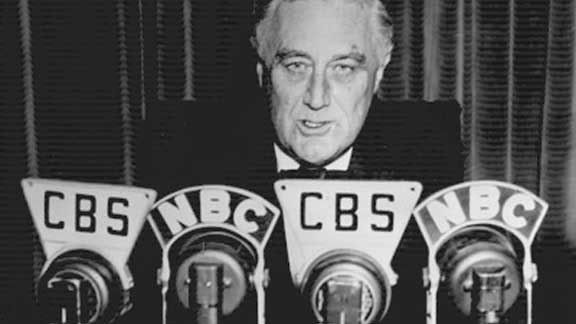
By reminders it could continue to motivate throughout the war, instilling and nourishing a need to totally end the enemy so we can never be scratched like that again. FDR himself showed his awareness of this aspect immediately: “we will not only defend ourselves to the uttermost,” from that point on anyway, “but will make very certain that this form of treachery shall never endanger us again.” No one hits us without paying big, the American psyche demands. The promise was sort of finalized with Truman's first official statement after we vaporized Hiroshima and Nagasaki: "The Japanese began the war from the air at Pearl Harbor. They have been repaid many fold.”

Hypothetical Outcomes
An illustrative exercise for understanding the decisions made in Washington prior to the surprise is to consider the possibilities as they might have - play it out a bit, war-gaming style. You’re President Roosevelt, or any of his cabinet who would have to chose to join any conspiracy - in just the situation they were in, mid-late 1941. Europe is almost totally under Axis control, Japan is in control of a good portion of Asia and clearly preparing for more expansion. The Pacific Fleet wants to go back to the mainland, feeling exposed and edgy at Pearl, the US public and congress remain divided on entry to the war, perhaps leaning towards for, but not enthusiastically on average. You receive two or three solid clues that Japan plans to strike the exposed US Fleet (probably clues of their other simultaneous southward offensives as well) and you’re presented with two main options: get the intel to the people who need it to meet the threat, or don’t, and doom them to fulfill the terms of a maximized useful crisis, as outlined above. Here are four general possible outcomes to consider:

1) Tipped off of a Japanese sneak attack from the northwest, the Pacific Fleet readies itself – the carriers are brought back, all their planes armed and readied, guns loaded, radar manned and watched carefully, surveillance missions flown in the right direction. Spies on the island see all this mobilization and get word to Tokyo that surprise is lost, causing a last-minute order to abort the mission. The striking force retreats, and this attack is foiled, but the other prongs of Japans strike-out occur, including the Philippines, Shanghai, Thailand, and Midway Island, just hundreds of miles from Hawaii. US and Allied interests in Asia and the Pacific are threatened, the Philippinees fall, with US deaths, and America is jolted, but in both directions. Isolationists win, FDR croaks, an uncertain Truman put the fleet back in California to avoid a successful repeat, and the US remains neutral as the Axis make further progress yet. The US finally goes to war after a 1943 German air raid on New York launched from occupied Greenland, supplied from occupied Great Britain. It’s too late by then and we lose. But you get to avoid sacrificing innocent people.

2) Same as above, up to the US response - war is pushed through Congress based on the Philippines attack and thwarted designs on Hawaii. Headlines with the big type saying WAR do get to be seen, but the details are ambiguous, and only somewhat motivating. America thus enters WWII but forever tainted with the question ‘did the Japanese really intend to attack Pearl Harbor or did FDR make that part up?’
3) You tip off the military and have a plan drawn up where the Harbor would be left quiet with Carriers instead moved out to sea, under a cover story, just far enough from spy eyes on the island to prevent the strike force from turning back. A mid-sized squad sorties from the Enterprise and spots them 400 mi nw of Hawaii. The carriers with destroyer support swing into place and the two sides engage in battle, sending planes against each other. Whatever the outcome, with a definite battle in place nearer Hawaii than the Japanese should have been, the aggression is obvious enough and outrage would be a bit more clear. Headlines might read “WAR: Jap force engaged off Hawaii: 2-300 US dead, fleet unharmed” So far this is looking like a decent proposal that allows a strong level of furor and still avoids sacrificing perhaps thousands of peacetime recruits in a unilateral massacre.

4) You keep the clues close and don’t share, keep the target vulnerable. Convince your subordinates to do the same, which is not as hard as normal, given the unusual stakes, the grim necessity, and the fact that it’s already rolling and there’s no way back. No reception or defense is prepared in Hawaii, a total surprise attack happens, dozens of hundreds of American sailors are killed. The battle is one-sided, the aggression and culpability 100% clear-cut, simple, undeniable, and massive in effect. The legal repercussions of the slaughter are near-automatic. Headlines read “WAR: Jap sneak attack on Hawaii: 3000 dead, Shocked US United, vows ‘absolute victory.’" The emotional surge channeled by moral certainty adds fuel and conviction to the embryonic war effort. So sustained, it doesn’t just exist but thrives and helps greatly in the Herculean task of smashing the Axis in both Europe and Asia.

The human costs are high, the moral issues troubling, and the limits on openness pretty obvious. Under normal circumstances, it would be hard to justify. But the payoff to the inevitable war effort is leaps and bounds beyond the other options, and in that dark winter at the apparent edge of global Fascist conquest, it might have seemed wise to cash in anything you had.

But Is It Memorable?
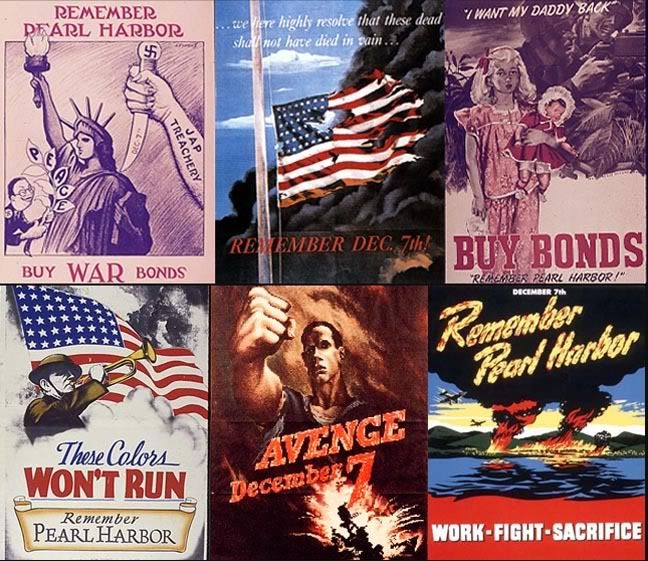
Having trouble deciding? Check these propaganda posters that were circulated after the real-world Pearl Harbor attack, which had the effect, if not the cause, of option 4. Unprovoked deceitful treachery, causing smoke and damage to a flag. We’re to remember, just like the loved ones of the fallen remember their loss. We should help fund the war in their sake, refuse to surrender, in the names of the dead, calling from Heaven, avenge them – defy the smoke of humiliating, emasculating defeat by working, fighting, sacrificing, firebombing to final victory.
Now imagine if this kind of sentiment would fly nearly as well under the terms of possibilities 1 or 2 or 3. What would you propose instead to generate such a degree of public sentiment? Nice speeches with epic language? Or would you roll over to the isolationists and let the world burn around you? Careful now, if FDR did have these clues, and it seems he was waiting for them, he actually pondered the options without the crutch you have of saying “FDR didn’t know.”

Tuesday, February 17, 2009

FORMER NAVAL PERSONS

CHURCHILL, ROOSEVELT, AND VOYAGES TO WAR
Adam Larson / Caustic Logic
The 12/7-9/11 Treadmill and Beyond
February 16 2009


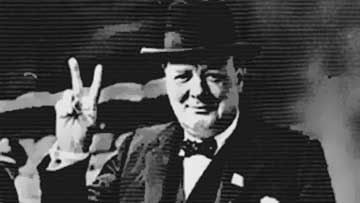
When the RMS Lusitania went down on May 7 1915 en route from New York to London, hit by a German U-boat and dragging down 1200 mostly English-speaking souls, two Naval personalities of great future importance watched from either side of the Atlantic. On one side of the pond, Winston Churchill had just set off from being the First Lord of the Admiralty and directly into the intensifying fray in a variety of war-related posts, on and off the battlefield. Across the way, A young Franklin D. Roosevelt was Assistant Secretary of the Navy, who among others urged US entry into the war following the attack.

There is some circumstantial evidence that Churchill, in his influential admiralty post, played a large role in steering the Germans towards downing the “livebait” Lusitania. British researcher Colin Simpson indicated this in a 1972 book; others were involved as well, on both sides of the Atlantic, and with the tacit approval of President Woodrow Wilson, worked to ensure what Churchill might have called a “maneuver which brings an ally into the field.” Roosevelt remained with, and helped guide, the Navy as the US prepared to enter the field and throughout the remainder of the war, re-learning again an old Roosevelt family secret – there’s nothing like a sunken boat to get a nation marching to war.

In 1939 the Britain-Germany feud again broke out in a big way and a war leader was needed in London to replace the ousted PM Chamberlain. Roosevelt was by then President of a decidedly neutral-minded and depression-racked US, prophetically urging his reluctant countrymen to rally against the new German threat. As World War II finally turned over from menace to inescapable reality in Europe, he reached out and offered his endorsement to Churchill as new Prime Minister. The sentiment was shared by Britain as a whole, and Churchill stepped in to bolster and brace the shaken British people. Now the two sat across the ocean as leaders not of Navies, but of nations bound together (at the head, if not yet the body) in opposition to Hitler’s Germany. It was at this time the two publicly formed what the FDR Library’s website describes as:

“one of the most extraordinary relationships in political history, a relationship marked by an intimate correspondence unparalleled among national leaders, a relationship which, in due course, would lead to the establishment of a military alliance unique among sovereign states.”

In particular, they bonded over their common Navy pedigree, and Churchill became known to Roosevelt by the nickname ‘Former Naval Person’ as they considered how to get the decidedly neutral ally maneuvered into the field against the Germans yet again. There were known methods to call on, but both the stakes and the resistance were higher than ever. A single ship would not likely suffice.

In late January 1940, three months before Churchill was finally elected, FDR sent his secretary Edwin Watson to fetch some documents from President Woodrow Wilson’s files. For whatever reason, Watson sent back specifically, and it seems exclusively, “the original manifest of the SS Lusitania” along with a note saying “I was afraid to [open it] until you had seen it.” This may mean nothing, but Colin Simpson found this original manifest years later not in its original place, but among FDR’s personal papers. [Simpson, Colin. The Lusitania. Little, Brown and Company, Boston. First US edition. Hardcover. 1973. pp 5, 267]

Thursday, February 12, 2009

THE MESSAGE WE MISSED?

Adam Larson / Caustic Logic
The 12/7-9/11 Treadmill and Beyond
February 12 2009
last edited 3/26


Throughout November 1941, as US-Japanese negotiations were secretly segueing into war maneuvers, the Japanese Navy mobilized to strike out across the Pacific at British, Dutch, and American interests. The last was tasked to a mighty force that had been assembled in secrecy at the 4-mile-wide hammer-head shaped Hitokappu Bay in the southern Kuril Islands (just north of Japan’s Hokkaido Island). By the middle of the month, would have been bustling with the “mobile striking force,” or Kido Butai, under the command of Admiral Chuichi Nagumo in his flagship Akagi; he was backed by 2 battleships, 2 heavy cruisers, 9 destroyers, 3 submarines, 8 train vessels, and, most tellingly, 6 aircraft carriers with about 360 combat-ready aircraft.

On the 25th, Fleet Admiral Yamamoto issued to Nagumi the fateful Combined Fleet Operations Order No. 5, ordering the force to set off for its intended target: - Pearl Harbor, Hawaii, and the bulk of the US Pacific Fleet moored there. The source from which I take this is the Joint Congressional Committee on Pearl Harbor, part 2 of their final report, published in 1946 [1]. Their telling reads as such:

”(a) The task force, keeping its movements strictly secret and maintaining close guard against submarines and aircraft, shall advance into Hawaiian waters and upon the very opening of hostilities, shall attack the main force of the United States Fleet in Hawaii and deal it a mortal blow. The first air raid is planned for dawn of X-day (exact date to be given by later order).

Upon completion of the air raid the task force, keeping close coordination and guarding against enemy counterattack, shall speedily leave the enemy waters and then return to Japan.

(b) Should it appear certain that Japanese-American negotiations will reach an amicable settlement prior to the commencement of hostile action, all the forces of the combined fleet are to be ordered to reassemble and return to their bases.

(c) The task force shall leave Hitokappu Bay on the morning of November 26 and advance to 42° N. And 170° E. (standing-by position) on the afternoon of December 4, Japan time, and speedily complete refueling. “


Clearly this order was crucial; it mentioned the target, the nature and location of the sneak attack, and the approximate date and time of day it would occur, just over two weeks later. If such information could have become available at that time to the US or to an ally inclined to share, the surprise could have been seen and pre-empted, or at least mitigated with some kind of proportional defense. None of this happened, of course, and the Kido Butai achieved total local surprise, which one may be tempted to accept as de facto evidence that the order remained hidden from American eyes at the time.

Such temptation should be resisted.

illustration using the given coordinates for stand-by position. This isn't quite right, as illustrated by the huge distance to travel the last leg. This probably means they modified the plan later, or had a further code in which one location actually mans another. A better map from Japanese sources can be seen at this page, and was used to make the more accurate and useful graphic below.
The Japanese Navy ordered the destruction of much of their records at war’s end, all copies of this order apparently being among the lost. Therefore, the Committee’s source for the wording they presented as evidence in 1946 would have to come from some other record(s) – hard copies that escaped the destruction order and fell into US hands, the memories of people who had written, read, or recieved the orders, or perhaps ‘our own copies,’ radio intercepts received by the US or an ally at the time but (presumably) decoded later.

In fact, the source the Committee cites is, essentially, anything but the third option. The order to sail is attributed to “Committee exhibit no. 8,” cited extensively throughout part two of their report when referencing Japanese plans or communications. Therein they explain:
“The chief sources of information concerning the attack are translations of captured Japanese documents, interrogations of prisoners of war, and reports submitted by general headquarters, supreme commander for the Allied Powers, comprising questionnaires filled out since VJ-day by former members of the Japanese naval high command. See committee exhibits Nos. 8, 8A, 8B, 8O, and 8D.” [2]
So it would seem that, even four years after the attack and the penetration of all Japanese codes, fuzzy memory and the odd scrap of paper was the best the Committee had access to. Apparently, we never got a copy of our own to decode and it was just lost into the ether. Admiral Edwin Layton concluded, after searching the available intercepts at the National Archive, “we evidently did not pick up Yamamoto’s 25 November sailing message” at all. [3] Note the judicious use of “evidently.”

The Pacific Fleet’s top intelligence officer at Pearl Harbor at that time, Layton published his own investigation at the end of his life, in the mid-1980s. Having found nothing of it in our archives, his source for the order to sail was “a reconstruction of events obtained from [the striking force’s] surviving commanders in 1945.” In particular, he cited the recollections of Capt. Mitsuo Fuchida, lead pilot of the actual air raid. This version is essentially the same as the above, with the exception of an “evening rendezvous” to refuel on Dec 3 Tokyo, not Hawaii time, and located at 40°N 170°E, two degrees south of the Committee’s findings. [4]

An Army Military History office document released in 1953 provides a whole string of communications surrounding the Kido Butai’s formation and intent, dating Nov 5 to Dec 2. While previous communications outlining the attack plan for Hawaii are recounted in great detail here, Yamamoto’s decisive Nov 25 order is provided only in a “general outline,” altering the standing-by position (from 165° to 170°) and ordering departure. Again, this document notes that “since all copies of these orders were destroyed prior to the end of the war, they have been reconstructed from personal notes and memory.” [5]

There is much debate among American researchers and little conclusive resolution as to how readable that code was to American cryptanalysts on December 7. The general mainstream consensus is that it was completely or essentially unreadable in the last days, as well as at the time of this pivotal order. The question of the code’s overall opacity as of November 25 1941 is one with no conclusive answer [hint - it was LESS likely to be readable on X-Day, and there are other nations whose own progress is uncertain]. The topic is shrouded in curiously dense secrecy and confusion (at least on my part), and will be the subject of a further post, or posts, after I’ve completed more research.

Sources:
[1] Investigation of the Pearl Harbor Attack. Report of the Joint Committee on the Investigation of the Pearl Harbor Attack. July 20 1946. Part II. Page 56. online - backup
[2] Ibid. Page 53.
[3] Layton, Edwin T. with Roger Pineau and John Costello "And I Was There": Pearl Harbor And Midway - Breaking the Secrets. William Morrow & Co. December 1985. Page 207.
[4] Ibid. Page 207.
[5] Japanese Monograph No. 97. PEARL HARBOR OPERATIONS: General Outline of Orders and Plans. Prepared by Military History Section Headquarters, Army Forces Far East. Distributed by Office of the Chief of Military History
Department of the Army. 19 February 1953. link

Wednesday, February 11, 2009

DERELICTION OF INFAMY

Adam Larson / Caustic Logic
The 12/7-9/11 Treadmill and Beyond
February 10 2009


Following is a re-post of an interesting 12/7 foreknowledge denier I stumbled upon, endorsing their own odd conspiracy theory in a bid to keep all blame away from FDR. I'm still researching the issue of Pearl Harbor, and not sure what to think in general, but I think this may all be hogwash.
---
Here it is 2009 and more than 65 years after the fact, there are those who still debate whether FDR knew anything about the pending attack on Pearl Harbor, December 7 1941. They don’t always come out and say it, but the gist of these arguments is that President Roosevelt was a traitor who consciously withheld information from Hawaii’s defenders to enable the Japanese attack and mobilize public support for US entry into World War II. The greatest generation did mobilize to knock down Japanese, Nazi, and Soviet aggression, but it was no thanks to any secret plan of the President. To anyone remotely reasonable, it should suffice to take a quick look at the people saying these things … the Holocaust-denying loons at Institute for Historical Review, the right-wingers at
John Birch Society
, 9/11 No-Planer-types, Marxists, paranoid NWO conspiratainers, Japs, of course, and crazy Japs.

It’s time to put the debate to bed. Speaking truth to such asshattery, noted director Jerry Bruckheimer once said “there’s a book that just came out which claims President Franklin D Roosevelt knew about the attack. That’s all bullshit. He didn’t know about the attack!” That book is probably Day of Deceit by Robert Stinnett, which actually said that Roosevelt and those around him desired, provoked, and allowed the attack. Oh, and knew. This is not far from a 9/11 style remote control attack by FDR himself... wait for part 2. It should be quite clear between Stinnett and Bruckheimer who knows what he’s talking about here - One wrote a stupid book based on stupid paranoid research, the other made a massively expensive and epic movie about the attack, which was nominated for five golden Raspberry awards, won an Academy Award for sound effects, and would surely have nabbed the historical accuracy and patriotic inspiration awards if they existed.

This simple fact guts Stinnett’s case and the myriad like it - FDR certainly couldn’t have arranged the attack if he didn’t even know about it. Which he didn’t, as has already been established. President Frank was a morally correct, upstanding gentleman and “former Naval Person” himself. He was certainly taken by surprise when the yellow rats snuck in and smashed the Navy, just like Admirals Kimmel and Short are widely thought to have been, but without that troubling “dereliction.”

Which brings us to a serious point about historical accountability – those at the time of the attack charged with investigating rightly pointed the blame at the failed defenders of the fleet, if they were a bit soft, referring only to “dereliction of duty.” But in recent decades there’s been a politically correct move to exonerate the names of these two negligent commanders – having their ranks reinstated after they both failed to prepare the Harbor and fleet despite several specific warnings. This is a troubling trend.

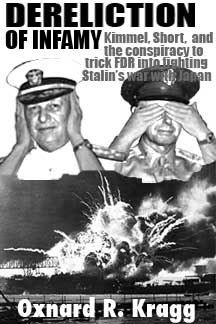
Independent resercher Oxnard R Kragg, in his recent book “Dereliction of Infamy,” reasons there can be no coincidence in Short and Kimmel both being “asleep at the switch” at the same time, just as everyone else was trying to raise the alarm for them about the obvious Japanese mobilization. This is a compelling point, and to back it up, Kragg has uncovered serious evidence that both commanders were secretly Communists, and probably agents of the Comintern! Previously unseen documents offered by Kragg make it more than likely the duo was in league with the USSR, to trick FDR from the inside into fighting the Japanese. The idea was that this would free up Stalin’s eastern front with Japan so he could focus on fighting the Nazis in Europe. As a perhaps intended side-effect, the attack forced the US to enter the war not just against the Japanese but the Germans as well, a fight in which many American soldiers were killed and the onset of the Cold War ensured.
All of this was avoidable, given existing islolationist sentiment, and the President’s own widely-stated desire to keep America out of the war at all costs. Recall the President’s pained words once his peace was shattered by Japanese bombers, that 12/7 would live in “infamy.” The Japs got off the hook easy – a little firebombing, two nukes, an occupation, and forced protectorate/tributary status and national techno-slavery, and you’re paid up, seems to have been our appeasement deal there. There are those that disingenuously try to pin the remaining domestic blame on FDR, and hardly anyone left with the courage to keep it where it belongs – on the traitors who sold us out from within. If history has taught me anything, and it hasn’t, a day cannot live in infamy by ignoring the dereliction at the heart of it.
---
ALL KIDDING ASIDE, The 12/7-9/11 Treadmill is back in operation after a hiatus of - dang! Two years! Keep an eye on this page.

Sunday, December 7, 2008

PEARL HARBOR {masterlist}


This masterlist will need to be re-done with all the good new posts flushing out the old over time.

New posts:
-> McCollum Memo: Analysis: A more in-depth and balanced examination that I had up previously of this perhaps pivotal document.
-> Former Naval Persons Churchill, Roosevelt, and Voyages to War. Circumstantial at best as evidence, but a cluster of intrigue worthy of a post here.
-> The Battle of Pearl Harbor: Alternate Outcomes Important post, in response to the objection over the sacrifice required in a "FDR knew" conspiracy theory. Hint: Massive loss was actually necessary.
-> By Special Request: The Move to Hawaii Admiral Richardson and the Fleet's relocation in 1940.
-> A "Restraining" Influence On the reasons for the fleet's retention at hawaii. Hint: Adm. Richardson didn't buy it.
-> A Thin Diet For Kimmel - And Genda A breakdown of Pacific Fleet depletion, April-December 1941. Result: 50% reduction of vulnerable warships.
-> The Carriers Controversy 100% reduction on the morning of the attack.
-> Walking Right Across the Broken Code Story Regarding Japanese naval code JN-25 and claims US "cryppies" had broken it prior to Pearl Harbor. Hint: unsubstantiated, at best.
-> The Message We Missed? Details on the Pearl Harbor striking force's order to sail and questions about its interception.
-> The Vacant Sea: On FDR's Order? On allegations the route of the Pearl Harbor striking force's path was intentionally cleared on order from Washington. Hint: it's a false claim.
-> The Bomb Plot Messages Vital intelligence that Pearl Harbor was being cased for attack, withheld from Hawaii. Perhaps the biggest intel "blunder" of all.
-> The Winds Messages Controversy Anticipated trivial intelligence of no particular value that was eagerly watched for but never transmitted.
-> Dereliction of Infamy: Mock book review on "Kimmel, Short, and the Conspiracy to Trick FDR into Fighting Stalin's War with Japan."
-> Pearl Harbor Discussions Links to forum threads (JREF) I've started to discuss the issue.

Old Posts worth keeping up [take these with a grain of salt]:
America at a Crossroads.
After Pearl Harbor : What a Catalyzing Event Looks Like - from Pearl Harbor through WWII and into the Cold War and the National Security State.
Never Mind: Stinnett just sort of drops the issue of provocation after 9/11. What's up with that? check out the "Bush Family 12/7-9/11 Circuit" post for some possible clues.

Friday, September 19, 2008

FALSE-FLAGGING IRAQ? {MASTERLIST}


Adam Larson / Caustic Logic
June 26 2009


Main Incident: September 19 2005 - arrest of Britons accused of terrorist plans
Other Alleged Incidents: Various times from invasion in 2003 to present
Alleged provocateurs: Military forces of United States and United Kingdom, perhaps Israel
Casualties: Unknown
Outcome: Varied
Investigations: A bit fishy

I’ve been in a bit of a time-warp this year, looking to the past with its protective shield of years and of secrets already revealed. Suspicious events in the present are by comparison more threatening, playing out quite directly in the now – I started out my research into false-flag operations and such with current events and questions about September 11 – After my long awkward dance with “9/11 Truth” I don’t feel like trying to re-approach that pivot, but rather the period just this side of it, the resultant War on Terror/World War IV/Long War/War of Many Names era.

The most visible battleground for this so far has been the cities of Iraq, out of which have emerged allegations of - and perhaps evidence for –Coalition forces using false flag terrorist attacks blamed on insurgents. This would apparently be intended to help keep occupied Iraq just that way. There are questions all along about motives and evidence, and I’m just on the outer edge of the fray. Since I’m not afraid of finding nothing awry – I hope not to in this case – I’ll look at it as an alleged pattern worthy of examination. This post will organize others exploring charges allegations and evidence. Primarly I’m looking at issues surrounding the 9/19 2005 incident involving the British army and Basra police, but will explore other avenues as well.

The Posts:
9/19 Basic Gist and Graphics

9/19 The First Half: The Arrest

On the Soldiers' Mission

Thursday, September 11, 2008

TERROR OF 9/99 {masterlist}

This post is to organize all those related to the "Terror of 9/99," the series of apartment bombings in Russian cities in 1999 that triggered the Second Chechen War and paved the way of Vladimir Putin to the Presidency. Since the beginning, Putin's career has been shadowed by widespread suspicion that Putin or an ally, not Chechen terrorists, was actually behind the bombings. like the hardcore 9/99 Truthers, I believe the Russian state was behind the campaign, though the full story is certainly more complex. I sense weird forces at work.

Notes on terminology/weird thoughts about weird coincidences:
9/99 is itself not a universally accepted name for the episode, but I took it up due to its catchiness and similarity to the branding of 9/11, which helps me illustrate my argument about that event. I first saw the term on the English-language Russian site Terror-99. I'm not sure, but I would guess that this site excellent and damning website is supported by Boris Berezovsky and other questionable anti-Putin characters - so while their facts seem fairly solid and the case itself is remarkably easy to make, I question their true motives. I also got a bit of a chill one day when I realized recently that 9/99 upside down is 666, the mark of the Beast. I don't believe in such nonsense, but many others do, and some have gone to pains to avoid the branding. Wikipedia's "Russian Apartment Bombings" page mentions the number "9/99" only in the sources, referring to the above website. A Google search of "9/99" shows a few sources, including me, and "terror of 9/99" reveals only Terror99.ru and myself. (Gulp). I'm on Putin's radar with the illicit inverted 66/6.

But what else could he expect? A series of bombings with 300 dead as they slept, dated 9/4, 9/9, 9/13, and 9/16 - with no precise date, we could pick the midpoint between the two middle bombings (which is reasonable since these happened in the capital and killed the most) - but that gives us 9/11, which doesn't have the same emergency implications as it does in America and it was left unused for the Americans' use two years later. But it wasn't about a single day, but rather a month, that bleak and nervous September as block after block was demolished - Black September 1999 - the Terror of 9/99 on the precipice of the Millenium. Some say it was Putin's 666 devil deal for power, the most logical name for it has that built right in, and if he did it himself, he had to have known this would happen. Couldn't it have waited 'till October?

Oh well - I guess as in America people see what they want to - those predisposed to see fire and horns see that, the rest who can't stomach the thought and face the obvious would argue Putin couldn't or wouldn't do that. Facts are of secondary nature to such strongly held beliefs and rarely can do much to change them. But it's worth a try.


Aftermath of 9/13 in Moscow, New President Putin resolute in January, Russian troops re-enter Grozny in October - kind of the wrong order I guess but you get the picture.

Wikipedia entry: Russian Apartment Bombings. They cite September 8 for the first bombing in Moscow, but I stick to the date from the Terror 99 site, which is from Russian Primary sources. Plus 9/8 throws off the spooky 9/11 hinge point.

- 9/99 part I: Putin's Godsend

- 9/99 part II: The Ryazan Incident - The Bombing that didn't Happen?

- 9/99 part III: The Investigation - The official investigation, PR campaign, the Kovalev Commission, its supporters, and its troubles. people die here.

- 9/99 part IV: The Conspiracy Theory - an "independent" investigation formed in London, pushed by exiled oligarchs, KGB/FSB defectors, and US Seantors. More people die here, and Europe is thrown into a subcontinent-wide radiation scare.

Monday, August 4, 2008

GULF OF TONKIN INCIDENT {MASTERLIST}

Adam Larson / Caustic Logic
Started June 2 2009
incomplete


Incident: Reported attack on USS Maddox and USS Turner Joy by North Vietnamese forces, Tonkin Gulf Vietnam, August 4 1964
Casualties: Zero dead, zero injured. Ships unharmed.
Official explanation: North Vietnamese attack that simply missed time and again for hours.
Outcome: The alleged attack led to the Gulf of Tonkin Resolution is Congress, and escalation of U.S. involvement in the Vietnam conflict. Some may have actually believed it, but by now at least few do.

The Posts:
- Attack Reports: The words on which a case for war hangs. "Many doubts" are just ignored.
- Desoto Patrols Explained: The mission that had the ships there at that time - two-part or three-part mission?
- The President's Haste: When you see someone running this quick across the frozen pond, you can bet they know just how thin the ice really is.
- Tonkin Gulf Opinions: And this is probably my last post on the subject.

Sunday, August 3, 2008

NATO’s SNEAK-BEHIND ARMIES {MASTERLIST}

Adam Larson / Caustic Logic
First Posted July 29 2009


Incident: Various acts of terrorism in Europe, 1947-1990.
Casualties: Uncertain but hundreds at least
Official explanation: Some Right-Wing extremists barely connected to NATO’s stay-behind armies and acting without authorization. Riiiiight…


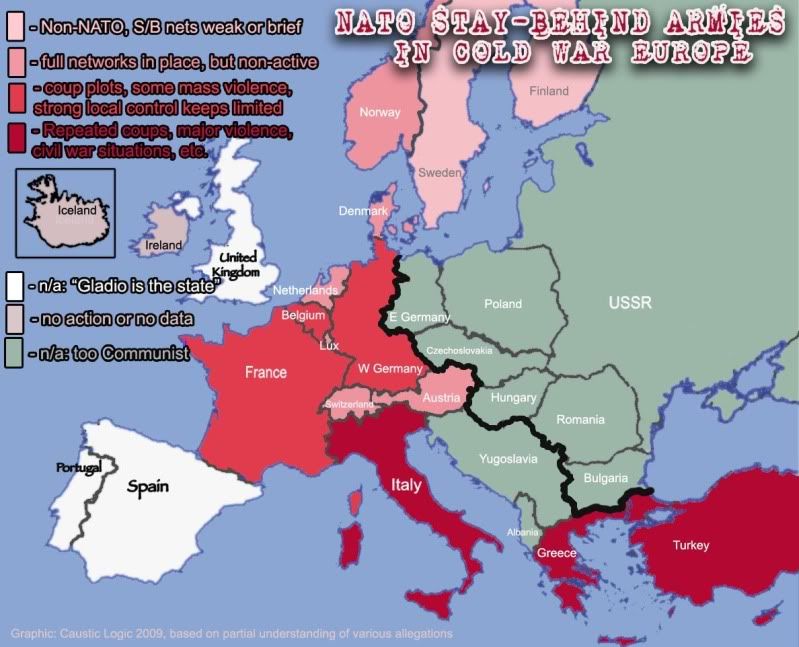
Due to the complexity of the topic, I’ve been reluctant to delve right into the “Operation Gladio” story, regarding NATO’s controversial stay-behind armies of the Cold War and their related groups and activities. The common name was but the active branch in Italy, the first revealed in mid-1990, due to intensive investigations stemming from a decade of deadly violence there. The picture at top is based on the seal of Gladio; the original text means "in silence we defend freedom." My version says "Silently we subvert Democracy."

It was told how this secret army Gladio had been operating since the mid-1940s with counterparts in every European country west of the Iron curtain, with the exception of Ireland and Iceland. Other nations were alarmed and started investigating throughout the 1990s and beyond. Different names, dates, and arms cache locations surfaced, as did different strategies from the silently abandoned to verging on civil war, as in Italy. Old mysteries finally made sense, while key secrets were left still concealed in each nation.

The networks themselves were in little doubt then, and none now; establishing a stay-behind army, capable of resisting a Soviet occupation, had always been a precondition for NATO membership. What might seem prudent in the face of a possible thrust beyond the Iron Curtain, also created dangers; the sabotage, infiltration, and assassination skills they learned could either go to waste waiting for a day that never came, or they could be employed, as they were, to create a “strategy of tension.” Under this concept, mysterious acts of violence were blamed on the Left’s radicals, but were carried out by Right-wingers using the hidden stay-behind arsenals and protected by state apparatus and the CIA to escape and strike again. Dropped charges over unsolved attacks came down like steady like the pitter-patter of rain drops during the Cold War decades.
The suspicious pattern led many to conclude, well prior to 1990, that larger forces behind these terrorists manipulating the political process – sneaking behind the democratic governments of Europe. The stance professed by insiders has been innocence and/or ignorance – the armies were meant to remain inactive until the doomsday invasion, and most did, but if not, then the zealots in the network got carried away. The violence was never the plan, but just happened - and was exploited in its effects, covered-up, at least tacitly encouraged, and continued widely almost until the 1990 revelations.

In 2005 Swiss researcher Dr. Daniele Ganser released a deeply-researched book on the subject NATO’s Secret Armies outlining the patterns of allegation, evidence, and mystery. Dr. John Prados of the American National Security Archive, who had tried unsuccessfully to get related files from the CIA, wrote the foreword. Undermining the ignorance construct, Prados noted:
“[N]etworks created to be quiescent became activists in political causes as a rule and not an exception [...] At a minimum Dr Ganser's record shows that capabilities created for straightforward purposes as part of the Cold War ultimately turned to more sinister ends,” leaving him wondering if it were “the United States itself, Britain, France, Italy, and others who should be on the list of state sponsors” of international terrorism.

My normal M.O so far has been to focus on a narrow event and study detailed evidence to narrow down the options that make most sense. In this case the mind boggles at how wide the roster of evidence would be – sixteen nations, four-and-a-half decades, lots of remaining secrets and uncertainties, the relative inaccessibility of primary sources… no way can I cover the whole subject in adequate depth – I will simply try to cover some general patterns and examine a few key periods/events/concepts, in hopes of shedding some new light on something.

THE POST(S)
> Forty-Three Years of Deceit: A detailed "general rundown" of the mysterious events attributed to the sneak-behinds.
(a few are coming)

Sunday, June 8, 2008

USS LIBERTY INCIDENT {MASTERLIST}


Incident: Attack on USS Liberty by Israeli Defense Forces, Navy and Air Force, off occupied Sinai, June 8 1967
Casualties: 34 killed, 171 injured, from a crew of 297 plus small contingent of civilian linguists. Narrowly avoided sinking, with perhaps 100% fatality. Liberty totaled beyond desire for repair and sold for scrap. Official explanation: communications blunders by US, mistaken identity by the IDF. Hardcore factor on a 1-10 scale: 187.

An introduction to "my inquiry," some notes on methodology, general opinions and areas of interest, etc...

The Posts so Far
"Investigation"
OFFICIAL INVESTIGATIONS: We start with Cristol's mythic thirteen and whittle it down... Israel has not been absolved by any meaningful investigation.

Aerial Surveillance:
- Blind Tracking the Liberty: The apparent, intense aerial surveillance of the Liberty and the IDF's professed ignorance of the ship make strange bedfellows.
- Aircraft Photo Analysis: On the photo of an apparent surveillance craft taken from Liberty's deck. Type of plane and time of day are the areas of inquiry.

- USS Liberty Flag thoughts: Why the ship's American flag is not my main issue, but worth at least fifteen observations.

Air Attack:
Air Attack Transcripts as published by Jerusalem Post, for reference.
Unable to Pursue: Myth: fighters were called in only because the target was (reported as) too fast. Reality: air attack was planned from the beginning.

Telex and Tapes: A four-part series regarding different versions of the IDF communications surrounding the air attack.
Part One: The supposed recording of the attack pilots ordered to attack despite seeing the U.S. flag. I'm agnostic, it's an interesting issue.
Part Two: What the men who recorded the American intercepts recall - again, flag and attack at the same time.
Part Three: What the Israeli recordings show - no flag report 'til well after the attack, tho lots of "Americans" mentioned prior to that.
Part Four: What the NSA claims to have - something's missing here.

"Misidentification"
"What is this? Americans?" Regarding a line spoken at IDF HQ, just before the attack started. What is this, a warning?
Boat-to-Boat Recognition: The Liberty spots the MTBs and vice versa. Lots of detail - from radar returns to the flag sighting and all the miscommunication and heedless aggression in between.
Liberty Mis-identification, Encore: The context of the MTB ID - erasing the "CTR" - but only for ten minutes!

THE GHOST SHIP SERIES
The One That Got Away? Introducing the 2nd ship story line as encountered via Michael Oren. What's with these clues pointing to another vessel provoking the IDF into attacking the nearby scapegoat?
Mystery Ship Inquiry: Relating to the above, a long list of raw quotes from IDF reports and others, with brief pithy comments.
USS Liberty Logs Analysis and other primary sources - emphasis on relation to the second-ship story line.

Graphics/Maps

Video: USS Liberty, Dead in the Water

Discussions I'm involved in at the JREF forum:
Roundhead's USS Liberty thread
UNLoVed Rebel's "injustice or propaganda" thread

Wednesday, May 7, 2008

THE LUSITANIA {masterlist}

The sinking by German submarine of the HMS Lusitania in early 1915 was the formative event in drawing the United states into World War I. Like other such events, the deadly U-boat attack off the Old Head of Kinsale has been haunted from the beginning by allegations of conspiracy. And like so many others, sadly, the suspicions are well-founded and probably true.

This post is to organize all the sub-posts on the subject. No posts are up yet but are in the works. Most of my information is from Colin simpson's 1972 book "The Lusitania: Finally, the Startling Truth about One of the Most Fateful of All Disasters of the Sea." {Boston, Little and Brown, First American Edition, 1973}

HMS Lusitania Facts:
Premier ocean liner of its times, the "Greyhound of the Sea." Operated by the British Cunard shipping line, named for a province of Spain under the Roman Empire, it was first launched on June 7 1906. Nearly 800 feet long, capable of carrying 2200 passengers, a crew of 850, and hundreds of tons of supplies at a top speed of 26.7 knots. Early in World War I the ship was lent out to the British war effort against Germany; she made a regular circuit to New York and back, carrying supplies from the US under its "arsenal of Democracy" policy. This violated a German blockade, and repeated warnings from the German end were buried as the ship entered on its final voyage in May 1915 and sailed right into a German trap, the path to which had been cleared and paved by the British Navy, in hopes of drawing America into the war. On May 7 the Lusitania was sunk by German U-Boat at a cost of 1,200 lives, many American, many wealthy and prominent. There was further delay before the US entered the Great War - internal disputes and the 1916 election had to pass first, but it was the Lusitania barbarity that was always the political and emotional underpinning of America's campaign in Europe.

Wikipedia article: http://en.wikipedia.org/wiki/RMS_Lusitania

Thursday, March 13, 2008

OPERATION NORTHWOODS {masterlist}

This post is to organize all posts dealing with Operation Northwoods, the 1962 military plan to basically committ acts of terrorism and blame Castro's Cuba to trigger war and regime change there. It was pitched to President Kennedy's people but was never implemented and covered up until 2001.

I'll start with chapter I of my book "Scenario 12-E: the philosophy, the technology, and the cover story behind Shadow 9/11," a short chapter posted in three parts. Given the importance of the Northwoods precedent, there will eventually be more material added later.

“Casualty lists in U.S. newspapers would cause a helpful wave of national indignation.” - Joint Chiefs of Staff, 1962

Sections:
I: Lemnitzer the Landmine: 1960-63, the Joint Chiefs and the White House in tense times.

II: Special Distribution: The Plan: Operation Northwoods, its ominous recommendations, Lemnitzer's pitch and the immediate aftermath (ie Lemnitzer tansferred and the affair covered up).

III: Northwoods 2001? The curious revelation of Northwoods decades later and just months before 9/11 and the Acting JCS Chairman caught in the thick of it.

Wednesday, February 27, 2008

REMEMBER 2/27: THE REICHSTAG FIRE {masterlist}

This post will organize and link to the several posts needed to convey the subtance, contzt, and effects of the Reichstag Fire in Berlin, Germany, February 27 1933. Initially blamed on Communist radicals hoping to conquer Germany from within, the burning of the government's meeting place was later found to have been engineered by the Nazis themselves. The fire shocked the nation and served as an enabling act for Chancellor Adolph Hitler to tighten his and his cronies' grip on power and begin the march towards the Third Reich, the Holocaust, and World War II.

- Desperate Times/The Gathering Storm: 1933 Germany: aftermath of World War I, the great depression, increasing resentment and nationalism, and the Rise of Hitler.

- The Revolution Bursts Into Flames: To quote rapper Paris, "See the Reichstag Burn, see the public buy it."

- Shadow 2/27, Skeptics, and the verdict of History

- Gleichschaltung - Consolidating Power

And the rest is history...

Friday, February 15, 2008

USS MAINE {MASTERLIST}

Adam Larson / Caustic Logic
May 3 2009


Incident: Sinking of USS Maine by disputed cause, Havana Harbor, Cuba, Feb 15 1898
Commanding Officer: Captain Charles D. Sigsbee
Arrived Havana Harbor Jan 24 1898, three weeks before exploding there.
Casualties: 274 US servicemen killed, from a crew of 363. Maine instantly totaled and quickly sunk.
First official explanation: Spanish/Cuban naval mine, detonating onboard ammunition.
Outcome: The sinking triggered the Spanish-American War, announcing the U.S as a major, maritime, neo-imperial power.
Investigations: Two military courts of inquiry, 1898 and 1911. Second sunk the remains in deep water. First private investigation by deep-water guy Adm. Rickover, 1976. No congressional investigations.

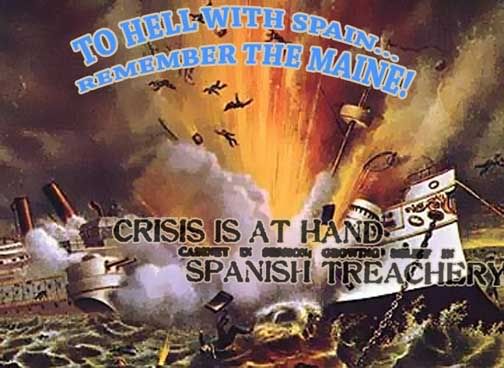
I'm sort of opening this "inquiry," but not planning much work at the moment. I felt I needed at least two posts on the subject, and then a masterlist. Considering the mechanical aspects (inward vs. outward blast) are still being hotly debated over a century after the fact, I think I'll be sidelining this. For now anyway, my focus is on the more circumstantial aspects - who benefits? (Clue - first name starts with a "T," last name ends with "velt.") Perhaps more than any other case in American history, the overwhelming weight of logic makes a true false flag operation, at the lest, far too likely to just toss aside. Certainly the Pax Americana owes a tremendous debt to the hands or fates that caused that blast.

One concrete question I'm curious about is how much ammunition was or should have been aboard.

- Remember the Maine, Forget the Treachery My original thesis-like speculative essay thing, and starting point.

- USS MAINE PRELUDES: WAR PLANS A new post simply compiling some external sources on the pre-1898 plans to seize Spanish holdings.

Thursday, February 8, 2007

Lusitania Teaser

Just in case anyone's paying attention and concerned I've abandoned this 'blog. I've been focussing on the Frustrating Fraud and with real life lately. Soooo... I don't have time to put together a proper post on the Lusitania like I'd intended, so here is a teaser, a few notes end excerts from Colin Simpson's 1972 The Lusitania.

Among the players we'll be looking at:
- Alfred Booth: Cunard Chairman
- George Booth: Deputy Director-General of the Ministry of Munitions, 1914-1919
- William Jennings Bryan: US Secretary of State 1914-1915
- Winston Churchill: First Lord of the Admiralty as of 1911, apparently among the prime, if not the prime, architect, of the British end of the Lusitania disaster set-up.
- Captain “Fairweather” Dow: demanded more coal in Dec 1914, took his case right to the Admiralty
- Lord Fisher, Churchill’s First Sea Lord: retired in 1911 – warnings to Churchill (p 31). Letter to Tirpitz March 1916: “I don’t blame you for the submarine business, I’d have done exactly the same myself.” (p 14).
- Captain Guy Gaunt: naval Attache at the British Embassy in Washington, “Hall’s deputy in America.”
- Capt. Reginald Hall: Director of British Naval intelligence as of Oct. 1914.
- Col. Edward M. House – proto-National Security Advider to President Wilson
- Robert M. Lansing: Advisor to the State Dept. on foreign territorial disputes and an errand boy for Wilson when Secretary of State Bryan wasn’t cooperative enough – uncle to Allan and John Foster Dulles, a chief architect of the American end of the Lusitania disaster set-up.
- US President Woodrow Wilson: Apparently down with the set-up but playing ambassadorial 14-points-compatible kind of plausible deniability.

Operation run from American end by Morgan interests working with Lansing, Edward Stettinius and representatives from “naval and military ordnance officers … attached to the British Consulate in New York.” [56] – “It is difficult to reconcile President Wilson’s well-publicized idealism and neutrality with his sanctioning of the Morgan operation.” [p51]

February 19 1913 – Cunard shipping line chairman Alfred Booth is called before Board of Admiralty, chaired by Lord Winston Churchill, and informed that the company’s deal with London to support the war effort was to be honored; effective immediately, their ships, including the Lusitania, were to be fitted with removable cannons and set to shipping war materiel and other aid across the Atlantic to create a semi-covert Anglo-American supply chain. At this point, Churchill told Booth that war was expected with Germany by September 1914. (p 25) War was finally declared on August 4 of that year, just after the German invasion of Belgium and a few weeks ahead of time.

By December 1914 – “Naval Intelligence was intercepting almost every German signal […] a stroke of good fortune had provided the admiralty with the official German naval codes and by the end of February 1915 Marconi had perfected a method of radio direction finding. […] by the end of January 1915, Hall was able to to advise the admiralty of the departure of each U-boat as it left for left for patrol.” [65]

On Churchill's book "The World Crisis:"
Simpson's excerpts: “The distinction between politics and strategy diminishes as the point of view is raised. At the summit true politics and strategy are one. The maneuver which brings an ally into the field is as serviceable as that which wins a great battle. The maneuver which gains an important strategic point may be less vauable than that which placates or overawes a dangerous neutral.” (35)
“The first British countermove, made on my responsibility […] was to deter the Germans from surface attack. The submerged U-Boat had to rely increasingly on underwater attak and thus ran the greater risk of mistaking neutral for British ships and of drowning neutral crews and thus embroiling Germany with other Great Powers.” (36)
Simpson: “The neutral to be “placated or overawed” was the United States. Churchill’s strategy was to goad the Germans into a confrontation with it, and by doing so he hoped at the very least to neutralize pro-German sentiment in America and to consolidate his source of supply.” (35-36)

Other moves by Churchill’s Navy to further increase such risks: - ignoring the long-established international “Cruiser Rules,” ordering all British ships to paint out their names an port of registry – fly neutral flags while in British waters (US flag usually) – mistreatment of U-Boat crews captured, denial of POW status, Churchill’s policy “prisoners should be taken as prisoner or shot, whichever is the most convenient.” made surrender of U-boats less likely and fighting more so – “the introduction of mystery” or Q-ships-military ships disguised as civilian (as of feb 1915) - one infamous reported Churchill policy: “in all actions, white flags should be fired upon with promptitude.” (37)

You can surely get the drift already...

Tuesday, February 6, 2007

THE BUSH FAMILY 12/7-9/11 CIRCUIT {masterlist}

In the course of my research on 9/11, the "new Pearl Harbor," and its namesake original, I stumbled across an intriguing confluence of events suggesting the crafting of a backdrop "New Day of Deceit" myth - whether intentional or not - by the people surrounding George Bush sr. This became one of my favorite discoveries, and along with an earlier and sinister "perfect Bush circle" surrounding America's entry into WWII, here is the double loop in chart form I did up as a circuit board. Beneath that, find a brief explanation for the elements of the chart and the connections between them. Follow the link for more detailed sub-potst.


The Elements of the Chart:
President (FD) Roosevelt, Secretary of War Henry Stimson, and possibly Roosevelt's adviser and ambassador W. Averell Harriman (among others) acted on the Japan provocation plan put forth by Lt. Commander Arthur McCollum at the Office of Naval Intelligence. The eight-point plan solidified existing intentions to bring down the Pearl Harbor attack and give the US an excuse to officially enter the Second World War on the side of the British and the Soviets. In addition to fighting the Nazis and their Japanese allies, the attack allowed the creation of an enduring "military-industrial complex" among its other profound transformationsof American society and economy with effects up to the present time.

War Secretary Stimson meanwhile was a friend of the Bush family, originally headed by Samuel Bush, a muscleman who helped make sure weapons were shipped right for the World War I effort, a sort of proto-military-industrial complex/Merchants of Death kind of guy. By 1940 the family was headed by Samuel's son Prescott, a businessman and senator who maintained ties with Stimson. Bush was also a business partner in Averell Harriman's investment banking firm, involved along with Harriman's brother in the subsidiary Union Banking Corp. that was helping finance the Nazi war machine via Fritz Thyssen until forcibly shut down in late 1942.

Among those young Americans by then called to service in the War effort unleashed by 12/7 was Prescott's son George H.W. Bush (named after Prescott's father-in-law and Harriman-related business partner George Herbert Walker). Another young recruit, Robert Stinnett, served together with Bush in the same aerial reconnaissance unit on the USS San Jacinto. Whatever connections they formed were nurtured with Stinnett's authoring of "George Bush, his WWII Years" in 1990, used as a GOP fundraiser for Bush's re-election campaign in 1992. (hence the link from Stinnett to Bush as president). Stinnett dropped hints about his coming Pearl Harbor thesis in this paen, and after visiting Bush in the oval office, his investigation (coincidentally?) skyrocketed and formed into the groundbreaking Dec. 7 1999 Day of Deceit, which for the first time cited McCollum's plan and in my opinion finally gutted the official story, a victory he started rehashing every December 7 with a reminder article - they provoked and allowed what could well be called a "catastrophic and catalyzing event."

Ironically, Day of Deceit was first published just as the Project for the New American Century was getting serious with its military ambitions, in September 2000 prominently noting the utility of a "new Pearl Harbor," just months after Stinnett had re-defined the term to mean a provoked event designed to transform american opinion. This group is dominated by former Bush sr functionaries (Cheney et al, the hawk "renegades" we're told) and was forming the advisory basis for the presidency of Bush's son. Then they oversaw the most spectacularly acute failure of defense in American history - a new Pearl Harbor in spades - after alleged intense provocations in Afghanistan in mid-2001. Will a McCollum memo from January 2001 surface one day?

A curious and perhaps telling footnote to all this is Stinnett's about-face on Pearl Harbor in the period after 9/11. Perhaps it's simply a coincidence, but as questions over what Bush knew began to arise in 2002, Stinnett's argument and questions changed significantly, no longer mentioning the McCollum memo or provocation. There seems to be no problem with the solidity of his case, so why the back-off? Did someone get a pang of "degrees of separation anxiety?" If this sound silly to you, just take another look at that circuit board above and think about it. It's gotta mean something.

Perhaps the crafting of an ephemeral, controllable, limited-time-only official conspiracy theory? In what context could it possibly make sense to imply that they provoked and allowed the attack? Are they pleading to a lesser crime since they know they physically did it themselves? Is the New Day of Deceit designed to cover for Shadow 9/11 by providing a more logical explanation for the attack's success that still keeps external terrorists center stage?

Monday, January 1, 2007

12/7 part VI: THE PEARL HARBOR SMOKING GUN

Former post pulled 3/19/09

This was a badly flawed piece, mostly from relying too heavily on Stinnett (whose book is largely bunk) and from general ignorance. The McCollum memo is still a vital piece of evidence, however, and now has a much better analysis that can be seen here. Please check it out.

NEVER MIND: STINNETT DROPS THE ISSUE

PROVOCATION ERASED, MCCOLLUM MEMO RE-CRYPTED
Adam Larson
Caustic Logic/The 12/7-9/11 Treadmill
December 26 2006


Day of Deceit author Robert Stinnett is a research fellow at the Independent Institute, an Oakland, CA-based conservative libertarian, anti-big government think tank. In addition to hosting Stinnett and his Pearl Harbor case and publishing books like “Against Leviathan,” they also feature as a fellow 9/11 skeptic and former Reagan economist Paul Craig Roberts. Via the Institute, Stinnett started to repeatedly explain and promote his arguments from Day of Deceit, starting with an event in May 2000 called “Pearl Harbor: Official Lies in an American War Tragedy?” [1] Later that year he wrote a commentary published to mark the 59th anniversary of “December 7, 1941: A Setup from the Beginning.” This piece explicitly mentioned “McCollum’s secret memo dated October 7, 1940, and recently obtained through the Freedom of Information Act.” He cited its eight points, the “centerpiece” of which was “keeping the might of the U.S. Fleet based in the Territory of Hawaii as a lure for a Japanese attack.” In this original piece, he listed two specific questions “at the top of the foreknowledge list: (1) whether President Franklin D. Roosevelt and his top military chieftains provoked Japan into an “overt act of war” directed at Hawaii, and (2) whether Japan’s military plans were obtained in advance by the United States but concealed from the Hawaiian military commanders, Admiral Husband E. Kimmel and Lieutenant General Walter Short so they would not interfere with the overt act.” [2] That is, the failure to intercept warnings was intentional and secondary to the provocation.

Robert Stinnett, if I'm not mistaken, at the White House in 1990
This December 2000 piece set a trend for anniversary commemorative articles. On the 60th anniversary of Pearl Harbor and just three months after 9/11, he published “Pentagon Still Scapegoats Pearl Harbor Fall Guys.” Again he posed the same two questions – was it provoked, and did they intercept messages. Again he made largely the same arguments as the previous year, prominently mentioning and explaining his exclusive evidence, the McCollum memo. [3]

But then something changed in 2002, curiously at just the same time the post-9/11 world and its questions of what Bush knew began to sink in. We can see a shift in direction in that his speech that year was five days early, on December 2. Still boldly titled “The Pearl Harbor Deception,” it was different in two ways than his presentations before 9/11 – First, his two questions had changed, now omitting provocation. “Two questions about the Japanese attack on Pearl Harbor have ignited a controversy that has burned for 60 years: Did U.S. naval cryptographers crack the Japanese naval codes before the attack? Did Japanese warships and their commanding admirals break radio silence at sea before the attack?” the second change I noticed is the lack of any reference to McCollum’s memo; he was leaving out what was the core of his argument, the primary thing that made it HIS argument. He was surrendering his edge. [4]

This was followed quickly by “The Truth about Pearl Harbor,” a January 30 2003 debate held at the Institute between Stinnett and foreknowledge denier Stephen Budiansky. It should be easy enough for Stinnett to win, since Budiansky argued the government line by citing only the old evidence, almost strictly code breaking (which he wrote the “complete” book on, as well as a book called “Closing the Door on Pearl Harbor”). Stinnett could have sunk Budiansky’s argument by illustrating the secondary nature of foresight when one is actively provoking something. Yet he did not, and played Budiansky’s game, keeping the very boring and tedious debate at the level of codes and of personal attacks over credibility. His presentation seems to consist of his December article, a word search of which shows that the name McCollum pops up, but only as a “James A. McCollum” cited as a source in the debate on code-breaking. The date of the memo, its author, its eight points, are totally absent. The words “provoke,” “provocation,” and various synonyms reveal nothing but the admission in the opening remarks by David Theroux that Stinnett had previously argued that “U.S. government leaders at the highest level not only knew that a Japanese attack was imminent, but that they had deliberately engaged in policies intended to provoke the attack.” In his “presentation” that day, Stinnett made no such argument. [5]

I'm sure he had very good reasons for the shift in course, but I can't say for sure what these are. It could be a case of someone finding out that the McCollum memo was maybe a forgery, forcing Stinnett to back off from it pending an investigation. I haven't heard of anyone from the swollen ranks of the 12/7 coverup apologists pointing this out, however, and to the best of my knowledge, the memo remains solid. The reason for dropping the issue could also be someone suffering "degrees of separation anxiety" and urging Stinnett to back off the hard case and leave Pearl Harbor intact.

He did, however, intriguingly point out in this twice-presented piece that “immediately after Day of Deceit appeared in bookstores in 1999, NSA began withdrawing pre-Pearl Harbor documents from the Crane Files housed in Archives II. This means the government decided to continue 60 years of Pearl Harbor censorship. As of January 2002, over two dozen NSA withdrawal notices have triggered the removal of Pearl Harbor documents from public inspection.” How ironic then that at about this same time Stinnett also started to censor himself. Though his book is still available and not removed from view at all, it’s as if Stinnett is trying to forget his core argument, or at least to stop reminding anyone of it. According to the Independent Institute’s website, Stinnett has written no more commentaries and given no more presentations in the four years since his forfeited debate with Budiansky. He seems to have retired from his pre-9/11 mission, and as far as I can tell he’s not spoken or typed the name Arthur McCollum since December 2001.

sources:
[1] independent Institute. Research Fellow: Robert B. Stinnett. http://www.independent.org/aboutus/person_detail.asp?id=514
[2] "December 7, 1941: A Setup from the Beginning." December 7, 2000. Robert B. Stinnett. Honolulu Advertiser. http://www.independent.org/newsroom/article.asp?id=103
[4] "Pentagon Still Scapegoats Pearl Harbor Fall Guys." December 7, 2001. Robert B. Stinnett. Providence Journal. http://www.independent.org/newsroom/article.asp?id=400
See [1].
[5] "The Truth About Pearl Harbor: A Debate." January 30, 2003 Robert B. Stinnett, Stephen Budiansky. http://www.independent.org/issues/article.asp?id=445
[6] http://www.independent.org/newsroom/article.asp?id=103