Saturday, November 28, 2009

LIGHTLY EXPLOSION-DAMAGED

Two Scientists, a Purple Bag, and a Possible Clue
[Pan Am 103 Series]
Adam Larson / Caustic Logic
November 29 2009


Going through the court transcripts of the Lockerbie trial at Camp Zeist, one point of interest that I ran across concerns the testimony of RARDE scientist Allen Feraday. This was on June 15 2000, day 21 of the trial (read the LTBU daily report in .doc format, outlining some of the controversies). The witness himself reportedly has little in the line of formal qualifications, citing a “higher certificate in applied physics” as his qualifications; He’s still conceivably capable of brilliant professional work; but judging by some previous high-profile anti-terrorism cases he’s been involved in, he could be seen as more of a “manager” of evidence than a reasonable assessor of it.

Feraday’s scientific findings relating to the Lockerbie investigation are inextricably linked and confused with those of his underling, Dr. Thomas Hayes, who has a proper PhD. I don’t know the arrangement, but Ferraday mentions analysis of the luggage and clothing that “was essentially done relatively early on, by Dr. Hayes, and then, obviously, checked by me.” (p 3328) The two are more famous for their handling of the miraculous timer fragment PT/35(b); Hayes found it in a shirt collar and alerted Feraday, who passed the news on to Williamson, and thence to Henderson, Marquise, Thurman, “Orkin” and the history books. In testimony Feraday also clarified the interchangeable nature of their collaboration “I did not always, when I was looking at [evidence], make any difference between myself and Hayes” (p. 3332)

The prosecution generally seemed to feel the same way; their habit of asking questions of Feraday better suited for the earlier witness led Mr. Keen to lodge for private audience with the judges. Once Feraday was sent from the room, Keen argued in part:
According to the evidence of this witness, he prepared the final report on the basis of his examination of certain matters, and by considering Dr. Hayes' notes. What my learned friend appears to be inviting is hearsay evidence […] I object to the Crown canvassing hearsay evidence, even in the context of what is referred to as a joint report, in respect of such a matter. If they wish to take direct evidence on this issue, then they had ample opportunity of doing so with Dr. Hayes. And in my submission, it is not competent for them to take hearsay evidence on this matter from Mr. Feraday. (pp 3215-3216)

Nonetheless the questioning continued in a similar line, a hundred pages later coming to my point of interest, the unusual collaboration on another piece of evidence: a damaged piece of luggage, described as “a purple-coloured holdall” and labeled PH/137. This bag, Feraday had wrtten in his final report of 1989, had within it two metal fragments “which both originate from the primary IED suitcase,” so it should be of some interest. Mr. Keen for the Defense addressed Dr. Hayes' draft report during his questioning of Feraday. He cited page 23 as listing categories including "Likely Explosion Damaged Luggage,” and noted that one item listed in that heading is PH/137. Feraday confirmed these facts while comparing with his own copy.
Q So from Dr. Hayes' draft report -- and I think you just told us he prepared this part of the report -- we can see that he designated this as explosion-damaged luggage?
A I think it was lightly --
Q Lightly explosion-damaged luggage?
A Yes.
(pp 3330-3331)

This attitude would help explain Feraday’s own notes, Production 1498, in which Keen noted “that nowhere in the index” and in fact “nowhere in your examination notes does the item PH/137 appear.” The witness confirms to both “that's correct, sir. Yes.” Of course lightly blast-damaged was a fudging statement and further probing shows him to believe it wasn’t in the explosion damage at all. Next Mr, Keen pulled up a photograph of this item. (Production 181, photograph 91)
Q It is apparent, is it not, Mr. Feraday, that you have not signed the label as it is photographed in photograph 91?
A That's correct, sir. Yes.
Q But your signature now appears on the label PH/137 in court?
A Yes, sir.
Q When did you sign that label, Mr. Feraday?
A When I had the bag back to write this -- the final report.
Q And what date was that, Mr. Feraday?
A I can't tell you without looking it up again on a list, I'm afraid.
Q Are you saying that that was before December 1991?
A I think it must be, yes. I finished the report by then, so yes.
Q And are you saying that you examined PH/137 before you finished the report?
A Yes, sir.
Q Where are the notes of that examination, Mr. Feraday?
A Well, there aren't any, because as I said, I did not always, when I was looking at them, make any difference between myself and Hayes -- although in this instance I did, and I told him so, that in my opinion you couldn't necessarily put that in the explosion damage. I couldn't convince myself that it was explosion damage. Prior to that, Hayes had written this preliminary report for another purpose -- I think the Fatal Accident Inquiry --
(pp 3331-3333)

So if I’m reading this right, he disagrees with the actual PhD scientist, but did no detailed, documented, admissible examination of his own to back this up. He couldn't recall when he made his divergent inspection, but did immediately recall that he made no notes for it. His lack of notes in turn is justified "because" they agree on things, "although" not in this case. Got it.

Notes or not, the reason for Feraday’s divergence seems to be an unexplained lack of conviction, with which Hayes lodged no disagreement:
Q And you recall --
A Sorry, I'm waiting for the --
Q I don't think you had finished, Mr. Feraday, so do finish your answer if you wish.
A Sorry. I came to the conclusion that I couldn't myself put it in the explosion – necessarily in the explosion-damaged baggage. I'm not saying it isn't, but I couldn't convince myself. And I still can't. And for that reason, I had a word with Hayes, and we agreed to put it in the second section.
Q So you -- you recall discussing this with Dr. Hayes, do you?
A At some stage I discussed it with Dr. Hayes, but I can't remember exactly when or if, in fact, it was when the -- I wrote the final report. And then Hayes certainly came in, obviously, and read it all and then signed, and we went through each item then. We through the report, if you like, line by line.
Q Line by line, Mr. Feraday?
A Well, he read through it, obviously, line by line.
(pp 3333-3334)

This implies no disagreement; Hayes was able to check Feraday’s findings and found no problem with the exclusion of PH/137 that Feraday had already decided on and reported. Next, Mr. Keen turned to Feraday’s given reasoning, in that report, to support his agnosticism.
Q If you would like to turn for a moment, Mr. Feraday, to your report 181 at page 51.
A Yes, sir.
Q Now, we can read this section for ourselves, but I'd like to look in particular at the third paragraph on that page, which you corrected during your examination in chief chief [a meeting just before his questioning - ed] by proposing the insertion, after the fourth word in the first line, of the word "other"?
A Yes, sir.
Q Now, taking the paragraph, of course, in its context, can we read that corrected paragraph. It states: "As there are no other penetration holes in either the holdall or the plastics bag, it appears most likely that these two fragments, which both originate from the primary IED suitcase, were picked up and placed inside the plastics bag, which was then itself
placed inside the purple holdall for convenience of carriage."
A Yes, sir.
Q Now, I have to suggest, Mr. Feraday, that if you insert the word "other" into that paragraph in the context of this section, the paragraph is deprived of sense or content.
A Is ... ?
Q Deprived of any sense or content. It tells us absolutely nothing if you correct it in that way. What do you say to that?
A I am not sure what you mean. But what it would then say is as there are no other penetration -- at the top of the page, I am talking about the ragged horizontal cuts which, obviously, one can see as penetrations. I see them as cuts. Now, in dealing with, first of all, the holdall, there are no other penetration holes in it, other than those that I've already said about the cuts. And in the plastics bag, there were none, the plastics bag which contained the two fragments of metal from the suitcase. So I was left scratching my head as to how they can get inside there, in a plastics bag, if they didn't come through any part of the bag.
Q Do you --
A I can't convince myself they come through the ragged cuts.
Q You recollect the label attached to the plastics bag, Mr. Feraday, having said "two pieces of metal, charred, found within baggage."
A Yes, I do, sir.
Q And you recollect finding penetrations in the side of the bag that went right through to the interior of the bag?
A Horizontal cuts, yes, sir.
Q But you felt it pertinent to remind us that there were no other penetrations in the bag, Mr. Feraday; is that right?
A Not big enough for the -- for anything to do with the two pieces of metal. That's correct, sir, yes.
Q But the penetrations you'd already found were big enough for the penetration of the two bits of metal?
A Oh, yes, sir.

Q Well, that might be an appropriate point, My Lords, if there is to be a short adjournment.
LORD SUTHERLAND: Yes, very well. We'll adjourn for 15 minutes.
(3334-3336)


I can only paraphrase Michael Palin in The Holy Grail “what a strange person.” Mr. Feraday’s stated reasoning then seems to be that even though these shards could fit through the penetrations if explosively hurled there, he couldn't convince himself this was what happened and chose to think of them as surface "cuts." Who knows what caused these cuts - perhaps the hold-all fell through a tree before landing. And the two unrelated IED suitcase bits were found elsewhere and simply put in the bag far carrying, with no note about being found elsewhere. His report first supported this saying there were "no penetrations" in the bag, corrected only in his examination in chief (a meeting just before his questioning) to "no other pentrations," aside from the "cuts" that they probably did enter through.

His references to the plastic bag is curious. This would clearly seem an ad hoc evidence bag (probably not a proper one or he’d teerm it as such), into which the shards were placed after being found. This would be a careless and illogical move, but I don't see anything else making sense. Transferring these also into a bag they weren’t found in makes this faux pas worse – something Mr. Feraday should have reported rather than just using it as he did to remove the explosion from PH/137. A lack of damage to this evidence bag is also cited as a clue these didn't fly in thru the cuts: “[T]here are no other penetration holes […] in the plastics bag […] which contained the two fragments of metal from the suitcase. So I was left scratching my head as to how they can get inside there, in a plastics bag, if they didn't come through any part of the bag.” This in particular is a ridiculous non-sequitur, but another clue to Feraday this was not explosion damage.

In the most rational explanation for this thought process, perhaps he just meant, "obviously, the bomb didn't put these metal shards in the plastic bag, one of our people did. Therefore, they probably got the scraps from somewhere else, but threw them in there instead." And perhaps if we could see the evidence we'd see why he felt the shards did not just enter through the tears. But for whatever intention, he effectively erased this piece of evidence from the bomb site picture – where Dr. Hayes had already placed it - based on his unexplained solution.

Although he comes across looking incompetent – nearly always looking at the wrong exhibit and frequently befuddled - I suspect Feraday is not actually an idiot. Therefore, if he seems like one, he may be playing dumb and that's often a clue. However I simply don't have the information to know just what this might mean. Detailed information on loading procedures at Heathrow could tip us off to where this bag might have wound up. Was the location of this item relative to, say, the Bedford suitcase, troubling in some way? Considering Feraday's strained logic over this issue, I suspect we may be looking at a valuable clue, if just another on the pile indicating he was not playing on the level with this investigation.

Monday, November 23, 2009

THE TESTIMONY OF BOGOMIRA ERAC

Camp Zeist, Netherlands, 30 August 2000
[Pan Am 103 Series]
Adam Larson / Caustic Logic
November 22 2009


The following is the first online posting of the full testimony, before the special Scottish Court at Camp Zeist , Netherlands, of Frankfurt Airport employee Bogomira Erac. Her importance to the Lockerbie investigation was previously explained in another post. This somewhat short discussion is extracted from Day 47 (of 86 days) of the full digital transcripts I just received copies of. Transcripts: Day 47, 30 August 2000, pages 6659-6671 (re-formatted with page numbers marking page breaks)

6659
MR. TURNBULL: The next witness, My Lords, is number 787 on the list, Bogomira Erac, who will give evidence in German.
THE MACER: Witness number 787 on the Crown list, Your Lordship, Bogomira Erac.
WITNESS: BOGOMIRA ERAC, sworn
LORD SUTHERLAND: Advocate Depute.
EXAMINATION IN CHIEF BY MR. TURNBULL:
Q Are you Bogomira Erac?
A Yes.
Q And do you live in Germany?
A Yes.
Q What age are you?
A 57.
Q Where were you born, please?
A In Crnomelj, Slovenia, in ex-Yugoslavia.
Q And did you live there for some time before living in Germany?
A I lived in Slovenia until '66.
Q Thank you. Do you now work at Frankfurt Airport?
A Since the 1st of January 2000, I am no longer working at Frankfurt Airport.
Q When did you begin working at Frankfurt

6660
Airport?
A On the 1st of May 1974 I started to work for a firm, and then in '75, I started to work for the Frankfurt Airport directly.
Q When you worked -- I'm sorry, was the firm you mentioned called ISI?
A Yes. The first firm was ISI from Berlin, and the one which I now work for is the FAG, Frankfurt.
Q What was your job when you worked with ISI at Frankfurt?
A I was a programmer when I worked for ISI. I also did some operating. And when I started out with FAG, I started out as a programmer, and later I did operating.
Q Did the firm ISI develop the software that was used to control the baggage conveyancing system at Frankfurt Airport?
A Yes.
Q So from your first involvement with Frankfurt Airport, have you worked with the baggage

6661
conveyancing system?
A Yes.
Q And were you working at Frankfurt Airport in December of 1988?
A Yes.
Q And did you work as an operator in the computer system at that time?
A Yes. Yes.
Q Was that the same department as Kurt Berg?
A Yes.
Q Was he your supervisor?
A Yes, he was my supervisor.
Q In December of 1988, was it possible to ask the computer to print out information about the baggage sent to a particular flight?
A Could you please repeat the question once again?
Q Was it possible to ask the computer to print out details of the baggage sent to an outgoing flight?
A Yes, that was possible.
Q And for how long would that information be kept in the computer?
A The information was kept in the computer

6662
for a few days; however, for various appraisal processes, we copied the data onto two boards. We switched between one and the other.
Q All right. Were you working in the computer department on the 21st of December of 1988?
A Yes, I was on the late shift.
Q And what time did you finish?
A Officially, we stopped at 22.00 hours, but we finished around about a quarter of an hour earlier, and so we were allowed to leave earlier, if we had finished our work earlier.
Q When did you hear about the crash of flight 103?
A I heard about it in my car when I was driving away from the airport.
Q And did you realise that that was a flight that had been handled during your shift?
A On the news it said the plane came from Frankfurt, and actually, I didn't know anything further about it. I thought it was a direct flight. I didn't know anything more than that.
Q And did you think that it had been one of the flights that had been dealt with during your shift?
A I was sure about that time, the

6663
afternoon we had dealt with all of the planes which were leaving Frankfurt in the afternoon.
Q Were you working the next day?
A Yes, I was doing the late shift the next day as well.
Q And did people at the airport speak about the crash?
A Yes, we talked a lot about this crash. In fact, that was virtually all that people talked about.
Q Did you decide to do something with the computer?
A Well, actually, it was quite late on. We've got -- we had a television in our unit. It's the news, I saw the images.
Q And did you then decide to make an inquiry in the computer system?
A Well, I was actually curious about that flight. A day earlier there had not been any problems, so I was interested to see how much luggage there had been. And so it was really because I was curious that I made a printout.
Q What did you make a printout of?
A I've got a KIK computer, and I made a

6664
printout of the plane from the day before, on the 21st of December.
Q Would you look at the screen with me, to Production 1060, image 1, please. Can we magnify to the top, please. Thank you. Do you recognise this document, Mrs. Erac?
A One moment, please. I've got to put my spectacles on.
Q Can we see the flight number?
A Yes. Yes, you can see the flight number.
Q And is it flight Pan Am 103?
A Yes, it's flight Pan Am 103, 1988, from December 21st was the date. It indicates the counter where the luggage for Pan Am 103 was checked in.
Q And is this the information that you asked the computer to print out?
A Yes, that's the information I wanted about the luggage which went through the luggage transportation system for that flight.
Q What did you do with the computer printout?
A Well, I took a look at it, and I was really surprised that so few pieces of luggage had been checked in whilst there were so many passengers on

6665
board. Generally, at that time of the year -- at that time, anyway -- Americans had much more luggage. I took a look to see whether all of the items of luggage came out of the system, the ones that had been checked in, and whether they were on time. And I saw that as far as the computer was concerned, nothing remained in Frankfurt.
Q Did you realise at the time that the Frankfurt flight had connected with a larger aircraft in London?
A No, I only found out about that later on.
Q All right. So once you had finished looking at the computer printout, did you give it to anyone?
A No. No. I didn't see anything problematic.
Q What did you do with the computer printout, then?
A No one instructed me to make this computer printout. I just did it for myself because I was curious about the way in which the flight had been dispatched, so I took a look at it, and then I kept it as a souvenir, one might say. I hung it up in my cupboard.

6666
Q Were you due to take some holiday leave about this time?
A A few days later, I went to Slovenia. That was what I did every year; I went to Slovenia for the New Year.
Q Do you recollect when you returned to Frankfurt?
A I think it would have been around about the 15th of January, perhaps one day before that.
Q Did there come a stage when you told Mr. Berg that you had the printout?
A That was around a week later. When I went to Frankfurt again, I was on the early shift. It was sometime between the 20th and the 25th of January.
Q Thank you. Did you give the printout to Mr. Berg at that time?
A Yes, I gave Mr. Berg this printout, because I'd realised that there was actually no other documentation available.
Q Did he ask you to check the computer at that stage to see if there was any more information available?
A In the computer -- well, there was -- the data was there for one week, and after that they were written over. Mr. Berg just asked me to take a

6667
look in the archive in order to see whether there were teletype printouts. These were the things which came automatically from the computer. But I couldn't find anything.
Q Would there be any record of the baggage sent to flight 103 if you hadn't made this printout?
A Not so far as I know.
Q Thank you.
LORD SUTHERLAND: Mr. Taylor.
MR. TAYLOR: I think Mr. Davidson is leading on this issue, My Lord, but I have no questions.
LORD SUTHERLAND: Mr. Davidson.
MR. BURNS: I have a number of questions, My Lord.
LORD SUTHERLAND: Very well, Mr. Burns.
CROSS-EXAMINATION BY MR. BURNS:
Q Mrs. Erac, can I ask you, please, something about the procedure in relation to the computers.
A Yes, go ahead.
Q In 1988, am I right in thinking that at the beginning of each day the baggage conveyancing system computers needed to be switched on?
A The computers were all switched on. We didn't switch them off at all, but every day we started

6668
anew, working with the standardized state, so that was with the baggage -- I believe it was a KIK computer where the data were stored. They were stored in that computer for a few days, and it would be possible then to copy the data onto disks.
Q All right. What I really am interested in knowing is whether, at the beginning of each day, the time needed to be entered into the computer system.
A Yes, at the start, the date and the time had to be put into the computer.
Q And the time would be taken, would it, from the person's watch, or an office clerk, at the time when the time was entered into the computer?
A I'm afraid I haven't quite understood what you mean with this question. Could you please repeat the question?
Q Where would the operator get the time which was entered into the computer at the stage we are talking about?
A You get the time from the main clock in the computer, or from one's own watch, or from another clock.
Q Now, during the course of the day, would the time that the computer showed start to deviate from the time that the clock showed, for instance?

6669
A Yes, that's correct, but it's a physical phenomenon. Computer time, after about 4.00 or 5.00 in the afternoon, one would note differences of two or three minutes, let's say. It's a physical phenomenon. We were aware of this. It's because of the frequencies.
Q All right. So because of the electrical frequencies that powered the computer --
A Yes.
Q -- the computer time would deviate from other times shown on, for instance, clocks or watches; is that the position?
A Yes, there were small deviations.
Q Do you know whether the power company had been -- by December 1988 had been contacted about these problems in the power -- in the electrical frequencies?
A Well, I wasn't actually in charge of that. I didn't deal with the hardware side of things. I don't know whether they had been contacted.
Q Could the deviation between computer and clock time increase beyond three minutes?
A Well, you have to know which time you are referring to; not in such general terms, but at what time are you referring to?

6670
Q Well, you've told us that by 4.00 or 5.00, the time difference would be two or three minutes. What I am interested to know is whetherit's -- the difference ever became more than three minutes.
A Well, I didn't really pay much attention to these differentials, because I was in charge of the luggage side of things for the software, not of the hardware.
Q Thank you very much indeed.
LORD SUTHERLAND: Mr. Davidson.
MR. DAVIDSON: No questions, My Lord.
LORD SUTHERLAND: Advocate Depute.
RE-EXAMINATION BY MR. TURNBULL:
Q Can I ask you one more thing, please,
Mrs. Erac. Whose job was it to set the time on the computer in the morning?
A Well, it was the operators when we started the computers.
Q Did you sometimes do it?
A Yes, almost every morning, either my colleague or myself.
Q When you were doing it, where did you get the time to enter into the computer?
A Well, from the clock in the computer, or

6671
sometimes from my watch. But that was identical, really. I presume, anyway.
Q Was there another computer, then, apart
from the one that you were setting the time for?
A Well, I'd like to know exactly what computer you are referring to when you refer to this other computer.
Q You mentioned, I think, getting the time from the clock in the main computer; is that correct?
A Well, in the central computer we entered the time, and the central computer then transmitted the time to the KIK computer, or the other computers.
Q I see. Thank you.
LORD SUTHERLAND: Thank you, Mrs. Erac. That's all.

Tuesday, November 17, 2009

FROM ZURICH TO MALTA TO TRIPOLI TO MALTA TO…

A DECEMBER DANCE OF ACCUSER AND ACCUSED
[Pan Am 103 Series]
Adam Larson / Caustic Logic
rough draft posted November 16 2009


One of the stranger patterns I’ve seen recently in connection to the Lockerbie case is the tight web of alleged movements of the two accused - and of Mebo co-founder Edwin Bollier - in the days preceding the PA103 attack. To start with, the close connection between the first accused, al Megrahi, and Mr. Bollier’s company is no secret. From the Camp Zeist Opinion of the Court [hereafter "verdict", paragraphs 54 and 88]:
[54] We also accept Mr Bollier’s evidence, supported by documentation, that MEBO rented an office in their Zurich premises some time in 1988 to the firm ABH in which the first accused and one Badri Hassan were the principals. They explained to Mr Bollier that they might be interested in taking a share in MEBO or in having business dealings with MEBO. …
[88] [Megrahi] also appears to have been involved in military procurement. He was involved with Mr Bollier, albeit not specifically in connection with MST timers, and had along with Badri Hassan formed a company which leased premises from MEBO and intended to do business with MEBO.

The questionable choreography begins when the Libyans had just finished employing the Mebo MST-13 in a carefully packed Malta-themed gift bag they had set to drop bits all across western Great Britain. In case the trail wasn’t obvious enough, they decided then to bring the talkative Mr. Bollier back to remind him with a new attempt to purchase a double order of the same nifty gadgets. The court cited Bollier’s evidence that Badri Hassan, Megrahi’s partner in ABH, “came to MEBO’s offices in Zurich at the end of November or early in December 1988 and asked the firm to supply forty MST-13 timers for the Libyan Army.” [verdict, para 46] Megrahi was apparently on a visit to Zurich at the same time, and from there the dance begins. Below is a timeline, compiled from a variety of sources, to illustrate how strange the patterns are.

> Nov 20 – Dec 20 Megrahi and Fhimah “did between 20 November and 20 December 1988, both dates inclusive, at the said premises occupied by MEBO AG, in Zurich aforesaid, … order and attempt to obtain delivery of 40 further such timers from the said firm of MEBO AG [indictment, para J]
> Around Dec 1 – Hassan’s order, in Zurich, for forty MST-13 timers. [Verdict, para 88]
> Early December - Megrahi had “traveled to Zurich in early December.” [Wallace]
> Dec 7-9 - Megrahi stays at the Holiday Inn in Silema, Malta. December 7 is the date the court decided he bought the Maltese clothes from talkative shopkeeper Tony Gauci at nearby Mary's House. [verdict, para 88]
> Dec 5 and 15 – Having no MST-13 timers on hand, Bollier buys 40 of the Olympus make instead, in two batches, on the open market. [verdict, para 88]
> Dec 15 – Fhimah diary entry “Abdelbaset coming from Zurich” [Lockerbie.ch]
> Dec 16 Bollier books a flight to Tripoli to bring the wrong timers [Verdict, para 88]
> Dec 17 – Megrahi returns to Malta on the 17th “and then on to Tripoli Libya, where Lamen Fhimah joined him.” [Wallace]
> Dec 18 - Bollier flies to Tripoli, meets no one, leaves timers at office of one Ezzadin Hinshiri [Verdict, para 88]
> Dec 19 - Hinshiri said that he wanted MST-13 timers and that the Olympus timers were too expensive. “Nevertheless, he retained the timers and directed Mr Bollier to go to the first accused’s office in the evening in order to get payment for them. From about 6.00pm Mr Bollier sat outside that office for two hours,” but “did not see the first accused,” being of course Megrahi. [Verdict, para 88]
> Dec 18-20 “in Tripoli aforesaid, and elsewhere in Switzerland and Libya,” Megrahi and Fhimah did “order and attempt to obtain delivery of 40 further such [MST-13] timers from the said firm of MEBO AG.” [indictment, para J]
> Dec 18-20 “we accept that Mr Bollier visited Tripoli between 18 and 20 December in order to sell timers to the Libyan army, because that is substantially vouched by documentary evidence and it was not challenged in evidence.” [Verdict, para 88]
> Dec 20 – “Al Megrahi was instructed by his boss Ibrahim Bishari to travel to Malta on December 20, 1988 for a security order (not in connection with the bombing of PanAm 103)” [Bollier]
> Dec 20 – “Abdel Baset and Lamen Fhimah returned to Malta on 20 December” with an alias for Megrahi and the bomb suitcase. [Wallace]
> Dec 20 – After a final dispute with Hinshiri, Bollier returns home with his Olympus timers, “flying by direct flight to Zurich rather than via Malta (as he had expected) where he would have had to spend that night.” [Verdict, para 88]
> Dec 20 (presumably) – “On his return to Zurich Mr Bollier claimed to have discovered that one of the timers had been set for a time and a day of the week which were relevant to the time when there was an explosion on board PA103.” Herr Meister confirmed this to the court. Libyans had been fiddling with them, absent-mindedly… the court dismissed Mebo’s claims as “so inconsistent that we are wholly unable to accept any of it.” [verdict, para 46]
> Dec 20: Upon returning to Zurich, Bollier is said to have testified in 2000 "a suitcase which had been in the Mebo office prior to Mr Bollier's departure, which the witness understood belonged to Mr Badri Hassan, was not seen again after Mr Bollier left on this trip." [LTBU]
> Dec 20: [indictment, (m)] (both accused) “did on 20 December 1988 at Luqa Airport, Malta enter Malta” with Megrahi under alias Abdusamad, and both “did there and then cause a suitcase to be introduced to Malta.”
> Dec 20-21: [Indictment, (n)] Megrahi “did on 20 and 21 December 1988 reside at the Holiday Inn, Sliema, aforesaid under the false identity of Ahmed Khalifa Abdusamad.


Bollier has added to this tight web of movements across the Mediterranean in those fateful days, in response to recent comments by myself and others at Professor Black’s Lockerbie case blog (this post, in comments beneath). His messages there are a complex mix of German and mixed English; one relevant part in German renders roughly as “today we know that the new order at the end of 1988 "to produce for the Libyan army, immediately further 40 pieces of MST-13 timers from a person; H.B." on behalf same western security services one made!” H.B. could be Badri Hassan, but this seems to imply that a Western agency placed the order (through him?). Perhaps these were the same folks who compelled Hinshiri or whoever to program PA103’s explode time into one of his Olympuses. And what ever DID happen to that suitcase, Mr. Bollier?
Documents indicate that originally the CIA and an other western intelligence service planned also to involve Edwin Bollier (MEBO Ltd.) together with Mr. Abdelbaset Al Megrahi into the PanAm 103 plot!

Edwin Bollier was told at the check-in at Tripoli airport that his already booked direct flight with Swissair to Zurich on December 20,1988 was fully booked and he should travel via Malta to Switzerland on the same day - the same flight on which Abdelbaset Al Megrahi was booked (*flight KM 107, on December 20, 1988 from Tripoli to Malta). According to a new statement Megrahi did not know that Bollier was planned to travel on the same flight as he was !

Bollier was suspicious because he didn't see many people on the airport and went to the Swissair Station Manager who told him that there were many empty seats on the Swissair flight to Zurich. So he took the direct flight to Zurich on December 20, 1988. Only Abdelbaset Al Megrahi (alias Ahmed Khalifa Abdusamad) traveled with flight KM 107 from Tripoli to Malta on December 20, 1988.

Therefore Bollier was not in Malta on the same day as Abdelbaset Al Megrahi. The CIA was confronted with a new situation and the same intelligence people decided to involve the station manager of 'Libyan Arab Airways' , Mr. Lamin Khalifa Fhimah, into the complot.

*Al Megrahi was instructed by his boss Ibrahim Bishari to travel to Malta on December 20, 1988 for a security order (not in connection with the bombing of PanAm 103) ...
On September 14, 1997 former foreign minister, Ibrahim Bishari, died in a car crash in Egypt ...
[Bollier]

Strangely for someone so nearly “framed” in the web set for Libya, Bollier was the first to try implicating Libya for the bombing of Flight 103 at all, with a letter delivered to American authorities in January 1989, well before they started finding any clues pointing that way. [see for example, verdict, para 47] This he claims he was compelled to write by - gasp! - Western agencies acting then through him to implicate Libya, a claim he’s made before and elaborates on in the same comments (worth a read for serious scholars). This letter and the claims around it will deserve their own post eventually, but something is entirely not level here, and Bollier is entirely too at the center of it. Somehow this whole byzantine Mediterranean waltz leaves me with the words and mood of the 80s poets Wham in Careless Whispers:
"Now I'm never gonna dance again, guilty feet have got no rhythm. Though it's easy to pretend, I know you're not a fool..."
---

Sources:
[verdict]
[Wallace] Rodney Wallace Lockerbie the story and the lessons 2001 page 62
[Lockerbie.ch]
[Indictment] Actually I think that's a verdict http://www.terrorismcentral.com/Library/Legal/HCJ/Lockerbie/TheIndictment.html
[Bollier]
[LTBU] Lockerbie Trial Briefing Unit: report 78554 - 16th June 2000. Original site:
http://www.gla.ac.uk/departments/schooloflaw/news/lockerbietrialbriefingunit/
text doc direct link: http://www.gla.ac.uk/media/media_78554_en.doc

Friday, November 6, 2009

FRANKFURT AIRPORT RECORDS pt. 2

COLEMAN'S CONTRIBUTIONS
[Pan Am 103 Series]
Adam Larson / Caustic Logic
November 6 2009
rough draft


In a previous post I outlined the publicly available records and lack thereof for the crucial Frankfurt link in the (alleged) Malta-Lockerbie bomb route. Previously I'd missed a major resource, Lester Coleman and Daniel Goddard's's epic 1993 book Trail of the Octopus. It was just published for the first time in the US, apparently on shortened form, so that may differ from the previous online posting of the relevant chapter 7. In this, he starts with the investigative shift from the PFLPGC to Libya, in conjunction with the earlier decision that the bomb had probably come from Frankfurt.
The first requirement was to get the Germans to cooperate, and the only way to do that was to show that the bomb had gone aboard Flight 103 in Frankfurt due to circumstances beyond their control. A possible solution was to show that the bronze Samsonite suitcase containing the bomb had been fed into the system at some other airport, and that it was therefore a failure on Pan Am's part which had allowed it to go aboard Flight 103 in Frankfurt without an accompanying passenger. If this could be 'proved', then the German authorities would be no more to blame than the British at Heathrow, who had also allowed the bag to be transferred from one aircraft to another for the trans-Atlantic leg of the flight. [emph mine]

The German federal police (BKA) were taken to task for some slowness; "After Detective Chief Superintendent John Orr had taken them to task in March 1989, for dragging their feet, the BKA in April sent him the files on the PFLP-GC cell they had broken up some eight weeks before the disaster..." At that time, or so I've heard, the BKA were already sitting on something that would eventually cut the previous PFLP-GC line off at the knees. This is of course the Erac printout supposedly held in private hands until at least mid-January, then handed to the BKA who didn't hand it over to the Scottish police until sometime in August. The foot-dragging had only just started in March, and their first slow moves - failing to try and get the records themselves before the airport people brought them a copy, is of the most interest to me.

What was needed to divert attention away from Frankfurt into politically safer channels was some 'new' evidence, preferably linked to the hard forensic evidence that had already been established and which, by association, would lend credibility to it. And as the police officers engaged in the field investigation could not be counted upon to cooperate in a political fix, that evidence had to be 'found' in a plausible way, even at the cost of further inter-agency bickering.

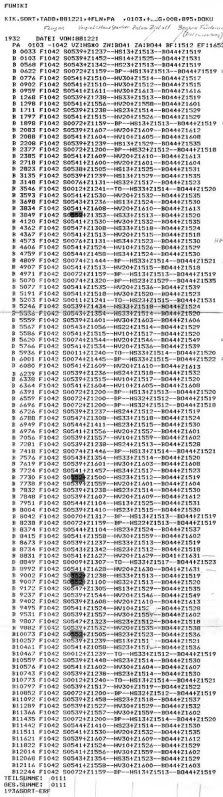
On 17 August 1989, eight months after the disaster, Chief Detective Superintendent John Orr received from the BKA what was said to be a computer print-out of the baggage-loading list for Pan Am Flight 103A from Frankfurt to London on the afternoon of 21 December 1988. Attached to this were two internal reports, dated 2 February 1989, describing the inquiries that BKA officers had made about the baggage-handling system at the airport. Also provided were two worksheets, one typewritten, the other handwritten, that were said to have been prepared on 21 December by airport workers at key points on the conveyor-belt network.

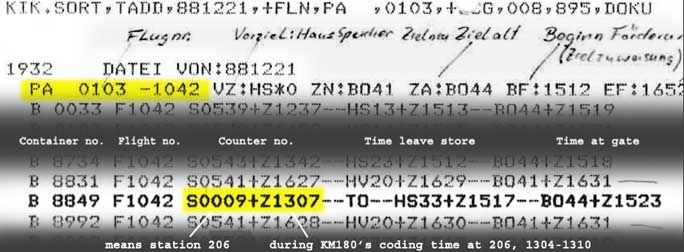
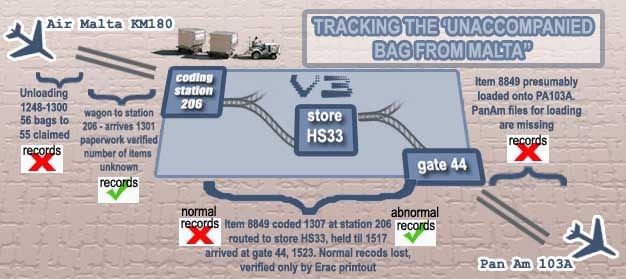
In the margin of the computer print-out, a penciled cross drew particular attention to bag number B8849 - that is the 8849th bag to be logged into the computerized system at Terminal B that day. By reference to the worksheets, B8849 could be shown to have arrived in Frankfurt by a scheduled Air Malta flight from Luqa airport and to have been 'interlined' through to Flight 103. But neither the Air Malta nor the Pan Am passenger lists showed anybody who had booked a through flight from Luqa to New York that day. In other words, bag B8849 had arrived from Malta unaccompanied but tagged for New York and had been loaded aboard Flight 103 without being matched with a passenger. And as the job of matching bags with passengers is the responsibility of the airline, not of the airport authorities or of the host government, Pan Am had plainly been guilty of lax security amounting to 'wilful misconduct'.

This tied in nicely with the forensic evidence, which had already shown that the bomb had been hidden in a Samsonite suitcase filled with an assortment of clothing made in Malta, including a baby's blue romper suit. [...] Two weeks after the BKA released the Frankfurt baggage print-out, two of Detective Chief Superintendent John Orr's men returned to Malta and, with the help of the manufacturers, traced the clothing to a shop in Sliema.

And from Silema to the Gaucis' shop and from there to history. Fishing for data points, 17 August is the date of the police report about the Malta-pointing printout. Attached were "two internal reports, dated 2 February 1989, describing the inquiries that BKA officers had made about the baggage-handling system at the airport." These I'd love to read. The date seems to be after they had the printout handed over. Any records of any earlier efforts, fruitful or not, remain under wraps. This new development sparked investigations of the airport by FBI and Scots through September and October, pretty much just as their German counterparts did months earlier, and as neither apparently bothered to do before being rung up with the news.

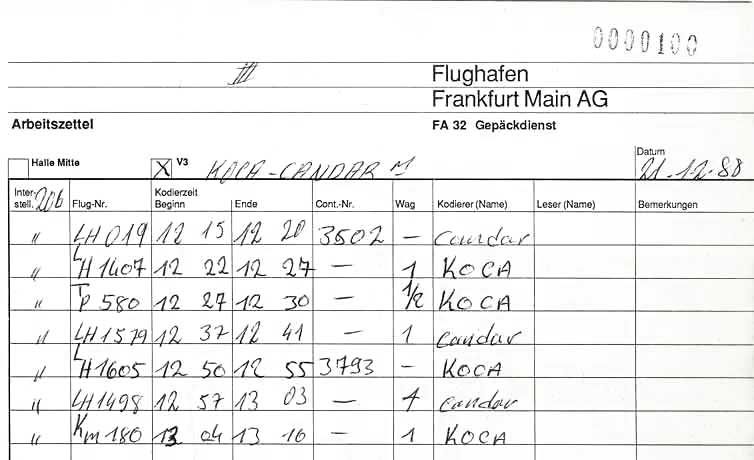
On the two worksheets from December 21, the handwritten one would have to be the station 206 log, with KM180's coding signed for by Mr. Koca. The "typrewritten" one is new to me, and would be interesting to learn more about. It wouldn't be included unless it had some relevance to item 8849, and probably not typed unless it was part of the computer system. And on the numbering, it seems this was not a sequentially-generated number system, but permanent ID for physical trays scattered at random. It was simply tray no. 8849 that this bag was (allegedly) put in. But I'm really no expert.

Coleman followed closely both the Lockerbie investigation and the liability cases against Pan Am that led to its downfall, almost concurrent with the Libyan indictment in late-1991. Along the way, he got a good look at what records the airline did and didn't keep at Frankfurt, as well as raising questions about the umber of of insidious unaccompanied bags thereon:
More particularly, there were problems with the computer records and worksheets from Frankfurt. For one thing, they did not tally with Pan Am's own baggage records, which although questionable as to their accuracy, were at least compiled in good faith. To this day no one knows exactly how many pieces of luggage there were aboard the doomed flight or consequently whether they have all been recovered or accounted for. Nobody even knows exactly how many suitcases were in the luggage pallet that contained the one with the bomb -- it was 45 or 46 -- or how many of these were brought in by the feeder flight from Frankfurt. (The number was also thought to include not one but four unaccompanied bags.)

The BKA estimate that 'about' 135 bags were sent through to the baggage room below the departure gate of Flight 103A, …. There were no records of luggage sent directly to the departure gate, nor of interline luggage taken directly from one aircraft to another, nor of bags belonging to first-class passengers.

Of the 135 bags mentioned by the BKA, 111 had been logged on the Frankfurt computer and about 24 taken directly to the aircraft from three other connecting Pan Am flights. The list compiled by Pan Am at its check-in desks, however, showed not 111 but 117 items of luggage, and the discrepancy has not been convincingly cleared up to this day.

The book evidences exactly my own incredulity over this alleged episode:
If the new Malta/Libyan theory was to replace the established Iran/PFLP-GC scenario, it was necessary, first of all, to believe that no one thought to ask for the baggage-loading lists for Flight 103A as soon as terrorist action was suspected -- which was almost at once.

It was necessary to believe that no one in any of the British, German and American police, intelligence and accident inquiry agencies who had a hand in investigating the disaster, or anyone who was in any way involved with airport management or security at Frankfurt or London, thought to secure the baggage lists as the one indispensable tool that would be needed to unravel the mystery of how the bomb got aboard.

It was necessary to believe that the only person who considered the lists to be at all important was a lowly computer operator at Frankfurt airport.

I can't accept these premises. Either investigators never came for the crucial evidence before its normal deletion, or it was deleted too early. THAT is why the printout wound up being the only and much-delayed record of the movements of the key bag. I suspect the printout lost NO corroboration in this early deletion. How early? According to this last snippet I'll share, the BKA had eight days to act under normal circumstances. Should have taken one or less.
The Observer's chief reporter, John Merritt, described how this came about in a story published almost two years after the disaster.
He wrote, on 17 November 1991:
A major breakthrough in the hunt for the Lockerbie bombers came to light only because of the quick thinking of a conscientious computer operator at Frankfurt airport.
The vital computer evidence, proving conclusively that the bag from Malta, identified as Item B8849, was on board as the airliner was blasted apart on the last stage of its journey from Heathrow to New York would have been lost forever if the woman operator had not kept her own record.
Acting on her own initiative, the woman, an employee of the Frankfurt Airport Company, who for legal reasons cannot be named, was working at the computer system known as KIK on the day of the disaster. She knew records relating to baggage loaded on to flights were kept in the system for only a limited time [eight days] before being wiped. So when she returned to work the next day she made her own print-out of the information and placed it in her locker before going on holiday.
On her return, weeks later, she was surprised to learn that no one had shown any interest in the computer records. She passed the print-out to her baggage section leader who gave it to investigators from the West German Bundeskriminalamt. But it was not until mid-August, eight months after the bombing, that the German authorities turned over this information to Scottish police in charge of the investigation.
The woman employee's role became known only last week when lawyers for families of the American victims took evidence from her in Germany. She had kept her own copy of the print-out and still had it in her locker.

Most of the rest of the chapter is a lengthy analysis of Juval Aviv's Interfor report. Coleman seems perhaps too accepting of this every-little-detail expose on how the bomb went on there, and I just haven't the patience to sort that wheat from that chaff. This is more than enough fiber and food for now.

Tuesday, October 27, 2009

PT35 MOVE CLAIMS, pt. two

THURMAN AND PT/35(b): ”MONTHS” WITH THE “REAL THING”
[Pan Am 103 Series]
Adam Larson / Caustic Logic
October 27 2009
last update/edit 11/5


Shuttling: The First 17 Months
Part one of this series covered the 2008 interviews revealed in Tegenlight: Lockerbie Revisited, which showed a contradiction in whether the fragment of circuit board, PT/35(b) was taken to the United States. FBI SCOTBOM chief Richard Marquise and identifying FBI agent James “Tom” Thurman both told interviewer Gideon Levy that the fragment was brought to Washington and examined there, whereas British authorities and Marquise (after a short-lived change of memory) refuted the claim, insisting it stayed in the UK. This part will cover the entanglement of this evidence and agent Thurman throughout the Lockerbie case and beyond, drawing largely from the writings of Marquise. The special emphasis is on clues about whether Thurman worked from a photograph of the evidence or from the real item, as he told the documentary.

A 1991 Miami Herald article reported that Thurman was first sent to Lockerbie, on behalf of the FBI SCOTBOM investigation, two days after the December 21 explosion to help in “combing the countryside for clues." He worked right through Christmas, and in “about two months at the scene,” the article continues, he “pored over thousands of pieces of evidence.” [1] According to FBI task force chief Richard Marquise, however, the intrepid special agent had returned from Scotland by Jan 19 1989, when he gave a briefing to the FBI confirming prior assumptions that a bomb was responsible. [2, p.35]

Thurman returned to Lockerbie several times, shuttling across the Atlantic and even further out into the field, as initial clues converged on a PFLPGC attack perhaps involving Jordanian agent and bomb-maker Marwan Khreesat. Marquise reveled that “Thurman had been part of the team that interviewed Khreesat” in Jordan, November 1989. [2, p.60] This special interview, carried out with CIA brokerage, and its (reportedly ambiguous) results were kept from Scottish investigators, causing some tensions later.

On Jan 10 1990 new Senior Investigating Officer Stuart Henderson (who replaced John Orr) presented at a meeting in the UK. He did not mention the timer fragment to all, but off to the side told Marquise and FBI’s ASAC John Kelso about it. They showed interest in helping find a match, but Henderson insisted on going it alone. “This decision cost us six months,” Marquise writes. [2, p.58]

On Cloud Nine: June1990-November 1991
Actually it was five months delayed; it was at an investigator’s conference in Virginia on June 11 when Marquise relates how the Scottish authorities finally made their puzzlement over the fragment known to all – 55 companies checked to no avail. Thurman “approached Henderson and asked if he could take photographs of PT-35 and attempt to identify it. Henderson, who believed the Scots had done all they could do, agreed.” [2, p 60] This passage is crucial to move claims, and rather ambiguous. It seems to read that Thurman, in Arlington, was allowed to take a picture of evidence Henderson had there with him. It could also mean a request to retain one of the photo-prints there, or to take a picture of the single photo they brought, or fly to Scotland to photograph PT/35(b). The last option seems out, given the mechanics of identification that followed. I remain agnostic on the reading here, and on its value as one of Mr. Marquise’s sometimes confused recollections.

The Herald decided after talking with Thurman that he “meticulously compared the picture of the fragment to hundreds of other devices,” a lengthy-sounding process. [1] The agent told the show Air Crash Investigation (in early 2008?): “I spent, uh, months, literally, looking through all about the files of the FBI on other examinations that we had, uh, conducted over many many many years. […] After a period I just ran out of leads” and was forced to look “outside the physical FBI laboratory.” [3]

But Marquise said “what Thurman did yielded fruit within two days. […] Henderson and his colleagues were on an airplane headed back to Scotland;” having just left from the Virginia conference, and the discovery “would turn Henderson around quicker than he ever imagined,” putting them back stateside within 24 hours of the discovery. Further evidence against Thurman’s months claim is his own well-memorized “day that I made the identification,” recalling it as one would a wedding anniversary: June 15 1989. He had four days tops to get this grueling season of cross-checking out of the way.

What Thurman did, Marquise sums up, is know where to look. He took the photo to a CIA explosives expert “Orkin” (real name unknown), who helped locate files on a possible fit – a circuit board style found in an unclear number of timers confiscated, by the CIA, in African nations Togo and Senegal in 1986 and ‘88 respectively. The Senegal timer had somehow gone missing, although there was a photo of its circuit board, but the Togo timer was physically available for Thurman to look at the board inside. Upon confirming the similarity, “within a few minutes, literally, I started getting cold chills,” he told Air Crash Investigation, a feeling that still haunts him since he “can still see that moment so vividly in my mind.” [3] That he got these chills only after getting access to the CIA’s special stores is proof the Agency is right to claim much of the credit, for the discovery, as they have in places: “the CIA’s most important contribution in helping secure the conviction” was “when a CIA engineer was able to identify the timer […] shifting the focus of the probe from a Palestinian terrorist group to Libya.” [4]

Later a marking saying MEBO, scratched out, was identified on the Togo timer’s board. Thurman has claimed he and others labored over this, contacting manufacturers trying to identify “M580” for some time before accepting that it was Mebo, the name of a Swiss firm supplying timers to rogue governments, including Libya. Thurman said they had “some inkling that’s what it was from the beginning, but we didn’t want to say okay, it’s Mebo’s exclusive, anything else, until we were absolutely certain” that the letters on there were indeed M-E-B-O. [5] Then they decided it was definitely Mebo’s exclusive for Libya only and only usable by Libyans and unable to fall into anyone else’s hands. Except the CIA, but they can still account for 50% of the ones they’ve been known to intercept.

Marquise later enthused how Thurman’s immaculate forensic work “quickly put us on a new track leading to the eventual solution,” a solution that shaped up into the indictments of al Megrahi and Fhimah on Nov 13 1991. This was Thurman’s prime-time moment and he seized it, doing his now-famous Nov 15 interview with ABC News, followed by other moppings-up of public adoration, like that Miami Herald article (Nov 30), where he sounded like a laid-off Don Henley lyricist: "We're the blacksmiths of the FBI. The nuts and bolts. We get extremely dirty, actually, filthy dirty. … your adrenalin is pumping. You can't sleep." Driven by “his curiosity, coupled with a sense of duty and empathy for the victims … he didn't stop until he linked the bomb to the Libyan government.” [1] Once he had done so with “conclusive proof,” he told ABC, what he felt was "absolute, positively euphoria. I was on cloud nine." [6]

After the High: 95 to Present
This euphoric winning streak continued for Thurman, and he went on to big things, like pursuing the domestic terrorists behind the Oklahoma City bombing in 1995. But somehow, extended highs like this are often followed by a crash; starting in autumn 1995 charges were publicized that agent Thurman and his explosives unit “routinely” manipulated findings to favor the prosecution in at least two cases, including OKC. A 1997 Justice Department Inspector General investigation found Thurman to have no expertise in explosives at all, being a political scientist, not forensic, by training. After this he was formally barred from working in the crime lab or giving expert testimony in trials, and then “retired” from the bureau. [7]

This casts new light on his statements to ABC in '91; upon the match, “I knew at that point what it meant. Because if you will I‘m an investigator as well as [read political scientist instead of] a forensic examiner. I knew where that would go.” He told them the board pattern similarity “really just jumps out at you … when you look at it under a microscope.” It is always startling the first time you look into one, isn’t it? Upon leaving the bureau, Thurman went on to teach explosives investigation at East Kentucky University - sort of an honorarium it seems.

It was there that the now-bearded professor accepted an interview from the BBC program Dispatches. Aired for the 10th anniversary in December 1998, the interviewer challenged him, as Levy later would: “I’m surprised that you only worked from a photograph. Umm, this can’t be ideal, um, an ideal way (inaudible).” [8] Considering with real physical evidence you can examine it in 3-D, measure its layering composition, and the nature of blast damage (gas pitting, etc.), this is a rather good point. But Thurman, missing that completely, responded quite differently than he would ten years later: “Actually, in a case like this it’s much better than the actual item. Because the photograph enlarged it, how many times? Uuuh… a number of times. So you can see the detail with the naked eye in that photograph, that you can’t see on the actual item, without the aid of a microscope.” [8]

Later he told the interviewer “See, the only thing I have is the photograph.” When challenged “but you said a photograph’s as good as the fragment,” he said “yeah, but at the same time, you can’t - it’s difficult to make an actual measurement through - through here (tapping pictures)” [8] There is so, and it’s called “scale.” What you can’t tell is things beyond the surface pattern similarities - the actual forensic details. All he did was look at a photo and a model timer and decided they were the same pattern, as any six-year-old and some dogs could do. Questioning his credentials in this area seems a little disingenuous, to say the least.

Then of course we have his 20th anniversary story shown in Lockerbie Revisited, where he told Levy “I did the real thing ... I had the real piece of evidence. … The photograph was the first thing, then the real piece of evidence was brought over … It wasn’t just a photograph.” He’s done too many interviews, giving us many points to analyze patterns. The guy clearly has a penchant for emphasizing the reality, the intensity, of things in a way suggesting some underlying dissociation. (eg, heavy use of “actually,” “literally,” “physically,” and absolutes: “absolutely,” “positive,” “certain,” “forensic,” etc. ) He seems to harbor few, but loud memories that like to exaggerate themselves. They change over time in detail, but not in volume or the tone of self-congratulation for his own rigorous diligence. Or are these really memories?

Sources:
[1] Roser, Ann. “'Nuts and Bolts’ Work Pays Off in Lockerbie Probe.” The Miami Herald. Published November 30, 1991. Link.
[2] Marquise, Richard. SCOTBOM: Evidence and the Lockerbie Investigation, Algora Publishing. Sept. 1, 2006. 268 pages. Google Books.
[3] Air Crash Investigation: Lockerbie. Season 6, episode one. Aired 2008. Youtube link.
[4] http://www.afio.com/sections/wins/2001/2001-06.html
[5] The Maltese Double Cross - Lockerbie. Film, Hemar Enterprises, 1994, 156 minutes. Written, produced, and directed by Allan Francovich. Wikipedia page - Google video (1hr, 6 min in)
[6] Biewen, John and Ian Ferguson. “Shadow Over Lockerbie: Mass Murder Over Scotland.” American Radio Works, National public Radio. March 2000. http://americanradioworks.publicradio.org/features/lockerbie/story/printable_story.html
[7] Peirce, Gareth. “The Framing of Al Megrahi.” September 24 2009. London Review of Books. http://www.lrb.co.uk/v31/n18/peir01_.html
[8] Dispaches: The Lockerbie Trial. Reporter: David Jessel. A Just television production for Channel Four Television. Aired December 1998. Video (MP4)

Friday, October 23, 2009

PT/35 MOVE CLAIMS, pt. one

"IT WAS NEVER IN THE UNITED STATES?"
[Pan Am 103 Series]
Adam Larson / Caustic Logic
October 23 2009
last update 10/28


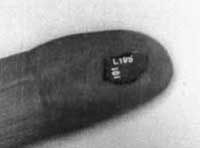
The recent hubbub regarding overly-mobile Lockerbie evidence started with Dutch journalist Gideon Levy’s early 2009 video Tegenlicht: Lockerbie Revisited. It’s a well-made video, with good music, some informative bits, and an unusual format of having interviewees watch and respond to recordings of others. Its prime focus was the crucial evidence PT/35(b), the Mebo timer fragment “tying” the bombing back to Libya. It’s therefore a little embarrassing that Levy announces another famous fragment, of general Toshiba circuit board displayed on a fingertip – as the article in question. This confusion surfaces elsewhere in the film, but manages to not become a big deal.

The main attraction that has generated some buzz was a curious discrepancy revealed and captured regarding the whereabouts of this historic find during the course of the investigation. As evidence from Scottish soil it was, should have been, in control of the Scottish police investigation, headed by the Senior Investigating Officer (SIO), a spot first held by Detective Chief Superintendent (DCS) John Orr (Strathclyde police, now Sir John Orr), and then by Orr's deputy, DCS Stuart Henderson (Lothian and Borders police, whom we meet below). The Scots would work in tandem with – but not give their evidence to – the American FBI's task force for the "SCOTBOM" investigation.

Officially the fragment was definitely taken outside Scotland - in the proper hands - to a RARDE lab at Kent, England and, as we’ve more recently had confirmed, to a private lab in Germany, both times for forensics testing. The understanding of then-Lord Advocate Lord Fraser of Carmyllie, which should have been quite good: “As far as I’m aware it’s always been in the UK,” he told Levy’s camera in 2008. He obviously didn’t know everything.

Besides the trips to England and Germany, which neither Lord Fraser nor Gideon Levy seemed aware of, there’s an alleged journey by this little blue key across the big blue sea to the United States. In the first of two interviews with Levy, FBI SCOTBOM chief Dick Marquise casually states that this one crucial piece of evidence, and nothing else, physically was brought to the FBI’s main lab in Washington.
“I’ll just tell you, not one piece - no I shouldn’t say that – the evidence – no, I’m not choosing my words carefully, I just want to make sure I say the right thing – all the evidence that was found in Lockerbie never made its way to be examined by the FBI laboratory. PT/35, as far as I remember, was the only piece of evidence that made its way to the laboratory, in the possession of a RARDE examiner. He brought it, he did the comparison, and he’s a scientist, and he took it back.”

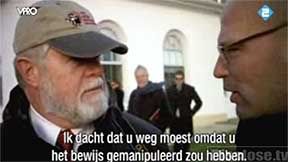
Well that's an interestingly worded twist to the story. FBI Special Agent James “Tom” Thurman, the man publicly credited with making the identification of the fragment as from a Libyan-supplied MST-13 timer, on June 15 1990, also made an appearance. Levy caught up with him, wearing his years well in retirement, at a December 2008 ceremony to marking the 20th anniversary of the Lockerbie disaster. Levy came across a bit wormy, in my opinion, using the solemn ceremony mostly to make Thurman squirm and deny he was dismissed from the FBI for altering evidence. More to the point, he challenged Thurman if comparing with a photo – as he has previously stated – was really scientific. Thus provoked, he responded:
Thurman: I did the real thing ... I had the real piece of evidence.
Levy: That pointed to Libya.
Thurman: Absolutely. Absolutely. The photograph was the first thing, then the real piece of evidence was brought over. And at that point –
Levy: It was – it was on your finger, the chip was on.
Thurman: At that point - then there was a one-to-one identification made. The real piece of evidence, to the timer, the MST-13 timer, was made in the FBI laboratory. It wasn’t just a photograph. The photograph started it, and then the authorities from England brought over the real piece of evidence. That piece of evidence was examined in the FBI laboratory, along with the MST-13. That examination was verified in the forensic science laboratory, in England. So, it wasn’t only my examination, it was verified by other peoples’ examination as well.
Suspicions condensing around the Thurman link here is natural; PT/35(b) was apparently taken outside normal channels to his lab, and put under the grip of a known manipulator of evidence. Problem is, the charges against him were not over physically altering physical evidence, but for his explosives unit allowing conclusions to be overstated in the prosecution’s favor, in multiple instances unrelated to this one. Agent Fred Whitehurst told Levy how Thurman altered his reports when he deemed that his own political science training trumped Whitehurst’s chemistry smarts.

This will and certainly should cast doubt on Thurman's general investigative even-handedness and his certainties over his own lab work (“I knew we had it,” it "absolutely, absolutely" implicates Libya, etc.). In fact why Thurman was selected is beyond me – any idiot with the two photos could affirm they’re the same, and this selectee has become a real liability. All the rage at the 1991 indictment, he was discredited and never called as a witness by the time of the big trial at camp Zeist in 2000.

But presenting this side-by-side with concerns over the “tampering with” of this evidence once taken somewhere dangerous is quite leading. The fact is, I can see no sign of tampering with the evidence, nor much of a reasons to suspect it. The problem is the thing itself, not where it was taken and who touched it in these dark corners.

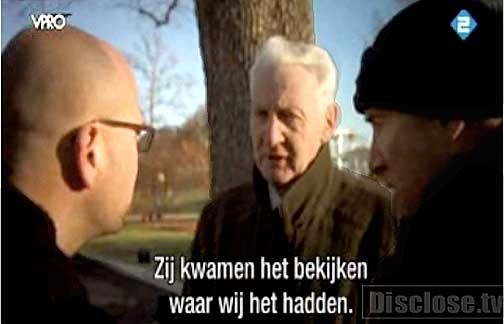
At that same chilly cemetery, as the people were leaving to more private venues, Levy caught up again with Mr. Marquise, as it so happened accompanied by his Scottish counterpart DCS Henderson. When standing side-by-side with the prime guardian of that fragment Marquise was of a different recollection altogether from his first interview. Levy was granted an answer to one question, and that's about what he asked, for almost four minutes.
Levy: When I asked Lord Fraser about the circuit board, he said something that contradicted what you said. He said it had never been to the United States. And if it was in the United States, then he would have known.
Marquise: No, I don’t know that I told you the circuit board was in the United States.
Henderson: The circuit board was never in the United States.
Marquise: Let’s back up, we’re talking two different things. There was a circuit board of MST-13 timer in the United States, but the fragment PT/35 was never in the United States. Photographs of it were in the United States.”
Levy: It was never in the United States? (murmured agreement) Oh, I thought it was…
Marquise: No the fragment never came to the United States, but the circuit board was in the United States, because we had the MST-13 timer, which we turned over to the police in Scotland.
Levy: Ah, but but… Tom Thurman, who was here today, also said it was in the United States.
Marquise: No, he never said that.
Levy: No?
Marquise: The fragment PT/35 was not in the United States.
Levy: But it was in England, but it came…
Marquise: It never came to the United States
Levy: It never came to the United States.
Marquise: I don’t believe so – I’m 100% sure it was not here.
Levy: Oh, it has never been here.
Henderson: Never released out of evidence control of ourselves. Couldn’t afford to let something like that …
Levy: I thought it was brought in the possession of Alan Feraday.
Marquise: Feraday’s over in RARDE. He’s in England. It’s in his possession.
Levy: Yes, yes, but I thought he came – I thought you told me that it came in his possession to the United States.
Marquise: I don’t know that…
Henderson: His possession and my possession. But it was never released for any reason (inaudible).
Levy: And who are you?
Henderson: Detective Chief Superintendent Henderson, I conducted the investigation.
Levy: Okay. My name’s Gideon Levy, and I’m from Holland - from the Dutch television. So it has never been in the United States.
Henderson: Confirmed

From the video: Levy, Henderson, Marquise (l-r) discuss whether or not it was ever in the United States. But it wasn't? No, wasn't it?
Levy: At all.
Henderson: Couldn’t be, ‘cause it was such an important point of evidence it wasn’t possible to release it. It had to be contained to be produced to the Court, therefore you couldn’t afford to have it waved around for everybody to see because it could have got interfered with.
Levy: Aha
Henderson: So it was far too valuable to be other than made available – couldn’t be.
Levy: Okay
Henderson: Very valuable piece of evidence.
Levy: (shouting over) But you said it was in the possession of Alan Feraday and brought to the United States.
Marquise: You know, its – you’ll have to talk to Alan Feraday about what he brought to the United States. I don’t remember…
Henderson: Alan Feraday had it in his possession with me, but he did not release it to anyone
Marquise: No, no, no, he said bring it with him. Did he bring it to the, I don’t remember.
Henderson: No, they came to us to see it.
Marquise: Yes. I saw it – I saw it in London.
Levy: Oh, you saw it in London?
Henderson: They came to where we had it, see. Because it wasn’t possible to remove any evidence out of the jurisdiction of the – Scottish control.
Levy: So you were the same – you were the FBI investigator and you were the Scotish investigator. Ultimate inestigators.
Both: affirmations
Levy: Okay.
Henderson: That’s why I’m here, to go and see the relatives.
Marquise: We need to go.
Henderson: We’ll have to go. Pleasure to meet you, gentlemen.
Levy: Thank you very much.
Henderson: And by the way, there is no hidden holes to find because the culprit is in custody. (with a smile and wink) Take my word for it. Okay?

So I would come away from this with an impression that it may well have not been in the United States, whatever Marquise and Thurman said to same guy ten minutes earlier. But I’m weird hat way, denying Henderson’s bait that I imagine was dangling there. A more normal reaction would be to get a little confused, and for many to solve that by taking their own default position. Some would just dismiss this all as faulty memory two decades on, while others will surely latch onto it as more proof of a cover-up, or at least something to make some more noise over.

My main concern with PT/35(b) is that this much-fretted over fragment may have been planted outright to begin with, or at least has been overstated as direct evidence pointing only to Libya. This hullabaloo about where the possible fraud was carted to adds little to an understanding of either level of worthwhile inquiry.

Update, 10/28: Something I saw later that fits best here: Marquise's unacknowledged about face here was short-lived. In September 2009, months later with Henderson not present, he again affirmed an American trip. This was in a response to Gareth Peirce, and sent into Robert Black's blog. I haven't been able to verify it, so do please take a grain of salt:
Once he identified the fragment, he asked Alan Feraday to come to Washington. Feraday brought the original fragment of the timer with him and they both examined it under a microscope. They independently agreed it was identical to the MEBO timer. The fragment was never out of the control of Mr. Feraday and returned with him to the lab at RARDE.


Second update, Nov 24 2009: Mr. Marquise responds to the confusion that indeed the fragment did come to the US, and he and Henderson were both confused by the tone of Levy's Arlington ambush. Again from Black's Lockerbie Blog:
With regard to the "travel" of PT-35-- once again-- it was the sharing of information which led to the solution of this case. If the fragment had remained behind in Scotland, never shared, it would possibly be unidentified today. No one would ever have discovered it was a piece of one of 20 timers given to Libyan intelligence. It is clear no one ever attempted to "cover" that up-- I freely admitted it in my book, Mr. Henderson stated such in his precognition and I again said so to Mr. Levy. My "confusion" at Arlington last December over whether it had come to the US or not, was due more to the tone of the question, the setting and the allegation I may have lied to him when he first interviewed me. Unlike Mr. Megrahi, I do not tell lies when it comes to the evidence in this case. I said it right when Mr. Levy first interviewed me. We had nothing to hide because we did the right thing and there has never, never, never been one scintilla of proof that PT-35 was altered or changed in any way.

Wednesday, October 21, 2009

MST-13 COMPARATIVE GRAPHICS no. 3

ALTERED BUT NOT SWAPPED
[Pan Am 103 Series]
Adam Larson / Caustic Logic
October 21 2009
last edited 10/22


Recently attention has come back onto the MST-13 timer fragment, upon which the Lockerbie investigation solidified its case against Libya, with statements the other day by Member of Scottish Parliament (MSP) Christine Grahame. Following suspicions raised by Gideon Levy’s 2009 film Lockerbie Revisited, people are asking like never before was this key evidence, pulled from a shirt collar months after the attack and designated PT/35(b), taken outside of Scotland? Outside Great Britain? Outside Europe and across the Atlantic? As the BBC reported:
Ms Grahame said: "The Crown Office have confirmed to me that the fragment, PT-35, the piece of evidence that it was claimed linked Libya to the attack, was also sent to Germany in April 1990, as well as the US. [...] If there was any suspicion that the fragment had been tampered with, it could have undermined the entire prosecution case.

Clearly this is big news that people will Google, and find things like this, posted last year by Edwin Bollier, co-founder of Mebo, the timer’s makers:
Inspector Keith Harrower (Scottish Police) visited on the 27th of April 1990, this the MST-13 fragment the electronic company Siemens AG in Munich, Germany. Engineer Brosante sawed this first brown original MST-13 fragment into two parts and confirmed: "standard brown PC-platine with 8 layers of fiberglass." The green machine made MST-13 timers delivered to Libya consisted of PC-boards with 9 layers of fiberglass.

So when these “new” questions start leading right to Mr. Bollier’s claims of tampering and worse, some clearing of the waters might be useful. I turn my attention to false or dubious claims, pushed by Bollier and a handful of others, about the fragment being planted or swapped-out with a clearly different fragment, during the process of investigation.
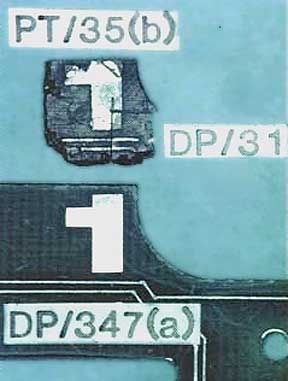
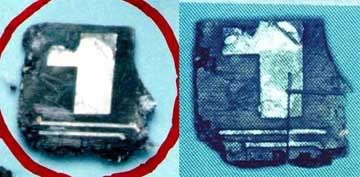
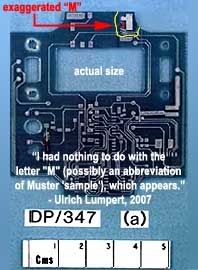
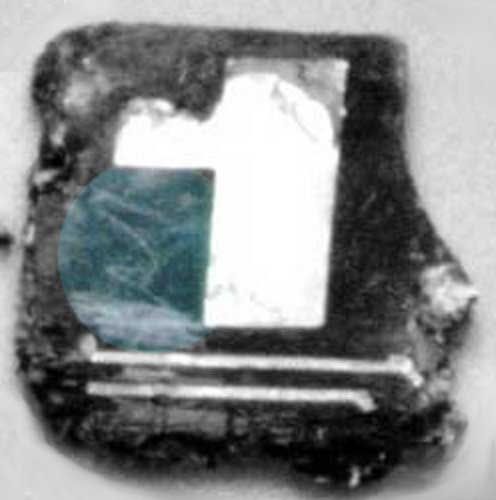
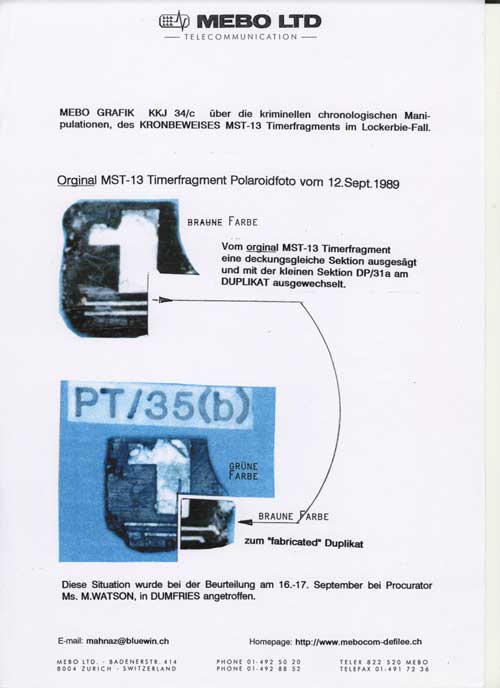
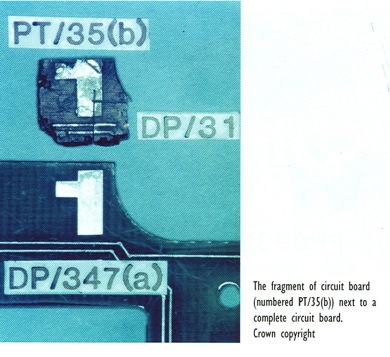
His claims on the board being different colors at different times are too convoluted to fully explore here, but Bollier has been swearing lately that a brown prototype handed to Swiss authorities had been used as the evidence, somehow clearly visible in the first known photograph from 1989 (left), while the later photo (mid-1990, right) of an altered PT35(b) are of a replacement green board.

The MTS-13’s designer, Ulrich Lumpert, apparently spawned this with his 2007 affidavit, by which he handed the brown board over to Swiss investigators who in turn gave it to SCOTBOM, who used as evidence. Engineer Brosante also agrees it was brown, judging by Bollier’s quote (that’s the first I’ve heard of him, so don’t ask me). The official story is of course that it’s always been the same green fragment they found in the wreckage of 103.

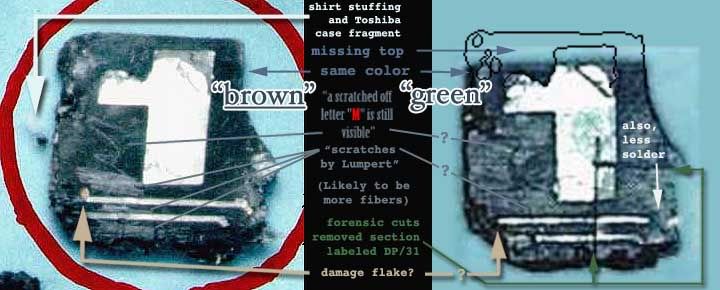
It is true that green here seems to mean blue, and the later photo is more blue than the first. However, this (as I found it online) shows clear signs of global photo-tinting and once corrected, the color matches up quite well with the original – dark muted blue-gray, like a green/blue board that had been burnt. It does seem possible some of the carbonized surface material has been cleaned off in the latter view, but otherwise there is no hint of brown I can see in either of these photos, and no color-based sign of meaningful alteration or replacement.

Considering comparison photos of PT/35(b) alongside an intact model board (links above), There are allegations of the curved edge not matching or the “1” touchpad and its relation to the “true edge” differing. But when the outlines are superimposed to scale (right), we find a perfect fit presuming the fragment is missing a sliver off the top. And here we can see a difference with the first photos and later ones – the top is present at first, giving it the right curve of an intact board. Later, it’s gone. Two prominent cuts at right angles also appear, apparently part of forensic examination carried out so controversially in Munich, to check the board’s layering style. This apparently severed a corner piece, put back in place and displayed as separate evidence item DP/31. But the removed top is not so displayed. It’s reasonable to surmise this tiny section – app. 1cm by 1/8cm – was simply ground off to get a profile, but mysteries remain... It's not clear how many layers were really found, but as it appears a green machine-made board, I'm guessing nine.

Among Mebo the clown’s most enthusiastic claims of proven forgery is how “the letter "M" was carved into” the original “brown” item sideways next to the touch pad, while “in the duplicate no. PT/35(b) (fake) it can be clearly seen that no letter “M” was carved into it!” Lumpert mentioned but disowned this in his affidavit: “I had nothing to do with the letter "M" (possibly an abbreviation of Muster 'sample'), which appears." To true scale (at left), this tiny M seems strangely small to use as a marking, nestled in next to the “1.” In reality, as JREF forum member Ambrosia showed with the enhancement below, the M casts a faint but visible shadow, and would seem to be a 3d object, a tiny ziggy fiber of presumably shirt stitching.

Beneath this alleged etching are three small light patches bracketing the solder lines, visible above. Of these Lumpert said “I clearly recognize the scratched remnants of the soldering tracts on this enlarged digital police photograph.” A poster available online shows a blowup with German text, perhaps based on something, labeling these as “Kratzstellen von Ing Lumpert,” scratches by Lumpert. That any villains would have chosen to cut out and display as evidence just the small corner that Lumpert had marked with random micro-abrasions and could identify raises some questions.

What exactly these really are is a minor mystery – perhaps more fibers of a different kind snagged on the solder. Whatever they are they’re as gone later as the M – either the political engineers sanded these off or painted them over, or replaced the board down to he tiniest details except for these scratches, as alleged by recent Mebo pages, or they were some inconsequential surface debris since removed.

And for a preview of what lies at the bottom of this rabbit hole, realize Bollier's claiming a green replacement for a brown original fake of an alleged green Libyan timer; A 'technical report' commissioned on actual graph paper suggests for no reason I can fathom the final PT/35(b) photo is of the green replacement except the corner DP/31, which is actually a matching corner from the original Lumpert-supplied brown fake! And they didn't even use the corner with the irreplaceable "M!" (lower right corner of right view below - the part that's the same blue/green as the rest).


So to summarize, as the graphic above pretty well does, the verifiable changes were the removal of surface debris, perhaps removal of some of the charred layer, loss of a small bit of solder, an apparent flake of damaged plastic (tan under-layer?), minor changes to the touch pad surface, and the obvious cuts and/or grinding to the board consistent with cross-section analysis. Nothing else about it changed, and there’s no evidence that anything misleading was done with this after its initial fraudulent insertion into the evidence chain.

Did everyone catch that? Don’t get distracted, then, is the main point here. There are still intelligent questions to ask.

Wednesday, October 14, 2009

FRANKFURT AIRPORT RECORDS

PAPERWORK: HARD, SOFT, AND NONE
[Pan Am 103 Series]
Adam Larson / Caustic Logic
October 14 2009
last update 10/15


"The records from Frankfurt were by no means complete."
- Denis Phipps, former head of security, British Airways, in The Maltese Doublecross

The Frankfurt Connection: A Grand Narrative
As connective tissue in the fraudulent case against al Megrahi and Libya as the perpetrators of the Lockerbie bombing, nothing carries more weight than the faint line from one plane to another traced by an odd little computer printout from Frankfurt, West Germany. I’ve already noted the most poignant aspect of this evidence for me; that it was received in such an abnormal way AND not in any of the standard, proper ways. This suspect but key evidence is said to show a piece of unaccompanied interline luggage, thought to be the one with the bomb in it, moving through Frankfurt Airport’s system on that fateful December 21, 1988, onto PanAm103A. This was a feeder flight into the real Flight 103, a separate plane waiting at Heathrow Airport in London, ready to shoot for New York.

In actuality it takes a few documents aside from this main printout to put the whole link together, as explained below. But the picture that emerges is quite precise; to summarize the Opinion [PDF link] of the special Scottish Court at Camp Zeist, delivered in 2001 after examining the available records and testimony:

Air Malta flight KM180 arrived from Luqa Airport, Malta, and reached its parking position at 12:48GMT. The plane was unloaded between then and 13:00, and one wagon of baggage from it arrived, at 13:01, at one of two main luggage facilities, designated “V3.” This baggage and nothing else was then coded at station 206 within V3 starting in three minutes at 1304 and running probably six minutes until 1310. One particular item was coded at 13:07 into container no. 8849. It was then routed down to one of several luggage stores, HS33, for two hours until moved at 15:17 to gate B044 and later, presumably, loaded onboard 103A before its 16:53 departure. No passenger transferred from the air Malta flight to the PanAm one, so the bag thus illustrated was of the dreaded “unaccompanied” variety.

The System (I Think)
From what I gather of the whole airport system, it could be broken down to two parts; the topside is a zone of tarmac and wheels, counters, hands, wagons, and airplane cargo holds. Hard paperwork is kept for topside transactions, and activities are overseen by actual people held responsible. The Court explained “baggage for most airlines was handled by the airport authority, but PanAm had their own security and baggage handling staff.” This is key to record-keeping; the airport and the airline each would then have responsibility for keeping track of their own efforts, and both should be called on in the investigation.
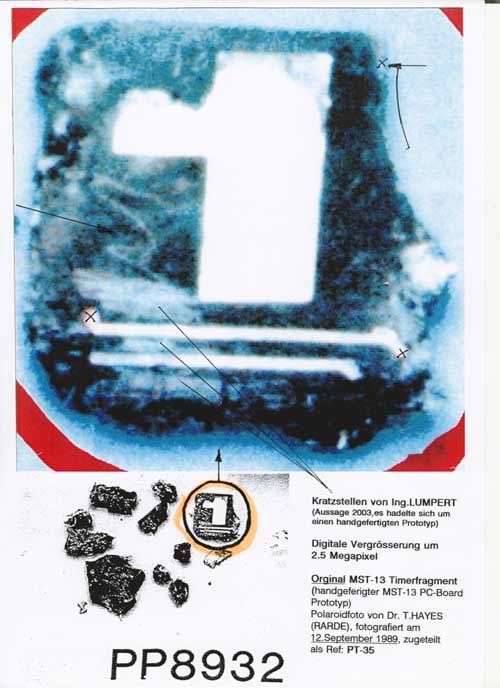
From the planes, luggage is carted to a coding station, where items are placed on bar-code numbered trays (containers), one item per tray, and the computers take over. The bottomside then is what the Court described as “a computer controlled automated baggage handling system” that I gather ran beneath the airport. This vast electro-mechanic system automatically routed coded items along roller conveyors and through switching stations, at key spots scanned and logged. This system connected coding stations to the various stores, and apparently up to gates, after which they re-emerged topside and then to the connecting aircraft’s hold. Not bad for 1988.

On the paperwork kept to track this complex arrangement, the court explained “the computer itself retained a record of the items sent through the system so that it was possible, for a limited period, to identify all the items of baggage sent through the system to a particular flight. After some time, however, that information would be lost from the system.” [emph mine] One would presume law enforcement and investigative agencies would be aware of that fact.

Records on the KM180 End
Production 1068: The court’s point [29] denotes this for “the evidence of Joachim Koscha, who was one of the managers of the baggage system at Frankfurt in 1988” It was his evidence that established KM180’s arrival and unloading time, 12:48-13:00. They do also cite a “record,” but provided no direct citation. It almost seems they’re just citing his memory, when normally paper records were kept.

Denis Phipps, former head of security, British Airways, who has closely inspected the primary records of different airlines and airports connected to the disaster. He said in The Maltese Doublecross [video, 1994] “the records from Frankfurt were by no means complete." Among his concerns:
“There was no record of who unloaded that flight KM180 when it arrived at Frankfurt. We don't know who the loaders were. There was no record of the number of bags that were actually unloaded from that flight. There were no records that I could find.”
He was trying to bolster Air Malta’s reasonable claims that all 55 bags on that flight were accompanied and claimed by its 39 passengers, and none could have gone on to 103. Thus the official story here is that there was one more bag than Air Malta admits to. That Phipps found no records to support that, and the court failed to specify any, are bad omens for that damning charge.

production 1092: This is an “interline writer’s sheet” filled out by Andreas Schreiner was in charge of monitoring the arrival of baggage at V3 That bears to record one wagon of baggage from KM180 arriving at V3 at 13:01.Within V3 are seven coding stations, where luggage is placed into bar-code numbered trays to enter bottomside. They cite the sheet’s contents in table form and it seems like they had these records at hand.

Mr Schreiner’s evidence expanded beyond this, to explanations for the the Lords of how coding “would generally begin three to five minutes after the arrival of the baggage at V3,” and that “luggage was always delivered from one flight only” at any given time. The basis for these points must be taken on the man’s word, but they help simplify the Prosecution’s case. Station 206 at 13:04-13:10 means KM180 baggage and nothing else. Simple common sense would dictate a breach of this standard MO is at least possible. A stronger retort was published in Time magazine in 1992, relating a FBI memo following a look at the airport’s records and methods:
On a guided tour of the baggage area in September 1989, it was disclosed, detective inspector Watson McAteer of the Scottish police and FBI special agent Lawrence G. Whitaker "observed an individual approach Coding Station 206 with a single piece of luggage, place the luggage in a luggage container, encode a destination into the computer and leave without making any notation on a duty sheet." This convinced the two investigators that a rogue suitcase could have been "sent to Pan Am 103 either before or after the unloading of Air Malta 180."
This bag would thus appear to investigators to have been part of whatever planeload they were coding there at the time. The same could be at work with our item 8849. The conclusion of this report, sent back to Washington: “"There remains the possibility that no luggage was transferred from Air Malta 180 to Pan Am 103."

Production 1061: This was identified by witnesses Mr Schreiner and Mr Koscha “as a work sheet completed by a coder to record baggage with which he dealt.” The name of the coder in question was Koca, who was not called as a witness.” Pity, since the document shows us little detail. The court again showed this data in tabular form. Here thanks to Mebo I have an image of the evidence in question [see below]. The signatures alternate Koca and Candar, listing either container numbers or numbers of wagons of luggage, the flight number it’s from, time they started coding, and stop time. The relevant line is the last one – one wagon of luggage from KM180 started coding at 13:04, and ended at a time disputed as 13:10 or 13:16.

The difference between the a 1310 reading and a 1316 one does not affect the link with the central printout showing 8849 coded at 1307. But as eminent investigator Paul Foot notes “If the end-time was 13.16 this left a gaping hole in time when other bags may have been encoded through the same station that did not come from Malta at all.” With the worksheet here we can compare some previous codings “Beginn” to “Ende” for the previous six flights: 5 min, 5 min, 3 min, 9 min, 5 min, and 6 min, to process one wagon or one container of baggage. (the apparent “4” is probably a “1” written over a dash). And finally, either six or twelve minutes for one wagon from KM180. Unless there was something weird that screwed up the pattern (which is entirely possible), I’m calling the end time 13:10 and moving on. The hole was as big as it was, other things could well get through, but the most likely item at 206 in that time is still a bag from Malta.

Records on the PA103A End: A Blanked-Out System
Production 1062: This is the court’s code for some unspecified “documentary evidence” that “the aircraft used for PA103A arrived from Vienna (as flight PA124) and was placed at position 44, from which it left for London at 1653.” I’ll accept that as valid, but note the ambiguity of citation.

Production 1060:
This is the famous printout of the late-sought tracking data on bags destined for the PanAm flight, on a whim saved from oblivion by the diligent Mrs. Erac. [see left – r-click, new window for readable size] Obviously this covers the broad computer-managed middle stage rather than “the 103A end.” But as it is, this is the only known link showing that item 8849 continued towards the fatal feeder flight. It’s the single document that allows “the inference," drawn by the Scottish Judges, "that an item which came in on KM180 was transferred to and left on PA103A.”

It’s not that there should be more; the one record is to be expected. The unexpected is no one official got to it before it was deleted, and we had to rely on a memento copy from someone’s locker. We’re told. And the investigation was lucky to get that after a curious delay of 7-8 months.

What it shows, briefly, is 111 items listed numerically by container no. The relevant portions are highlighted in the condensed version below. PA103A is referred to herein as F1042. The relevant item 8849 was coded at station S0009, which it’s been determined means station 206, at 1307. That is a fit with KM180’s load. It then goes to Gate B044 at 1523, the same few-minute span most of it arrived. What happened from there is outside the computerized system and not recorded here.


Production Null: This is the designation – none – given to PanAm’s loading records for flight 103A. Holding to previous patterns, we’re back to tarmac and wheels space, and there should be records kept at gates 44 and 41 regarding the luggage items received and loaded onto the planes at each gate. There should be a verification that item 8849 was among them, and that it was then loaded to the plane.

Obviously the Airport authority couldn’t offer this to the court, as it wasn’t their job to load a PanAm plane or to log what they don’t do. There’s no mention in the Court’s opinion of what PanAm provided to the case; they went bankrupt in late 1991, so it’s natural they didn’t send anyone to the 2000 trial. But judging by Marquise, they also added nothing to the 1989-91 investigation, at least regarding the crucial Frankfurt link. The court adds nothing to that, only citing "evidence [...] that no baggage was left at the gate" in reasoning that " it can be inferred that all items sent there were loaded." Again, a non-admission admission that they don't really have the evidence they should.

Positive confirmation of this lack of records can be found in The Maltese Double-Cross (same section linked above). According to Michael Jones, Pan Am’s security chief with the London office [emph mine]:
I went to Frankfurt airport on 23rd of January 1989, to look for documents in relation to the preparation of Flight 103 from Frankfurt to London, and particularly the cargo and baggage loading plan, who was responsible for loading the plane and what their duties were, but these documents were missing from the daily file. … If the original documents had been taken by the authorities, and by that I mean the police, then it would be normal practice for a copy to be retained in the Pan Am file.

We have a date – one month after the disaster, and the crucial files for this plane are reportedly gone by this time. No one I know of has reported seeing them since. The computer tracking system was also gone to nearly all eyes as of January and on through August before it resurfaced to lead the case in a new direction. It would appear that investigators before that clue had no data on what went onto that plane that fed into the other plane. This in itself is a little-known but major scandal, quite likely its own crime scene that could not be traced back to foreign terrorists. Therefore, it’s to remain little-known.

Graphic Representation


Sources:
- Lords Sutherland, Coulsfield, MacLean, Case No: 1475/99. OPINION OF THE COURT delivered by Lord Sutherland in causa HER MAJESTY’S ADVOCATE v ABDELBASET ALI MOHMED AL MEGRAHI and AL AMIN KHALIFA FHIMAH. Delivered January 31 2001. PDF or txt file available at: http://www.scotcourts.gov.uk/library/lockerbie/index.asp
- The Maltese Double Cross - Lockerbie. Film, Hemar Enterprises, 1994, 156 minutes. Written, produced, and directed by Allan Francovich. Wikipedia page
- Rowan, Roy. Pan Am 103: Why did they Die? Time. April 27 1992http://www.time.com/time/magazine/article/0,9171,975399-1,00.html