[Pan Am 103 Series]
Adam Larson / Caustic Logic
October 14 2009
last update 10/15
"The records from Frankfurt were by no means complete."
- Denis Phipps, former head of security, British Airways, in The Maltese Doublecross
The Frankfurt Connection: A Grand Narrative
As connective tissue in the fraudulent case against al Megrahi and Libya as the perpetrators of the Lockerbie bombing, nothing carries more weight than the faint line from one plane to another traced by an odd little computer printout from Frankfurt, West Germany. I’ve already noted the most poignant aspect of this evidence for me; that it was received in such an abnormal way AND not in any of the standard, proper ways. This suspect but key evidence is said to show a piece of unaccompanied interline luggage, thought to be the one with the bomb in it, moving through Frankfurt Airport’s system on that fateful December 21, 1988, onto PanAm103A. This was a feeder flight into the real Flight 103, a separate plane waiting at Heathrow Airport in London, ready to shoot for New York.
In actuality it takes a few documents aside from this main printout to put the whole link together, as explained below. But the picture that emerges is quite precise; to summarize the Opinion [PDF link] of the special Scottish Court at Camp Zeist, delivered in 2001 after examining the available records and testimony:
Air Malta flight KM180 arrived from Luqa Airport, Malta, and reached its parking position at 12:48GMT. The plane was unloaded between then and 13:00, and one wagon of baggage from it arrived, at 13:01, at one of two main luggage facilities, designated “V3.” This baggage and nothing else was then coded at station 206 within V3 starting in three minutes at 1304 and running probably six minutes until 1310. One particular item was coded at 13:07 into container no. 8849. It was then routed down to one of several luggage stores, HS33, for two hours until moved at 15:17 to gate B044 and later, presumably, loaded onboard 103A before its 16:53 departure. No passenger transferred from the air Malta flight to the PanAm one, so the bag thus illustrated was of the dreaded “unaccompanied” variety.
The System (I Think)
From what I gather of the whole airport system, it could be broken down to two parts; the topside is a zone of tarmac and wheels, counters, hands, wagons, and airplane cargo holds. Hard paperwork is kept for topside transactions, and activities are overseen by actual people held responsible. The Court explained “baggage for most airlines was handled by the airport authority, but PanAm had their own security and baggage handling staff.” This is key to record-keeping; the airport and the airline each would then have responsibility for keeping track of their own efforts, and both should be called on in the investigation.
From the planes, luggage is carted to a coding station, where items are placed on bar-code numbered trays (containers), one item per tray, and the computers take over. The bottomside then is what the Court described as “a computer controlled automated baggage handling system” that I gather ran beneath the airport. This vast electro-mechanic system automatically routed coded items along roller conveyors and through switching stations, at key spots scanned and logged. This system connected coding stations to the various stores, and apparently up to gates, after which they re-emerged topside and then to the connecting aircraft’s hold. Not bad for 1988.
On the paperwork kept to track this complex arrangement, the court explained “the computer itself retained a record of the items sent through the system so that it was possible, for a limited period, to identify all the items of baggage sent through the system to a particular flight. After some time, however, that information would be lost from the system.” [emph mine] One would presume law enforcement and investigative agencies would be aware of that fact.
Records on the KM180 End
Production 1068: The court’s point [29] denotes this for “the evidence of Joachim Koscha, who was one of the managers of the baggage system at Frankfurt in 1988” It was his evidence that established KM180’s arrival and unloading time, 12:48-13:00. They do also cite a “record,” but provided no direct citation. It almost seems they’re just citing his memory, when normally paper records were kept.
Denis Phipps, former head of security, British Airways, who has closely inspected the primary records of different airlines and airports connected to the disaster. He said in The Maltese Doublecross [video, 1994] “the records from Frankfurt were by no means complete." Among his concerns:
“There was no record of who unloaded that flight KM180 when it arrived at Frankfurt. We don't know who the loaders were. There was no record of the number of bags that were actually unloaded from that flight. There were no records that I could find.”He was trying to bolster Air Malta’s reasonable claims that all 55 bags on that flight were accompanied and claimed by its 39 passengers, and none could have gone on to 103. Thus the official story here is that there was one more bag than Air Malta admits to. That Phipps found no records to support that, and the court failed to specify any, are bad omens for that damning charge.
production 1092: This is an “interline writer’s sheet” filled out by Andreas Schreiner was in charge of monitoring the arrival of baggage at V3 That bears to record one wagon of baggage from KM180 arriving at V3 at 13:01.Within V3 are seven coding stations, where luggage is placed into bar-code numbered trays to enter bottomside. They cite the sheet’s contents in table form and it seems like they had these records at hand.
Mr Schreiner’s evidence expanded beyond this, to explanations for the the Lords of how coding “would generally begin three to five minutes after the arrival of the baggage at V3,” and that “luggage was always delivered from one flight only” at any given time. The basis for these points must be taken on the man’s word, but they help simplify the Prosecution’s case. Station 206 at 13:04-13:10 means KM180 baggage and nothing else. Simple common sense would dictate a breach of this standard MO is at least possible. A stronger retort was published in Time magazine in 1992, relating a FBI memo following a look at the airport’s records and methods:
On a guided tour of the baggage area in September 1989, it was disclosed, detective inspector Watson McAteer of the Scottish police and FBI special agent Lawrence G. Whitaker "observed an individual approach Coding Station 206 with a single piece of luggage, place the luggage in a luggage container, encode a destination into the computer and leave without making any notation on a duty sheet." This convinced the two investigators that a rogue suitcase could have been "sent to Pan Am 103 either before or after the unloading of Air Malta 180."This bag would thus appear to investigators to have been part of whatever planeload they were coding there at the time. The same could be at work with our item 8849. The conclusion of this report, sent back to Washington: “"There remains the possibility that no luggage was transferred from Air Malta 180 to Pan Am 103."
Production 1061: This was identified by witnesses Mr Schreiner and Mr Koscha “as a work sheet completed by a coder to record baggage with which he dealt.” The name of the coder in question was Koca, who was not called as a witness.” Pity, since the document shows us little detail. The court again showed this data in tabular form. Here thanks to Mebo I have an image of the evidence in question [see below]. The signatures alternate Koca and Candar, listing either container numbers or numbers of wagons of luggage, the flight number it’s from, time they started coding, and stop time. The relevant line is the last one – one wagon of luggage from KM180 started coding at 13:04, and ended at a time disputed as 13:10 or 13:16.
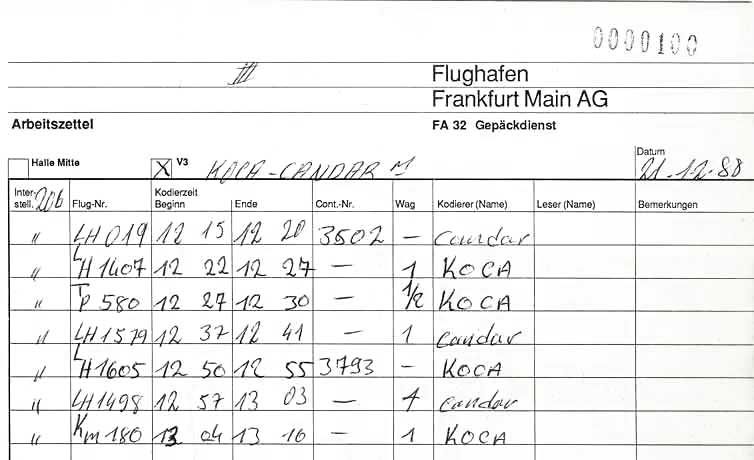
The difference between the a 1310 reading and a 1316 one does not affect the link with the central printout showing 8849 coded at 1307. But as eminent investigator Paul Foot notes “If the end-time was 13.16 this left a gaping hole in time when other bags may have been encoded through the same station that did not come from Malta at all.” With the worksheet here we can compare some previous codings “Beginn” to “Ende” for the previous six flights: 5 min, 5 min, 3 min, 9 min, 5 min, and 6 min, to process one wagon or one container of baggage. (the apparent “4” is probably a “1” written over a dash). And finally, either six or twelve minutes for one wagon from KM180. Unless there was something weird that screwed up the pattern (which is entirely possible), I’m calling the end time 13:10 and moving on. The hole was as big as it was, other things could well get through, but the most likely item at 206 in that time is still a bag from Malta.
Records on the PA103A End: A Blanked-Out System
Production 1062: This is the court’s code for some unspecified “documentary evidence” that “the aircraft used for PA103A arrived from Vienna (as flight PA124) and was placed at position 44, from which it left for London at 1653.” I’ll accept that as valid, but note the ambiguity of citation.
Production 1060:
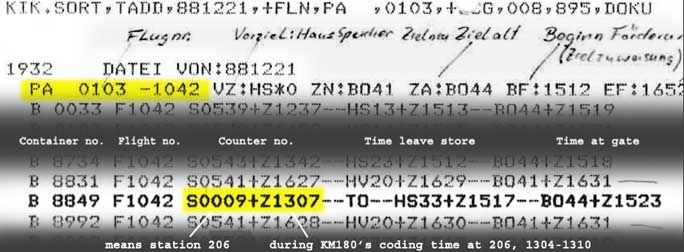
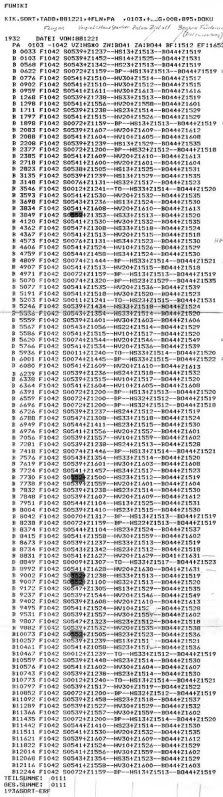 This is the famous printout of the late-sought tracking data on bags destined for the PanAm flight, on a whim saved from oblivion by the diligent Mrs. Erac. [see left – r-click, new window for readable size] Obviously this covers the broad computer-managed middle stage rather than “the 103A end.” But as it is, this is the only known link showing that item 8849 continued towards the fatal feeder flight. It’s the single document that allows “the inference," drawn by the Scottish Judges, "that an item which came in on KM180 was transferred to and left on PA103A.”
 It’s not that there should be more; the one record is to be expected. The unexpected is no one official got to it before it was deleted, and we had to rely on a memento copy from someone’s locker. We’re told. And the investigation was lucky to get that after a curious delay of 7-8 months.
What it shows, briefly, is 111 items listed numerically by container no. The relevant portions are highlighted in the condensed version below. PA103A is referred to herein as F1042. The relevant item 8849 was coded at station S0009, which it’s been determined means station 206, at 1307. That is a fit with KM180’s load. It then goes to Gate B044 at 1523, the same few-minute span most of it arrived. What happened from there is outside the computerized system and not recorded here.
Production Null: This is the designation – none – given to PanAm’s loading records for flight 103A. Holding to previous patterns, we’re back to tarmac and wheels space, and there should be records kept at gates 44 and 41 regarding the luggage items received and loaded onto the planes at each gate. There should be a verification that item 8849 was among them, and that it was then loaded to the plane.
Obviously the Airport authority couldn’t offer this to the court, as it wasn’t their job to load a PanAm plane or to log what they don’t do. There’s no mention in the Court’s opinion of what PanAm provided to the case; they went bankrupt in late 1991, so it’s natural they didn’t send anyone to the 2000 trial. But judging by Marquise, they also added nothing to the 1989-91 investigation, at least regarding the crucial Frankfurt link. The court adds nothing to that, only citing "evidence [...] that no baggage was left at the gate" in reasoning that " it can be inferred that all items sent there were loaded." Again, a non-admission admission that they don't really have the evidence they should.
Positive confirmation of this lack of records can be found in The Maltese Double-Cross (same section linked above). According to Michael Jones, Pan Am’s security chief with the London office [emph mine]:
I went to Frankfurt airport on 23rd of January 1989, to look for documents in relation to the preparation of Flight 103 from Frankfurt to London, and particularly the cargo and baggage loading plan, who was responsible for loading the plane and what their duties were, but these documents were missing from the daily file. … If the original documents had been taken by the authorities, and by that I mean the police, then it would be normal practice for a copy to be retained in the Pan Am file.
We have a date – one month after the disaster, and the crucial files for this plane are reportedly gone by this time. No one I know of has reported seeing them since. The computer tracking system was also gone to nearly all eyes as of January and on through August before it resurfaced to lead the case in a new direction. It would appear that investigators before that clue had no data on what went onto that plane that fed into the other plane. This in itself is a little-known but major scandal, quite likely its own crime scene that could not be traced back to foreign terrorists. Therefore, it’s to remain little-known.
Graphic Representation
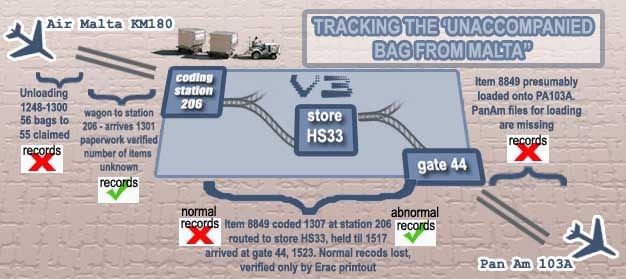
Sources:
- Lords Sutherland, Coulsfield, MacLean, Case No: 1475/99. OPINION OF THE COURT delivered by Lord Sutherland in causa HER MAJESTY’S ADVOCATE v ABDELBASET ALI MOHMED AL MEGRAHI and AL AMIN KHALIFA FHIMAH. Delivered January 31 2001. PDF or txt file available at: http://www.scotcourts.gov.uk/library/lockerbie/index.asp
- The Maltese Double Cross - Lockerbie. Film, Hemar Enterprises, 1994, 156 minutes. Written, produced, and directed by Allan Francovich. Wikipedia page
- Rowan, Roy. Pan Am 103: Why did they Die? Time. April 27 1992http://www.time.com/time/magazine/article/0,9171,975399-1,00.html