Showing posts with label Mebo. Show all posts

Friday, January 1, 2010

NUMBER ONE ON TOP: A SIGN FROM ON HIGH?

MST-13 COMPARATIVE GRAPHICS no. 4
[Pan Am 103 Series]
Adam Larson / Caustic Logic
January 1 2010 (last edit 1/2)


There's a plot device I must've seen once in a horror movie - a whole village, space station, whatever, was wiped out by something horrible, left desolate and stumbled on by a ragtag group of (4-7) likable misfits banded together by fate or conscription. Among the ruins they find one survivor - perhaps a young girl - who miraculously survived. The wandering Samaritans take her in of course as they moved on to whatever their new plan became. Up front I'm wondering, hey, just how did she survive? Only too late will they learn what I shouted twelve minutes in ... she IS the disguised monster that killed the (village, space station, etc) and then kills most (but not all) of the characters we had earlier bonded with through subtle cues.

Anyway, that feeling is similar to one I get about at least two of the crucial few bits of evidence against Libya, one being that timer fragment PT/35(b). In past readings and discussions I've run across some intriguing doubts about whether any such fragment would be expected to survive the semtex explosion required to bring down a plane. I know not the forensics, and am probably not going to. I do suspect the fragment was inserted into the evidence pool, but didn't want to say, as some did, that it must be a plant simply due to existing.

But its existence is odd, first of all in being found on land when it was fully capable of hiding itself in the deep ocean. Then its loneliness - parts of the radio itself were found, but nothing else from what was added. RARDE scientist Alan Feraday's final report noted "this piece of circuit board is the sole recovered fragment originating from the mechanism of the IED itself."

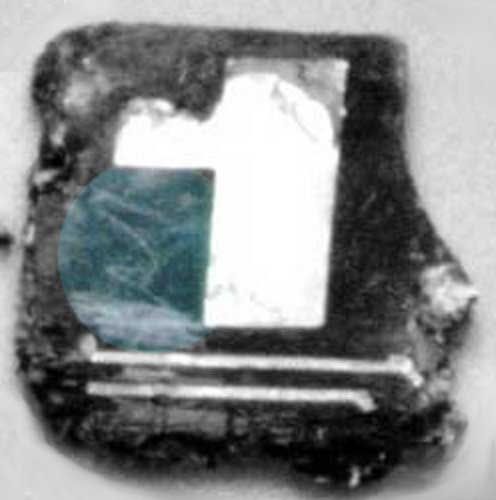
Now if the explosion were not strong enough to vaporize everything, I would expect a few surviving pieces, with this probably the largest. Rather it's the single and only. Luckily it was a piece of the highly-identifiable and highly-Libya-linked MST-13 circuit board that triggered the bomb, says the official papers. Discovered within a piece of exploded clothing, the fragment of fiberglass circuit board, about a millimeter thick, itself looks hardly exploded. Note its fracture lines, left, bottom, and lower right edges - are all straight lines at right angles to each other. I imagine there are reasonable explosion-related causes for this, but it strikes me as unnatural, FWIW.
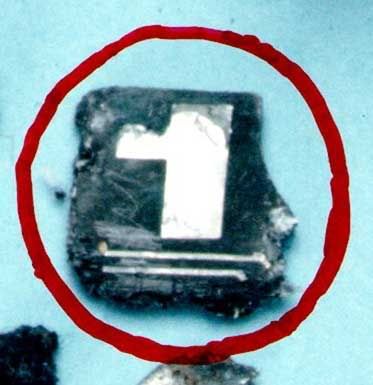
Approximately one cm square (hugely magnified above), its printed surface is dominated by a touch pad that uncanilly resembles an upright number one, and double-underlined at that. Considering the entire board (below, right - color adjusted, touch pad area outlined), there is no other spot on the board that contains a recognizable symbol. There are plenty of spots with little lines that might be shown to match, but they don't seem to really say anything. When you're like Tom Thurman, searching with intrepid zeal for the one clue you need, that must be almost a religious experience to see... bam. THE ONE, telling its discoverers "There is but one way to conviction, and it is by me. I shall be thine number one evidence, and only savior." Subtly, it evokes the PA one-oh-three it was alleged to have brought down, and wispers in our left ear "we're number one" for solving this most awesome forensics puzzle and gettin the baddies.
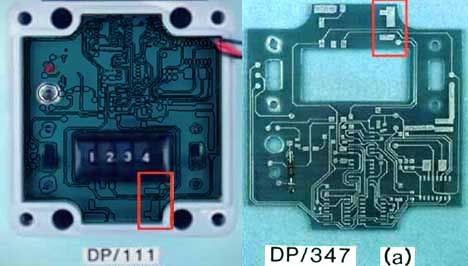

Or less hyperbolically, when one sees this, the temptation is too much to turn it so that's visible. But in fact, the boxed MST-13 trial exhibit DP/111 (above left) shows the readout from the front (circuitry traced here for reference). We've been reading it upside down. Consider the other trial photo at right, with upside-down board, and the area of PT35(b) indicated in red, apparently on top and to the right. What a better place for an underlined number one could there be? Bottom sucks. Left, evil. Turn the whole world upside down if need be to make sure we're number one, double underlined, on the right and at the top. And can "prove" libya did it in the process. Who's writing this stuff? Random fate? Really? You aren't believing in God by now?
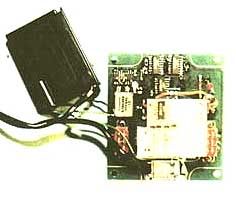
In addition to the fragment's clear and powerful message, we have its perhaps-miraculous existence. Previously I had wondered if maybe such a piece could have been shielded behind a larger element attached to the board before nestling in that shirt collar. But I knew it was a bit of a stretch. At left is a duplicate MST-13 with elements attached. The photo is from the website of a Mr. Byers, who claims the CIA was making these fake MST-13s in Florida. At any rate, I don't know what these things all do or are called I've even been told but it didn't sink in. Do note the largest block is the timer dispaly, seen here from the back, and set just south of middle. The rest is surely capacitors, flux inhibitionists, and some grommets around the outer parts.

Some of these things are probably made of metal and materials stronger and thicker than fiberglass board and could shield our PT/35(b) in the chaos of explosion. But if something like that happened, then where is that protector now? Did it vaporize itself? Or plunge irrecoverably into the mud at the bottom of a Scottish loch? Maybe, but then all elements of the bomb except this "number one" corner of that Mebo-traceable, indictment-enabling layout wind up disappearing into the ether? I'm a reasonable chap but I find that harder to swallow than what so many other clues are already saying - the rest was cut or blown off elsewhere, and only THE ONE was ever near this crime scene, after being carefully selected for the job. I can't see just why fate would have any interest in making sure the evidence "says something to us." A false God playing with reality and feeling immune in orbit might just take the chance.

Tuesday, November 17, 2009

FROM ZURICH TO MALTA TO TRIPOLI TO MALTA TO…

A DECEMBER DANCE OF ACCUSER AND ACCUSED
[Pan Am 103 Series]
Adam Larson / Caustic Logic
rough draft posted November 16 2009


One of the stranger patterns I’ve seen recently in connection to the Lockerbie case is the tight web of alleged movements of the two accused - and of Mebo co-founder Edwin Bollier - in the days preceding the PA103 attack. To start with, the close connection between the first accused, al Megrahi, and Mr. Bollier’s company is no secret. From the Camp Zeist Opinion of the Court [hereafter "verdict", paragraphs 54 and 88]:
[54] We also accept Mr Bollier’s evidence, supported by documentation, that MEBO rented an office in their Zurich premises some time in 1988 to the firm ABH in which the first accused and one Badri Hassan were the principals. They explained to Mr Bollier that they might be interested in taking a share in MEBO or in having business dealings with MEBO. …
[88] [Megrahi] also appears to have been involved in military procurement. He was involved with Mr Bollier, albeit not specifically in connection with MST timers, and had along with Badri Hassan formed a company which leased premises from MEBO and intended to do business with MEBO.

The questionable choreography begins when the Libyans had just finished employing the Mebo MST-13 in a carefully packed Malta-themed gift bag they had set to drop bits all across western Great Britain. In case the trail wasn’t obvious enough, they decided then to bring the talkative Mr. Bollier back to remind him with a new attempt to purchase a double order of the same nifty gadgets. The court cited Bollier’s evidence that Badri Hassan, Megrahi’s partner in ABH, “came to MEBO’s offices in Zurich at the end of November or early in December 1988 and asked the firm to supply forty MST-13 timers for the Libyan Army.” [verdict, para 46] Megrahi was apparently on a visit to Zurich at the same time, and from there the dance begins. Below is a timeline, compiled from a variety of sources, to illustrate how strange the patterns are.

> Nov 20 – Dec 20 Megrahi and Fhimah “did between 20 November and 20 December 1988, both dates inclusive, at the said premises occupied by MEBO AG, in Zurich aforesaid, … order and attempt to obtain delivery of 40 further such timers from the said firm of MEBO AG [indictment, para J]
> Around Dec 1 – Hassan’s order, in Zurich, for forty MST-13 timers. [Verdict, para 88]
> Early December - Megrahi had “traveled to Zurich in early December.” [Wallace]
> Dec 7-9 - Megrahi stays at the Holiday Inn in Silema, Malta. December 7 is the date the court decided he bought the Maltese clothes from talkative shopkeeper Tony Gauci at nearby Mary's House. [verdict, para 88]
> Dec 5 and 15 – Having no MST-13 timers on hand, Bollier buys 40 of the Olympus make instead, in two batches, on the open market. [verdict, para 88]
> Dec 15 – Fhimah diary entry “Abdelbaset coming from Zurich” [Lockerbie.ch]
> Dec 16 Bollier books a flight to Tripoli to bring the wrong timers [Verdict, para 88]
> Dec 17 – Megrahi returns to Malta on the 17th “and then on to Tripoli Libya, where Lamen Fhimah joined him.” [Wallace]
> Dec 18 - Bollier flies to Tripoli, meets no one, leaves timers at office of one Ezzadin Hinshiri [Verdict, para 88]
> Dec 19 - Hinshiri said that he wanted MST-13 timers and that the Olympus timers were too expensive. “Nevertheless, he retained the timers and directed Mr Bollier to go to the first accused’s office in the evening in order to get payment for them. From about 6.00pm Mr Bollier sat outside that office for two hours,” but “did not see the first accused,” being of course Megrahi. [Verdict, para 88]
> Dec 18-20 “in Tripoli aforesaid, and elsewhere in Switzerland and Libya,” Megrahi and Fhimah did “order and attempt to obtain delivery of 40 further such [MST-13] timers from the said firm of MEBO AG.” [indictment, para J]
> Dec 18-20 “we accept that Mr Bollier visited Tripoli between 18 and 20 December in order to sell timers to the Libyan army, because that is substantially vouched by documentary evidence and it was not challenged in evidence.” [Verdict, para 88]
> Dec 20 – “Al Megrahi was instructed by his boss Ibrahim Bishari to travel to Malta on December 20, 1988 for a security order (not in connection with the bombing of PanAm 103)” [Bollier]
> Dec 20 – “Abdel Baset and Lamen Fhimah returned to Malta on 20 December” with an alias for Megrahi and the bomb suitcase. [Wallace]
> Dec 20 – After a final dispute with Hinshiri, Bollier returns home with his Olympus timers, “flying by direct flight to Zurich rather than via Malta (as he had expected) where he would have had to spend that night.” [Verdict, para 88]
> Dec 20 (presumably) – “On his return to Zurich Mr Bollier claimed to have discovered that one of the timers had been set for a time and a day of the week which were relevant to the time when there was an explosion on board PA103.” Herr Meister confirmed this to the court. Libyans had been fiddling with them, absent-mindedly… the court dismissed Mebo’s claims as “so inconsistent that we are wholly unable to accept any of it.” [verdict, para 46]
> Dec 20: Upon returning to Zurich, Bollier is said to have testified in 2000 "a suitcase which had been in the Mebo office prior to Mr Bollier's departure, which the witness understood belonged to Mr Badri Hassan, was not seen again after Mr Bollier left on this trip." [LTBU]
> Dec 20: [indictment, (m)] (both accused) “did on 20 December 1988 at Luqa Airport, Malta enter Malta” with Megrahi under alias Abdusamad, and both “did there and then cause a suitcase to be introduced to Malta.”
> Dec 20-21: [Indictment, (n)] Megrahi “did on 20 and 21 December 1988 reside at the Holiday Inn, Sliema, aforesaid under the false identity of Ahmed Khalifa Abdusamad.


Bollier has added to this tight web of movements across the Mediterranean in those fateful days, in response to recent comments by myself and others at Professor Black’s Lockerbie case blog (this post, in comments beneath). His messages there are a complex mix of German and mixed English; one relevant part in German renders roughly as “today we know that the new order at the end of 1988 "to produce for the Libyan army, immediately further 40 pieces of MST-13 timers from a person; H.B." on behalf same western security services one made!” H.B. could be Badri Hassan, but this seems to imply that a Western agency placed the order (through him?). Perhaps these were the same folks who compelled Hinshiri or whoever to program PA103’s explode time into one of his Olympuses. And what ever DID happen to that suitcase, Mr. Bollier?
Documents indicate that originally the CIA and an other western intelligence service planned also to involve Edwin Bollier (MEBO Ltd.) together with Mr. Abdelbaset Al Megrahi into the PanAm 103 plot!

Edwin Bollier was told at the check-in at Tripoli airport that his already booked direct flight with Swissair to Zurich on December 20,1988 was fully booked and he should travel via Malta to Switzerland on the same day - the same flight on which Abdelbaset Al Megrahi was booked (*flight KM 107, on December 20, 1988 from Tripoli to Malta). According to a new statement Megrahi did not know that Bollier was planned to travel on the same flight as he was !

Bollier was suspicious because he didn't see many people on the airport and went to the Swissair Station Manager who told him that there were many empty seats on the Swissair flight to Zurich. So he took the direct flight to Zurich on December 20, 1988. Only Abdelbaset Al Megrahi (alias Ahmed Khalifa Abdusamad) traveled with flight KM 107 from Tripoli to Malta on December 20, 1988.

Therefore Bollier was not in Malta on the same day as Abdelbaset Al Megrahi. The CIA was confronted with a new situation and the same intelligence people decided to involve the station manager of 'Libyan Arab Airways' , Mr. Lamin Khalifa Fhimah, into the complot.

*Al Megrahi was instructed by his boss Ibrahim Bishari to travel to Malta on December 20, 1988 for a security order (not in connection with the bombing of PanAm 103) ...
On September 14, 1997 former foreign minister, Ibrahim Bishari, died in a car crash in Egypt ...
[Bollier]

Strangely for someone so nearly “framed” in the web set for Libya, Bollier was the first to try implicating Libya for the bombing of Flight 103 at all, with a letter delivered to American authorities in January 1989, well before they started finding any clues pointing that way. [see for example, verdict, para 47] This he claims he was compelled to write by - gasp! - Western agencies acting then through him to implicate Libya, a claim he’s made before and elaborates on in the same comments (worth a read for serious scholars). This letter and the claims around it will deserve their own post eventually, but something is entirely not level here, and Bollier is entirely too at the center of it. Somehow this whole byzantine Mediterranean waltz leaves me with the words and mood of the 80s poets Wham in Careless Whispers:
"Now I'm never gonna dance again, guilty feet have got no rhythm. Though it's easy to pretend, I know you're not a fool..."
---

Sources:
[verdict]
[Wallace] Rodney Wallace Lockerbie the story and the lessons 2001 page 62
[Lockerbie.ch]
[Indictment] Actually I think that's a verdict http://www.terrorismcentral.com/Library/Legal/HCJ/Lockerbie/TheIndictment.html
[Bollier]
[LTBU] Lockerbie Trial Briefing Unit: report 78554 - 16th June 2000. Original site:
http://www.gla.ac.uk/departments/schooloflaw/news/lockerbietrialbriefingunit/
text doc direct link: http://www.gla.ac.uk/media/media_78554_en.doc

Wednesday, October 21, 2009

MST-13 COMPARATIVE GRAPHICS no. 3

ALTERED BUT NOT SWAPPED
[Pan Am 103 Series]
Adam Larson / Caustic Logic
October 21 2009
last edited 10/22


Recently attention has come back onto the MST-13 timer fragment, upon which the Lockerbie investigation solidified its case against Libya, with statements the other day by Member of Scottish Parliament (MSP) Christine Grahame. Following suspicions raised by Gideon Levy’s 2009 film Lockerbie Revisited, people are asking like never before was this key evidence, pulled from a shirt collar months after the attack and designated PT/35(b), taken outside of Scotland? Outside Great Britain? Outside Europe and across the Atlantic? As the BBC reported:
Ms Grahame said: "The Crown Office have confirmed to me that the fragment, PT-35, the piece of evidence that it was claimed linked Libya to the attack, was also sent to Germany in April 1990, as well as the US. [...] If there was any suspicion that the fragment had been tampered with, it could have undermined the entire prosecution case.

Clearly this is big news that people will Google, and find things like this, posted last year by Edwin Bollier, co-founder of Mebo, the timer’s makers:
Inspector Keith Harrower (Scottish Police) visited on the 27th of April 1990, this the MST-13 fragment the electronic company Siemens AG in Munich, Germany. Engineer Brosante sawed this first brown original MST-13 fragment into two parts and confirmed: "standard brown PC-platine with 8 layers of fiberglass." The green machine made MST-13 timers delivered to Libya consisted of PC-boards with 9 layers of fiberglass.

So when these “new” questions start leading right to Mr. Bollier’s claims of tampering and worse, some clearing of the waters might be useful. I turn my attention to false or dubious claims, pushed by Bollier and a handful of others, about the fragment being planted or swapped-out with a clearly different fragment, during the process of investigation.

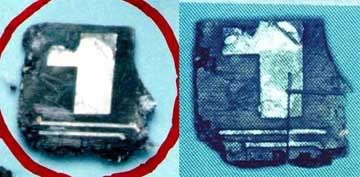
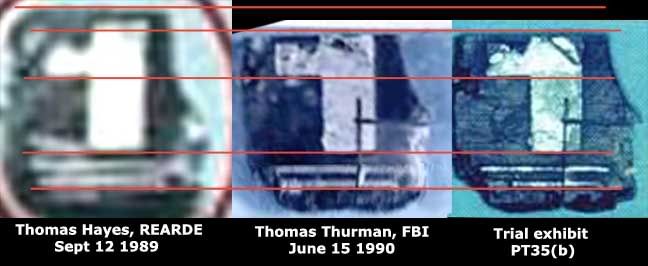
His claims on the board being different colors at different times are too convoluted to fully explore here, but Bollier has been swearing lately that a brown prototype handed to Swiss authorities had been used as the evidence, somehow clearly visible in the first known photograph from 1989 (left), while the later photo (mid-1990, right) of an altered PT35(b) are of a replacement green board.

The MTS-13’s designer, Ulrich Lumpert, apparently spawned this with his 2007 affidavit, by which he handed the brown board over to Swiss investigators who in turn gave it to SCOTBOM, who used as evidence. Engineer Brosante also agrees it was brown, judging by Bollier’s quote (that’s the first I’ve heard of him, so don’t ask me). The official story is of course that it’s always been the same green fragment they found in the wreckage of 103.
It is true that green here seems to mean blue, and the later photo is more blue than the first. However, this (as I found it online) shows clear signs of global photo-tinting and once corrected, the color matches up quite well with the original – dark muted blue-gray, like a green/blue board that had been burnt. It does seem possible some of the carbonized surface material has been cleaned off in the latter view, but otherwise there is no hint of brown I can see in either of these photos, and no color-based sign of meaningful alteration or replacement.

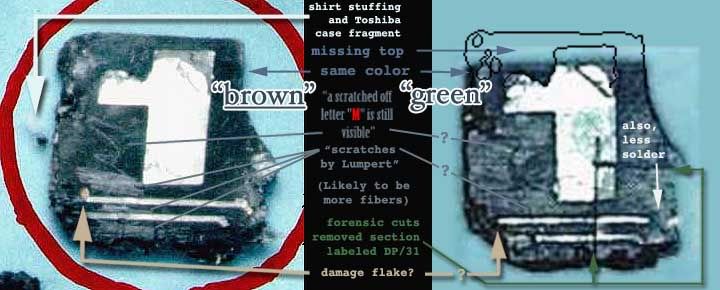
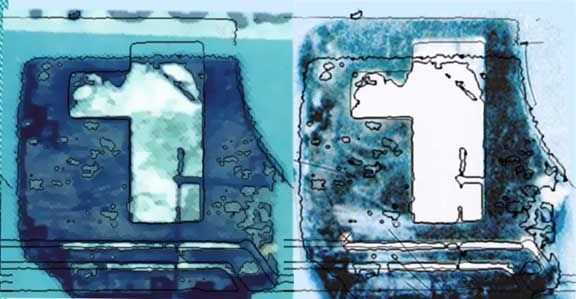
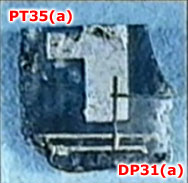
Considering comparison photos of PT/35(b) alongside an intact model board (links above), There are allegations of the curved edge not matching or the “1” touchpad and its relation to the “true edge” differing. But when the outlines are superimposed to scale (right), we find a perfect fit presuming the fragment is missing a sliver off the top. And here we can see a difference with the first photos and later ones – the top is present at first, giving it the right curve of an intact board. Later, it’s gone. Two prominent cuts at right angles also appear, apparently part of forensic examination carried out so controversially in Munich, to check the board’s layering style. This apparently severed a corner piece, put back in place and displayed as separate evidence item DP/31. But the removed top is not so displayed. It’s reasonable to surmise this tiny section – app. 1cm by 1/8cm – was simply ground off to get a profile, but mysteries remain... It's not clear how many layers were really found, but as it appears a green machine-made board, I'm guessing nine.

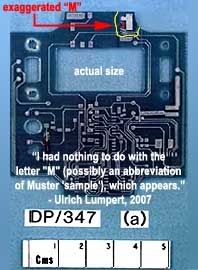
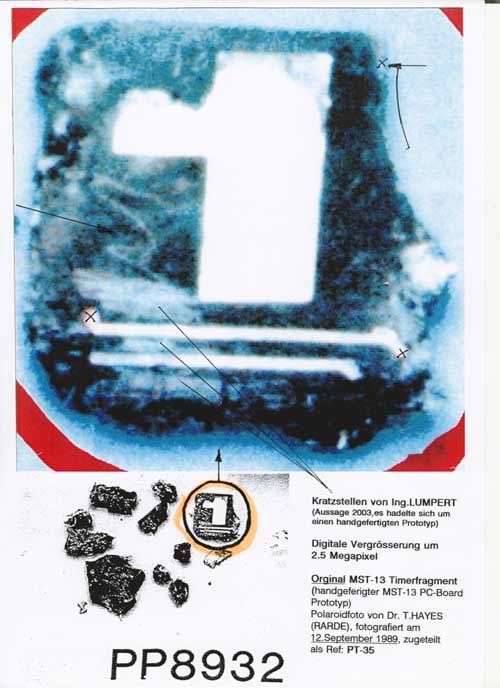
Among Mebo the clown’s most enthusiastic claims of proven forgery is how “the letter "M" was carved into” the original “brown” item sideways next to the touch pad, while “in the duplicate no. PT/35(b) (fake) it can be clearly seen that no letter “M” was carved into it!” Lumpert mentioned but disowned this in his affidavit: “I had nothing to do with the letter "M" (possibly an abbreviation of Muster 'sample'), which appears." To true scale (at left), this tiny M seems strangely small to use as a marking, nestled in next to the “1.” In reality, as JREF forum member Ambrosia showed with the enhancement below, the M casts a faint but visible shadow, and would seem to be a 3d object, a tiny ziggy fiber of presumably shirt stitching.

Beneath this alleged etching are three small light patches bracketing the solder lines, visible above. Of these Lumpert said “I clearly recognize the scratched remnants of the soldering tracts on this enlarged digital police photograph.” A poster available online shows a blowup with German text, perhaps based on something, labeling these as “Kratzstellen von Ing Lumpert,” scratches by Lumpert. That any villains would have chosen to cut out and display as evidence just the small corner that Lumpert had marked with random micro-abrasions and could identify raises some questions.

What exactly these really are is a minor mystery – perhaps more fibers of a different kind snagged on the solder. Whatever they are they’re as gone later as the M – either the political engineers sanded these off or painted them over, or replaced the board down to he tiniest details except for these scratches, as alleged by recent Mebo pages, or they were some inconsequential surface debris since removed.

And for a preview of what lies at the bottom of this rabbit hole, realize Bollier's claiming a green replacement for a brown original fake of an alleged green Libyan timer; A 'technical report' commissioned on actual graph paper suggests for no reason I can fathom the final PT/35(b) photo is of the green replacement except the corner DP/31, which is actually a matching corner from the original Lumpert-supplied brown fake! And they didn't even use the corner with the irreplaceable "M!" (lower right corner of right view below - the part that's the same blue/green as the rest).


So to summarize, as the graphic above pretty well does, the verifiable changes were the removal of surface debris, perhaps removal of some of the charred layer, loss of a small bit of solder, an apparent flake of damaged plastic (tan under-layer?), minor changes to the touch pad surface, and the obvious cuts and/or grinding to the board consistent with cross-section analysis. Nothing else about it changed, and there’s no evidence that anything misleading was done with this after its initial fraudulent insertion into the evidence chain.

Did everyone catch that? Don’t get distracted, then, is the main point here. There are still intelligent questions to ask.

Sunday, October 4, 2009

MST-13 COMPARATIVE GRAPHICS no. 1

INVESTIGATORS’ VIEWS, 1989-90
[Pan Am 103 Series]
Adam Larson / Caustic Logic
October 5 2009
last update/edit 11/2/09


In this post I will relate all direct visual evidence, gathered from different sites, relating to the circuit board fragment found in the evidence of the Lockerbie bombing. These should be official photographs and documents, mostly from the British side of the investigation. My sources are a few, but mostly websites run by Mebo, the board’s manufacturers and confusing advocates in the trial and its controversies. At the risk of accepting bad evidence, I will accept these as accurte, if not the commentary, and simply lay them out in approximated chronological order with some of the available information on them.
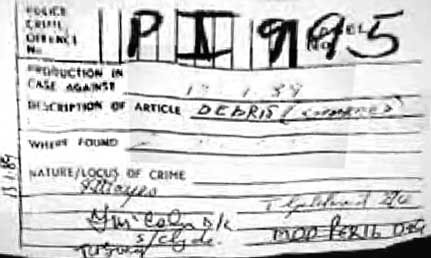
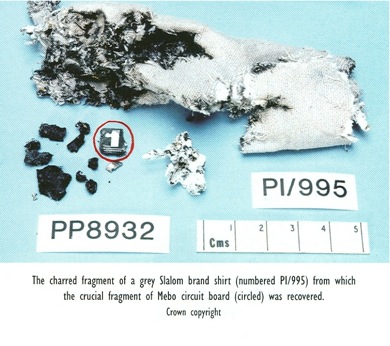
The fragment was allegedly first gathered by DCs Gilchrist and McColm, unseen within a piece of cloth logged in mid-January 1989 as item PI/995, “Cloth (charred).” Anomalously, the label was later changed with “debris” written right over “cloth.” In the 2000 trial, Gilchrist was asked about the overwriting; the judges found his explanations "at worst evasive and at best confusing," but found no "sinister connotation" in this (and neither do I, in particular). Note also how the date (13/1/89 as on the left side) seems faintly penciled in for "introduction in case against," and the loaction found line seems written over with invisible ink. The resolution on these is not good - here I took the full tag and a clearer zoom-in (original images page) and merged them for the best effect.

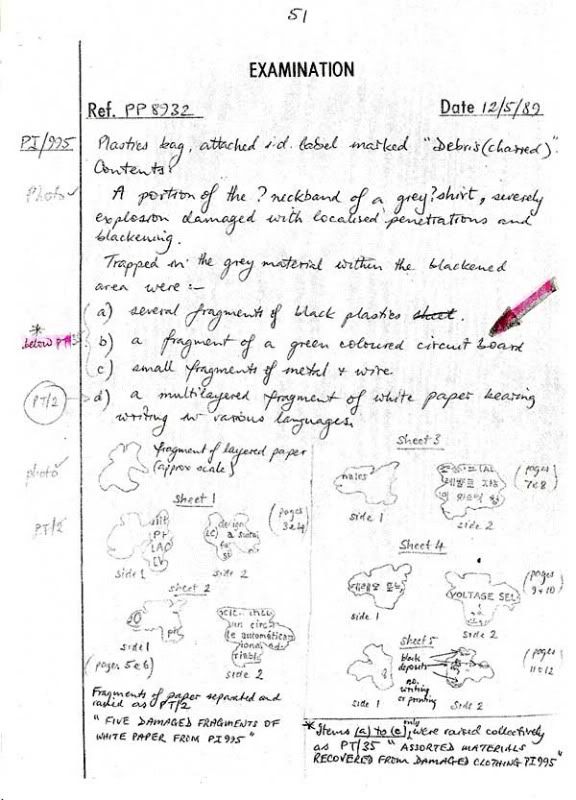
One signature on this cluttered tag seems to be Dr. Thomas Hayes [wiki] of RARDE (Royal Armament Research and Development Establishment), who analyzed this material more closely on May 12, 1989, according to his lab log (on page 51, left - r-click new window for readable view). This was the first mention anywhere of the pivotal timer fragment, as item b) at left. Reportedly, the pages following this in Hayes’ journal were renumbered, which he was unable to explain in later testimony. This could well mean this page was inserted after the fact, as widely speculated, to introduce a backdated paper trail for a later plant. It's a little sloppy to my eyes, and doesn’t add much detail to the record; there is nothing about the board other than a simple note of “a fragment of green coloured circuit board." He offers no drawing, no details. Note that the paper fragments, carefully re-sketched here (five sheets, 2 sides each, lower half of page), were identified early and given the evidence no. PT/2. The exploded electrics of items a-c, on the same page here, are "raised" collectively as PT/35 “assorted materials RECOVERED from clothing PI995.” (caps in original) I think this means 31 pieces of evidence were catalogued between these identifications allegedly noted on the same day.

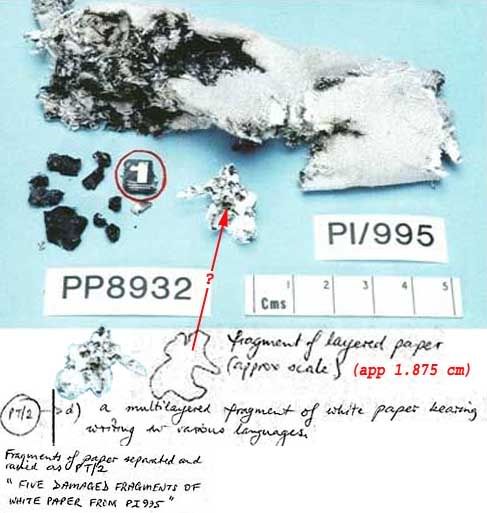
The first photograph to be taken of the fateful fragment was reportedly taken, on or around September 12 1989, by Hayes, or by “RARDE photographer Heines.” according to different web pages sponsored by Mebo, the board’s confusing makers. (Hayes version, Heines version). This is three days prior to the September 15 Feraday letter (see below), leading some to suspect he took the picture then. Its acual date of capture seems to be prior to Hayes' May 12 entry, as the lumpy shape to the right of the fragment seems to be the paper fragments prior to being separated and drawn therein. The famous photo shows the shirt collar and all the evidence taken from it, with the circuit board chunk circled in red in the publicly available version. Considering the quality of blow-ups possible from this (see below) it is presumably 35mm, and not one of the "polaroids" mentioned below. (Original Image)

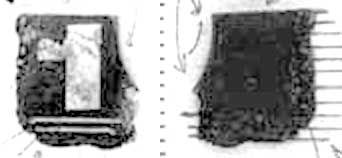
At left is the best blow-up of this available, from a higher resolution original than is up anywhere on the Internet. Here can be noted the “1” shaped touch pad, twin solder lines beneath this, the intact top edge, rounded corner, crumbly edges. The "etched" sideways “M" and "scratches" beneath it have been called clues of forgery, but likely are fibers of fabric like those clustered on the left side. The color of this board's coating plastic, described as green by RARDE people, and as evidently BROWN by Mebo missives, seems to me no particular color, but more precisely off-black or muted dark gray-blue with a slight greenish hue. It's probably supposed to be burnt, so green-blue seems closer than brown. (source)

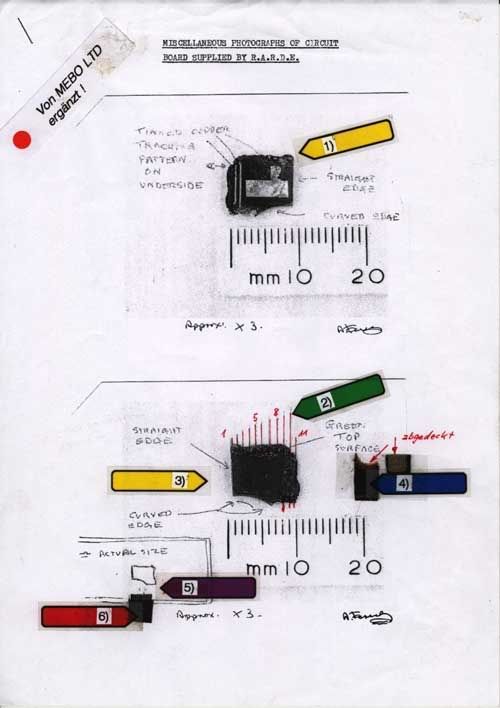
Another to take a crack at this fragment was Alan Feraday [wiki] the director at the time of DERA (Defense Evaluation and Research Agency), who at some point made a study using another shot, straight on, with another view of it flipped over on its back. Using enlarged photos (“approx X 3”), perhaps photocopied on paper, he added notes around the mirror-flipped dark shapes - the following are my best reading:
"straight edge" pointing to the straight top edge.
"curved edge" pointing to curved edge
"trimmed copper" pointing to solder lines. ("track pattern on underside" added)
"Green top surface" pointing to back view.

There isn’t much resolution here to work with, but that back view is totally unique. So I used a separate layer with maxxed out contrast to pop out all details (below, right). There seems to be a small bump corresponding to the middle of the touch pad, and some roughness (fracture? bubbling?) around the edges, quite a ways in at bottom and right. Otherwise little can be seen. image source

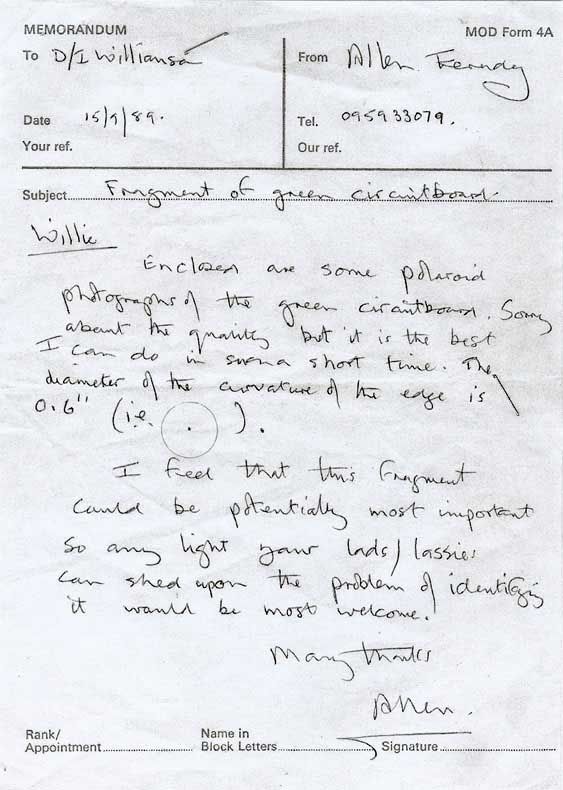
On September 15 1989, judging by the header, Feraday sent a memo to Detective Inspector William Williamson, a counterpart in the Dumfries and Galloway police (along with the FBI, they were the official investigators). This was to explain “some Polaroid photographs of the green circuit board,” which he found "potentially most important," depending on what ID the D&G could come up with. Feraday apologized for the quality of these pictures, noting “it is the best I can do in such a short time.” Some have presumed he was sending the circled photo above, but the use of plural photographs, could mean what he sent was the analysis above, having two photos in it. It’s not entirely clear what the rush was all about or why that precluded better pictures. (source)

Following this is a long gap in the timeline of what I've sorted out, from later '89 into early 1990. Investigators analyzed the fragment (though not for explosives residue), searched for matching board patterns, and so on. According to a Mebo site, on February 8, 1990 “a needle-thin section” was removed from the evidence, apparently for forensics work, “by Mr. French from CIBA-Geigy." Four days later, the site continues,
“Mr. Roderick MacDonald, withness no. 589, had been called into Strathclyde police-station to take some photographs of an allegedly Lockerbie-recovered MST-13 timer fragment with the allocated no: PT/35 (evidence: production no:1754) According to Court-documents, the alleged MST-13 timer fragment PT/35 was at that time no longer in its orginal condition and in one piece!” (source)

For a good trans-Atlantic, Anglo-American (sorry, Scots-American) investigation, it only seems appropriate to bring in some expertise from across the pond. Investigator Paul Foot (Flight from justice, PDF, page 11) reports a July 1990 call from FBI forensic authority and political scientist James "Tom" Thurman [wiki] offering a lead to DCI Williamson on the fragment Feraday told him of. Reportedly Feraday and Williamson both went to Virginia to meet him. Although some have said this fragment was physically taken there, and the controversy recently upped with Levy’s Lockerbie Revisited video, the preponderance of testimony suggests to me, so far, that it was just a photo. I may sort it out in a separate post.

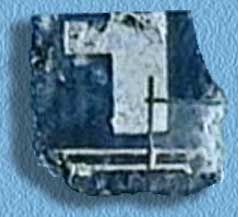
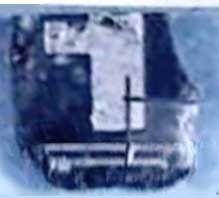
At any rate, Thurman was able to get pictures also of a captured Libyan MST-13 timer and, on June 15 as he recalls (not July as Foot reported) found a perfect match to the fragment from Scotland. He kept some photos on file to show reporters later, including a giant blow-up, heavily blue-tinted, of the fragment, perhaps MacDonald's view. This is shown alongside a comparison board with unfilled solder lines and some odd spatterings off the touch pad. (this Mebo photo seems to be the same board Thurman compared to, here in odd color, a different angle, and labeled). The image at left also is from a Mebo graphic, with the backdrop only altered by me for aesthetic reasons. (Original Image) This is the earliest view I know of showing he top sliver missing, as well as the lower right corner cut out or at least deeply scored. Otherwise, it appears to be the same piece, if perhaps a bit bluer, probably due to photo tinting. Also note, the “M” is missing, supporting the idea it was a transitory fiber since cleaned off.

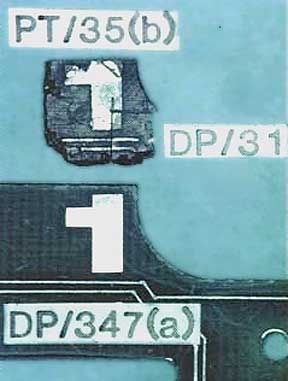
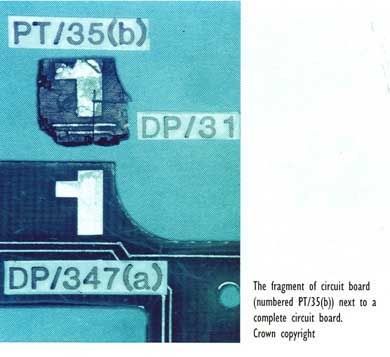
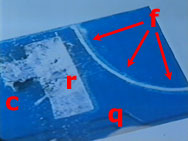
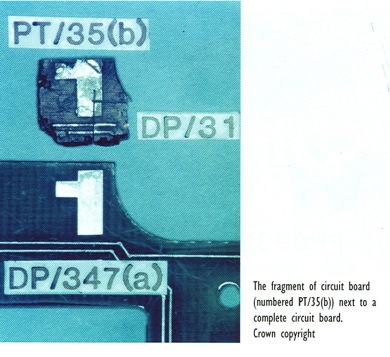
I’m still vague as to when the famous trial photo below was taken. Showing evidence PT/35(b) and, apparently, the separated corner labeled DP/31, compared to model DP/347(a), an intact MST-13 timer. This might seem the photo taken by MacDonald on Feb 12, which would leave one wondering why the trip to America if they already knew what to put it alongside. It may have been after Thurman’s ID in June, as a verification with cleaner sample, and done in 3-D. Or as some have stated, this side-by-side was done by Thurman himself, with access to both real items. Whenever, wherever, and by whomever it was captured, again with intense blue tinting of the whole evidence photo. Here I’ve color-corrected to the best (app) nexus of natural whites, standard blue backdrops, and fragment plastic color. I’m not sure where this model is from, but it’s clearly different from the one Thurman used for comparison.

In the end, counter-claims aside, the fragment looks the same throughout, other than the noted diminishings, so if any planting happened it was at the beginning, which could be later than the paperwork suggests. But the case was made and handed to us thusly: this was from the wreckage, near the bomb, perhaps part of it. It was handled carefully by trained and diligent professionals leaving a clear paper trail. It was rigorously matched, with photos AND microscopes, to a style used by Libyan operatives. And it all came down to a fragment of circuit board, and wound up appealing to the kind of late-90s popular TV fiction mentality needed to win crucial public/political support for the indictment. As agent Thurman bragged to the TV news just after the 1991 indictment, "when that identification was made, of the timer, I knew that we had it." Whether by accident or staging, it was brilliant theater.

Friday, September 25, 2009

MST-13 COMPARATIVE GRAPHICS no. 2

A CHIP OFF THE OLD BOARD AND A CHIP OFF OF THAT
[Pan Am 103 Series]
Adam Larson / Caustic Logic
September 29 2009
Last update 10/22


Among the evidence used to implicate Libyan al Megrahi for the bombing of Pan Am 103, the strongest, most tangible, most sciencey, is the small but identifiable fragment of timer circuit board though by some to have triggered the bomb that brought the plane down on Lockerbie Scotland in December 1988. What we know is the style is the same, circuit-wise, as a MST-13 board, made by a Swiss company, Mebo, in a limited run of 20 (plus three prototypes) for Libyan intelligence in the mid-1980s. Notwithstanding the likelihood of anything surviving the reported type of explosion, fact is little is alleged to survive, and I will proceed on the notion that it's possible for this to be genuine, but far from a foregone conclusion.

In the course of a discussion thread started at the JREF forum by member Rolfe, examining whether the timer fragment was planted, I was able to establish some visual patterns helpful to understanding the issue. There are already numerous documented, eyebrow-raising anomalies with how this historic evidence has been handled and by whom, and I will address these elsewhere - here I hope to just make a quick post to convey, mostly with pictures, what I thought might be an important piece of new information I discovered looking at some jpeg images, available online and purporting to be genuine trial-related evidentiary photos. One may note a color shift from the first to view to the last, with an original faintly blue-tinted gray later showing as tinted blue all over the image. The board's color is referred to by all who speak of it as "green." The shape and layout of the fragment as seen in each photo, however, remains consistent enough, steadily holding the known shape of Mebo's MST-13 board.

< The first, chronologically, shows a battered collar from a "Slalom" brand shirt, from which were supposedly removed some fragments, the interesting one of which is visible, blown-up, at left. This poster is annotated, in Dutch it seems, and attributes this photo to Dr. Thomas Hayes, RARDE scientist, on September 12 1989. For convenience, I'm using this to identify the shot.

> The next is a file photo shown on ABC News in Nov. 1991 by FBI agent James "Tom" Thurman. This was presumably taken at the time of his June 15 1990 identification of the fragment as from a MST-13. There is plenty of confusion also as to whether he actually inspected the fragment or a photo of it, but here I'll just share his publicized hard copy, stretched to the same proportions as the exhibit photo (below), from Gideon Levy's totally amazing (but partly Dutch) Lockerbie Revisited video. Note the deep cuts, meeting at a right angle in the lower right of the touch pad. This does not seem to be present in the older photo.

< Exhibit PT35(b) photo - it's unknown at what time this was taken, but probably sometime around mid-1990. This is the most commonly seen view, as it clarifies just how open-and-shut the case is. Case being, does this dubious fragment match a board style similar to one usually made by... etc. The comparison model is reportedly an intact MST-13 confiscated from another Libyan intelligence agent, who had been planning some different bombing. It's supposedly just these two items side-by-side that allowed agent Thurman to make the connection.

Dr. Ludwig De Brackeleer, however, as a minor point of a detailed article largely about the fragment, disagreed:

There is a small glitch... It is obvious that the fragment PT35(b) does not come from one of the 20 machine-made MST13 timer delivered to Libya. The location of the T shaped touch pad, its absolute and relative dimensions do not match. Moreover the curvature of the fragment round edge equally differs!
< I took the corner from the intact board in PT35(b) into Photoshop and applied the 'trace contour' filter. Beneath this I scaled a blowup of the fragment until the "1" shaped touch pad and as much as possible matched. It's quite a perfect fit in fact, minus a missing top portion, in addition to missing sections left, right, and below - not too surprising.

What I do find interesting is, well, this:

The earlier view is lacking the right-angle cut marks marking the lower right quadrant, and the later one is lacking the top portion straight across. Why on Earth would the top portion of a piece of evidence just go missing, and why would someone hack lines across it like that?

I had my own elaborate thoughts about some renegade scientist who smelled a rat swiping a chunk to hold as blackmail, using a safe deposit box and a team of Swiss lawyers, and was trying to tie in both the Mossad and an elaborate car chase through the plazas of Rome. Before I got this far however, JREF member Dan O, who seems to know a lot about electronics and investigations, offered a more plausible explanation:
In order to examine the cross section of the piece for identification of the material, it must be cleanly cut through a good part of the board. They need to make two cuts at right angles to map the orientation of the fibers in the epoxy board. Obviously some of the documentation for this chip is not present or this would have been explained. link
That the gouges are deep into the board is evident looking at the middle view, Thurman's file photo. The portion above the horizontal slice is definitively darker than the section below, indicating slightly different planes catching the light differently. The board is either bent or completely cut through there. Where the vertical slice crosses the solder lines at bottom, it seems the solder was pulled along into a short connecting line. This is only hinted at in the later exhibit photo but quite pronounced in Thurman's picture. Below is a closer view, shown on 60 Minutes in 1999.

The missing top is a little more problematic. Dan O. seems to think a cross-section examination or something of that sort might explain the decapitation, but agreed with me that it's unusual to not present the evidence as whole as possible, with cut off parts either put back in or near their original places. Mebo's in-house designer of the MST-13 Ulrich Lumpert, In his highly unusual 2007 affidavit, mentioned a fragment cut up and presented as evidence. Lumpert claims he handed a non-operational brown-base prototype board to Swiss investigators for the Lockerbie investigation, and the next time he saw it was as the green/blue exhibit PT35(b) after it "had been sawed into two pieces apparently for forensic reasons."
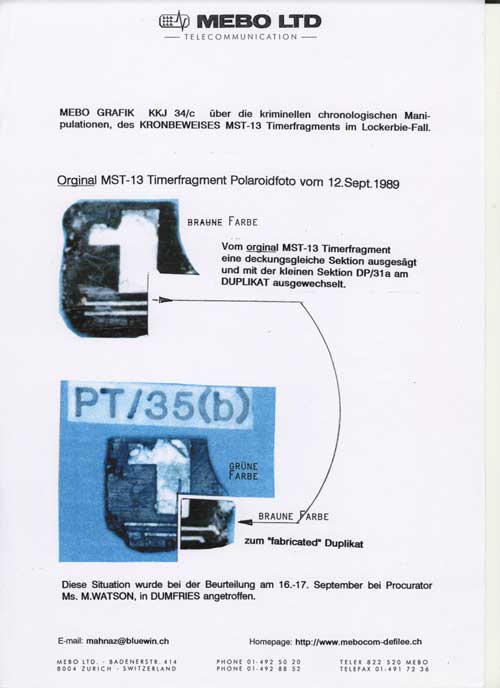
Originally I had taken this to mean one small piece (the fragment) was presented, with the other piece (most of the board) chucked or whatever. However I'm now seeing a missing piece even of the small piece, and Mebo's "it was a fraud!" page seemed to be hinting at it when their site said the fragment itself, not the whole board, "was sawed into two parts in Scotland for forensic reasons." They specify that both were shown as evidence; "The large piece was given the police no. PT/35(b) and the smaller one was given the no. DP/31(a)." Looking back at the exhibit photo, it's got the label DP31 off to the side, right next to 35(b). Is the severed top shown off to the right, cropped off here along with the (a)? Mebo's take actually seems more on-target here after all. They seem to have decided it refers to the totally cut free lower-right corner section. The label does indeed point to that sector of the board, although it seems strange to log this as a separate piece of evidence, and it still leaves the top just gone.

The funny thing about this is, the Fraud page suggests first a full substitution - the forgers cut up Lumper's sample, as the original "brown" chip in the circled photo. Apparently they cut around the sideways letter "M" Lumpert scratched into it next to the "1" touch pad, to make sure he could recognize it later. In reality thisis more likely a fabric fiber like those hanging on the side, or perhaps some other illusion. But by Mebo's reckoning It wasn't til later that the perps realized it should be green, and this was after they'd cut up the brown one for "forensic reasons." In the exhibit photo "the larger piece," PT35(b), "was replaced with a green duplicate MST-13 fragment," carefully milled to mimick the original brown fake. This is known not so much by the color as the simple fact that "it can be clearly seen that no letter “M” was carved into it!" Oops! And for no particular reason I can discern, they decided the corner piece DP31(a) was actually from the brown original fake swapped back in to the swapped-out second replacement fake. Apparently they painted that section blue before fitting it in, so it would not stand out, since it doesn't. But you can't fool its designers, no! They see through any ruse no matter how imaginary it might be!
And nowhere in there, at least in graphics or English, did they make note of the missing top section as a glaring difference between the two fragments. For my part, I don't know what to make of it, and am willing to let it go as duly noted.