Showing posts with label Marquise R. Show all posts

Friday, January 22, 2010

HARRY BELL AND PAUL GAUCI ON THE DATE OF PURCHASE

TWO SHOCKING ADMISSIONS
[Pan Am 103 Series]
Adam Larson / Caustic Logic
January 23 2010


Among other points raised in a letter re-posted by Victims of Pan Am 103 Inc., Richard Marquise mused: “It was strange that of all the people in the world, Mr. Megrahi was in Malta the same day the clothing was purchased and was there the same day the bomb left on its fateful journey.” (emphasis mine)
I reminded him of the statement in the comments section at Professor Back’s blog, and posed the following five questions to him. Apparently he never caught them, as he never offered an answer.

1) Is it not strange that of all the days in the subset November 23 and December 7 you and the investigation had to pick the latter as the best fit for the purchase, even though that choice requires badly misreading the actual evidence?
2) What did the SCCRC find about the Christmas light going up?
3) What do local weather records say for rainfall on Dec 7 vs. Nov 23?
4) What do football schedules (Rome-Dresden) say about Paul’s absence at 6:50 pm? What does Paul say?
5) Why doesn’t November 23 work again, aside from Megrahi not being there?

For those who don't know, the clothes thought to have been packed around the bomb that took down PA 103, were traced to a shop in Malta and shopkeeper Tony Gauci, who eventually took $2 million to recall the purchase for investigators. He famously decided the accused al Megrahi resembled the purchaser a bit, and supposedly gave a date that made it at least possible for the accused to have made the buy.

The date was of key importance, and the absence of Gauci's brother, Paul, at the time of the purchase was a key to narrowing that down. Paul was at home in the evening to watch a football game, which was narrowed down to one of two Rome-Dresden matches, on November 23 or December 7 1988. For the earlier date, the accused purchaser, al Megrahi, has a solid alibi of being not on the island. For the latter date, he was present, and the prosecution decided the purchase occurred on December 7. Many have suspected it was Megrahi's presence, and not the clues provided by the Gaucis, that caused them to chose the date. This would seem a hard point to prove, but not at all difficult to indicate. (The following points will be more fully explained and sourced elsewhere - this is just a summary.)

The purchaser Tony remembered came at around ten 'til 7 pm, as Paul was watching his game at home. The December 7 game was aired app. 1-3pm local, while November 23's was aired app. 7-9 pm local. The math is clear. Tony recalled specifically the Christmas lights in his neighborhood were not yet up. As the Scottish Criminal Case Review Commission (SCCRC) found years later through new evidence, those lights went up on December 6, meaning his memory if on December 7 would have been recalling they were up, had just gone up. On the 23rd, the neighborhood was still dark and cheerless, as he first recalled the evening. He recalled the purchaser bought an umbrella to deal with the rain outside. Weather records show appreciable but light rainfall in Silema the evening of November 23, but December 7 shows up dry as a bone for that time frame and all day, Island-wide.

Is that confusing, unclear, or ambiguous? The investigators were later clear that December 7 was the obvious choice and the true one, but seem to have been confused, admitting it when pressed. Detective Inspector Harry Bell, who headed the Scottish police effort on Malta and was the main contact point for the Gaucis, was interviewed in 2006 by the SCCRC. Some extracts were re-printed in Megrahi's rock-solid grounds of appeal. Excerpts from there:
DI Bell SCCRC interview (25-26/7/06)
"...The evidence of the football matches was confusing and in the end we did not manage to bottom it out..."
"...I am asked whether at the time I felt that the evidence of the football matches was strongly indicative of 7th December 1988 as the purchase date. No, I did not. Both dates 23rd Nov & 7th Dec 1988 looked likely.
"...It really has to be acknowledged how confusing this all was. No date was signficant for me at the time. Ultimately it was the applicant's [Megrahi’s] presence on the island on 7th December 1988 that persuaded me that the purchase took place on that date. Paul specified 7th December when I met with him on 14th December 1989 and I recorded this..."
[Source: Grounds of Appeal]

The bolded is a shocking admission of just what many had guessed. And then, almost as an afterthought (and a quick one I'd venture) "Paul specified 7th December" as the right day, during a meeting of "14th December 1989." He even has the date memorized! No direct quotes provided there of this meeting. But two months earlier, in a 19 October meeting with the same Harry Bell, he clearly specified the other day. In a police report obtained by Private Eye and published in Paul Foot's 2000 booklet Lockerbie, the Flight from Justice, Mr. Gauci said:
“I was shown a list of European football matches I know as UEFA. I checked all the games and dates. I am of the opinion that the game I watched on TV was on 23 November, 1988: SC Dynamo Dresden v AS Roma. On checking the 7th December 1988, I can say that I watched AS Roma v Dynamo Dresden in the afternoon. All the other games were played in the evening. I can say for certain I watched the Dresden v Roma game. On the basis that there were two games played during the afternoon of 23 November and only one on the afternoon of 7th December, I would say that the 23rd November 1988 was the date in question.” [Foot, 2000, p 21]

If indeed the man was specifying the desired date two months later, that's a second admission from Bell. By December 1989 at the latest, they were trying to implicate al Megrahi, and had been trying to long enough that Paul Gauci had taken the hint.

This makes it clear why, despite his specific and useful memory, Paul was not called to give evidence at trial, and reports like this from 19 October were likewise not produced. He did however manage to secure a $1 million payment himself, probably informal sharing rights on his brothers two mil, and the same DoJ witness relocation/protection/silencing program as his brother. Three million will buy a lot of shrimp for the barbie, and it already bought the Americans one of four planks they needed to get their political fantasy to become legal reality.

Tuesday, October 27, 2009

PT35 MOVE CLAIMS, pt. two

THURMAN AND PT/35(b): ”MONTHS” WITH THE “REAL THING”
[Pan Am 103 Series]
Adam Larson / Caustic Logic
October 27 2009
last update/edit 11/5


Shuttling: The First 17 Months
Part one of this series covered the 2008 interviews revealed in Tegenlight: Lockerbie Revisited, which showed a contradiction in whether the fragment of circuit board, PT/35(b) was taken to the United States. FBI SCOTBOM chief Richard Marquise and identifying FBI agent James “Tom” Thurman both told interviewer Gideon Levy that the fragment was brought to Washington and examined there, whereas British authorities and Marquise (after a short-lived change of memory) refuted the claim, insisting it stayed in the UK. This part will cover the entanglement of this evidence and agent Thurman throughout the Lockerbie case and beyond, drawing largely from the writings of Marquise. The special emphasis is on clues about whether Thurman worked from a photograph of the evidence or from the real item, as he told the documentary.

A 1991 Miami Herald article reported that Thurman was first sent to Lockerbie, on behalf of the FBI SCOTBOM investigation, two days after the December 21 explosion to help in “combing the countryside for clues." He worked right through Christmas, and in “about two months at the scene,” the article continues, he “pored over thousands of pieces of evidence.” [1] According to FBI task force chief Richard Marquise, however, the intrepid special agent had returned from Scotland by Jan 19 1989, when he gave a briefing to the FBI confirming prior assumptions that a bomb was responsible. [2, p.35]

Thurman returned to Lockerbie several times, shuttling across the Atlantic and even further out into the field, as initial clues converged on a PFLPGC attack perhaps involving Jordanian agent and bomb-maker Marwan Khreesat. Marquise reveled that “Thurman had been part of the team that interviewed Khreesat” in Jordan, November 1989. [2, p.60] This special interview, carried out with CIA brokerage, and its (reportedly ambiguous) results were kept from Scottish investigators, causing some tensions later.

On Jan 10 1990 new Senior Investigating Officer Stuart Henderson (who replaced John Orr) presented at a meeting in the UK. He did not mention the timer fragment to all, but off to the side told Marquise and FBI’s ASAC John Kelso about it. They showed interest in helping find a match, but Henderson insisted on going it alone. “This decision cost us six months,” Marquise writes. [2, p.58]

On Cloud Nine: June1990-November 1991
Actually it was five months delayed; it was at an investigator’s conference in Virginia on June 11 when Marquise relates how the Scottish authorities finally made their puzzlement over the fragment known to all – 55 companies checked to no avail. Thurman “approached Henderson and asked if he could take photographs of PT-35 and attempt to identify it. Henderson, who believed the Scots had done all they could do, agreed.” [2, p 60] This passage is crucial to move claims, and rather ambiguous. It seems to read that Thurman, in Arlington, was allowed to take a picture of evidence Henderson had there with him. It could also mean a request to retain one of the photo-prints there, or to take a picture of the single photo they brought, or fly to Scotland to photograph PT/35(b). The last option seems out, given the mechanics of identification that followed. I remain agnostic on the reading here, and on its value as one of Mr. Marquise’s sometimes confused recollections.

The Herald decided after talking with Thurman that he “meticulously compared the picture of the fragment to hundreds of other devices,” a lengthy-sounding process. [1] The agent told the show Air Crash Investigation (in early 2008?): “I spent, uh, months, literally, looking through all about the files of the FBI on other examinations that we had, uh, conducted over many many many years. […] After a period I just ran out of leads” and was forced to look “outside the physical FBI laboratory.” [3]

But Marquise said “what Thurman did yielded fruit within two days. […] Henderson and his colleagues were on an airplane headed back to Scotland;” having just left from the Virginia conference, and the discovery “would turn Henderson around quicker than he ever imagined,” putting them back stateside within 24 hours of the discovery. Further evidence against Thurman’s months claim is his own well-memorized “day that I made the identification,” recalling it as one would a wedding anniversary: June 15 1989. He had four days tops to get this grueling season of cross-checking out of the way.

What Thurman did, Marquise sums up, is know where to look. He took the photo to a CIA explosives expert “Orkin” (real name unknown), who helped locate files on a possible fit – a circuit board style found in an unclear number of timers confiscated, by the CIA, in African nations Togo and Senegal in 1986 and ‘88 respectively. The Senegal timer had somehow gone missing, although there was a photo of its circuit board, but the Togo timer was physically available for Thurman to look at the board inside. Upon confirming the similarity, “within a few minutes, literally, I started getting cold chills,” he told Air Crash Investigation, a feeling that still haunts him since he “can still see that moment so vividly in my mind.” [3] That he got these chills only after getting access to the CIA’s special stores is proof the Agency is right to claim much of the credit, for the discovery, as they have in places: “the CIA’s most important contribution in helping secure the conviction” was “when a CIA engineer was able to identify the timer […] shifting the focus of the probe from a Palestinian terrorist group to Libya.” [4]

Later a marking saying MEBO, scratched out, was identified on the Togo timer’s board. Thurman has claimed he and others labored over this, contacting manufacturers trying to identify “M580” for some time before accepting that it was Mebo, the name of a Swiss firm supplying timers to rogue governments, including Libya. Thurman said they had “some inkling that’s what it was from the beginning, but we didn’t want to say okay, it’s Mebo’s exclusive, anything else, until we were absolutely certain” that the letters on there were indeed M-E-B-O. [5] Then they decided it was definitely Mebo’s exclusive for Libya only and only usable by Libyans and unable to fall into anyone else’s hands. Except the CIA, but they can still account for 50% of the ones they’ve been known to intercept.

Marquise later enthused how Thurman’s immaculate forensic work “quickly put us on a new track leading to the eventual solution,” a solution that shaped up into the indictments of al Megrahi and Fhimah on Nov 13 1991. This was Thurman’s prime-time moment and he seized it, doing his now-famous Nov 15 interview with ABC News, followed by other moppings-up of public adoration, like that Miami Herald article (Nov 30), where he sounded like a laid-off Don Henley lyricist: "We're the blacksmiths of the FBI. The nuts and bolts. We get extremely dirty, actually, filthy dirty. … your adrenalin is pumping. You can't sleep." Driven by “his curiosity, coupled with a sense of duty and empathy for the victims … he didn't stop until he linked the bomb to the Libyan government.” [1] Once he had done so with “conclusive proof,” he told ABC, what he felt was "absolute, positively euphoria. I was on cloud nine." [6]

After the High: 95 to Present
This euphoric winning streak continued for Thurman, and he went on to big things, like pursuing the domestic terrorists behind the Oklahoma City bombing in 1995. But somehow, extended highs like this are often followed by a crash; starting in autumn 1995 charges were publicized that agent Thurman and his explosives unit “routinely” manipulated findings to favor the prosecution in at least two cases, including OKC. A 1997 Justice Department Inspector General investigation found Thurman to have no expertise in explosives at all, being a political scientist, not forensic, by training. After this he was formally barred from working in the crime lab or giving expert testimony in trials, and then “retired” from the bureau. [7]

This casts new light on his statements to ABC in '91; upon the match, “I knew at that point what it meant. Because if you will I‘m an investigator as well as [read political scientist instead of] a forensic examiner. I knew where that would go.” He told them the board pattern similarity “really just jumps out at you … when you look at it under a microscope.” It is always startling the first time you look into one, isn’t it? Upon leaving the bureau, Thurman went on to teach explosives investigation at East Kentucky University - sort of an honorarium it seems.

It was there that the now-bearded professor accepted an interview from the BBC program Dispatches. Aired for the 10th anniversary in December 1998, the interviewer challenged him, as Levy later would: “I’m surprised that you only worked from a photograph. Umm, this can’t be ideal, um, an ideal way (inaudible).” [8] Considering with real physical evidence you can examine it in 3-D, measure its layering composition, and the nature of blast damage (gas pitting, etc.), this is a rather good point. But Thurman, missing that completely, responded quite differently than he would ten years later: “Actually, in a case like this it’s much better than the actual item. Because the photograph enlarged it, how many times? Uuuh… a number of times. So you can see the detail with the naked eye in that photograph, that you can’t see on the actual item, without the aid of a microscope.” [8]

Later he told the interviewer “See, the only thing I have is the photograph.” When challenged “but you said a photograph’s as good as the fragment,” he said “yeah, but at the same time, you can’t - it’s difficult to make an actual measurement through - through here (tapping pictures)” [8] There is so, and it’s called “scale.” What you can’t tell is things beyond the surface pattern similarities - the actual forensic details. All he did was look at a photo and a model timer and decided they were the same pattern, as any six-year-old and some dogs could do. Questioning his credentials in this area seems a little disingenuous, to say the least.

Then of course we have his 20th anniversary story shown in Lockerbie Revisited, where he told Levy “I did the real thing ... I had the real piece of evidence. … The photograph was the first thing, then the real piece of evidence was brought over … It wasn’t just a photograph.” He’s done too many interviews, giving us many points to analyze patterns. The guy clearly has a penchant for emphasizing the reality, the intensity, of things in a way suggesting some underlying dissociation. (eg, heavy use of “actually,” “literally,” “physically,” and absolutes: “absolutely,” “positive,” “certain,” “forensic,” etc. ) He seems to harbor few, but loud memories that like to exaggerate themselves. They change over time in detail, but not in volume or the tone of self-congratulation for his own rigorous diligence. Or are these really memories?

Sources:
[1] Roser, Ann. “'Nuts and Bolts’ Work Pays Off in Lockerbie Probe.” The Miami Herald. Published November 30, 1991. Link.
[2] Marquise, Richard. SCOTBOM: Evidence and the Lockerbie Investigation, Algora Publishing. Sept. 1, 2006. 268 pages. Google Books.
[3] Air Crash Investigation: Lockerbie. Season 6, episode one. Aired 2008. Youtube link.
[4] http://www.afio.com/sections/wins/2001/2001-06.html
[5] The Maltese Double Cross - Lockerbie. Film, Hemar Enterprises, 1994, 156 minutes. Written, produced, and directed by Allan Francovich. Wikipedia page - Google video (1hr, 6 min in)
[6] Biewen, John and Ian Ferguson. “Shadow Over Lockerbie: Mass Murder Over Scotland.” American Radio Works, National public Radio. March 2000. http://americanradioworks.publicradio.org/features/lockerbie/story/printable_story.html
[7] Peirce, Gareth. “The Framing of Al Megrahi.” September 24 2009. London Review of Books. http://www.lrb.co.uk/v31/n18/peir01_.html
[8] Dispaches: The Lockerbie Trial. Reporter: David Jessel. A Just television production for Channel Four Television. Aired December 1998. Video (MP4)

Friday, October 23, 2009

PT/35 MOVE CLAIMS, pt. one

"IT WAS NEVER IN THE UNITED STATES?"
[Pan Am 103 Series]
Adam Larson / Caustic Logic
October 23 2009
last update 10/28


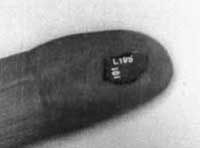
The recent hubbub regarding overly-mobile Lockerbie evidence started with Dutch journalist Gideon Levy’s early 2009 video Tegenlicht: Lockerbie Revisited. It’s a well-made video, with good music, some informative bits, and an unusual format of having interviewees watch and respond to recordings of others. Its prime focus was the crucial evidence PT/35(b), the Mebo timer fragment “tying” the bombing back to Libya. It’s therefore a little embarrassing that Levy announces another famous fragment, of general Toshiba circuit board displayed on a fingertip – as the article in question. This confusion surfaces elsewhere in the film, but manages to not become a big deal.

The main attraction that has generated some buzz was a curious discrepancy revealed and captured regarding the whereabouts of this historic find during the course of the investigation. As evidence from Scottish soil it was, should have been, in control of the Scottish police investigation, headed by the Senior Investigating Officer (SIO), a spot first held by Detective Chief Superintendent (DCS) John Orr (Strathclyde police, now Sir John Orr), and then by Orr's deputy, DCS Stuart Henderson (Lothian and Borders police, whom we meet below). The Scots would work in tandem with – but not give their evidence to – the American FBI's task force for the "SCOTBOM" investigation.

Officially the fragment was definitely taken outside Scotland - in the proper hands - to a RARDE lab at Kent, England and, as we’ve more recently had confirmed, to a private lab in Germany, both times for forensics testing. The understanding of then-Lord Advocate Lord Fraser of Carmyllie, which should have been quite good: “As far as I’m aware it’s always been in the UK,” he told Levy’s camera in 2008. He obviously didn’t know everything.

Besides the trips to England and Germany, which neither Lord Fraser nor Gideon Levy seemed aware of, there’s an alleged journey by this little blue key across the big blue sea to the United States. In the first of two interviews with Levy, FBI SCOTBOM chief Dick Marquise casually states that this one crucial piece of evidence, and nothing else, physically was brought to the FBI’s main lab in Washington.
“I’ll just tell you, not one piece - no I shouldn’t say that – the evidence – no, I’m not choosing my words carefully, I just want to make sure I say the right thing – all the evidence that was found in Lockerbie never made its way to be examined by the FBI laboratory. PT/35, as far as I remember, was the only piece of evidence that made its way to the laboratory, in the possession of a RARDE examiner. He brought it, he did the comparison, and he’s a scientist, and he took it back.”

Well that's an interestingly worded twist to the story. FBI Special Agent James “Tom” Thurman, the man publicly credited with making the identification of the fragment as from a Libyan-supplied MST-13 timer, on June 15 1990, also made an appearance. Levy caught up with him, wearing his years well in retirement, at a December 2008 ceremony to marking the 20th anniversary of the Lockerbie disaster. Levy came across a bit wormy, in my opinion, using the solemn ceremony mostly to make Thurman squirm and deny he was dismissed from the FBI for altering evidence. More to the point, he challenged Thurman if comparing with a photo – as he has previously stated – was really scientific. Thus provoked, he responded:
Thurman: I did the real thing ... I had the real piece of evidence.
Levy: That pointed to Libya.
Thurman: Absolutely. Absolutely. The photograph was the first thing, then the real piece of evidence was brought over. And at that point –
Levy: It was – it was on your finger, the chip was on.
Thurman: At that point - then there was a one-to-one identification made. The real piece of evidence, to the timer, the MST-13 timer, was made in the FBI laboratory. It wasn’t just a photograph. The photograph started it, and then the authorities from England brought over the real piece of evidence. That piece of evidence was examined in the FBI laboratory, along with the MST-13. That examination was verified in the forensic science laboratory, in England. So, it wasn’t only my examination, it was verified by other peoples’ examination as well.
Suspicions condensing around the Thurman link here is natural; PT/35(b) was apparently taken outside normal channels to his lab, and put under the grip of a known manipulator of evidence. Problem is, the charges against him were not over physically altering physical evidence, but for his explosives unit allowing conclusions to be overstated in the prosecution’s favor, in multiple instances unrelated to this one. Agent Fred Whitehurst told Levy how Thurman altered his reports when he deemed that his own political science training trumped Whitehurst’s chemistry smarts.

This will and certainly should cast doubt on Thurman's general investigative even-handedness and his certainties over his own lab work (“I knew we had it,” it "absolutely, absolutely" implicates Libya, etc.). In fact why Thurman was selected is beyond me – any idiot with the two photos could affirm they’re the same, and this selectee has become a real liability. All the rage at the 1991 indictment, he was discredited and never called as a witness by the time of the big trial at camp Zeist in 2000.

But presenting this side-by-side with concerns over the “tampering with” of this evidence once taken somewhere dangerous is quite leading. The fact is, I can see no sign of tampering with the evidence, nor much of a reasons to suspect it. The problem is the thing itself, not where it was taken and who touched it in these dark corners.

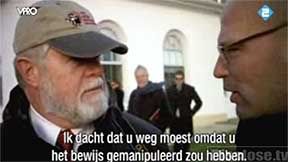
At that same chilly cemetery, as the people were leaving to more private venues, Levy caught up again with Mr. Marquise, as it so happened accompanied by his Scottish counterpart DCS Henderson. When standing side-by-side with the prime guardian of that fragment Marquise was of a different recollection altogether from his first interview. Levy was granted an answer to one question, and that's about what he asked, for almost four minutes.
Levy: When I asked Lord Fraser about the circuit board, he said something that contradicted what you said. He said it had never been to the United States. And if it was in the United States, then he would have known.
Marquise: No, I don’t know that I told you the circuit board was in the United States.
Henderson: The circuit board was never in the United States.
Marquise: Let’s back up, we’re talking two different things. There was a circuit board of MST-13 timer in the United States, but the fragment PT/35 was never in the United States. Photographs of it were in the United States.”
Levy: It was never in the United States? (murmured agreement) Oh, I thought it was…
Marquise: No the fragment never came to the United States, but the circuit board was in the United States, because we had the MST-13 timer, which we turned over to the police in Scotland.
Levy: Ah, but but… Tom Thurman, who was here today, also said it was in the United States.
Marquise: No, he never said that.
Levy: No?
Marquise: The fragment PT/35 was not in the United States.
Levy: But it was in England, but it came…
Marquise: It never came to the United States
Levy: It never came to the United States.
Marquise: I don’t believe so – I’m 100% sure it was not here.
Levy: Oh, it has never been here.
Henderson: Never released out of evidence control of ourselves. Couldn’t afford to let something like that …
Levy: I thought it was brought in the possession of Alan Feraday.
Marquise: Feraday’s over in RARDE. He’s in England. It’s in his possession.
Levy: Yes, yes, but I thought he came – I thought you told me that it came in his possession to the United States.
Marquise: I don’t know that…
Henderson: His possession and my possession. But it was never released for any reason (inaudible).
Levy: And who are you?
Henderson: Detective Chief Superintendent Henderson, I conducted the investigation.
Levy: Okay. My name’s Gideon Levy, and I’m from Holland - from the Dutch television. So it has never been in the United States.
Henderson: Confirmed

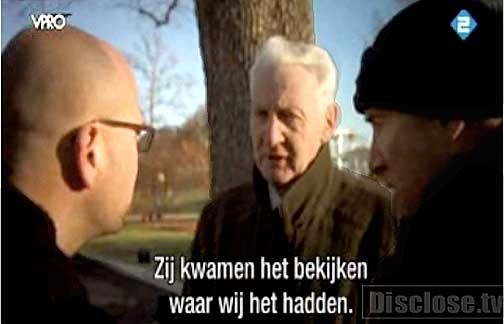
From the video: Levy, Henderson, Marquise (l-r) discuss whether or not it was ever in the United States. But it wasn't? No, wasn't it?
Levy: At all.
Henderson: Couldn’t be, ‘cause it was such an important point of evidence it wasn’t possible to release it. It had to be contained to be produced to the Court, therefore you couldn’t afford to have it waved around for everybody to see because it could have got interfered with.
Levy: Aha
Henderson: So it was far too valuable to be other than made available – couldn’t be.
Levy: Okay
Henderson: Very valuable piece of evidence.
Levy: (shouting over) But you said it was in the possession of Alan Feraday and brought to the United States.
Marquise: You know, its – you’ll have to talk to Alan Feraday about what he brought to the United States. I don’t remember…
Henderson: Alan Feraday had it in his possession with me, but he did not release it to anyone
Marquise: No, no, no, he said bring it with him. Did he bring it to the, I don’t remember.
Henderson: No, they came to us to see it.
Marquise: Yes. I saw it – I saw it in London.
Levy: Oh, you saw it in London?
Henderson: They came to where we had it, see. Because it wasn’t possible to remove any evidence out of the jurisdiction of the – Scottish control.
Levy: So you were the same – you were the FBI investigator and you were the Scotish investigator. Ultimate inestigators.
Both: affirmations
Levy: Okay.
Henderson: That’s why I’m here, to go and see the relatives.
Marquise: We need to go.
Henderson: We’ll have to go. Pleasure to meet you, gentlemen.
Levy: Thank you very much.
Henderson: And by the way, there is no hidden holes to find because the culprit is in custody. (with a smile and wink) Take my word for it. Okay?

So I would come away from this with an impression that it may well have not been in the United States, whatever Marquise and Thurman said to same guy ten minutes earlier. But I’m weird hat way, denying Henderson’s bait that I imagine was dangling there. A more normal reaction would be to get a little confused, and for many to solve that by taking their own default position. Some would just dismiss this all as faulty memory two decades on, while others will surely latch onto it as more proof of a cover-up, or at least something to make some more noise over.

My main concern with PT/35(b) is that this much-fretted over fragment may have been planted outright to begin with, or at least has been overstated as direct evidence pointing only to Libya. This hullabaloo about where the possible fraud was carted to adds little to an understanding of either level of worthwhile inquiry.

Update, 10/28: Something I saw later that fits best here: Marquise's unacknowledged about face here was short-lived. In September 2009, months later with Henderson not present, he again affirmed an American trip. This was in a response to Gareth Peirce, and sent into Robert Black's blog. I haven't been able to verify it, so do please take a grain of salt:
Once he identified the fragment, he asked Alan Feraday to come to Washington. Feraday brought the original fragment of the timer with him and they both examined it under a microscope. They independently agreed it was identical to the MEBO timer. The fragment was never out of the control of Mr. Feraday and returned with him to the lab at RARDE.


Second update, Nov 24 2009: Mr. Marquise responds to the confusion that indeed the fragment did come to the US, and he and Henderson were both confused by the tone of Levy's Arlington ambush. Again from Black's Lockerbie Blog:
With regard to the "travel" of PT-35-- once again-- it was the sharing of information which led to the solution of this case. If the fragment had remained behind in Scotland, never shared, it would possibly be unidentified today. No one would ever have discovered it was a piece of one of 20 timers given to Libyan intelligence. It is clear no one ever attempted to "cover" that up-- I freely admitted it in my book, Mr. Henderson stated such in his precognition and I again said so to Mr. Levy. My "confusion" at Arlington last December over whether it had come to the US or not, was due more to the tone of the question, the setting and the allegation I may have lied to him when he first interviewed me. Unlike Mr. Megrahi, I do not tell lies when it comes to the evidence in this case. I said it right when Mr. Levy first interviewed me. We had nothing to hide because we did the right thing and there has never, never, never been one scintilla of proof that PT-35 was altered or changed in any way.