Showing posts with label NSA. Show all posts

Wednesday, July 8, 2009

TELEX AND TAPES, PART FOUR

THE FINAL WORD: 2001-2007
Adam Larson / Caustic Logic
[USS Liberty series]
July 8 2009, last update 7/31


RESPONSIVE RECORDS
Apparently spurred by the Bamford/Nowicki revalations about recorded intercepts of the Liberty attack (as covered in part two), Judge A. Jay Cristol moved to have any such tapes declassified, He was probably confident they would show what he knew the IDF communications to show (as covered in part three) – the attackers had no idea they were attacking an American vessel, and all IDF parties missed the U.S. flag until well after they had stopped “screwing her.” Cristol filed a FOIA request with the National Security Agency (NSA) in April 2001 for release of any transmissions, on the day of the attack, to or from USS Liberty, USS Amberjack (submarine, long story), or the EC-121 everyone was talking about at the time. [1]

The judge gave them nearly two years before deciding the agency had “failed to comply” and he launched a lawsuit, via the U.S. District Court for Southern Florida, in January 2003. [2] This was sufficient to jar things loose; after a brief back-and-forth over details of the request, successful declassification was announced by the NSA’s Director of Policy on July 2 2003. Searches for the first two, anything from the ephemeral Amberjack or from spy ship Liberty (verified to be near the attack) revealed “no records responsive.” However the then-secret agency did manage to gather some intel from the plane, on tapes they still had around. These were declassified, and sent to Cristol in original audio and translated transcripts. [3] These amazing primary source materials arrived only after his book had been printed, but he was missing less than you might think - the 2003 release is far more noteworthy for what it doesn’t clarify than what it does.

THE CONTENTS: REALITY OR RITUAL?
The tapes are of voice communications, in Hebrew, and cover the time frame 1429 to 1519 local time. The start point of 2:29pm is about 15 minutes after the air attackers left, and six minutes before the MTBs fired their torpedoes. Thus it starts within “the attack” time span, and ends at 15:19, a few minutes after the flag was reported by the helicopters. The 50 minutes of audio between is only of talk between the “Super Frelon” helicopters and their IAF controllers at Hazor Airfield. These two birds were never involved in the attack and only arrived well after it was done to assess the situation and offer any help needed (opinions on the type of "help" intended differ). Most of the intercept is long, dull stretches of “are we there yet?” “Where are you?” “We’re over here” type chatter. Both audio (.wav) and transcripts (.pdf) are available for download here.

The tapes do show, on this limited level, an apparent confusion about the nationality of the crew, perhaps reflecting the back-and-forth between the "hunches" of some and the heedlessness of others. En route Hazor tells them the target is an Egyptian warship, and then and Egyptian supply ship. Then some doubt becomes evident just before they got on the scene; since there was supposedly “no flag on her!” it was to imperative to figure out where they came from. It was decided that only pulling survivors from the water or landing on the ship and interrogating them would do, and both options were discussed. English or Arabic were the specified languages to listen for. Someone was always wondering about "Americans," even though they supposedly had no reason to (see hunch link and part three) until after the flag was seen. But here it starts just before.

Upon arrival, the first helicopter reports the hull number again as “CTR-5” (which still meant "noting") and no visible flag, while the second apparently reported the American flag. This must occur somewhere a little before 15:12 (around 22:50 in the audio of tape 105). Although he’s present earlier describing the scene, and does seem to confirm with the controller after this, the pilot is not to be heard actually reporting a flag, on the audio or paper versions. Preceding the flag talk is at least two minutes of the controller talking one-way with no audible input from the helicopters. At 13:10:06 he warns the pilots to “watch out for the mast there,” which is where the flag should be seen. No response. Twenty seconds later he tells the lead pilot “take 810 with you, you’re both returning home.” Again no pilot response is heard. Thirty-six seconds later Hazor says, per the transcript:

13:12:03 Hazor: RGR, QSL, I understand.
13:12:08 Hazor: RGR, understand. Did you clearly identify an American flag?
13:12:13 Hazor: Thanks (Toda), stay over the area for now.

After an eight-second pause, the pilots finally pipe in, with the distinctive “choppy” chopper signal.
13:12:21 Pilot: [unknown statement, 3 sec, transcribed as “(CL)”]
13:12:31 Pilot: [unknown question, 1.5 sec, as “(CL)”]
13:12:36 Hazor: [answer, question, as “(CL)”]
13:12:40 Pilot: [short answer, not transcribed]
13:12:41 Hazor: They request that you make another pass and check once again whether it is really an American flag.
13:12:45 Pilot: RGR.


As on paper, the question in voce “did you clearly identify an American flag?” (22:59 in the wav audio) seems to come from nowhere. He was already aware that English might be spoken on the ship, and had seemingly heard nothing about such a sign, or anything at all, from the birds on the scene. Was he asking them to go ahead and verify the question scrawled on a napkin and slipped to him, after switching their channel back on? Sometimes these tapes sound more like ritual than reality.

RESPONSIVE REFLECTIONS
This release by NSA at the least failed to specifically contradict the IDF’s story that only the helicopter pilots spotted the flag. It supports it indirectly, in that the Hazor controller was certainly privy to no conclusive American ID, although he had the notion. However, the public had yet to see the rest of the recordings, the parts with the actual attack, during which the flag was also mentioned (according to the preponderance of American witnesses). Left hanging, different people drew different conclusions.

One side claimed, as they always have, that the issue was now closed. Judge Cristol told CNN in July "I don't think there's any question that anyone who reads these tapes would be absolutely convinced there was the fog of war out there […] I think this is probably the most important link in the evidence that ought to bring closure to this matter," Cristol said. [5] Somewhat more mildly, Israeli Embassy spokesman Mark Regev told CNN the tapes served as "further evidence that the Liberty incident was a terrible and tragic case of mistaken identity." [6] A July 9 Ha'aretz article, widely re-printed, was poorly titled "U.S. agency confirms sinking of USS Liberty was accident." [7]

Proof that it wasn’t fully sunk, Liberty survivor and early revisionist James Ennes, wrote in September that the ship’s crew “were pleased when we learned in June that apologists for our attackers had asked the federal courts to order the release of key intercept transcripts compiled during the attack.” He was confident that such tapes “would prove our case and disprove that of the apologists,” but “instead of releasing transcripts of the attack itself,” the NSA only put out tapes of the helicopters that “came afterward to clean up,” as he ambiguously describes their mission. [8]

Ennes finds that “nothing in the documents released suggests that [the attack] was an accident.” [9] To be fair, the tapes do show apparent confusion vis-a-vis the ship’s nationality, and other IDF records generally line up on the same confusion, with Soviet thrown into the mix at least at one point. [10] To me it’s exactly this confusion that makes no sense, given the broad sweep of ignorance required, making it less “fog of war” than “super-dense thunderhead of war.” Far more blinding, that, but it requires special conditions to form.

Even accepting the confusion in these tapes as genuine, characterizing it as proving the accidental attack theory is both misleading and common. “To our astonishment,” Ennes wrote, perhaps sarcastically, “the pro-Israel PR team put their own false spin on what was released. […] This false account was […] repeated as established fact - often with quotes from Chief Apologist A. Jay Cristol, proclaiming victory.” [11] A Baltimore Sun article from July 16 published some Cristol’s triumphant proclamations:
“[Cristol] says the recordings support his conclusion that the Israeli attackers had no idea they were targeting a U.S. vessel. […] "these tapes contain nothing showing that the attack was deliberate […] to me at least, they show it was a mistake […] nothing more of significance [remains] to be found. I think it will settle the matter for all but that 2 percent of die-hard conspiracy theorists.”” [12]

I suspect his math is wrong here on the numbers who would refuse to be distracted, it’s true that the “die-hards” (they survived rockets, napalm, torpedoes) were among them. So was Steve Forslund, who responded to these “only and final "tapes" that the NSA has released” in his statement to the Liberty Survivors' Assn. “Parties state that these are the only tapes of intercepts that exist. That may very well be true, now.” [13] But he apparently remains as steadfast as ever that the actual attack traffic was intercepted, transcribed in English and printed at his station at Offutt AFB, and showed an assault proceeding despite flag reports and pilot protests (see part one). The Agency disagrees.

UNDER THE BUS
The chief NSA linguist aboard the EC-121 in question, Marvin Nowicki, had to be disappointed. Like Forslund and others, he felt the transmissions he captured were of the attack and featured the stars and stripes. In his version, of course, this stops the attack. Judging by his past advocacy for release of the exculpatory recordings he remembered, Nowicki likely did something about this snub, quietly and respectfully. But there would be no more; in early June of 2007 the NSA “finalized the review of all material relative to the 08 June 1967 attack on the USS Liberty. This additional release adds to the collection of documents and audio recordings and transcripts previously posted to the site on 02 July 2003.” What was added was fairly minor, and included no additional intercepts. Again, they clearly affirmed that all they got was "voice conversations between two Israeli helicopter pilots [...] following the attack on the Liberty." "No communications were available [...] that might reflect the attack or reaction," they regretted to inform the pubic. [14] that June 8, the exact 40th anniversary of the attack, was selected for this statement served to amplify the deliberate finality of it.

The telex witnesses of part one, and Nowicki and his teammate all maintained the tapes “reflected the attack” quite clearly, as well as the U.S. flag. The NSA acknowledges only recordings that mention the ensign but well after the attack. This is noteworthy in that it offers a plausible explanation – all these men simply heard this helicopter talk and read in that the helicopters were involved in a vicious attack. For comparison, the man who captured these signals for the NSA has said:
“For the record, we (my teammate and I) both heard and recorded the references to the U.S. flag made by the pilots and captains of the motor torpedo boats.” [15] “[O]nly later in the afternoon did we hear references to [the] flag during the attacks. [16] ”As I recall, we recorded most, if not all, of the attack.” [17]

There is little in these distinctive helicopter communications about seeing a ship and flying survivors to shore that could be construed as a two-phase air-sea attack being either carried out or called off. Nonetheless, many rational people will now conclude, however odd such a widespread embellishment seems, that they simply must have been confused.

So, Nowicki’s last chance had come and gone; the NSA decided everything it recorded can be released publicly, and his tapes weren’t on this last bus either. To mix metaphors, he was in fact left beneath this last bus as it rolled away into the night over his previous credibility. His tapes were never to return, obliviated down the memory hole. There’s been no comment since then, but his teammate – named as Michael Prostinak - was interviewed after this final thud, and told Chicago Tribune’s John Crewdson "I can tell you there were more tapes than just the three on the Internet," he said, referring to the NSA’s 2003 releases. "No doubt in my mind, more than three tapes." After inspecting these, “Prostinak said it was clear from the sequence in which they were numbered that at least two tapes that had once existed were not there.” These other tapes, unlike those released, contained clear language indicating an attack; Prostinak told Crewdson the people he heard “were not just tranquil or taking care of business as normal. We knew that something was being attacked." [18]

The agency disagrees.
---
Sources:
[1, 2] US District Court, Southern District of Florida. A. Jat Cristol v. National Security Agency. Case No. 03-20123. Stamped 21 Januart 2003. Accessed via: http://www.fas.org/sgp/foia/cristol.html
[3] http://www.fas.org/irp/nsa/liberty.html
[4] Hanley, Delinda. Those Not Invited to Speak Steal the Show at State Department Liberty Discussion. Washington Report on Middle East Affairs. March 2004. http://www.wrmea.com/archives/March_2004/0403009b.html
[5, 6] Ensor, David. “USS Liberty attack tapes released.” CNN.com. July 10, 2003. http://edition.cnn.com/2003/WORLD/meast/07/09/uss.liberty.tapes/
[7] Guttman, Nathan. “U.S. agency confirms sinking of USS Liberty was accident.” Haaretz. July 9 2003. Last Update: 09/07/2003. Found via: http://www.israelforum.com/board/showthread.php?t=3237
[8, 9, 11] Ennes, James M. “National Security Agency Documents on Attack on USS Liberty Prove What?” Washington Report on Middle East Affairs, September 2003, page 25. By James M. Ennes http://www.wrmea.com/archives/sept03/0309025.html
[10] See Division 914 War Log, 1451 entry. http://www.thelibertyincident.com/israellogs.html
[12] Shane, Scott. NSA tapes offer clues in '67 attack on U.S. spy ship. Baltimore Sun. July 16 2003. Found via: http://www.freerepublic.com/focus/f-news/947319/posts
[13] Forslund, Steve. Statement to USS Liberty Survivor’s Association. Undated (apparently 2003 or 2004). http://www.ussliberty.org/forslund.htm
[14] National Security Agency. Declassification initiatives: USS Liberty: What’s New? Posted January 15 2009. http://www.nsa.gov/public_info/declass/uss_liberty/
[15] Nowicki, letter to the Editor, Wall Street Journal. Published May 16 2001.
http://www.libertyincident.com/nowicki-wsj.html
[16] Nowicki. Exculpatory evidence supporting a mistaken attack
http://www.libertyincident.com/nowicki-evidence.html
[17] Nowicki. E-mail to James Bamforth [sic] March 3 2000. http://www.libertyincident.com/nowicki-email.html
[18] Crewdson, John. "New revelations in attack on American spy ship." Chicago Tribune. October 2 2007. Page 6. http://www.chicagotribune.com/services/newspaper/printedition/tuesday/chi-liberty_tuesoct02,0,1050179.story

Thursday, May 28, 2009

TELEX AND TAPES, PART TWO

THE MEN BEHIND THE TRANSCRIPTS WEIGH IN
Adam Larson / Caustic Logic
[USS Liberty series]
May 28 2009


NOWICKI AND BAMFORD: INFORMATION MISUSED?
Part one of this series listed the witnesses to secret attack-the-flag transcripts of the USS Liberty attack - translated copies of American (NSA) intercepts of the IDF communications proving the Israeli intent to attack a known American ship, for whatever reason. Therefore, perhaps the most informed witnesses would be the guys who made these recordings, apparently stationed on a US Navy controlled EC-121 aircraft circling 15,000 feet over the general war zone.

The plane was on a NSA SIGINT mission, and staffed to effectively spy on both sides. This plane contained the normal retinue of Russian and Arabic linguists, as well as three trained Hebrew Linguists (called “special Arabic” at the time). [1] Relative newcomers to the world of public scrutiny, two of the three NSA Jew-spying-spooks listening in from above have been named.

Dr. Marvin Nowicki is the more famous one of the two, starting with an e-mail to NSA’s nom d’plume James Bamford in March 2000, as he was assembling his magnum opus Body of Secrets. The insider enclosed five documents, including Assault on the Liberty: The untold Story from SIGINT, which explained their presence above the Liberty and what they heard there. This became the kernel of Bamford’s chapter on the attack, which came out highly critical of the IDF and supportive of the crew’s views. That Nowicki’s account was seamlessly worked into supporting this meant distortion was afoot, and he complained publicly in a letter to the Wall Street Journal:
“My position, which is opposite of Mr. Bamford's, is that the attack, though terrible and tragic especially to the crew members and their families on that ill-fated day in June 1967, was a gross error.” [2]

Accident advocate Judge Cristol took up Nowicki’s case, re-publishing this letter and all the materials sent to Bamford, who “claims the Nowicki letter told him that the tapes establish that the Israelis knew they were attacking a US ship,” Cristol explains. “Dr. Nowicki did not agree with Bamford's interpretation.” [3] The judge points to the e-mail and its five enclosures, which collectively offer a cogent and well-researched Cristol-light attempted absolution. He felt the attack on an ally was a mistake, and ironically that was from hearing and re-examining the same transmissions several others had said proved, once in print, that it was a purposeful decision. And his familiarity with the material didn’t end when he handed it over to the NSA’s analysts.
“[T]he next time I saw those voice tapes […]completely re-transcribed […] was over a year later when I was ordered to NSA for duty in 1968. […] Up to this point, I always felt the evidence we collected showed the Israelis attacked the Liberty by mistake in the heat of battle. All my conversations with colleagues in G643 and reading of the voice transcript confirmed as much to me.” [4]

The NSA had the audio, but decided against admitting it, or even acknowledging the plane was there. James Ennes’ 1979 book was written in complete ignorance of the flight, and it remained secret for another two decades past that. Nowicki’s second attachment explained his efforts to have it all publicized to quell the rumors.
"Several months before I retired in 1979, I even wrote a personal letter to the Commander of the Naval Security Group, Rear Admiral Eugene Ince, saying I thought it was time to make the information public. Admiral Ince surely knew about the VQ-2 tapes because he was the senior NSG officer on the staff of CINCUSNAVEUR in 1967 during the attack on the Liberty. I received no reply from him.” [5]

Nowicki points only to one phase of attack halting as evidence of mistake theory, which fails to explain why it was brutally resumed minutes later. Apparently the tapes would make it all clear once publicized. By 2000 this had still not happened, and we had only the chief’s account to Bamford, the case it was woven into for Body of Secrets, and the rebuttals.

IN HIS OWN WORDS: NOWICKI VS. IDF
It’s true that Nowicki told Bamford up-front that “our intercepts, never before made public, showed the attack to be an accident on the part of the Israelis.” [6] The author could have mentioned this sentiment in the book but failed to. Otherwise I see no misrepresentation. He simply used the words to support a general picture already painted by plenty of other people and evidence. His account is high-quality, detailed and well-assembled, and of clear historical significance. Some key quotes mined from the various sources [emph mine throughout], with comparative notes added:
"After a couple of hours of hard work, I received a heated call on the secure intercom from Hebrew linguist [deleted]. [deleted] excitedly proclaimed something to the effect, "Hey, Chief, I've got really odd activity on UHF. They mentioned an American flag. I don't know what's going on." I asked him for the frequency and rolled up to it. Sure, as the devil, Israeli aircraft were completing an attack on some object. I alerted the Eval, giving him sparse details, adding that we had no idea what was taking place. The activity subsided." [7]
By this, the chief missed some of the audio, including the flag report, before getting the phones on to hear the end of an air attack. Such a report is not in the IDF’s tapes at all, with no flag mentioned (except once in the negative – “there is no flag on her!”). Air Force recordings, as now available, make no mention of a US flag at all until the rescue helicopters arrive, shortly after 15:00 – a half hour after the attack was finally called off, and nearly an hour after the attacking jets left the area.
"After some time passed, Petty Officer [deleted] called me again. He told me about new activity and that the American flag is being mentioned again. I had the frequency but for some strange reason, despite seeing it on my spectrum analyzer, couldn't hear it on my receiver, so I left my position to join him to listen at his position. I heard a couple of references to the flag during an apparent attack. The attackers weren't aircraft; they had to be surface units (we later found out at USA-512J it was the Israeli motor torpedo boats attacking the Liberty). […] Despite replaying portions of the tapes, we still did not have a complete understanding of what transpired except for the likelihood that a ship flying the American flag was being attacked by Israeli air and surface forces." [8]

There’s a time delay after the chatter subsides, maybe correlating to the air-MTB intermission of about ten minutes. Then the flag was mentioned again, multiple times during the renewed attack by torpedo boats. This is a new twist the other witnesses didn’t catch. He feels it’s this flag report that finally has the attack called off. If they said U.S. flag multiple times and the EC-121 heard it, that’s interesting since any such report during this time failed to make it into either the MTB or Navy logs.
“My personal recollection remains after 34 years that the aircraft and MTBs prosecuted the Liberty until their operators had an opportunity to get close-in and see the flag, hence the references to the flag.” [9]
"Although the attackers never gave a name or a hull number, the ship was identified as flying an American flag." [10]
This is just about dead backwards from the IDF’s tapes of their communications. As I’ve found, their records show it was not a flag, but rather the hull number GTR-5, and perhaps the name Liberty, that had the attack called off twice. The second time it was said these indicated a Soviet ship.
“We have no idea what time any […] information about the American flag was made available in the war room. I think it was probably during the MTB attack because the torpedo boats halted their attacks when they could have finished off the Liberty.” [11]

We know now what time they claim anyway – 1512 local time. Torpedo hit was at 1435.
“[O]ur intercepts […] showed the attack to be an accident on the part of the Israelis.” [12]
“Our intercepts further showed that perhaps the attack was a mistake.” [13]

Just how? The fact that the "flag" stopped it? That's not the reason the IDF settled on. This dangerously aberrant version has direct knowledge of American ID running openly throughout the attack, rather than concealed in double-talk as it seems from the available sources. Any report of a flag failed to make it into the IDF air control tapes and failed to prevent the ridiculous re-identification as El Quseir leading to the deadly torpedo assault [see above link]. The recollection he shares does seem vague enough that it’s open to interpretation – in the same data one person might see intent, the other confusion. Both see the stars and stripes specifically failing to stop the attack, in direct contradiction of the IDF's documentation.

CORROBORATION: PROSTINAK COMES FORWARD
The “teammate” cited by Chief Nowicki, the one excited about "something crazy on UHF," is apparently Petty Officer Michael Prostinak. He did not talk to and remained unnamed by Bamford, but did come out in his chief’s wake and spoke to John Crewdson for his 2007 Chicago Tribune article. Since those days intercepting war chatter, Prostinak had settled down in a small North Carolina town to be chief of police and later a town administrator. He told the paper "everyone we were listening to was excited. You know, it was an actual attack. […] We copied it until we got completely out of range. We got a great deal of it." Although this accounts is much thinner, at least once edited into the article, it verifies Nowicki’s recollection of flag reports at this time: “During the attack was when mention of the American flag was made." Crewdson explains how “[Prostinak’s] Hebrew was not good enough to understand every word being said, but that after the mention of the American flag "the attack did continue.”” [14]

Again, Crewdson was able to “twist” this into fitting with the shoot-the-flag transcript reports. It wasn’t difficult, since it has more attacking after the identification, just like Nowicki’s account. Both the linguists’ stories differ from what other witnesses in some key ways - the flag is not apparently not reported before either phase of assault, and they mention no pilots protesting or resisting their orders. So far however, all knowledgeable American sources agree that the flag was reported by the attacking forces and this somehow failed to halt the attack. Prostinak does not say that it was an intentional mistake – for all we know, he feels it’s just a mix-up in communications. Nowicki specifically says it was accidental, but many others from a wider field reached the opposite conclusion on seeing it in print. Nowicki summed up the answer to the dilemma as well as the other side might:

”How can I prove [my version]? I can't unless the transcripts/tapes are found and released to the public. I last saw them in a desk drawer at NSA in the late 1970s before I left the service.” [15]

Apparently spurred by the Bamford/Nowicki revalations, Judge Cristol filed a FOIA lawsuit against NSA in April 2001 to get the tapes. Not far from his home turf, Cristol wrangled with the Florida district court system and NSA’s lawyers for release of any transmissions to or from USS Liberty, USS Amberjack (submarine, long story), or the EC-121 everyone was talking about [16]. The lawsuit would eventually yield results, but this would take years to unfold, and one more post, part three, before I can use that to close up this story line with a final twist in part four.

Sources:
[1] Bamford, Body of Secrets p. 205
[2], [15] Nowicki, Mavin. Letter to The Wall Street Journal. Published May 16, 2001, page A-23. http://www.libertyincident.com/nowicki-wsj.html
[3] Cristol. Nowicki Documents. http://www.libertyincident.com/nowicki.html
[4], [5] Nowicki, Marvin. Postscript to the attack on the Liberty. 2000? http://www.libertyincident.com/nowicki-ps.html
[6] Nowicki, Marvin to James Bamford. E-mail, March 3, 2000. http://www.libertyincident.com/nowicki-email.html
[7]
[14] Crewdson, John. "New revelations in attack on American spy ship." Chicago Tribune. October 2 2007. (Additional material published Dec 2). Page 6. http://www.chicagotribune.com/services/newspaper/printedition/tuesday/chi-liberty_tuesoct02,0,1050179.story?page=6
[16]A. Jay Cristol, Pro Se, Plaintiff, v. National Security Agency, Defendant. U.S. District Court, Southern District of Florida. Case No. 03-20123. Various documents. http://www.fas.org/sgp/foia/cristol.html

Monday, May 4, 2009

USS LIBERTY OFFICIAL INVESTIGATIONS

13, 12, 11, 10… COUNTDOWN TO TRUTH?
Adam Larson / Caustic Logic
May 1 2009
last update 5/4


A NUMBERS GAME
Terence O’Keefe, a writer for he Washington Report on Middle East Affairs, in a December 2003 article, took aim at – and sunk – a key argument of pro-Israel obfuscation artist Jay. A Cristol. In his 2002 book The Liberty Incident, O’Keefe explains, Cristol’s “mantra” was that "thirteen investigations have all exonerated Israel" for their 1967 attack. [1] I’m past my “viewing limit” for the book, but O’Keefee did offer a numbered run-down of them (largely reproduced below), which I’m relying on for my critique.

To get 13, and he could have actually claimed 14, Cristol includes three self-exonerating Israeli reports. The first two reports, Ram Ron’s and Yerushalmi’s, from 1967, are actually lumped together as one entry; as O’Keefe explains and my partial examination confirms, these were not investigations at all but part of an internal Israeli process to find if anyone in particular should be charged with crimes. They concluded there was no negligence in the incident acute enough for a trial. The second was an IDF “official” history in response to renewed controversy in the United States. It may have had an investigative element, but was primarily a synthesis, with wider circulation, of the 1967 reports. [2] In all three, the fact that the incident was purely mistake was the first assumption, and was never questioned or examined.

Considering that Cristol’s primary target audience is American, it would make sense then to just drop the two Israeli non-investigation, and focus on the US investigations, which would seem to number eleven. He apparently did at one point, and this assemblage echoed around the infoverse - Alison Weir wrote for Counterpunch in June 2007 to analyze USA Today's first-ever news story on the Liberty. Reporter Oren Dorell talked only with analysts “with ties to Israel,” and while he did feature survivor accounts, these were pre-empted with the caveat “Israel has always insisted the attack was a case of mistaken identity, and 11 U.S. investigations over the years have reached the same conclusion." [3] The list Weir recounts is O’Keefe’s findings minus the two Israeli entries.

One critic noted how at a 2004 book signing, “the haughty Cristol persisted with his bogus argument, at the signing, that there has been "seven investigations" that have exonerated Israel. (In his book, he claimed thirteen! Go figure.)” [4] Cristol’s site currently explains “after ten official US investigations (including five congressional investigations), there was never any evidence that the attack was made with knowledge that the target was a US ship.” [5] There has been some semantics-playing by Liberty supporters, about the lack of Congressional = lack of governmental, but the "mantra" on that side is there have been NO Congressional investigations, let alone five. [see below for details] The Numbers game aside, there have been investigations by elements of the U.S. government regarding the incident, and all have avoided outright claims of hostile intentions towards the US. They also do little else of any relevance to the question.

NAVAL COURT OF INQUIRY; “TOTALLY INADEQUATE”
Among the U.S. investigations, the first in time, scope, power, and importance is the Naval Court of Inquiry, ordered even before the Liberty finished its slow journey to safe harbor. Admiral John McCain II was put in charge of finding what went wrong; as commander of U.S. naval forces in Europe, he had wide subpoena authority and other tools available. These he passed on to his deputy, Admiral Isaac Kidd, who would preside over the Court. His first order of business, appropriate to an investigation, was to tell the Liberty crew to keep quiet. Unlike normal, however, Kidd’s stern injunctions were taken as permanent.

All in all, it appears the Court treated the attacks as they might an inevitable act of nature – the questions were only how to keep ships away from those areas in the future, and tips on how to handle flooding, document security, medical triage, etc… Liberty survivor John Hrankowski has called the NCOI “a farce,” largely from failing to go “into the Israeli aspect. Israel was never queried about it." A site run by CAMERA (Center for Accuracy in Middle East Reporting in America) responded to this complaint “In fact, the Court of Inquiry was primarily focused on the actions of the Liberty’s crew, and thus quite properly did not include Israeli testimony.” [6] The same site lists its findings as “mistaken identity,” as if this means much of anything in the context.

John Crewdson’s historic Chicago Tribune article from 2007 concurred, stating “the court’s charge was narrow: to determine whether any shortcomings on the part of the Liberty’s crew had contributed to the injuries and deaths that resulted from the attack. McCain gave Kidd’s investigators a week to complete the job.” [7] Actually their purview was, or became, wider than this, covering the US military beyond the Liberty’s deck as well as speculative forays into other areas. NCOI’s fifty-two total findings of fact largely concern communications errors that left Liberty crawling in harm’s way, itself an interesting issue.

The inquiry did little, and could be expected to do little to exonerate the Israelis, since "it was not the responsibility of the court to rule on the culpability of the attackers, and no evidence was heard from the attacking nation." [8] They do acknowledge how Tel Aviv “set forth 7 points of rationale to explain,” but they gathered nothing of their own from the Israeli end, and from these papers “there are no available indications that the attack was intended against a U.S. Ship.” Finding 48 did acknowledge “LIBERTY apparently experienced a phenomenon identified as electronic jamming of her voice radio just prior to and during air attack,” which many say indicates they knew to jam U.S. frequencies. Nonetheless, the Court’s “available evidence combines to indicate the attack on LIBERTY on 8 June was in fact a case of mistaken identity.” [9]

Capt. Ward Boston, who had been the chief legal counsel to the Court of Inquiry, later denounced the process (his own part included, it seems) as a fraud. Once presumably tasked with drafting legal opinions on Israel’s offered explanations, and thus setting the Inquiry’s tone, decades later confessed he was in fact “certain" the IDF "were well aware that the ship was American." As O’Keefe explained:
“[Boston and the Court] found that the attack was deliberate, but reported falsely that it was not because they were directed by the president of the United States and the secretary of defense to report falsely. So the findings are fraudulent. Yet these fraudulent findings were the basis for several other reports that followed.” [10]

Boston has said - in no uncertain terms - that this view was shared by his boss, the NCOI’s president, Adm. Kidd. "The evidence was clear. Both Admiral Kidd and I believed with certainty that this attack [...] was a deliberate effort to sink an American ship and murder its entire crew." [11] To be fair, Kidd was dead by the time of these statements and unable to verify. Adm. McCain has never spoken up like this that I’ve heard, but, as O’Keefe found at least one more dissenter from high up in the investigation: “Rear Adm. Merlin Staring, the Navy’s former judge advocate general, was asked to assess the American inquiry’s report before it was sent to Washington. But Staring said it was taken from him when he began to question some aspects of the report. He describes it now as “a hasty, superficial, incomplete and totally inadequate inquiry.” [12]

This is not such a good track record for this pivotal no-confidence-voted non-exoneration. But never mind what they men involved really think, they once were persuaded to put their names on a report that put some nice exculpatory quotes at the very top of their findings, when these “facts” were never “found,” but rather “sent” by the Israelis themselves.

THE REST
Aside from the NCOI, that leaves ten once-alleged US investigations (and nine current) that “absolved Israel.” Here I’ll list O’Keefe’s explanations, renumbered for effect, starting at 2 since the NCOI was #1. The first two below I haven't studied yet, but no. 4 is juicy...
2. The Joint Chiefs of Staff Report of June 1967: This was an inquiry into the mishandling of several messages intended for the ship. It was not an investigation into the attack. It did not exonerate Israel, because it did not in any way consider the question of culpability.

3. CIA report of June 13, 1967: This interim report, completed five days after the attack, reported "our best judgment [is] that the attack...was a mistake." No investigation was conducted, and no first-hand evidence was collected. Then-CIA Director Richard Helms concluded and later reported in his autobiography that the attack was planned and deliberate.

4. Clark Clifford report of July 18, 1967: Clark Clifford was directed by Lyndon Johnson to review the Court of Inquiry report and the interim CIA report and "not to make an independent inquiry." His was merely a summary of other fallacious reports, not an "investigation"... The report reached no conclusions and did not exonerate Israel... On the contrary, Clifford wrote later that he regarded the attack as deliberate.

In fact, Clifford's report does reach conclusions, but they are highly intelligent, restrained, and nuanced. The report is strident in its denouncement of "a flagrant act of gross negligence for which the Israeli Government should be held completely responsible, and the Israeli military personnel involved should be punished." And he mentions that there is a "theory," not yet disproved, "that the highest echelons of the Israeli Government were aware of the Liberty's true identity or of the fact that an attack on her was taking place." However, he finds that "The information thus far available does not reflect" that possibility, and that to know if any information not yet available might reflect this, "would necessitate a degree of access to Israeli personnel and information which in all likelihood can never be achieved." Another astute observation from this report, in line with my own and well-put:
"That the Liberty could have been mistaken for the Egyptian supply ship El Quseir is unbelievable. El Quseir has one-fourth the displacement of the Liberty, roughly half the beam, is 180 feet shorter, and is very differently configured. The Liberty's unusual antenna array and hull markings should have been visible to low-flying aircraft and torpedo boats. In the heat of battle the Liberty was able to identify one of the attacking torpedo boats as Israeli and to ascertain its hull number. In the same circumstances, trained Israeli naval personnel should have been able easily to see and identify the larger hull markings on the Liberty."

Interestingly, when Clifford summarizes Israel's explanations, the word "mistake" is always joined with quotation marks. He's also been quoted as saying "I do not know to this day at what level the attack on the Liberty was authorized and I think it is unlikely that the full truth will ever come out." So yeah, Clifford once put his name on a paper that said basically "well, we don't have PROOF of a conspiracy, but..." Great, keep the "exonerations" rolling in, this is stupendous amusement.
5. National Security Agency Report, 1981: Upon the publication in 1980 of "Assault on the Liberty" by James Ennes, the National Security Agency completed a detailed account of the attack. The report drew no conclusions, although its authors did note that the deputy director dismissed the Israeli excuse (the Yerushalmi report) as "a nice whitewash." The report did not exonerate Israel.
This one is available though I haven't studied it. But speaking of "whitewash," just open the PDF, drag the scroll bar down and just hold it – how long til the flashing white of hundreds of redacted pages put you to sleep?
6. and 7. Two Senate meetings: The Committee on Foreign Relations meeting of 1967 and Senate Armed Services Committee meeting of 1968 were hearings on unrelated matters which clearly skeptical members used to castigate representatives of the administration under oath before them. Typical questions were, "Why can't we get the truth about this?" They were not "investigations" at all, but budget hearings, and reported no conclusions concerning the attack. They did not exonerate Israel.
8. House Appropriations Committee meeting of April and May 1968: This was a budget committee meeting which explored the issue of lost messages intended for the ship. It was not an investigation and reported no conclusions concerning the attack.
9. House Armed Services Committee Review of Communications, May 1971: Liberty communications were discussed along with other communications failures. The committee reported no conclusions concerning the attack.
That’s four of the five touted “congressional investigations.” Two were more ad-hoc discussions than anything; there were certainly no findings published. The latter two do only concern communications problems, as per the JCS report, and so solely American in scope. The last does appear more what I’d consider an investigation, one apparently planned for the purpose, but again irrelevant to Israel’s intentions.
10. Senate Select Committee on Intelligence, 1979/1981: [Miami bankruptcy judge A. Jay Cristol, author of a book exonerating Israel] claims that the committee investigated the attack and exonerated Israel, yet he has been unable to provide minutes, a report or other evidence of such an investigation. Rules of the select committee require that any committee investigation be followed by a report. There is no report of such an investigation; ergo, there was no such investigation.
Ouch, Congressional “investigation” no. 5 just does not exist, or at least has been brought into unanswered doubt. I confess I haven’t looked into this accusation closely – it hardly seems worthwhile given how the known investigations have panned out. Five congressional investigations is actually then informal discussions-cum-probes with no power, mandate, research or findings. Two just discuss communications on the US side and not what the attackers did or why. The fifth apparently never happened back in 1979 or 81. But what’s this, there’s more? That’s right, the 11th US investigation, and the 6th Congressional one:
11. House Armed Services Committee meeting of 1991/1992: Though cited by Mr. Cristol as an investigation which exonerates Israel, the U.S. government reports no record of such an investigation. Cristol claims that the investigation resulted from a letter to Rep. Nicholas Mavroules from Joe Meadors, then-president of the USS Liberty Veterans Association, seeking Mavroules' support. Instead of responding to Liberty veterans, however, Congressman Mavroules referred the matter to Mr. Cristol for advice. Survivors heard nothing further. Meadors' letter was never answered. The U.S. government reports that there has been no such investigation.

According to this, one of his alleged exculpations was a letter about a potential investigation that he was shown – for advice – that eventually was scuttled. Thus Cristol may have killed it himself, and then claimed it “exonerated Israel!” So that’s six *congressional investigations*; and since the good judge is currently citing five, one must wonder which of the two allegedly non-existent ones he’s dropped and which he’s still reporting as true. CAMERA’s USS Liberty page is less inclusive, citing “at least six government investigations which reached relevant conclusions as to the facts of the attack.” A noble gesture, to consider whether their findings are “relevant,” but unfortunately the site lists as one of the six “House Armed Services Committee, 1991/1992 - No support for claims attack was intentional.” Until I get a copy of the book, I have CAMERA’s explanation that “after a one year investigation the matter was closed, the investigators evidently finding nothing to support conspiracy claims or any Israeli intentions to attack a US ship”. I’ll reserve further comment until I’ve examined the controversy more closely.

So that’s it, the baker's dozen of case-closings that have left this case more closed to questions than the West Bank is to Palestinian exiles. Of course there is at least one professional-level but private investigation which, outside the control of Tel Aviv and the White House, is worthless as evidence and to be utterly ignored.

rest coming...

Thursday, March 12, 2009

BLAH BLAH WIND, BLAH BLAH BLAH

THE WINDS SET-UP, PART 1
Adam Larson / Caustic Logic
The 12/7-9/11 Treadmill and Beyond
March 15 2009
last edit/update 3/28


THE CODE SET-UP
Perhaps due to its poetic nature and readability enhancement it offers, the “winds code” system has figured widely into most accounts of the Pearl Harbor attack. And it cerianly became a part of the story that can’t be ignored, but not for the clues or hints of Haiku contained within. For purpose of American detectives at the time, the code proved good only for making a lot noise without any substance, indeed, like the wind.
"North wind cloudy" ("Kitano kaze kumori") = War with the USSR
"West wind clear" ("Nishi no kaze hare") = War with Great Britain
"East wind rain" ("Higashi no kaze ame") = War with the United States

These were the code phrases conveyed in the “set-up message,” sent encoded and encrypted (in the J-19 system) by Japan’s Foreign Ministry to its diplomatic posts around the world. It was intercepted by US intelligence on November 13, decrypted and read on the 28th, just before Tokyo’s stated deadline for a miracle of diplomacy (or else “things will happen automatically.”) The catchy clue was passed on to all relevant parties, including at Pearl Harbor - where it was among the few clues received, and that almost immediately.

This system was basically a back-up reminder to diplomatic staffs, in case regular communication lines should be cut, to take action consistent with the onset of warfare. These included destruction of codes and code machines and any secret files in the case of hostilities (real or imminent) with any combination of the three allied nations. Any expected delivery of the code words came to be known as a “winds execute” message to be embedded in routine weather reports. A prescribed pattern of repetition would be the tip-off the words truly mean war should be presumed.

Japan’s top spy in Hawaii, Takeo Yoshikawa claims he dismissed the Sunday morning attack as a US bombing exercise until he heard “east wind rain” repeated twice over his radio. At this cue, Time reported, “Yoshikawa immediately began burning his code books and other intelligence materials.” The evidence appears solid that those words were not transmitted before or during the attack, or ever.

ORIGINAL CLAIMS AND DISMISSALS
Yoshikawa’s memory is in a class of its own with no supporting accounts I know of, and no other evidence pointing to a Winds Execute transmission during the Pearl Harbor attack. Another oddball tack from the US intelligence arena had it that the message was transmitted days before then, when it might qualify as a viable warning. This has been the fuel for a second-tier construct often repeated in the foreknowledge discussion for decades.

The controversy we’ve inherited stems mostly from one source; the prime actor in this, at the time of the investigations in 1945-46, was Lt. Lawrence Safford; no lowly analyst, he in fact essentially founded the Navy’s cryptanalytic agency, OP-20-G, in 1936. To the Joint Congressional Committee, at least, Lt. Safford insisted he held and passed along a transcript of that message, with both east and west indicators in the patterns indicating war with both the US and Great Britain.

Lt. Safford couldn’t recall the exact date, but had it pinned at most likely December 4, and no copies or receipts could be found when he began looking in 1943. By early 1944 he was writing coded letters in search of verification, and citing a list of “about fifteen” existing witnesses. When investigators later received a copy of and followed-up on the list , the alleged witnesses claimed they never did see such a message. Beyond the immediate arena, the notions involved have, over the years, spurred charges of coercion and changed stories, cover-up of vital intelligence, disappeared documents, and general suspiciously senseless squabbling.

The Committee had to deal with at least some of that drama, and after much investigation gently dismissed Safford’s story. While remaining more open minded, the Committee’s dissenting minority report noted “The evidence before this Committee bearing on the interception of the activating message from Tokyo […] covers hundreds of pages. Admittedly the evidence is confusing and conflicting.” I’ll take this as advice then in glossing over the massive depths of this controversy.

The majority report was not so circumspect, and offered a fairly elegant explanation of this code’s irrelevance to the debate in three parts [emph mine]:
“[The winds code] was designed for use in the event ordinary commercial channels of communication were no longer available to Japan, a contemplation which did not materialize prior to Pearl Harbor.”

“Extensive evidence […] indicates that no genuine execute message was intercepted by or received in the War and Navy Departments prior to the attack on Pearl Harbor. Investigation conducted in Japan strongly indicates no execute message was dispatched before the attack and the British and Dutch, who were also monitoring for an execute message, have advised that no such message was intercepted.”

“Granting for purposes of discussion that a genuine execute message applying to the winds code was intercepted before December 7, we believe that such fact would have added nothing to what was already known concerning the critical character of our relations with the Empire of Japan.

It’s a summary brush-off, but expanded on in appendices, and offered in 1946. I see no reason to challenge these findings, although neither can I vouch for them. The third point – that this intelligence added nothing - is most important to my own tendency to move on. The clues offered if so were too vague to have been of any assistance to Pearl Harbor, offering nothing of precise time, location, or method of any attack. There may well be evidence of a cover-up over this, and there may have in fact been one. This would not, however, mean there was anything to actually cover-up other than an empty spot. If there’s any interest to me in this clue, it would be more on the level of disinformation, but that’s a side-track at the moment.

MICROCOSM MAINTAINED
That such a noisy situation did cause so much fuss in the years after the attack certainly does not mean there was any design to that end. The controversy, just by existing, would attract attention – and others have done their part to amplify the supposed relevance of this possible clue.

The New York Times described the winds code controversy, when it emerged, as a “bitter microcosm” of the investigations. “If there was such a message,” the influential paper opined, “the Washington military establishment would have been gravely at fault in not having passed it along.” And even covered it up, elaborately. Conversely, if the execute was truly never sent (or at least never received) supporters of Kimmel and Short “would have lost an important prop to their case.”

One might accuse the Times of setting up a false dichotomy to Kimmel's detriment, but the good Admiral himself claimed the thing in his defense, and to its chagrin. Apparently believing there had been a Dec 4 intercept as claimed by Safford, Kimmel told the Congressional Pearl Harbor Committee that if he had learned of this clue he “would have gone to sea with the fleet...and been in a good position to intercept the Japanese attack.” This appears to be little more than a self-serving boast, but perhaps understandable given the charges against him. A statement like this also couldn’t help but add to the shell of intrigue that allowed the winds execute controversy to continue on alongside more substantial clues.

1980s RESURGENCE; BRIGGS, COSTELLO, TOLAND, LAYTON
After a long simmer, the old contentions about Pearl Harbor re-surfaced in the late 1970s and especially early 80s, spurred largely by a round of declassification of evidentiary documents, and a slew of memoirs by aging participants nearing their own passing. At the outset of this period, another self-described witness to the winds execute message presaging US-Japanese hostilities stepped into the scene.

Ralph Briggs, a civilian intercept operator of OP-20-G had submitted to a recorded 1977 Naval history interview in which he claims he saw and copied the winds execute. When this interview was declassified in 1980, it made it into revisionist circles in little time; John Costello cited the twin cases of Safford and Briggs in the appendix to The Pacific War (1981), apparently corroborating the claim, and supporting cover-up. He reportedly backed off the charge once it was publicized and Brigg's version was shown to be inconsistent with Safford’s (or so I hear, again, I’m not going into the details here). But by then it was echoing further out.

East Wind, Rain… 
It was the Japanese code that meant war… 

Thus reads the back cover of John Toland's 1982 Infamy, which also called on Safford and Briggs and expanded the theme more explicitly as a primary part of his foreknowledge construct. The foreword lists the “crucial questions” about the attack, mentioning only one specific clue by name: “Had there truly been a “”winds” execute message in early December 1941? Had the nine investigations, in short, been an elaborate cover-up to place the blame primarily on Admiral Kimmel and General Short while whitewashing those in Washington?” Apparently no, and maybe, but this is not a good clue. I just got the book and already I know I'll have a hard time trusting it.

Pacific Fleet intelligence director as of Pearl Harbor, Rear Admiral Edwin T Layton, writing with the help of Costello in 1984, presents an interesting take. Layton was only certain that “no warning that a winds [execute] alert had been received was ever sent to us at Pearl Harbor.” He sides with Safford quite a bit throughout the book, points out that the issue "has been fiercely debated ever since,” spends six pages detailing the ins and outs of it, and leadingly refers to “the official effort to deny their ever was a winds intercept”

DISMISSALS, ROUND 2
From this 40th anniversary-era watershed, the old issue took on its most recent resurgence in the foreknowledge discussion, although it doesn’t seem to have stuck widely or for long. Robert Stinnett, in his 1999 Day of Deceit, perhaps the most widely-read recent revisionist tome, dismissed the issue out-of-hand. He seemed to hint at “the now discredited “Winds Code” as being disinformation to distract from his (unsupported AFAIK) allegation that ill-defined “naval codes” had been cracked, that may have (depending) revealed precise details of the attack:
“News of the “Winds Code” system created a media sensation during the congressional hearings. Reporters focused on the “Winds Code” and lost interest in the less fantastic naval intercepts. Eventually the controversy was dismissed when congress learned that the implementing weather message was never transmitted by Japan. By then the 5-Num dispatches had been forgotten.”

Somewhat echoing Stinnett, George Victor gets mentioned, since I bought his book The Pearl Harbor Myth (2007), hoax acceptance and all. He noted in a section on “secrecy and cover up” that “for sixty years, the [winds code] controversy distracted attention from warnings that specified Pearl Harbor as Japan’s target.” Yet he spends pages outlining in detail the stormy history of changed testimonies, apparent coercion and cover-up over the alleged receipt of the distraction without clarifying what he thinks we’re looking at.

With essentially the opposite viewpoint from Stinnett and Victor, Henry Clausen agrees in dismissing the weather controversy. A controversial but little-known special investigator for War Secretary Stimson in 1945 (who did get a detailed and semi-coherent criticism from Victor), he wrote in-depth of some of his findings in the 1990s. This was published as Pearl Harbor: Final Judgement [sic], (1992, written with Bruce Lee, app. first published in 2000?). His simple take on the issue at hand was that “the winds Code took on much greater proportions than I thought it should have.” It’s when he muses a bit on the big picture that we get an interesting insight that I will return to in another post:
“If someone wanted to create a role for the goddess of discord, and throw a golden apple over a fence to cause people to fight and waste time, the Winds Code was that golden apple. It was a red herring for men such as Safford, and Noyes, and Bratton and Sadtler to follow and let dominate their thinking.”

Finally, a recent in-depth study published by the National Security Agency’s Center for Cryptologic History seems to have put the last nail in the controversy’s coffin. And administered last rites, poured its concrete sarcophagus, and written the eulogy. In West Wind Clear [2008] Authors Robert J. Hanyok and the late David Mowry assembled what looks to be a surprisingly comprehensive document [the PDF weighs in at over 350 pages], fascinating, very detailed and loaded with original material, including dozens of raw intercepts reproduced as appendices. [PDF download link]

The interesting conclusion, from which the report draws its title, is that a winds execute message was in fact transmitted, recorded, and acted on – and it said West Wind Clear, or war with Great Britain, and it was transmitted a few hours after the attack on Oahu. I don’t have the time to read the whole thing, but I have cited a few facts from it for this piece, and it promises to leaves no doubt that Safford and Briggs are incorrect, and there was no value lost to the defenders of Pearl Harbor:
"Within the tempest of controversy about the nature and amount of available intelligence, especially communications intelligence, and its dissemination prior to the attack on Pearl Harbor, the Winds message imbroglio should have been no more than the smallest eddy."

THE WINDS SET-UP, PART 2
Having discussed this distraction from the 1940s to the present, the next installment will explain the more relevant role winds confusion played in December 1941.

Monday, January 1, 2007

NEVER MIND: STINNETT DROPS THE ISSUE

PROVOCATION ERASED, MCCOLLUM MEMO RE-CRYPTED
Adam Larson
Caustic Logic/The 12/7-9/11 Treadmill
December 26 2006


Day of Deceit author Robert Stinnett is a research fellow at the Independent Institute, an Oakland, CA-based conservative libertarian, anti-big government think tank. In addition to hosting Stinnett and his Pearl Harbor case and publishing books like “Against Leviathan,” they also feature as a fellow 9/11 skeptic and former Reagan economist Paul Craig Roberts. Via the Institute, Stinnett started to repeatedly explain and promote his arguments from Day of Deceit, starting with an event in May 2000 called “Pearl Harbor: Official Lies in an American War Tragedy?” [1] Later that year he wrote a commentary published to mark the 59th anniversary of “December 7, 1941: A Setup from the Beginning.” This piece explicitly mentioned “McCollum’s secret memo dated October 7, 1940, and recently obtained through the Freedom of Information Act.” He cited its eight points, the “centerpiece” of which was “keeping the might of the U.S. Fleet based in the Territory of Hawaii as a lure for a Japanese attack.” In this original piece, he listed two specific questions “at the top of the foreknowledge list: (1) whether President Franklin D. Roosevelt and his top military chieftains provoked Japan into an “overt act of war” directed at Hawaii, and (2) whether Japan’s military plans were obtained in advance by the United States but concealed from the Hawaiian military commanders, Admiral Husband E. Kimmel and Lieutenant General Walter Short so they would not interfere with the overt act.” [2] That is, the failure to intercept warnings was intentional and secondary to the provocation.

Robert Stinnett, if I'm not mistaken, at the White House in 1990
This December 2000 piece set a trend for anniversary commemorative articles. On the 60th anniversary of Pearl Harbor and just three months after 9/11, he published “Pentagon Still Scapegoats Pearl Harbor Fall Guys.” Again he posed the same two questions – was it provoked, and did they intercept messages. Again he made largely the same arguments as the previous year, prominently mentioning and explaining his exclusive evidence, the McCollum memo. [3]

But then something changed in 2002, curiously at just the same time the post-9/11 world and its questions of what Bush knew began to sink in. We can see a shift in direction in that his speech that year was five days early, on December 2. Still boldly titled “The Pearl Harbor Deception,” it was different in two ways than his presentations before 9/11 – First, his two questions had changed, now omitting provocation. “Two questions about the Japanese attack on Pearl Harbor have ignited a controversy that has burned for 60 years: Did U.S. naval cryptographers crack the Japanese naval codes before the attack? Did Japanese warships and their commanding admirals break radio silence at sea before the attack?” the second change I noticed is the lack of any reference to McCollum’s memo; he was leaving out what was the core of his argument, the primary thing that made it HIS argument. He was surrendering his edge. [4]

This was followed quickly by “The Truth about Pearl Harbor,” a January 30 2003 debate held at the Institute between Stinnett and foreknowledge denier Stephen Budiansky. It should be easy enough for Stinnett to win, since Budiansky argued the government line by citing only the old evidence, almost strictly code breaking (which he wrote the “complete” book on, as well as a book called “Closing the Door on Pearl Harbor”). Stinnett could have sunk Budiansky’s argument by illustrating the secondary nature of foresight when one is actively provoking something. Yet he did not, and played Budiansky’s game, keeping the very boring and tedious debate at the level of codes and of personal attacks over credibility. His presentation seems to consist of his December article, a word search of which shows that the name McCollum pops up, but only as a “James A. McCollum” cited as a source in the debate on code-breaking. The date of the memo, its author, its eight points, are totally absent. The words “provoke,” “provocation,” and various synonyms reveal nothing but the admission in the opening remarks by David Theroux that Stinnett had previously argued that “U.S. government leaders at the highest level not only knew that a Japanese attack was imminent, but that they had deliberately engaged in policies intended to provoke the attack.” In his “presentation” that day, Stinnett made no such argument. [5]

I'm sure he had very good reasons for the shift in course, but I can't say for sure what these are. It could be a case of someone finding out that the McCollum memo was maybe a forgery, forcing Stinnett to back off from it pending an investigation. I haven't heard of anyone from the swollen ranks of the 12/7 coverup apologists pointing this out, however, and to the best of my knowledge, the memo remains solid. The reason for dropping the issue could also be someone suffering "degrees of separation anxiety" and urging Stinnett to back off the hard case and leave Pearl Harbor intact.

He did, however, intriguingly point out in this twice-presented piece that “immediately after Day of Deceit appeared in bookstores in 1999, NSA began withdrawing pre-Pearl Harbor documents from the Crane Files housed in Archives II. This means the government decided to continue 60 years of Pearl Harbor censorship. As of January 2002, over two dozen NSA withdrawal notices have triggered the removal of Pearl Harbor documents from public inspection.” How ironic then that at about this same time Stinnett also started to censor himself. Though his book is still available and not removed from view at all, it’s as if Stinnett is trying to forget his core argument, or at least to stop reminding anyone of it. According to the Independent Institute’s website, Stinnett has written no more commentaries and given no more presentations in the four years since his forfeited debate with Budiansky. He seems to have retired from his pre-9/11 mission, and as far as I can tell he’s not spoken or typed the name Arthur McCollum since December 2001.

sources:
[1] independent Institute. Research Fellow: Robert B. Stinnett. http://www.independent.org/aboutus/person_detail.asp?id=514
[2] "December 7, 1941: A Setup from the Beginning." December 7, 2000. Robert B. Stinnett. Honolulu Advertiser. http://www.independent.org/newsroom/article.asp?id=103
[4] "Pentagon Still Scapegoats Pearl Harbor Fall Guys." December 7, 2001. Robert B. Stinnett. Providence Journal. http://www.independent.org/newsroom/article.asp?id=400
See [1].
[5] "The Truth About Pearl Harbor: A Debate." January 30, 2003 Robert B. Stinnett, Stephen Budiansky. http://www.independent.org/issues/article.asp?id=445
[6] http://www.independent.org/newsroom/article.asp?id=103

Wednesday, December 27, 2006

NORTHWOODS III: NORTHWOODS 2001?

An informed citizenry being central to a working democracy, we were never informed of Northwoods; neither Lemnitzer nor McNamara burst Americans’ bubble by publicizing this in any way and it remained a dirty little secret at the time and for decades to come. The memo was in fact ordered destroyed and erased, but somehow one copy survived in an archive somewhere. It was finally declassified in the mid-1990s, apparently part of the post-Oliver Stone “JFK” conspiracy craze that forced Clinton’s hand to release a number of Kennedy-era secret papers.

In April 2001 this copy made it to the eyes of the public in the pages of the massive Body of Secrets: Anatomy of the Ultra-Secret National Security Agency. Its author James Bamford has worked for ABC World News Tonight as senior Washington Investigative Reporter, and had already written his groundbreaking The Puzzle Palace (1982), the first book published about the hitherto top-secret National Security Agency. Worried about the NSA’s unveiling to the eyes of the world, the Reagan administration initially blocked the book’s publication. But it was finally published and Bamford was in fact invited back for more, with Body of Secrets again primarily about the now less-secret NSA. The chapters are named after parts of the body, with the Northwoods-related chapter being “Fists.” Bamford included this JCS plot, not even part of the NSA anatomy, to illustrate tensions between Lemnitzer’s military plan for Cuba and the slicker approach of NSA and CIA-types, which was more favored by Kennedy.

So clearly the JCS had “quietly slipped over the edge,” but the sole existing evidence of that slippage, the one salvaged copy of Operation Northwoods, sat just as quietly for decades until April 2001, just five months before the September 11 attacks, offering a strangely-timed glimpse into the dark machinations of Lemnitzer’s Joint Chiefs.

Submitted for your approval (props to Serling): On the morning of September 11 2001, Vice-Chairman Richard Myers was standing-in as JCS Chairman, his boss having departed that very morning for pre-arranged business in Europe. Myers took the helm in the same post once held by Lemnitzer just as the day’s Joint Chiefs-NORAD war game “Vigilant Warrior,” and the first hijacking of the morning, began. As Mike Ruppert explains in his 2004 Crossing the Rubicon, it seems any war game with the word “warrior” attached involved “live-fly” planes, possibly drones, feigning hijack symptoms. Two days after this curious confluence of events, Myers was promoted to permanent JCS Chairman, as previously scheduled.

This doesn’t necessarily prove anything, but it’s interesting to note that McNamara and Rumsfeld are two very different people. And clearly, Myers will now be on board to defend the official story of 9/11. He found himself in a curious spot (an integral part of the chain of command in emergencies like 9/11) at a curious time (five months after Northwoods was first publicized and minutes before the attacks began). Thus whether he was involved with the operation or not, he may be the first to go down if the official story should collapse; so far he has done nothing to upset that official story.

But Northwoods proposed limited and tightly-controlled fake attacks, mostly in remote military installations, along the lines of a scaled-down Pearl Harbor. It did not promote multiple simultaneous fake attacks ranging over the northeastern U.S. mainland, nor planes flying into the military’s own headquarters, nor skyscrapers imploding and blanketing Manhattan in concrete and bone dust. Lemnitzer probably did not envision the “helpful” casualty lists to take seven to ten pages of U.S. papers, nor for the “wave of national indignation” to be of such tsunami proportions. Northwoods provides just a hint of Shadow 9/11 – bigger, uglier thinking and better technology would be required to pull off such a spectacular brand of inside job, and the stakes would have to be bigger than Cuba.

Wednesday, December 6, 2006

NORTHWOODS II: SPECIAL DISTRIBUTION - THE PLAN

Before all this could come about, there was at least one more major development regarding Cuba that brings us to the central thread of this book. Bamford wrote “although no one in Congress could have known at the time, Lemnitzer and the Joint Chiefs had quietly slipped over the edge.” [1] They were not through with Cuba - one plan had failed, theirs had not yet been tried. They even had a plan to win public support for this war at all costs, and it was called “Operation Northwoods.” Like the CIA’s Bay of Pigs plan, the roots of Northwoods go back to the twilight of Eisenhower’s term. On January 3, Eisenhower told Lemnitzer and others that, as Bamford explains, “he would move against Castro before [Kennedy’s] inauguration if only the Cubans gave him a really good excuse.” [2] It didn’t happen in time for Eisenhower, but on the 19th, the day before Kennedy was sworn in, new Joint Chiefs chairman Lemnitzer gave his approval to a proposal that would eventually morph into this sinister plan to provide that “really good excuse.” [3]

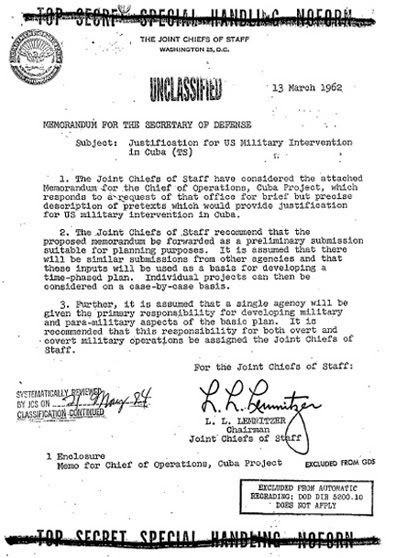
The origin of the name “Northwoods” is not clear, but is possibly a reference to the London suburb of Northwood, home of the Permanent Joint Headquarters (PJHQ), the British equivalent of the JCS, possibly indicating a British connection or inspiration. In March 1962, Operation Northwoods was completed, and Lemnitzer signed off on it. The “special distribution” document opened:

”As requested by Chief of Operations, Cuba project, the Joint Chiefs of Staff are to indicate brief but precise description of pretexts which they consider would provide justification for US military intervention in Cuba.” [4]


Wikipedia article on Northwoods

Destabilizing or toppling Castro’s regime and the re-subduction of Cuba was still American policy in general, and Northwoods itself was part of a larger, Kennedy-supported “Cuba Project.” But this report went beyond the pale, promoting harassment and a threatening posture to elicit an attack “since,” the memo states, “it would seem desirable to use legitimate provocation as the basis for US military intervention.” [5] But of course Cuba was not Japan, and Castro was not Tojo, and so the report focused more on the backup plans. These were more cynical than anything FDR or Arthur McCollum, the author of his Japan provocation policy, would have dreamed up - if Cuba failed to be provoked into a “mistake,” the JCS proposed providing a pretext themselves in a false flag operation and blaming Cuba for it.

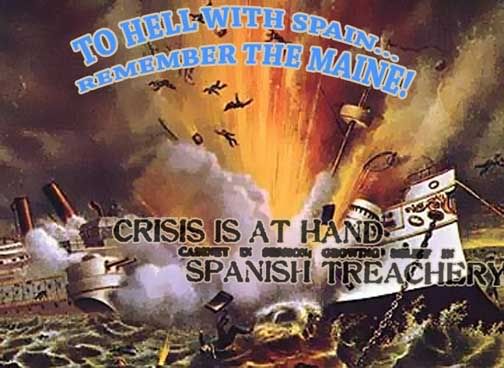
They suggested what they candidly described as a “remember the Maine” incident, the sinking of a U.S. ship in Guantanamo Bay to be blamed on Castro. Mock attacks on U.S. bases by friendly Cubans dressed as Castro forces, the planting of “plastic bombs” in Miami, Washington, and elsewhere, and even the sinking of a boatload of Cuban refugees (“real or simulated”) were mentioned. In fact, a little death would be useful - the report noted that “casualty lists in U.S. newspapers would cause a helpful wave of national indignation.” [6] While they never planned to shoot him down themselves, Northwoods did suggest that, should John Glenn’s space capsule accidentally crash as he attempted the first American orbit of the earth, this could be blamed on Cuba as well. [7]

In all, Northwoods offered dozens of variations on the theme, but the ones regarding aircraft bear a look here. For what it’s worth, all these are neatly contained in pages nine to eleven (that is, 9-11). These received extra attention perhaps because they did not involve deaths at all, simply high-tech aerial acrobats and cynical trickery. Point six, for example, mentions use of “an F-86, properly painted” to simulate a Cuban MIG (Soviet-made) fighter jet, and that “reasonable copies of the MIG could be produced from US resources in about three months.” It mentioned that the “destruction of U.S. military drone aircraft” by these MIG replicas could look convincingly like a Cuban attack. Keep in mind that drone means remote-controlled and pilotless.

Point eight is especially interesting and elaborate. Here is an extended citation (emphasis mine throughout):

“It is possible to create an incident which will demonstrate convincingly that a Cuban aircraft has attacked and shot down a chartered civil airliner en route from the United States to Jamaica, Guatemala, Panama, or Venezuela. The destination would be chosen only to cause the flight plan route to cross Cuba. The passengers could be a group of college students off on a holiday or any grouping of persons with a common interest to support chartering a non-scheduled flight.

a. An aircraft at Elgin AFB would be painted and numbered as an exact duplicate for a civil registered aircraft belonging to a CIA proprietary organization in the Miami area. At a designated time the duplicate would be substituted for the actual civil aircraft and would be loaded with the selected passengers, all boarded under carefully prepared aliases. The actual registered aircraft would then be converted to a drone.

b. Take off times of the drone aircraft and the actual aircraft will be scheduled to allow a rendezvous south of Florida. From the rendezvous point the passenger carrying aircraft will descend to minimum altitude and go directly into an auxiliary field at Elgin AFB where arrangements will have been made to evacuate the passengers and return the aircraft to its original status. The drone aircraft meanwhile will continue to fly the filed flight plan. When over Cuba, the drone will begin transmitting the international distress frequency a “MAY DAY” message stating he is under attack by Cuban MIG aircraft. The transmission will be interrupted by destruction of the aircraft which will be triggered by radio signal. This will allow ICAO radio stations in the Western Hemisphere to tell the US what has happened to the aircraft instead of the US trying to “sell” the incident.”

Points seven and nine also deal with such aircraft-related deceit. These three pages contain several elements of “silly” 9-11 conspiracy theories, even some of the ones I don’t necessarily buy:

- Destruction of remote control drone jets
- Aircraft “rendezvous,” crossing paths to confuse radar and swap drones for manned flights
- Aliases, false paint jobs, and CIA “proprietary companies” to allow pilots, passengers and planes to “disappear”
- Training missions as cover
- Planted evidence of a nonexistent attack
- Manipulated flight data and radio transmissions
- Remote controlled explosives

All of these were presented as real possibilities in a real and proven JCS-sponsored conspiracy. No theory here. The plan suggested the provocations occur “within the time frame of the next few months” and closed with the recommendation that the entire deal be carried out by the Joint Chiefs themselves. [8] After reviewing the memo, Lemnitzer signed it and pitched it to Kennedy’s military representative, General Maxwell Taylor, on March 13, 1962. What exactly happened during the meeting is unknown, but it only took three days for President Kennedy to inform Lemnitzer that the game was over; there was no longer a possibility of overt U.S. force against Cuba. Still the Joint Chiefs persisted, insisting to Defense Secretary McNamara that the war needed to begin soon. McNamara responded by rejecting nearly everything they sent his way. [9]

Within months, Lemnitzer would be denied another term as chairman and transferred to another job. This was not much of a demotion – he was named Commander of U.S. forces in Europe in November 1962 and was appointed Supreme Allied Commander of NATO the following January. [10] He retired from the military in 1969, and in 1975 was selected by President Ford to serve on the Rockefeller Commission, looking into Rockefeller-connected, illegal CIA projects (like the MK Ultra mind control experiments) overseen by his old partner Allen Dulles at the CIA. [11]

But as for Lemnitzer’s own illegal activities - was Northwoods a unique example, or are such “special distribution” recommendations actually common? The report noted on page four “it is assumed that there will be similar submissions from other agencies and that these inputs will be used as a basis for developing a time-phased plan.” [12] It appears that even as far as this “Cuba Project” was concerned, Northwoods was not alone, and they probably knew this from previous experience - its uniqueness therefore may lie not its existence but in its eventual publication.

In fact Bamford notes Northwoods as a precedent for events to come. On the subject of the Gulf of Tonkin incident, the August 1964 alleged attack by North Vietnamese forces on American ships that led to direct U.S. involvement in the Vietnam War, he wrote:

“In light of the Operation Northwoods documents, it is clear that deceiving the public and trumping up wars for Americans to fight and die in was standard, approved policy at the highest levels of the Pentagon. […] One needs only replace “Guanantanamo Bay” with “Tonkin Gulf,” and “Cuba” with “North Vietnam.” The Gulf of Tonkin incident may or may not have been stage-managed, but the senior Pentagon leadership at the time was clearly capable of such deceit.” [13]

Bamford described Northwoods as “what may be the most corrupt plan ever created by the U.S. government.” [14] But that’s not to stay it didn’t have stiff competition, nor that other nations at other times have not trumped the JCS, nor that the U.S. itself hasn’t trumped this in the period after the book’s release. To act like Lemnitzer and his people invented such cynical thinking is disingenuous – such deceit is standard operating procedure for politicians and leaders worldwide and throughout history. But this report shatters the belief that America is somehow different, protected by a bubble of Democracy.