CURIOUS DISCONNECTS IN AERIAL SURVEILLANCE
Adam Larson / Caustic Logic
May 20 2009
last edit 5/21, 5pmFIRST CONTACTOne of the more convincing counter-arguments to the friendly fire theory, often pointed out by
Liberty survivors and others, is the detailed aerial surveillance that followed the ship all morning prior to the attack. They were circled as many as thirteen times, by some counts [1], but these inspections only seemed to make the IDF less and less aware of the vessel as the day wore on and got weird in the middle. Lt. Col. Matti Greenberg’s 1982 IDF report complained of “those who would claim that Israel had tracked the "Liberty" constantly and that IAF planes had carried out several reconnaissance overflights to identify the vessel. These claims have no foundation in reality.” [2] His own claim is only half-rooted in reality, at best. It may be technically true, as records seem to indicate, that “the IAF did not direct any sortie over the "Liberty" until 1400 hours.” However, it’s probably not true.
The first eye in the sky for June 8 was barely noted by the
Liberty’s crew an hour after sunrise; when James Ennes took over as Officer of the Deck shortly after 0700 am, he relieved John Scott, who reported that “about an hour ago, we were circled by a flying boxcar. Real slow and easy.” [3] This and the bulk of the other IDF Air Force inspections were recorded in Ennes’ book
Assault on the Liberty (1979), compiled from his shipmates’ recollections and his own. This early passage is not recorded in the Liberty’s Deck log, nor mentioned in Captain McGonagle’s testimony to the Naval Court of Inquiry (NCOI).
But the flight happened, and is well confirmed by Israeli Defense Force records. What was called “flying boxcar” was actually a similar model plane known as a Noratlas; it was on a routine coastal patrol, and held a naval observer who examined the
Liberty as they chanced upon her. This was first reported at 05:45, clarified five minutes later; at first it looked like a destroyer, but as Greenberg’s report explained “later, at 0603 hours, an additional report arrived from the plane, which described the vessel as a supply ship of the US Navy.” [4] Illuminated by the early sun’s horizontal rays, the hull no. “GTR-5” was accurately noted, if not reported ‘til after the pilot landed. He did not report a flag, but the number and
Jane’s Fighting Ships helped the navy identify their guest as the USS
Liberty, American “research” ship. [5]
| A potentially important issue: In the graphic below, note a small V-shaped aberration of the path just before the 0630 mark, and just after the 5:45 pass. Judge Cristol speculates “the maneuvers may have been undertaken to deceive the Aircraft into thinking that the ship under observation was heading for Port Said.” [6] I see no good reason the captain would order such a thing, but the timing is close – 5:45 first sighting, 5:53 c/c. The deck log records the maneuvers, all apparently at the steady ten knots recorded. There is no mention of a reason for the turn, aircraft or otherwise. K.J. Halliwell speculated it was to “blow tubes,” a way of cleaning the boilers. “Depending on wind direction,” he explained, “the ship may temporarily change course to blow tubes, to prevent the black soot from falling on its decks.” His case is incomplete but logical. [7] |
It was around 1000 before this was decided for sure, and this would be her last accurate hull number reading of the day. It earned the ship a green marker on Naval HQ’s big tactical map - identified neutral non-combatant ship. She shouldn’t be there, but they don’t shoot at the green ones.
POINT ALPHAThere were no more over-flights reported by any party for three hours after this fruitful mission. At 0849, however, the Liberty reached its pre-set point Alpha, where it was to turn sharply west, heading 253° to point Bravo, and halve its speed to crawl along the Gaza/Sinai coast. Ennes oversaw this major turn, which was being executed as the second visitor was spotted behind them and to their right. Ennes claims this was just before 9:00, and that Captain McGonagle was next to him as they both watched “a jet” (no details) pass high along their starboard (right) side, then veer left several miles ahead east towards the Gaza coast. [8]
Neither the captain’s NCOI testimony nor the deck log note this aircraft. However, it happened, as again the IDF mentions it. A lone jet (no details) returning from some corner of the battlescape chanced up behind the ship. At first the pilot reported “gray, bulky, with its bridge amidships.” [9] Curiously, this pilot at first claimed he was
shot at by
Liberty, and this initiated a kneejerk sortie of two Israeli
destroyers towards the hostile ship.
But just at the same time, the IDF’s story goes, the Liberty ID was agreed on, and they were recalled. Also the pilot said he wasn’t so sure he was fired on by the American ship after all. Lucky break for the hapless boat. Again, it was the last of the day. Point B would be reached at 1132, and a turn thirty degrees to the north towards distant point Charlie. By a twist, this final target was barely different from the Israeli Air Force “Point Boaz,” described by Greenberg as “the spot over which most IAF sorties would swoop into and out of Sinai.” This is probably where the 0900 flight came from, and their approach towards it in the mid-day means increasing air traffic, meaning some planes might have “appeared to the ship's crew as directed to them.” [10] This should be remembered and considered.
IN A PROVOCATIVE MANNERFrom there the tone changed; the L-shaped sweep across their path (see graphic below) – in retrospect - is like a cut-off line beyond which they were not interested in keeping track of this vessel. The IDF admit to no more reports attributed to the Liberty after 0900, even though
apparent surveillance intensified and even took on a menacing tone, to read Ennes’s account. “Just before 10 o’clock the bridge lookouts reported jet fighters approaching from astern,” he writes. “Off the starboard side, high, I could see two sleek delta-wing jets in tight side-by-side formation, paralleling our course.” They were armed with bombs he could see, but had no markings visible at the range. They tuned left a few miles ahead, and doubled back down port side, and turned again to repeat the loop. “They made three complete orbits before disappearing from view.” [11]
Captain McGonagle does attest to a similar pass of “two unidentified Jet aircraft orbited […] three times at a distance of approximately two miles.” [12] The two disagree on the distance, Ennes of course closer, and they disagree on time. McGonagle places it at 10:30 to his OOD’s 10:00. So far Ennes has a better track record on this issue, and 10:00 I’m going with, at the risk of being wrong on a minor point.
A half hour later, at the time the Captain places the fighters, “we received another visit from the flying boxcar,” Ennes reports, “now more curious and coming closer.” This is probably a different Noratlas than the one circling around 0600, which had landed around 9:30 and reported the hull no. This one approached from behind, paralleling their path off the starboard (right) side, turning left ahead, a full 180 turn back and down port side, then behind them. Not satisfied with the horseshoe, he sliced a dramatic turn back to an aggressive low-level approach and mast-level diagonal pass over the ship. As it showed its full belly, camera ports, and Star of David marking to the intruders, the captain feared it was attacking, according to the book: “Watch him. If you see those bomb bay doors start to open, order an immediate hard right turn.” [13]
The Noratlas pass was placed by the deck log at 10:57, blandly, as “unidentified aircraft circled ship.” [14] The captain swore that “it was not possible to see any markings on the aircraft and the identity of this aircraft remains unknown.” Curiously, he decided to point out how “this aircraft
did not approach the ship in any provocative manner.” [15] Then why mention how it “did not” do so? Was it
supposed to have? Was he troubled that he wasn’t “provoked” into leaving when it swooped over them? Unanswerable questions must be regarded as unanswered.
Ennes and mcGonagle agree on at least two more visits from this plane “in a somewhat similar fashion approximately at 30 minute intervals,” the captain says, at 10:57 and 11:26. [16] After its first 10:30 pass, “the flying boxcar returned just before eleven o’clock,” writes Ennes, “and again thirty minutes later, each time executing the now familiar counter-clockwise orbit before completing a low-level, diagonal, direct overflight of the ship. And each time I verified the condition of our flag,” perfectly displayed each time, no doubt. [17] Repeated tight defined orbits, no direct communication attempted, but attention-getting moves that almost read like warnings, following an extended show of arms, all apparently directed at the Liberty. I imagine if I were in charge of that ship, orders be damned, I’d leave the area quickly. But hindsight is always so clear, and besides, Captain McGonagle was more steadfast than I.
As Lt. Col. Greenberg and other offical sources have said, any impression of IAF surveillance or anything directed at the
Liberty is just an illusion caused by the steady traffic of war. Israeli historian Michael Oren admits “there may indeed have been additional Israeli overflights, but the IAF pilots were not looking for the
Liberty.” [18] Neither was the 6:00 flight, or the 9:00 one, but they both saw and reported it and it connected back. But at least three, and perhaps four close-up flights specifically orbited the ship, just in the next 2.5 hours. And we have no available records of any such interactions, let alone any explanation. I don’t see any reason a plane approaching point Boaz, or scanning for Egyptian submarines, would repeatedly conduct unreported swoops over an unidentified ship. Was it just a pilot having some sport?
YET MORE MISSED OPPORTUNITIESShortly after the last verified Noratlas pass,
Liberty arrived at point Bravo, and at 11:32 changed course to 283° to move towards point Charlie/Boaz. After that turn, Ennes was relieved briefly to get some lunch, leaving the deck in Lt. Painter’s hands from 1200-1300. He mentions “testimony from Liberty officers, ignored by the Naval Court of Inquiry, “of additional reconnaissance flights during the noon hour.” [19] From what I’ve seen (only part of the eyewitness reports), these are all equally vague regarding what craft, passing in what way, and just when and how often.
For example, Painter testified that somewhere in this hour “from the Bridge, I again observed the slow flying Israeli aircraft circle our ship.” [20] George Golden, considered the senior and “saltiest” sailor aboard, said he witnessed more surveillance in the noon hour and noted the flag extended at that time. [21] No details on the plane(s). The Salans memorandum, a State Department document from ’67 noted “testimony of various members of the crew indicate reconnaissance overflights of the Liberty at 0515 [sic], 0850,1030, 1056, 1126,
1145, 1220, and 1245.” No details. [22] This span remains an impressionist painting, for whatever reasons.
For Israeli records at this time, Cristol cites an unidentified ship “observed and even reported […] by other Israeli high-altitude aircraft the
Liberty crew never sighted.” He cites a 1988 interview with an IAF pilot who flew 30,000 feet over the ship at noon, and reported it had ”no wake.” [23] This fits precisely with no shipboard sightings, meaning a 1200 entry needs to be added to the list, for four alleged encounters between 1130 and 1300. These would have been able to give excellent picture of speed and direction change if plotted as in the graphic below. A solid path from
Liberty’s last location, on a near-west heading at a creeping five knots, slowness verified by report of “no [visible] wake.”
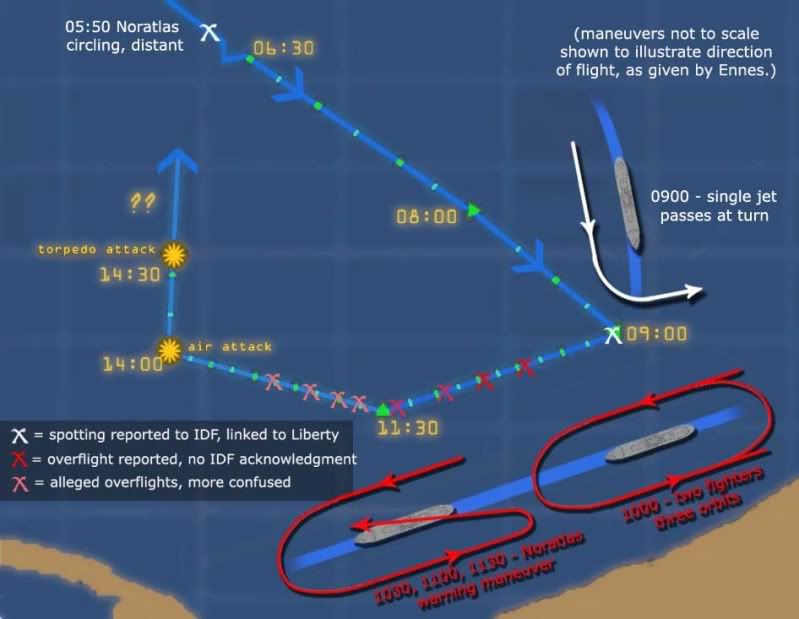
Although the data was all available, none of this was put together, at least not in the normal way. By 1300 everyone was wondering about the explosions on the Sinai shore, east and west of El Arish; the Liberty increased vigilance, and the IDF was following up, first hearing about the problem at about 11:30. Reports from land and unspecified
air observations had
either one or two unknown ships approaching and presumably shelling the shore at this time. As the last alleged overpass faded at 12:45, the torpedo boats of Division 914 were en route to investigate the mystery ship, with attack aircraft ready to scramble. You keep your recon planes away from your combat situations. This was the aerial calm before the storm.
THE SELF-BLINDED LEADING THE TRIGGER-HAPPYSo to summarize the IDF Air Force admits two Identifications at about 0600 and 0900, and then nothing, intelligence-wise, that was (or is now acknowledged to have been) connected back to this ship. There were overflights, sure, as many as eight of them - but officially these were on other business and any info that was accepted from them found no such link back. Somehow it was back to square one.
Of course this is all highly significant – the lack of new intelligence on the ship is the cited reason for Capt. Avraham Lunz at Naval HQ deciding to remove the ship’s neutral marker at 11:00 – leaving it unmarked at all – and not even mentioning this to the oncoming chief, Izzy Rahav. [24] Lunz’s decision has been the subject of some speculation; for example, he was the sole named part for possible court-martial in the Yerushalmi investigation. [25] The charges were dropped of course, and
all the “mistakes” were ruled just that. He just didn't have current enough intelligence. (more detail in a later post)
The timing of the info cut-off is crucial, as that’s almost the moment she turned from point Alpha to Bravo and dropped from ten knots down to five. The heading change is less important – without turning she would hit the beach in less than an hour and halfway across the Sinai nearing the Gulf of Aqaba by noon. And if that fighter passed after 8:50, the new WSW heading was probably observed. Every Liberty overflight before 11:30 happened along that heading. It’s the logical path it would take if leaving.
| Another aside and criticism: Cristol cites the ship as last seen “steering south at fifteen knots.” As I explain, the surest way to calculate speed is consider 9:00 position vs. 0600, which would verify a southeast path, app. 130° and 10 knots speed, as the deck log shows. Fifteen knots was not reached that morning, and “South,” “towards Port Said,” was only achieved once, during the possible tube-blowing event [see small text near the top], for about fifteen minutes, just after the first Noratlas pass. Although it’s possible this was seen, there is no evidence this minor movement effected Lunz’s decision, and even less reason it should have. |
Far more important is the speed reduction of 50%, which occurred after the turn - at 9:05 by the deck log. This would be harder to predict and easier to miss; a single pass of a jet may be too short a sampling to determine speed very well. The better way is compare two positions over time; her speed until 0900 could well have been calculated for that three hour span. Only additional observation could help see the speed after 0900, and this was denied. Predicting a turn to the west, and projecting the 10 knots observed, would double her anticipated progress over the hours, taking
Liberty much further out in the Mediterranean than she actually was.
This type of thinking is exactly what’s said to have influenced Lunz in his unfortunate erasure. As reported by Cristol “his explanation was that ships do not stand still.” They can actually, but this one was only
close to still – five knots with “no [visible] wake.” But Lunz had cut off his awareness of the
Liberty at some arbitrary point and “was of the opinion,” Cristol pleads, “that the ship had moved
at least seventy-five miles from the point where it was previously sighted.” [25] For the Liberty to move that far since 0900, it would have to be going about 37 knots, twice her top speed, and more than seven times her current clip. If he meant since the
first sighting at 0600, then he felt it was moving at 15 knots, 50% faster than it ever was that morning, and importantly he was foolishly ignoring the later sighting.
This ridiculous, ass-pulled-out-of “opinion” meant the fast ship was clearly of no concern to events in the area around El Arish. And that’s it. With no markers, no notes, or memories about an American ship recently in the area, any mid-size gray ship near some explosions was probably an enemy destroyer, and so on. The way was opened for an ensuing flood of errors, what can almost be seen as a well-orchestrated “Operation Oops!” The erasure was triggered Lunz's sheer ignorance, we're told, but as we can see, a lack of usable aerial surveillance was not the reason for that.
Sources:
[1] Bamford, Body of Secrets, p 206
[2] Greenberg, Matti, Lt. Col. The Attack on the "Liberty" Incident: 8 June 1967. IDF History Department, 1982. p 39. http://www.gtr5.com/evidence/idfhr.htm
[3] Ennes, James M., Jr. Assault on the Liberty. Random House, 1979. p 50]
[4] See [2], pp 7/8.
[5] See [2], pp 8/9.
[6] Cristol, A. Jay. The Liberty Incident. Brassey's Inc. 2002. p 40.
[7] Halliwell, K.J. source
[8] See [3], p 152.
[9] Oren, Michael B. The 'USS Liberty': Case Closed. Azure, Spring 2000. http://web.archive.org/web/20000917231200/http://www.azure.org.il/9-Oren.htm
[10] See [2], p 10.
[11] See [3], p 53.
[12] Naval Court of Inquiry Report. p 32.
[13] See [3] pp 54-55.
[21] Ennes, p 152.
[22] U.S. Department of State. Legal Advisor Carl F. Salans. "The Liberty" -- Discrepancies Between Israeli Inquiry and U.S. Navy Inquiry. 21 September 1967. http://www.gtr5.com/evidence/salans.htm
[23] Cristol, p 89.
[24]
[25]
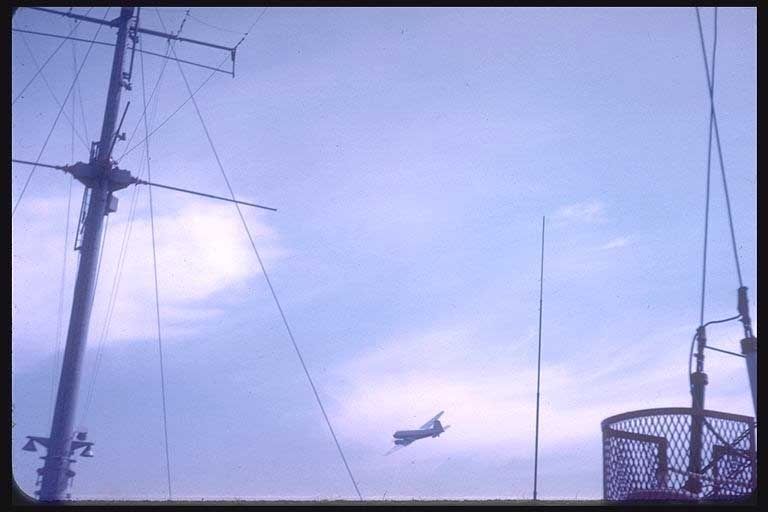 At least one photograph of presumed reconnaissance aircraft (above) has survived and is published on the USS Liberty survivors association image index web page with the following caption: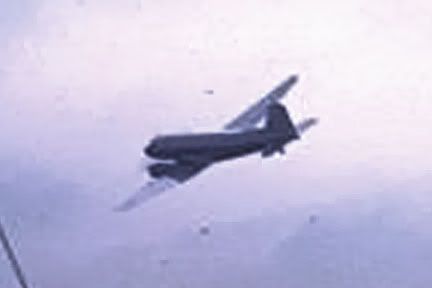
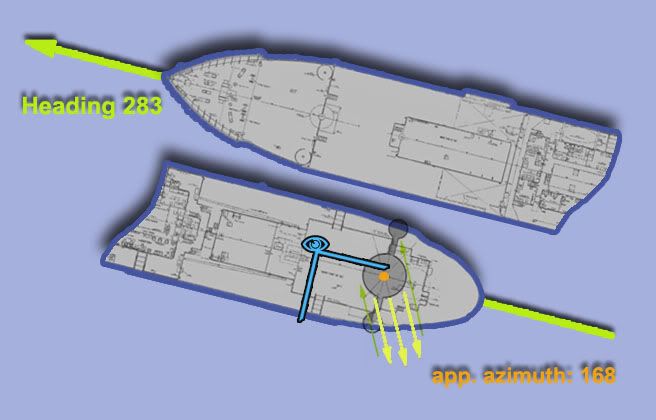
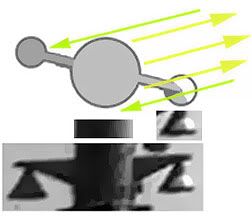 11:45 is one minute past local solar noon, with the sun at its highest elevation (82° above the horizon, so nearly overhead). and with an azimuth (direction to sun) of 180° - due south. First I presumed this was after the 11:32 course change, so I set my model on a 283 heading and set to narrowing down the solar azimuth angle which helps me get a close time estimate. I found the light angle, approximate, from the rear mast (lower left corner) by analyzing light fall-off around the mast’s curve and and shadow patterns on its attached lights. They indicated one general direction, which I marked with arrows – some to and some from the sun, whatever.