Showing posts with label Layton. Show all posts

Thursday, February 26, 2009

THE BOMB PLOT MESSAGES

ATTENTION TO DETAIL DULY IGNORED
Adam Larson / Caustic Logic
The 12/7-9/11 Treadmill and Beyond
Feb 26 2009


Note: All information for this piece was extracted from Layton, Edwin T. with Roger Pineau and John Costello "And I Was There": Pearl Harbor And Midway -- Breaking the Secrets. New York, Quill, 1985. Chapter 14, pp 161-168.

Ensign Takeo Yoshikawa was Japan’s top spy on Honolulu in 1941, a resourceful Navy intelligence operative working at the consulate under an alias, and a prolific source of detailed information. For eight months he scoped out Pearl Harbor, completely undetected it would seem, and the US Pacific Fleet that had been permanently tacked-on there. He reportedvia Consul Nagao Kita, who sent the info back to Tokyo via wireless radio signals, encoded and enciphered.

On September 24 a curiously detailed request was sent to Honolulu with a mission for Yoshikawa; it read in part:
"The waters (of Pearl Harbor) are to be divided roughly into five
sub-areas […] With regard to warships and aircraft carriers, we would like to have you report on those […] we would like to have you make mention of the fact when there are two or more vessels along side the same wharf.)"
The requested facts were gathered and Kita supplied the first installation of details five days later, establishing a code system for different locations and ships. This was not a one-time deal, but required regular updates in the form of weekly “ships-in-harbor reports.” As war loomed ever nearer during 1941, these were upped to bi-weekly, and eventually daily transmissions to keep the military as updated as possible.

According to the US Fleet’s intelligence director at the time, RADM Edwin Layton, this communication was carried out using the code-and-cipher system known to US cryptographers as J-19. This was a penetrated and readable code, but the intercepts had to be printed and mailed unread to Washington via courier, then at least some of them were decrypted and read. Layton says these were given lower priority than the higher-volume Purple system messages. Diplomats in Washington, the Philippines, and most other places used this more famously open method, while Honolulu’s oddball J-19 system meant that, for example, five times the number of Manila messages as Honolulu were read at this time.

The Army’s crypto unit broke the original ‘divide-the-waters’ message on October 9, while the Navy cracked the 1st response giving the coordinates the next day. While these later became known as the 'bomb plot’ messages (plots, or coordinates, for use in a bombing attack), this was not necessarily obvious without hindsight, as is often pointed out. But at least one official considered among the possibilities at the time “a plan for sabotage … a plan for a submarine attack …. or it might be a plan for an air attack.” Any of these is worthy of concern and worth more analysis and dissemination to, for example, Pearl Harbor.

As the man charged with defending the fleet, CINCPAC ADM Kimmell said if He'd heard about this string of reports, it “would have radically changed the estimate of the situation made by me and my staff.” Referring to these and other J-19 messages that offered supporting clues, Layton wrote “neither the Fourteenth Naval District nor our headquarters was ever told about these early signs” which clearly indicated hostile scheming, and summed up that “the failure of the office of naval operations to ensure that the bomb plot messages were sent to us at Pearl Harbor was blind stupidity at the least, and gross negligence at the best.”

The scoffer will be tempted to call this just more sour grapes from another wheel-sleeper-atter with 20/20 hindsight. But in reality, there is a proper way to interpret this material; I’m not the expert to say what that is, but I tend to support the view that this should have been recognized as “vital intelligence,” and a blessing to have. The main tip-off for any analyst must have been the change from the usual spy pattern of reporting ship movements, a natural class of general intelligence, to passing on the precise locations of ships at rest. There can be little use for this unless they wanted to do something to the ships in those locations. The harbor and fleet, and eventually the whole surrounding base area, had an invisible tactical grid placed over it; it was known and planned around by the Japanese military. If it had been known at Pearl Harbor, it would have led to a different kind of reception on 12/7 or, more likely, an early cancellation, or re-scheduling.

Layton’s book explains how some in the intelligence circuit (Kirk, Safford, others) pressed their superiors to inform Pearl of these clues and/or put the HYPO station there to work on decoding the messages for themselves. Either seems reasonable, since the plots were being sent from their soil and concerning their ships. But these requests were specifically blocked by others, the book asserts, notably Navy communications chief Leigh Noyes, who told them he was “not going to tell any district commandant how to run his job!” Such fine details cannot be decisively established, but however it happened, it’s clear the messages were received in Washington and not received in Hawaii.

Memories of how that bottleneck happened are not entirely clear; in the investigations, some recalled the series of messages clearly and professed an “impression” that these were somehow sent to Pearl. One Army officer testified that these were just another series of messages among thousands, but did confess it was the only such conversation among those so specific “in the sense of dividing any particular waters.” He didn’t bother sending it to General Short at Pearl Harbor, tasked with defending those waters. Theodore Wilkinson, a brief interim director of the Office of Naval Intelligence, did recall what seems to be the bomb plot “information system.” Wilkinson told the Joint Congressional Committee he felt this material didn’t warrant being sent to Pearl Harbor as it showed nothing more that “the nicety of detail of intelligence” they were gathering – about how to attack Pearl Harbor, as it turns out.

At the highest levels most consistently placed in the center of the “folly” and “tragic miscalculations” leading up the the attack, the denial gets the most specific. Chief of Naval Operations Stark, and his self-appointed intel distributor Turner both professed to not recalling the messages at all, and dismissing the significance if they had seen or heard of them as showing the Japanese "attention to detail". [they love to, um, make really accurate scale models of our harbors, and - um - real-world accurate ship placements worked in. Yeah, it's a zen thing…]. I didn’t see what if any response Gen. Marshall, the Army’s Chief of Staff, offered to the messages, but it was likely similar.

So there you have it – it was vital and available, but Washington was - too bureaucratic - or something? Someone please help me understand (comments open – link at bottom). Because in my paranoid confusion, it looks like a bit the top decision-makers wanted to sideline the whole issue away from reality for the moment. The White House mantra after the surprise attack was that the clues all pointed further west and nearer Japan; no designs on the ‘impregnable fortress’ of Hawaii were considered credible – ergo, these counter-points to the mantra must simply not be clues, and only Kimmel, Layton, etc. are making it look a big deal afterwards, in order to shift the blame from their own random inexplicable human failures. But hey, we won, no hard feelings, we’re all Human, and so on…

Thursday, February 12, 2009

THE MESSAGE WE MISSED?

Adam Larson / Caustic Logic
The 12/7-9/11 Treadmill and Beyond
February 12 2009
last edited 3/26


Throughout November 1941, as US-Japanese negotiations were secretly segueing into war maneuvers, the Japanese Navy mobilized to strike out across the Pacific at British, Dutch, and American interests. The last was tasked to a mighty force that had been assembled in secrecy at the 4-mile-wide hammer-head shaped Hitokappu Bay in the southern Kuril Islands (just north of Japan’s Hokkaido Island). By the middle of the month, would have been bustling with the “mobile striking force,” or Kido Butai, under the command of Admiral Chuichi Nagumo in his flagship Akagi; he was backed by 2 battleships, 2 heavy cruisers, 9 destroyers, 3 submarines, 8 train vessels, and, most tellingly, 6 aircraft carriers with about 360 combat-ready aircraft.

On the 25th, Fleet Admiral Yamamoto issued to Nagumi the fateful Combined Fleet Operations Order No. 5, ordering the force to set off for its intended target: - Pearl Harbor, Hawaii, and the bulk of the US Pacific Fleet moored there. The source from which I take this is the Joint Congressional Committee on Pearl Harbor, part 2 of their final report, published in 1946 [1]. Their telling reads as such:

”(a) The task force, keeping its movements strictly secret and maintaining close guard against submarines and aircraft, shall advance into Hawaiian waters and upon the very opening of hostilities, shall attack the main force of the United States Fleet in Hawaii and deal it a mortal blow. The first air raid is planned for dawn of X-day (exact date to be given by later order).

Upon completion of the air raid the task force, keeping close coordination and guarding against enemy counterattack, shall speedily leave the enemy waters and then return to Japan.

(b) Should it appear certain that Japanese-American negotiations will reach an amicable settlement prior to the commencement of hostile action, all the forces of the combined fleet are to be ordered to reassemble and return to their bases.

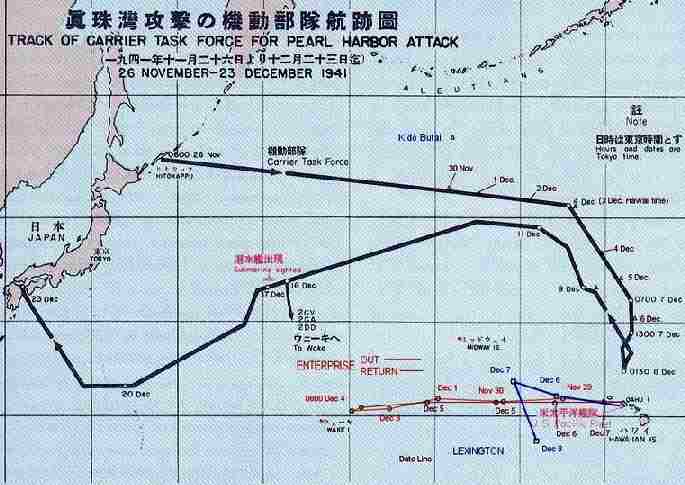
(c) The task force shall leave Hitokappu Bay on the morning of November 26 and advance to 42° N. And 170° E. (standing-by position) on the afternoon of December 4, Japan time, and speedily complete refueling. “


Clearly this order was crucial; it mentioned the target, the nature and location of the sneak attack, and the approximate date and time of day it would occur, just over two weeks later. If such information could have become available at that time to the US or to an ally inclined to share, the surprise could have been seen and pre-empted, or at least mitigated with some kind of proportional defense. None of this happened, of course, and the Kido Butai achieved total local surprise, which one may be tempted to accept as de facto evidence that the order remained hidden from American eyes at the time.

Such temptation should be resisted.

illustration using the given coordinates for stand-by position. This isn't quite right, as illustrated by the huge distance to travel the last leg. This probably means they modified the plan later, or had a further code in which one location actually mans another. A better map from Japanese sources can be seen at this page, and was used to make the more accurate and useful graphic below.
The Japanese Navy ordered the destruction of much of their records at war’s end, all copies of this order apparently being among the lost. Therefore, the Committee’s source for the wording they presented as evidence in 1946 would have to come from some other record(s) – hard copies that escaped the destruction order and fell into US hands, the memories of people who had written, read, or recieved the orders, or perhaps ‘our own copies,’ radio intercepts received by the US or an ally at the time but (presumably) decoded later.

In fact, the source the Committee cites is, essentially, anything but the third option. The order to sail is attributed to “Committee exhibit no. 8,” cited extensively throughout part two of their report when referencing Japanese plans or communications. Therein they explain:
“The chief sources of information concerning the attack are translations of captured Japanese documents, interrogations of prisoners of war, and reports submitted by general headquarters, supreme commander for the Allied Powers, comprising questionnaires filled out since VJ-day by former members of the Japanese naval high command. See committee exhibits Nos. 8, 8A, 8B, 8O, and 8D.” [2]
So it would seem that, even four years after the attack and the penetration of all Japanese codes, fuzzy memory and the odd scrap of paper was the best the Committee had access to. Apparently, we never got a copy of our own to decode and it was just lost into the ether. Admiral Edwin Layton concluded, after searching the available intercepts at the National Archive, “we evidently did not pick up Yamamoto’s 25 November sailing message” at all. [3] Note the judicious use of “evidently.”

The Pacific Fleet’s top intelligence officer at Pearl Harbor at that time, Layton published his own investigation at the end of his life, in the mid-1980s. Having found nothing of it in our archives, his source for the order to sail was “a reconstruction of events obtained from [the striking force’s] surviving commanders in 1945.” In particular, he cited the recollections of Capt. Mitsuo Fuchida, lead pilot of the actual air raid. This version is essentially the same as the above, with the exception of an “evening rendezvous” to refuel on Dec 3 Tokyo, not Hawaii time, and located at 40°N 170°E, two degrees south of the Committee’s findings. [4]

An Army Military History office document released in 1953 provides a whole string of communications surrounding the Kido Butai’s formation and intent, dating Nov 5 to Dec 2. While previous communications outlining the attack plan for Hawaii are recounted in great detail here, Yamamoto’s decisive Nov 25 order is provided only in a “general outline,” altering the standing-by position (from 165° to 170°) and ordering departure. Again, this document notes that “since all copies of these orders were destroyed prior to the end of the war, they have been reconstructed from personal notes and memory.” [5]

There is much debate among American researchers and little conclusive resolution as to how readable that code was to American cryptanalysts on December 7. The general mainstream consensus is that it was completely or essentially unreadable in the last days, as well as at the time of this pivotal order. The question of the code’s overall opacity as of November 25 1941 is one with no conclusive answer [hint - it was LESS likely to be readable on X-Day, and there are other nations whose own progress is uncertain]. The topic is shrouded in curiously dense secrecy and confusion (at least on my part), and will be the subject of a further post, or posts, after I’ve completed more research.

Sources:
[1] Investigation of the Pearl Harbor Attack. Report of the Joint Committee on the Investigation of the Pearl Harbor Attack. July 20 1946. Part II. Page 56. online - backup
[2] Ibid. Page 53.
[3] Layton, Edwin T. with Roger Pineau and John Costello "And I Was There": Pearl Harbor And Midway - Breaking the Secrets. William Morrow & Co. December 1985. Page 207.
[4] Ibid. Page 207.
[5] Japanese Monograph No. 97. PEARL HARBOR OPERATIONS: General Outline of Orders and Plans. Prepared by Military History Section Headquarters, Army Forces Far East. Distributed by Office of the Chief of Military History
Department of the Army. 19 February 1953. link