Showing posts with label CIA. Show all posts

Wednesday, January 13, 2010

A THREE-YEAR TEST DRIVE, PARKED 8 YEARS, AND THEN A HIGH-SPEED CRASH, pt 1

A.M. GIAKA'S SKELETON OF FANTASY
[Pan Am 103 Series]
Adam Larson / Caustic Logic
completed January 22 2010


Note: what follows is the first half of a looong working essay I just had to see up even before it's done. It covers from Giaka's defection to the start of trial preparations in 1999. Part two will be long-delayed, but will call on Giaka's direct testimony via trial transcripts.
A Missing Link
Among the sources collecting the evidence against Abdelbaset al Megrahi (and/or his accused accomplice Lamin Fhimah), most mention the same three “keys to the solution of the case” given by the FBI’s lead investigator on the SCOTBOM case, Richard Marquise, in his 2006 book. He gives these as Tony Gauci, “the Mebo chip,” and the souvenir printout of the Frankfurt luggage records taken by Bogomiras Erac, which was strangely “the only record” anyone could find of this vital information. [Marquise p 210] There are other peripheral clues of importance, but few with the resonance, clarity, and specificity of these three as indicators of Libya’s guilt, via the two accused.

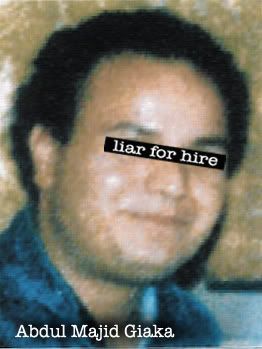
But missing from such formulations is a fourth and most important key – Abdul Majid Giaka [different spellings have been used], a Libyan intelligence defector turned intelligence asset for the U.S. side of the investigation. In fact, in coming on board four months before the Lockerbie bombing, Giaka’s connections with Malta, Luga Airport, and Libyan intelligence put him in a prime position to be the first to mention both accused - to his CIA handlers - in the first place. The majority of everything he said has by now been discredited and shown to be fabrication – at best enabled and at worst demanded by his American friends.

Giaka’s intelligence was transformed to evidence with some CIA/FBI alchemy, tying several loose ends together and, in essence, providing the skeleton for the ‘Libyan villains’ case to stand on. The defector’s tales underpinned the US/UK joint indictment, the years-long extradition wrangle, and was finally brought as far as the Scottish Court as Camp Zeist in 2000. But as we’ll see, it went no further and has been mentioned as little as possible since.

Effective Defector Detected
Abdul Majid started this journey as a self-described disaffected Libyan perturbed by Tripoli’s terroristic ways and Gaddafi’s Masonic schemes. A low-level intelligence agent with the JSO, and stationed on Malta, he approached the US embassy there in August 1988 offering his services. Paul Foot’s seminal 2000 booklet Lockerbie: Flight From Justice explains how this started a “long series of meetings with American intelligence officials in Malta,” 41 secret meetings total, spanning almost three years from “September 1988, the same month he started getting regular payments from the CIA.” [Foot]

For $1,000 US per month, rising to $1,500, he wasn't a huge payback at first. “His information was patchy and unreliable,” Foot reported. “He pretended he was a senior official in the Libyan intelligence organisation JSO though in reality (as the Americans quickly realised) he was a former garage mechanic who helped to maintain JSO vehicles.” The BBC Conspiracy Files program in 2008 treated this subject fairly, and summed up “not so much double-oh-seven, more WD40.” [CF 44:20] He had however “graduated to the exalted position of assistant station manager for Libyan Arab Airlines,” Foot concedes, work carried out at Luqa International Airport, on the island's near-south side.

Giaka was given the code-name "puzzle piece" by his CIA handlers, [CF, 43:29] at least one which also worked at the airport, under cover as a baggage handler. [LTBU 8/29] The agent kept tabs on him, writing cables back to the CIA that named the subject in code as “P/1” (and referred to the JSO as ESO). P/1’s job there involved aircraft security, “but he is also obliged to assist ESO operatives transitting or on missions to Malta,” according to a copy shown on the Conspiracy Files. That’s a reasonably rich source for intel reports, but the agent noted Giaka “has been a “shirker” while in Malta, generally dodging ESO assignments since his Luqa appointment.” [CF 44:12]

Whatever the defector’s shortfalls, in October 1988 he reported his first big lead – Lamin Fhimah, a “JSO agent” also working at the airport, kept eight pounds of TNT in a locked desk drawer of an office. Paul Foot again relates how two months later in December (whether before or after the Lockerbie bombing is unclear) “he was asked about the movements of JSO officials through Luqa airport. He replied that a man he regarded as a senior JSO officer, Abdelbasset Ali Mohamed Al Megrahi, had passed through Luqa airport on 7 December.” [Foot] The names may not have meant much at first among Giaka’s other intelligence, but as soon as investigators were willing to consider a Libyan link, and it was found that both were also present on Malta December 20, the eventual suspects were clearly on file and ready to drop in place even before 1988 had closed.

Giaka and America Rescue Each Other
By the beginning of September 1989 the investigation’s scope was narrowing in, of all places, on Malta. The oddly-delayed Frankfurt printout revealed in mid-August an unaccompanied bag from Malta had apparently gone onto PA103A. At the same time, the tattered Maltese clothes from inside that bag had led to Maltese shopkeeper Tony Gauci, who gave his first statement about the buyer on September 1. But Giaka was probably not told these things as, on September 4th Foot maintains, “his CIA handlers in Malta told Giaka he was “on trial” until the next New Year (1990).” [Foot]
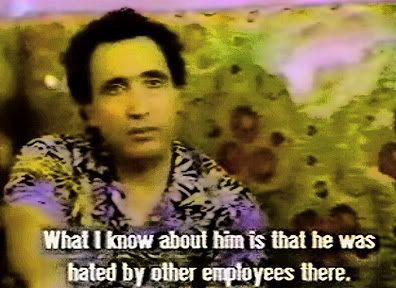
The informant likely grew nervous as his bridges to America became more precarious, his bridges on Malta stood burned, and his bridges back to Libya were threatening. The 1994 film The Maltese Double Cross featured interviews with both accused, who indeed knew Giaka, at least in passing. Megrahi confirmed he did security work there, and “he was hated by other employees there.” Fhimah added “He behaved badly towards the employees working with us, in dealing with passengers. The Maltese airport authorities know this.” [MDC 1:28:10-1:31:28] Some bias might be expected of course, but others interviewed for the film vouched that he was irresponsible, a partier and amasser of debts. And he wasn’t going to be getting any more popular trying to sell intelligence to the CIA.

One anonymous Libyan related for the film how Giaka was put up for transfer at some point: “they asked him to return back to Libya because his contract finished, for his staying in Malta.” Apparently desperate to maintain his situation there and his possible ticket away from Libya, Giaka asked the CIA to pay for a surgery to injure his arm so he wouldn’t be called away to serve in the Libyan Army. [Foot] They apparently consented and “after a few days,” the anomymous source said “[Giaka] came here after the hotel and he had a plaster on his hand” which he said was from falling down the stairs. This seemed to help him “get an extension of around three or four months to stay here.” [MDC 1:31:15]

By 1991, the regular cables were describing P/1 as “a shattered person” who “does not want to be part of the security apparatus and is certainly milking any of his contacts, including us, for whatever he can get.” [NYT] The Americans were ready to milk back - the fruit was ripe and dripping with urgent ‘get-me-outta-here’ intel possibilities. Perhaps realizing that Giaka really was the best they were going to get, the decision was made by July 11, when the Department of Justice told Mr. Giaka they would “accept or reject him" as a witness "based on his response to their Inquiries,” which would be done at leisure within the United States. The very next day, Foot writes,
“Giaka, to his intense gratification, was taken off Malta by an American warship, and interrogated there by an FBI officer, Hal Hendershot. Before long he was safe in the US where he was later joined by his wife. He was paid a regular salary in exchange for constant interrogations by the CIA and the FBI. What he told them plainly satisfied them.

In October, in conditions of great secrecy, he gave evidence to a US Grand Jury. The result, in November 1991, was a detailed indictment charging Megrahi and Fhimah with murder by planting a bomb in a suitcase on a flight from Malta to Frankfurt and thence to London – and the explosion over Lockerbie.”
[Foot]

The World Dances to the Fantasist Tune (Played Real Loud)
The United States government for this point forward until now, without interruption, has accepted the core of this indictment as unassailable truth. The findings of Libyan guilt via al Megrahi and Fhhimah and others not named, the findings found primarily in Giaka’s words, has been the basis of economic sanction, diplomatic pressures, approval of clandestine operations, public vilification of Libya allowing more of the same to pass, and so on.

Most of the world was rather surprised at the turn of events, running counter to all the old evidence that made more sense and involved no Libyans. And was, of course, highly inconvenient for the Americans. Naturally, suspicions of cover-up flourished, especially in the UK. This was primarily channeled into an intriguing “CIA drug-running” cluster of theories (which this author considers a huge distraction) that got its biggest boost with an April 1992 cover story in Time magazine.

A Department of State press release from the same month sought to counter growing confusion at home and abroad by calmly laying out the facts in a press release. The Suitcase itself, fairly non-descript and not directly accounted for anywhere in the luggage records of three airports, was prime evidence at the time, thanks to Giaka’s incredible contributions.
“Forensic analysis has identified the bag that contained the Pan Am 103 bomb as a brown, hard-sided Samsonite suitcase. The following evidence links Al-Megrahi and Fhimah to the suitcase:
-- Al-Megrahi, traveling in alias, arrived in Valletta with Fhimah from Libya on the evening of 20 December 1988--the day before the bombing. Fhimah, the former manager of the LAA office in Valletta, retained full access to the airport. Al-Megrahi and Fhimah brought a large, brown hard-sided Samsonite suitcase with them into Malta on that occasion.
[DoS]
They make it sound like the Fact they had such a suitcase is evidence they planted the bomb, but in reality, Giaka’s intelligence was the only evidence they had such a suitcase. This emerges chronologically, below. That his stories wound up matching the emerging evidence at the scene is highly troubling – the similarities are from neither truth (as we’ll see) nor likely from coincidence. It seems Mr P/1 served as a two-way intelligence conduit - milking the CIA so they could re-milk him – helping them launder propaganda into intelligence and, via FBI acceptance of that, into evidence ready for trial.

The top man who promoted Giaka as evidence, and the most likely to be fully aware of such unethical activities, would have been Vincent Cannistraro, senior director of the CIA’s own Lockerbie investigation until October 1990 [Ashton] . He continued promoting the story line he'd helped write in the years between indictment and trial. For a 1995 BBC program, he described the case modestly as:
“… overwhelming … conclusive … tremendous amount of evidence … mind boggling amount of detail … that will allow the prosecutors to present the chronology of the operation from its very inception … describe and in almost excruciating detail exactly how they made the bomb, how they secreted it, how they got it on board the aircraft, and I think that's a fairly strong case.” [FS]
His favorite part that he singled out for emphasis in that interview was “they have a live witness for one thing, who would be presented in a court of law.” [FS] Cannistraro bravely spoke to The Maltese Double Cross, again pimping Giaka, just not yet by name: “a former member of the Libyan Intelligence Service who has defected” into Justice Department witness protection, “so he would be used in a trial of Fhimah and Megrahi.” [MDC, 1:28:25]

Such a trial was demanded, in the US or Scotland, based the much-hyped amazing case. The demand was repeated often, and with force, befitting a mighty nation’s drive for truth and justice for the 270 dead. Faced with such confidence, people and whole nations started falling for it. Those comprising the UN Security Council at the moment, in particular, were collectively convinced enough to enforce the indictment with sanctions.

In 1992 and 1993, Security Council resolutions 748 and 883 imposed and tightened embargoes, diplomatic restrictions, and various other punishments. Aircraft equipment and supplies in particular were squeezed on, putting al Megrahi to work on the gray market (the likely cause behind his "suspicious" Zurich office and Swiss bank account). It was under this prolonged duress that Libya eventually relented to a compromise solution. By late 1998 the framework of a trial was established, and in April 1999 the accused were flown to the special Scottish court in neutral Netherlands. Megrahi and Fhimah were arrested at “Camp Zeist” and set to await their trial. Sanctions were immediately suspended, under threat of re-enforcement.

All this was based on an alarming mass acceptance of the American/Scottish case, in turn largely built up on “accepting” Giaka’s intelligence as evidence. The suspects, the suitcase, the materials, the plans, and the evil behind the Pan Am 103 plot were all attested to by a desperate defector, in trade for a steady paycheck, a maimed hand, and a new life in America. It had all wowed the grand jury and secured the indictment, but now that Cannistraro’s dares had paid off, it would be challenged for once, and before the whole world at that. At stake were these claims, in "job resume" format. Most of these were unknown to the public at the time, but about to see the light of day:

- Giaka’s own credentials/authority: JSO agent, high-level, secret files department – related to former King Idriss - hates Gaddafi - aware of Masonic plots between Libya and Malta.

- Has a long-standing friendship with Ezzadin Hinshiri, director of the central security section, JSO (allegedly involved in buying the MST-13 timers as used in the bombing, including an order placed for 40 more just two days before the bombing!)

- Long-standing friendship with Said Rashid, head of the operations section, JSO (also involved, allegedly, in timer acquisition and other wickedness)

- Acquaintance with Abdullah Senussi, the head of operations administration for the JSO. (convicted in absentia in 1989 for using that role to blow up an airplane (not 103). Also, Gaddafi's brother-in-law.)

– Can describe the high-level JSO connections of the accused – worked directly under the first accused – hated his boss - can testify to their movements at the airport – able to read clues from them, ranging from subtle to fictitious, revealing their plot.

– Was asked by Said Rashid, in 1986, to write a report on whether a bomb cold be put on a British plane - had someone else look, who said yeah so he wrote the report saying so. The upper levels mulled the idea over...

- Turned said report in via his boss, “Lockerbie bomber” Megrahi, who definitely saw it. Megrahi later mentioned the idea back to Giaka and said “don’t rush things.”

- Can testify to Fhimah’s personal handling of explosives, in his desk, which were overseen by Megrahi, for the JSO.

- Was invited to the final plotters’ meeting as Megrahi and Fhimah met at Luqa airport on the day of the Lockerbie bombing, with a suitcase just like the one that would do that explosion hours later, after having come in from Malta (other evidence covered that, obviously). That’s the clincher for sure.

- Has defected safely from the murderous regime, after a grueling three-year initiation, and can therefore finally reveal the secrets he held of the devious, random, and surprisingly unselfconscious scheming that climaxed five miles above Scotland four days before Christmas. That - is - evil. Thank God they've got a witness who saw it all, ready to go before the judges...

---
Sources:
[Ashton] http://www.copi.com/articles/lockerbie.html
[CF] "The Conspiracy Files: Lockerbie." Prod/Dir Guy Smith, Ex Prod Sam Anstiss, Narr Caroline Catz. BBC Two. First Aired 31 August 2008. http://video.google.com/videoplay?docid=-327765978162851498&hl=en#
[Foot] Foot, Paul, Lockerbie: Flight From Justice. Published 2000 by Private Eye. https://secure2.subscribeonline.co.uk/PEYE/digital_downloads.cfm
[FS] Frontline Scotland: "Silence Over Lockerbie" Reporter: Shelley JofreProducer: Murdoch Rodgers. Aired 1995. Transcript accessed at: http://plane-truth.com/Aoude/geocities/silence.html
[LTBU 8/29] Connelly, Clare. "Controversy Over CIA Cables Continues." 29 August 2000. Lockerbie Trial Briefing Unit. .doc link: http://www.gla.ac.uk/media/media_78571_en.doc
[MDC] The Maltese Double Cross. Produced, written, and directed by Allan Francovich, Hemar Enterprises, November 1994. http://video.google.com/videoplay?docid=7160854996287567609&ei=EAtQS8iUNYOYqQPjnaka&q=Maltese+Double+Cross+&hl=en
[Marquise] Marquise, Richard. SCOTBOM: Evidence and the Lockerbie Investigation, Algora Publishing. Sept. 1, 2006. 268 pages.
http://books.google.com/books?id=JKLT360G_zAC&pg=PA119&lpg=PA119&dq=Marquise+SCOTBOM&source=bl&ots=WGsIBNTRDo&sig=ZkD5iwHr
[NYT] McNeil, Donald, Jr. “Defense in Lockerbie Trial Undermines a Key Witness.” New York Times. September 28, 2000. Accessed at:
http://plane-truth.com/Documents/Defense%20in%20Lockerbie%20Trial%20Undermines%20a%20Key%20Witness.htm

Tuesday, October 27, 2009

PT35 MOVE CLAIMS, pt. two

THURMAN AND PT/35(b): ”MONTHS” WITH THE “REAL THING”
[Pan Am 103 Series]
Adam Larson / Caustic Logic
October 27 2009
last update/edit 11/5


Shuttling: The First 17 Months
Part one of this series covered the 2008 interviews revealed in Tegenlight: Lockerbie Revisited, which showed a contradiction in whether the fragment of circuit board, PT/35(b) was taken to the United States. FBI SCOTBOM chief Richard Marquise and identifying FBI agent James “Tom” Thurman both told interviewer Gideon Levy that the fragment was brought to Washington and examined there, whereas British authorities and Marquise (after a short-lived change of memory) refuted the claim, insisting it stayed in the UK. This part will cover the entanglement of this evidence and agent Thurman throughout the Lockerbie case and beyond, drawing largely from the writings of Marquise. The special emphasis is on clues about whether Thurman worked from a photograph of the evidence or from the real item, as he told the documentary.

A 1991 Miami Herald article reported that Thurman was first sent to Lockerbie, on behalf of the FBI SCOTBOM investigation, two days after the December 21 explosion to help in “combing the countryside for clues." He worked right through Christmas, and in “about two months at the scene,” the article continues, he “pored over thousands of pieces of evidence.” [1] According to FBI task force chief Richard Marquise, however, the intrepid special agent had returned from Scotland by Jan 19 1989, when he gave a briefing to the FBI confirming prior assumptions that a bomb was responsible. [2, p.35]

Thurman returned to Lockerbie several times, shuttling across the Atlantic and even further out into the field, as initial clues converged on a PFLPGC attack perhaps involving Jordanian agent and bomb-maker Marwan Khreesat. Marquise reveled that “Thurman had been part of the team that interviewed Khreesat” in Jordan, November 1989. [2, p.60] This special interview, carried out with CIA brokerage, and its (reportedly ambiguous) results were kept from Scottish investigators, causing some tensions later.

On Jan 10 1990 new Senior Investigating Officer Stuart Henderson (who replaced John Orr) presented at a meeting in the UK. He did not mention the timer fragment to all, but off to the side told Marquise and FBI’s ASAC John Kelso about it. They showed interest in helping find a match, but Henderson insisted on going it alone. “This decision cost us six months,” Marquise writes. [2, p.58]

On Cloud Nine: June1990-November 1991
Actually it was five months delayed; it was at an investigator’s conference in Virginia on June 11 when Marquise relates how the Scottish authorities finally made their puzzlement over the fragment known to all – 55 companies checked to no avail. Thurman “approached Henderson and asked if he could take photographs of PT-35 and attempt to identify it. Henderson, who believed the Scots had done all they could do, agreed.” [2, p 60] This passage is crucial to move claims, and rather ambiguous. It seems to read that Thurman, in Arlington, was allowed to take a picture of evidence Henderson had there with him. It could also mean a request to retain one of the photo-prints there, or to take a picture of the single photo they brought, or fly to Scotland to photograph PT/35(b). The last option seems out, given the mechanics of identification that followed. I remain agnostic on the reading here, and on its value as one of Mr. Marquise’s sometimes confused recollections.

The Herald decided after talking with Thurman that he “meticulously compared the picture of the fragment to hundreds of other devices,” a lengthy-sounding process. [1] The agent told the show Air Crash Investigation (in early 2008?): “I spent, uh, months, literally, looking through all about the files of the FBI on other examinations that we had, uh, conducted over many many many years. […] After a period I just ran out of leads” and was forced to look “outside the physical FBI laboratory.” [3]

But Marquise said “what Thurman did yielded fruit within two days. […] Henderson and his colleagues were on an airplane headed back to Scotland;” having just left from the Virginia conference, and the discovery “would turn Henderson around quicker than he ever imagined,” putting them back stateside within 24 hours of the discovery. Further evidence against Thurman’s months claim is his own well-memorized “day that I made the identification,” recalling it as one would a wedding anniversary: June 15 1989. He had four days tops to get this grueling season of cross-checking out of the way.

What Thurman did, Marquise sums up, is know where to look. He took the photo to a CIA explosives expert “Orkin” (real name unknown), who helped locate files on a possible fit – a circuit board style found in an unclear number of timers confiscated, by the CIA, in African nations Togo and Senegal in 1986 and ‘88 respectively. The Senegal timer had somehow gone missing, although there was a photo of its circuit board, but the Togo timer was physically available for Thurman to look at the board inside. Upon confirming the similarity, “within a few minutes, literally, I started getting cold chills,” he told Air Crash Investigation, a feeling that still haunts him since he “can still see that moment so vividly in my mind.” [3] That he got these chills only after getting access to the CIA’s special stores is proof the Agency is right to claim much of the credit, for the discovery, as they have in places: “the CIA’s most important contribution in helping secure the conviction” was “when a CIA engineer was able to identify the timer […] shifting the focus of the probe from a Palestinian terrorist group to Libya.” [4]

Later a marking saying MEBO, scratched out, was identified on the Togo timer’s board. Thurman has claimed he and others labored over this, contacting manufacturers trying to identify “M580” for some time before accepting that it was Mebo, the name of a Swiss firm supplying timers to rogue governments, including Libya. Thurman said they had “some inkling that’s what it was from the beginning, but we didn’t want to say okay, it’s Mebo’s exclusive, anything else, until we were absolutely certain” that the letters on there were indeed M-E-B-O. [5] Then they decided it was definitely Mebo’s exclusive for Libya only and only usable by Libyans and unable to fall into anyone else’s hands. Except the CIA, but they can still account for 50% of the ones they’ve been known to intercept.

Marquise later enthused how Thurman’s immaculate forensic work “quickly put us on a new track leading to the eventual solution,” a solution that shaped up into the indictments of al Megrahi and Fhimah on Nov 13 1991. This was Thurman’s prime-time moment and he seized it, doing his now-famous Nov 15 interview with ABC News, followed by other moppings-up of public adoration, like that Miami Herald article (Nov 30), where he sounded like a laid-off Don Henley lyricist: "We're the blacksmiths of the FBI. The nuts and bolts. We get extremely dirty, actually, filthy dirty. … your adrenalin is pumping. You can't sleep." Driven by “his curiosity, coupled with a sense of duty and empathy for the victims … he didn't stop until he linked the bomb to the Libyan government.” [1] Once he had done so with “conclusive proof,” he told ABC, what he felt was "absolute, positively euphoria. I was on cloud nine." [6]

After the High: 95 to Present
This euphoric winning streak continued for Thurman, and he went on to big things, like pursuing the domestic terrorists behind the Oklahoma City bombing in 1995. But somehow, extended highs like this are often followed by a crash; starting in autumn 1995 charges were publicized that agent Thurman and his explosives unit “routinely” manipulated findings to favor the prosecution in at least two cases, including OKC. A 1997 Justice Department Inspector General investigation found Thurman to have no expertise in explosives at all, being a political scientist, not forensic, by training. After this he was formally barred from working in the crime lab or giving expert testimony in trials, and then “retired” from the bureau. [7]

This casts new light on his statements to ABC in '91; upon the match, “I knew at that point what it meant. Because if you will I‘m an investigator as well as [read political scientist instead of] a forensic examiner. I knew where that would go.” He told them the board pattern similarity “really just jumps out at you … when you look at it under a microscope.” It is always startling the first time you look into one, isn’t it? Upon leaving the bureau, Thurman went on to teach explosives investigation at East Kentucky University - sort of an honorarium it seems.

It was there that the now-bearded professor accepted an interview from the BBC program Dispatches. Aired for the 10th anniversary in December 1998, the interviewer challenged him, as Levy later would: “I’m surprised that you only worked from a photograph. Umm, this can’t be ideal, um, an ideal way (inaudible).” [8] Considering with real physical evidence you can examine it in 3-D, measure its layering composition, and the nature of blast damage (gas pitting, etc.), this is a rather good point. But Thurman, missing that completely, responded quite differently than he would ten years later: “Actually, in a case like this it’s much better than the actual item. Because the photograph enlarged it, how many times? Uuuh… a number of times. So you can see the detail with the naked eye in that photograph, that you can’t see on the actual item, without the aid of a microscope.” [8]

Later he told the interviewer “See, the only thing I have is the photograph.” When challenged “but you said a photograph’s as good as the fragment,” he said “yeah, but at the same time, you can’t - it’s difficult to make an actual measurement through - through here (tapping pictures)” [8] There is so, and it’s called “scale.” What you can’t tell is things beyond the surface pattern similarities - the actual forensic details. All he did was look at a photo and a model timer and decided they were the same pattern, as any six-year-old and some dogs could do. Questioning his credentials in this area seems a little disingenuous, to say the least.

Then of course we have his 20th anniversary story shown in Lockerbie Revisited, where he told Levy “I did the real thing ... I had the real piece of evidence. … The photograph was the first thing, then the real piece of evidence was brought over … It wasn’t just a photograph.” He’s done too many interviews, giving us many points to analyze patterns. The guy clearly has a penchant for emphasizing the reality, the intensity, of things in a way suggesting some underlying dissociation. (eg, heavy use of “actually,” “literally,” “physically,” and absolutes: “absolutely,” “positive,” “certain,” “forensic,” etc. ) He seems to harbor few, but loud memories that like to exaggerate themselves. They change over time in detail, but not in volume or the tone of self-congratulation for his own rigorous diligence. Or are these really memories?

Sources:
[1] Roser, Ann. “'Nuts and Bolts’ Work Pays Off in Lockerbie Probe.” The Miami Herald. Published November 30, 1991. Link.
[2] Marquise, Richard. SCOTBOM: Evidence and the Lockerbie Investigation, Algora Publishing. Sept. 1, 2006. 268 pages. Google Books.
[3] Air Crash Investigation: Lockerbie. Season 6, episode one. Aired 2008. Youtube link.
[4] http://www.afio.com/sections/wins/2001/2001-06.html
[5] The Maltese Double Cross - Lockerbie. Film, Hemar Enterprises, 1994, 156 minutes. Written, produced, and directed by Allan Francovich. Wikipedia page - Google video (1hr, 6 min in)
[6] Biewen, John and Ian Ferguson. “Shadow Over Lockerbie: Mass Murder Over Scotland.” American Radio Works, National public Radio. March 2000. http://americanradioworks.publicradio.org/features/lockerbie/story/printable_story.html
[7] Peirce, Gareth. “The Framing of Al Megrahi.” September 24 2009. London Review of Books. http://www.lrb.co.uk/v31/n18/peir01_.html
[8] Dispaches: The Lockerbie Trial. Reporter: David Jessel. A Just television production for Channel Four Television. Aired December 1998. Video (MP4)

Saturday, September 19, 2009

A MOCKERY OF JUSTICE?

PA 103 INTRODUCTORY THOUGHTS
[Pan Am 103 Series]
Adam Larson / Caustic Logic
September 20 2009


I'm young enough still that I only faintly remember hearing, as kid that only catches the high points of the news, about the bombing of Pan Am Flight 103 over Lockerbie, Scotland just shy of Christmas 1988. In the decades since this distant bad thing, I was only dimly aware of the evolving impetus against some kind of Libyan terrorists and even less conscious of any controversies about the case. Recent events have however brought the story to my attention as something worth covering on this site. It’s not quite a false flag operation, at least not necessarily, but it does appear to be a manufactured crisis, a big lie hatched in conspiracy, foisted on the world by and for power.

It took over twelve years and epic political maneuvers to secure the only conviction in connection with the bombing, with Libyan "official" Abdelbaset Ali al Megrahi sentenced in January 2001 to 27 years to life. A few weeks ago, after serving just over 8 years, he was ordered freed by the Scottish Justice Secretary Kenny MacAskill on what’s called “compassionate grounds.” Aged 57 and given but months to live due to aggressive prostate cancer, the convicted killer of 270 flew home to Libya and his family on August 20. Angry crowds along his route out of town and remote gripes from elsewhere evidence the bitterness many feel for Scottish “compassion” and for the “hero’s welcome” accorded al Megrahi on his return home. What’s worse, the stated prognosis of three months to live has been questioned – it could be as high as eight, and the convicted murderer of 270 will enjoy them, if in great discomfort, at least in freedom and among those he loves.

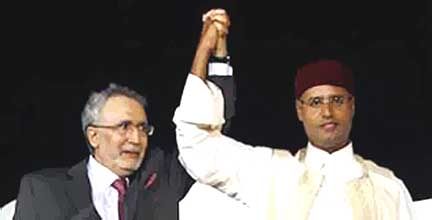
Al Megrahi (left) meets with Col. Gaddafi's son Saif at the plane in Tripoli, Aug 20 2009
The victims of the airliner bombing and their loved ones aren’t so lucky. Susan Cohen, who lost a daughter in the attack, is among the most vocal in denouncing the “appeasement” of the Libyan’s release, a "triumph for terrorism" that “really endangers the innocent public.” source The preponderance of Obama administration officials and U.S. Congress seem to agree with this basic sentiment, wishing al Megrahi to die in jail, judging by their recent comments, out of concern for justice and the sentiments of family members like Cohen. For example, former FBI Director Robert S. Mueller, in a sharp letter to McKaskill, “your action makes a mockery of the rule of law,” and “gives comfort to terrorists around the world who now believe that […they may] be freed by one man's exercise of "compassion."” Mueller, who explained he was speaking up based on his unbiassed knowledge of the case as “Assistant Attorney General in charge of the investigation and indictment of Megrahi,” capped this powerful missive with "most importantly, your action makes a mockery of the grief of the families who lost their own on December 21, 1988." source

But comparing al Megrahi’s fate with those of the Pan Am 103 victims has its pitfalls. Of course he gets to die on the ground and after plenty of warning and time for closure, while they did not. Neither do a multitude of others who die every in plane crashes every year around the world, both before and since the bombing of Flight 103. They die violently in terror while al Megrahi revels in the splendor of his hospital bed. He isn’t responsible for everyone killed in a plane crash and mandated to somehow balance out their fates. So why the moral linkage for these 270 in particular? Ah yes, how silly of me, the conviction, following allegations, a trial, some evidence, and so on… but that’s where it starts to get confusing, if you take an honest closer look. It can get less confusing again, but only after you’ve passed through a mental shift and realize that no matter how official and how widely-accepted this story is, it is – at least all too probably is – dead wrong.

Props are due to JREF forum member Rolfe, who started a thread on the issue of the accused bomber and his case back in 2007 – recently given new life by the controversial release. In numerous under-appreciated posts Rolfe has presented an amazingly strong case that the convicted killer was wrongfully convicted, in a blatant frame-up by the CIA (and others), in a campaign supported by London and Washington and rubber-stamped by the thee-judge Scottish court (no jury) with its unanimous guilty verdict in January 2001.

I haven’t personally verified many of the details myself, there are agendas all around, unverifiable allegations, and plenty of bona fide mystery. My partial examination of the primary sources and the shifting public discourse shows strongly mixed feelings but frequent citations of the “theory” that al Megrahi is innocent after all. This startlingly different view has the backing and support of a stunning number of people involved in or familiar with the case: one of the lawyers who set up the trial, a special U.N. observer, a handful of British MPs, some of the American investigators and Scottish detectives, some victims’ family members, a whole Swiss electronics company tangled up in the case, and many other educated commentators, as well as much of the non-English-speaking world, and virtually the entire Arab-Muslim world. All these people are quite confident the case againt al Megrahi and Libya were manufactured for political reasons and history will, or should, absolve them.

If al Megrahi was indeed framed as it seems, this leaves the true culprits successful, unindcited, and free. This will absolutely piss off survivor’s families when and if they ever realize it. The thinking on culprits, which could soon turn heated, runs in two broad directions I find worth considering. The most obvious direction the case might go if re-opened is towards where the first official evidence clearly pointed – Palestinian terrorists acting on behalf of Iran, in revenge for an Iranian airliner shot down by the Americans. The reason(s) why this line was dropped in favor of a Libyan lead can only be guessed, but the most widely accepted theory is to minimize friction with Iran as the West shifted towards conflict with neighboring Iraq.

Coversely, this eclipsed line of evidence could be every bit as bogus as the one that replaced it, with actual guilt on some unacknowledged parties working for the CIA or some other Western agency. The actual evidence for this possibility would be slim and/or circumstantial, and some would consider the notion fanciful. Nonetheless, there were a number of pre-attack peculiarities followed by vigorous Anglo-American steering of the investigation and adamant refusal of any review or reversal of the hard-won conviction. Considering all this, which I plan to explore in some detail, it seems entirely worth considering that they’re covering some very touchy personal secrets.

Thursday, July 30, 2009

FORTY-THREE YEARS OF DECEIT

A BASIC OVERVIEW IN THREE MOVEMENTS
[NATO Sneak-Behind Armies series]
Adam Larson / Caustic Logic
July 31 2009 - incomplete


NOTES ON METHOD
Here I offer a general overview of key events tangled up, allegedly at least, in the epic tragedy of NATO’s “sneak-behind armies” – the manipulation of Europe’s Cold War politics by Right Wing violence to keep the West safely away from the Left. These activities are widely believed to emerge from NATO “stay-behind” resistance cadres – whose job was to wait for a Soviet invasion – activated by CIA schemes and allegedly kept quite busy in the meantime. For the moment, I’m relying on two primary resources from the same source: Dr. Daniele Ganser’s NATO’s Secret Armies [Frank Cass, London, 2005], for some details, and for the skeleton a timeline compiled by Ganser I believe, for the Zurich-based Parallel History Project on Cooperative Security (PHP), supported by International Relations and Security Network (ISN). ISN is, in turn, part of the Zurich-based Center for Security Studies, at which Dr. Ganser is a senior researcher.

Collectively, this Swiss analysis seems a well-researched and a reasonable take, if slanted a bit to the left and against the United States and NATO. This is fine by me, and probably closer to the truth than the official disavowals of all links to the terrorist stuff. This instinct leads to an inclusive approach to research, possibly providing some chaff with the wheat. This too is fine as I like information and have my own filters (whch are currently at work, not finished). Here then is a broad sweep, in three phases, of the related events of 1947 to 1990. My source is usually the timeline, with uncited supporting details from various parts of Ganser’s book, with a few other internet sources linked where they appear.

GROUND RULES: 1947-1960
The story’s roots go back well into World War II and even further back, but really started becoming clear in 1947, as President Truman laid out his containment doctrine in March and the National Security State emerged with the September act of that name. The resultant Central Intelligence Agency ushered in its covert action section called Office of Policy Coordination, which was soon organizing existing Conservative/Monarchist/Fascist activists in Europe. These would in strict secrecy form networks of trustworthy “religious” types overseen by the respective nation’s Secret Services, which in turn maintained links to the CIA and the British foreign intelligence service MI6. Hidden weapon and supply caches and radio communication systems were the primary infrastructure set up in each nation.

The Anglo-American Trans-Atlantic consensus rolled ahead, expanded to the concept of the Western Union with “Free” Europe, ranged against the Soviet Bloc. This pre-NATO union operated from Paris with its “Clandestine Committee” (WUCC) created in 1948 to oversee the continent-wide stay-behind system. The following year, the union solidified around the North Atlantic Treaty into NATO, still based in Paris, and the WUCC was absorbed and renamed Clandestine Planning Committee (CPC).

Ironically, it was in France that one of the earliest stay-behind armies was exposed in late June 1947, when Interior Minister Edouard Depreux revealed the existence of a secret army codenamed “Plan Bleu” (as in, opposite of Red). This had envisioned a military coup to bring DeGaulle to power and sideline all leftist tendencies, and planning was well-along, with American and British support, before it was busted up. The stay-behind army Rose De Vents, French for “compass rose,” which is of course NATO’s logo, was formed within the SDECE military police following the scandal, keeping the network alive and again concealed. The government continued on wobbling left and right as is natural, until in 1958 a similar “Operation Resurrection” was organized, with the support of Rose de Vents, to replace the soft Fourth Republic with a right-wing state under De Gaulle. This time the government quietly surrendered and invited the change, thus leaving the coup d’etat unrealized.

The post-war ideological battle was uniquely pitched in France at the time, as it was in Italy, where the US had been recruiting the likes of the Fascist “black prince” Borghese for years, and spent 1947-48 pumping tens of millions into manipulation and dirty tricks for the anti-Communist campaigns for the 1948 national elections. This succeeded and left Italy solidly in the Right/NATO camp, to be kept there by complex networks operating largely through the CIA-linked P2 faux-Masonic lodge. Italy would in the years ahead become the main battlefield of the Left-Right secret wars of the European Cold War; sometimes involving the Italian mafia and/or the Vatican among the usual suspects, it tops the heap for both mind-boggling intrigue and deadly violence.

With the full, cold weight of East Germany pressing next door, West Germany had no allowable possibility of Communist leaning, and so the West’s networks there pulled out the stops following World war II. Intelligence types made contacts with useful former Nazis, including Clause Barbie, Reinhard Gehlen, etc. among other measures, so that well before NATO membership in 1955, West Germany’s government was in no way neutral. The original German equivalent of Gladio was known as BDJ-TD (Bund Deutscher Jugend – technical division), set up by other former Nazis, including Col. Gunther Bernau. This was trained, equipped, funded, and at least indirectly commanded by the CIA, and promised full protection from domestic and international law to any of its members accused of illegal acts.

The Iberian peninsula – Spain and Portugal – presented an unusual situation. Their long-running strong-man regimes were of the same Fascist camp as Germany and Italy had been, but they had managed to remain officially neutral during World War II. In the Cold War, context, onetime liabilities were suddenly clear assets, as in Germany and Italy. Spain’s surviving General Franco was given the blessing by NATO to keep ruling, and Spain was treated as a partner, but not allowed to join until 1982, after his death and a democratization process. Portugal however, under 36-year dictator Antonio Salazar, managed to become a NATO member immediately in 1949, but was never blessed with a domestic stay-behind army of the kind used elsewhere to keep governments in check. Spain’s president in 1981-82 Calvo Sotelo said after the 1990 revelations why there was no Spanish Gladio equivalent; "the regime itself was Gladio." This probably applies to Portugal as well, and thus Iberia had the trust to escape the leash and was used as a secure platform to support operations across the continent. The paths between violence-ridden Rome and Rightist safe-Haven Madrid is perhaps the heaviest trodden of the secret wars.

Not all the networks became violent or very disruptive, however; a Swedish stay-behind network was in operation by 1951 at latest, despite Sweden’s official neutrality and NATO non-member status. This was based on a Nazi-affiliated wartime model called Svealborg, operating under that same name and original director Otto Hallberg. William Colby, later CIA director, from Stockholm oversaw the training of stay-behind armies in neutrals Sweden and Finland, both of which were shut down early on, and the enduring branches for Norway and Denmark. By 1953, Swedish police arrested Sveaborg’s leader, and the network was partly unraveled, but Hallberg himself was let off the hook and it seems likely operations continued.

In a bizarre and devastating turn for the network’s fortune, in Germany, 1952, a former SS officer Hans Otto just walked into the police station in Frankfurt and ratted out the BDJ-TD network he’d become sickened with. He revealed all their secrets, their HQ location, their CIA links represented by a “Mr. Garwood.” Their bases raided and many arrested, it was found the Technical Division gang had been compiling lists of Leftists to exterminate on an unspecified “Day X.” The local government was furious, as many of its members were on the hit lists. The BDJ-TD was shut down, but apparently re-constituted, and ultimately those arrested were found not guilty, under pressure from the national government in Bonn. Likewise, operations apparently continued in some other name, spawning minor violence in the coming years.

In 1957, quieter troubles surfaced in Norway, where secret service director Vilhelm Evang, known as soft on the Left, protested to NATO about the “domestic subversion” of his country by this stay-behind system, and pulled his nation from the CPC until persuaded back. All these frictions in the stay-behind network’s first decade had the potential to bring it all down. The system remained intact though, simply re-forming where needed and hiding all new secrets. The friction may have contributed to the creation of a new system for managing the system, ushered in with NATO’s 1958 founding of the Allied Clandestine Committee (ACC) to coordinate their secret warfare under cover of doomsday planning. This system continued churning out the controversy over the following decades, but with renewed secrecy and then with a greater confidence, zeal, scope, and death toll.

THE EXPANSIVE YEARS: 1960-1974
In general NATO’s stay-behind system made steady gains in non-Atlantic Southern Europe in the 1960s. In Italy the Gladio network was heavily involved in “a silent coup d’état” called Piano (Plan) Solo - the military police persuaded all Socialist Ministers out of the government with a convincing show of military force. To the east of Italy, Greece and Turkey had their stay-behinds approved and were admitted to NATO in 1952. In Turkey, the CIA et al. Were impressed with the anti-communist potential of the imperialist/racist ideology of Pan-Turkism, as espoused by leaders of the 1960 military coup - supported by the secret army “Counter-Guerilla” - that had Prime Minister Adnan Menderes killed.

In 1964 In Greece Socialist George Pompandreous managed to take the Prime Minister slot despite being cheated of it in a 1961 CIA-supported vote-rigging operation. Soon he was trying to disassemble secret networks he found to be fused irremovably to the CIA. Instead he was removed in 1967, with a fierce and sweeping military coup d’état – involving the Greek stay-behind army Hellenic Raiding Force. The powerful Greek Left was punished for its intransigence in making Pompandreous possible with what Ganser describes as “a regime of imprisonment and torture, the like of which had not been seen in Western Europe since the end of the Second World War,” and which lasted for seven years before succumbing to a renewed revolt.

1966 also witnesses the creation, in Salazar’s Portugal, of “Aginter Press” which under the direction of French schemer Captain Yves Guerin Serac studied techniques of subversion, propaganda, bomb-making, network building to disseminate the skills to where needed. It was Aginter’s network that primarily solidified the overt notion of the “strategy of tension,” to disguise the acts of violence as Communist to turn the public against them and towards the real bombers. Within a few years they were killing resistance leaders in Portuguese Mozambique, working for Spain’s secret police, training Italians in bomb-making, liaising with their accomplished colleagues in rightist Greece, etc, thus raising the tension of the general political climate of Europe as the 60s slipped into the 70s.

But in NATO’s heartland – France – the decade went quite less smoothly. April 1961 had seen plotters within the French military with stay-behind-links and alleged CIA support, launch their concerted effort to alter president DeGaulle’s plans to surrender Algeria. The new Organisation Armee Secrete (OAS) takes over in Algiers in April, aiming for Paris next, the OAS insurgency brought the country near to civil war, but was gradually crushed by Paris and fully surrendered in March 1962; along with recognition of Algeria’s independence, the Algier Francaise scene faded, but its ideologues would carry on - like Guerin Serac (real name Guillou) who would help establish Aginter Press.

Perhaps aware of the American role in the networks that were plotting against him, or of other such interfere with France’s sovereignty DeGaulle started enacting policies that CIA felt were “paralyzing NATO” in Europe as early as 1961. Within five years it had come to a head, and in March 1966 the President dramatically canceled the country’s NATO membership, and ordered its headquarters to leave his soil. They complied and moved camp to neighboring Belgium. The stay-behind coordinating ACC was code-named SDRA 11, fused within the Belgian military secret service SGR based right next to NATO. They have never had to move again, thankfully. It must be quite embarrassing.

The mid-1960s saw secrets slipping as well, but compared to the gains, it seems the secret armies were running a tight ship. The timeline I’m citing here reports on NATO’s move to Brussels, “secret NATO protocols are revealed that allegedly protect right-wingers in anti-communist stay-behind armies.” In 1968 a British MI6 agent working with the stay-behind network in neutral Sweden willingly reveals secrets to the KGB. The first stay-behind arms caches in neutral Austria – 34 locations – were found by police in 1965, based on info they somehow forced from British MI6 agents who knew where they were.

Then one of the more ominous moments; on December 12 1969 a bank bombing at the Piazza Fontana in Milan killed sixteen ordinary people, mostly farmers; along with three other bombings in Italy the same day and an un-detonated fourth (C4, usually American) the brazen attack was quickly blamed on the Italian Left. During a 1990s trial, General Maletti, former head of Italian counter-intelligence, “claims that the massacre had been carried out by the Italian stay-behind army and right wing terrorists,” as the timeline puts it, “on the orders of the US secret service Central Intelligence Agency (CIA) in order to discredit the Italian Communists.”

This was but the opening shot of the Italy’s nightmare, the fiercest years of the secret wars with an overall estimate of 490 killed between late 1969 and 1980. A year after the Piaza Fontana bombings, in December 1970 a coup d’etat led by Fascist luminary Valerio Borghese, supported by the Gladio networks, was only called off at the last minute under mysterious circumstances. On May 31 1972 a booby-trapped car exploded near the village Peteano killing three police officers; the terror fell on May Day, and insiders planted false leads implicating the local Communists, causing a crackdown and setbacks for their agendas. The crime was later traced, however, back to right-wing terrorists including Vincenzo Vinciguerra, who had fled to Spain with the help of the Italian secret services. He would be arrested, as such men often were, but he returns to our story in the 1980s. In 1974 two more massacres “during an anti-fascist demonstration" and "in the Rome to Munich train “Italicus Express”, kill 20 and wound well over 100, the timeline says. I’m not sure if these were also blamed on Communists but it was getting tense, resembling some kind of civil war.

1974 AND AFTER: ESCALATION AND COLLAPSE
It was in October 1974 that Italy’s legal system managed to push back at the right spot; General Vito Miceli, chief of the military secret service SID and prominent P2 member, was arrested in relation to the 1970 Borghese coup attempt. Perhaps intending to awe the court, he revealed that “it was the United States and NATO who asked me” to establish his “super SID,” which was involved in the coup. (The full quote varies, often a little misleading – later post). Miceli was acquitted in 1978 but at least one secret had slipped out, and the episode also spurred parliamentary moves to restructure and rein in the secret services. Gladio’s capabilities were thus limited, but the floating freelance terrorists beyond them were still at large.

In Denmark the secret stay-behind army Absalon tried in 1974 to block some Leftist academics from “becoming members of the directing body of the Danish Odense University,” but failed to do so, and somehow in the melee, “the secret army is exposed.” They never had much luck in the north, but in general the Iberian peninsula remained stable and strongly in NATO’s right hand. However in 1974 an unusual popular revolution (of the flowers) rocked Portugal and Salazar’s regime was overthrown. In the process Aginter Press and other NATO secret operations were shut down. Related operatives and operations moved to Spain before the new government could nab them, and from 1975 on cooperated with Franco against Basque separatists and Communists, as with the 1977 Atocha massacre.

In the mid-1970s, the Italian parliament, to smooth tensions with the large and permanently locked out Italian communist party, made moves to allow some Communists to join the government. This option unacceptable to the Italian Right, or to Washington and NATO, but it rolled ahead under MP and former President Aldo Moro. In 1978 Moro was taken hostage in Rome by “an armed secret unit” as the PHP timeline puts it, and killed 55 days later. The murder fits the motives of the secret armies, but the government enthusiastically blamed the Leftist Red Brigades, and cracked down hard. That story makes no sense, but fits perfectly with the Rightist “strategy of tension,” which was working.

Perhaps due to this encouragement, he terror continued to escalate into the worst single atrocity of the decades-long secret war; in August 1980 a massive bomb ripped apart a waiting room at the Bologna railway station, killing 85 and seriously injuring and maiming a further 200. It remains unknown, and one of the biggest questions, what full links Gladio had to the Bologna massacre. A later Italian Senate investigation found some evidence the explosives were from a cache established for the secret army. Perhaps for a bit of camouflage, this one was not blamed on Leftists but on less favored Right-Wing extremists, who probably had no access to Gladio’s stocks, and in turn claimed to be framed by Licio Gelli of the CIA-linked P2 Masonic Lodge, but were jailed anyway and remain there now. Aginter co-founder Delle Chiaie had been charged with association, but the charges were dropped. An Italian judge decades later charged Gelli with criminal diversion is the case.

Following the 1971 Turkish military coup d’état against Demirel’s center-Right regime, with the help of the stay-behind army Counter-Guerrilla. This network continued under state tutelage to kill hundreds in domestic terrorism; for example, in 1977 their gunmen killed 38 at a demonstration in Istanbul. Somewhere in there things were deemed to have slid into softness and in 1980 the commander of Counter-Guerrilla launched a successful coup to re-gain tighter control. Just as the violence against actual Communists in actual Europe was dying down things continued to stay brutal here; during the mid-1980s the stay behind army worked on answers to Turkey’s “Kurdish question,” killing and torturing thousands of suspected separatists.

The late 70s and early 80s saw revelations of the network increasing; In 1976 the German secret service BND secretary Heidrun Hofer was arrested for sharing secrets of the German stay-behind army with her husband. Her husband was apparently a spy for the KGB. Oops. The Norwegian police discover a stay-behind arms ache in 1978, leading to the arrest of Hans Otto Meyer who reveals the Norwegian secret army. In 1983 Dutch hikers near the village of Velp discover a large arms cache, a finding that led to the government admitting that the arms were related to NATO “unorthodox warfare” plans for the Netherlands. Other such remote arsenals were being used before X-day - In October 1980 gunmen at a Munich festival killed 13 and wounded hundreds of German civilians; a large weapons cache allegedly used by the right-wing assailants – later believed of the Gladio network - was discovered the following year near the village of Uelzen.

In 1984 Italy right-wing terrorist Vincenzo Vinciguerra, on trial for the Peteano bombing of ‘72, reveals the Gladio secret army and its networks in great detail to Judge Felice Casson. Vinciguerra’s testimony remains perhaps the most vivid single summation of the alleged patterns of NATO/CIA manipulation: "You had to attack civilians, the people, women, children, innocent people, unknown people far removed from any political game,” and convince them the danger came from the Left and the Right was their only salvation. After so describing the “strategy of tension,” Vinciguera was successfully sentenced to life and imprisoned. This time, the charges were NOT dropped. By 1984 the violence in Italy had mellowed from previous years, though not quite stopped for another year or two.

From 1982-1985, a series of brutal and terrifying armed attacks shocked NATO HQ’s host nation Belgium. The usual target was a supermarket in the Brabant region near Brussels, where supremely confident masked men started strafing shoppers, and freely engaging any police who dared show up. They usually targeted the same store chain (Delhaize) always escaped and were never caught, but sparked a heightened state of security and associated mindsets across the nation. The worst was November 9, 1985 – a pre-Christmas holiday there - in which 28 were killed and scores injured. The PHP timeline explains "investigations link the terror to a conspiracy among the Belgian stay-behind SDRA8, the Belgian Gendarmerie SDRA6, the Belgian right-wing group Westland New Post, and the Pentagon secret service Defense Intelligence Agency (DIA).” Wow. This one I’ll have to look into. Whatever the case, the tough mindset adopted after the St. Martin’s Day massacre apparently caused the terror to go away, and no more attacks followed.

As Cold War tensions relaxed in the latter 1980s amid reforms in the USSR and Warsaw Pact, the PHP timeline shows no entries at all for years 1986, 87, 88, or 89. Things were certainly happening, but it was subtle, perhaps just sleep and maintenance mode. The ACC was still meeting in Brussels, and no one can say just what they were thinking, there had to be more uncertainty than before just how needed they would remain. In the autumn of 1989, the majority of Eastern Europe went through a string of revolutions, shaking off the Soviet cloak and toppling the iron curtain. Borders were re-drawn, countries re-named, and NATO given massive room for expansion as the Warsaw Pact dissolved. The wave of reform somehow echoed back on the Soviet Union itself in tsunami proportions – Gorbachev’s hope for New World Order was eclipsed by the end of the USSR itself, creating fifteen new nations and yet more room for the “North Atlantic” gang’s grasp.

At this point, any reason for the stay-behind network to exist should have been seriously reviewed, to say the least. Those who knew the Gladiators were there in the shadows may have wondered if the network would die in secret or grow and fester there in some different form. The question was most acute in Italy, where the worst violence was but a decade past. Judge Casson, who was already thinking along Gladio lines after dealing with Vinciguera in 1984, was again perusing military intelligence archives when his luck changed, due to a decision at Italy’s highest level. In January 1990, Casson applied to search a previousy top-secret military archive in Rome. Perhaps well-knowing the danger, Prime Minister Giulio Andreotti granted the request in July. Casson quickly found a document naming Gladio as the network, givng clues to its NATO sponsorship, and the existence of other armies in across Europe.

With specifics in hand, Judge Casson was set to blow it all up. He passed this on to a parliament committee looking into the origins of the terrorism, and they in turn persuaded PM Andreoti to announce the news publicly. Having previously lied to cover up Gladio operations in the 1970s, he stood before the parliament on August 3 and explained the basic clean version of Gladio’s existence. He denied any link to the terrorist stuff – they only waited for war, he said. In Belgium the Allied Clandestine Committee met for the last time on October 23 and 24 to discuss the new realities of their loss of mission and of cover. As the meeting was happening, Andreotti repeated his revelation and explained they were still active and in congress at that moment in Brussels. NATO denied any stay-behind networks on November 5, then shifted back to their usual “neither confirm nor deny mode.”

The world media was immediately distracted with the Gulf War, but eventually pursued the story, searching out answers in the capitols of Europe in the last months of 1990 and to a lesser extent over the following years. Various public and private investigations turned up many clues, forming much of the timeline preceding . Many gaps remain. The program in neutral (non-NATO) countries of Finland, Sweden, Austria, and Switzerland is especially sensitive. Colonel Herbert Alboth promised to tell “the whole truth” of the Swiss secret stay-behind army P26 he once commanded, but instead fell on his own sword – repeatedly - and was found dead “stabbed with his own military bayonet.”

Within the year, based on whatever evidence, hunches, and common sense, the parliament of the European Union issued a resolution sharply condemning NATO and the United States for steering European politics with the stay-behind network. Of the involved nations, the US and UK remain the tightest-lipped. NATO continued to say nothing, the CIA refused to cooperate either with the National Security Archive’s FOIA requests or those of Dr. Ganser, or anyone else. Additional clues continued to surface from time to time. London’s Imperial War Museum in 1995 did ackowledge in an exhibit ("Secret Wars") MI6 and SAS involvement in forming stay-behinds across Western Europe following World War II. But officially, nothing.
...

Wednesday, December 6, 2006

NORTHWOODS II: SPECIAL DISTRIBUTION - THE PLAN

Before all this could come about, there was at least one more major development regarding Cuba that brings us to the central thread of this book. Bamford wrote “although no one in Congress could have known at the time, Lemnitzer and the Joint Chiefs had quietly slipped over the edge.” [1] They were not through with Cuba - one plan had failed, theirs had not yet been tried. They even had a plan to win public support for this war at all costs, and it was called “Operation Northwoods.” Like the CIA’s Bay of Pigs plan, the roots of Northwoods go back to the twilight of Eisenhower’s term. On January 3, Eisenhower told Lemnitzer and others that, as Bamford explains, “he would move against Castro before [Kennedy’s] inauguration if only the Cubans gave him a really good excuse.” [2] It didn’t happen in time for Eisenhower, but on the 19th, the day before Kennedy was sworn in, new Joint Chiefs chairman Lemnitzer gave his approval to a proposal that would eventually morph into this sinister plan to provide that “really good excuse.” [3]

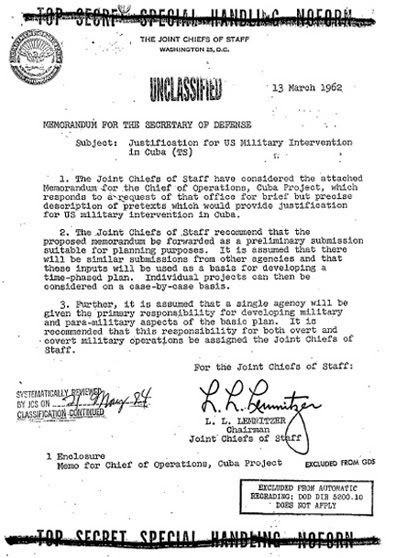
The origin of the name “Northwoods” is not clear, but is possibly a reference to the London suburb of Northwood, home of the Permanent Joint Headquarters (PJHQ), the British equivalent of the JCS, possibly indicating a British connection or inspiration. In March 1962, Operation Northwoods was completed, and Lemnitzer signed off on it. The “special distribution” document opened:

”As requested by Chief of Operations, Cuba project, the Joint Chiefs of Staff are to indicate brief but precise description of pretexts which they consider would provide justification for US military intervention in Cuba.” [4]


Wikipedia article on Northwoods

Destabilizing or toppling Castro’s regime and the re-subduction of Cuba was still American policy in general, and Northwoods itself was part of a larger, Kennedy-supported “Cuba Project.” But this report went beyond the pale, promoting harassment and a threatening posture to elicit an attack “since,” the memo states, “it would seem desirable to use legitimate provocation as the basis for US military intervention.” [5] But of course Cuba was not Japan, and Castro was not Tojo, and so the report focused more on the backup plans. These were more cynical than anything FDR or Arthur McCollum, the author of his Japan provocation policy, would have dreamed up - if Cuba failed to be provoked into a “mistake,” the JCS proposed providing a pretext themselves in a false flag operation and blaming Cuba for it.

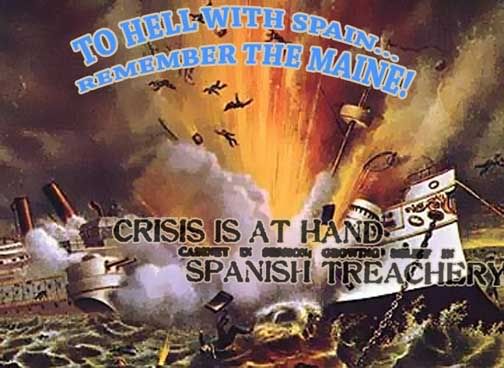
They suggested what they candidly described as a “remember the Maine” incident, the sinking of a U.S. ship in Guantanamo Bay to be blamed on Castro. Mock attacks on U.S. bases by friendly Cubans dressed as Castro forces, the planting of “plastic bombs” in Miami, Washington, and elsewhere, and even the sinking of a boatload of Cuban refugees (“real or simulated”) were mentioned. In fact, a little death would be useful - the report noted that “casualty lists in U.S. newspapers would cause a helpful wave of national indignation.” [6] While they never planned to shoot him down themselves, Northwoods did suggest that, should John Glenn’s space capsule accidentally crash as he attempted the first American orbit of the earth, this could be blamed on Cuba as well. [7]

In all, Northwoods offered dozens of variations on the theme, but the ones regarding aircraft bear a look here. For what it’s worth, all these are neatly contained in pages nine to eleven (that is, 9-11). These received extra attention perhaps because they did not involve deaths at all, simply high-tech aerial acrobats and cynical trickery. Point six, for example, mentions use of “an F-86, properly painted” to simulate a Cuban MIG (Soviet-made) fighter jet, and that “reasonable copies of the MIG could be produced from US resources in about three months.” It mentioned that the “destruction of U.S. military drone aircraft” by these MIG replicas could look convincingly like a Cuban attack. Keep in mind that drone means remote-controlled and pilotless.

Point eight is especially interesting and elaborate. Here is an extended citation (emphasis mine throughout):

“It is possible to create an incident which will demonstrate convincingly that a Cuban aircraft has attacked and shot down a chartered civil airliner en route from the United States to Jamaica, Guatemala, Panama, or Venezuela. The destination would be chosen only to cause the flight plan route to cross Cuba. The passengers could be a group of college students off on a holiday or any grouping of persons with a common interest to support chartering a non-scheduled flight.

a. An aircraft at Elgin AFB would be painted and numbered as an exact duplicate for a civil registered aircraft belonging to a CIA proprietary organization in the Miami area. At a designated time the duplicate would be substituted for the actual civil aircraft and would be loaded with the selected passengers, all boarded under carefully prepared aliases. The actual registered aircraft would then be converted to a drone.

b. Take off times of the drone aircraft and the actual aircraft will be scheduled to allow a rendezvous south of Florida. From the rendezvous point the passenger carrying aircraft will descend to minimum altitude and go directly into an auxiliary field at Elgin AFB where arrangements will have been made to evacuate the passengers and return the aircraft to its original status. The drone aircraft meanwhile will continue to fly the filed flight plan. When over Cuba, the drone will begin transmitting the international distress frequency a “MAY DAY” message stating he is under attack by Cuban MIG aircraft. The transmission will be interrupted by destruction of the aircraft which will be triggered by radio signal. This will allow ICAO radio stations in the Western Hemisphere to tell the US what has happened to the aircraft instead of the US trying to “sell” the incident.”

Points seven and nine also deal with such aircraft-related deceit. These three pages contain several elements of “silly” 9-11 conspiracy theories, even some of the ones I don’t necessarily buy:

- Destruction of remote control drone jets
- Aircraft “rendezvous,” crossing paths to confuse radar and swap drones for manned flights
- Aliases, false paint jobs, and CIA “proprietary companies” to allow pilots, passengers and planes to “disappear”
- Training missions as cover
- Planted evidence of a nonexistent attack
- Manipulated flight data and radio transmissions
- Remote controlled explosives

All of these were presented as real possibilities in a real and proven JCS-sponsored conspiracy. No theory here. The plan suggested the provocations occur “within the time frame of the next few months” and closed with the recommendation that the entire deal be carried out by the Joint Chiefs themselves. [8] After reviewing the memo, Lemnitzer signed it and pitched it to Kennedy’s military representative, General Maxwell Taylor, on March 13, 1962. What exactly happened during the meeting is unknown, but it only took three days for President Kennedy to inform Lemnitzer that the game was over; there was no longer a possibility of overt U.S. force against Cuba. Still the Joint Chiefs persisted, insisting to Defense Secretary McNamara that the war needed to begin soon. McNamara responded by rejecting nearly everything they sent his way. [9]

Within months, Lemnitzer would be denied another term as chairman and transferred to another job. This was not much of a demotion – he was named Commander of U.S. forces in Europe in November 1962 and was appointed Supreme Allied Commander of NATO the following January. [10] He retired from the military in 1969, and in 1975 was selected by President Ford to serve on the Rockefeller Commission, looking into Rockefeller-connected, illegal CIA projects (like the MK Ultra mind control experiments) overseen by his old partner Allen Dulles at the CIA. [11]

But as for Lemnitzer’s own illegal activities - was Northwoods a unique example, or are such “special distribution” recommendations actually common? The report noted on page four “it is assumed that there will be similar submissions from other agencies and that these inputs will be used as a basis for developing a time-phased plan.” [12] It appears that even as far as this “Cuba Project” was concerned, Northwoods was not alone, and they probably knew this from previous experience - its uniqueness therefore may lie not its existence but in its eventual publication.

In fact Bamford notes Northwoods as a precedent for events to come. On the subject of the Gulf of Tonkin incident, the August 1964 alleged attack by North Vietnamese forces on American ships that led to direct U.S. involvement in the Vietnam War, he wrote:

“In light of the Operation Northwoods documents, it is clear that deceiving the public and trumping up wars for Americans to fight and die in was standard, approved policy at the highest levels of the Pentagon. […] One needs only replace “Guanantanamo Bay” with “Tonkin Gulf,” and “Cuba” with “North Vietnam.” The Gulf of Tonkin incident may or may not have been stage-managed, but the senior Pentagon leadership at the time was clearly capable of such deceit.” [13]

Bamford described Northwoods as “what may be the most corrupt plan ever created by the U.S. government.” [14] But that’s not to stay it didn’t have stiff competition, nor that other nations at other times have not trumped the JCS, nor that the U.S. itself hasn’t trumped this in the period after the book’s release. To act like Lemnitzer and his people invented such cynical thinking is disingenuous – such deceit is standard operating procedure for politicians and leaders worldwide and throughout history. But this report shatters the belief that America is somehow different, protected by a bubble of Democracy.

Thursday, November 23, 2006

NORTHWOODS I: LEMNITZER THE LANDMINE

TENSE TIMES IN THE CHICKEN HOUSE

1961: The Cold War was nearing its zenith of insanity, people were getting at each other’s throats over how to deal with the USSR and its two new and troubling satellites: Sputnik and Cuba. By the end of 1960, the Soviets had taken the lead in the emerging space race and opened a new storefront just eighty miles from Florida, and the first worries over the apparently fictitious “misile gap,” a widening margin by which the Soviets were thought to have us out-armed, had been aired. Concerns were growing on the political right about communist infiltration at home, with some insisting that this was a more immediate menace even than the Soviet Union itself. And then to top this off there was the big political re-shuffling that accompanied the tumultuous 1960 presidential election.

Lemnitzer
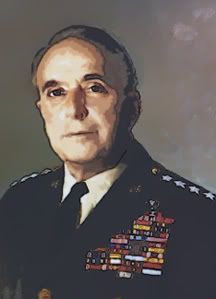
General Lemnitzer, Eisenhower's window on the Kennedy White House and ours on the schemes of empire
General Lyman L. Lemnitzer (US Army) was a troubled man. Maybe it was the excess of Ls in his name, maybe it was just the tense times. He had been a military protégé of General Eisenhower in World War II, helping plan the early invasions of North Africa and Sicily. At war’s end he was involved in securing the surrender of the Axis leadership, working closely with Allen Dulles, who would later head the CIA; Lemnitzer has been accused of helping some former Nazis move to South America, and he helped others to stay behind in Europe, under the auspices of NATO, as spies against the USSR. [1]

By 1960, Lemnitzer was chief of staff for the Army, and Eisenhower was finishing his second term as President of the U.S. In November it became clear that Democrat John F. Kennedy, not Eisenhower’s vice president Richard Nixon, would be the next president; at this point, Eisenhower turned to his old aide Lemnitzer, appointing him Chairman of the Joint Chiefs of Staff, the highest military post in the country, in regular contact with the president. According to James Bamford in Body of Secrets (2001) Lemnitzer’s view of Eisenhower at this time of this promotion reportedly “bordered on reverence.” By leaving Lemnitzer behind, Bamford wrote, “Eisenhower would have a window onto the next administration,” and as would become clear in due time, Lemnitzer would also “become a landmine in the Kennedy administration.” [2]

Lyman was a hard line anti-Communist, an immaculate planner and control freak. According to Bamford, upon becoming chairman, “he sent out elaborate instructions outlining exactly how his fellow chiefs were to autograph group pictures – they were to sign their names directly under his, and they must follow his slant.” [3] He was reportedly not pleased to be working under Kennedy, and he wasn’t the only one. Fears were widespread, especially in the military, that Kennedy, his brother, and the rest of their team were inexperienced, liberal, and/or soft on communism. These concerns were very serious, and would come to a head very quickly over response to the revolution in Cuba.

Planning for the elimination of Fidel Castro's new regime had already begun under Eisenhower; as Kennedy came to office, two primary models prevailed, one backed by the military, one backed by the still-new CIA. Kennedy wanted no proof of American involvement, fearing that would antagonize the Soviet Union and world opinion. Thus he preferred the sneakier CIA model, based on the earlier and successful CIA-led operations that overthrew the Presidents of Iran and Guatemala. This was the basic model that came to be - injecting a force of nominally independent Cuban exiles back into their homeland, and hoping that they unite the oppressed peasantry behind themselves and march on Havana. No American forces or aid was to be seen, but secret training and arming was done in the southern U.S. and - surprise - the recently-re-subdued Guatemala. [4]

Lemnitzer and those of like mind felt that Kennedy underestimated the Castro regime, which was starting to receive military supplies and pilot training from the communist government of Czechoslovakia. “Time is working against us,” Lemnitzer told Kennedy at their first meeting on January 25. [5] He felt that America had to risk direct military involvement if they wanted success, and predicted that if the CIA’s sloppy plan were used, it would end in disaster. [6] It was used, and it failed spectacularly in mid-April, just three months after Kennedy was sworn in. The failed invasion, even though it was not planned by Kennedy himself, displayed to some exactly the inexperience they feared, and the invasion, while very hard on the anti-Castro forces who were mowed down, was very soft on Castro himself.

While the military mistrusted the Kennedies, much of the public and their Congress at the time were worried about the military. Eisenhower himself had warned in his farewell address, January 17 1961, of the dangers of the “military industrial complex.” He emphasized the need for “an alert and knowledgeable citizenry” to “never let the weight of this combination endanger our liberties or democratic processes.” Such fears were widespread in the following years, as evidenced by the later success of the 1964 film Seven Days in May. Starring Kirk Douglas and written by Rod Serling, the film was about a military coup against a president perceived as soft on communism, led by the Joint Chiefs of Staff.

Congress stepped in with a 1961 Senate Foreign Relations Committee investigation of right-wing activity in the military, and Lemnitzer himself came under their microscope. Among the most critical of the JCS chairman in the hearings was Sen. Al Gore sr. (D-TN) Citing recent right-wing military revolts and coups in France and elsewhere, the committee published a report on their findings of a “considerable danger” in the “education and propaganda activities of military personnel.” [7]

The committee also called for an investigation of possible ties between Lemnitzer himself and right-wing groups like the John Birch Society (JBS) and his awareness of the activities of former Major General Edwin Walker. Walker was a right-winger accused of pushing racist ideas and JBS propaganda on his subordinates. He had resigned when singled out by Defense Secretary Robert McNamara in April 1961, becoming more vocal in his charges that Communists had infiltrated the administration. [8] Walker made a failed bid for Governor of Texas in 1962, losing badly to Tom Connally. In 1963 he began “Operation Midnight Ride,” an evangelical anti-communist crusade. [9] At this time Walker and his aides say he was being trailed and spied on by mysterious men, one of whom allegedly shot at him on April 10 but by pure luck missed Walker's head. The crime went unsolved for over eight months before the FBI, Dallas PD, and Walker himself identified the gunman as none other than Lee Harvey Oswald, the master marksman who had just blown off the President's head. [10] Hmmm…

As Kennedy came to power amid the Bay of Pigs fiasco, in late April 1961 he met with General Douglas MacArthur. According to Kennedy aide Theodore Sorenson, MacArthur told Kennedy “the chickens are coming home to roost, and you happen to have just moved into the chicken house.” [11] And of course the evolving Cuba situation would soon lead to the Missile Crisis of 1962, followed by the 1963 murder of president Kennedy before the nation’s eyes, allegedly by Walker’s stalker, providing the most vivid national trauma for nearly four decades.

But I'm no expert in this field and this is all a bit of an aside from the story of Lyman L. Lemnitzer and Operation Northwoods, to which we turn in the next post.

Sources:
[1] Petit, Andres. “Operation Northwoods: Joint Chiefs of Staff USA.” AfroCubaWeb. Last Modified August 20, 2004. Accessed November 13 2005 at: http://www.afrocubaweb.com//news/northwoods/northwoods.htm
[2] Bamford, James. Body of Secrets: Anatomy of the Super-Secret National Security Agency. New York. Anchor Books. First Anchor Books edition. 2002. Pages 67, 68
[3] See [2]. Page 73.
[4] "Bay of Pigs Invasion." Wikipedia. http://en.wikipedia.org/wiki/Bay_of_Pigs_Invasion
[5] See [2]. Page 72.
[6] See [2]. Page 73.
[7] See [2]. Page 80.
[8] See [2]. Page 79.
[9] “Edwin Walker.” Wikipedia. Accessed November 1, 2005 at: http://en.wikipedia.org/wiki/Edwin_Walker
[10] North, Mark. Act of Treason: The Role of J. Edgar Hoover in the Assassination of President Kennedy. New York. Carroll and Graf Publishers, Inc. First Carroll and Graf edition. 1991. Page 255
[11] Tarpley, Webster G. and Anton Chaitkin. George Bush, the Unauthorized Biography. Ch VIII-b: The Bay of Pigs and the Kennedy Assassination. Accessed November 8, 2005 at: http://www.tarpley.net/bush8b.htm