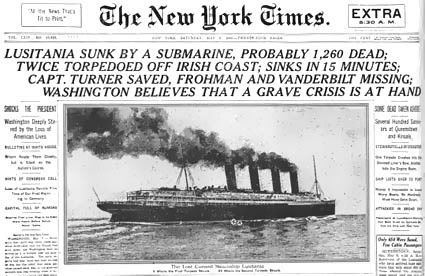
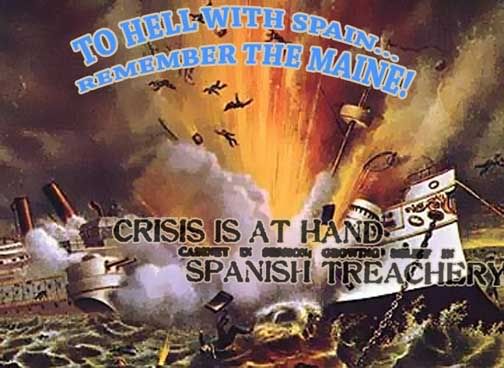
Just in case anyone's paying attention and concerned I've abandoned this 'blog. I've been focussing on the Frustrating Fraud and with real life lately. Soooo... I don't have time to put together a proper post on the Lusitania like I'd intended, so here is a teaser, a few notes end excerts from Colin Simpson's 1972
The Lusitania.
Among the players we'll be looking at:
- Alfred Booth: Cunard Chairman
- George Booth: Deputy Director-General of the Ministry of Munitions, 1914-1919
- William Jennings Bryan: US Secretary of State 1914-1915
- Winston Churchill: First Lord of the Admiralty as of 1911, apparently among the prime, if not
the prime, architect, of the British end of the Lusitania disaster set-up.
- Captain “Fairweather” Dow: demanded more coal in Dec 1914, took his case right to the Admiralty
- Lord Fisher, Churchill’s First Sea Lord: retired in 1911 – warnings to Churchill (p 31). Letter to Tirpitz March 1916: “I don’t blame you for the submarine business, I’d have done exactly the same myself.” (p 14).
- Captain Guy Gaunt: naval Attache at the British Embassy in Washington, “Hall’s deputy in America.”
- Capt. Reginald Hall: Director of British Naval intelligence as of Oct. 1914.
- Col. Edward M. House – proto-National Security Advider to President Wilson
- Robert M. Lansing: Advisor to the State Dept. on foreign territorial disputes and an errand boy for Wilson when Secretary of State Bryan wasn’t cooperative enough – uncle to Allan and John Foster Dulles, a chief architect of the American end of the Lusitania disaster set-up.
- US President Woodrow Wilson: Apparently down with the set-up but playing ambassadorial 14-points-compatible kind of plausible deniability.
Operation run from American end by Morgan interests working with Lansing, Edward Stettinius and representatives from “naval and military ordnance officers … attached to the British Consulate in New York.” [56] – “It is difficult to reconcile President Wilson’s well-publicized idealism and neutrality with his sanctioning of the Morgan operation.” [p51]
February 19 1913 – Cunard shipping line chairman Alfred Booth is called before Board of Admiralty, chaired by Lord Winston Churchill, and informed that the company’s deal with London to support the war effort was to be honored; effective immediately, their ships, including the Lusitania, were to be fitted with removable cannons and set to shipping war materiel and other aid across the Atlantic to create a semi-covert Anglo-American supply chain. At this point, Churchill told Booth that war was expected with Germany by September 1914. (p 25) War was finally declared on August 4 of that year, just after the German invasion of Belgium and a few weeks ahead of time.
By December 1914 – “Naval Intelligence was intercepting almost every German signal […] a stroke of good fortune had provided the admiralty with the official German naval codes and by the end of February 1915 Marconi had perfected a method of radio direction finding. […] by the end of January 1915, Hall was able to to advise the admiralty of the departure of each U-boat as it left for left for patrol.” [65]
On Churchill's book "The World Crisis:"
Simpson's excerpts: “The distinction between politics and strategy diminishes as the point of view is raised. At the summit true politics and strategy are one. The maneuver which brings an ally into the field is as serviceable as that which wins a great battle. The maneuver which gains an important strategic point may be less vauable than that which placates or overawes a dangerous neutral.” (35)
“The first British countermove, made on my responsibility […] was to deter the Germans from surface attack. The submerged U-Boat had to rely increasingly on underwater attak and thus ran the greater risk of mistaking neutral for British ships and of drowning neutral crews and thus embroiling Germany with other Great Powers.” (36)
Simpson: “The neutral to be “placated or overawed” was the United States. Churchill’s strategy was to goad the Germans into a confrontation with it, and by doing so he hoped at the very least to neutralize pro-German sentiment in America and to consolidate his source of supply.” (35-36)
Other moves by Churchill’s Navy to further increase such risks: - ignoring the long-established international “Cruiser Rules,” ordering all British ships to paint out their names an port of registry – fly neutral flags while in British waters (US flag usually) – mistreatment of U-Boat crews captured, denial of POW status, Churchill’s policy “prisoners should be taken as prisoner or shot, whichever is the most convenient.” made surrender of U-boats less likely and fighting more so – “the introduction of mystery” or Q-ships-military ships disguised as civilian (as of feb 1915) - one infamous reported Churchill policy: “in all actions, white flags should be fired upon with promptitude.” (37)
You can surely get the drift already...