Showing posts with label USS Liberty attack. Show all posts

Sunday, June 21, 2009

TELEX AND TAPES, PART THREE

SESSIONS WITH THE IDF TAPES
Adam Larson / Caustic Logic
[USS Liberty series]
First posted June 20 2009
Major re-write 7/12/09


Note: This article has been re-written since my original copy of the Jerusalem Post transcript was fraudulent I had previously made a central point of discrepancies between this and Cristol’s version, but the actual article from its original source does not have the same differences. The altered re-post and its contradictory implications are covered at another post now.

A JUDGE AND A JOURNALIST
As parts one and two covered, memories from the American side of the event have perhaps exclusively stated the air attack on the Liberty revealed reports of the American flag flying over the ship. Some cite the attack commencing despite this, some called off due to it. I’ve mentioned how Israeli military sources insist this was not the case at all, with no mention of the flag until well after both the air attack and torpedo assault were finished. The American claims are based on intercepts passed through Air Force intelligence channels, but no one has been able to show a recording or transcript to back up their memories. The Israelis, on the other hand, have produced both recordings and transcripts of (at least part of) the attack.

The tapes they’ve got are apparently normal procedural recordings of conversations between air units and their ground controllers. For decades these were held tightly in military circles, used in official investigations, sometimes quoted in these reports, and therefore present as hints in other works. Accident advocate Aharon Jay Cristol (a Florida judge) explains how England’s Thames TV produced a documentary in 1986, first talking with the survivors, then speaking with IDF personnel, expecting the standard “no comment.” Instead, a few there, including Lt. Col. Matti Greenberg, achieved a PR coup by sharing some of their records, including “transcriptions and translations of audiotape of the attack.” This decision, as Cristol writes, unexpectedly changed the whole approach of the film from critical over to neutral-leaning-to-accident. [Cristol pp 175-76]

A select few people outside the military loop have been allowed to actually hear the tapes, as well as getting transcripts. Judge Cristol was among these, sitting in on a June 1990 session that included several Hebrew linguists and original air controllers. He repeated the privilege on September 7 2001, in a similar session. He published his transcript and notes in 2002 as appendix 2 in The Liberty Incident [pp 209-223]. The tape he listened to ran nearly eight hours, from 13:43 until 21:30, with the last entry dealing with the Liberty at 18:57. I’ll cover the details of what it says below.

By the time Cristol’s version was published, James Bamford had re-invigorated the controversy with new evidence in Body of Secrets, released in 2001. Bamford’s charges that the flag was seen and the attack continued anyway snowballed over the following years, and the IDF again looked for a coup, offering paper copies and a listen to Jerusalem Post writer Arieh O’Sullivan. His article featuring another much shorter version of the transcript was published in the Post in June 2004. (full re-post here) It was accompanied by supporting thoughts and a controversial interview with lead attack pilot Yiftah Specter, in which he accused the survivors of (perhaps) being anti-Semitic, and being pretty dishonest considering they should be dead.

This widely-read version only runs from 13:50 up to 14:14 and the calling-off of the air attack. The transcript was compiled in this case anyway from two tapes, one air-to-ground (pilots and controllers), and the other ground-to-ground (chief and regional air controllers). The audiotapes themselves were not released,” he wrote, but only “a mix of the two tapes into one transcript, which explains the time overlaps.”

For reference, the parties on the tapes are chief air controllers at Air Control South, Air Control Central, and at General HQ in Tel Aviv (“Menachem,” “Robert,” and “Kislev”) Other regular players include deputies for these men and the attacking forces; lead Mirage jets commanded by Specter and code-named “Kursa,” and the second wave napalm-carrying jets designated “Royal.” A planned third wave with iron bombs is oddly tagged “Nixon,” mentioned but not in the discussion. The Motor Torpedo Boats are even represented with one boat in communication with Kursa – this shows as “Migdal” in the transcript.

Between all these, in twenty-four minutes, there is no mention of a flag, except in the negative (no flag reported at attack's end). There is a peculiarly high number of random mentions of the word “American” or “Americans,’ but these could not have been triggered by flag reports unless those came in on another line or were edited out.

WHAT IS THIS ABOUT AMERICANS?
The first of these pops out of nowhere at 13:54, about two minutes before the shooting started, when weapons system officer Lazar Karni (L.K.) injects as his only line “what is this, Americans?” This is fairly well agreed on by both transcripts for time and content. As I wrote earlier, with no flag in sight, O’Sullivan explains this was “a hunch”, and Cristol cites the man’s testimony as making a valid logic point worthy of blurting and then of being “immediately retracted.” The “American” lines following this begin immediately:

Time

Cristol

O’Sullivan

1354

L.K.: What is that? Americans?

LK What is this? Americans?


Shimon: What Americans?

Shimon: Where are Americans?


Kislev: Robert, what did you say?

KISLEV Robert, what are you saying?


[No one answers]

(quickly disregarding the comment, Kislev moves on)


O’Sullivan noted how at some point “suddenly, in the middle of the attack, an unknown voice cuts in from the side: "What is this? What about the Americans?" The similar line attributed to “Shimon” is neither unknown nor “in the middle of the attack.” Was this line left out of the paper version? 

We know that not every transmission was heard; at 1400 and 1401 at least Cristol notes (presumably mundane) transmissions from Royal flight missed or blocked and not present in the audio. Others were left out due to being on the non-included channel 19; right before the 1357 mark “Shimon” asks “Robert” to have Royal call in on channel 19. The conversation they have is not included in the tapes or transcripts. Cristol noted: “At this time Royal […] is arguing with his controller about the fact that he is carrying napalm, not iron bombs.” [p 213] It’s not clear how he knows that’s what the argument was about – but I already noted no flag reports unless they were on another line. And here is just such a moment, about a minute into the air attack when the pilots first got up close.

F----D BY THE NAVY
The next point of interest is where the Post version ends, with a slight time offset between the two versions and a slight translation difference as well but no substantial disagreement.

Time

Cristol

O’Sullivan

1413

Menachem: Kislev, what country?

X[later]X


Kislev: Possibly American

X[later]X

1414

X[no 1414]X


MENACHEM: Kislev, what country?


X[no 1414]X

KISLEV: Apparently American

1415

Shimon: Kislev, maybe you know which countries are around here. …

X[ends 1414]X


This itself is an odd statement, as no one is supposed to have reported a flag, nor to have understood the hull number to be anything other than non-Arab (or an Arab ruse?). Some discrepancy in tape mixing or transcription is most likely reason for the one-minute maximum time difference, but Cristol’s 14:14 slot being empty could suggest no dialogue there, for at least a minute, and certainly no shouting. This is interesting because a later slot cryptically refers to someone’s "theory” I’m now curious about:
1439
Unknownn: Robert, did you hear my theory? Just when the navy saw we’re getting them off, they began shouting.
1440
Robert: Kiselv shouted “Americans.” [It was Kislev at 1414].
[220]


The brackets are Cristol’s notes – it would seem likely he’s referring to the earlier “possibly” line and this means nothing but citing the wrong minute. It may also be a case of the transcripts not matching the tapes he heard. The 1413 line was apparently not a shout, but witnesses told Cristol that shortly after hearing the hull number at 1412, Kislev had blurted out “damnit! The navy has f---ed us again.” [p 47] This line is definitely not in either transcript, so perhaps his shout included both this and the word “Americans.”

At any rate, Cristol notes “Kislev remembers that, at 1412, he concluded that the target of Kursa and Royal Flights was American. It is clear, however, from the recordings that during the remainder of that afternoon, as the tragedy was unfolding and he was listening to the radio traffic on his headset, he changed his mind several times, still thinking that the ship might be Egyptian.” [p 47] Indeed, as the torpedo boats re-identified and attacked the Liberty at 14:35 and machine gunned it for some minutes after, Kislev was apparently done with shouting about the damn navy fucking them over the American ID. My own impression is he seems unconvinced, but going with the flow as “Robert” and “Shimon” at Air Control central lead them all back to Egyptian ID, which isn’t fully abandoned for another half-hour, until it’s quite clear the navy had failed to sink it anyway.

MISSING PARTS?
That the transcripts are incomplete relative to the tapes may be taken to indicate the tapes themselves are complete and unaltered. There’s nothing in there proving that at all, and the fact that they contain none of the flag reports mentioned by American listeners is evidence in fact that they aren’t complete. One of the attack-the-flag transcript witnesses commented on O’Sullivan’s version "There is simply no way that [is] the same as what I saw. […] The fact that the Israeli pilots clearly identified the ship as American and asked for further instructions from ground control appears to be a missing part of that Jerusalem Post article." [Crewdson]

Taking his source seriously, John Crewdson wrote in his Chicago Tribune article how O’Sullivan “said the Israeli Air Force tapes he listened to contained blank spaces,” and that “he assumed those blank spaces occurred while Israeli pilots were conducting their strafing runs and had nothing to communicate.” [Crewdson] Perhaps this was an unjustified assumption, but to be fair, O’Sullivan also had the advantage of hearing the gaps. But then, realistic gaps can be created in a professional remix operation. What to conclude?

---
Sources:
- Cristol, A. Jay. The Liberty Incident” The 1967 Israeli Attack on the U.S. Navy Spy Ship. Brassey's Inc. 2002.
- O’Sullivan, Arieh. “Liberty Revisited: The Attack." Jerusalem Post. June 4, 2004. Features, page 20. Verified by JPost archive, 7/11/09.
- Crewdson, John. "New revelations in attack on American spy ship." Chicago Tribune. October 2 2007. (Additional material published Dec 2). Page 4. http://www.chicagotribune.com/services/newspaper/printedition/tuesday/chi-liberty_tuesoct02,0,1050179.story?page=4

Sunday, May 31, 2009

USS LIBERTY FLAG THOUGHTS

O SAY, CAN YOU SEE? NO, REALLY, CAN YOU?
Adam Larson / Caustic Logic
[USS Liberty series]
May 31 2009


So far in my investigation of the Liberty incident, I’ve reached a similar conclusion to that of many survivors – the ship’s identity was likely well known to its Israeli attackers, both at the tip of the spear and at the shoulder of command. However, one of the lynchpin arguments of the survivors - that the American flag flying from their main mast had to be visible and known throughout the day – comes in far down the list of egregious and persistent “mistakes” by the Israeli Defense Forces. These moves all share the common denominator of justifying the attack, with varying degrees of plausibility from the humdrum to the absurd, and beyond. I find failing to note Old Glory relatively believable, and, as if my opinion matters, I’ll explain why.

In my first arguments, I started to question how the pilots could miss the huge friggin’ American flag, but then decided I’d better check if I could see the thing. It took a little while to find a clear enough shot to even make out the little scrap nestled up there, less visible than the nearby signal flags. Along this line, accident advocate Dr. Marvin Nowicki makes a valid point:
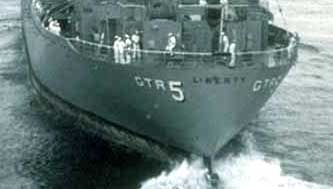
”In reconstruction of the attack, the Liberty crew makes much of flying the American flag, as if it would somehow protect them in harm's way. Little does the crew appreciate the difficulty of identifying a ship from an aircraft merely on the basis of a flag or even a hull number (GTR 5 displayed by the Liberty). […referring to photograph below…] This crisp overhead photo does not clearly show the identity of the American ship. So how could the attacking Israeli forces conclude this was a friendly ship?” [1]

This is the photo in question, here with the flag area actually highlighted with realistic colors. It’s still hardly more than a speck. Now I do see a clear difference between the flag and the hull number, well-illustrated by the same photo, which does in fact identify the ship with or without the flag being noticeable. No one has had any doubts if the hull was fully extended or drooping and unreadable; the “5” in particular is ten feet high, all letters of the solid block type, with offset drop-shadows to enhance clarity. This designation belongs to only one ship in the world.

Among the Liberty’s own mistakes that clearly brought it on themselves, per IDF, are “failure to signal,” changing direction, “running away,” hiding under smoke, trying to guilt trip them with the dead guys bleeding on deck, etc. (okay, I made up the last one) “Another grave error” discussed in Col. Ron’s report is that “it seems that the ship made every effort to conceal her identity” by, for example, “flying a small flag which was unidentifiable from a distance.” [2] He doesn't clarify whether the flag was smaller than it should have been or just small enough to offer as an excuse.

IDF records have admitted absolutely no reports of a flag from their the eight-plus aircraft orbits conducted over the day. Official records show the attacking planes never noticed such a flag, nor the Motor Torpedo Boats that nearly sank the Liberty. As Judge Yerushalmi’s report put it (once translated) “throughout the contact no American or any other flag appeared on the ship, and it was only a helicopter, sent after the attack in order to render assistance--if necessary--which noticed a small American Flag flying over the target.” [3] This total absence I find both unlikely and at least faintly possible.

The Hull number on the other hand was something they couldn’t even pretend to miss, and was reported multiple times. The first such acknowledgment came after the 0600 Noratlas overflight; the accurate reading “GTR-5” generated a precise ID as the USS Liberty, which was almost instantly erased for still-debatable reasons. It was eight hours later when the hull no. was reported again as “CTR-5” - not enough to name the Liberty but enough it had the air attack called off after a fierce fifteen minutes. This failed to prevent the MTB surface attack, which was finally cancelled after all but one of its torpedoes were spent. It wasn’t a flag they explained this with, but the same hull no. seen again, not far from the bungalow-sized hole they just blew out of the hull. [details on this]

That’s a powerful identifier, and could have averted catastrophe, rather than just tripping it up a bit. If GTR hadn’t been erased, CTR would mean something, so this decision trumps the more wiggly flag issue in my mind.

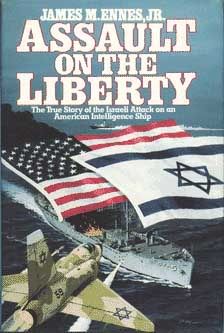
At times it seems keeping this particular issue front and center is more motivated by symbolism and appeal patriotism than by pure evidentiary considerations. What it really does is dramatize the patriotic war/sacrifice/vengeance/etc. aspect and taps into the old us vs. them mentality. Consider the painting on the cover of James Ennes’ book – Star of David vs. Old Glory, emphasis on “vs.” Interestingly, it seems this painting is based on the same photo of the ship as above, but with the barely visible real flag eclipsed by the mammoth symbolism. Hardly any dedicated patriot can’t help but be effected by this dichotomy – whether it’s toward questioning the accident or away from it is bound to vary.

FIFTEEN THOUGHTS: PRO AND CON
Now, clearly the U.S. flag is a crucial clue that should have been seen at some point. And given the general pattern of errors and missed signals in IDF command that day, I have a hard time accepting that – again - all parties had genuinely missed the flag from sunrise until just after the attack. Taken on its own, however, I admit it seems possible, and not even bizarre. So I can see both sides on this one and don’t normally go on about the flag when there are stronger cases to make. However, here are some final flag thoughts from both sides – “pro” means a point supports that the flag should have been seen and reported, and “con” indicates a reason maybe it wouldn’t be so clear.

Con: At one point at least, the flag then flying was found to be tarnished "tangled in the lines [...] dark with soot and badly tattered," according to James Ennes, who caught it and ordered a new flag up shortly after 0700. [4] This may well have been a factor in the 0600 sighting, which ironically was the only pre-attack inspection of the Liberty that yielded an accurate ID.

Con: Both the tarnished flag and its replacement were quite small relative to the ship – app. five by eight feet (see picture above, and K.J. Halliwell’s examination of flag size).

Pro: The ship’s weather log plus speed and heading shows the flag should have been at least largely unfurled as the air attack began; Ennes concluded 12 knots relative wind at 1300 (5 knots from ship speed. plus 7 of wind on a similar line back) [5].

Pro: Wind would probably be similar at 1400 as IDF sources cite “a run over the ship” by the fighters prior to attack, looking for a spread flag (“but found none”). [6] The witness record seems to show immediate attack. IDF transcripts show nothing but a one-minute distance survey (“warship” was the only conclusion) prior to strafing. [7] That someone apparently made up the looking for a flag, or removed the episode from the tapes, supports that the flag was visible.

Pro: unfurled or drooping is not as relevant as its made – if they could see it well enough to identify spread, they could have identified it limp as well, if they cared to. US would appear prominently as red and white jumbled, or “splashed” together, perhaps looking pink from a distance, with a blue corner visible even drooping. Either a Soviet or an Egyptian (U.A.R.) flag would stand out like – well, a red flag. Solid red is vivid, and it wasn’t there to see.

Pro: A photo as above is not a good model – they’d see the any flag moving over time, rippling even if subtly. You might glimpse a red-white-pink flicker, zero in and see a wobbling dark blue patch cover it, with no bold red visible. What flag can that be?

Con: As Nowicki wrote: “Based on my experience of flying many "low and slow" reconnaissance flights over ships in the Med and Atlantic with VQ2, unless the flights are almost overhead, target identification is virtually impossible." [8]

Pro: The attacking aircraft supposedly felt it was possible enough to try, they were directly over the ship, at close and low quarters, passing over it from different angles for at least five minutes each wave. In the early part of the attack at least the flag and hull no. should have been discernable to one of the pilots on one of the passes, at the very least.

Pro: Several witnesses (including Nowicki) claim they heard transmissions or saw transcripts of same showing the IDF pilots did spot the U.S. flag and reported it, either before the first strafing run, which was ordered regardless, or during the attack, causing it to be broken off. If so, this means the IDF altered their records, further illustrating guilty conscience.

Pro: If they were unable to verify a flag when it was up, the pilots became strangely able to know when it was down; the decisive “there’s no flag on her!” was reported at the end of the air attack, 1414, alongside the hull no. report. [9] By this time the statement was actually true; the halyard line it swung from had been severed in the attack, and the flag lay face down on the burning deck. This indicates to me he knew where it had been and wasn’t anymore.

Pro: The motor torpedo boat crews were perhaps close enough to actually observe the larger (8x13?) replacement flag being hoisted for their arrival, and it almost certainly should be visible by binoculars once they got closer. The ship was sailing at something over ten knots due north before they hit it, so some cross-wind should have been lifting the holiday colors.

Pro: The MTB crew don’t acknowledge (in their log, or that of Navy HQ) seeing the flag until the helicopters told them about it at 1512, after they’d spent the better part of an hour hanging out within a mile or less of the ship. This reeks more of omission than of anything else.

Con: The ship was of course by then emitting a mass of smoke from the air attack. The fires were partly under control, but still factors of some visibility impairment.

Con: In the photo above the flag seems perhaps 6-800 feet from the camera – the MTBs were app. ten times as far off (accounts vary), perhaps too far to identify, when they decided to drop their torpedoes at 14:35.

Pro: The IDF records flaglessness finally runs out with the second rescue helicopter pilot who finally saw the stars and stripes and reported it as such, verified in a second pass. It was 15:12. As a journalist reported of a 2003 talk with James Bamford, “if the helicopter pilot saw those identifiers, Bamford asks, why didn't the fighter pilots and torpedo boat crews?” [10] There may be legitimate technical explanations, but we can’t ignore the common theme among those who failed to see – they were the ones shooting the ship, perhaps sent to simply attack, not look at stuff.

Sources:
[1]Nowicki, Marvin. Exculpatory evidence supporting a mistaken attack. Undated message to James Bamford. http://www.libertyincident.com/nowicki-evidence.html
[2]
[3]
[4] Ennes, James. Assault on the Liberty. 1979. P
[5] See [4]. pp 245-247 (Appendix H)
[6]
[10] Shane, Scott. NSA tapes offer clues in '67 attack on U.S. spy ship. Baltimore Sun. July 16 2003. http://www.freerepublic.com/focus/f-news/947319/posts

Thursday, May 28, 2009

TELEX AND TAPES, PART TWO

THE MEN BEHIND THE TRANSCRIPTS WEIGH IN
Adam Larson / Caustic Logic
[USS Liberty series]
May 28 2009


NOWICKI AND BAMFORD: INFORMATION MISUSED?
Part one of this series listed the witnesses to secret attack-the-flag transcripts of the USS Liberty attack - translated copies of American (NSA) intercepts of the IDF communications proving the Israeli intent to attack a known American ship, for whatever reason. Therefore, perhaps the most informed witnesses would be the guys who made these recordings, apparently stationed on a US Navy controlled EC-121 aircraft circling 15,000 feet over the general war zone.

The plane was on a NSA SIGINT mission, and staffed to effectively spy on both sides. This plane contained the normal retinue of Russian and Arabic linguists, as well as three trained Hebrew Linguists (called “special Arabic” at the time). [1] Relative newcomers to the world of public scrutiny, two of the three NSA Jew-spying-spooks listening in from above have been named.

Dr. Marvin Nowicki is the more famous one of the two, starting with an e-mail to NSA’s nom d’plume James Bamford in March 2000, as he was assembling his magnum opus Body of Secrets. The insider enclosed five documents, including Assault on the Liberty: The untold Story from SIGINT, which explained their presence above the Liberty and what they heard there. This became the kernel of Bamford’s chapter on the attack, which came out highly critical of the IDF and supportive of the crew’s views. That Nowicki’s account was seamlessly worked into supporting this meant distortion was afoot, and he complained publicly in a letter to the Wall Street Journal:
“My position, which is opposite of Mr. Bamford's, is that the attack, though terrible and tragic especially to the crew members and their families on that ill-fated day in June 1967, was a gross error.” [2]

Accident advocate Judge Cristol took up Nowicki’s case, re-publishing this letter and all the materials sent to Bamford, who “claims the Nowicki letter told him that the tapes establish that the Israelis knew they were attacking a US ship,” Cristol explains. “Dr. Nowicki did not agree with Bamford's interpretation.” [3] The judge points to the e-mail and its five enclosures, which collectively offer a cogent and well-researched Cristol-light attempted absolution. He felt the attack on an ally was a mistake, and ironically that was from hearing and re-examining the same transmissions several others had said proved, once in print, that it was a purposeful decision. And his familiarity with the material didn’t end when he handed it over to the NSA’s analysts.
“[T]he next time I saw those voice tapes […]completely re-transcribed […] was over a year later when I was ordered to NSA for duty in 1968. […] Up to this point, I always felt the evidence we collected showed the Israelis attacked the Liberty by mistake in the heat of battle. All my conversations with colleagues in G643 and reading of the voice transcript confirmed as much to me.” [4]

The NSA had the audio, but decided against admitting it, or even acknowledging the plane was there. James Ennes’ 1979 book was written in complete ignorance of the flight, and it remained secret for another two decades past that. Nowicki’s second attachment explained his efforts to have it all publicized to quell the rumors.
"Several months before I retired in 1979, I even wrote a personal letter to the Commander of the Naval Security Group, Rear Admiral Eugene Ince, saying I thought it was time to make the information public. Admiral Ince surely knew about the VQ-2 tapes because he was the senior NSG officer on the staff of CINCUSNAVEUR in 1967 during the attack on the Liberty. I received no reply from him.” [5]

Nowicki points only to one phase of attack halting as evidence of mistake theory, which fails to explain why it was brutally resumed minutes later. Apparently the tapes would make it all clear once publicized. By 2000 this had still not happened, and we had only the chief’s account to Bamford, the case it was woven into for Body of Secrets, and the rebuttals.

IN HIS OWN WORDS: NOWICKI VS. IDF
It’s true that Nowicki told Bamford up-front that “our intercepts, never before made public, showed the attack to be an accident on the part of the Israelis.” [6] The author could have mentioned this sentiment in the book but failed to. Otherwise I see no misrepresentation. He simply used the words to support a general picture already painted by plenty of other people and evidence. His account is high-quality, detailed and well-assembled, and of clear historical significance. Some key quotes mined from the various sources [emph mine throughout], with comparative notes added:
"After a couple of hours of hard work, I received a heated call on the secure intercom from Hebrew linguist [deleted]. [deleted] excitedly proclaimed something to the effect, "Hey, Chief, I've got really odd activity on UHF. They mentioned an American flag. I don't know what's going on." I asked him for the frequency and rolled up to it. Sure, as the devil, Israeli aircraft were completing an attack on some object. I alerted the Eval, giving him sparse details, adding that we had no idea what was taking place. The activity subsided." [7]
By this, the chief missed some of the audio, including the flag report, before getting the phones on to hear the end of an air attack. Such a report is not in the IDF’s tapes at all, with no flag mentioned (except once in the negative – “there is no flag on her!”). Air Force recordings, as now available, make no mention of a US flag at all until the rescue helicopters arrive, shortly after 15:00 – a half hour after the attack was finally called off, and nearly an hour after the attacking jets left the area.
"After some time passed, Petty Officer [deleted] called me again. He told me about new activity and that the American flag is being mentioned again. I had the frequency but for some strange reason, despite seeing it on my spectrum analyzer, couldn't hear it on my receiver, so I left my position to join him to listen at his position. I heard a couple of references to the flag during an apparent attack. The attackers weren't aircraft; they had to be surface units (we later found out at USA-512J it was the Israeli motor torpedo boats attacking the Liberty). […] Despite replaying portions of the tapes, we still did not have a complete understanding of what transpired except for the likelihood that a ship flying the American flag was being attacked by Israeli air and surface forces." [8]

There’s a time delay after the chatter subsides, maybe correlating to the air-MTB intermission of about ten minutes. Then the flag was mentioned again, multiple times during the renewed attack by torpedo boats. This is a new twist the other witnesses didn’t catch. He feels it’s this flag report that finally has the attack called off. If they said U.S. flag multiple times and the EC-121 heard it, that’s interesting since any such report during this time failed to make it into either the MTB or Navy logs.
“My personal recollection remains after 34 years that the aircraft and MTBs prosecuted the Liberty until their operators had an opportunity to get close-in and see the flag, hence the references to the flag.” [9]
"Although the attackers never gave a name or a hull number, the ship was identified as flying an American flag." [10]
This is just about dead backwards from the IDF’s tapes of their communications. As I’ve found, their records show it was not a flag, but rather the hull number GTR-5, and perhaps the name Liberty, that had the attack called off twice. The second time it was said these indicated a Soviet ship.
“We have no idea what time any […] information about the American flag was made available in the war room. I think it was probably during the MTB attack because the torpedo boats halted their attacks when they could have finished off the Liberty.” [11]

We know now what time they claim anyway – 1512 local time. Torpedo hit was at 1435.
“[O]ur intercepts […] showed the attack to be an accident on the part of the Israelis.” [12]
“Our intercepts further showed that perhaps the attack was a mistake.” [13]

Just how? The fact that the "flag" stopped it? That's not the reason the IDF settled on. This dangerously aberrant version has direct knowledge of American ID running openly throughout the attack, rather than concealed in double-talk as it seems from the available sources. Any report of a flag failed to make it into the IDF air control tapes and failed to prevent the ridiculous re-identification as El Quseir leading to the deadly torpedo assault [see above link]. The recollection he shares does seem vague enough that it’s open to interpretation – in the same data one person might see intent, the other confusion. Both see the stars and stripes specifically failing to stop the attack, in direct contradiction of the IDF's documentation.

CORROBORATION: PROSTINAK COMES FORWARD
The “teammate” cited by Chief Nowicki, the one excited about "something crazy on UHF," is apparently Petty Officer Michael Prostinak. He did not talk to and remained unnamed by Bamford, but did come out in his chief’s wake and spoke to John Crewdson for his 2007 Chicago Tribune article. Since those days intercepting war chatter, Prostinak had settled down in a small North Carolina town to be chief of police and later a town administrator. He told the paper "everyone we were listening to was excited. You know, it was an actual attack. […] We copied it until we got completely out of range. We got a great deal of it." Although this accounts is much thinner, at least once edited into the article, it verifies Nowicki’s recollection of flag reports at this time: “During the attack was when mention of the American flag was made." Crewdson explains how “[Prostinak’s] Hebrew was not good enough to understand every word being said, but that after the mention of the American flag "the attack did continue.”” [14]

Again, Crewdson was able to “twist” this into fitting with the shoot-the-flag transcript reports. It wasn’t difficult, since it has more attacking after the identification, just like Nowicki’s account. Both the linguists’ stories differ from what other witnesses in some key ways - the flag is not apparently not reported before either phase of assault, and they mention no pilots protesting or resisting their orders. So far however, all knowledgeable American sources agree that the flag was reported by the attacking forces and this somehow failed to halt the attack. Prostinak does not say that it was an intentional mistake – for all we know, he feels it’s just a mix-up in communications. Nowicki specifically says it was accidental, but many others from a wider field reached the opposite conclusion on seeing it in print. Nowicki summed up the answer to the dilemma as well as the other side might:

”How can I prove [my version]? I can't unless the transcripts/tapes are found and released to the public. I last saw them in a desk drawer at NSA in the late 1970s before I left the service.” [15]

Apparently spurred by the Bamford/Nowicki revalations, Judge Cristol filed a FOIA lawsuit against NSA in April 2001 to get the tapes. Not far from his home turf, Cristol wrangled with the Florida district court system and NSA’s lawyers for release of any transmissions to or from USS Liberty, USS Amberjack (submarine, long story), or the EC-121 everyone was talking about [16]. The lawsuit would eventually yield results, but this would take years to unfold, and one more post, part three, before I can use that to close up this story line with a final twist in part four.

Sources:
[1] Bamford, Body of Secrets p. 205
[2], [15] Nowicki, Mavin. Letter to The Wall Street Journal. Published May 16, 2001, page A-23. http://www.libertyincident.com/nowicki-wsj.html
[3] Cristol. Nowicki Documents. http://www.libertyincident.com/nowicki.html
[4], [5] Nowicki, Marvin. Postscript to the attack on the Liberty. 2000? http://www.libertyincident.com/nowicki-ps.html
[6] Nowicki, Marvin to James Bamford. E-mail, March 3, 2000. http://www.libertyincident.com/nowicki-email.html
[7]
[14] Crewdson, John. "New revelations in attack on American spy ship." Chicago Tribune. October 2 2007. (Additional material published Dec 2). Page 6. http://www.chicagotribune.com/services/newspaper/printedition/tuesday/chi-liberty_tuesoct02,0,1050179.story?page=6
[16]A. Jay Cristol, Pro Se, Plaintiff, v. National Security Agency, Defendant. U.S. District Court, Southern District of Florida. Case No. 03-20123. Various documents. http://www.fas.org/sgp/foia/cristol.html

Tuesday, May 26, 2009

AIRCRAFT PHOTO ANALYSIS

1245 RECONNAISSANCE OF LIBERTY?
Adam Larson / Caustic Logic
May 25 2009
incomplete


THE PROOF IN THE PUDDING
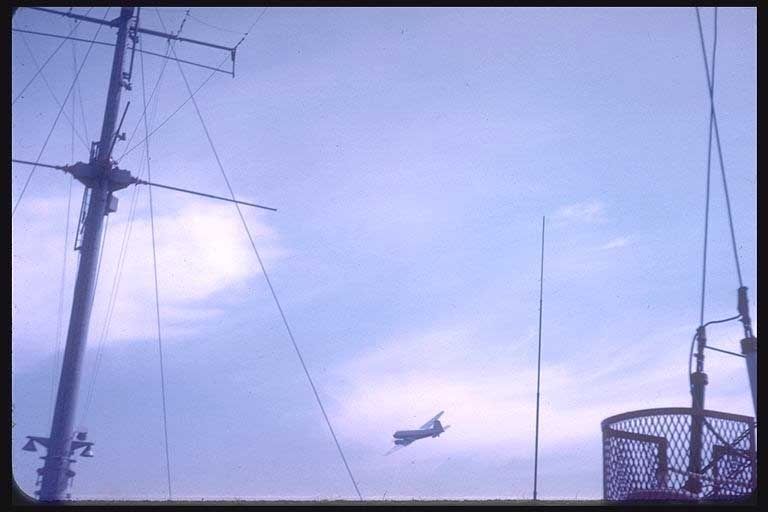
At least one photograph of presumed reconnaissance aircraft (above) has survived and is published on the USS Liberty survivors association image index web page with the following caption:
Israel says there was no pre-attack reconnaissance. Any aircraft we saw, they say, were high in the sky carrying troops to the battlefield. Not so. Here is an Israeli reconnaissance airplane that circled the ship about an hour before the attack. The pilot was heard reporting to HQ that he saw an American flag and men sunning themselves on deck. [1]
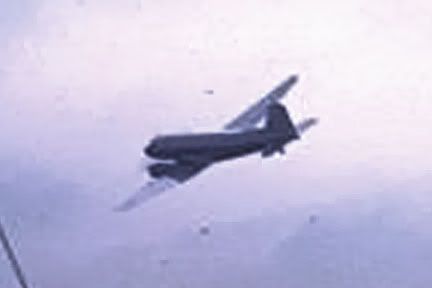
First, it does seem to be checking the ship out. It’s quite close, low, passing starboard side to the aft and clearly turning as if to keep circling. This is not a casual disinterested high-alt pass-over. However, that flag-n-sunbathers report is news to me, and so far I see no source aside from this image index. And also I’m pretty sure the time frame “about an hour” before the 1400 attack is wrong.

This photo would perhaps have been taken by Petty Officer Charles Rowley, the ship’s photographer, reportedly in the lab most of the morning during the earlier aircraft recon. [2] It could have been someone else as well. The picture was apparently taken from the aft (rear) portion of the ship, looking back and to their right of the rear antenna mast (visible at left). Its crossbars extend left and right, across the beam, and the small lights (lower corner) are fairly low to the deck, so the camera is apparently at main deck level and pointed up at a moderate angle. At right is a wire mesh thing I can’t locate in photos, and apparently anchoring cables for some antenna. My right-side reference is thus un-anchored. Should be TRSSCOM housing there (Here's a good view of the rear of the ship, seen from the middle - TRSSCOM is the big dish, rear antenna mast behind that).

Anyway, the aircraft is quite close off the port aft, not very high above the waves, banking and turning left. Both the fuselage shadow on left wing and the light falling on the mast and its lights shows the sun is quite high in the sky, meaning, in general, around mid-day. I checked with a solar calculator the lat-long points, date, year, time, and found solar noon on the Liberty's path would fall one second after 11:44 local time. (selecting Cairo, June 8 1967, UTC offset -2, will get you close).

WHAT THE PLANE TELLS US

In my previous analysis of aerial reconnaissance reports, I got a general grasp of what different craft are said to have circled the ship. Anywhere near mid-day we first have two delta-wing Mirage fighters orbiting the ship thrice at about 1000 or 1030 (accounts vary). This is clearly not one of those, and both slots seem too early for the sun here. This was followed by two or three visits, at perhaps 1030, and certainly at 1057 and 1126, by a craft thought by the crew similar to a “Flying Boxcar”, and called by its Israeli owners a Noratlas. The two do indeed resemble each other, but not the plane in this photo. So barring a problem with the accepted timeline, this must be after 11:26, and presumably after the subsequent course change at 11:32, where they turned thirty degrees to the north.

The aerial visits after that point are more sketchy for detail, but this photo is said to be “about an hour” before attack, so it could only be the last visit, what Ennes cites as another visit of the “Flying boxcar” at 1245 (second-hand – he was having lunch) [3] But as we’ve established that’s no Noratlas, and it seems the sun is no match for that late in the day either. Jundge Cristol describes a1200 flight, way up at 30,000 feet, and the wrong aircraft to boot; he cites as a “Vatour,” but it would actually be a Vautour, which is French for vulture. [4]

The plane we see here is not a fit with any of the over-flying craft I’m aware of. It’s non-descript, generic, bulky body, low-set wings with engines beneath like any smaller cargo plane or airliner. Something tells me those are propellers, not jet engines. I’m really no plane buff. It is a possible fit with one other reported aircraft never reported close by - [56, 50] a “fat little prop plane, maybe a light bomber” repeatedly traversing the beach, “just skimming the sand dunes.” This was first reported before 0700, with no specific mentions after. But as Ennes noted explosions ashore between 1130 and 1200, he did note “the little bomber that had patrolled the beach all morning could no longer be seen.” [5]

With no other planes besides Noratlas and Mirage jets mentioned before the 1132 turn, this is probably after that but apparently not much after. The next plane alleged is 11:45, a fit for the time of the explosions. This is one of the less verified, only mentioned in a list in the Salans Memo with no details (see previous post, link above). Who saw what plane do what at that time? Ennes was officer of the Deck, and would have seen such a plane, but there is no mention in his book, just the Noratlas again in his absence at 1215 and 1245. [6] Wrong plane and time for this case. Again with the time, how do I know what time it is here?

WHAT THE EGYPTIAN SUN TELLS US
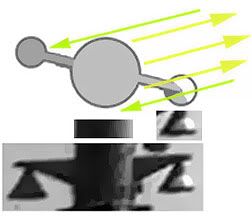
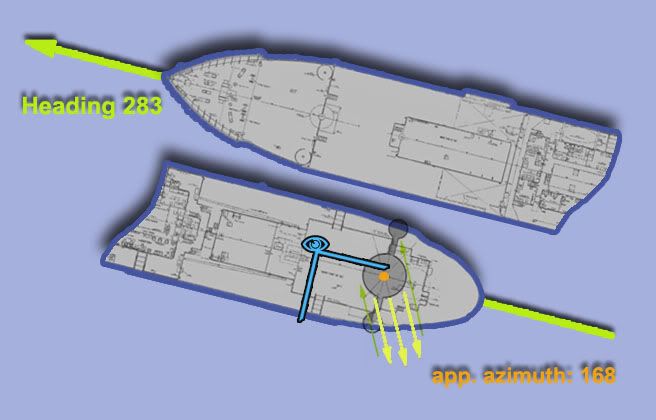
11:45 is one minute past local solar noon, with the sun at its highest elevation (82° above the horizon, so nearly overhead). and with an azimuth (direction to sun) of 180° - due south. First I presumed this was after the 11:32 course change, so I set my model on a 283 heading and set to narrowing down the solar azimuth angle which helps me get a close time estimate. I found the light angle, approximate, from the rear mast (lower left corner) by analyzing light fall-off around the mast’s curve and and shadow patterns on its attached lights. They indicated one general direction, which I marked with arrows – some to and some from the sun, whatever.

This I pasted back on the ship at the proper angle (not to scale, that doesn’t matter). To hit the mast at that angle with the ship at 283 true, the azimuth would be somewhere around 168, or in a range of, say, 162-174. This is consistent with a general noon-ish time frame indicated by the high solar elevation. And the Azimuth is much better at setting time - the change I'm seeing here is close to one degree per minute!

The exact minute is not to be taken too literally given the margins of error in each step – but the resultant azimuth range for a 162-174 spread is between 1132-1141 local time. I simply can’t see anything outside this range explaining that photo. Either this is Ennes’ 1126 misidentified “flying boxcar” (and the Captain’s 1126 “unidentified”), lingering quite a bit, or it’s the unknown rounded-to-1145 plane that Ennes missed as he wrapped up his shift.

Saturday, May 23, 2009

MY USS LIBERTY INQUIRY

A WELCOME, AND A CALL FOR INVOLVEMENT
Adam Larson / Caustic Logic
May 22 2009


Welcome to my Caustic Logic USS Liberty inquiry!

For a while now I’ve been intrigued by the anomalous Israeli attack on the USS Liberty way back in 1967. I started out seeing the attack as presented in the video Dead in the Water. I don’t mean the cover-up of some war maneuver or massacre, which seems to me silly, for reasons I’ll explain more fully elsewhere. Rather I find merit in the attempted false flag interpretation, where the attack was to be blamed on the Egyptians and draw America into the war, or into something useful anyway. Obviously if that was the goal, it would require silencing the crew momentarily with total communications jamming, and then permanently by sending the ship to the bottom. If these were their goals, they failed decisively in both, but that doesn’t necessarily mean they didn’t try. Sometimes you start with one plan and then have to change in the middle…

Intriguing as this narrative can be, I never did quite believe it. Looking closer at the evidence, that possibility still lingers, but is less solid than I first thought, and I’m starting to feel it was perhaps more of a false “no flag” attack. The sticking point for me is identity – on at least some levels, if not all, the IDF knew they were attacking an American ship or, at the very least, that it was not the Arab ship(s) they were pretending it was. The blunders leading to the “mistaken” attack show the outlines of what might have been called “Operation Oops!” The goal may have been only to maim the ship and make a point of nearly sinking her in tragic error that might be avoided in the future by people minding their own business. There would be a small array of other possible motives to consider in regards to this.


The U.S. side of course has its own mistakes leading to the ship being where all later agreed it should not have been. This doesn’t well explain Israel’s “mistakes,” but it is true as they say this wouldn’t have – couldn’t have – happened if the messages pulling Liberty back had managed to get through to action. That two nations had to each commit their own inexplicable string of blunders all focused on this ship does not leave the two canceling each other out; rather, the strangeness is multiplied. If Washington were willing to somehow provide the Israelis with the target for “Operation Oops!” again, the issue of motive arises. And of course when dealing with two nations, we have the relative issues between them to consider – did their motives agree? Was there a double-cross halfway through? Why did this have to happen right before the U.S solidified its strategic partnership as Israel’s staunchest ally? High politics, way high up there… I’ve thought less and posted almost nothing yet on the American end and I’m not ready to make any case without more study.

My research is at the moment based on a critical examination of official and primary sources regarding the attack itself, in great detail. My sources are largely Israeli, with an emphasis on patterns of agreement or contradiction between each other, other sources, and logic. Eyewitness testimony is important as evidence, but prone to imprecision and embellishment, largely inconclusive on issues of intent, and well covered elsewhere by other revisionists. Therefore, at the moment I’m not basing much on the crew’s testimonies (although I m reading Ennes’ book at the moment and starting ti figure out who’s who a little more). The resulting posts are usually too verbose and detailed for most, but are compiled here for the advanced or intrepid.

Of course I am well aware this is a sensitive issue and one that raises questions about – well, anyone who’s so interested in re-visiting a sensitive issue. An issue that is also widely harped on by anti-Zionists, neo-Nazis, Muslim radicals, and other such rabble. Judging by Google searches, quite a few people are looking at this page and at me lately. Fair enough. I’ve actually been hoping for some feedback; the Comments section is open and easy to use (click the link at bottom of a post that usually says “0 comments.”). Who should click:
  • the curious with their questions, 
  • critics with rebuttals or debunks, 
  • compatriots not too alienated by my omni-direcitional iconoclasm, 
  • experts with a correction or a tip, 
  • anyone with a relevant opinion. 
You can also contact me privately by submitting a comment headed “private.” I will read but not post these. Also my contact can be found in the sidebar. Silent lurkers are so boring, and my CIA sting operation to draw out all the wierdos for further profiling will fail if no one is drawn out! (kidding). I invite the opinionated as well on all sides – I can moderate. Oh, and I approve first, rather than delete later, FYI. At this post I will accept general comments.

Thursday, May 21, 2009

DEAD IN THE WATER (VIDEO)

May 21 2009

This is the best-made, most informative documentary I've yet seen on the Liberty Incident. I don't buy every theory presented, but there are definitely some valuable bits, and it's a good introduction for the novice trying to grasp the issue. I will add some notes and comments below when I have time.

Google video page.

Saturday, May 16, 2009

"WHAT IS THIS? AMERICANS?"

ON LK'S "HUNCH"
Adam Larson / Caustic Logic
May 16 2009
last edit 5/23


Within the drama of the IDF tapes surrounding the Liberty attack is the mystery of numerous witnesses to orders sent, intercepted, and read by American eyes to attack the ship despite the American flag. The official transcripts allowed to the public, despite other inconsistencies, agree in containing no mentions of a flag until helicopters after 15:00, either well after the attack, or well after the worst of it, depending on the accounts you believe. The tapes do however contain mentions of “Americans” on at least three occasions during the attack, each seeming strangely out of place. It might be reasonable to presume these witnesses just saw these lines amid the chatter, and deduced it was from a seen flag, perhaps embellishing the memory later. Conversely these might be the responses to the flag reports, severed from their other halves in the edited final, left hanging as random musings and blurted hunches.

As the case may be, the first “Americans” mention is one of the most interesting lines in the episode, delivered by one Lazar Karni, a weapons system officer based at General Headquarters who remains otherwise silent. His role is generally described as “to listen to ground-to-air communications and make occasional suggestions,” and at 13:54, the first fighters were just within view of the Liberty, preparing to assist the torpedo boats by initiating the attack on a presumed enemy something-or-other. Karni, known as “L.K.” in the transcripts, made his dramatic cameo appearance at this point:“What is this? Americans?”

Arieh O’Sullivan, who heard the tapes, explained that was “blurted out,” but was based only on “what he later testified was a hunch.” My curiosity was piqued by this “hunch,” since an American ship had been identified in the area that morning and mightn’t be entirely out of everyone’s minds, despite the efforts of fate to erase it.

Judge J.A. Cristol’s transcript of these tapes, which I discovered later as appendix 2 in his book, gives the line as "what is that? Americans?" He also offers as a sub-appendix invaluable first-hand insight into L.K.’s thinking - his July 1967 testimony to the second Israeli (Yerushalmi) investigation. Apparently working from these basic tapes, and with the same question I had, the examining judge wanted to know what that line was about. In testimony declassified at Cristol’s request, the weapons system officer describes his duty and reason for speaking up.
“I was not the officer who would have been able to decide on an attack, but it was my duty to be as a passive part on the line in order to absorb information that might have helped, but like any officer I wanted to help …”
Karni said of his own actions “it is clear to me that I threw in the question – a shout which is written. It does not relate to the conversation that was conducted on the line at that same moment. […] In relation to this there are two possibilities.” Strange comments – apparently he means the remark seems disconnected, implying it was from some side conversation, somehow making it into the wrong transcript. In fact the active discussion his question was disconnected from “was about an attack on missile bases,” he says. He then decides one possibility is “that this question was asked during a conversation […] about the ship that purposefully was shelling El Arish, and the Air Force was about to attack it jointly with the Navy.”

Once turned around to the episode his words are publicly attached to, he offers his reasoning for the comment, if that’s what he was commenting on. (??) Most importantly he did confirm to the court, in the last sentence, “I did not know about the existence of an American ship in the morning.” He certainly should have, of course, but apparently this is just a hunch, not an intentional reminder of the GTR5 ship. If he had been in the loop back at about 10am, quietly forgotten in his passive role, he would probably have absorbed the identification of Liberty in that area. So either he came on line only after it was removed from the tactical info system at 11am, or his testimony is incorrect. On the thinking Karni claimed:
“I at that time expressed an opinion that we had taken only one action, that is to say, we had ascertained it was not an Israeli ship, and we did this through the naval representatives who were sitting with us.
[…]
like any officer I wanted to help, and therefore I wanted to suppose to the ears of those who were managing the war to a possibility – supposition that it was an American ship. That was only my supposition, since it was my assessment that it was not Egyptian, for they would not dispatch a solitary ship to our coast, and therefore I thought there was such a possibility.”
[??]

This logic consideration is a very good point Karni might bring up to explain his “supposition” and get people thinking, if only he were asked to explain his provocative comment. They would find it just a thought, but a good one, that it might be American or, for all they knew, Soviet. It’s somewhat reassuring that at least one soul in the IDF system showed the kind of sanity to put their neck out and blurt the unconsidered option everyone else had missed - they hadn’t yet identified this thing well enough.

“Shimon” (full name classified) is the deputy for one “Robert,” chief air controller at Air Control Central, who was on the line in Robert’s stead as LK dropped his thought bomb. The first to respond, Shimon asks as one might expect “what Americans?” This is included in Cristol’s version but not O’Sullivan’s. Kislev’s first response is to ask “Robert, what did you say?” (or “what are you saying?”) He may not have recognized “LK” as a participant and thought the question was posed by a returning “Robert.” Karni does not answer "Shimon's" query, nor does anyone respond to Kislev’s poorly-aimed question. The issue is apparently dropped like a hot potato and within seconds, all are proceeding with the attack on the mystery ship, which is but two minutes away.

Explaining the lack of response to the identification question, Cristol summarized “no one had any data on the location for Americans. Without hard data, the subject was not pursued further.” Strangely, Karni’s testimony implies a lively and curious response:
“All those who were connected on this line were able to hear me. Of course, all of them were overcome by this and they began to ask and then I did not want to delay the attack on the ship [because] they said it was shelling El Arish. And since the supposition was not based on data but on an assessment – supposition – therefore I did not want to delay the thing. Therefore I immediately retracted.”
So it seems by speaking up, the guy was willing to try and delay the attack with a worthwhile consideration - supposition. Something instantly changed his mind. It was the questions he cited, but if the transcripts are any clue, it wasn’t their number or their specificity. Perhaps something the transcript doesn't reveal, like the tone of either Shimon's or Kislev's voice, or how they emphasized their words, convinced Karni this was not a line of thought they were interested in.

Maybe his line was somehow cut off. It is curious he didn't follow-up with at least a "never mind." Such a line, if worth blurting, is worth a sequel as well. That it didn't get one is evidence something cut his train of thought off from the action. "My line went dead, so I guess I immediately retracted..." Hmmm... just trying the line out - not courtroom material, even if it were true.

Even the plain text of the audio released the controllers clearly showed an active disinterest in re-considering the situation; only two questions total were asked – "what Americans" and "what did you say." No answers was offered, pressed for or - it would seem - wanted. Ambiguity and second thoughts are the enemy of the decisive split-second life-and-death blahblahblah that had made Israel so great. As Karni’s testimony shows, nobody was willing to “delay the thing” that was already in mid-motion.
---
It was worth a try, Lazar, and we all thank you. You offered them a last chance out, and they refused to take it. You might rock the boat, but tipping it over is another story; ultimately of course you are a soldier of and loyal to Israel. You stood your ground and no one else's, and that's worthy of respect at least. Was it spooky, to be in the middle of all that blind volition?

Wednesday, May 13, 2009

LIBERTY MISIDENTIFICATION, ENCORE

ON THE ORDER NOT TO ATTACK: RECEIVED, RESOLVED
Adam Larson / Caustic Logic
re-written with new info May 13 2009
last update 5/23


WHAT STOPPED THE SINKING?
The deadliest phase of the attack on the USS Liberty was the surface torpedo strike that followed twenty minutes after the air attack ended; with six torpedoes pointed at her starboard side, and under the control of those to whom everything looked Egyptian, the defenseless ship could well have been sunk. For whatever reason, and this is a bit of a mystery, only one torpedo of the five launched made its mark, blasting a 30-foot hole just below the waterline, killing 25 and causing the ship to list dangerously, but leaving her afloat and eventually able to limp towards safe harbor unaided.

The sixth torpedo was held, and never fired, as the blitzkrieg assault was finally called off. Conspiracy Theorists have long argued the intent was to fully sink the Liberty, and only fear of a confrontation with US aircraft reported en route chased them off. As the epic Admiral Thomas H. Moorer wrote in his pivotal 30-year anniversary statement on the “ridiculous” Israeli story:
“As we know now, if the rescue aircraft from U.S. carriers had not been recalled, they would have arrived at the Liberty before the torpedo attack, reducing the death toll by 25. The torpedo boat commanders could not be certain that Sixth Fleet aircraft were not on the way and this might have led to their breaking off the attack after 40 minutes rather than remaining to send the Liberty and its crew of 294 to the bottom.” [1]

The Israeli Defense Force of course claims the whole attack was horrendous error, and this part in particular is painted as a final tragic glitch – it was simply called off when they realized they were wrong. A surface reading of the presented facts looks almost like IDF Naval Headquarters became aware finally what they were attacking, and tried to stop the torpedo attack, but the message came too late, or too far to the left, or whatever, to stop the near-fatal blow. I’ve seen just this interpretation argued, and based on two separate attempted delays, in favor of the friendly fire/fog of war rationale.

Such a reading is not, however, consistent with a careful examination of the IDF’s own self-exculpations, which reveal a more troubling reality in each case.

THE FIRST CONFUSION
En route to the Liberty, the three Motor Torpedo Boats (MTBs) of Division 914, under Commander Moshe Oren, were in contact with the aircraft then attacking the ship. On this channel, they received early reports of a flagless, unidentifiable Arab Destoryer, in line with the Division’s own radar readings and reports of shelling. The problem for the attack came when the hull-marking “CTR-5” was reported to general HQ in Tel Aviv by the last attacking pilot, at 14:11. “Pay attention. This ship's markings are Charlie-Tango-Romeo 5.” [2] This was apparently not communicated directly to Division 914, but did go to their controllers at “homeland,” Air Force HQ in Tel Aviv, and from there to the Navy.

“CTR-5” is not exactly accurate, but reasonably close to the Liberty’s “GTR-5” that had been perfectly identified from the air hours earlier, and logged at Naval HQ in Haifa. Initially tagged as a US Navy supply ship, she was designated neutral by the navy chief presiding there, RADM Shlomo Erell, and by 10 am identified as the USS Liberty, spy ship. But that data was “removed from the agenda” in Haifa, as one IDF report accurately sums up, about an hour later. [3] (we’ll return to this below).

Arguably the Air Force could have and should have been aware of this known non-combatant vessel, and had their own notes to make the connection to this report, but apparently CTR-5 meant nothing in particular to them. However, it did clearly and loudly indicate one thing – it was not an Arab vessel, and Col. Shmuel Kislev instantly called the attack off with a terse “leave her.” [4] From this moment AF HQ became concerned about the ship’s identity, dreading a Soviet ID. This concern was passed to the Navy, who had their MTBs at the ready for attack – their records show it coming through to them at 1414, further garbled as “CPR-5.” [5] Michael B. Oren’s 2000 Case Closed is probably the most widely-read recitation of what happened next:
”While Egyptian naval ships were known to disguise their identities with Western markings, they usually displayed Arabic letters and numbers only. The fact that the ship had Western markings led [Gen. Yitzhak] Rabin to fear that it was Soviet, and he immediately called off the jets […] while the torpedo boat squadron was ordered to hold its fire pending further attempts at identification. Though that order was recorded in the torpedo boat's log, Oren claimed he never received it. [6]

The early IDF sources I’ve studied generally agree that a) the hold your fire order was sent, and b) Commander Oren claimed, in testimony along the way, he didn’t receive it. Neither the Ram Ron’s nor Yerushalmi’s nor Greenberg’s connect these two in the way modern apologists sometimes do. Greenberg’s 1982 report acknowledged the ambiguity; Commander Oren “later testified that he did not receive the order from Naval Operations/3. […] However, […] an attempt was made to identify the vessel, although this was difficult due to the billowing clouds of smoke […]. As a result, the Division Commander cancelled the attack order.” Here it’s Oren’s decision due to his own inability to clear up the confusion he – wasn’t told of? This report summarizes, whatever the reason, “the end result was the same - the torpedo Division held its fire and approached the target in order to more clearly identify the vessel.” [7]

THE RESOLUTION: MIS-ID, REDUX
However, this whole controversy illustrates and draws attention to an alarming reality, as shown in the primary evidence, that the IDF allowed its confusion to be canceled out by Division 914’s ineptitude. I found an English-language copy of the MTB logs, as well as those of their controllers at Stella Maris. obtained by Judge Cristol (I do appreciate this aspect of his work). These were translated by someone he knew, and I suspect they’re pretty accurate. “Sea/3” is Stela Maris, then under Capt. Izzy Rahav. “Div” refers to Division 914, the MTBs. The order “1 9 [Tesha Vuv],” is some code that clearly means torpedo attack.
1411 – Order from Sea/3 – “We told the birds to leave after this strike, you go in.”

1415 – Aircraft left.

1419 – Going in for torpedo attack. 1 9. [Tesha Vuv]

1420 – Order from Sea/3 “Do not attack. There might be misidentification by the aircraft. Did any men go overboard? An Air Force helicopter is coming.”

1426 – Our identification indicates it may be a commercial vessel. Reported to Sea/3. Order to Div from Div CDR, Cancel 1 9 [Tesha vuv].
[8]

From this we can see the change in orders clearly transmitted from HQ, logged at 1420, and repeated from Commander Oren to his boats six minutes later. “Order to Div” means from Oren, whereas “from Sea/3 is to him. Whatever he thinks he’s talking about not receiving, it’s clear this order was received and acted on.

Yet, as we know, about ten minutes later, he ordered the Division’s torpedoes launched. The reason was not that he thought the original orders stood; rather, he and his men created a new misidentification from the ground up, negating the aircraft’s observation. Worthy of note Is that the log entries regarding this are out-of-order and unclear, running 1433, 1436, 1427?, 1435, 1437.
1427? - We tried to establish identification by light signal, “What ship?” She replied: “AA.” The vessel is all in smoke. Only the front is visible with a gun.

1435 – Div commander detected firing flashes coming from the vessel.

1437 – T-203 Identified the El Quiser, a supply ship. We checked and it seems to be reasonable. Div reported to Sea/3 that we are going in for torpedo launch. Order to Div 1 9 [Tesha Vuv]

It is corroborated by the Liberty's crew that their ship fired first, in some unfortunate error, with their weak machine guns. But no provocative "AA" (identify yourself first) message was flashed by the crew - any signal the MTBs saw was some illusion, and one that reminded commander Oren of an Egyptian ship he once encountered. [9] Given the real firing and imagined signals, plus the semi-fit with the El Quseir, Egyptian enemy perhaps seems a justifiable conclusion (the misidentification is covered more in-depth in another post). Indeed, justifications have been offered.

So, in the larger context, Naval HQ/Sea/3 starts out with incorrect news of the shore being shelled, meaning a warship. They had just finished being aware of the unarmed Liberty GTR-5. The MTBs find a radar target going 30 knots to Egyptian port – attackable speed and attackable heading and both drastically wrong. Aircraft are called in, decide in bizarre error it looks like a destroyer with cannons, and attack repeatedly. Someone finally notices a single non-Arabic clue, throwing a wrench into the previously smooth operation of error. The dumb-asses of the air Force are ordered to leave the field while the experts on the surface come in to fix things. Known to only have ID books for Arab vessels, the MTBs are tasked with re-identifying it and decided it was an Arab auxiliary ship after all and hostile. What a Mitzvah it was to have kids like the ones of Division 914 handy to clear up the confusion and make attack kosher again.

SEA 3’S ACCEPTANCE: INAPPROPRIATE
Anyone paying attention and trying the slightest to avoid a mistake would:
A) Consider that the ship they were after – capable of shelling, and clocked at 30 knots – was getting away in all this distraction with a slow unarmed confusing vessel or
B) realize that that first ship never existed, and was just this ship that had been misidentified in at least five different ways already and refuse to accept another version as the basis for a final attack and the sinking of the ship.

But T-203’s “reasonable” decision was apparently good enough for both Commander Oren and thence to Capt. Rahav at Naval HQ. Just twenty minutes earlier he had been informed of the alarming non-Arabic markings that might mean a Soviet vessel had been mistakenly attacked. Now that that vessel was found to resemble one Arab ship (so the kids are telling him) and it was shooting some kind of gun, any certainty was apparently tossed aside. Sea/3 war log, 1436, reads “identification [as El Quseir] is definite. Approval was made for torpedo attack.” [10]

By this time, of course, the IDF’s info on *GTR-5 USS LIBERTY, neutral ship, in vicinity of el Arish* was lost to the ether; a simple note, any flicker of memory of anyone present before 11:00 might have helped avoid honest confusion. But Admiral Erell, who had overseen that identification, was out of the room as of then, down at Haifa harbor for some never-explained business. As he left Capt. Avraham Lunz erased the Liberty’s neutral marker, since he felt it was gone, without telling Erell’s replacement, Rahav, that it had ever been there. [11] As reports of shelling from that area started coming in a half hour later, he ordered the MTBs in and ordered an air strike readied. By the time the attack was half-done and the hull no. was reported to Stela Maris, at 1414 (garbled as “C P R 5”), Admiral Erell who might have understood, was still away from the command center – and so confusion reigned at naval HQ, which quite quickly devolved into the torpedo attack on the Liberty.

Cristol’s book argues that Rahav may have felt obliged to allow the Div to attack, since they were under fire. [12] Oddly, war log entry for 1437, right after sink approval “The target did not open fire, the Div is shelling it with gunfire.” [13] This must be a typo or translation error as the Liberty of course did fire and the MTBs recorded it in their log – and this was apparently part of the reason to re-justify the sinking of the CTR-5 ship.

It is true that command center has a less clear view of the physical operation; they rely on reports, and have to form mental images that can be wrong. But Cristol’s assessment is worthy of note here; first, hypothesizing Rahav’s awareness of the shooting, but not of their El Quseir ID, he mused “if the MTBs were engaging an Egyptian destroyer, they were in mortal danger,” and Rahav’s re-authorizing the suspended Tesha vuv order “was appropriate.” After this thought exercise, Cristol offers no evidence Rahav still though it was a destroyer. In fact, the author provides a small handful of clues to the contrary – he should have realized this was not a deadly warship, as had been presumed during the air attack. His authorization was based on the ID as El Quseir, which is nowhere near a warship. “Nevertheless, Rahav responded “Tesha Vuv approved.”” [14] Whether he meant to or not, Cristol is explaining how this decision was not appropriate in response to a mis-identified small vessel armed only with machine guns. Of course, it’s hard to get around the sense that something went wrong here, and inappropriate is perhaps softening the reality, but it’s at least a step past knee-jerk absolvism.

CANCELED AGAIN/LINGERING DOUBTS
In his book, Cristol cites no controversy over the 14:20 “do not attack” order, taking as evident that fire was held until re-approved based on the “definite” Arab ID and some kind of “firing.” He instead places the controversy of Oren and his orders over a different attempted halt – from Admiral Erell himself, who had just then returned and ordered the attack stopped.

Ironically, Admiral Erell.’s own son Udi was among the MTB crew flailing in the dark just when his Dad’s knowledge was most needed – in fact, on the crew of T-203, who fired the successful hit. His knowledgeable father remained out for almost exactly the duration of the disaster, according to Judge Cristol, returning from the harbor apparently just after Rahav gave his approval for tesha vuv, but before the torpedo strike was reported – so between 1436 and 39 Sea/3 time. He quickly sent word to halt the attack – there had been a mix-up. “Commander Oren stated he did not receive the order,” Cristol writes, but “there is evidence that the order was received by the CIC officer on MTB 204.” Though he has no citation, and the MTB log at least shows no such order from Sea/3 at this time. [15]

The Liberty’s logs show the first torpedo pass at 1434 and the impact of the second at 1435 – eight minutes before the MTB log entry noting it at 1443. Other points support a time offset of about 8 minutes between their chronologies (MTBs ahead). So to avoid confusion, I’m dealing in MTB log time, by which the attack was canceled by Commander Oren at 1447, four minutes after the torpedo hit. The Div also seems ahead of Sea/3, by about four minutes, so I specify by whose time. Sea/3’s log reports torpedo hit at 1439, and their 1443 entry has the first thing like a cancellation; “if the target is sinking, stop fire and take survivors.” [16] This does correspond with Oren’s cancellation, but that was announced with the cryptic 1447 entry “One more attack. After identification of mark, order to the Div to cease fire. Attack called off.” [17] His decision was apparently informed less by any order from Sea/3 than by “identifying” a “mark.” Just what is not explained.

Sea/3’s 1446 entry (1450 MTB time, so a bit late) explains “The Div reports the marking is C T R 95.” [18] The 9 is an unusual variation I can’t imagine them actually seeing, so likely just a typo, and again, we’re presented with that giant “5” and mysterious CTR prefix that reads clearly in Hebrew as “not Arab.” This exact finding is not mentioned in the MTB’s log, but clearly the mark they noted is the same one the pilots had reported 30 minutes earlier. It was apparently enough for Oren to call it off over, and he was denied two different sources (Sea/3 and the aircraft direct) for variations of that mark. This does not excuse the decision to sink the ship, but it is curious how key facts just refused to get to the right people, spreading the blame around as Division 914 undid their predecessors’ findings only to re-create them again ten minutes and five torpedoes later.

Interestingly, Cristol’s book fails to mention the early identification of the ship’s “mark,” seen at the bow of the ship, right side, as he argues for utter confusion that lingers. * He does mention the episode five minutes later when some letters were found on the back of the ship that indicated to them Soviet. But not the giant letters on the front five minutes earlier. [19] The reason for this omission is not entirely clear.

* Note: I goofed this - the same identification, along with the name "LIBERTY" are on the rear of the ship. Took me a while to find a photograph of this. So they could have seen "the mark" at either end. But again, their log puts it at 1447. Sea/3's 1451: "My [sic] be Russian nationality, based on writing on aft," matches the MTB log's 1451: "Report to C3: "Vessel may be Russian [...] based on writing on back of vessel." Da, "Liberty" does have that Stalinist flavor, don't it? Can't read English? They could have spelled it out like they did C-T-R. But they apparently missed it until just before their 1640 entry where "Liberty" is first mentioned nearly two hours after they first floated past it.


Sources:
[1]Moorer, Thomas H. Adm. “Attack on the USS Liberty, June 8,
1967.” Memorandum to Americans for Middle East Understanding. June 8 1997. http://web.austin.utexas.edu/chenry/usme/moorer.html
[2], [4] Air-Ground communications, transcript. Jerusalem Post, 2004. 14:11. My re-post.
[3], [7] Greenberg, Matti, Lt. Col. "The Attack on the Liberty Incident." Israeli Defense Forces history department. 1982.
[5] Israeli Defense Forces. Sea Section/3 war log. WARLN. June 8 1967. English language translation. PDF available at: http://www.thelibertyincident.com/israellogs.html
[6] Oren, Michael B. The 'USS Liberty': Case Closed. Azure, Spring 2000. http://web.archive.org/web/20000917231200/http://www.azure.org.il/9-Oren.htm
[8] Israeli Defense Forces. Division 914 war log. WARL914. June 8 1967. English language translation. PDF available at: http://www.thelibertyincident.com/israellogs.html
[9] See 6, also Cristol p53, etc.
[10] ...
[19] Cristol, p. 57

Tuesday, May 5, 2009

USS LIBERTY AIR ATTACK TRANSCRIPTS

Adam Larson / Caustic Logic
First Posted May 5 2009
Updated July 21 2009


Here I'll do something I rarely do by re-posting another article in its entirety with no comment. What follows is a transcript of communications between the fighter jets attacking the Liberty and their ground controllers. It was first published in the Jerusalem Post in 2004, but is only openly available on the internet in places like this discussion forum post, where I first found it, and where important and inexplicable "errors" are sometimes introduced. I purchased this direct from the JPost archive on July 11, and forgot to update this post right away (I'd previously used the erred version linked above, issue discussed in another post). My main interest here is the actual transcripts, which seem essentially authentic if quite possibly edited, so I left out the surrounding article, including pilot Spector's controversial remarks (this can all be found intact here). It was just waaaay too long a post with all included.
Liberty revisited: the attack
Arieh O'Sullivan Jun. 4, 2004

[...]
The pilots speak only before and after they act. There are full minutes of almost total silence and you know that men are being killed.
The only sound is of an automated female voice reading out the time every 20 seconds: "The time is now 14 and two minutes."
There are two tapes, one of the radio transmissions between the pilots and controllers, and the other of telephone conversations between the chief air controller and regional air controllers. The audiotapes themselves were not released. The following transcript is a mix of the two tapes into one transcript, which explains the time overlaps.
Cast of characters
Homeland - Air controllers
Kislev - chief air controller at general headquarters in Tel Aviv
Menahem - chief air controller at Air Control South
Yigal - Menahem's deputy
Robert - chief air controller at Air Control Central
Shimon - Robert's deputy
LK - Capt. Lazar Karni, weapons system officer
Kursa - two-ship formation of Mirage IIICJs commanded by Capt. Yiftah Spector
Royal - two-ship formation of Super-Mysteres that made the second run on Liberty
Nixon - two-ship formation of Mysteres armed with bombs for third strike
Pagoda - three torpedo boats commanded by Lt.-Cmdr. Moshe Oren
Migdal - one of the three torpedo boats that communicates with the pilots
Background
The Navy has just identified a mysterious vessel off El Arish possibly shelling the ammunition depot on the beach. It dispatched three torpedo boats against it, but has asked the Air Force to intercept the ship.

13:50
Kislev: Yigal, you have a ship at 26 (site designation). Take Kursa over there. If it's a warship then screw it.
Yigal: Clear
13:51
Unknown: Wait a minute, Kislev. The Navy says that our torpedo boats are in the area and are called Pagoda. They're on frequency 186.
Kislev: If it is a warship, you can attack. There are two of our torpedo boats there and they want [the pilots] to either see them or contact them on frequency 186. (There were actually three boats.) Robert, do you have Royal?
Robert: Royal?
Shimon: He is at Hava 16 (grid coordinates). That's route 15.
Kislev: Robert, take Royal along the coast so that if Kursa identifies, then he'll be able to go in, too.
Robert: All right.
Kislev: Menahem, how much fuel does Kursa have? Menahem: He has a lot. About a minute ago he had 3,000 (liters).
13:52
Kursa: What's the range? Seven turns, 040 degrees. Roger, I'll stay on 19 and 9 (frequencies). How do you call the torpedo boats? Pagoda? Kursa 9 and 3.
13:53
Kursa: Homeland, keep on directing me to the place.
Homeland: 045 degrees, 20 miles. Ah, can you see them at the moment?
13:54
Kursa: Affirmative, it looks longer by eyesight.
LK: What is this? Americans? (The weapons system officer in general headquarters blurted out in what he later testified was a hunch.)
Shimon: Where are Americans?
Kislev: Robert, what are you saying? (Quickly disregarding the comment, Kislev moves on.)
Kislev: Does he see more torpedo boats north of him?
13:55
Kislev: Menahem, if there are three torpedo boats, then this could be ours. (He is aware of the correct number of boats now.)
Shimon: Pay attention, Kursa
13:55
Kursa: Pagoda from Kursa. Migdal?
Migdal: Affirmative
Kursa: Are you attacking some ship now?
Migdal: We're on our way to one.
Kursa: OK. I'll come and give you a hand. Where are you?
Kursa: Migdal from Kursa. Are you there? There is no need. Bring yourselves up some 10-15 kilometers from the ship. Is it in the direction of your home?
Kursa: I see you on a right turn. Why are you turning? It's not in that direction.
Migdal: OK, all right. Affirmative Affirmative.
13:56
Migdal: Can you identify the target?
Kursa: Can you identify his target, Migdal?
Kursa: She's running from you in the direction of El Arish, correction, Port Said. What is it? What is it? A destroyer? A patrol boat? What is it?
Migdal: Kursa, Can you manage to identify it?
Kursa: I can't identify it, but in any case it's a military ship.
Migdal: OK, what is it?
Kursa: It has one mast and one smokestack.
Migdal: Roger.
Kursa: It has one mast up front.
13:56
Shimon: Menahem, Kursa is calling you.
Shimon: He says he is starting to strafe them.
Menahem: I told him that if it is a warship then he has authorization to attack. That was the last command.
Kislev: Menahem.
Menahem: Does he have authorization to attack?
Kislev: He does. If this is a warship then yes. Royal is to be directed to there.
Menahem: OK.
Kislev: Send Royal over there with bombs
Robert: On what frequency are you attacking?
Shimon: She's running away from this. (He says this as he monitors the Liberty on his radar screen.)
Kislev: Menahem, after he attacks, have him explain to Royal how to find her.
Shimon: She's fleeing very fast.
Kislev: OK, attack.
Shimon: Robert, have Royal call us on 19.
Robert: Royal to you on 19.
13:57
Shimon: Just a second, Kislev, we see the ship. (On radar.) That's one hell of a ship.
Robert: Menahem, I'm passing 105th [Super Mysteres squadron] to you on 19. Royal (over) El Arish at 20 (20,000 feet).
Kislev: Menahem, have (Kursa) tell us if there is anti-aircraft fire.
13:58
Kislev: Menahem, nu?
Menahem: We're asking him. She's not shooting back.
Kislev: Not shooting? Give me 19. (His voice has a puzzled expression.)
13:59
Kursa: We've hit her a lot... but maybe she is doing it (putting out smoke) on purpose, I don't know. Oil is spilling out into the water. I'm in eye contact. Great! Wonderful! She's burning! She's burning!
Menahem: Did you hear? He's hit her a lot. There's a lot of black smoke. There's an oil leak into the water. He's continuing.
Kislev: Was there any anti-aircraft fire on him?
Menahem: She's burning! The warship is burning! Menahem: Shmulik, she's burning! The moment Kursa is finished we're sending in Royal. (He uses Kislev's first name, Shmulik, in his excitement.)
Kislev: That's right, to sink her. (He says this flatly.)
Menahem: To sink her, OK.
14:00
Royal: Eye contact with the target. Eye contact with Kursa. Royal requests 15 (15,000 feet).
Kursa: OK, Kursa is coming in... you a bit further in. I'll go in the direction OK. (His comments are to his wingman.)
Kursa: I think she is putting out smoke on purpose. It's coming out of the smokestack. OK. I'm finished, too. The ship is really burning. There is a large fire and a lot of black smoke.
14:01
Kursa: Royal, your altitude? We're at 5 (5,000 feet).
Royal: You're east, right?
Kursa: We're south of the ship.
14:01
Kislev: Menahem.
Menahem: We're sending in Royal.
Kislev: Good.
Robert: (garbled) this ship?
Kislev: Menahem, if Royal has napalm it would be more efficient.
14:02
Kursa: Affirmative.
Royal: Not ours?
Royal: Homeland, can you hear? Call Homeland on 19. Ask if it's allowed to go in.
Royal: I understand, do not go in. Fine. We're circling above the ship at 15 (15,000 feet). Tell him that the Navy will be arriving before us. I can see.
14:02
Shimon: Menahem, Royal is calling you.
Menahem: He got off the line
Kursa: I've got him. (Kursa is relaying to control for Royal.)
Royal: Does Royal have permission? (20 empty seconds pass.)
Shimon: Kislev, there's doubt as to the identification.
Kislev: If there is a doubt, don't attack.
Shimon: Don't attack, Menahem.
Robert: Pay attention. There is doubt as to the identification. (Robert consults with a naval liaison officer in his headquarters.)
Kislev: What does that mean?
Robert: OK, you can go in. (Apparently resolving the issue with the Navy.)
Kislev: You may go in.
Kursa: Affirmative, you have permission, Royal.
14:02
Royal: Sausages, in the middle and up in one pass. Two together. (He instructs his wingman on dropping the napalm.) We'll come in from the rear. Watch out for the masts. Don't hit the masts, careful of the masts. I'll come in from her left, you come behind me.
Shimon: Next formation - get a briefing on what took place.
14:03
Robert: Authorized to sink her?
Kislev: You can sink her.
Shimon: Royal is exchanging words. They started chatting.
Robert: One Eight (sector coordinates) that is not the ship. Wait a minute
14:04
Kislev: Menahem, Is he screwing her?
Menahem: He's going down on her with napalm all the time.
Kislev: You don't need any more for the ship. Enough.
Menahem: There is no need. Our forces are there. The Navy's there, too.
Shimon: It'll be worth it just for the insurance.
Kislev: But napalm went there.
Unknown: What does napalm do (to a ship)?
14:04
Royal: on the right side of the stern...
14:05
Royal wingman: You've missed by an undershot.
Royal: a deep gash
14:05
Kislev: What is Kursa reporting? Was there any anti- aircraft fire?
Menahem: I've passed him on to 33 (frequency) and asked for a report.
Kislev: Robert, ask Kursa if there was any anti- aircraft fire.
Robert: Kislev, the Navy asks not to sink her completely. They want to get close and have a look.
Shimon: Have them rescue the people with the torpedo boats to help.
Robert: OK, finish with this formation. The torpedoes are coming up to them.
14:06
Kislev: What does Kursa say?
Robert: I'm telling you already. This is easier than (shooting down) MiGs.
Kislev: What is the situation now?
Unknown: I don't know. Two (Royal wingman) hit the ship with (napalm) and now he's strafing.
14:07
Royal: Fine, pull up.
Royal: I'm behind you. Careful of her antennas.
14:08
Royal: Homeland from Royal, how do you hear me? She has some kind of marking, P30 and something.
Kislev: Robert, take formation 116 (Nixon) out there too.
Robert: Good.
Menahem Her marking (He is cut off by Kislev.)
Kislev: Yes I heard. We are checking.
14:09
Royal: Homeland, if you could have a two-ship formation with bombs (here) before the Navy arrives then it would be a mitzva. Otherwise the Navy will be here in 10 minutes.
Shimon: Before the Navy arrives, it will be a mitzva.
Kislev: In the meantime take formation 116 (Nixon). Who is checking this? (The mysterious markings on the ship.)
Shimon: Royal reported that it would be a mitzva before the Navy comes!
Kislev: Look for a flag if they can see one. Have Royal look. See if they can identify her with a flag.
14:10
Royal: Twelve o'clock... look higher. Now left, slowly, slowly a bit faster so it will stay external, OK?
14:10
Robert: Kislev, they (the Navy) are asking us not to do anything else about her. They want to take her. It's a pity to sink her. I want to receive an answer.
Kislev: No, no. We are attacking meanwhile.
14:11
Robert: Menahem, is Royal leaving?
Menahem: Not yet. Just a moment. He is reporting something.
Kislev: OK, attack, Menahem. (He orders Nixon in for a third strike.)
Robert: Menahem, has Royal left?
Menahem: Not yet.
14:11
Royal: Homeland from Royal, do you read me? Pay attention. This ship's markings are Charlie-Tango-Romeo 5. There is no flag on her! She looks like a minesweeper with that marking. Roger, I'm leaving her. I'm staying around one more minute. (The Liberty's correct markings were GTR- 5.)
14:12
Robert: What altitude? What altitude is Royal reaching?
Menahem: Charlie-Senator-Romeo. (He incorrectly recalls CSR-5.)
Kislev: Leave her! (His flat tone changes dramatically as he realizes this was no Egyptian ship.)
Robert: Leave her. What ship is this?
Kislev: Leave her. (He says tersely). Menahem, report the approximate damage. (Redirect) 116 to its original mission.
14:13
Royal: Homeland, there's external fire on her, a lot of hits on her upper parts. People are jumping into the water. She's not shooting at all. She has hardly any armaments on her. She's going full steam towards the north.
Kislev: Shimon, Robert. We're sending two helicopters to them.
Robert: Good. Clear. I am dispatching helicopters.
14:14
Menahem: Kislev, what country?
Kislev: Apparently American.