Showing posts with label FDR. Show all posts

Wednesday, March 11, 2009

BY SPECIAL REQUEST: THE MOVE TO HAWAII

Adam Larson / Caustic Logic
The 12/7-9/11 Treadmill and Beyond
March 10 2009
updated 3/26


It was not unusual at all when, on April 2 1940, the Pacific Fleet migrated en masse from its moorings in San Pedro, California, and steamed towards Hawaii. This was for a yearly ritual of their training process: a series of complex war games called a “Fleet Problem,” designed to experiment and find deficiencies to work out by next year. This usually took a month all told, followed by an easy return to the coast. The schedule for Fleet Problem XXI was to exercise in and around Pearl Harbor until May 9, and arrive back home by the 17th.

The Fleet’s movements and security in Hawaii, as in California, were overseen by Commander in Chief of the US Fleet (CINCUS) Adm. James O. Richardson (the Pacific Fleet to be headed by his successor, Kimmel, was not yet formed). As the exercises wrapped up and the time to depart neared, Adm Richardson was given a heads up that there would be a slight hitch. Though correspondence with his superior, Chief of Naval Operation Harold Stark, this was found to be, most likely, a delay of two weeks or less before they headed east.

As the original set-off date neared, Stark cabled Richardson on May 7 and asked him to announce, as he did, “I have requested permission to remain in Hawaiian waters to accomplish some things I wanted to do while here.” Of course he requested no such thing, and later wrote that repeating this “made a perfect “nitwit” out of me.”

At first, the stay was to be temporary but “for some time,” as Stark informed “Jo” on May 15. Through these back-and-forth letters, but without clear explanation, the stay gradually crystallized into “until further notice.” Hawaii was home, and the mission remained one of training, and serving some undefined political impulse Richardson – and apparently Stark - grappled with understanding. “The Italian situation is extremely delicate,” the CNO alerted the CINCUS at one point. “the two weeks ahead regarded as critical, then --- ????? nobody can answer the riddle just now.” Stark answered some questions and raised others with another letter on May 27 that Richardson called “one of the most direct replies to any of my letters to him, although it was far from being as definitive as I would have liked:"
“Why are you in the Hawaiian area? Answer: You are there because of the deterrent effect which it is thought your presence may have on the Japs going into the East Indies. In previous letters I have hooked this up with the Italians going into the war. The connection is that with Italy in, it is thought the Japs might feel just that much freer to take independent action.”


Immediately on learning of the planned delay, on May 1, Richardson requested an audience with the President to discuss the issue. He repeated his request until granted and traveled back to Washington in July. He met with Roosevelt on the afternoon of the 8th, and advised they were ill-positioned for war and under-manned, and Roosevelt in turn assured him the Fleet would not be sent to the Far East. In the days afterward, the CINCUS also met with a variety of colleagues and discussed the inadequacies of the forces given the world situation, the wrong-headed and “silly” war plans, etc. On the Fleet’s fate, he decided:
“[T]he top flight of officials in Washington believed that Japanese aggression could be restrained by a strong attitude on the part of the United States; that the retention of the Fleet in Hawaii was a reflection of this strong attitude […] I was told that the fleet would remain in Hawaii indefinitely – as long as required to support our diplomatic activity.”
However he felt about the decision, Hawaii was home and Richardson and his staff were faced with the challenge of securing the fleet and the base for an extended period of time. By placing so much so far forward for so long, the need for extraordinary measure of security had been heightened and would need to be met.

Friday, February 20, 2009

THE BATTLE OF PEARL HARBOR: ALTERNATE OUTCOMES

IT TAKES A LOT TO "LIVE IN INFAMY'
Adam Larson / Caustic Logic
The 12/7-9/11 Treadmill and Beyond
Feb 20 2009
last edited 2/24


A Question of Motive
When confronted with the “FDR knew” conspiracy theories, defenders of the dominant narrative sometimes point out as a logical flaw the ‘unanswered’ question of why Roosevelt or his advisers want to withhold intelligence and defenses from Hawaii if they had known the attack was coming? The truly naïve fall for the usually valid but simplistic presumption that losing ships and people is ‘a bad thing,’ and to be avoided. When they can get to the next level and adjust their cynicism goggles, concede the political opposition to be overcome and the importance of entering the war, it’s not hard to imagine an attack might have been desired. But these semi-rational coincidence theorists often stop the line of reasoning there, and contend that a foiled attack (or at least a met one) would have been sufficient for the cause.

For example, in his 1963 The Two Ocean War, Samuel Elliot Morrison dismissed the notion that FDR provoked or enabled the surprise attack, first by pointing out that “a little reflection” would show this “impossible,” since others would have to be involved, whom he names and finds too “loyal and honorable” to have participated. Besides this leap of faith, Morrison notes:

“More reflection might suggest that if Roosevelt and his cabinet ministers and armed service chiefs had schemed to get us into the war, their purpose would have been better served by warning the Hawaiian commanders in time to get the Fleet to sea and the planes airborne. Even a frustrated attempt to strike Pearl Harbor would have been sufficient cams [sic?] belli to satisfy the most isolationist congressman.”

That’s as bold and unsubstantiated a presumption as the first one. Another expression of this sentiment was offered in a 2001 Salon piece by Judith Greer, in which she stated that “no one has quite explained how being alert and prepared to beat off the attack would have significantly diminished its political effect.” The notion that “no one” has explained this is absurd; the reasoning is worked into nearly every explanation of the theory I have read, and that she is unaware of this is unlikely. What she seems to mean is ‘no one has offered an explanation I was willing to consider.’

Anatomy of a Useful Crisis
In case anyone would like to have it laid out again, I will illustrate in different ways the obvious and massive difference in “political effect” between a repulsed attack vs. the one we got. It may help to first realize what a big word “political” is in this context, and to consider the difference between the public attitudes of US and Great Britain, vis-avis fighting in the war. Few Americans can truly imagine the ”political” effect of actual Nazi bombs falling freely by the hundreds on the cities and baby carriages of Great Britain. Without the brutal daily reminders that made war a no-brainer, we’d have to suffice with, and maximize, a single such event to remember and keep remembering.

The first and foremost consideration is establishing the clarity of the aggressor/victim situation; the public would not tolerate our entry as an aggressor, but might be forced to concede to a ‘defensive’ war if the other side fired the first shot. Consider this line from the vague and misleading warning to Army commanders in the Pacific, sent Nov 27: “If hostilities cannot, repeat, cannot be avoided, the United States desires that Japan commit the first overt act.” This is not quite the order to ‘let yourself get shot’ that some present it as, but it does illustrate, at the least, that Washington explicitly desired a well-defined they-started-it beginning (to the extent they wanted a beginning at all, of course).

As it wound up, hostilities could not be avoided, and the Japanese fired hundreds of first shots. Our side managed but a few in return, quite obviously in defense, and the administration got their desired clarity in spades.

Once the evident moral conditions above are met, the scale of devastation works to your advantage, magnifying the outrage in direct proportion to the loss; a whole fleet crippled can provide the emotional steam to run a dozen such fleets.

Like ships, the number of dead is best in the high/painful range, since in the right hands, a frightening or depressing situation can be molded and used to mobilize a nation, so long as that nation feels otherwise vital enough to resist and change the situation. The one-sided surprise slaughter of thousands of young sailors would set a revenge charge in the American psyche to help keep America not just technically involved, but emotionally invested and their Congressional representatives likewise kept in line. Even the isolationists would be stuck in the pincer move.

By reminders it could continue to motivate throughout the war, instilling and nourishing a need to totally end the enemy so we can never be scratched like that again. FDR himself showed his awareness of this aspect immediately: “we will not only defend ourselves to the uttermost,” from that point on anyway, “but will make very certain that this form of treachery shall never endanger us again.” No one hits us without paying big, the American psyche demands. The promise was sort of finalized with Truman's first official statement after we vaporized Hiroshima and Nagasaki: "The Japanese began the war from the air at Pearl Harbor. They have been repaid many fold.”

Hypothetical Outcomes
An illustrative exercise for understanding the decisions made in Washington prior to the surprise is to consider the possibilities as they might have - play it out a bit, war-gaming style. You’re President Roosevelt, or any of his cabinet who would have to chose to join any conspiracy - in just the situation they were in, mid-late 1941. Europe is almost totally under Axis control, Japan is in control of a good portion of Asia and clearly preparing for more expansion. The Pacific Fleet wants to go back to the mainland, feeling exposed and edgy at Pearl, the US public and congress remain divided on entry to the war, perhaps leaning towards for, but not enthusiastically on average. You receive two or three solid clues that Japan plans to strike the exposed US Fleet (probably clues of their other simultaneous southward offensives as well) and you’re presented with two main options: get the intel to the people who need it to meet the threat, or don’t, and doom them to fulfill the terms of a maximized useful crisis, as outlined above. Here are four general possible outcomes to consider:

1) Tipped off of a Japanese sneak attack from the northwest, the Pacific Fleet readies itself – the carriers are brought back, all their planes armed and readied, guns loaded, radar manned and watched carefully, surveillance missions flown in the right direction. Spies on the island see all this mobilization and get word to Tokyo that surprise is lost, causing a last-minute order to abort the mission. The striking force retreats, and this attack is foiled, but the other prongs of Japans strike-out occur, including the Philippines, Shanghai, Thailand, and Midway Island, just hundreds of miles from Hawaii. US and Allied interests in Asia and the Pacific are threatened, the Philippinees fall, with US deaths, and America is jolted, but in both directions. Isolationists win, FDR croaks, an uncertain Truman put the fleet back in California to avoid a successful repeat, and the US remains neutral as the Axis make further progress yet. The US finally goes to war after a 1943 German air raid on New York launched from occupied Greenland, supplied from occupied Great Britain. It’s too late by then and we lose. But you get to avoid sacrificing innocent people.

2) Same as above, up to the US response - war is pushed through Congress based on the Philippines attack and thwarted designs on Hawaii. Headlines with the big type saying WAR do get to be seen, but the details are ambiguous, and only somewhat motivating. America thus enters WWII but forever tainted with the question ‘did the Japanese really intend to attack Pearl Harbor or did FDR make that part up?’
3) You tip off the military and have a plan drawn up where the Harbor would be left quiet with Carriers instead moved out to sea, under a cover story, just far enough from spy eyes on the island to prevent the strike force from turning back. A mid-sized squad sorties from the Enterprise and spots them 400 mi nw of Hawaii. The carriers with destroyer support swing into place and the two sides engage in battle, sending planes against each other. Whatever the outcome, with a definite battle in place nearer Hawaii than the Japanese should have been, the aggression is obvious enough and outrage would be a bit more clear. Headlines might read “WAR: Jap force engaged off Hawaii: 2-300 US dead, fleet unharmed” So far this is looking like a decent proposal that allows a strong level of furor and still avoids sacrificing perhaps thousands of peacetime recruits in a unilateral massacre.

4) You keep the clues close and don’t share, keep the target vulnerable. Convince your subordinates to do the same, which is not as hard as normal, given the unusual stakes, the grim necessity, and the fact that it’s already rolling and there’s no way back. No reception or defense is prepared in Hawaii, a total surprise attack happens, dozens of hundreds of American sailors are killed. The battle is one-sided, the aggression and culpability 100% clear-cut, simple, undeniable, and massive in effect. The legal repercussions of the slaughter are near-automatic. Headlines read “WAR: Jap sneak attack on Hawaii: 3000 dead, Shocked US United, vows ‘absolute victory.’" The emotional surge channeled by moral certainty adds fuel and conviction to the embryonic war effort. So sustained, it doesn’t just exist but thrives and helps greatly in the Herculean task of smashing the Axis in both Europe and Asia.

The human costs are high, the moral issues troubling, and the limits on openness pretty obvious. Under normal circumstances, it would be hard to justify. But the payoff to the inevitable war effort is leaps and bounds beyond the other options, and in that dark winter at the apparent edge of global Fascist conquest, it might have seemed wise to cash in anything you had.

But Is It Memorable?
Having trouble deciding? Check these propaganda posters that were circulated after the real-world Pearl Harbor attack, which had the effect, if not the cause, of option 4. Unprovoked deceitful treachery, causing smoke and damage to a flag. We’re to remember, just like the loved ones of the fallen remember their loss. We should help fund the war in their sake, refuse to surrender, in the names of the dead, calling from Heaven, avenge them – defy the smoke of humiliating, emasculating defeat by working, fighting, sacrificing, firebombing to final victory.
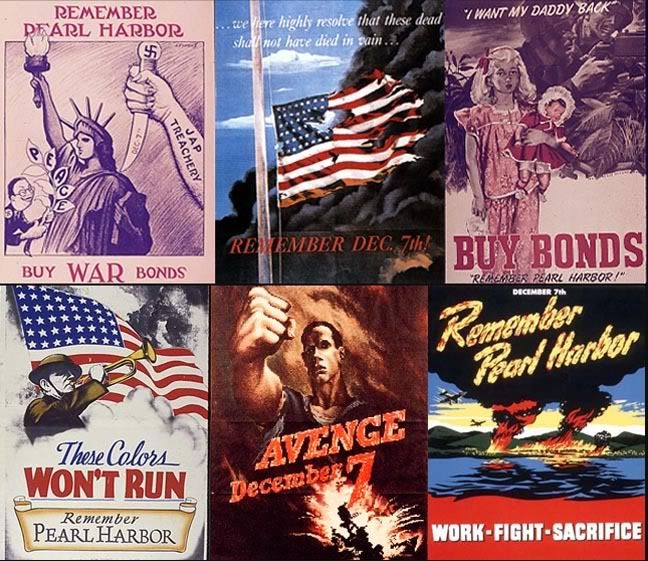
Now imagine if this kind of sentiment would fly nearly as well under the terms of possibilities 1 or 2 or 3. What would you propose instead to generate such a degree of public sentiment? Nice speeches with epic language? Or would you roll over to the isolationists and let the world burn around you? Careful now, if FDR did have these clues, and it seems he was waiting for them, he actually pondered the options without the crutch you have of saying “FDR didn’t know.”

Tuesday, February 17, 2009

FORMER NAVAL PERSONS

CHURCHILL, ROOSEVELT, AND VOYAGES TO WAR
Adam Larson / Caustic Logic
The 12/7-9/11 Treadmill and Beyond
February 16 2009


When the RMS Lusitania went down on May 7 1915 en route from New York to London, hit by a German U-boat and dragging down 1200 mostly English-speaking souls, two Naval personalities of great future importance watched from either side of the Atlantic. On one side of the pond, Winston Churchill had just set off from being the First Lord of the Admiralty and directly into the intensifying fray in a variety of war-related posts, on and off the battlefield. Across the way, A young Franklin D. Roosevelt was Assistant Secretary of the Navy, who among others urged US entry into the war following the attack.

There is some circumstantial evidence that Churchill, in his influential admiralty post, played a large role in steering the Germans towards downing the “livebait” Lusitania. British researcher Colin Simpson indicated this in a 1972 book; others were involved as well, on both sides of the Atlantic, and with the tacit approval of President Woodrow Wilson, worked to ensure what Churchill might have called a “maneuver which brings an ally into the field.” Roosevelt remained with, and helped guide, the Navy as the US prepared to enter the field and throughout the remainder of the war, re-learning again an old Roosevelt family secret – there’s nothing like a sunken boat to get a nation marching to war.

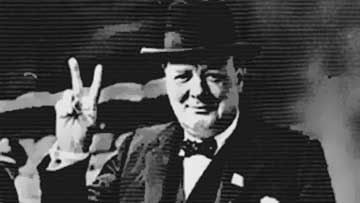
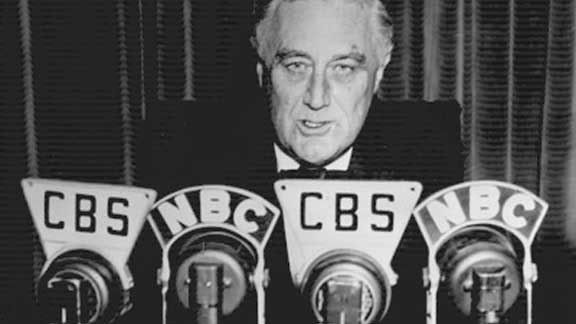
In 1939 the Britain-Germany feud again broke out in a big way and a war leader was needed in London to replace the ousted PM Chamberlain. Roosevelt was by then President of a decidedly neutral-minded and depression-racked US, prophetically urging his reluctant countrymen to rally against the new German threat. As World War II finally turned over from menace to inescapable reality in Europe, he reached out and offered his endorsement to Churchill as new Prime Minister. The sentiment was shared by Britain as a whole, and Churchill stepped in to bolster and brace the shaken British people. Now the two sat across the ocean as leaders not of Navies, but of nations bound together (at the head, if not yet the body) in opposition to Hitler’s Germany. It was at this time the two publicly formed what the FDR Library’s website describes as:

“one of the most extraordinary relationships in political history, a relationship marked by an intimate correspondence unparalleled among national leaders, a relationship which, in due course, would lead to the establishment of a military alliance unique among sovereign states.”

In particular, they bonded over their common Navy pedigree, and Churchill became known to Roosevelt by the nickname ‘Former Naval Person’ as they considered how to get the decidedly neutral ally maneuvered into the field against the Germans yet again. There were known methods to call on, but both the stakes and the resistance were higher than ever. A single ship would not likely suffice.

In late January 1940, three months before Churchill was finally elected, FDR sent his secretary Edwin Watson to fetch some documents from President Woodrow Wilson’s files. For whatever reason, Watson sent back specifically, and it seems exclusively, “the original manifest of the SS Lusitania” along with a note saying “I was afraid to [open it] until you had seen it.” This may mean nothing, but Colin Simpson found this original manifest years later not in its original place, but among FDR’s personal papers. [Simpson, Colin. The Lusitania. Little, Brown and Company, Boston. First US edition. Hardcover. 1973. pp 5, 267]

Wednesday, February 11, 2009

DERELICTION OF INFAMY

Adam Larson / Caustic Logic
The 12/7-9/11 Treadmill and Beyond
February 10 2009


Following is a re-post of an interesting 12/7 foreknowledge denier I stumbled upon, endorsing their own odd conspiracy theory in a bid to keep all blame away from FDR. I'm still researching the issue of Pearl Harbor, and not sure what to think in general, but I think this may all be hogwash.
---
Here it is 2009 and more than 65 years after the fact, there are those who still debate whether FDR knew anything about the pending attack on Pearl Harbor, December 7 1941. They don’t always come out and say it, but the gist of these arguments is that President Roosevelt was a traitor who consciously withheld information from Hawaii’s defenders to enable the Japanese attack and mobilize public support for US entry into World War II. The greatest generation did mobilize to knock down Japanese, Nazi, and Soviet aggression, but it was no thanks to any secret plan of the President. To anyone remotely reasonable, it should suffice to take a quick look at the people saying these things … the Holocaust-denying loons at Institute for Historical Review, the right-wingers at
John Birch Society
, 9/11 No-Planer-types, Marxists, paranoid NWO conspiratainers, Japs, of course, and crazy Japs.

It’s time to put the debate to bed. Speaking truth to such asshattery, noted director Jerry Bruckheimer once said “there’s a book that just came out which claims President Franklin D Roosevelt knew about the attack. That’s all bullshit. He didn’t know about the attack!” That book is probably Day of Deceit by Robert Stinnett, which actually said that Roosevelt and those around him desired, provoked, and allowed the attack. Oh, and knew. This is not far from a 9/11 style remote control attack by FDR himself... wait for part 2. It should be quite clear between Stinnett and Bruckheimer who knows what he’s talking about here - One wrote a stupid book based on stupid paranoid research, the other made a massively expensive and epic movie about the attack, which was nominated for five golden Raspberry awards, won an Academy Award for sound effects, and would surely have nabbed the historical accuracy and patriotic inspiration awards if they existed.

This simple fact guts Stinnett’s case and the myriad like it - FDR certainly couldn’t have arranged the attack if he didn’t even know about it. Which he didn’t, as has already been established. President Frank was a morally correct, upstanding gentleman and “former Naval Person” himself. He was certainly taken by surprise when the yellow rats snuck in and smashed the Navy, just like Admirals Kimmel and Short are widely thought to have been, but without that troubling “dereliction.”

Which brings us to a serious point about historical accountability – those at the time of the attack charged with investigating rightly pointed the blame at the failed defenders of the fleet, if they were a bit soft, referring only to “dereliction of duty.” But in recent decades there’s been a politically correct move to exonerate the names of these two negligent commanders – having their ranks reinstated after they both failed to prepare the Harbor and fleet despite several specific warnings. This is a troubling trend.

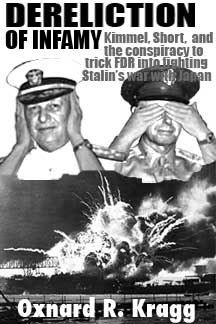
Independent resercher Oxnard R Kragg, in his recent book “Dereliction of Infamy,” reasons there can be no coincidence in Short and Kimmel both being “asleep at the switch” at the same time, just as everyone else was trying to raise the alarm for them about the obvious Japanese mobilization. This is a compelling point, and to back it up, Kragg has uncovered serious evidence that both commanders were secretly Communists, and probably agents of the Comintern! Previously unseen documents offered by Kragg make it more than likely the duo was in league with the USSR, to trick FDR from the inside into fighting the Japanese. The idea was that this would free up Stalin’s eastern front with Japan so he could focus on fighting the Nazis in Europe. As a perhaps intended side-effect, the attack forced the US to enter the war not just against the Japanese but the Germans as well, a fight in which many American soldiers were killed and the onset of the Cold War ensured.
All of this was avoidable, given existing islolationist sentiment, and the President’s own widely-stated desire to keep America out of the war at all costs. Recall the President’s pained words once his peace was shattered by Japanese bombers, that 12/7 would live in “infamy.” The Japs got off the hook easy – a little firebombing, two nukes, an occupation, and forced protectorate/tributary status and national techno-slavery, and you’re paid up, seems to have been our appeasement deal there. There are those that disingenuously try to pin the remaining domestic blame on FDR, and hardly anyone left with the courage to keep it where it belongs – on the traitors who sold us out from within. If history has taught me anything, and it hasn’t, a day cannot live in infamy by ignoring the dereliction at the heart of it.
---
ALL KIDDING ASIDE, The 12/7-9/11 Treadmill is back in operation after a hiatus of - dang! Two years! Keep an eye on this page.

Tuesday, February 6, 2007

THE BUSH FAMILY 12/7-9/11 CIRCUIT {masterlist}

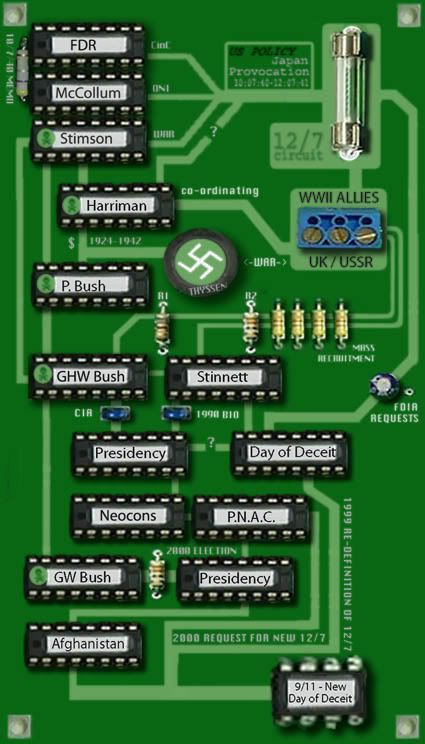
In the course of my research on 9/11, the "new Pearl Harbor," and its namesake original, I stumbled across an intriguing confluence of events suggesting the crafting of a backdrop "New Day of Deceit" myth - whether intentional or not - by the people surrounding George Bush sr. This became one of my favorite discoveries, and along with an earlier and sinister "perfect Bush circle" surrounding America's entry into WWII, here is the double loop in chart form I did up as a circuit board. Beneath that, find a brief explanation for the elements of the chart and the connections between them. Follow the link for more detailed sub-potst.


The Elements of the Chart:
President (FD) Roosevelt, Secretary of War Henry Stimson, and possibly Roosevelt's adviser and ambassador W. Averell Harriman (among others) acted on the Japan provocation plan put forth by Lt. Commander Arthur McCollum at the Office of Naval Intelligence. The eight-point plan solidified existing intentions to bring down the Pearl Harbor attack and give the US an excuse to officially enter the Second World War on the side of the British and the Soviets. In addition to fighting the Nazis and their Japanese allies, the attack allowed the creation of an enduring "military-industrial complex" among its other profound transformationsof American society and economy with effects up to the present time.

War Secretary Stimson meanwhile was a friend of the Bush family, originally headed by Samuel Bush, a muscleman who helped make sure weapons were shipped right for the World War I effort, a sort of proto-military-industrial complex/Merchants of Death kind of guy. By 1940 the family was headed by Samuel's son Prescott, a businessman and senator who maintained ties with Stimson. Bush was also a business partner in Averell Harriman's investment banking firm, involved along with Harriman's brother in the subsidiary Union Banking Corp. that was helping finance the Nazi war machine via Fritz Thyssen until forcibly shut down in late 1942.

Among those young Americans by then called to service in the War effort unleashed by 12/7 was Prescott's son George H.W. Bush (named after Prescott's father-in-law and Harriman-related business partner George Herbert Walker). Another young recruit, Robert Stinnett, served together with Bush in the same aerial reconnaissance unit on the USS San Jacinto. Whatever connections they formed were nurtured with Stinnett's authoring of "George Bush, his WWII Years" in 1990, used as a GOP fundraiser for Bush's re-election campaign in 1992. (hence the link from Stinnett to Bush as president). Stinnett dropped hints about his coming Pearl Harbor thesis in this paen, and after visiting Bush in the oval office, his investigation (coincidentally?) skyrocketed and formed into the groundbreaking Dec. 7 1999 Day of Deceit, which for the first time cited McCollum's plan and in my opinion finally gutted the official story, a victory he started rehashing every December 7 with a reminder article - they provoked and allowed what could well be called a "catastrophic and catalyzing event."

Ironically, Day of Deceit was first published just as the Project for the New American Century was getting serious with its military ambitions, in September 2000 prominently noting the utility of a "new Pearl Harbor," just months after Stinnett had re-defined the term to mean a provoked event designed to transform american opinion. This group is dominated by former Bush sr functionaries (Cheney et al, the hawk "renegades" we're told) and was forming the advisory basis for the presidency of Bush's son. Then they oversaw the most spectacularly acute failure of defense in American history - a new Pearl Harbor in spades - after alleged intense provocations in Afghanistan in mid-2001. Will a McCollum memo from January 2001 surface one day?

A curious and perhaps telling footnote to all this is Stinnett's about-face on Pearl Harbor in the period after 9/11. Perhaps it's simply a coincidence, but as questions over what Bush knew began to arise in 2002, Stinnett's argument and questions changed significantly, no longer mentioning the McCollum memo or provocation. There seems to be no problem with the solidity of his case, so why the back-off? Did someone get a pang of "degrees of separation anxiety?" If this sound silly to you, just take another look at that circuit board above and think about it. It's gotta mean something.

Perhaps the crafting of an ephemeral, controllable, limited-time-only official conspiracy theory? In what context could it possibly make sense to imply that they provoked and allowed the attack? Are they pleading to a lesser crime since they know they physically did it themselves? Is the New Day of Deceit designed to cover for Shadow 9/11 by providing a more logical explanation for the attack's success that still keeps external terrorists center stage?

Friday, December 15, 2006

12/7 part I: AMERICA AT A CROSSROADS

As the great ideological struggles of the mid-20th Century began to play themselves out in Europe, the United States was in the midst of the Great Depression, and one had to look no farther than the nearest bread line to get the feeling the old system wasn’t working. But the disaffected nation seemed at cross-odds with itself as to what side, if any, it was on. The country was divided right and left, with growing sympathies towards Stalin and Hitler amid a shrinking but intensifying core of principled isolationists. Wall Street was enamored of the fascists - first Mussolini, then Hitler – and their promises to roll back the influence of Communism in Europe. Moral and material support flowed to the axis, mostly kept secret at the time. A Congressional Committee later uncovered the letters of Col. William Taylor from 1932-33, explaining “German political associations, like the Nazis and others, are nearly all armed with American [guns] The principal arms coming from America are Thompson submachine guns and revolvers. The number is great.” [1] These shipments were largely from Remington, and came at a time when the Weimer Republic was struggling for survival against the Nazis.

In early 1933, just as Hitler’s “National Socialists” finally took over in Germany with their guns and thugs and engineered Reichstag fire, a new U.S. President, Franklin D, Roosevelt, was sworn-in. Upon entering office, Roosevelt established his Socialist-style New Deal, angering the financial establishment. Some factions on Wall Street and in the military with Fascist sympathies in fact allegedly plotted to overthrow FDR in 1934, but this was brought to light and led to a congressional investigation in November into what many called the “business plot” (more below). [2] 1934 was already the year of the “Merchants of Death,” the title both of a book blaming arms-makers for WWI, and the nickname for another Congressional investigation into the munitions industry in question for arming the Nazis and their allies. [3] Under the leadership Gerald Nye and with general counsel Alger Hiss, the committee was in operation through 1936, eventually finding that World War I was not engineered by the munitions industry. [4]

But still, Merchants of Death was soon joined by another pivotal book in redefining WWI: Brigadier General Smedley Butler’s 1935 War is a Racket (“the only one in which the profits arte reckoned in dollars and the losses in lives”). [5] The decorated WWI commander and reformed “racketeer for capitalism” insisted America should simply strengthen its defenses and stay out of the coming war in Europe. Butler, unlike many other isolationists, was not a Nazi sympathizer in any way, but an avowed leftist who believed in “taking Wall Street by the throat” to pay WWI soldiers’ bonus pay. [6] He had also been central in publicizing the alleged “Business Plot” against FDR, having curiously been invited to join it despite his known slant and big mouth.

The Congress seemed dispose to agree with Butler's and the public's sentiment; neutrality acts were passed from 1935-37 and isolationism reigned as Americans struggled to stay out of another engineered World War. But conflict just kept getting more inevitable as the Axis got stronger and bolder - with continued American aid. Munitions assistance was limited after 1934, but the Nazis were in power by then and fully capable of making their own excellent weapons. But financial assistance for Germany’s Third Reich continued from New York by, for example, Chase National Bank of Manhattan, as explained by Charles Higham in Trading with the Enemy (1983). Of course there was Henry Ford, the well-known Nazi supporter and anti-Semite who approved the construction of trucks to assist the German occupation in France through its French subsidiary Opel in 1940-41. [7] The crimes of the Rockefeller-owned Standard Oil of New Jersey in supporting the Reich are epic, assisting the German Army, Navy, and Air Force with their fuel and petrochemical needs through numerous arrangements. Higham summarized: “[T]he heartbreaking truth is that a number of financial and industrial figures of World War II and several members of the government served the cause of money before the cause of patriotism. While aiding the United States’ war effort, they also aided Nazi Germany’s.” [8]

DEHOMAG
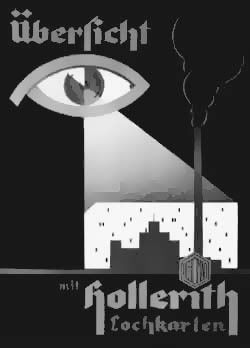
Dehomag poster circa 1934 - "Oversight - with Hollerith punchcard machines"
A key technology that helped Nazi Germany be so ruthlessly efficient was provided by International Business Machines (IBM). As Edwin Black illustrated in his 2001 IBM and the Holocaust, the company’s German subsidiary Dehomag manufactured thousands of punch-card machines, proto-computers that greatly sped-up the Reich’s data processing. With full support from and handsome (if complicated) profits to IBM headquarters, Dehomag’s machines were used in everything from a race-based census to tracking materiel for warfare, to the movement of people to concentration camps and gas chambers. The 5-digit prisoner coding system for these machines was in fact the origin of the famous tattoos at Auschwitz. [9] IBM continues to base its own holocaust denials on the argument that Dehomag was no longer connected to IBM at the time, but the factual record Black presented indicates otherwise.

Of course eventuall Germany signed a mutual defense clause with Japan, then Japan was maneuvered into attacking the US, which was soon at war against the Third Reich and set to turning back its grip on Europe. The War triggered an immediate rush to build a mighty war machine on the shoulders of the once-villified “merchants of death” who were able to reform themselves by fighting the Nazis they’d helped build up, and were paid well for their services. It’s not necessarily that Smedley Butler was right and War is simply a racket engineered for profit, but if it were, this is about how it would be done: build up the Axis and withhold from the Allies in phase one, and once a crisis is reached, cut the Axis off (but only at the last possible moment) and start supplying the Allies as they gear up to move in on the worldwide battlefronts created by years of well supplied Axis aggression.

Sources:
[1] Tarpley, Webster G. and Anton Chaitkin. George Bush: The Unauthorized Biography. Chapter - II - The Hitler Project. Accessed online at: http://www.tarpley.net/bush2.htm
[2] Parfrey, Adam. “How a Military Hero Blew the whistle on Corporate Malfeasance.” Foreword to the 2003 Feral House edition of War is a Racket by Smedley D. Butler (1935) Pages 10-18.
[3] Phillips, Kevin. American Dynasty: Aristocracy, Fortune, and Deceit in the House of Bush. New York. Viking Penguin. 2004. Page 259.
[4] “Nye Committee.” Wikipedia. http://en.wikipedia.org/wiki/Nye_Committee
[5] Butler, Smedley D. “War is a Racket.” 1935. Re-released under original title with additional material: Los Angeles. Feral House. 2003. Page 23
[6] See [2]. Page 8.
[7] Higham, Charles. Trading with the Enemy: an Expose of the Nazi-American Money plot, 1933-1949. New York, Delacorte Press, 1983. Second Printing.. Page xv.
[8] See [7]. Page xiii.
[9] Black, Edwin. “IBM and the Holocaust: The Strategic Alliance Between Nazi Germany and America’s Most Powerful Corporation.” Three Rivers Press. March 2002. Page 352.