Showing posts with label Great Depression. Show all posts

Friday, December 15, 2006

12/7 part I: AMERICA AT A CROSSROADS

As the great ideological struggles of the mid-20th Century began to play themselves out in Europe, the United States was in the midst of the Great Depression, and one had to look no farther than the nearest bread line to get the feeling the old system wasn’t working. But the disaffected nation seemed at cross-odds with itself as to what side, if any, it was on. The country was divided right and left, with growing sympathies towards Stalin and Hitler amid a shrinking but intensifying core of principled isolationists. Wall Street was enamored of the fascists - first Mussolini, then Hitler – and their promises to roll back the influence of Communism in Europe. Moral and material support flowed to the axis, mostly kept secret at the time. A Congressional Committee later uncovered the letters of Col. William Taylor from 1932-33, explaining “German political associations, like the Nazis and others, are nearly all armed with American [guns] The principal arms coming from America are Thompson submachine guns and revolvers. The number is great.” [1] These shipments were largely from Remington, and came at a time when the Weimer Republic was struggling for survival against the Nazis.

In early 1933, just as Hitler’s “National Socialists” finally took over in Germany with their guns and thugs and engineered Reichstag fire, a new U.S. President, Franklin D, Roosevelt, was sworn-in. Upon entering office, Roosevelt established his Socialist-style New Deal, angering the financial establishment. Some factions on Wall Street and in the military with Fascist sympathies in fact allegedly plotted to overthrow FDR in 1934, but this was brought to light and led to a congressional investigation in November into what many called the “business plot” (more below). [2] 1934 was already the year of the “Merchants of Death,” the title both of a book blaming arms-makers for WWI, and the nickname for another Congressional investigation into the munitions industry in question for arming the Nazis and their allies. [3] Under the leadership Gerald Nye and with general counsel Alger Hiss, the committee was in operation through 1936, eventually finding that World War I was not engineered by the munitions industry. [4]

But still, Merchants of Death was soon joined by another pivotal book in redefining WWI: Brigadier General Smedley Butler’s 1935 War is a Racket (“the only one in which the profits arte reckoned in dollars and the losses in lives”). [5] The decorated WWI commander and reformed “racketeer for capitalism” insisted America should simply strengthen its defenses and stay out of the coming war in Europe. Butler, unlike many other isolationists, was not a Nazi sympathizer in any way, but an avowed leftist who believed in “taking Wall Street by the throat” to pay WWI soldiers’ bonus pay. [6] He had also been central in publicizing the alleged “Business Plot” against FDR, having curiously been invited to join it despite his known slant and big mouth.

The Congress seemed dispose to agree with Butler's and the public's sentiment; neutrality acts were passed from 1935-37 and isolationism reigned as Americans struggled to stay out of another engineered World War. But conflict just kept getting more inevitable as the Axis got stronger and bolder - with continued American aid. Munitions assistance was limited after 1934, but the Nazis were in power by then and fully capable of making their own excellent weapons. But financial assistance for Germany’s Third Reich continued from New York by, for example, Chase National Bank of Manhattan, as explained by Charles Higham in Trading with the Enemy (1983). Of course there was Henry Ford, the well-known Nazi supporter and anti-Semite who approved the construction of trucks to assist the German occupation in France through its French subsidiary Opel in 1940-41. [7] The crimes of the Rockefeller-owned Standard Oil of New Jersey in supporting the Reich are epic, assisting the German Army, Navy, and Air Force with their fuel and petrochemical needs through numerous arrangements. Higham summarized: “[T]he heartbreaking truth is that a number of financial and industrial figures of World War II and several members of the government served the cause of money before the cause of patriotism. While aiding the United States’ war effort, they also aided Nazi Germany’s.” [8]
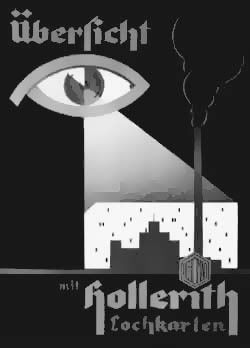
DEHOMAG
Dehomag poster circa 1934 - "Oversight - with Hollerith punchcard machines"
A key technology that helped Nazi Germany be so ruthlessly efficient was provided by International Business Machines (IBM). As Edwin Black illustrated in his 2001 IBM and the Holocaust, the company’s German subsidiary Dehomag manufactured thousands of punch-card machines, proto-computers that greatly sped-up the Reich’s data processing. With full support from and handsome (if complicated) profits to IBM headquarters, Dehomag’s machines were used in everything from a race-based census to tracking materiel for warfare, to the movement of people to concentration camps and gas chambers. The 5-digit prisoner coding system for these machines was in fact the origin of the famous tattoos at Auschwitz. [9] IBM continues to base its own holocaust denials on the argument that Dehomag was no longer connected to IBM at the time, but the factual record Black presented indicates otherwise.

Of course eventuall Germany signed a mutual defense clause with Japan, then Japan was maneuvered into attacking the US, which was soon at war against the Third Reich and set to turning back its grip on Europe. The War triggered an immediate rush to build a mighty war machine on the shoulders of the once-villified “merchants of death” who were able to reform themselves by fighting the Nazis they’d helped build up, and were paid well for their services. It’s not necessarily that Smedley Butler was right and War is simply a racket engineered for profit, but if it were, this is about how it would be done: build up the Axis and withhold from the Allies in phase one, and once a crisis is reached, cut the Axis off (but only at the last possible moment) and start supplying the Allies as they gear up to move in on the worldwide battlefronts created by years of well supplied Axis aggression.

Sources:
[1] Tarpley, Webster G. and Anton Chaitkin. George Bush: The Unauthorized Biography. Chapter - II - The Hitler Project. Accessed online at: http://www.tarpley.net/bush2.htm
[2] Parfrey, Adam. “How a Military Hero Blew the whistle on Corporate Malfeasance.” Foreword to the 2003 Feral House edition of War is a Racket by Smedley D. Butler (1935) Pages 10-18.
[3] Phillips, Kevin. American Dynasty: Aristocracy, Fortune, and Deceit in the House of Bush. New York. Viking Penguin. 2004. Page 259.
[4] “Nye Committee.” Wikipedia. http://en.wikipedia.org/wiki/Nye_Committee
[5] Butler, Smedley D. “War is a Racket.” 1935. Re-released under original title with additional material: Los Angeles. Feral House. 2003. Page 23
[6] See [2]. Page 8.
[7] Higham, Charles. Trading with the Enemy: an Expose of the Nazi-American Money plot, 1933-1949. New York, Delacorte Press, 1983. Second Printing.. Page xv.
[8] See [7]. Page xiii.
[9] Black, Edwin. “IBM and the Holocaust: The Strategic Alliance Between Nazi Germany and America’s Most Powerful Corporation.” Three Rivers Press. March 2002. Page 352.

Thursday, November 30, 2006

2-27 II: DESPERATE TIMES

GERMANY 1933: THE SYNCHRONIZATION BEGINS

January 1933 – Berlin. The Great Depression grips the world, Germany more tightly than most places. Having lost the bitter Word War and been forced to sign the Versailles peace treaty. Under the terms of the Versailles peace treaty that closed World War I, Germany had to disarm and dismantle its military machinery. The nation was forced to render substantial reparations payments to France, Russia, the U.K and the U.S., and the political process was controlled largely by the victorious nations in a sort of indirect joint occupation. The Depression, on top of a war-damaged economy and reparations, caused hyper-inflation had German workers literally taking wheelbarrows to the bank to cash their paychecks. People were starving and freezing to death in significant numbers. A sense of resentment and humiliation permeated post-war German society. This in turn threatened to spill over into revolution.

The USSR, recently disconnected from the recently-crippled capitalist economy, was largely unaffected by Great Depression. Under Stalin’s harsh rule, the Soviet Union in fact grew, something that did not go unnoticed in the long bread lines of the U.S., Great Britain, or Germany. Just before the United States instituted its own brand of moderate socialism (in the form of the New Deal) the lesson had already been learned and absorbed elsewhere. Many in the West turned to Socialism or Communism as the answer to the obvious shortfalls of Capitalism. The USSR did not fail to capitalize on this growing sentiment, and actively worked to foment revolution among the disaffected masses across Europe and in the U.S. In Europe, Capitalism lashed back – with Fascism, which had already made a distinct showing with the ascendancy of Mussolini in Italy.

In the frustrating environment of 1930’s Germany, nationalism and xenophobia surged, and Adolf Hitler rose on that surge, promising to re-claim the “honor” and martial glory of a humiliated nation. Inspired by Musolini’s example, Hitler and his allies manipulated the truth and pushed lies, using thug tactics whenever necessary and political maneuvers when possible, bringing forth their bold and uncompromising vision of a renewed German Empire. National Socialism drew members from the growing left wing with the language of Socialism, but steered their new recruits in a nationalistic direction. Proponents of Naziism, as it came to be shortened, promised to shake off the "foreign-controlled" Weimar regime and the oppressive terms of Versailles. Eventually, this would be broadened into a renewal of the old German-centered “Holy Roman Empire” – the Third Reich.

Hindenburg
Paul Von Hindenburg, Reichpresident 1925-1934.

Hitler ran for President of Germany on the Nazi platform, in a bitter contest with incumbent President Paul Von Hindenburg. Hitler gained points by accusing Hindenburg of bowing to foreign pressure and selling out the fatherland and in the end, neither candidate won a clear majority. In a March 11 run-off election, Hitler lost solidly to Hindenburg, and Prussian police in fact seized documents that showed the Nazis had placed SA troops all over Berlin, in preparation for an all-out coup in the event of a Hitler victory. (1)


hello down there
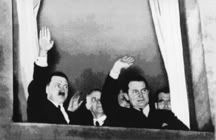
Chancellor Hitler and Herman Goerring "waving" to supporters, January 30, 1933.

The resourceful and well-connected Hitler, while briefly tarnished by the conspirator image, quickly remade himself. Over the next year he and his supporters grew their power base and wriggled higher into the levels of power. With deft political maneuvering, Hitler was appointed as Chancellor, reluctantly, by President Hindenburg on January 30, 1933. (2) He teamed up with fellow Nazi and president of the Reichstag (something like Senate Majority Leader) Hermann Goering. Playing coalition politics and outflaniking everyone, they went to work within days on the early phase of their “synchronization”, a euphemism for the transformation of the political system to incorporate an all-powerful central government under Nazi control. (3)

One party that suffered a major defeat at Versailles was the German armaments industry. Weapons makers like Krupp and I.G. Farben, put out of business by the ban on all weapons of war, were reassured that the Nazi way was their way. In a private meeting Goering’s Reichstag President’s Palace, February 20, these leading industrialists were assured that “National Socialism” did not mean Communism. Indeed, if given the chance, they would break the back of Communism and organized labor in Germany (and democracy to boot), and re-assert Germany’s age-old military values and Imperial ambitions. Hitler and Goerring collected an immediate $3 million Deutsche Marks in cash donations, with promises of more to come. Hitler said “now we stand before the last election.” (4) But before that last election, to be precise, before March 5th, two eventful weeks would unfold and utterly transform Germany’s power structure.

Sources:
[1]Shirer, William. The Rise and Fall of the Third Reich: A History of Nazi Germany. New York. Crest Books. 7th Printing. July 1965. Page 224.
[2] See[1]. Page 262.
[3] Wikipedia. Herman Goering. http://en.wikipedia.org/wiki/Goering
[4] See[1]. Page 265-266