A BASIC OVERVIEW IN THREE MOVEMENTS
[NATO Sneak-Behind Armies series]
Adam Larson / Caustic Logic
July 31 2009 - incomplete
NOTES ON METHOD
Here I offer a general overview of key events tangled up, allegedly at least, in the epic tragedy of NATO’s “sneak-behind armies” – the manipulation of Europe’s Cold War politics by Right Wing violence to keep the West safely away from the Left. These activities are widely believed to emerge from NATO “stay-behind” resistance cadres – whose job was to wait for a Soviet invasion – activated by CIA schemes and allegedly kept quite busy in the meantime. For the moment, I’m relying on two primary resources from the same source: Dr. Daniele Ganser’s NATO’s Secret Armies [Frank Cass, London, 2005], for some details, and for the skeleton a timeline compiled by Ganser I believe, for the Zurich-based Parallel History Project on Cooperative Security (PHP), supported by International Relations and Security Network (ISN). ISN is, in turn, part of the Zurich-based Center for Security Studies, at which Dr. Ganser is a senior researcher.
Collectively, this Swiss analysis seems a well-researched and a reasonable take, if slanted a bit to the left and against the United States and NATO. This is fine by me, and probably closer to the truth than the official disavowals of all links to the terrorist stuff. This instinct leads to an inclusive approach to research, possibly providing some chaff with the wheat. This too is fine as I like information and have my own filters (whch are currently at work, not finished). Here then is a broad sweep, in three phases, of the related events of 1947 to 1990. My source is usually the timeline, with uncited supporting details from various parts of Ganser’s book, with a few other internet sources linked where they appear.
GROUND RULES: 1947-1960
The story’s roots go back well into World War II and even further back, but really started becoming clear in 1947, as President Truman laid out his containment doctrine in March and the National Security State emerged with the September act of that name. The resultant Central Intelligence Agency ushered in its covert action section called Office of Policy Coordination, which was soon organizing existing Conservative/Monarchist/Fascist activists in Europe. These would in strict secrecy form networks of trustworthy “religious” types overseen by the respective nation’s Secret Services, which in turn maintained links to the CIA and the British foreign intelligence service MI6. Hidden weapon and supply caches and radio communication systems were the primary infrastructure set up in each nation.
The Anglo-American Trans-Atlantic consensus rolled ahead, expanded to the concept of the Western Union with “Free” Europe, ranged against the Soviet Bloc. This pre-NATO union operated from Paris with its “Clandestine Committee” (WUCC) created in 1948 to oversee the continent-wide stay-behind system. The following year, the union solidified around the North Atlantic Treaty into NATO, still based in Paris, and the WUCC was absorbed and renamed Clandestine Planning Committee (CPC).
Ironically, it was in France that one of the earliest stay-behind armies was exposed in late June 1947, when Interior Minister Edouard Depreux revealed the existence of a secret army codenamed “Plan Bleu” (as in, opposite of Red). This had envisioned a military coup to bring DeGaulle to power and sideline all leftist tendencies, and planning was well-along, with American and British support, before it was busted up. The stay-behind army Rose De Vents, French for “compass rose,” which is of course NATO’s logo, was formed within the SDECE military police following the scandal, keeping the network alive and again concealed. The government continued on wobbling left and right as is natural, until in 1958 a similar “Operation Resurrection” was organized, with the support of Rose de Vents, to replace the soft Fourth Republic with a right-wing state under De Gaulle. This time the government quietly surrendered and invited the change, thus leaving the coup d’etat unrealized.
The post-war ideological battle was uniquely pitched in France at the time, as it was in Italy, where the US had been recruiting the likes of the Fascist “black prince” Borghese for years, and spent 1947-48 pumping tens of millions into manipulation and dirty tricks for the anti-Communist campaigns for the 1948 national elections. This succeeded and left Italy solidly in the Right/NATO camp, to be kept there by complex networks operating largely through the CIA-linked P2 faux-Masonic lodge. Italy would in the years ahead become the main battlefield of the Left-Right secret wars of the European Cold War; sometimes involving the Italian mafia and/or the Vatican among the usual suspects, it tops the heap for both mind-boggling intrigue and deadly violence.
With the full, cold weight of East Germany pressing next door, West Germany had no allowable possibility of Communist leaning, and so the West’s networks there pulled out the stops following World war II. Intelligence types made contacts with useful former Nazis, including Clause Barbie, Reinhard Gehlen, etc. among other measures, so that well before NATO membership in 1955, West Germany’s government was in no way neutral. The original German equivalent of Gladio was known as BDJ-TD (Bund Deutscher Jugend – technical division), set up by other former Nazis, including Col. Gunther Bernau. This was trained, equipped, funded, and at least indirectly commanded by the CIA, and promised full protection from domestic and international law to any of its members accused of illegal acts.
The Iberian peninsula – Spain and Portugal – presented an unusual situation. Their long-running strong-man regimes were of the same Fascist camp as Germany and Italy had been, but they had managed to remain officially neutral during World War II. In the Cold War, context, onetime liabilities were suddenly clear assets, as in Germany and Italy. Spain’s surviving General Franco was given the blessing by NATO to keep ruling, and Spain was treated as a partner, but not allowed to join until 1982, after his death and a democratization process. Portugal however, under 36-year dictator Antonio Salazar, managed to become a NATO member immediately in 1949, but was never blessed with a domestic stay-behind army of the kind used elsewhere to keep governments in check. Spain’s president in 1981-82 Calvo Sotelo said after the 1990 revelations why there was no Spanish Gladio equivalent; "the regime itself was Gladio." This probably applies to Portugal as well, and thus Iberia had the trust to escape the leash and was used as a secure platform to support operations across the continent. The paths between violence-ridden Rome and Rightist safe-Haven Madrid is perhaps the heaviest trodden of the secret wars.
Not all the networks became violent or very disruptive, however; a Swedish stay-behind network was in operation by 1951 at latest, despite Sweden’s official neutrality and NATO non-member status. This was based on a Nazi-affiliated wartime model called Svealborg, operating under that same name and original director Otto Hallberg. William Colby, later CIA director, from Stockholm oversaw the training of stay-behind armies in neutrals Sweden and Finland, both of which were shut down early on, and the enduring branches for Norway and Denmark. By 1953, Swedish police arrested Sveaborg’s leader, and the network was partly unraveled, but Hallberg himself was let off the hook and it seems likely operations continued.
In a bizarre and devastating turn for the network’s fortune, in Germany, 1952, a former SS officer Hans Otto just walked into the police station in Frankfurt and ratted out the BDJ-TD network he’d become sickened with. He revealed all their secrets, their HQ location, their CIA links represented by a “Mr. Garwood.” Their bases raided and many arrested, it was found the Technical Division gang had been compiling lists of Leftists to exterminate on an unspecified “Day X.” The local government was furious, as many of its members were on the hit lists. The BDJ-TD was shut down, but apparently re-constituted, and ultimately those arrested were found not guilty, under pressure from the national government in Bonn. Likewise, operations apparently continued in some other name, spawning minor violence in the coming years.
In 1957, quieter troubles surfaced in Norway, where secret service director Vilhelm Evang, known as soft on the Left, protested to NATO about the “domestic subversion” of his country by this stay-behind system, and pulled his nation from the CPC until persuaded back. All these frictions in the stay-behind network’s first decade had the potential to bring it all down. The system remained intact though, simply re-forming where needed and hiding all new secrets. The friction may have contributed to the creation of a new system for managing the system, ushered in with NATO’s 1958 founding of the Allied Clandestine Committee (ACC) to coordinate their secret warfare under cover of doomsday planning. This system continued churning out the controversy over the following decades, but with renewed secrecy and then with a greater confidence, zeal, scope, and death toll.
THE EXPANSIVE YEARS: 1960-1974
In general NATO’s stay-behind system made steady gains in non-Atlantic Southern Europe in the 1960s. In Italy the Gladio network was heavily involved in “a silent coup d’état” called Piano (Plan) Solo - the military police persuaded all Socialist Ministers out of the government with a convincing show of military force. To the east of Italy, Greece and Turkey had their stay-behinds approved and were admitted to NATO in 1952. In Turkey, the CIA et al. Were impressed with the anti-communist potential of the imperialist/racist ideology of Pan-Turkism, as espoused by leaders of the 1960 military coup - supported by the secret army “Counter-Guerilla” - that had Prime Minister Adnan Menderes killed.
In 1964 In Greece Socialist George Pompandreous managed to take the Prime Minister slot despite being cheated of it in a 1961 CIA-supported vote-rigging operation. Soon he was trying to disassemble secret networks he found to be fused irremovably to the CIA. Instead he was removed in 1967, with a fierce and sweeping military coup d’état – involving the Greek stay-behind army Hellenic Raiding Force. The powerful Greek Left was punished for its intransigence in making Pompandreous possible with what Ganser describes as “a regime of imprisonment and torture, the like of which had not been seen in Western Europe since the end of the Second World War,” and which lasted for seven years before succumbing to a renewed revolt.
1966 also witnesses the creation, in Salazar’s Portugal, of “Aginter Press” which under the direction of French schemer Captain Yves Guerin Serac studied techniques of subversion, propaganda, bomb-making, network building to disseminate the skills to where needed. It was Aginter’s network that primarily solidified the overt notion of the “strategy of tension,” to disguise the acts of violence as Communist to turn the public against them and towards the real bombers. Within a few years they were killing resistance leaders in Portuguese Mozambique, working for Spain’s secret police, training Italians in bomb-making, liaising with their accomplished colleagues in rightist Greece, etc, thus raising the tension of the general political climate of Europe as the 60s slipped into the 70s.
But in NATO’s heartland – France – the decade went quite less smoothly. April 1961 had seen plotters within the French military with stay-behind-links and alleged CIA support, launch their concerted effort to alter president DeGaulle’s plans to surrender Algeria. The new Organisation Armee Secrete (OAS) takes over in Algiers in April, aiming for Paris next, the OAS insurgency brought the country near to civil war, but was gradually crushed by Paris and fully surrendered in March 1962; along with recognition of Algeria’s independence, the Algier Francaise scene faded, but its ideologues would carry on - like Guerin Serac (real name Guillou) who would help establish Aginter Press.
Perhaps aware of the American role in the networks that were plotting against him, or of other such interfere with France’s sovereignty DeGaulle started enacting policies that CIA felt were “paralyzing NATO” in Europe as early as 1961. Within five years it had come to a head, and in March 1966 the President dramatically canceled the country’s NATO membership, and ordered its headquarters to leave his soil. They complied and moved camp to neighboring Belgium. The stay-behind coordinating ACC was code-named SDRA 11, fused within the Belgian military secret service SGR based right next to NATO. They have never had to move again, thankfully. It must be quite embarrassing.
The mid-1960s saw secrets slipping as well, but compared to the gains, it seems the secret armies were running a tight ship. The timeline I’m citing here reports on NATO’s move to Brussels, “secret NATO protocols are revealed that allegedly protect right-wingers in anti-communist stay-behind armies.” In 1968 a British MI6 agent working with the stay-behind network in neutral Sweden willingly reveals secrets to the KGB. The first stay-behind arms caches in neutral Austria – 34 locations – were found by police in 1965, based on info they somehow forced from British MI6 agents who knew where they were.
Then one of the more ominous moments; on December 12 1969 a bank bombing at the Piazza Fontana in Milan killed sixteen ordinary people, mostly farmers; along with three other bombings in Italy the same day and an un-detonated fourth (C4, usually American) the brazen attack was quickly blamed on the Italian Left. During a 1990s trial, General Maletti, former head of Italian counter-intelligence, “claims that the massacre had been carried out by the Italian stay-behind army and right wing terrorists,” as the timeline puts it, “on the orders of the US secret service Central Intelligence Agency (CIA) in order to discredit the Italian Communists.”
This was but the opening shot of the Italy’s nightmare, the fiercest years of the secret wars with an overall estimate of 490 killed between late 1969 and 1980. A year after the Piaza Fontana bombings, in December 1970 a coup d’etat led by Fascist luminary Valerio Borghese, supported by the Gladio networks, was only called off at the last minute under mysterious circumstances. On May 31 1972 a booby-trapped car exploded near the village Peteano killing three police officers; the terror fell on May Day, and insiders planted false leads implicating the local Communists, causing a crackdown and setbacks for their agendas. The crime was later traced, however, back to right-wing terrorists including Vincenzo Vinciguerra, who had fled to Spain with the help of the Italian secret services. He would be arrested, as such men often were, but he returns to our story in the 1980s. In 1974 two more massacres “during an anti-fascist demonstration" and "in the Rome to Munich train “Italicus Express”, kill 20 and wound well over 100, the timeline says. I’m not sure if these were also blamed on Communists but it was getting tense, resembling some kind of civil war.
1974 AND AFTER: ESCALATION AND COLLAPSE
It was in October 1974 that Italy’s legal system managed to push back at the right spot; General Vito Miceli, chief of the military secret service SID and prominent P2 member, was arrested in relation to the 1970 Borghese coup attempt. Perhaps intending to awe the court, he revealed that “it was the United States and NATO who asked me” to establish his “super SID,” which was involved in the coup. (The full quote varies, often a little misleading – later post). Miceli was acquitted in 1978 but at least one secret had slipped out, and the episode also spurred parliamentary moves to restructure and rein in the secret services. Gladio’s capabilities were thus limited, but the floating freelance terrorists beyond them were still at large.
In Denmark the secret stay-behind army Absalon tried in 1974 to block some Leftist academics from “becoming members of the directing body of the Danish Odense University,” but failed to do so, and somehow in the melee, “the secret army is exposed.” They never had much luck in the north, but in general the Iberian peninsula remained stable and strongly in NATO’s right hand. However in 1974 an unusual popular revolution (of the flowers) rocked Portugal and Salazar’s regime was overthrown. In the process Aginter Press and other NATO secret operations were shut down. Related operatives and operations moved to Spain before the new government could nab them, and from 1975 on cooperated with Franco against Basque separatists and Communists, as with the 1977 Atocha massacre.
In the mid-1970s, the Italian parliament, to smooth tensions with the large and permanently locked out Italian communist party, made moves to allow some Communists to join the government. This option unacceptable to the Italian Right, or to Washington and NATO, but it rolled ahead under MP and former President Aldo Moro. In 1978 Moro was taken hostage in Rome by “an armed secret unit” as the PHP timeline puts it, and killed 55 days later. The murder fits the motives of the secret armies, but the government enthusiastically blamed the Leftist Red Brigades, and cracked down hard. That story makes no sense, but fits perfectly with the Rightist “strategy of tension,” which was working.
Perhaps due to this encouragement, he terror continued to escalate into the worst single atrocity of the decades-long secret war; in August 1980 a massive bomb ripped apart a waiting room at the Bologna railway station, killing 85 and seriously injuring and maiming a further 200. It remains unknown, and one of the biggest questions, what full links Gladio had to the Bologna massacre. A later Italian Senate investigation found some evidence the explosives were from a cache established for the secret army. Perhaps for a bit of camouflage, this one was not blamed on Leftists but on less favored Right-Wing extremists, who probably had no access to Gladio’s stocks, and in turn claimed to be framed by Licio Gelli of the CIA-linked P2 Masonic Lodge, but were jailed anyway and remain there now. Aginter co-founder Delle Chiaie had been charged with association, but the charges were dropped. An Italian judge decades later charged Gelli with criminal diversion is the case.
Following the 1971 Turkish military coup d’état against Demirel’s center-Right regime, with the help of the stay-behind army Counter-Guerrilla. This network continued under state tutelage to kill hundreds in domestic terrorism; for example, in 1977 their gunmen killed 38 at a demonstration in Istanbul. Somewhere in there things were deemed to have slid into softness and in 1980 the commander of Counter-Guerrilla launched a successful coup to re-gain tighter control. Just as the violence against actual Communists in actual Europe was dying down things continued to stay brutal here; during the mid-1980s the stay behind army worked on answers to Turkey’s “Kurdish question,” killing and torturing thousands of suspected separatists.
The late 70s and early 80s saw revelations of the network increasing; In 1976 the German secret service BND secretary Heidrun Hofer was arrested for sharing secrets of the German stay-behind army with her husband. Her husband was apparently a spy for the KGB. Oops. The Norwegian police discover a stay-behind arms ache in 1978, leading to the arrest of Hans Otto Meyer who reveals the Norwegian secret army. In 1983 Dutch hikers near the village of Velp discover a large arms cache, a finding that led to the government admitting that the arms were related to NATO “unorthodox warfare” plans for the Netherlands. Other such remote arsenals were being used before X-day - In October 1980 gunmen at a Munich festival killed 13 and wounded hundreds of German civilians; a large weapons cache allegedly used by the right-wing assailants – later believed of the Gladio network - was discovered the following year near the village of Uelzen.
In 1984 Italy right-wing terrorist Vincenzo Vinciguerra, on trial for the Peteano bombing of ‘72, reveals the Gladio secret army and its networks in great detail to Judge Felice Casson. Vinciguerra’s testimony remains perhaps the most vivid single summation of the alleged patterns of NATO/CIA manipulation: "You had to attack civilians, the people, women, children, innocent people, unknown people far removed from any political game,” and convince them the danger came from the Left and the Right was their only salvation. After so describing the “strategy of tension,” Vinciguera was successfully sentenced to life and imprisoned. This time, the charges were NOT dropped. By 1984 the violence in Italy had mellowed from previous years, though not quite stopped for another year or two.
From 1982-1985, a series of brutal and terrifying armed attacks shocked NATO HQ’s host nation Belgium. The usual target was a supermarket in the Brabant region near Brussels, where supremely confident masked men started strafing shoppers, and freely engaging any police who dared show up. They usually targeted the same store chain (Delhaize) always escaped and were never caught, but sparked a heightened state of security and associated mindsets across the nation. The worst was November 9, 1985 – a pre-Christmas holiday there - in which 28 were killed and scores injured. The PHP timeline explains "investigations link the terror to a conspiracy among the Belgian stay-behind SDRA8, the Belgian Gendarmerie SDRA6, the Belgian right-wing group Westland New Post, and the Pentagon secret service Defense Intelligence Agency (DIA).” Wow. This one I’ll have to look into. Whatever the case, the tough mindset adopted after the St. Martin’s Day massacre apparently caused the terror to go away, and no more attacks followed.
As Cold War tensions relaxed in the latter 1980s amid reforms in the USSR and Warsaw Pact, the PHP timeline shows no entries at all for years 1986, 87, 88, or 89. Things were certainly happening, but it was subtle, perhaps just sleep and maintenance mode. The ACC was still meeting in Brussels, and no one can say just what they were thinking, there had to be more uncertainty than before just how needed they would remain. In the autumn of 1989, the majority of Eastern Europe went through a string of revolutions, shaking off the Soviet cloak and toppling the iron curtain. Borders were re-drawn, countries re-named, and NATO given massive room for expansion as the Warsaw Pact dissolved. The wave of reform somehow echoed back on the Soviet Union itself in tsunami proportions – Gorbachev’s hope for New World Order was eclipsed by the end of the USSR itself, creating fifteen new nations and yet more room for the “North Atlantic” gang’s grasp.
At this point, any reason for the stay-behind network to exist should have been seriously reviewed, to say the least. Those who knew the Gladiators were there in the shadows may have wondered if the network would die in secret or grow and fester there in some different form. The question was most acute in Italy, where the worst violence was but a decade past. Judge Casson, who was already thinking along Gladio lines after dealing with Vinciguera in 1984, was again perusing military intelligence archives when his luck changed, due to a decision at Italy’s highest level. In January 1990, Casson applied to search a previousy top-secret military archive in Rome. Perhaps well-knowing the danger, Prime Minister Giulio Andreotti granted the request in July. Casson quickly found a document naming Gladio as the network, givng clues to its NATO sponsorship, and the existence of other armies in across Europe.
With specifics in hand, Judge Casson was set to blow it all up. He passed this on to a parliament committee looking into the origins of the terrorism, and they in turn persuaded PM Andreoti to announce the news publicly. Having previously lied to cover up Gladio operations in the 1970s, he stood before the parliament on August 3 and explained the basic clean version of Gladio’s existence. He denied any link to the terrorist stuff – they only waited for war, he said. In Belgium the Allied Clandestine Committee met for the last time on October 23 and 24 to discuss the new realities of their loss of mission and of cover. As the meeting was happening, Andreotti repeated his revelation and explained they were still active and in congress at that moment in Brussels. NATO denied any stay-behind networks on November 5, then shifted back to their usual “neither confirm nor deny mode.”
The world media was immediately distracted with the Gulf War, but eventually pursued the story, searching out answers in the capitols of Europe in the last months of 1990 and to a lesser extent over the following years. Various public and private investigations turned up many clues, forming much of the timeline preceding . Many gaps remain. The program in neutral (non-NATO) countries of Finland, Sweden, Austria, and Switzerland is especially sensitive. Colonel Herbert Alboth promised to tell “the whole truth” of the Swiss secret stay-behind army P26 he once commanded, but instead fell on his own sword – repeatedly - and was found dead “stabbed with his own military bayonet.”
Within the year, based on whatever evidence, hunches, and common sense, the parliament of the European Union issued a resolution sharply condemning NATO and the United States for steering European politics with the stay-behind network. Of the involved nations, the US and UK remain the tightest-lipped. NATO continued to say nothing, the CIA refused to cooperate either with the National Security Archive’s FOIA requests or those of Dr. Ganser, or anyone else. Additional clues continued to surface from time to time. London’s Imperial War Museum in 1995 did ackowledge in an exhibit ("Secret Wars") MI6 and SAS involvement in forming stay-behinds across Western Europe following World War II. But officially, nothing.
...
Showing posts with label NATO. Show all posts
Showing posts with label NATO. Show all posts
Thursday, July 30, 2009


Sunday, August 3, 2008
NATO’s SNEAK-BEHIND ARMIES {MASTERLIST}
Adam Larson / Caustic Logic
First Posted July 29 2009

Incident: Various acts of terrorism in Europe, 1947-1990.
Casualties: Uncertain but hundreds at least
Official explanation: Some Right-Wing extremists barely connected to NATO’s stay-behind armies and acting without authorization. Riiiiight…
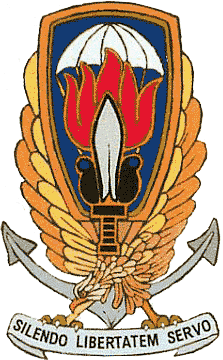
Due to the complexity of the topic, I’ve been reluctant to delve right into the “Operation Gladio” story, regarding NATO’s controversial stay-behind armies of the Cold War and their related groups and activities. The common name was but the active branch in Italy, the first revealed in mid-1990, due to intensive investigations stemming from a decade of deadly violence there. The picture at top is based on the seal of Gladio; the original text means "in silence we defend freedom." My version says "Silently we subvert Democracy."
It was told how this secret army Gladio had been operating since the mid-1940s with counterparts in every European country west of the Iron curtain, with the exception of Ireland and Iceland. Other nations were alarmed and started investigating throughout the 1990s and beyond. Different names, dates, and arms cache locations surfaced, as did different strategies from the silently abandoned to verging on civil war, as in Italy. Old mysteries finally made sense, while key secrets were left still concealed in each nation.
The networks themselves were in little doubt then, and none now; establishing a stay-behind army, capable of resisting a Soviet occupation, had always been a precondition for NATO membership. What might seem prudent in the face of a possible thrust beyond the Iron Curtain, also created dangers; the sabotage, infiltration, and assassination skills they learned could either go to waste waiting for a day that never came, or they could be employed, as they were, to create a “strategy of tension.” Under this concept, mysterious acts of violence were blamed on the Left’s radicals, but were carried out by Right-wingers using the hidden stay-behind arsenals and protected by state apparatus and the CIA to escape and strike again. Dropped charges over unsolved attacks came down like steady like the pitter-patter of rain drops during the Cold War decades.
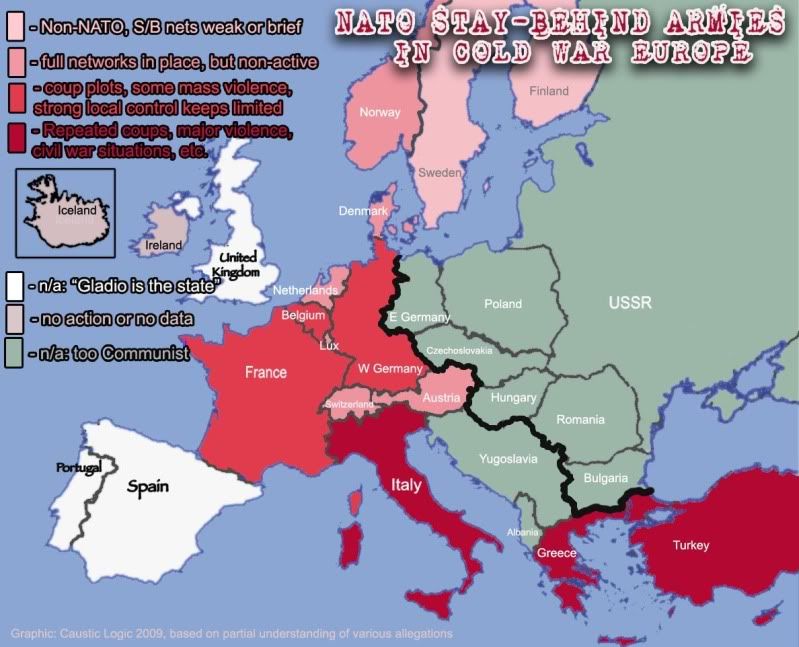 The suspicious pattern led many to conclude, well prior to 1990, that larger forces behind these terrorists manipulating the political process – sneaking behind the democratic governments of Europe. The stance professed by insiders has been innocence and/or ignorance – the armies were meant to remain inactive until the doomsday invasion, and most did, but if not, then the zealots in the network got carried away. The violence was never the plan, but just happened - and was exploited in its effects, covered-up, at least tacitly encouraged, and continued widely almost until the 1990 revelations.
In 2005 Swiss researcher Dr. Daniele Ganser released a deeply-researched book on the subject NATO’s Secret Armies outlining the patterns of allegation, evidence, and mystery. Dr. John Prados of the American National Security Archive, who had tried unsuccessfully to get related files from the CIA, wrote the foreword. Undermining the ignorance construct, Prados noted:
“[N]etworks created to be quiescent became activists in political causes as a rule and not an exception [...] At a minimum Dr Ganser's record shows that capabilities created for straightforward purposes as part of the Cold War ultimately turned to more sinister ends,” leaving him wondering if it were “the United States itself, Britain, France, Italy, and others who should be on the list of state sponsors” of international terrorism.
My normal M.O so far has been to focus on a narrow event and study detailed evidence to narrow down the options that make most sense. In this case the mind boggles at how wide the roster of evidence would be – sixteen nations, four-and-a-half decades, lots of remaining secrets and uncertainties, the relative inaccessibility of primary sources… no way can I cover the whole subject in adequate depth – I will simply try to cover some general patterns and examine a few key periods/events/concepts, in hopes of shedding some new light on something.
THE POST(S)
> Forty-Three Years of Deceit: A detailed "general rundown" of the mysterious events attributed to the sneak-behinds.
(a few are coming)
First Posted July 29 2009
Incident: Various acts of terrorism in Europe, 1947-1990.
Casualties: Uncertain but hundreds at least
Official explanation: Some Right-Wing extremists barely connected to NATO’s stay-behind armies and acting without authorization. Riiiiight…
Due to the complexity of the topic, I’ve been reluctant to delve right into the “Operation Gladio” story, regarding NATO’s controversial stay-behind armies of the Cold War and their related groups and activities. The common name was but the active branch in Italy, the first revealed in mid-1990, due to intensive investigations stemming from a decade of deadly violence there. The picture at top is based on the seal of Gladio; the original text means "in silence we defend freedom." My version says "Silently we subvert Democracy."
It was told how this secret army Gladio had been operating since the mid-1940s with counterparts in every European country west of the Iron curtain, with the exception of Ireland and Iceland. Other nations were alarmed and started investigating throughout the 1990s and beyond. Different names, dates, and arms cache locations surfaced, as did different strategies from the silently abandoned to verging on civil war, as in Italy. Old mysteries finally made sense, while key secrets were left still concealed in each nation.
The networks themselves were in little doubt then, and none now; establishing a stay-behind army, capable of resisting a Soviet occupation, had always been a precondition for NATO membership. What might seem prudent in the face of a possible thrust beyond the Iron Curtain, also created dangers; the sabotage, infiltration, and assassination skills they learned could either go to waste waiting for a day that never came, or they could be employed, as they were, to create a “strategy of tension.” Under this concept, mysterious acts of violence were blamed on the Left’s radicals, but were carried out by Right-wingers using the hidden stay-behind arsenals and protected by state apparatus and the CIA to escape and strike again. Dropped charges over unsolved attacks came down like steady like the pitter-patter of rain drops during the Cold War decades.
The suspicious pattern led many to conclude, well prior to 1990, that larger forces behind these terrorists manipulating the political process – sneaking behind the democratic governments of Europe. The stance professed by insiders has been innocence and/or ignorance – the armies were meant to remain inactive until the doomsday invasion, and most did, but if not, then the zealots in the network got carried away. The violence was never the plan, but just happened - and was exploited in its effects, covered-up, at least tacitly encouraged, and continued widely almost until the 1990 revelations. In 2005 Swiss researcher Dr. Daniele Ganser released a deeply-researched book on the subject NATO’s Secret Armies outlining the patterns of allegation, evidence, and mystery. Dr. John Prados of the American National Security Archive, who had tried unsuccessfully to get related files from the CIA, wrote the foreword. Undermining the ignorance construct, Prados noted:
“[N]etworks created to be quiescent became activists in political causes as a rule and not an exception [...] At a minimum Dr Ganser's record shows that capabilities created for straightforward purposes as part of the Cold War ultimately turned to more sinister ends,” leaving him wondering if it were “the United States itself, Britain, France, Italy, and others who should be on the list of state sponsors” of international terrorism.
My normal M.O so far has been to focus on a narrow event and study detailed evidence to narrow down the options that make most sense. In this case the mind boggles at how wide the roster of evidence would be – sixteen nations, four-and-a-half decades, lots of remaining secrets and uncertainties, the relative inaccessibility of primary sources… no way can I cover the whole subject in adequate depth – I will simply try to cover some general patterns and examine a few key periods/events/concepts, in hopes of shedding some new light on something.
THE POST(S)
> Forty-Three Years of Deceit: A detailed "general rundown" of the mysterious events attributed to the sneak-behinds.
(a few are coming)
Wednesday, December 6, 2006
NORTHWOODS II: SPECIAL DISTRIBUTION - THE PLAN
Before all this could come about, there was at least one more major development regarding Cuba that brings us to the central thread of this book. Bamford wrote “although no one in Congress could have known at the time, Lemnitzer and the Joint Chiefs had quietly slipped over the edge.” [1] They were not through with Cuba - one plan had failed, theirs had not yet been tried. They even had a plan to win public support for this war at all costs, and it was called “Operation Northwoods.” Like the CIA’s Bay of Pigs plan, the roots of Northwoods go back to the twilight of Eisenhower’s term. On January 3, Eisenhower told Lemnitzer and others that, as Bamford explains, “he would move against Castro before [Kennedy’s] inauguration if only the Cubans gave him a really good excuse.” [2] It didn’t happen in time for Eisenhower, but on the 19th, the day before Kennedy was sworn in, new Joint Chiefs chairman Lemnitzer gave his approval to a proposal that would eventually morph into this sinister plan to provide that “really good excuse.” [3]
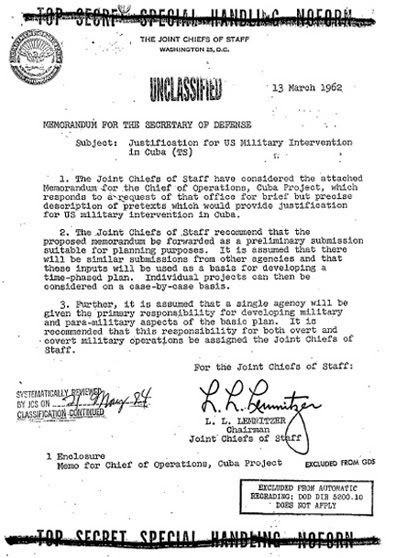
The origin of the name “Northwoods” is not clear, but is possibly a reference to the London suburb of Northwood, home of the Permanent Joint Headquarters (PJHQ), the British equivalent of the JCS, possibly indicating a British connection or inspiration. In March 1962, Operation Northwoods was completed, and Lemnitzer signed off on it. The “special distribution” document opened:
”As requested by Chief of Operations, Cuba project, the Joint Chiefs of Staff are to indicate brief but precise description of pretexts which they consider would provide justification for US military intervention in Cuba.” [4]
Wikipedia article on Northwoods
Destabilizing or toppling Castro’s regime and the re-subduction of Cuba was still American policy in general, and Northwoods itself was part of a larger, Kennedy-supported “Cuba Project.” But this report went beyond the pale, promoting harassment and a threatening posture to elicit an attack “since,” the memo states, “it would seem desirable to use legitimate provocation as the basis for US military intervention.” [5] But of course Cuba was not Japan, and Castro was not Tojo, and so the report focused more on the backup plans. These were more cynical than anything FDR or Arthur McCollum, the author of his Japan provocation policy, would have dreamed up - if Cuba failed to be provoked into a “mistake,” the JCS proposed providing a pretext themselves in a false flag operation and blaming Cuba for it.
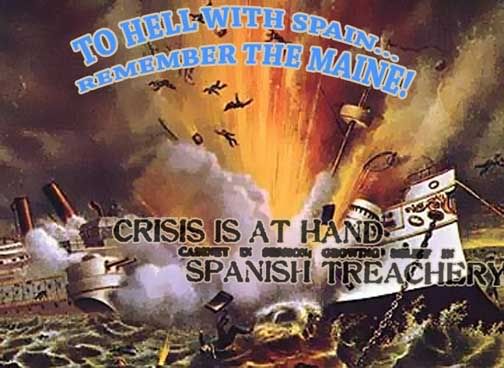
They suggested what they candidly described as a “remember the Maine” incident, the sinking of a U.S. ship in Guantanamo Bay to be blamed on Castro. Mock attacks on U.S. bases by friendly Cubans dressed as Castro forces, the planting of “plastic bombs” in Miami, Washington, and elsewhere, and even the sinking of a boatload of Cuban refugees (“real or simulated”) were mentioned. In fact, a little death would be useful - the report noted that “casualty lists in U.S. newspapers would cause a helpful wave of national indignation.” [6] While they never planned to shoot him down themselves, Northwoods did suggest that, should John Glenn’s space capsule accidentally crash as he attempted the first American orbit of the earth, this could be blamed on Cuba as well. [7]
In all, Northwoods offered dozens of variations on the theme, but the ones regarding aircraft bear a look here. For what it’s worth, all these are neatly contained in pages nine to eleven (that is, 9-11). These received extra attention perhaps because they did not involve deaths at all, simply high-tech aerial acrobats and cynical trickery. Point six, for example, mentions use of “an F-86, properly painted” to simulate a Cuban MIG (Soviet-made) fighter jet, and that “reasonable copies of the MIG could be produced from US resources in about three months.” It mentioned that the “destruction of U.S. military drone aircraft” by these MIG replicas could look convincingly like a Cuban attack. Keep in mind that drone means remote-controlled and pilotless.
Point eight is especially interesting and elaborate. Here is an extended citation (emphasis mine throughout):
“It is possible to create an incident which will demonstrate convincingly that a Cuban aircraft has attacked and shot down a chartered civil airliner en route from the United States to Jamaica, Guatemala, Panama, or Venezuela. The destination would be chosen only to cause the flight plan route to cross Cuba. The passengers could be a group of college students off on a holiday or any grouping of persons with a common interest to support chartering a non-scheduled flight.
a. An aircraft at Elgin AFB would be painted and numbered as an exact duplicate for a civil registered aircraft belonging to a CIA proprietary organization in the Miami area. At a designated time the duplicate would be substituted for the actual civil aircraft and would be loaded with the selected passengers, all boarded under carefully prepared aliases. The actual registered aircraft would then be converted to a drone.
b. Take off times of the drone aircraft and the actual aircraft will be scheduled to allow a rendezvous south of Florida. From the rendezvous point the passenger carrying aircraft will descend to minimum altitude and go directly into an auxiliary field at Elgin AFB where arrangements will have been made to evacuate the passengers and return the aircraft to its original status. The drone aircraft meanwhile will continue to fly the filed flight plan. When over Cuba, the drone will begin transmitting the international distress frequency a “MAY DAY” message stating he is under attack by Cuban MIG aircraft. The transmission will be interrupted by destruction of the aircraft which will be triggered by radio signal. This will allow ICAO radio stations in the Western Hemisphere to tell the US what has happened to the aircraft instead of the US trying to “sell” the incident.”
Points seven and nine also deal with such aircraft-related deceit. These three pages contain several elements of “silly” 9-11 conspiracy theories, even some of the ones I don’t necessarily buy:
- Destruction of remote control drone jets
- Aircraft “rendezvous,” crossing paths to confuse radar and swap drones for manned flights
- Aliases, false paint jobs, and CIA “proprietary companies” to allow pilots, passengers and planes to “disappear”
- Training missions as cover
- Planted evidence of a nonexistent attack
- Manipulated flight data and radio transmissions
- Remote controlled explosives
All of these were presented as real possibilities in a real and proven JCS-sponsored conspiracy. No theory here. The plan suggested the provocations occur “within the time frame of the next few months” and closed with the recommendation that the entire deal be carried out by the Joint Chiefs themselves. [8] After reviewing the memo, Lemnitzer signed it and pitched it to Kennedy’s military representative, General Maxwell Taylor, on March 13, 1962. What exactly happened during the meeting is unknown, but it only took three days for President Kennedy to inform Lemnitzer that the game was over; there was no longer a possibility of overt U.S. force against Cuba. Still the Joint Chiefs persisted, insisting to Defense Secretary McNamara that the war needed to begin soon. McNamara responded by rejecting nearly everything they sent his way. [9]
Within months, Lemnitzer would be denied another term as chairman and transferred to another job. This was not much of a demotion – he was named Commander of U.S. forces in Europe in November 1962 and was appointed Supreme Allied Commander of NATO the following January. [10] He retired from the military in 1969, and in 1975 was selected by President Ford to serve on the Rockefeller Commission, looking into Rockefeller-connected, illegal CIA projects (like the MK Ultra mind control experiments) overseen by his old partner Allen Dulles at the CIA. [11]
But as for Lemnitzer’s own illegal activities - was Northwoods a unique example, or are such “special distribution” recommendations actually common? The report noted on page four “it is assumed that there will be similar submissions from other agencies and that these inputs will be used as a basis for developing a time-phased plan.” [12] It appears that even as far as this “Cuba Project” was concerned, Northwoods was not alone, and they probably knew this from previous experience - its uniqueness therefore may lie not its existence but in its eventual publication.
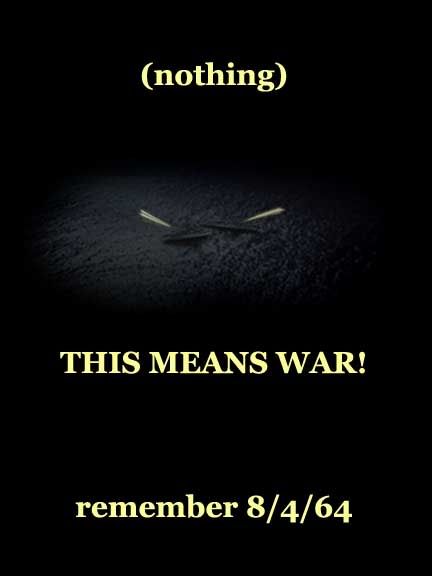
In fact Bamford notes Northwoods as a precedent for events to come. On the subject of the Gulf of Tonkin incident, the August 1964 alleged attack by North Vietnamese forces on American ships that led to direct U.S. involvement in the Vietnam War, he wrote:
“In light of the Operation Northwoods documents, it is clear that deceiving the public and trumping up wars for Americans to fight and die in was standard, approved policy at the highest levels of the Pentagon. […] One needs only replace “Guanantanamo Bay” with “Tonkin Gulf,” and “Cuba” with “North Vietnam.” The Gulf of Tonkin incident may or may not have been stage-managed, but the senior Pentagon leadership at the time was clearly capable of such deceit.” [13]
Bamford described Northwoods as “what may be the most corrupt plan ever created by the U.S. government.” [14] But that’s not to stay it didn’t have stiff competition, nor that other nations at other times have not trumped the JCS, nor that the U.S. itself hasn’t trumped this in the period after the book’s release. To act like Lemnitzer and his people invented such cynical thinking is disingenuous – such deceit is standard operating procedure for politicians and leaders worldwide and throughout history. But this report shatters the belief that America is somehow different, protected by a bubble of Democracy.
The origin of the name “Northwoods” is not clear, but is possibly a reference to the London suburb of Northwood, home of the Permanent Joint Headquarters (PJHQ), the British equivalent of the JCS, possibly indicating a British connection or inspiration. In March 1962, Operation Northwoods was completed, and Lemnitzer signed off on it. The “special distribution” document opened:
”As requested by Chief of Operations, Cuba project, the Joint Chiefs of Staff are to indicate brief but precise description of pretexts which they consider would provide justification for US military intervention in Cuba.” [4]
Wikipedia article on Northwoods
Destabilizing or toppling Castro’s regime and the re-subduction of Cuba was still American policy in general, and Northwoods itself was part of a larger, Kennedy-supported “Cuba Project.” But this report went beyond the pale, promoting harassment and a threatening posture to elicit an attack “since,” the memo states, “it would seem desirable to use legitimate provocation as the basis for US military intervention.” [5] But of course Cuba was not Japan, and Castro was not Tojo, and so the report focused more on the backup plans. These were more cynical than anything FDR or Arthur McCollum, the author of his Japan provocation policy, would have dreamed up - if Cuba failed to be provoked into a “mistake,” the JCS proposed providing a pretext themselves in a false flag operation and blaming Cuba for it.
They suggested what they candidly described as a “remember the Maine” incident, the sinking of a U.S. ship in Guantanamo Bay to be blamed on Castro. Mock attacks on U.S. bases by friendly Cubans dressed as Castro forces, the planting of “plastic bombs” in Miami, Washington, and elsewhere, and even the sinking of a boatload of Cuban refugees (“real or simulated”) were mentioned. In fact, a little death would be useful - the report noted that “casualty lists in U.S. newspapers would cause a helpful wave of national indignation.” [6] While they never planned to shoot him down themselves, Northwoods did suggest that, should John Glenn’s space capsule accidentally crash as he attempted the first American orbit of the earth, this could be blamed on Cuba as well. [7]
In all, Northwoods offered dozens of variations on the theme, but the ones regarding aircraft bear a look here. For what it’s worth, all these are neatly contained in pages nine to eleven (that is, 9-11). These received extra attention perhaps because they did not involve deaths at all, simply high-tech aerial acrobats and cynical trickery. Point six, for example, mentions use of “an F-86, properly painted” to simulate a Cuban MIG (Soviet-made) fighter jet, and that “reasonable copies of the MIG could be produced from US resources in about three months.” It mentioned that the “destruction of U.S. military drone aircraft” by these MIG replicas could look convincingly like a Cuban attack. Keep in mind that drone means remote-controlled and pilotless.
Point eight is especially interesting and elaborate. Here is an extended citation (emphasis mine throughout):
“It is possible to create an incident which will demonstrate convincingly that a Cuban aircraft has attacked and shot down a chartered civil airliner en route from the United States to Jamaica, Guatemala, Panama, or Venezuela. The destination would be chosen only to cause the flight plan route to cross Cuba. The passengers could be a group of college students off on a holiday or any grouping of persons with a common interest to support chartering a non-scheduled flight.
a. An aircraft at Elgin AFB would be painted and numbered as an exact duplicate for a civil registered aircraft belonging to a CIA proprietary organization in the Miami area. At a designated time the duplicate would be substituted for the actual civil aircraft and would be loaded with the selected passengers, all boarded under carefully prepared aliases. The actual registered aircraft would then be converted to a drone.
b. Take off times of the drone aircraft and the actual aircraft will be scheduled to allow a rendezvous south of Florida. From the rendezvous point the passenger carrying aircraft will descend to minimum altitude and go directly into an auxiliary field at Elgin AFB where arrangements will have been made to evacuate the passengers and return the aircraft to its original status. The drone aircraft meanwhile will continue to fly the filed flight plan. When over Cuba, the drone will begin transmitting the international distress frequency a “MAY DAY” message stating he is under attack by Cuban MIG aircraft. The transmission will be interrupted by destruction of the aircraft which will be triggered by radio signal. This will allow ICAO radio stations in the Western Hemisphere to tell the US what has happened to the aircraft instead of the US trying to “sell” the incident.”
Points seven and nine also deal with such aircraft-related deceit. These three pages contain several elements of “silly” 9-11 conspiracy theories, even some of the ones I don’t necessarily buy:
- Destruction of remote control drone jets
- Aircraft “rendezvous,” crossing paths to confuse radar and swap drones for manned flights
- Aliases, false paint jobs, and CIA “proprietary companies” to allow pilots, passengers and planes to “disappear”
- Training missions as cover
- Planted evidence of a nonexistent attack
- Manipulated flight data and radio transmissions
- Remote controlled explosives
All of these were presented as real possibilities in a real and proven JCS-sponsored conspiracy. No theory here. The plan suggested the provocations occur “within the time frame of the next few months” and closed with the recommendation that the entire deal be carried out by the Joint Chiefs themselves. [8] After reviewing the memo, Lemnitzer signed it and pitched it to Kennedy’s military representative, General Maxwell Taylor, on March 13, 1962. What exactly happened during the meeting is unknown, but it only took three days for President Kennedy to inform Lemnitzer that the game was over; there was no longer a possibility of overt U.S. force against Cuba. Still the Joint Chiefs persisted, insisting to Defense Secretary McNamara that the war needed to begin soon. McNamara responded by rejecting nearly everything they sent his way. [9]
Within months, Lemnitzer would be denied another term as chairman and transferred to another job. This was not much of a demotion – he was named Commander of U.S. forces in Europe in November 1962 and was appointed Supreme Allied Commander of NATO the following January. [10] He retired from the military in 1969, and in 1975 was selected by President Ford to serve on the Rockefeller Commission, looking into Rockefeller-connected, illegal CIA projects (like the MK Ultra mind control experiments) overseen by his old partner Allen Dulles at the CIA. [11]
But as for Lemnitzer’s own illegal activities - was Northwoods a unique example, or are such “special distribution” recommendations actually common? The report noted on page four “it is assumed that there will be similar submissions from other agencies and that these inputs will be used as a basis for developing a time-phased plan.” [12] It appears that even as far as this “Cuba Project” was concerned, Northwoods was not alone, and they probably knew this from previous experience - its uniqueness therefore may lie not its existence but in its eventual publication.
In fact Bamford notes Northwoods as a precedent for events to come. On the subject of the Gulf of Tonkin incident, the August 1964 alleged attack by North Vietnamese forces on American ships that led to direct U.S. involvement in the Vietnam War, he wrote:
“In light of the Operation Northwoods documents, it is clear that deceiving the public and trumping up wars for Americans to fight and die in was standard, approved policy at the highest levels of the Pentagon. […] One needs only replace “Guanantanamo Bay” with “Tonkin Gulf,” and “Cuba” with “North Vietnam.” The Gulf of Tonkin incident may or may not have been stage-managed, but the senior Pentagon leadership at the time was clearly capable of such deceit.” [13]
Bamford described Northwoods as “what may be the most corrupt plan ever created by the U.S. government.” [14] But that’s not to stay it didn’t have stiff competition, nor that other nations at other times have not trumped the JCS, nor that the U.S. itself hasn’t trumped this in the period after the book’s release. To act like Lemnitzer and his people invented such cynical thinking is disingenuous – such deceit is standard operating procedure for politicians and leaders worldwide and throughout history. But this report shatters the belief that America is somehow different, protected by a bubble of Democracy.
Subscribe to:
Posts (Atom)