Showing posts with label 9/99. Show all posts

Thursday, September 11, 2008

TERROR OF 9/99 {masterlist}

This post is to organize all those related to the "Terror of 9/99," the series of apartment bombings in Russian cities in 1999 that triggered the Second Chechen War and paved the way of Vladimir Putin to the Presidency. Since the beginning, Putin's career has been shadowed by widespread suspicion that Putin or an ally, not Chechen terrorists, was actually behind the bombings. like the hardcore 9/99 Truthers, I believe the Russian state was behind the campaign, though the full story is certainly more complex. I sense weird forces at work.

Notes on terminology/weird thoughts about weird coincidences:
9/99 is itself not a universally accepted name for the episode, but I took it up due to its catchiness and similarity to the branding of 9/11, which helps me illustrate my argument about that event. I first saw the term on the English-language Russian site Terror-99. I'm not sure, but I would guess that this site excellent and damning website is supported by Boris Berezovsky and other questionable anti-Putin characters - so while their facts seem fairly solid and the case itself is remarkably easy to make, I question their true motives. I also got a bit of a chill one day when I realized recently that 9/99 upside down is 666, the mark of the Beast. I don't believe in such nonsense, but many others do, and some have gone to pains to avoid the branding. Wikipedia's "Russian Apartment Bombings" page mentions the number "9/99" only in the sources, referring to the above website. A Google search of "9/99" shows a few sources, including me, and "terror of 9/99" reveals only Terror99.ru and myself. (Gulp). I'm on Putin's radar with the illicit inverted 66/6.

But what else could he expect? A series of bombings with 300 dead as they slept, dated 9/4, 9/9, 9/13, and 9/16 - with no precise date, we could pick the midpoint between the two middle bombings (which is reasonable since these happened in the capital and killed the most) - but that gives us 9/11, which doesn't have the same emergency implications as it does in America and it was left unused for the Americans' use two years later. But it wasn't about a single day, but rather a month, that bleak and nervous September as block after block was demolished - Black September 1999 - the Terror of 9/99 on the precipice of the Millenium. Some say it was Putin's 666 devil deal for power, the most logical name for it has that built right in, and if he did it himself, he had to have known this would happen. Couldn't it have waited 'till October?

Oh well - I guess as in America people see what they want to - those predisposed to see fire and horns see that, the rest who can't stomach the thought and face the obvious would argue Putin couldn't or wouldn't do that. Facts are of secondary nature to such strongly held beliefs and rarely can do much to change them. But it's worth a try.
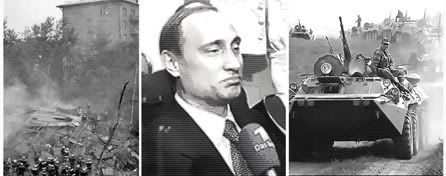

Aftermath of 9/13 in Moscow, New President Putin resolute in January, Russian troops re-enter Grozny in October - kind of the wrong order I guess but you get the picture.

Wikipedia entry: Russian Apartment Bombings. They cite September 8 for the first bombing in Moscow, but I stick to the date from the Terror 99 site, which is from Russian Primary sources. Plus 9/8 throws off the spooky 9/11 hinge point.

- 9/99 part I: Putin's Godsend

- 9/99 part II: The Ryazan Incident - The Bombing that didn't Happen?

- 9/99 part III: The Investigation - The official investigation, PR campaign, the Kovalev Commission, its supporters, and its troubles. people die here.

- 9/99 part IV: The Conspiracy Theory - an "independent" investigation formed in London, pushed by exiled oligarchs, KGB/FSB defectors, and US Seantors. More people die here, and Europe is thrown into a subcontinent-wide radiation scare.

Wednesday, December 27, 2006

9/99 part II: THE RYAZAN INCIDENT

The deadly string of apartment block bombings could have been worse. Amid this climate of crisis, on September 22 at 9:15 pm, an alert citizen of Ryazan coming home from work watched three people load several large bags of powder from a mysteriously marked car into the basement of his apartment building. He called it in to local police, and the Interior Ministry's UVD division in Ryazan confirmed the worst fears – the bags were filled with the explosive Hexogen, which had taken out the other buildings, and connected to a timer set to spark at 5:30 am. They evacuated the building and defused the bomb without incident, and the near-miss was all the buzz on the morning of the 23rd. This time the car was seen, its passengers identifiable, and the hunt for suspects was on. By the 24th they were reported as cornered, their car found and arrests imminent. [1]

Curiously, new FSB chief Patrushev revealed on the 24th that the bags had contained only sugar and had been planted as a readiness drill to see if people would catch the next attack in time. It was perhaps a ill-advised in its timing, but it was only a drill, and they found the sugar and succeded splendidly. Give yourselves a pat on the back. Of course since the ‘drill’ was an FSB operation, the Chechen "terrorists" who unloaded the bags were actually just FSB employees and so went unmolested as the government closed its case. FSB spokesman Alexander Zdanovich led the media campaign to explain away the incident as the official inestigation confirmed the official story and the official suspects were dragged before a kangaroo court and convicted.

FSB officers went to the building the "drill" was run on: one woman said "several people from the FSB came to see us, led by a colonel. They apologized. They said that they hadn't known anything either." [2] But the FSB later rebuffed lawsuits by people who had heart attacks and suffered long-term stress from the scare. Officially, the Ryazan incident, first framed as a failed attack, has been largely erased. For example, the Wikipedia article sites the duration of the September bombing spree as two weeks - Sept. 4-16. Ryazan is thus not part of it.

On the 23rd, as it still looked like terrorism and with the first air raids commencing in Chechnya, PM Putin stated about the failed "attack:” “As for the events in Ryazan, I don't think there was any kind of failure involved. […] This is absolutely the correct response. No panic, no sympathy for the bandits. This is the mood for fighting them to the very end. Until we win. And we shall win.” [5] He knew by then to start hinting at a readiness drill, but to still keep it vague enough to appear as maybe-terrorism to feed the all-important war drive, which would partly bury the following day's FSB "admission" long enough to let it get obscured beneath the official investigation.

Sources:
[1] Reynolds, Maura. “Ryazan Fears Darker Truth of Bombings.” The Moscow Times. January 18, 2000.
http://eng.terror99.ru/publications/013.htm
[2] “The Ryazan Story.” Excerpts from "Blowing Up Russia: Terror from Within" by Yuri Felshtinsky and Alexander Litvinenko
http://eng.terror99.ru/publications/080.htm
[3] Borisova, Yevgenia. "No Proof Chechens Blew Up Buildings." Moscow Times. March 17, 2000. http://www.cdi.org/russia/johnson/4174.html
[4] See [3]
[5] See [2]

Saturday, December 2, 2006

9/99 part I: PUTIN'S GODSEND

Vladimir Vladimirovich Putin
During the latter phase of the Cold War, Vladimir Vladimirovich Putin was a loyal patriot and Party member, a dedicated KGB agent stationed in East Germany. Charged with recruiting spies to steal NATO secrets, his tenure there only ended with East Germany itself. He then went back to Russia and later resigned his KGB post to protest the August 1991 coup against Gorbachev, casting his lot with the premier’s reforms and thus the future. A devout atheist all during the Soviet years, after the Union fell he promptly adopted Russian Orthodox Catholicism. This was not politics but divine intervention; he and his illicit but meaningless aluminum crucifix together survived a small fire sometime in the early 1990s, clearly a miraculous sign.

He adapted himself in other ways, serving quietly and efficiently in the Post-Communist government of his hometown, St. Petersburg, promoting international relations and foreign investment. In 1996 the promising technocrat was summoned to Moscow to serve in the national government. After two years of proving himself at various posts in Yeltsin’s second administration, Putin took the lofty appointment of director of the Federal Security Service of the Russian Federation (FSB, for Federal'naya Sluzhba Bezopasnosti), successor to the Russian KGB, which had fallen on hard times.

After helping revive the FSB, in 1999 he added another job title to his resume - head of the Security Council, an office of the President’s that “drafts policy proposals on defending the vital interests of individuals, society and the state against internal or external threats.” Putin worked diligently to keep Russians safe, drafting proposals on how to deal with, for example, the problem of Chechnya (at the time de facto independent after the First Chechen War of 1994-96), while overseeing the FSB’s efforts to prevent, for example, Chechen terrorism. He had to resign both posts, on Yeltsin’s orders, with Nikolai Platonovich Patrushev taking his place at FSB. He was not being sacked, of course, but promoted to head his own government; on August 9, Putin switched over to the Kremlin to become Prime Minister of the Russian Federation. But as the fifth prime minister in a year-and-a-half of economic and political chaos, his chances of political survival seemed slim.

But then something happened - Just as Putin was being sworn in, Muslim militants from Chechnya invaded the neighboring region of Dagestan (on Russia’s Caspian coast) and less than a month after he left it, the FSB proved unable to prevent the war from coming home. A wave of sophisticated, powerful bomb attacks rocked Russia; the worst were apartment bombings in Moscow on September 9 (9/9/99) on Guryanov Street, killing 94, and on Kashirskoye Shosse on the 13th, killing 119. Along with an earlier bombing on the 4th in Dagestan (at Buinaksk, which also suffered a second bombing on the 13th) and a later one on the 16th at Volgodonsk, just over 300 lives were terminated beneath concrete slabs as they slept and many thousands were injured or emotionally traumatized. A nation of millions was shocked and enraged; it was Russia’s mini-9/11, but with no exact date it became known as 9/99 for the month and year of the attacks.

Yeltsin and Putin solidified their power base by taking a firm and simple stand – bombs began falling on Chechnya on September 23, a week after the Volgodonsk attack and the day of a foiled sixth bombing at Ryazan (later deemed a training mission when it was revealed that FSB personnell were responsible). The ground invasion of the southern republic began on the last day of September, a fierce renewal of the previous war set to re-claim Chachnya for Moscow and gave Putin a support base as a hard line defender of Russians from terror, boosting his popularity immensely.

While not formally associated with any party, he was supported by the newly formed Edinstvo (unity) party, which won the most seats in the Duma elections of December 1999. Yeltsin, in failing health and falling popularity, saw that the leadership was strong and had the support of the new Duma, and so stepped down and appointed Putin Acting President on December 31, 1999. Once confirmed by election in March 2000, Putin officially became the second President of the Post-Soviet Russian Federation, a remarkably swift rise to power to announce a very interesting turn of the century.