Adam Larson / Caustic Logic
May 3 2009
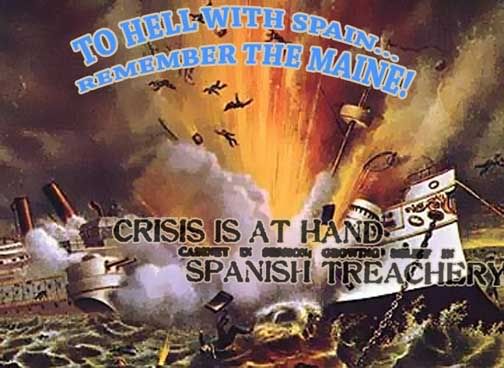
In the process of fleshing out my previous thoughts on the USS Maine incident, this post will serve to gather some clues to fill in the "war games" angle. I'd only caught a glimpse of this before in a book by G.J.A. O'Toole, but it left me noticing how the "splendid little war" had been planned out at least two years in advance of the fortuitous pretext blasting its way into history. In my 2006 barely-researched essay I wrote in part:
In 1896, the recently created Office of Naval Intelligence drafted a plan should war with Spain be ignited over these developing issues. The plan recommended simultaneously attacking Spanish colonial holdings in the Philippines and in the Caribbean. The conclusion, apparently, was that the U.S. would win handily and could easily seize these strategic possessions.
[...]
[T]he gears kept turning at the Navy, under Secretary John Long and his assistant Secretary Theodore Roosevelt; by the end of June, the Navy had adopted the 1896 war plan. In August, Long went on vacation, leaving Roosevelt at the helm. President McKinley invited Teddy for at least two personal discussions, at which time the acting Secretary acquainted the President with the ONI’s suggestions. McKinley was apparently impressed with both Teddy and the plan.
[...]
I would note that it was a well-timed accident that the Maine should blow up, of all times and places, right after it had docked in soon-to-be-enemy waters for murky reasons, allowing that two-year-old plan to go into effect to the great benefit of U.S. policy.
So with this hint at what I'm looking for details regarding, here are some credible sources adding light to that dim awareness:
“After the renewal of the Cuban insurrection in 1895, officers of the Navy War College and the Office of Naval Intelligence drew up and then revised a series of war plans for the fleet in case the United States and Spain went to war. All three major parties endorsed freedom for Cuba during the election campaign of 1896, and the Spanish government would not end its pacification campaign or negotiate away its colonies, hence this planning was prudent. While President William McKinley and the State Department attempted to come to terms with Spain, a Navy War Board of five senior officers reviewed and revised the basic plan drafted in 1896. Essentially, the Navy War Board envisioned offensive operations against the Spanish fleet in the Caribbean and in the western pacific near another Spanish colony, the Philippine Islands. A defeat in the Caribbean would isolate Cuba and blockade the Spanish armies in Cuba and Puerto Rico, while a victory in the Philippines would allow the American government to hold Manila hostage until a peace was negotiated.” [2]
“Although the Navy War Board did not plan any specific operations to seize temporary bases, its plan implied that such actions might be necessary. In any event, by the end of 1897 the Navy Department had a fairly accurate vision of its responsibilities in 1898.” [3]
"When the Cuban insurrection broke out the following year, the officers in charge at the Naval War College believed that it was important to undertake a full-scale study of a Spanish-American conflict. They gave the class of 1895 a "special problem" concerning war with Spain where the objective was to secure independence for Cuba. The plan [was] submitted to the Navy Department in January 1896 [...] The Office of Naval Intelligence entered the planning effort later in 1896. Lieutenant William Kimball prepared a plan that focussed on a tight naval blockade of Cuba [...] supporting attacks against Manila and the Spanish coast [...] According to Kimball's plan, only if these efforts failed to bring about peace, would the army land in Cuba and operate against Havana. The Naval War College criticized the plan [but] endorsed the idea to use the Asiatic Squadron against Spanish forces in the Philippines, and this element would reappear in later plans.
[...]
Secretary of the Navy Hilary Herbert [convened] a board in the summer of 1896 to draft a separate plan for war with Spain. Like the Kimball plan, the Ramsay Board focused on the a naval blockade, but added the deep water ports of Puerto Rico to those of Cuba. [more details...] Finally, the European Squadron should be reinforced by ships from the U.S. and the Asiatic Squadron, and together operate against the Spanish coast after capturing the Canary Islands as an advance base.
[...]
Perhaps confused by the different positions in the existing plans, the new Secretary of the Navy, John Long, convened his own War Planning Board under Commander in Chief of the North Atlantic Station, Rear Admiral Montgomery Sicard, in June 1897. Chief Intelligence Officer Lieutenant Commander Richard Wainwright was the only member who had served on the previous board. The Sicard Board endorsed the War College idea that joint operations against Havana would be necessary to end the war. Therefore, the plan called for the early seizure of Matanzas, sixty miles east of Havana, to serve as a base of operations against the latter, and to deliver arms to the Cuban insurgents.
[...]
When war between the United States and Spain appeared unavoidable following the destruction of USS Maine in Havana harbor on 15 February 1898, the Navy Department had a solid body of plans and documents honed by four years of debate by its leading officers. Although the realities of war would force several modifications, many of the concepts laid out in the Sicard Plan were implemented
[...]
[N]early every plan called for the purchase or charter of merchant vessels to serve as auxiliary cruisers, colliers, and transports. The data furnished in appended lists and the inspiration to act quickly served as a basis for decision making in those crucial weeks prior to war. [...] The destruction of the Maine propelled the department into action. Assistant Secretary of the Navy Theodore Roosevelt organized a Board of Auxiliary Vessels [...] On 9 March Congress passed a $50 million emergency defense appropriation bill, and the Navy Department began to acquire vessels. [4]
"Roosevelt and his expansionist friends, led by Senator Henry Cabot Lodge, lobbied successfully for his appointment as Assistant Secretary of the Navy after McKinley's victory in 1896--despite McKinley's views that TR was too pugnacious. Coming to office several years into the Cuban insurgency, TR's top priority was expelling Spain from the Americas, but he had to contend with a variety of naval war plans on how to do it. In the event of war, the Office of Naval Intelligence advocated an attack on not only Cuba but also the Philippines to force a Spanish war indemnity and to tie down their fleet. The Naval War College planned for a defensive coastal war if Britain joined Spain in defending Cuba, but an attack against Spain itself if Britain stayed out. Typically, TR favored the most aggressive option--attacking Spanish forces more or less everywhere." [5]
“In 1896-97, [ONI] chief intelligence officer Lt. Comdr. Richard Wainwright, and his staff officer Lt. William W. Kimball, expanded a war plan begun at the Naval War College […] Wainwright also sent Lt. Comdr. George L. Dyer in 1897 as the first full-time U.S. naval attaché to Madrid. Wainwright collaborated closely with the Assistant Secretary of the Navy Theodore Roosevelt in developing clandestine U.S. war preparations, the secret purchase of armaments and warships overseas, and development of a spy network in Europe. Roosevelt corresponded with naval attachés Lt. Comdr. John C. Colwell in London and Lt. William S. Sims in Paris. Colwell and Sims operated a string of civilian spies with a “Secret Service Emergency Fund” sent directly by Assistant Secretary of the navy Roosevelt, probably without the knowledge of either the secretary of the navy or the president.” [6]
!!!
Sources:
[1] O'Toole, G.J.A. The Spanish War: An American Epic 1898. New York. WW Norton. 1989. Pages 100-102.
[2] Millett, Allan Reed. Semper Fidelis: The History of the United States Marine Corps. Simon and Schuster, 1991. p.128 Google Books.
[3] Ibid. p 129.
[4] Hayes, Mark L. War Plans and Preparations and Their Impact on U.S. Naval Operations in the Spanish-American War. Early History Branch, Naval Historical Center. Paper presented March 23 1998.
[5] Parker, Tom The Realistic Roosevelt. The National Interest, Fall 2004.
[6] Beadle, Benjamin R., ed. The War of 1898 and U.S. Interventions, 1898-1934: An Encyclopedia. Google Books p 235.