Showing posts with label Japan. Show all posts

Thursday, April 2, 2009

THE VACANT SEA: ON FDR'S ORDER?

Adam Larson / Caustic Logic
The 12/7-9/11 Treadmill and Beyond
April 2 2009


THE BLIND ALLEY
To the north of Hawaii is a broad band of the Pacific running roughly east-west, that by some combination of commerce, weather, and oceanography, was little-enough traveled to become known as the “the Vacant Sea.” So long as it stayed empty, it was no problem - but if it suddenly was occupied by a hostile enemy, there may be no one else there to spot them in advance. It was a blind-spot in Hawaii's defense. As Maj Gen Sherman Miles, the Army’s head of intelligence, told the Congressional Pearl Harbor investigation:
“Of course we had had information for a great many years which had been considered in all our war plans in Hawaii that there was a certain part of the Pacific Ocean that we called the ‘Vacant Sea’ in which there were practically no ships and in which large movements of ships could occur without anybody seeing them.” [1]

An article by Miles published in the Atlantic Monthly reported in 1948 how this channel “through which an attacking force could approach Hawaii undetected, had been marked down in our defense studies.” [2] But studies can only so far, and surveillance - surface or aerial - only so much further. As one of Randall Wallace’s characters (based on no one in particular I know of but included in the 2001 movie) said, if he were a Japanese planner, he’d hit the Pacific Fleet at Hawaii via that blind alley; “You could hide the entire land mass of Asia in the Vacant Sea, and nobody would know.” [3] Indeed, in December 1941 no one we know of saw the Kido Butai - a strong Japanese task force with six aircraft carriers and two dozen accompanying vessels - cross the vacant sea, hover north of Hawaii, then swoop south. Nothing but radar was watching the north side of the islands, and that didn’t see anything until the planes were airborne and halfway there.

IT’S A CONSPIRACY!
This reverse buffer was engineered, says revisionist Don Quixote Robert Stinnett, by none other than President Roosevelt, specifically to allow that very Japanese strike. In his unusual estimation, the vacant sea was not an accident of long-term circumstance, but a narrowly enforced directive from Washington:
“Navy officials declared the North Pacific a “vacant Sea” and ordered all US and allied shipping out of the waters. […] The Vacant Sea order dramatized Admiral Kimmel’s helplessness in the face of FDR’s desires.” [4]

Other aspects of Stinnett’s case have it that the president and top naval officers knew full well every worthwhile detail of the planned strike, including its course (based on the breaking of the main naval code, which did not actually occur). So it would seem highly suspicious that in this climate they issued an order on November 25, “about an hour” after the Kido Butai set sail on its fateful mission into the “vacated sea.” [5] Stinnett cites as supporting evidence Rear Admiral R.K. Turner, the Navy’s director of war plans at the time, later telling investigators “we were prepared to divert traffic when we believed war was imminent. We sent the traffic down via Torres strait, so that the track of the Japanese task force would be clear of any traffic.” [6] Stinnett seems to take this “startling admission” for a reference to the Pearl Harbor task force – startling indeed that Turner would so slip, when all other officials have denied any prior knowledge of that prong. We'll get back to how that's wrong in a moment.

There is nothing aside from Stinnett to support this interpretation of events – he acknowledges that all ten investigations so far have “ignored” this vital clue, and all sources I find online mentioning a “vacant sea order” refer back to him, if to anything. The notion finds little support from logic – the implication is this lane was usually bustling with eyes until ordered clear. Yet the order was only given after the force set sail, leaving one wondering what the planners in Tokyo had been thinking up until that lucky break. But he has the November 25 order mentioning Torres, and Turner's affirmation this was to avoid a “task force.” So no matter what other investigators can’t or won’t confirm, and no matter the logic of it, the evidence proves it true, right?

THE FIRST ONES CLEARED: PACIFIC FLEET
There is no document Stinnett has unearthed “declaring” the North Pacific an empty area, or “ordering” it to be vacated. Rather he finds clues, the most intriguing of which is the cancellation of an exercise of the Pacific Fleet, an eerily prescient one ordered by Admiral Kimmel, which I learned of in Stinnett’s book and, unfortunately, nowhere else.

He cites some CinCPAC papers for the details, and refers to it as Exercise 191, carried out on Sunday November 23, and cancelled early on request from Washington, Stinnett explains. He cites a known dispatch of November 24 from Navy Operations citing a threat of “hostile action in any direction” and urging “utmost secrecy” and nothing at all to precipitate problems in the “tense situation.” The scuttled operation was reportedly set in the waters north of Hawaii, quite a ways from the fleet’s normal operating area, practicing surveillance and detection of a Japanese force approaching through the Vacant sea lane. This order for "recall of the Pacific Fleet from the North Pacific" was among the prime failures that allowed the attack two weeks later. [7]

Stinnett offers details of Kimmel’s thoughts, ship maneuvers performed, the flag code system used, and other details. I have yet to see any corroboration – Layton’s book should certainly mention this but didn’t, that I noticed. I could find nothing in At Dawn We Slept. Stinnett himself admits neither Admiral Kimmel nor his family seemed to remember this episode either. [8] This certainly seems an elaborate episode to have simply fabricated, and I haven’t written it off just yet, but close.

AROUND THE ORANGE ISLANDS
The main point I can confirm is that the Navy did issue an order November 25 routing Pacific traffic to the south. This is available online as part of Joint Committee exhibits 9-43, parts poorly scanned (investigating the PEABL HAEBOE ATTACK) – a series of communications from October and Novemeber between Navy operations/CNO Stark (OPNAV), Kimmel (CINCPAC), Adm Hart (CINCAF) Naval Districts 12 (SF), 14 (HI), and 16 (Philippines), and others. [9 – source for all dispatches quoted below]

The alternate route in question was first outlined in mid-October by Naval Operations for traffic already southeast-bound (destined for, or coming from the “Far East area,” Shanghai, India and “East India area”) to keep this traffic “to the southward and well clear of Orange [Japanese] mandates taking maximum advantage of Dutch and Australian patrolled areas.” [see graphics] This order was about getting around the extensive area of small Islands mandated to Japanese control after World War I. It would affect traffic to Guam, the Philippines, Thailand, and so on, not the sparse traffic headed to or from north Japan and northeast Asia.
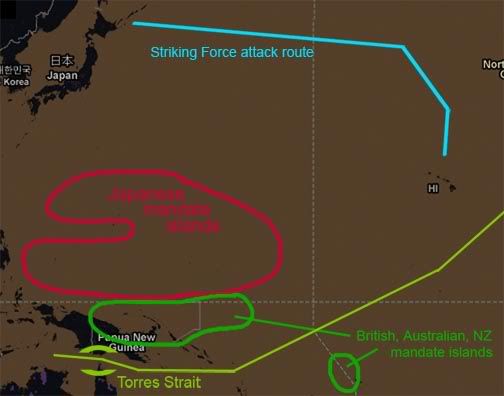
It proved a controversial order, and in about a month complaints started appearing. A request from Kimmel came through on November 22 about “conflicting routings,” looking for permission for a different route to Guam due to “limited fresh water radius.” This was answered by Stark the following day, reiterating “routes south of mandates means through Torres Straits.” The 23rd also saw concern from Com 12 (SF) to the CNO about planned troop movements:
“Department dispatches apparently do not take cognizance of magnitude of Army troop movement directed by War Department from San Francisco by December 10 involving about 22 vessels including largest liners. […] In view reports Japanese patrolling this area believe it vulnerable. Subject to further study believe routing south about Australia impracticable. If troop movement must be made at this time recommend great circle course to San Bernardino Strait with adequate fleet protection.” [emph mine]

This patroling of the Torres area was reported by Stark on the 21st (also included on the page), but Com 12's concerns triggered by it were again answered by Stark with an affirmation of the selected detour, in the form of the November 25 dispatch Stinnett cited so disjointed from all context. It was info addressed to CINCPAC, CINCAF, COM 14, COM 16, and stated simply “Route all transpacific shipping thru Torres Straits. CINCPAC and CINCAF provide necessary escort.”

Quit your complaining, everyone goes through Torres, seems to be the gist. So the Torres diversion appears supported by the evidence and proves interesting in itself. While Stinnett draws attention to the first line of that last order, Percy Greaves, involved with research for the Congressional committee’s minority report, drew attention to the second. He passed on this exchange between his colleague Sen. Ferguson and one Admiral Inglis:
Senator FERGUSON: Now, I will ask you why you did not put in the part that was to provide for escorts.
Admiral INGLIS: I think that was perhaps omitted by my staff because it might have been somewhat controversial.
Senator FERGUSON: You think that this part of the message is controversial, "providing necessary escort"?
Admiral INGLIS: It might lead to controversy because of the word "necessary." There might be a difference of opinion as to ships for escorts as opposed to the need for keeping them concentrated for combat.
[10]

Whatever possible interest there may be in this story, it does not work towards the end it was employed to by Mr. Stinnett. Considering again Turner’s quote about claring the path of a Japanese task force, it’s fairly clear what’s going on here. The southward prongs of japan’s massive attack were known of, and were largely centered in the Mandate Islands. The re-routing through Torres was for traffic set to head through the mandates, not for traffic to the north of Hawaii, nor to clear the path of an unknown task force up that way. There was no need to vacate the vacant sea, and Stinnett has been shown to be “painting us a picture.”

TEST CASE: THE URITSKY
Layton’s book says nothing about exercise 191 or a “vacant sea order,” and I haven’t checked yet on any opinions of the Toerres routing. But it does pass on an obscure episode that openly defies Stinnett’s case. Layton and/or his co-authors cite Japanese military sources for a concern on November 25 over “a Soviet merchant ship bound from San Francisco to the Far East” that was believed on course to cross the Kido Butai's path and perhaps spoil the surprise. It was apparently a concern only, and such a fateful meeting was avoided. [11]
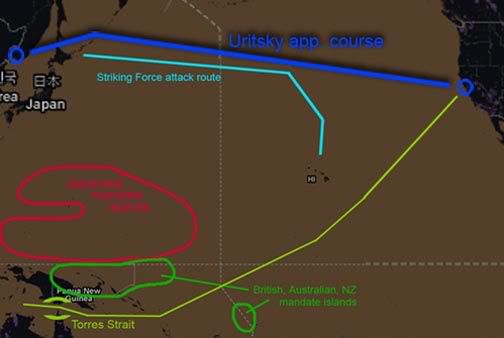
Further research indicated this was almost certainly the Uritsky, which started the journey November 25, interestingly, loaded with US leand-lease military hardware, en route to Vladivostok to help in the pitched fight against Nazi invaders. The book presents questions about who told who about this route, leading to a “deduction” that the Soviets alerted Tokyo to this planned passage. This in turn leads the authors to a “logical assumption that Soviet intelligence knew precise details of the course to be taken across the Northern Pacific by Nagumo’s striking force!” [12] Or, they knew they’d have to pass around the Japanese Kuriles before reaching home port, and were putting in a friendly heads-up to avoid any possible troubles anywhere along the way. [see graphics]

In short, we have a case of one of those rare vessels actually traveling the vacant Sea in that key period, and the supposed order to clear the area had no effect on it. Either there was no such order, or it could not be enforced on the Soviets, but it was only luck and/or nimble planning on the Japanese side that avoided a likely sighting.

Sources:
[1] Prange, Gordon W., with Donald M. Goldstein and Katherine V. Dillon. At Dawn We Slept: The Untold Story of Pearl Harbor. . 2001 edition. Penguin. P 424. 
[2] Miles, Sherman. Pearl Harbor in Retrospect. The Atlantic Monthly. July 1948.
Online posting
[3] Wallace, Randall. Pearl Harbor (early)
Link.
[4] Stinnett, Robert. Day of Deceit: The Truth About FDR and Pearl Harbor. First Touchstone edition, 2001. pp. 144-145.
[5] Stinnett. p. 145. 
[6] Stinnett. p. 144. 
[7] Stinnett. p. 156. 
[8] Stinnett. p. 145. 
[9] Part 14 - Joint Committee exhibit nos 9 through 43. Hearings Before the Joint Committee on the Investigation of the Pearl Harbor Attack. 1945/46. Online posting. 
[10] Greaves, Percy L., jr. Senator Homer Ferguson and the Pearl Harbor Congressional Investigation. Institute for Historical Review. Online posting.
[11] Layton, Edwin T., with Roger Pineau and John Costello. "And I Was There" Pearl Harbor and Midway - Breaking the Secrets. New York. Quill. 1985. Pp. 220-221.
[12] Ibid.

Wednesday, March 25, 2009

A "RESTRAINING" INFLUENCE

Adam Larson / Caustic Logic
The 12/7-9/11 Treadmill and Beyond
March 25 2009
Last update 4/2


WINDOW DRESSING
As outlined in a previous post, as of mid-1940, a “strong attitude” towards Japan was thought in Washington a useful means to deter further Asian or Pacific adventures. As also discussed there, Adm J.O. Richardson, Commander-in-Chief US Fleet (CinCUS), had been told that the Navy was to act out this attitude, and that the Pacific Fleet’s retention at Hawaii was part of this bit of theater. But being on the stage rather than behind it gives him more credibility, and this clout was staked on his finding this deterrent policy wrong-headed should have caused second thoughts in the Capitol. It apparently did not.

The posture of keeping the Fleet much nearer Japan was perhaps first explained in a May 27 letter from Chief of Naval Operations Harold Stark to Admiral Richardson in Hawaii, who called it "one of the most direct replies to any of my letters to him, although it was far from being as definitive as I would have liked:"
“Why are you in the Hawaiian area? Answer: You are there because of the deterrent effect which it is thought your presence may have on the Japs going into the East Indies. In previous letters I have hooked this up with the Italians going into the war. The connection is that with Italy in, it is thought the Japs might feel just that much freer to take independent action.”

Whatever its possible political impact, the posture was “valueless from the hard realities of war,” in Richardson’s mind, although it was was played out with the tools and personnel of war. In his 1958 memoirs he lamented that this “window dressing” was “assigned great weight” by the brains In Washuington [2], and labored to explain why it was wrong, starting with this banal observation:
“In my discussions in Washington, both within the Navy department and within the White House, it was constantly asserted that the presence of the fleet in Hawaiian waters was exerting a restraining influence on the Japanese. […] the statement might have had a factual basis […but...] it has always seemed odd to me that such an affirmative statement had not been made in the intervening years by some Japanese military officer occupying an important position in the Japanese governmental structure during this period.” [3]

The interpretation offered in an obscure Army history work on coalition warfare seems to offer two clues:
“The US Fleet […] received orders to remain at Pearl Harbor […] with the purpose of dissuading the Japanese Government from moving southward […] The War Department staff believed that a show of strength in the Pacific might be taken by the Japanese Government as an occasion to open hostilities. On this ground the Army planners strongly objected to leaving the Pacific Fleet at Pearl Harbor. […] The retention of the fleet in the Pacific might cause Japanese leaders to review and revise their plans, but it would act as a deterrent “only as long as other manifestations of government policy do not let it appear that the location of the fleet is only a bluff.” [4 – emph mine]

Richardson cited at least one example that’s exactly what was being allowed to appear - a mid-1940 Navy decision to recall all possible aviators from Pearl for further training in Florida. This left the islands and the fleet with even weaker aviation abilities, and it was done in the open. “Since this information […] was bound to become known to Japanese intelligence activities,” he surmised, “it was a sure giveaway to the Japanese that the U.S. governmental positioning of the fleet in Hawaii was one of bluff, and not of early combative action.” [5 – emph mine]

Stationed on a lonely string of rocky blisters on the vast surface of the Pacific, Richardson was more aware of the challenges - and threats – inherent in their position and predisposition. That the President and his cabinet truly just didn’t understand how to bluff correctly seems a stretch, and the CinCUS’ early protests are a vital clue that the deterrent agenda was likely never the motive at all. In summary, as Admiral Richardson told the Congressional investigation in November 1945:
"I stated that in my opinion the presence of the fleet in Hawaii might influence a civilian political government, but that Japan had a military government which knew that the fleet was undermanned, unprepared for war, and had no training or auxiliary ships without which it could not undertake active operations. Therefore, the presence of the Fleet in Hawaii could not exercise a restraining influence on Japanese action." [6 – emph mine]

Admittedly, this is all from one source on the purpose of the Fleet’s retention, since I only have this one cool hard-too-find original memoir book to peruse. But his opinions are invaluable, and his assessments were regarding the Fleet as he headed it, in mid-late 1940. From there on it only got less prepared with the detachments of 1941, starting with Admiral Richardson himself. He was detached from command at the end of January due in some sense or other to friction with the President, and replaced with Adm. Kimmel, to head the newly re-named Pacific Fleet, which was soon being pilfered and scattered. Edwin T. Layton, who served both commanders as intelligence chief, later offered this support to Richardson’s take on things:
“The seed of the disaster […] had been sown as Admiral Richardson had predicted the year before, when our foreign policy was allowed to dictate military strategy. This situation had resulted in a disastrous deterrent posture.”

The disaster was that any deterrence there may have been failed to hold in the face of Washington’s decision to cut off Japan’s oil flow in August 1941, and subsequent moves hastening their impulse to southern conquest to “save face,” not to mention their empire. It was at this point, Layton reckons, that the deterrent effect would be tested – the result: “Our bluff was called.” [7 - emphasis, again, is mine]

Sources: coming - lost some of my page citations

Friday, February 20, 2009

THE BATTLE OF PEARL HARBOR: ALTERNATE OUTCOMES

IT TAKES A LOT TO "LIVE IN INFAMY'
Adam Larson / Caustic Logic
The 12/7-9/11 Treadmill and Beyond
Feb 20 2009
last edited 2/24


A Question of Motive
When confronted with the “FDR knew” conspiracy theories, defenders of the dominant narrative sometimes point out as a logical flaw the ‘unanswered’ question of why Roosevelt or his advisers want to withhold intelligence and defenses from Hawaii if they had known the attack was coming? The truly naïve fall for the usually valid but simplistic presumption that losing ships and people is ‘a bad thing,’ and to be avoided. When they can get to the next level and adjust their cynicism goggles, concede the political opposition to be overcome and the importance of entering the war, it’s not hard to imagine an attack might have been desired. But these semi-rational coincidence theorists often stop the line of reasoning there, and contend that a foiled attack (or at least a met one) would have been sufficient for the cause.

For example, in his 1963 The Two Ocean War, Samuel Elliot Morrison dismissed the notion that FDR provoked or enabled the surprise attack, first by pointing out that “a little reflection” would show this “impossible,” since others would have to be involved, whom he names and finds too “loyal and honorable” to have participated. Besides this leap of faith, Morrison notes:

“More reflection might suggest that if Roosevelt and his cabinet ministers and armed service chiefs had schemed to get us into the war, their purpose would have been better served by warning the Hawaiian commanders in time to get the Fleet to sea and the planes airborne. Even a frustrated attempt to strike Pearl Harbor would have been sufficient cams [sic?] belli to satisfy the most isolationist congressman.”

That’s as bold and unsubstantiated a presumption as the first one. Another expression of this sentiment was offered in a 2001 Salon piece by Judith Greer, in which she stated that “no one has quite explained how being alert and prepared to beat off the attack would have significantly diminished its political effect.” The notion that “no one” has explained this is absurd; the reasoning is worked into nearly every explanation of the theory I have read, and that she is unaware of this is unlikely. What she seems to mean is ‘no one has offered an explanation I was willing to consider.’

Anatomy of a Useful Crisis
In case anyone would like to have it laid out again, I will illustrate in different ways the obvious and massive difference in “political effect” between a repulsed attack vs. the one we got. It may help to first realize what a big word “political” is in this context, and to consider the difference between the public attitudes of US and Great Britain, vis-avis fighting in the war. Few Americans can truly imagine the ”political” effect of actual Nazi bombs falling freely by the hundreds on the cities and baby carriages of Great Britain. Without the brutal daily reminders that made war a no-brainer, we’d have to suffice with, and maximize, a single such event to remember and keep remembering.

The first and foremost consideration is establishing the clarity of the aggressor/victim situation; the public would not tolerate our entry as an aggressor, but might be forced to concede to a ‘defensive’ war if the other side fired the first shot. Consider this line from the vague and misleading warning to Army commanders in the Pacific, sent Nov 27: “If hostilities cannot, repeat, cannot be avoided, the United States desires that Japan commit the first overt act.” This is not quite the order to ‘let yourself get shot’ that some present it as, but it does illustrate, at the least, that Washington explicitly desired a well-defined they-started-it beginning (to the extent they wanted a beginning at all, of course).

As it wound up, hostilities could not be avoided, and the Japanese fired hundreds of first shots. Our side managed but a few in return, quite obviously in defense, and the administration got their desired clarity in spades.

Once the evident moral conditions above are met, the scale of devastation works to your advantage, magnifying the outrage in direct proportion to the loss; a whole fleet crippled can provide the emotional steam to run a dozen such fleets.

Like ships, the number of dead is best in the high/painful range, since in the right hands, a frightening or depressing situation can be molded and used to mobilize a nation, so long as that nation feels otherwise vital enough to resist and change the situation. The one-sided surprise slaughter of thousands of young sailors would set a revenge charge in the American psyche to help keep America not just technically involved, but emotionally invested and their Congressional representatives likewise kept in line. Even the isolationists would be stuck in the pincer move.

By reminders it could continue to motivate throughout the war, instilling and nourishing a need to totally end the enemy so we can never be scratched like that again. FDR himself showed his awareness of this aspect immediately: “we will not only defend ourselves to the uttermost,” from that point on anyway, “but will make very certain that this form of treachery shall never endanger us again.” No one hits us without paying big, the American psyche demands. The promise was sort of finalized with Truman's first official statement after we vaporized Hiroshima and Nagasaki: "The Japanese began the war from the air at Pearl Harbor. They have been repaid many fold.”

Hypothetical Outcomes
An illustrative exercise for understanding the decisions made in Washington prior to the surprise is to consider the possibilities as they might have - play it out a bit, war-gaming style. You’re President Roosevelt, or any of his cabinet who would have to chose to join any conspiracy - in just the situation they were in, mid-late 1941. Europe is almost totally under Axis control, Japan is in control of a good portion of Asia and clearly preparing for more expansion. The Pacific Fleet wants to go back to the mainland, feeling exposed and edgy at Pearl, the US public and congress remain divided on entry to the war, perhaps leaning towards for, but not enthusiastically on average. You receive two or three solid clues that Japan plans to strike the exposed US Fleet (probably clues of their other simultaneous southward offensives as well) and you’re presented with two main options: get the intel to the people who need it to meet the threat, or don’t, and doom them to fulfill the terms of a maximized useful crisis, as outlined above. Here are four general possible outcomes to consider:

1) Tipped off of a Japanese sneak attack from the northwest, the Pacific Fleet readies itself – the carriers are brought back, all their planes armed and readied, guns loaded, radar manned and watched carefully, surveillance missions flown in the right direction. Spies on the island see all this mobilization and get word to Tokyo that surprise is lost, causing a last-minute order to abort the mission. The striking force retreats, and this attack is foiled, but the other prongs of Japans strike-out occur, including the Philippines, Shanghai, Thailand, and Midway Island, just hundreds of miles from Hawaii. US and Allied interests in Asia and the Pacific are threatened, the Philippinees fall, with US deaths, and America is jolted, but in both directions. Isolationists win, FDR croaks, an uncertain Truman put the fleet back in California to avoid a successful repeat, and the US remains neutral as the Axis make further progress yet. The US finally goes to war after a 1943 German air raid on New York launched from occupied Greenland, supplied from occupied Great Britain. It’s too late by then and we lose. But you get to avoid sacrificing innocent people.

2) Same as above, up to the US response - war is pushed through Congress based on the Philippines attack and thwarted designs on Hawaii. Headlines with the big type saying WAR do get to be seen, but the details are ambiguous, and only somewhat motivating. America thus enters WWII but forever tainted with the question ‘did the Japanese really intend to attack Pearl Harbor or did FDR make that part up?’
3) You tip off the military and have a plan drawn up where the Harbor would be left quiet with Carriers instead moved out to sea, under a cover story, just far enough from spy eyes on the island to prevent the strike force from turning back. A mid-sized squad sorties from the Enterprise and spots them 400 mi nw of Hawaii. The carriers with destroyer support swing into place and the two sides engage in battle, sending planes against each other. Whatever the outcome, with a definite battle in place nearer Hawaii than the Japanese should have been, the aggression is obvious enough and outrage would be a bit more clear. Headlines might read “WAR: Jap force engaged off Hawaii: 2-300 US dead, fleet unharmed” So far this is looking like a decent proposal that allows a strong level of furor and still avoids sacrificing perhaps thousands of peacetime recruits in a unilateral massacre.

4) You keep the clues close and don’t share, keep the target vulnerable. Convince your subordinates to do the same, which is not as hard as normal, given the unusual stakes, the grim necessity, and the fact that it’s already rolling and there’s no way back. No reception or defense is prepared in Hawaii, a total surprise attack happens, dozens of hundreds of American sailors are killed. The battle is one-sided, the aggression and culpability 100% clear-cut, simple, undeniable, and massive in effect. The legal repercussions of the slaughter are near-automatic. Headlines read “WAR: Jap sneak attack on Hawaii: 3000 dead, Shocked US United, vows ‘absolute victory.’" The emotional surge channeled by moral certainty adds fuel and conviction to the embryonic war effort. So sustained, it doesn’t just exist but thrives and helps greatly in the Herculean task of smashing the Axis in both Europe and Asia.

The human costs are high, the moral issues troubling, and the limits on openness pretty obvious. Under normal circumstances, it would be hard to justify. But the payoff to the inevitable war effort is leaps and bounds beyond the other options, and in that dark winter at the apparent edge of global Fascist conquest, it might have seemed wise to cash in anything you had.

But Is It Memorable?
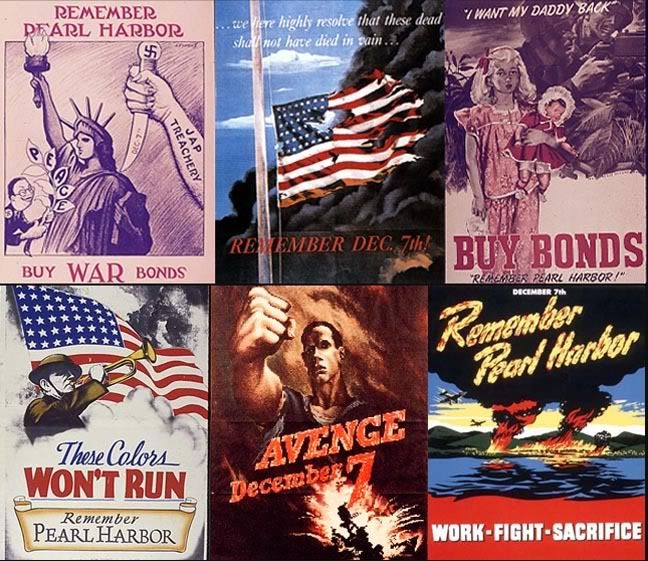
Having trouble deciding? Check these propaganda posters that were circulated after the real-world Pearl Harbor attack, which had the effect, if not the cause, of option 4. Unprovoked deceitful treachery, causing smoke and damage to a flag. We’re to remember, just like the loved ones of the fallen remember their loss. We should help fund the war in their sake, refuse to surrender, in the names of the dead, calling from Heaven, avenge them – defy the smoke of humiliating, emasculating defeat by working, fighting, sacrificing, firebombing to final victory.
Now imagine if this kind of sentiment would fly nearly as well under the terms of possibilities 1 or 2 or 3. What would you propose instead to generate such a degree of public sentiment? Nice speeches with epic language? Or would you roll over to the isolationists and let the world burn around you? Careful now, if FDR did have these clues, and it seems he was waiting for them, he actually pondered the options without the crutch you have of saying “FDR didn’t know.”

Thursday, February 12, 2009

THE MESSAGE WE MISSED?

Adam Larson / Caustic Logic
The 12/7-9/11 Treadmill and Beyond
February 12 2009
last edited 3/26


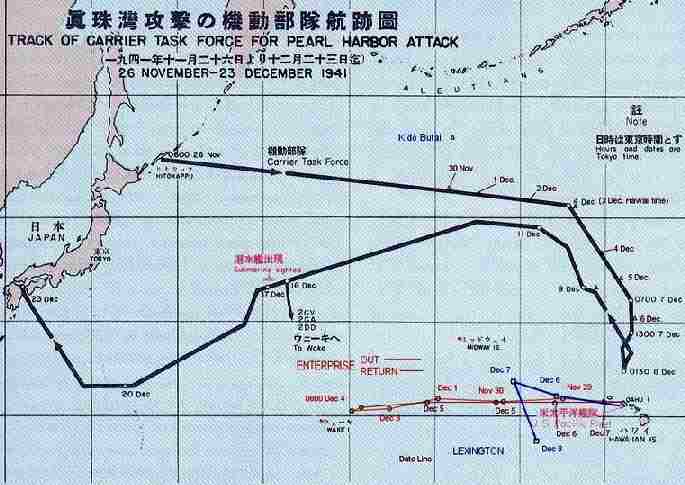
Throughout November 1941, as US-Japanese negotiations were secretly segueing into war maneuvers, the Japanese Navy mobilized to strike out across the Pacific at British, Dutch, and American interests. The last was tasked to a mighty force that had been assembled in secrecy at the 4-mile-wide hammer-head shaped Hitokappu Bay in the southern Kuril Islands (just north of Japan’s Hokkaido Island). By the middle of the month, would have been bustling with the “mobile striking force,” or Kido Butai, under the command of Admiral Chuichi Nagumo in his flagship Akagi; he was backed by 2 battleships, 2 heavy cruisers, 9 destroyers, 3 submarines, 8 train vessels, and, most tellingly, 6 aircraft carriers with about 360 combat-ready aircraft.

On the 25th, Fleet Admiral Yamamoto issued to Nagumi the fateful Combined Fleet Operations Order No. 5, ordering the force to set off for its intended target: - Pearl Harbor, Hawaii, and the bulk of the US Pacific Fleet moored there. The source from which I take this is the Joint Congressional Committee on Pearl Harbor, part 2 of their final report, published in 1946 [1]. Their telling reads as such:

”(a) The task force, keeping its movements strictly secret and maintaining close guard against submarines and aircraft, shall advance into Hawaiian waters and upon the very opening of hostilities, shall attack the main force of the United States Fleet in Hawaii and deal it a mortal blow. The first air raid is planned for dawn of X-day (exact date to be given by later order).

Upon completion of the air raid the task force, keeping close coordination and guarding against enemy counterattack, shall speedily leave the enemy waters and then return to Japan.

(b) Should it appear certain that Japanese-American negotiations will reach an amicable settlement prior to the commencement of hostile action, all the forces of the combined fleet are to be ordered to reassemble and return to their bases.

(c) The task force shall leave Hitokappu Bay on the morning of November 26 and advance to 42° N. And 170° E. (standing-by position) on the afternoon of December 4, Japan time, and speedily complete refueling. “


Clearly this order was crucial; it mentioned the target, the nature and location of the sneak attack, and the approximate date and time of day it would occur, just over two weeks later. If such information could have become available at that time to the US or to an ally inclined to share, the surprise could have been seen and pre-empted, or at least mitigated with some kind of proportional defense. None of this happened, of course, and the Kido Butai achieved total local surprise, which one may be tempted to accept as de facto evidence that the order remained hidden from American eyes at the time.

Such temptation should be resisted.

illustration using the given coordinates for stand-by position. This isn't quite right, as illustrated by the huge distance to travel the last leg. This probably means they modified the plan later, or had a further code in which one location actually mans another. A better map from Japanese sources can be seen at this page, and was used to make the more accurate and useful graphic below.
The Japanese Navy ordered the destruction of much of their records at war’s end, all copies of this order apparently being among the lost. Therefore, the Committee’s source for the wording they presented as evidence in 1946 would have to come from some other record(s) – hard copies that escaped the destruction order and fell into US hands, the memories of people who had written, read, or recieved the orders, or perhaps ‘our own copies,’ radio intercepts received by the US or an ally at the time but (presumably) decoded later.

In fact, the source the Committee cites is, essentially, anything but the third option. The order to sail is attributed to “Committee exhibit no. 8,” cited extensively throughout part two of their report when referencing Japanese plans or communications. Therein they explain:
“The chief sources of information concerning the attack are translations of captured Japanese documents, interrogations of prisoners of war, and reports submitted by general headquarters, supreme commander for the Allied Powers, comprising questionnaires filled out since VJ-day by former members of the Japanese naval high command. See committee exhibits Nos. 8, 8A, 8B, 8O, and 8D.” [2]
So it would seem that, even four years after the attack and the penetration of all Japanese codes, fuzzy memory and the odd scrap of paper was the best the Committee had access to. Apparently, we never got a copy of our own to decode and it was just lost into the ether. Admiral Edwin Layton concluded, after searching the available intercepts at the National Archive, “we evidently did not pick up Yamamoto’s 25 November sailing message” at all. [3] Note the judicious use of “evidently.”

The Pacific Fleet’s top intelligence officer at Pearl Harbor at that time, Layton published his own investigation at the end of his life, in the mid-1980s. Having found nothing of it in our archives, his source for the order to sail was “a reconstruction of events obtained from [the striking force’s] surviving commanders in 1945.” In particular, he cited the recollections of Capt. Mitsuo Fuchida, lead pilot of the actual air raid. This version is essentially the same as the above, with the exception of an “evening rendezvous” to refuel on Dec 3 Tokyo, not Hawaii time, and located at 40°N 170°E, two degrees south of the Committee’s findings. [4]

An Army Military History office document released in 1953 provides a whole string of communications surrounding the Kido Butai’s formation and intent, dating Nov 5 to Dec 2. While previous communications outlining the attack plan for Hawaii are recounted in great detail here, Yamamoto’s decisive Nov 25 order is provided only in a “general outline,” altering the standing-by position (from 165° to 170°) and ordering departure. Again, this document notes that “since all copies of these orders were destroyed prior to the end of the war, they have been reconstructed from personal notes and memory.” [5]

There is much debate among American researchers and little conclusive resolution as to how readable that code was to American cryptanalysts on December 7. The general mainstream consensus is that it was completely or essentially unreadable in the last days, as well as at the time of this pivotal order. The question of the code’s overall opacity as of November 25 1941 is one with no conclusive answer [hint - it was LESS likely to be readable on X-Day, and there are other nations whose own progress is uncertain]. The topic is shrouded in curiously dense secrecy and confusion (at least on my part), and will be the subject of a further post, or posts, after I’ve completed more research.

Sources:
[1] Investigation of the Pearl Harbor Attack. Report of the Joint Committee on the Investigation of the Pearl Harbor Attack. July 20 1946. Part II. Page 56. online - backup
[2] Ibid. Page 53.
[3] Layton, Edwin T. with Roger Pineau and John Costello "And I Was There": Pearl Harbor And Midway - Breaking the Secrets. William Morrow & Co. December 1985. Page 207.
[4] Ibid. Page 207.
[5] Japanese Monograph No. 97. PEARL HARBOR OPERATIONS: General Outline of Orders and Plans. Prepared by Military History Section Headquarters, Army Forces Far East. Distributed by Office of the Chief of Military History
Department of the Army. 19 February 1953. link

Wednesday, February 11, 2009

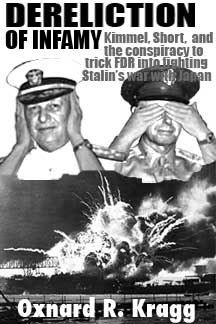
DERELICTION OF INFAMY

Adam Larson / Caustic Logic
The 12/7-9/11 Treadmill and Beyond
February 10 2009


Following is a re-post of an interesting 12/7 foreknowledge denier I stumbled upon, endorsing their own odd conspiracy theory in a bid to keep all blame away from FDR. I'm still researching the issue of Pearl Harbor, and not sure what to think in general, but I think this may all be hogwash.
---
Here it is 2009 and more than 65 years after the fact, there are those who still debate whether FDR knew anything about the pending attack on Pearl Harbor, December 7 1941. They don’t always come out and say it, but the gist of these arguments is that President Roosevelt was a traitor who consciously withheld information from Hawaii’s defenders to enable the Japanese attack and mobilize public support for US entry into World War II. The greatest generation did mobilize to knock down Japanese, Nazi, and Soviet aggression, but it was no thanks to any secret plan of the President. To anyone remotely reasonable, it should suffice to take a quick look at the people saying these things … the Holocaust-denying loons at Institute for Historical Review, the right-wingers at
John Birch Society
, 9/11 No-Planer-types, Marxists, paranoid NWO conspiratainers, Japs, of course, and crazy Japs.

It’s time to put the debate to bed. Speaking truth to such asshattery, noted director Jerry Bruckheimer once said “there’s a book that just came out which claims President Franklin D Roosevelt knew about the attack. That’s all bullshit. He didn’t know about the attack!” That book is probably Day of Deceit by Robert Stinnett, which actually said that Roosevelt and those around him desired, provoked, and allowed the attack. Oh, and knew. This is not far from a 9/11 style remote control attack by FDR himself... wait for part 2. It should be quite clear between Stinnett and Bruckheimer who knows what he’s talking about here - One wrote a stupid book based on stupid paranoid research, the other made a massively expensive and epic movie about the attack, which was nominated for five golden Raspberry awards, won an Academy Award for sound effects, and would surely have nabbed the historical accuracy and patriotic inspiration awards if they existed.

This simple fact guts Stinnett’s case and the myriad like it - FDR certainly couldn’t have arranged the attack if he didn’t even know about it. Which he didn’t, as has already been established. President Frank was a morally correct, upstanding gentleman and “former Naval Person” himself. He was certainly taken by surprise when the yellow rats snuck in and smashed the Navy, just like Admirals Kimmel and Short are widely thought to have been, but without that troubling “dereliction.”

Which brings us to a serious point about historical accountability – those at the time of the attack charged with investigating rightly pointed the blame at the failed defenders of the fleet, if they were a bit soft, referring only to “dereliction of duty.” But in recent decades there’s been a politically correct move to exonerate the names of these two negligent commanders – having their ranks reinstated after they both failed to prepare the Harbor and fleet despite several specific warnings. This is a troubling trend.

Independent resercher Oxnard R Kragg, in his recent book “Dereliction of Infamy,” reasons there can be no coincidence in Short and Kimmel both being “asleep at the switch” at the same time, just as everyone else was trying to raise the alarm for them about the obvious Japanese mobilization. This is a compelling point, and to back it up, Kragg has uncovered serious evidence that both commanders were secretly Communists, and probably agents of the Comintern! Previously unseen documents offered by Kragg make it more than likely the duo was in league with the USSR, to trick FDR from the inside into fighting the Japanese. The idea was that this would free up Stalin’s eastern front with Japan so he could focus on fighting the Nazis in Europe. As a perhaps intended side-effect, the attack forced the US to enter the war not just against the Japanese but the Germans as well, a fight in which many American soldiers were killed and the onset of the Cold War ensured.
All of this was avoidable, given existing islolationist sentiment, and the President’s own widely-stated desire to keep America out of the war at all costs. Recall the President’s pained words once his peace was shattered by Japanese bombers, that 12/7 would live in “infamy.” The Japs got off the hook easy – a little firebombing, two nukes, an occupation, and forced protectorate/tributary status and national techno-slavery, and you’re paid up, seems to have been our appeasement deal there. There are those that disingenuously try to pin the remaining domestic blame on FDR, and hardly anyone left with the courage to keep it where it belongs – on the traitors who sold us out from within. If history has taught me anything, and it hasn’t, a day cannot live in infamy by ignoring the dereliction at the heart of it.
---
ALL KIDDING ASIDE, The 12/7-9/11 Treadmill is back in operation after a hiatus of - dang! Two years! Keep an eye on this page.

Monday, January 1, 2007

NEVER MIND: STINNETT DROPS THE ISSUE

PROVOCATION ERASED, MCCOLLUM MEMO RE-CRYPTED
Adam Larson
Caustic Logic/The 12/7-9/11 Treadmill
December 26 2006


Day of Deceit author Robert Stinnett is a research fellow at the Independent Institute, an Oakland, CA-based conservative libertarian, anti-big government think tank. In addition to hosting Stinnett and his Pearl Harbor case and publishing books like “Against Leviathan,” they also feature as a fellow 9/11 skeptic and former Reagan economist Paul Craig Roberts. Via the Institute, Stinnett started to repeatedly explain and promote his arguments from Day of Deceit, starting with an event in May 2000 called “Pearl Harbor: Official Lies in an American War Tragedy?” [1] Later that year he wrote a commentary published to mark the 59th anniversary of “December 7, 1941: A Setup from the Beginning.” This piece explicitly mentioned “McCollum’s secret memo dated October 7, 1940, and recently obtained through the Freedom of Information Act.” He cited its eight points, the “centerpiece” of which was “keeping the might of the U.S. Fleet based in the Territory of Hawaii as a lure for a Japanese attack.” In this original piece, he listed two specific questions “at the top of the foreknowledge list: (1) whether President Franklin D. Roosevelt and his top military chieftains provoked Japan into an “overt act of war” directed at Hawaii, and (2) whether Japan’s military plans were obtained in advance by the United States but concealed from the Hawaiian military commanders, Admiral Husband E. Kimmel and Lieutenant General Walter Short so they would not interfere with the overt act.” [2] That is, the failure to intercept warnings was intentional and secondary to the provocation.

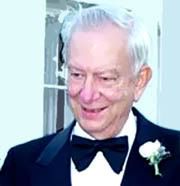
Robert Stinnett, if I'm not mistaken, at the White House in 1990
This December 2000 piece set a trend for anniversary commemorative articles. On the 60th anniversary of Pearl Harbor and just three months after 9/11, he published “Pentagon Still Scapegoats Pearl Harbor Fall Guys.” Again he posed the same two questions – was it provoked, and did they intercept messages. Again he made largely the same arguments as the previous year, prominently mentioning and explaining his exclusive evidence, the McCollum memo. [3]

But then something changed in 2002, curiously at just the same time the post-9/11 world and its questions of what Bush knew began to sink in. We can see a shift in direction in that his speech that year was five days early, on December 2. Still boldly titled “The Pearl Harbor Deception,” it was different in two ways than his presentations before 9/11 – First, his two questions had changed, now omitting provocation. “Two questions about the Japanese attack on Pearl Harbor have ignited a controversy that has burned for 60 years: Did U.S. naval cryptographers crack the Japanese naval codes before the attack? Did Japanese warships and their commanding admirals break radio silence at sea before the attack?” the second change I noticed is the lack of any reference to McCollum’s memo; he was leaving out what was the core of his argument, the primary thing that made it HIS argument. He was surrendering his edge. [4]

This was followed quickly by “The Truth about Pearl Harbor,” a January 30 2003 debate held at the Institute between Stinnett and foreknowledge denier Stephen Budiansky. It should be easy enough for Stinnett to win, since Budiansky argued the government line by citing only the old evidence, almost strictly code breaking (which he wrote the “complete” book on, as well as a book called “Closing the Door on Pearl Harbor”). Stinnett could have sunk Budiansky’s argument by illustrating the secondary nature of foresight when one is actively provoking something. Yet he did not, and played Budiansky’s game, keeping the very boring and tedious debate at the level of codes and of personal attacks over credibility. His presentation seems to consist of his December article, a word search of which shows that the name McCollum pops up, but only as a “James A. McCollum” cited as a source in the debate on code-breaking. The date of the memo, its author, its eight points, are totally absent. The words “provoke,” “provocation,” and various synonyms reveal nothing but the admission in the opening remarks by David Theroux that Stinnett had previously argued that “U.S. government leaders at the highest level not only knew that a Japanese attack was imminent, but that they had deliberately engaged in policies intended to provoke the attack.” In his “presentation” that day, Stinnett made no such argument. [5]

I'm sure he had very good reasons for the shift in course, but I can't say for sure what these are. It could be a case of someone finding out that the McCollum memo was maybe a forgery, forcing Stinnett to back off from it pending an investigation. I haven't heard of anyone from the swollen ranks of the 12/7 coverup apologists pointing this out, however, and to the best of my knowledge, the memo remains solid. The reason for dropping the issue could also be someone suffering "degrees of separation anxiety" and urging Stinnett to back off the hard case and leave Pearl Harbor intact.

He did, however, intriguingly point out in this twice-presented piece that “immediately after Day of Deceit appeared in bookstores in 1999, NSA began withdrawing pre-Pearl Harbor documents from the Crane Files housed in Archives II. This means the government decided to continue 60 years of Pearl Harbor censorship. As of January 2002, over two dozen NSA withdrawal notices have triggered the removal of Pearl Harbor documents from public inspection.” How ironic then that at about this same time Stinnett also started to censor himself. Though his book is still available and not removed from view at all, it’s as if Stinnett is trying to forget his core argument, or at least to stop reminding anyone of it. According to the Independent Institute’s website, Stinnett has written no more commentaries and given no more presentations in the four years since his forfeited debate with Budiansky. He seems to have retired from his pre-9/11 mission, and as far as I can tell he’s not spoken or typed the name Arthur McCollum since December 2001.

sources:
[1] independent Institute. Research Fellow: Robert B. Stinnett. http://www.independent.org/aboutus/person_detail.asp?id=514
[2] "December 7, 1941: A Setup from the Beginning." December 7, 2000. Robert B. Stinnett. Honolulu Advertiser. http://www.independent.org/newsroom/article.asp?id=103
[4] "Pentagon Still Scapegoats Pearl Harbor Fall Guys." December 7, 2001. Robert B. Stinnett. Providence Journal. http://www.independent.org/newsroom/article.asp?id=400
See [1].
[5] "The Truth About Pearl Harbor: A Debate." January 30, 2003 Robert B. Stinnett, Stephen Budiansky. http://www.independent.org/issues/article.asp?id=445
[6] http://www.independent.org/newsroom/article.asp?id=103