The 12/7-9/11 Treadmill and Beyond
April 2 2009
THE BLIND ALLEY
To the north of Hawaii is a broad band of the Pacific running roughly east-west, that by some combination of commerce, weather, and oceanography, was little-enough traveled to become known as the “the Vacant Sea.” So long as it stayed empty, it was no problem - but if it suddenly was occupied by a hostile enemy, there may be no one else there to spot them in advance. It was a blind-spot in Hawaii's defense. As Maj Gen Sherman Miles, the Army’s head of intelligence, told the Congressional Pearl Harbor investigation:
“Of course we had had information for a great many years which had been considered in all our war plans in Hawaii that there was a certain part of the Pacific Ocean that we called the ‘Vacant Sea’ in which there were practically no ships and in which large movements of ships could occur without anybody seeing them.” [1]
An article by Miles published in the Atlantic Monthly reported in 1948 how this channel “through which an attacking force could approach Hawaii undetected, had been marked down in our defense studies.” [2] But studies can only so far, and surveillance - surface or aerial - only so much further. As one of Randall Wallace’s characters (based on no one in particular I know of but included in the 2001 movie) said, if he were a Japanese planner, he’d hit the Pacific Fleet at Hawaii via that blind alley; “You could hide the entire land mass of Asia in the Vacant Sea, and nobody would know.” [3] Indeed, in December 1941 no one we know of saw the Kido Butai - a strong Japanese task force with six aircraft carriers and two dozen accompanying vessels - cross the vacant sea, hover north of Hawaii, then swoop south. Nothing but radar was watching the north side of the islands, and that didn’t see anything until the planes were airborne and halfway there.
IT’S A CONSPIRACY!
This reverse buffer was engineered, says revisionist Don Quixote Robert Stinnett, by none other than President Roosevelt, specifically to allow that very Japanese strike. In his unusual estimation, the vacant sea was not an accident of long-term circumstance, but a narrowly enforced directive from Washington:
“Navy officials declared the North Pacific a “vacant Sea” and ordered all US and allied shipping out of the waters. […] The Vacant Sea order dramatized Admiral Kimmel’s helplessness in the face of FDR’s desires.” [4]
Other aspects of Stinnett’s case have it that the president and top naval officers knew full well every worthwhile detail of the planned strike, including its course (based on the breaking of the main naval code, which did not actually occur). So it would seem highly suspicious that in this climate they issued an order on November 25, “about an hour” after the Kido Butai set sail on its fateful mission into the “vacated sea.” [5] Stinnett cites as supporting evidence Rear Admiral R.K. Turner, the Navy’s director of war plans at the time, later telling investigators “we were prepared to divert traffic when we believed war was imminent. We sent the traffic down via Torres strait, so that the track of the Japanese task force would be clear of any traffic.” [6] Stinnett seems to take this “startling admission” for a reference to the Pearl Harbor task force – startling indeed that Turner would so slip, when all other officials have denied any prior knowledge of that prong. We'll get back to how that's wrong in a moment.
There is nothing aside from Stinnett to support this interpretation of events – he acknowledges that all ten investigations so far have “ignored” this vital clue, and all sources I find online mentioning a “vacant sea order” refer back to him, if to anything. The notion finds little support from logic – the implication is this lane was usually bustling with eyes until ordered clear. Yet the order was only given after the force set sail, leaving one wondering what the planners in Tokyo had been thinking up until that lucky break. But he has the November 25 order mentioning Torres, and Turner's affirmation this was to avoid a “task force.” So no matter what other investigators can’t or won’t confirm, and no matter the logic of it, the evidence proves it true, right?
THE FIRST ONES CLEARED: PACIFIC FLEET
There is no document Stinnett has unearthed “declaring” the North Pacific an empty area, or “ordering” it to be vacated. Rather he finds clues, the most intriguing of which is the cancellation of an exercise of the Pacific Fleet, an eerily prescient one ordered by Admiral Kimmel, which I learned of in Stinnett’s book and, unfortunately, nowhere else.
He cites some CinCPAC papers for the details, and refers to it as Exercise 191, carried out on Sunday November 23, and cancelled early on request from Washington, Stinnett explains. He cites a known dispatch of November 24 from Navy Operations citing a threat of “hostile action in any direction” and urging “utmost secrecy” and nothing at all to precipitate problems in the “tense situation.” The scuttled operation was reportedly set in the waters north of Hawaii, quite a ways from the fleet’s normal operating area, practicing surveillance and detection of a Japanese force approaching through the Vacant sea lane. This order for "recall of the Pacific Fleet from the North Pacific" was among the prime failures that allowed the attack two weeks later. [7]
Stinnett offers details of Kimmel’s thoughts, ship maneuvers performed, the flag code system used, and other details. I have yet to see any corroboration – Layton’s book should certainly mention this but didn’t, that I noticed. I could find nothing in At Dawn We Slept. Stinnett himself admits neither Admiral Kimmel nor his family seemed to remember this episode either. [8] This certainly seems an elaborate episode to have simply fabricated, and I haven’t written it off just yet, but close.
AROUND THE ORANGE ISLANDS
The main point I can confirm is that the Navy did issue an order November 25 routing Pacific traffic to the south. This is available online as part of Joint Committee exhibits 9-43, parts poorly scanned (investigating the PEABL HAEBOE ATTACK) – a series of communications from October and Novemeber between Navy operations/CNO Stark (OPNAV), Kimmel (CINCPAC), Adm Hart (CINCAF) Naval Districts 12 (SF), 14 (HI), and 16 (Philippines), and others. [9 – source for all dispatches quoted below]
The alternate route in question was first outlined in mid-October by Naval Operations for traffic already southeast-bound (destined for, or coming from the “Far East area,” Shanghai, India and “East India area”) to keep this traffic “to the southward and well clear of Orange [Japanese] mandates taking maximum advantage of Dutch and Australian patrolled areas.” [see graphics] This order was about getting around the extensive area of small Islands mandated to Japanese control after World War I. It would affect traffic to Guam, the Philippines, Thailand, and so on, not the sparse traffic headed to or from north Japan and northeast Asia.
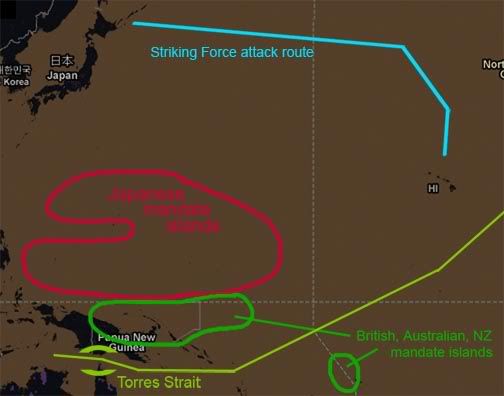
It proved a controversial order, and in about a month complaints started appearing. A request from Kimmel came through on November 22 about “conflicting routings,” looking for permission for a different route to Guam due to “limited fresh water radius.” This was answered by Stark the following day, reiterating “routes south of mandates means through Torres Straits.” The 23rd also saw concern from Com 12 (SF) to the CNO about planned troop movements:
“Department dispatches apparently do not take cognizance of magnitude of Army troop movement directed by War Department from San Francisco by December 10 involving about 22 vessels including largest liners. […] In view reports Japanese patrolling this area believe it vulnerable. Subject to further study believe routing south about Australia impracticable. If troop movement must be made at this time recommend great circle course to San Bernardino Strait with adequate fleet protection.” [emph mine]
This patroling of the Torres area was reported by Stark on the 21st (also included on the page), but Com 12's concerns triggered by it were again answered by Stark with an affirmation of the selected detour, in the form of the November 25 dispatch Stinnett cited so disjointed from all context. It was info addressed to CINCPAC, CINCAF, COM 14, COM 16, and stated simply “Route all transpacific shipping thru Torres Straits. CINCPAC and CINCAF provide necessary escort.”
Quit your complaining, everyone goes through Torres, seems to be the gist. So the Torres diversion appears supported by the evidence and proves interesting in itself. While Stinnett draws attention to the first line of that last order, Percy Greaves, involved with research for the Congressional committee’s minority report, drew attention to the second. He passed on this exchange between his colleague Sen. Ferguson and one Admiral Inglis:
Senator FERGUSON: Now, I will ask you why you did not put in the part that was to provide for escorts.
Admiral INGLIS: I think that was perhaps omitted by my staff because it might have been somewhat controversial.
Senator FERGUSON: You think that this part of the message is controversial, "providing necessary escort"?
Admiral INGLIS: It might lead to controversy because of the word "necessary." There might be a difference of opinion as to ships for escorts as opposed to the need for keeping them concentrated for combat. [10]
Whatever possible interest there may be in this story, it does not work towards the end it was employed to by Mr. Stinnett. Considering again Turner’s quote about claring the path of a Japanese task force, it’s fairly clear what’s going on here. The southward prongs of japan’s massive attack were known of, and were largely centered in the Mandate Islands. The re-routing through Torres was for traffic set to head through the mandates, not for traffic to the north of Hawaii, nor to clear the path of an unknown task force up that way. There was no need to vacate the vacant sea, and Stinnett has been shown to be “painting us a picture.”
TEST CASE: THE URITSKY
Layton’s book says nothing about exercise 191 or a “vacant sea order,” and I haven’t checked yet on any opinions of the Toerres routing. But it does pass on an obscure episode that openly defies Stinnett’s case. Layton and/or his co-authors cite Japanese military sources for a concern on November 25 over “a Soviet merchant ship bound from San Francisco to the Far East” that was believed on course to cross the Kido Butai's path and perhaps spoil the surprise. It was apparently a concern only, and such a fateful meeting was avoided. [11]
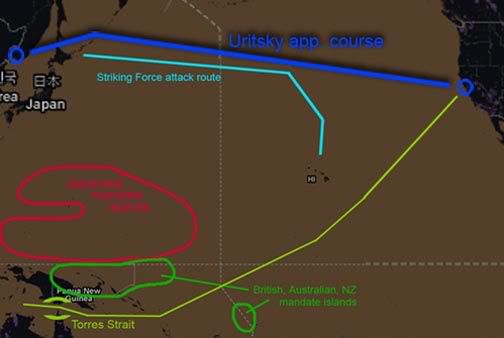
Further research indicated this was almost certainly the Uritsky, which started the journey November 25, interestingly, loaded with US leand-lease military hardware, en route to Vladivostok to help in the pitched fight against Nazi invaders. The book presents questions about who told who about this route, leading to a “deduction” that the Soviets alerted Tokyo to this planned passage. This in turn leads the authors to a “logical assumption that Soviet intelligence knew precise details of the course to be taken across the Northern Pacific by Nagumo’s striking force!” [12] Or, they knew they’d have to pass around the Japanese Kuriles before reaching home port, and were putting in a friendly heads-up to avoid any possible troubles anywhere along the way. [see graphics]
In short, we have a case of one of those rare vessels actually traveling the vacant Sea in that key period, and the supposed order to clear the area had no effect on it. Either there was no such order, or it could not be enforced on the Soviets, but it was only luck and/or nimble planning on the Japanese side that avoided a likely sighting.
Sources:
[1] Prange, Gordon W., with Donald M. Goldstein and Katherine V. Dillon. At Dawn We Slept: The Untold Story of Pearl Harbor. . 2001 edition. Penguin. P 424.
[2] Miles, Sherman. Pearl Harbor in Retrospect. The Atlantic Monthly. July 1948. Online posting
[3] Wallace, Randall. Pearl Harbor (early) Link.
[4] Stinnett, Robert. Day of Deceit: The Truth About FDR and Pearl Harbor. First Touchstone edition, 2001. pp. 144-145.
[5] Stinnett. p. 145.
[6] Stinnett. p. 144.
[7] Stinnett. p. 156.
[8] Stinnett. p. 145.
[9] Part 14 - Joint Committee exhibit nos 9 through 43. Hearings Before the Joint Committee on the Investigation of the Pearl Harbor Attack. 1945/46. Online posting.
[10] Greaves, Percy L., jr. Senator Homer Ferguson and the Pearl Harbor Congressional Investigation. Institute for Historical Review. Online posting.
[11] Layton, Edwin T., with Roger Pineau and John Costello. "And I Was There" Pearl Harbor and Midway - Breaking the Secrets. New York. Quill. 1985. Pp. 220-221.
[12] Ibid.