WHERE MOïSE AND I DISAGREE
Adam Larson / Caustic Logic
June 10 2009
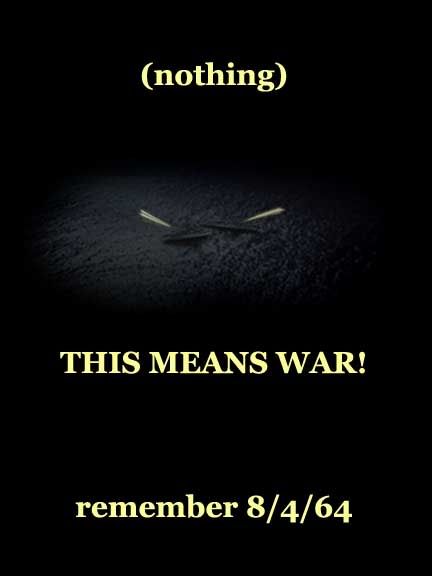
Since it’s all I have to offer anyway, I will momentarily skip out on further analysis and state my opinions on the Gulf of Tonkin Incident, Okay, I’ll cite a few supports, but the point is this might suffice as my final post on the subject, which is quick, since I’ve only put up three previously. I'm not even tempted to make any cool graphics for this one, after looking at the endless nonsensical scribbles Edwin E. Moïse had to wade through to re-construct the reality behind the two-hour circus of blunders.
From a cursory skim of some of the evidence, I find the faint possibility that some real vessels firing real torpedoes were involved, at least in the first part of the reported two-hour attack. This is the only aspect that might mean anything new; it would to me strongly imply a false flag operation involving RVN torpedo boats on a heavily-modified OPLAN 34-A raid. However, such a possibility raises many questions, and my guess is that it would not hold enough water to bother looking into it.
Aside from this intriguing distant possibility, I see little need to examine the actual non-events of August 4, 1964. All reputable and most non-reputable sources by now agree, from the overwhelming body of evidence, that no attack took place where one was claimed and aggressively pushed as the pretext for an endlessly escalating yet endlessly losing war of choice. Among all the surviving then-experts at NSA, CIA, Pentagon, various fleet commands, etc., one can find no surviving belief in the reality of this history-making engagement. Moïse’s Tonkin Gulf and the Escalation of the Vietnam War cites “profoundly disturbing” attempts by the U.S. Navy, as late as 1986, to pass the alleged attack off as real with an impressive-looking official history. [p xii] By now however even the Navy has given up the cause; as researcher John Prados explained in 2004, “the history of U.S. destroyers carried on the Navy's official website no longer contains any reference to a naval engagement having occurred on August 4.” [Prados]
Remaining questions encompass the area of unprovables – what did the active parties think and believe as they set this faux pas into motion? Opinions will differ, as mine and Moïse’s do; he feels the second attack reports were “not a deliberate fabrication” by the United States, as the North Vietnamese charged at the time. “I was quite sure that President Johnson had been making an honest mistake when he bombed the DRV in “retaliation” for an action the DRV had not committed.” [p xv] That author admits being embarrassed explaining this view to his Vietnamese hosts, who surely rolled their eyes, mentally at least. I’m not convinced he really believes that interpretation, what with former White House advisors and top generals and the like to interview, it might serve one well to avoid making such bold accusations – even if they seem warranted.
Of course he was also speaking with much of the epically befuddled destroyer crews who honestly believed the string of BS they reported that night. He doesn’t seem to feel anyone consciously made up anything, and proceeds examining how such massively erred reports originated absent any dishonesty. I’ve already expressed the possibility that the destroyer crews consciously made up the attack, and this would explain the consistency of error that reigned during the two hours an impossible attack was being reported. This is not a case I’ve seen anyone else make, and of course it’s entirely possible that an amazing string of errors in the tense climate triggered the hysteria after all. As the Pentagon set about constructing the story they’d stick with, the pressure from Washington to deliver an attack may have effected the crew only subconsciously, making their continued misinformation just more honest mistakes. Human memory can be, or can be presumed to be, infinitely strange.
Whatever the mindset behind the reports, it’s the pressure from above that matters - the suction of retaliation already in progress, that pulled out a bit more evidence, to the extent it even mattered once the wind was blowing that way. The force of that shift is clearly illustrated by President Johnson’s haste to hit back before figuring out whether there was really an engagement or not on August 4. The first draft of the Tonkin Gulf Resolution was done up and discussed with some in Congress within nine hours of the first reports, and retaliatory air strikes underway five hours after that. And those were considered far behind schedule.
The military moved along the path blazed by the President’s decisive headlong rush to war. From what I’ve read, they did this with private reservations about the pretext, but otherwise with gusto and enthusiasm and no outward doubt. The first order of business was too get hostilities opened, the second to establish their collective cover story for the pretext, which wound up being a half-ass amalgamation of carefully screened evidence. This is the essence of fabrication, in its original sense. Separate threads were somehow brought together and were consciously woven by a pre-designated pattern; a “fabric” was undeniably formed, and a major and brutal war was then sewn from that fabric.
But was it deliberate? Moïse found “no evidence,” nor any “reason to suppose” anyone in the Washington leadership had any doubts about the incident during the crucial three days between its occurrence and the passage of the Tonkin Gulf Resolution. He did find evidence that President Johnson had passed from doubts about the attack’s veracity to little doubt it was all bogus within “a few days” of the incident, with his famous “flying fish” comment. [p. 210-211] Defense Secretary Robert MacNamara was initially and for a long time publicly certain their pretext was sound, privately expressing some doubts years later, and only deciding out loud that it was probably not real in 1995. He was clearly aware from at least mid-September 1964 that the President didn’t believe his own case, according to recorded conversations between the two declassified in 2001.
My opinion is if these people were inclined to any caution, they must have at least suspected the attack was unreal, grossly exaggerated, unverified, or something other than what they presented it as. Downplaying genuine doubts and presenting something other than what happened is, in a sense anyway, “deliberate fabrication.” Again, there is no way to prove whether LBJ, MacNamara, any of their subordinates or advisers or the generals and planners and escalators or the destroyer crews themselves knew they were selling bullshit. They might have honestly thought it was something wholesome and real, not realizing the stink. In my opinion, it all comes down to how fucking stupid you believe these guys were.
Sources:
Moïse, Edwin E. “Tonkin Gulf and the Escalation of the Vietnam War.” Chapel Hill (University of North Carolina Press). 1997. 255 pages
Prados, John. Essay: 40th Anniversary of the Gulf of Tonkin Incident. National Security Archive, George Washington University. Posted August 4 2004. http://www.gwu.edu/~nsarchiv/NSAEBB/NSAEBB132/essay.htm
Showing posts with label Moise E. Show all posts
Showing posts with label Moise E. Show all posts
Wednesday, June 10, 2009


Tuesday, June 9, 2009
THE PRESIDENT’S HASTE
BLAZING THE TRAIL TO WAR
Adam Larson / Caustic Logic
June 9 2009
PRIME-TIME MATERIAL
In his 1997 book Tonkin Gulf and the Escalation of the Vietnam War, Edwin E. Moïse made an excruciatingly thorough examination of all available information and found “no evidence,” nor any “reason to suppose” President Johnson or Defense Secretary MacNamara had any doubts about the reported incident during the crucial three days before passage of the Tonkin Gulf Resolution. [p 210] Of course the evidence was always ambiguous, contradictory, and unlikely at best, and all the doubts they needed were available to such high officials from the get-go. Instead, as Moïse writes:
Retaliatory bombing is serious, and should only be done based on verifiable, logical evidence of something to retaliate for. Very few if any doubts should be allowed, not “many,” as Commander Herrick warned along with his report. If you wait for daylight to look for evidence, as Herrick recommended, but find none, that should strengthen, not weaken, the doubts. Some solid visual contacts at least should be required, some damage to the ships verified as not caused by the other ship. Something resembling what the DRV was even capable of might be a good benchmark, and another that the August 4 reports failed to meet.
If one wants to avoid an honest mistake, a little time should be allowed to figure out questions like the above. But the President had his plan and his timeline; having been handed the attack reports conveniently at the working day’s beginning, he committed to go to war with it, to have strikes underway and announced live on national TV before too much of the nation was asleep for the night.
To fit this schedule, LBJ put immense pressure on the Defense Department to gather any verification possible and prepare counter-strikes for launch as early as possible. The military scrambled, complting a surface scan for evidence of a battle (negative), bringing in a second aircraft carrier, flying in extra jets, fueling, arming, target selection, pre-reconaissance, rules of engagement, so on. MacNamara and Johnson grew impatient as the evening deepened over the eastern seaboards and stated threatening their westward audiences. [p 214-16]
”AS I SPEAK…”
Once the air attacks were apparently, arguably, underway enough, the President was on the air at 11:37pm – about fourteen hours after first learning of the alleged attack. He announced to the world:
In fact, the attacks were about to begin, and LBJ jumping the gun to make the late news slot put the retaliatory mission in jeopardy. In fact, Vietnamese records reveal that whatever defenses they did erect against the air strikes were based on interception of this speech, which aired live well before the planes were in striking range, and just before the first radar readings were reported. [p 222]
That haste had only limited effect on the mission’s success and losses, but the brinksmanship is telling. Politics dictating military strategy Is nothing new, but it didn’t just set the timing of retaliation – it also guided what the military would have to “decide” about what happened in the Gulf that night.
VIETNAM BURNING OR WASHINGTON?
Once the first 24 hours had passed, it may have seemed to some that their job, aside from executing retaliation, was to find support for the vital war effort and the President’s snap decisions. There was certainly no order to this effect, but reality is capable of writing its own script once decided on and set in motion. The belli was rolling, and the casus would have to justify it, and the alternative may have looked rather ugly and dangerous to career military men.
Evidence was gathered, mostly at the hands of skilled Pentagon lawyers who “redebriefed” all classes of witnesses extracting legally admissible clues [p 186-187] Defense Department, Joint Chiefs, Pacific Fleet, etc. had their initial doubts, but allowed them to be quickly corrected by partial sightings, supporting intercepts (some just doctored together), more testimony and recollections and opinions leaning towards a genuine engagement, and most importantly “the flow.”
Johnson’s haste, which set the tempo of all this, might be effected by his famous engagement at the time in pressing domestic issues. All summer had been consumed with passing the Civil Rights Bill and related issues of the Freedom Summer era. Some in the south took it as a bit like a war, and three enemy agents – civil rights activists James Chaney, Andrew Goodman, and Michael Schwermer - had suspiciously disappeared in Mississippi in late June. News that their bodies had been found by the FBI task force there reached the President on the night of the 4th, as he was waiting to announce the air strikes. [p. 216]
The episode of their killing – as fictitiously portrayed in 1988 movie Mississippi Burning - offers an interesting metaphor for what happened in Washington a month later. It’s been a while since I’ve seen the film, but I recall in the dead of night, the assassins with their police powers catch the three men driving alone on a back road and get them pulled over, unjustly harass them on some bogus explanation, and then begin the brutal violence. It’s painfully obvious this is the kind of infringement that gets you in trouble if witnesses talk about it. At this point it becomes clear they have passed all possibility of turning back on the course they’ve set, and one participant drawls with sinister pleasure something to the effect “well, we’re in it now boys!” However it really happened, the killers shot all three men dead, hid the bodies, concoct alibis and flaunted the feds, essentially declaring a war they would eventually lose.
---
Source: Moïse, Edwin E. “Tonkin Gulf and the Escalation of the Vietnam War.” Chapel Hill (University of North Carolina Press). 1997. 255 pages
Adam Larson / Caustic Logic
June 9 2009
PRIME-TIME MATERIAL
In his 1997 book Tonkin Gulf and the Escalation of the Vietnam War, Edwin E. Moïse made an excruciatingly thorough examination of all available information and found “no evidence,” nor any “reason to suppose” President Johnson or Defense Secretary MacNamara had any doubts about the reported incident during the crucial three days before passage of the Tonkin Gulf Resolution. [p 210] Of course the evidence was always ambiguous, contradictory, and unlikely at best, and all the doubts they needed were available to such high officials from the get-go. Instead, as Moïse writes:
“McGeorge Bundy has said that President Johnson decided at an early hour on August 4 – from his description of the timing, this might even have been before the shooting started, when all Johnson had were reports that the destroyers might be attacked – to use the incident as an occasion to get Congress to pass what was to become known as the Tonkin Gulf Resolution. […] Johnson had made up his mind. He had done so without first asking whether it was absolutely certain that an attack had actually occurred. [...] MacNamara [in seeking verification of the attack] was “asking on behalf of a president who had already committed himself to having a resolution and a speech and had the air time.”" [p 209]
Retaliatory bombing is serious, and should only be done based on verifiable, logical evidence of something to retaliate for. Very few if any doubts should be allowed, not “many,” as Commander Herrick warned along with his report. If you wait for daylight to look for evidence, as Herrick recommended, but find none, that should strengthen, not weaken, the doubts. Some solid visual contacts at least should be required, some damage to the ships verified as not caused by the other ship. Something resembling what the DRV was even capable of might be a good benchmark, and another that the August 4 reports failed to meet.
If one wants to avoid an honest mistake, a little time should be allowed to figure out questions like the above. But the President had his plan and his timeline; having been handed the attack reports conveniently at the working day’s beginning, he committed to go to war with it, to have strikes underway and announced live on national TV before too much of the nation was asleep for the night.
To fit this schedule, LBJ put immense pressure on the Defense Department to gather any verification possible and prepare counter-strikes for launch as early as possible. The military scrambled, complting a surface scan for evidence of a battle (negative), bringing in a second aircraft carrier, flying in extra jets, fueling, arming, target selection, pre-reconaissance, rules of engagement, so on. MacNamara and Johnson grew impatient as the evening deepened over the eastern seaboards and stated threatening their westward audiences. [p 214-16]
”AS I SPEAK…”
Once the air attacks were apparently, arguably, underway enough, the President was on the air at 11:37pm – about fourteen hours after first learning of the alleged attack. He announced to the world:
“[R]enewed hostile actions against United States ships on the high seas in the Gulf of Tonkin have today required me to order the military forces of the United States to take action in reply. […] That reply is being given as I speak to you tonight. Air action is now in execution…”
In fact, the attacks were about to begin, and LBJ jumping the gun to make the late news slot put the retaliatory mission in jeopardy. In fact, Vietnamese records reveal that whatever defenses they did erect against the air strikes were based on interception of this speech, which aired live well before the planes were in striking range, and just before the first radar readings were reported. [p 222]
That haste had only limited effect on the mission’s success and losses, but the brinksmanship is telling. Politics dictating military strategy Is nothing new, but it didn’t just set the timing of retaliation – it also guided what the military would have to “decide” about what happened in the Gulf that night.
VIETNAM BURNING OR WASHINGTON?
Once the first 24 hours had passed, it may have seemed to some that their job, aside from executing retaliation, was to find support for the vital war effort and the President’s snap decisions. There was certainly no order to this effect, but reality is capable of writing its own script once decided on and set in motion. The belli was rolling, and the casus would have to justify it, and the alternative may have looked rather ugly and dangerous to career military men.
Evidence was gathered, mostly at the hands of skilled Pentagon lawyers who “redebriefed” all classes of witnesses extracting legally admissible clues [p 186-187] Defense Department, Joint Chiefs, Pacific Fleet, etc. had their initial doubts, but allowed them to be quickly corrected by partial sightings, supporting intercepts (some just doctored together), more testimony and recollections and opinions leaning towards a genuine engagement, and most importantly “the flow.”
Johnson’s haste, which set the tempo of all this, might be effected by his famous engagement at the time in pressing domestic issues. All summer had been consumed with passing the Civil Rights Bill and related issues of the Freedom Summer era. Some in the south took it as a bit like a war, and three enemy agents – civil rights activists James Chaney, Andrew Goodman, and Michael Schwermer - had suspiciously disappeared in Mississippi in late June. News that their bodies had been found by the FBI task force there reached the President on the night of the 4th, as he was waiting to announce the air strikes. [p. 216]
The episode of their killing – as fictitiously portrayed in 1988 movie Mississippi Burning - offers an interesting metaphor for what happened in Washington a month later. It’s been a while since I’ve seen the film, but I recall in the dead of night, the assassins with their police powers catch the three men driving alone on a back road and get them pulled over, unjustly harass them on some bogus explanation, and then begin the brutal violence. It’s painfully obvious this is the kind of infringement that gets you in trouble if witnesses talk about it. At this point it becomes clear they have passed all possibility of turning back on the course they’ve set, and one participant drawls with sinister pleasure something to the effect “well, we’re in it now boys!” However it really happened, the killers shot all three men dead, hid the bodies, concoct alibis and flaunted the feds, essentially declaring a war they would eventually lose.
---
Source: Moïse, Edwin E. “Tonkin Gulf and the Escalation of the Vietnam War.” Chapel Hill (University of North Carolina Press). 1997. 255 pages
Subscribe to:
Posts (Atom)