Showing posts with label Stinnett. Show all posts

Friday, April 3, 2009

WALKING RIGHT ACROSS THE BROKEN CODE STORY

Adam Larson / Caustic Logic
The 12/7-9/11 Treadmill and Beyond
April 3 2009


KEEPER OF SECRETS
JN-25 is the name given by US cryptanalysts to the Imperial Japanese Navy’s main operational code in 1941. More precisely, it was JN-25B, the second incarnation introduced in Dec 1940 (it was called “AN’ code at the time, and has also been referred to as “5-numeral” code, or variants thereof). A sophisticated code-and-cipher system, JN-25 was based on 5-number groups directly representing words, enciphered with random additives to scramble the number groups. It effectively concealed hundreds of thousands of intercepted IJN messages with among the most vital clues available to Japanese intentions. They believed it unbreakable, but it was finally cracked in spring 1942, helping turn the tide of the Pacific War from the Battle of Midway onward

JN-25-encoded messages include the November 1941 transmission of plans for the Pearl Harbor attack – actually a three-week-long string of communications outlining all the details multiple times in different ways. Whether these messages ever were transmitted by radio is itself an unanswered question, to my knowledge. Most sources, reputable and otherwise, seem to presume it was, but with surprisingly little reason given (I’ll try to settle this at another time). If it were sent on radio waves it would be open to interception, which would put it at the mercy of the cryptographers and code-breakers and offered every clue one would need to fully prepare for the battle of Pearl Harbor

How well the secrets would hold up at that level is a matter of some controversy – the body of evidence supports the general accepted stance that the code was at least partly recoverable, and some 10-15% of this was readable as of November 1941 (different aspects of it changed frequently, including at the end and beginning of that month). Some revisionists have suspected the code may have been completely broken by US analysts prior to December 7, and a few have gone so far as to claim to have proven this – that the intent of the Japanese force was openly available to the top levels of power but withheld from those who were to be sacrificed. I've seen two different clue tracks said to lead to this stance, offered by two different theorists. Both are absolutely worthless (the evidence tracks). [ETA: There are other allegations of pre-12/7 JN-25 penetration by either the British or the Dutch, but these, and their proponents, will be covered later]

STINNETT’S CASE: THE LIETWILER LETTER
The prime champion of JN-25 revisionism is the eminent Robert B. Stinnett, who explains his case in the afterword to the second edition of Day of Deceit, too late a discovery to make it to the first cut in 1999. The main text covering this is a remarkably slim two-and-a-half pages with scant detail, considering the truly massive implications if it were true. In May 2000 he claims to have received over 4,000 never-before-seen documents that revealed to him the “unambiguous truth” that “by mid-November 1941, as Japanese naval forces headed for Hawaii, America’s radio cryptographers had solved the principal Japanese naval codes” [1] Station CAST on Corregidor in the Philippines were the geniuses he credits with the feat. They pierced the "5-num code" as he calls it, by no later than November 16, when CAST’s commanding officer, Lieutenant John M. Lietwiler, wrote to a colleague in Washington:
“we are reading enough current traffic (messages) to keep two translators very busy.” [2]

After spending so much time in the quote mine, that's not much of a nugget to haul back. But thanks to Lietwiler’s historic “admission,” Stinnett can say with no hyperbole “the major secrets of Pearl Harbor are at last out in the open.”

The next few pages highlight some of the new finds, and elaborates on the letter that “notifies naval headquarters” about CAST’s hinted-at breakthrough. “Lietwiler bragged that his crypto yeoman, Albert E. Myers, Jr., had initiated a new technique that allowed the cryppies to “walk right across” the Japanese messages.” A further explanatory note attached to this explains Myers and another guy named Hess were transferred to CAST in September 1941 and brought a new machine, the Jeep IV “for recovering the 5 NUM code.” This wondrous device “enabled the cryppies to recover current (July to December 4, 1941) additives and subtractors for the 5-Num code.” [3]

David Kahn, author of The Codebreakers panned Stinnett's interpretation; he decided the letter "expresses discontent," not joy, over the Jeep IV, and "whatever Lietwiler is discussing, it is clearly not the Imperial Japanese Navy's main, currently used naval cryptosystem, JN 25 B." [4] He offers a fuller excerpt of the letter (parts not shown by Stinnett bolded):
"We are reading enough current traffic to keep two translators very busy, with their code recovery efforts, etc. included. In this connection, I certainly wish you could see your way clear to drop the ancient history of this cipher and work with us on each current system as it comes up."

Another researcher named Timothy Wilford assembled a detailed article on JN-25, and seems to agree with Stinnett's take. However, he offers an even fuller look at the letter, allowing me to see more context for this strangely vague discovery without doing a ton of original research. [5] (This time Stinnett quotes bolded, [...] edits by me):
"We have stopped work on the period 1 February to 31 July as we have all we can do to keep up with the current period. We are reading enough current traffic to keep two translators very busy, i.e., with their code recovery efforts, etc. included. In this connection, I certainly wish you could see your way clear to drop the ancient history side of this cipher and work with us on each current system as it comes up. With Singapore, we have adopted a system of exchanging block numbers to prevent duplication. We have more or less given them a free hand in selecting the cipher blocks they tackle on account of their more limited traffic.
[...]
Using the 400 high frequency groups we have compiled a table of 24,000
differences. When we are stuck on a column now we take any likely looking group and subtract it from every other group in the column from the master group. […] reference to the table […] reciprocals […] Two days ago I saw MYERS walk right across the first 20 columns of a sheet using this method almost exclusively. In view of this I do not believe we want a new Jeep IV."

“We are reading […] current traffic” is the operative phrase – it does seem to mean understanding the underlying code, but also could mean ‘trying to read,’ or ‘reading for, ‘reading at,’ the difference between looking and seeing just vague enough I’d need more verification than Stinnett provides (which is zero, for the record). It looks like Myers was "walking right across" columns of additives in a manual process, since the Jeep IV was a pain in the arse, rather than across the actual code. All in all, the request seems to be to get help with "work" on "cipher blocks" for the "current system," not the kind of thing you'd ask for if it was already solved.

WILLEY'S CASE: THE SAFFORD MEMO
The second clue track I'd like to look at is one cited by right-wing revisionist Mark Willey, presumably in his book Pearl Harbor: Mother of all Conspiracies, as found on one of his websites. His tip-off reads "the first paragraph of the Congressional Report Exhibit 151 says the US was "currently" (instantly) reading JN-25B and exchanging the "translations" with the British prior to Pearl Harbor." [6] I was able to locate this exhibit in its entirety online. [7] It's a years-later memorandum (May 1945) from Lt. Laurence Safford, a founding member of the US cryptologic community, aka the "Winds execute" guy. Safford lists as references "Com 14-260110 (Nov. 1941), Com 16-261331 (Nov. 1941)," whatever these mean, he seems to be referring to November 1941, and Station HYPO (Pearl Harbor, 14th Naval District or COM 14), and station CAST (Corregidor, Philippines, 16th naval district). The letter reads, in part:
"Com 16's estimates were more reliable than Com 14's, not only because of better radio interception, but because Com 16 was currently reading messages in the Japanese Fleet Cryptographic System ("5-number code" or "JN25") and was exchanging technical information and translations with the British C. I. Unit at Singapore. […] some large scale movement involving most if not all of the Japanese Navy was about to take place. […] this estimate * was based entirely on "radio intelligence," the Com 14 C. I. Unit being unable to read anything except the Weather Ciphers and other minor systems of the Japanese Navy at that particular time. This fact was known in the Navy Department, and the Director of Naval Communications and the Director of Naval Intelligence were so informed by me."
* This being "strong force may be preparing to operate in Southeastern Asia while component parts may operate from Palao and Marshalls."

Again we see the ambiguous word "reading." Further passages give context to how that word is meant here; if he meant it was readable as Japanese text, he probably wouldn't say this:
"[T]he current code (JN25B) had been in effect since 1 December 1940, remained in effect until 27-31 May, 1942, and was partially readable in November 1941. A new system of keys was introduced on 4 December 1941 and reported by Com 16_041502, but the carry over of the old code made their solution quite simple, and we were reading messages again by Christmas, Corregidor getting the "initial break" on 8 December 1941."

Reading again, partially as before... nothing new here. The question is just how much, and there has been nothing aside from conjecture to support any more than 10% or so. The next question from there is "which 10%?" Mysteries upon mysteries...

Sources;
[1] Stinnett, Robert. Day of Deceit: The Truth About FDR and Pearl Harbor. First Touchstone edition, 2001. p. 261
[2] Ibid. p. 262.
[3] Ibid. p. 269.
[4] Kahn, David. Remember Pearl Harbor: Response to Robert Stinnett. The New York Review of Books. February 8 2001. http://www.nybooks.com/articles/14086
[5] Wilford, Timothy. Decoding Pearl Harbor: USN Cryptanalysis and the Challenge of JN-25B in 1941. The Northern Mariner/Le marin du nord, XII, No. 1 (January 2002), p. 17 - 37. PDF download link.
[6] Willey, Mark. Pearl Harbor: Mother of All Conspiracies. http://www.geocities.com/Pentagon/6315/pearl.html
[7] Joint Congressional Committe on Investigation of he Pearl harbor Attacks. Exhibit no. 151. Memoranda prepared by Captain Safford. Originally for the Hewitt inquiry. http://www.ibiblio.org/pha/pha/misc/x18-151.htm

Thursday, April 2, 2009

THE VACANT SEA: ON FDR'S ORDER?

Adam Larson / Caustic Logic
The 12/7-9/11 Treadmill and Beyond
April 2 2009


THE BLIND ALLEY
To the north of Hawaii is a broad band of the Pacific running roughly east-west, that by some combination of commerce, weather, and oceanography, was little-enough traveled to become known as the “the Vacant Sea.” So long as it stayed empty, it was no problem - but if it suddenly was occupied by a hostile enemy, there may be no one else there to spot them in advance. It was a blind-spot in Hawaii's defense. As Maj Gen Sherman Miles, the Army’s head of intelligence, told the Congressional Pearl Harbor investigation:
“Of course we had had information for a great many years which had been considered in all our war plans in Hawaii that there was a certain part of the Pacific Ocean that we called the ‘Vacant Sea’ in which there were practically no ships and in which large movements of ships could occur without anybody seeing them.” [1]

An article by Miles published in the Atlantic Monthly reported in 1948 how this channel “through which an attacking force could approach Hawaii undetected, had been marked down in our defense studies.” [2] But studies can only so far, and surveillance - surface or aerial - only so much further. As one of Randall Wallace’s characters (based on no one in particular I know of but included in the 2001 movie) said, if he were a Japanese planner, he’d hit the Pacific Fleet at Hawaii via that blind alley; “You could hide the entire land mass of Asia in the Vacant Sea, and nobody would know.” [3] Indeed, in December 1941 no one we know of saw the Kido Butai - a strong Japanese task force with six aircraft carriers and two dozen accompanying vessels - cross the vacant sea, hover north of Hawaii, then swoop south. Nothing but radar was watching the north side of the islands, and that didn’t see anything until the planes were airborne and halfway there.

IT’S A CONSPIRACY!
This reverse buffer was engineered, says revisionist Don Quixote Robert Stinnett, by none other than President Roosevelt, specifically to allow that very Japanese strike. In his unusual estimation, the vacant sea was not an accident of long-term circumstance, but a narrowly enforced directive from Washington:
“Navy officials declared the North Pacific a “vacant Sea” and ordered all US and allied shipping out of the waters. […] The Vacant Sea order dramatized Admiral Kimmel’s helplessness in the face of FDR’s desires.” [4]

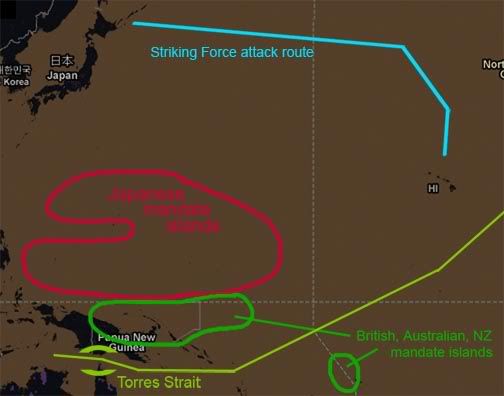
Other aspects of Stinnett’s case have it that the president and top naval officers knew full well every worthwhile detail of the planned strike, including its course (based on the breaking of the main naval code, which did not actually occur). So it would seem highly suspicious that in this climate they issued an order on November 25, “about an hour” after the Kido Butai set sail on its fateful mission into the “vacated sea.” [5] Stinnett cites as supporting evidence Rear Admiral R.K. Turner, the Navy’s director of war plans at the time, later telling investigators “we were prepared to divert traffic when we believed war was imminent. We sent the traffic down via Torres strait, so that the track of the Japanese task force would be clear of any traffic.” [6] Stinnett seems to take this “startling admission” for a reference to the Pearl Harbor task force – startling indeed that Turner would so slip, when all other officials have denied any prior knowledge of that prong. We'll get back to how that's wrong in a moment.

There is nothing aside from Stinnett to support this interpretation of events – he acknowledges that all ten investigations so far have “ignored” this vital clue, and all sources I find online mentioning a “vacant sea order” refer back to him, if to anything. The notion finds little support from logic – the implication is this lane was usually bustling with eyes until ordered clear. Yet the order was only given after the force set sail, leaving one wondering what the planners in Tokyo had been thinking up until that lucky break. But he has the November 25 order mentioning Torres, and Turner's affirmation this was to avoid a “task force.” So no matter what other investigators can’t or won’t confirm, and no matter the logic of it, the evidence proves it true, right?

THE FIRST ONES CLEARED: PACIFIC FLEET
There is no document Stinnett has unearthed “declaring” the North Pacific an empty area, or “ordering” it to be vacated. Rather he finds clues, the most intriguing of which is the cancellation of an exercise of the Pacific Fleet, an eerily prescient one ordered by Admiral Kimmel, which I learned of in Stinnett’s book and, unfortunately, nowhere else.

He cites some CinCPAC papers for the details, and refers to it as Exercise 191, carried out on Sunday November 23, and cancelled early on request from Washington, Stinnett explains. He cites a known dispatch of November 24 from Navy Operations citing a threat of “hostile action in any direction” and urging “utmost secrecy” and nothing at all to precipitate problems in the “tense situation.” The scuttled operation was reportedly set in the waters north of Hawaii, quite a ways from the fleet’s normal operating area, practicing surveillance and detection of a Japanese force approaching through the Vacant sea lane. This order for "recall of the Pacific Fleet from the North Pacific" was among the prime failures that allowed the attack two weeks later. [7]

Stinnett offers details of Kimmel’s thoughts, ship maneuvers performed, the flag code system used, and other details. I have yet to see any corroboration – Layton’s book should certainly mention this but didn’t, that I noticed. I could find nothing in At Dawn We Slept. Stinnett himself admits neither Admiral Kimmel nor his family seemed to remember this episode either. [8] This certainly seems an elaborate episode to have simply fabricated, and I haven’t written it off just yet, but close.

AROUND THE ORANGE ISLANDS
The main point I can confirm is that the Navy did issue an order November 25 routing Pacific traffic to the south. This is available online as part of Joint Committee exhibits 9-43, parts poorly scanned (investigating the PEABL HAEBOE ATTACK) – a series of communications from October and Novemeber between Navy operations/CNO Stark (OPNAV), Kimmel (CINCPAC), Adm Hart (CINCAF) Naval Districts 12 (SF), 14 (HI), and 16 (Philippines), and others. [9 – source for all dispatches quoted below]

The alternate route in question was first outlined in mid-October by Naval Operations for traffic already southeast-bound (destined for, or coming from the “Far East area,” Shanghai, India and “East India area”) to keep this traffic “to the southward and well clear of Orange [Japanese] mandates taking maximum advantage of Dutch and Australian patrolled areas.” [see graphics] This order was about getting around the extensive area of small Islands mandated to Japanese control after World War I. It would affect traffic to Guam, the Philippines, Thailand, and so on, not the sparse traffic headed to or from north Japan and northeast Asia.

It proved a controversial order, and in about a month complaints started appearing. A request from Kimmel came through on November 22 about “conflicting routings,” looking for permission for a different route to Guam due to “limited fresh water radius.” This was answered by Stark the following day, reiterating “routes south of mandates means through Torres Straits.” The 23rd also saw concern from Com 12 (SF) to the CNO about planned troop movements:
“Department dispatches apparently do not take cognizance of magnitude of Army troop movement directed by War Department from San Francisco by December 10 involving about 22 vessels including largest liners. […] In view reports Japanese patrolling this area believe it vulnerable. Subject to further study believe routing south about Australia impracticable. If troop movement must be made at this time recommend great circle course to San Bernardino Strait with adequate fleet protection.” [emph mine]

This patroling of the Torres area was reported by Stark on the 21st (also included on the page), but Com 12's concerns triggered by it were again answered by Stark with an affirmation of the selected detour, in the form of the November 25 dispatch Stinnett cited so disjointed from all context. It was info addressed to CINCPAC, CINCAF, COM 14, COM 16, and stated simply “Route all transpacific shipping thru Torres Straits. CINCPAC and CINCAF provide necessary escort.”

Quit your complaining, everyone goes through Torres, seems to be the gist. So the Torres diversion appears supported by the evidence and proves interesting in itself. While Stinnett draws attention to the first line of that last order, Percy Greaves, involved with research for the Congressional committee’s minority report, drew attention to the second. He passed on this exchange between his colleague Sen. Ferguson and one Admiral Inglis:
Senator FERGUSON: Now, I will ask you why you did not put in the part that was to provide for escorts.
Admiral INGLIS: I think that was perhaps omitted by my staff because it might have been somewhat controversial.
Senator FERGUSON: You think that this part of the message is controversial, "providing necessary escort"?
Admiral INGLIS: It might lead to controversy because of the word "necessary." There might be a difference of opinion as to ships for escorts as opposed to the need for keeping them concentrated for combat.
[10]

Whatever possible interest there may be in this story, it does not work towards the end it was employed to by Mr. Stinnett. Considering again Turner’s quote about claring the path of a Japanese task force, it’s fairly clear what’s going on here. The southward prongs of japan’s massive attack were known of, and were largely centered in the Mandate Islands. The re-routing through Torres was for traffic set to head through the mandates, not for traffic to the north of Hawaii, nor to clear the path of an unknown task force up that way. There was no need to vacate the vacant sea, and Stinnett has been shown to be “painting us a picture.”

TEST CASE: THE URITSKY
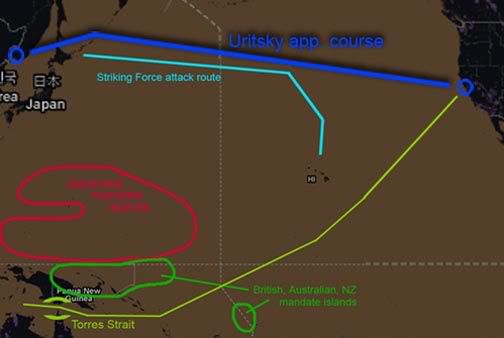
Layton’s book says nothing about exercise 191 or a “vacant sea order,” and I haven’t checked yet on any opinions of the Toerres routing. But it does pass on an obscure episode that openly defies Stinnett’s case. Layton and/or his co-authors cite Japanese military sources for a concern on November 25 over “a Soviet merchant ship bound from San Francisco to the Far East” that was believed on course to cross the Kido Butai's path and perhaps spoil the surprise. It was apparently a concern only, and such a fateful meeting was avoided. [11]

Further research indicated this was almost certainly the Uritsky, which started the journey November 25, interestingly, loaded with US leand-lease military hardware, en route to Vladivostok to help in the pitched fight against Nazi invaders. The book presents questions about who told who about this route, leading to a “deduction” that the Soviets alerted Tokyo to this planned passage. This in turn leads the authors to a “logical assumption that Soviet intelligence knew precise details of the course to be taken across the Northern Pacific by Nagumo’s striking force!” [12] Or, they knew they’d have to pass around the Japanese Kuriles before reaching home port, and were putting in a friendly heads-up to avoid any possible troubles anywhere along the way. [see graphics]

In short, we have a case of one of those rare vessels actually traveling the vacant Sea in that key period, and the supposed order to clear the area had no effect on it. Either there was no such order, or it could not be enforced on the Soviets, but it was only luck and/or nimble planning on the Japanese side that avoided a likely sighting.

Sources:
[1] Prange, Gordon W., with Donald M. Goldstein and Katherine V. Dillon. At Dawn We Slept: The Untold Story of Pearl Harbor. . 2001 edition. Penguin. P 424. 
[2] Miles, Sherman. Pearl Harbor in Retrospect. The Atlantic Monthly. July 1948.
Online posting
[3] Wallace, Randall. Pearl Harbor (early)
Link.
[4] Stinnett, Robert. Day of Deceit: The Truth About FDR and Pearl Harbor. First Touchstone edition, 2001. pp. 144-145.
[5] Stinnett. p. 145. 
[6] Stinnett. p. 144. 
[7] Stinnett. p. 156. 
[8] Stinnett. p. 145. 
[9] Part 14 - Joint Committee exhibit nos 9 through 43. Hearings Before the Joint Committee on the Investigation of the Pearl Harbor Attack. 1945/46. Online posting. 
[10] Greaves, Percy L., jr. Senator Homer Ferguson and the Pearl Harbor Congressional Investigation. Institute for Historical Review. Online posting.
[11] Layton, Edwin T., with Roger Pineau and John Costello. "And I Was There" Pearl Harbor and Midway - Breaking the Secrets. New York. Quill. 1985. Pp. 220-221.
[12] Ibid.

Monday, March 16, 2009

THE MCCOLLUM MEMO - ANALYSIS

BLUEPRINT NO, IMPORTANT CLUE, YES
Adam Larson / Caustic Logic
The 12/7-9/11 Treadmill and Beyond
First posted March 15 2009
last updated 3/17


BLOWING OFF THE DUST
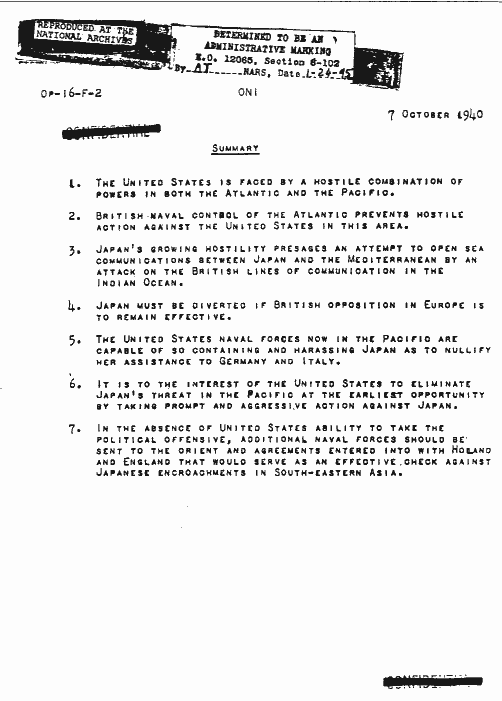
The McCollum Memo is the most common name given to a 6-page pre-Pearl Harbor document, signed by Lt. Com. Arthur H. McCollum of Office of Naval Intelligence, and dated October 7, 1940. It was numbered OP-16-F-2, headed ONI, Memorandum for the Director, meaning Director Naval Intelligence RADM Walter Anderson. Although there are possible questions about the memo’s authenticity, like most everyone else who hears of it, I tend to accept it as a genuine piece of history. This unique clue remained unknown until declassified in 1994, the better part of a century after it was written, and well after all the ‘decisive’ books on the attack (At Dawn We Slept, etc.) had emerged in the 1980s.

The document was then obtained by researcher Robert Stinnett using the Freedom Of Information Act (FOIA). He describes receiving bundles of documents not seen since 1941, “covered with dust, tightly bunched together in the boxes and tied with unusual waxed twine.” [1] He quickly recognized this one as a vital clue never seen before, and worked it into his mammoth book Day of Deceit: The Truth About FDR and Pearl Harbor. As Stinnett interpreted the thinking behind the eight actions proposed in the memo, McCollum “felt that war with Japan was inevitable and that the United States should provoke it at a time which suited US interests.” [2]

Whatever the book’s other merits or drawbacks, it does contain – in fact opens with - this new and compelling piece of the puzzle. It certainly caught my attention as I started the book, and I was dazzled enough to call it a "smoking gun" of FDR’s foreknowledge and provocation, in an older article this one will replace. I was not alone in that prognosis, but the reality is more ambiguous than that, and well worth a closer look.

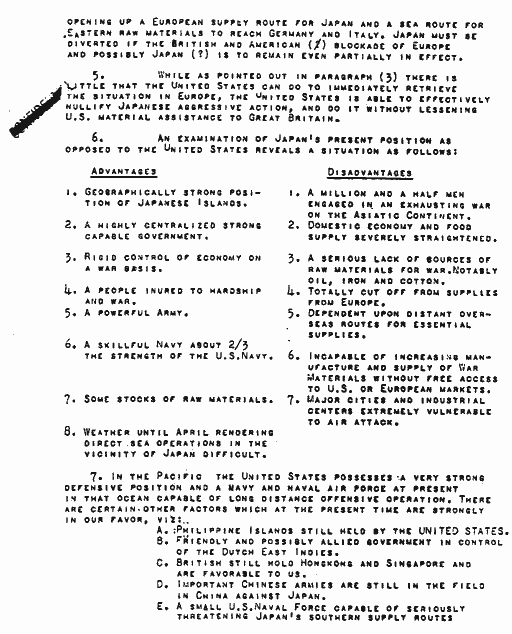
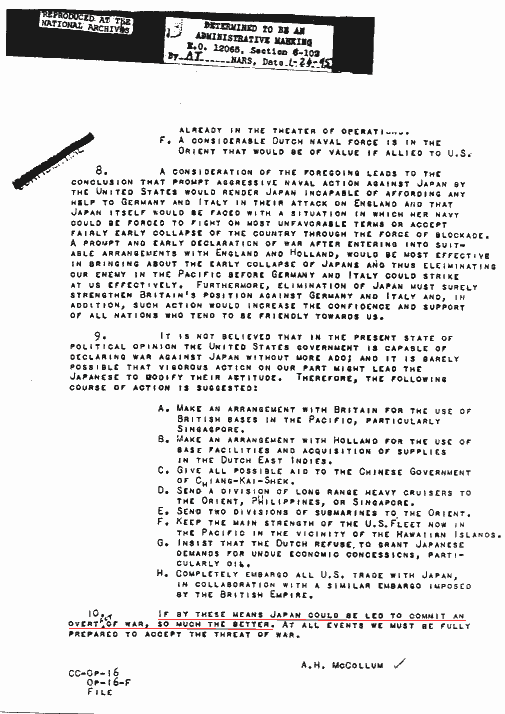
[the actual document as found here - r-click, new window for readable sized view. Red underline on page 4 apparently added to the scan. "Act" being omitted from that line of type but penciled in is in the original.]


BY THESE MEANS: THE CONTENTS
In the first few pages, the less famous major portion, McCollum outlines the world situation, with the totalitarian powers in charge of all Europe except Great Britain, aided as much as possible by the US in her resistance. He mentions attempts to subvert, propagandize, and "confuse" the US into a purely defensive posture, Latin American meddling and Pacific moves by Japan against British supply lines in Asia. Perhaps reflecting the dark times, McCollum actually predicts the USSR will more than likely side with the Axis sooner or later.

To bring the danger home, he predicts that if England should fall, this super-Axis would quite likely attack America next, making war a likely matter of when, not if. McCollum calls for meeting the threat head-on with "prompt, warlike action" in either theater (Atlantic or Pacific). He feels the Tripartite Pact leaves "no ground on which to doubt" the three totalitarian powers will go to war with the US if entering as a full ally of the UK or "should she attempt to forcibly interfere with Japan's aims in the orient." To keep Britain's lines open, he proposed that Japan should be "diverted or neutralized." He then outlines the strategic situation of the US vs. Japanese position in the Pacific, called for detailed arrangements with Britain and Netherlands and a "prompt and early declaration of war."

Finally he wraps it up with point 9, which is what the conspiracy theorists drool over, and not without reason:
It is not believed that in the present state of political opinion the United States government is capable of declaring war against Japan without more ado; and it is barely possible that vigorous action on our part might lead the Japanese to modify their attitude. Therefore, the following course of action is suggested:

A. Make an arrangement with Britain for the use of British bases in the pacific, particularly Singapore.
B. Make an arrangement with Holland for use of base facilities and acquisition of supplies in the Dutch East Indies.
C. Give all possible aid to the Chinese government of Chiang Kai-shek.
D. Send a division of long-range heavy cruisers to the Orient, Philippines, or Singapore.
E. Send two divisions of submarines to the Orient.
F. Keep the main strength of the US Fleet, now in the Pacific, in the vicinity of the Hawaiian islands.
G. Insist that the Dutch refuse to grant Japanese demands for undue economic concessions, particularly oil.
H. Completely embargo all trade with Japan, in collaboration with a similar embargo imposed by the British Empire.

If by these means Japan could be led to commit an overt act of war, so much the better. At all events we must be fully prepared to accept the threat of war.
In essence, then, the McCollum memo offers a list of actions proposed because Japan wasn't changing and more "ado" would be needed before FDR was "capable" of declaring war. Hawaii is mentioned. An overt act of war is mentioned. It would be hindsight historicism to just draw a straight line between them, but there they are side-by-side: The fleet at Pearl is in fact in the list of "means" by which Japan might be "led" to "do some fool thing," as FDR once put it, and start a war on the Pacific.

The troubling phrase "so much the better" implies two things to me:
1) It's not the main purpose. To be "better" is to be other than the thing you've been referring to. The main purpose seems to be to prepare for war in the Pacific since it should and perhaps might materialize soon.
2) Better implies it is to the same ends as the main purpose. The whole thing is about war, and how to get into it. Having them fire the first shot would be "better" than us doing it, from a legalistic and moralistic perspective.

Just from the contents, the Eight-Action Memo (as it’s also called) does not look anything like a finalized ‘blueprint’ for the ultimate Pearl Harbor provocation plan. It is however instructive of the type and level of thought going on in Washington at the time, and could with the smallest shift of view become such a template for tragedy, as Stinnett’s and my own and others’ gut reactions to the memo testify.

RIPPLES THROUGH REALITY
This telling packet was of course addressed to, and intended to be seen by, DNI Anderson, at the very least. Stinnett claims it was also addressed to Dudley Knox, an ONI strategist of great repute, who left his mark as having seen it. Knox endorsed McCollum's proposal in general but, in forwarding his thoughts to Anderson, added the caveat “we should not precipitate anything in the Orient.” [3 - see also document above, page 6] Beyond this, Stinnett could find no paper trail for the document, aside from a diary entry from Assistant Secretary of State Breckenridge Long - dated Oct 7 1940 - that he felt “little by little we will face a situation which will bring us into conflict with Japan.” This had been triggered, Stinnett sums, when he that day “learned of a series of steps involving the US Navy and that one included concentrating the fleet at Honolulu.” [4]

There are also less direct clues of this thinking bleeding into the following 14-month string of ‘fatally flawed’ real-world decisions regarding Japan. FDR was reportedly fond of the idea, as proposed in action D, of putting some US vessels outside their normal zones and into areas of Japanese interest. CNO Stark recalled the President favoring “pop-up Cruises,” saying something like “I just want them to keep popping up here and there and keep the Japs guessing. I don’t mind losing one or two cruisers, but do not take a chance on losing five or six.” Three such missions, including to a prime IJN training ground near Honshu, were carried out from March-July 1941. All ended without any overt act of war. [5]

In late July action H was more nearly approached – by a leap and not a step – with an embargo on the most vital petroleum exports to Japan. The oil embargo is universally accepted as one of the prime factors toppling their equilibrium irreversibly towards major war in SE Asia, at least sooner than otherwise would happen. I'm not conversant enough with the details of which other actions were followed, but action F, keeping the Pacific part of the US Fleet at Hawaii, was faithfully held to for the duration. At the time, the prime obstacle to this was the man tasked with defending the fleet while there – CinCUS Admiral James O. Richardson. He had earlier butted heads with the President personally over the issue, and As McCollum typed his points, the Admiral was en route to Washington for one last talk with FDR.

THE DAY AFTER: RICHARDSON GETS A WHIFF?
Direct evidence that the President ever read McCollum's memorandum is not known, but its prime addressee, DNI Anderson, was a close military adviser to the president, and Stinnett reports that McCollum himself was a regular routing officer for Navy intelligence to be delivered to Roosevelt, often directly and in person. [6] The exact relationship between these proposals and any White House policy would be interesting but at present impossible to know. It could be that these ideas directly shaped an unwritten policy we don't know of, or that they helped in some aspects to form a nebulous plan. It may have offered more a mental framework or attitude than it did concrete steps, and it's quite possible that FDR was already in that groove and just asked McCollum to write up something to help clarify the issues and options. That it never even reached the boss himself is possible, but somehow seems doubtful.

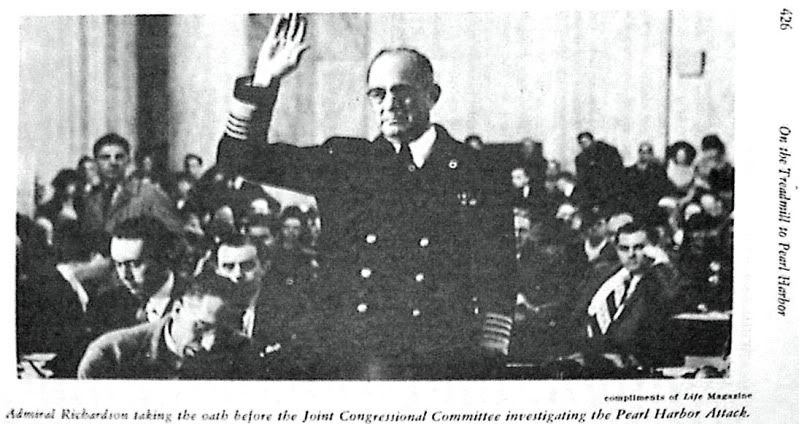
The connection Stinnett drew, and that I feel worthy of consideration, is with FDR's meeting with Adm. Richardson on October 8, the day after he had perhaps read the memo. “Jo” Richardson was back at the President’s request, which itself offers a clue the memo was perhaps requested by FDR. By the Admiral’s recollection they essentially just argued the same points as in July, and FDR was even more adamant that the fleet was exerting a deterrent effect in Hawaii and must stay, no matter what the CinCUS said. More intriguingly, Richardson recalled this meeting for the Congressional investigation in 1945, and mentioned:
Later I asked the President if we were going to enter the war. He replied that if the Japanese attacked Thailand, or the Kra peninsula, or the Dutch East Indies we would not enter the war, that if they even attacked the Philippines he doubted whether we would enter the war, but that they could not always avoid making mistakes and that as the war continued and the area of operations expanded sooner or later they would make a mistake and we would enter the war. [7]
Where might such a potent mistake be goofed into existence? Even the Philippines wouldn’t do it, so he wasn’t thinking Guam, or Johnston Island, but something would eventually suffice for war… this leaves as candidates Panama, California, Alaska, Seattle…. Oh, Hawaii…

[as published in On The Treadmill to Pearl Pearl Harbor: The Memoirs of Admiral James O Richardson]

Admiral Richardson held back from the Committee, but published in his memoirs, a note connected to this statement about a 'mistake': "This caused me to think that he meant sooner or later the Japanese would commit an overt act against the U.S., with the result that the citizens of the United States would be willing to enter the war." He followed this with a damning estimate of the President's "real intentions or beliefs in the matter, which were that we would be at war with Japan in due time, and that he was willing for some ship of the Navy to be the victim of a Japanese “mistake.”" [8]

Thus a seasoned and patriotic Commander-in-Chief’s real thoughts after meeting the President disturbingly complement the gist of the McCollum memo as seen by 21st century paranoids. And the thought was formed the day after the memo was written. That the President himself likely saw the paper just before the Admiral comes as close as anything to showing the mood set with those eight actions ran right through FDR on its way down that treadmill to Pearl Harbor. He's asserting the new mooring was a deterrent, when it had just been explicitly outlined as a "means" that could possibly "lead" Japan to an "overt act of war." That is not called a deterrent, except in euphemism. He's also leaving a roughly Hawaii shaped blank spot in the list of places a Japanese “mistake” might in fact mean war, as he insisted on keeping that hole filled with the fleet. We cannot at this point know if these two strands are directly connected. But if they are, that's about all you'd need to know. It's an awfully big question mark.

---
Addenda

FOIA: Considering how well the above fits, and the general unreliability of Stinnett, I'm wondering if the memo is authentic after all. I am planning (but have not yet filed) a Freedom of Information Act request with the National Archives to see if I can verify it or get a negative hit. News will likely be a bit slow and will get its own post, with a link in this space, so bookmark it!

Response to review of Day of Deceit: I just read Phil Jacobson's pan and I'm sure he's primarily correct on radio silence, naval codes, and other points. However his take on the memo was weak. Here I'll respond point-by-point:
One of the centerpieces of his argument is an October 1940 memorandum by then Lieutenant Commander McCollum of ONI in response to the September 1940 signing of the Tripartite Pact by Germany, Italy and Japan and not as any blueprint for initiating war with Germany and Japan.
Au contraire [sp]... The response was to exploit the treaty to enter the war. "Prompt warlike action," the eight actions, all against Japan, with "an overt act of war" as a bonus, but either way we'd be at war, prob. against all three Axis powers.
McCollum recognized the danger to the western powers if Japan was able to connect up with Germany and Italy through Asia and suggested eight actions designed to contain Japan generally and to keep her from making such connection with its other Axis partners.
Kinda - there's no talk of 'linking up,' but rather a joint closing of Britain's supply lines, Euro-Axis at Suez, Asia-Axis at Singapore/etc. area. 'Contain' is actually referred to as 'divert' and 'neutralize.'
Unfortunately, the book seizes on an off hand comment that is not one of the main points of the memo as the springboard for its conspiracy theory. That comment was if the eight proposed actions designed to contain Japan should by chance cause Japan to commit an overt act of war, so much the better.
Yeah, that's not the main goal, it's better than it. Better than what? Unprovoked "prompt warlike action." Us entering as aggressors without being attacked first. These are clearly the two desired outcomes, one being better.
No proof of any official implementation of this mid-level memo is provided.
No proof that it was only "mid-level" is provided, nor that it was not acted on, or considered among other points in the President's mind.
Furthermore, Stinnett improperly ascribes McCollum's office as "an element of Station US (by which he means OP-20-G), a secret American cryptographic center located at the main naval headquarters" in an effort to tie McCollum closer to OP-20-G than he actually was before WWII.

Probably correct, sounds like a Stinnett move.
A non-cryptologic fallacy of the book is the fact that Roosevelt had no assurance that Germany would declare war on the U.S. if the Japanese did attack Pearl Harbor thus negating any reasonable conspiratorial design to get the U.S. into war with Germany by forcing Japan to attack the U.S.

How is that a fallacy? He had no guarantee, per se, but doesn't a good leader ever take a calculated risk? McCollum had in fact worked against this fallacy, in the memo in question, by pointing out the Pact leaves "no ground on which to doubt" the three totalitarian powers will go to war with the US if entering as a full ally of the UK or "should she attempt to forcibly interfere with Japan's aims in the orient." And that's exactly how it went down.
---
Sources:
[1] Stinnett, Robert B. “The Pearl Harbor Deception.” Presentation at the Independent Institute. December 2, 2002. http://www.independent.org/newsroom/article.asp?id=127
[2] Stinnett, Robert B. Day of Deceit: The Truth about FDR and Pearl Harbor. New York. Touchstone. 2000. Page 8.
[3] Day of Deceit p 9
[4] Day of Deceit p 14
[5] Day of Deceit p 9-10
[6] Day of Deceit pp 8, 15
[7] Pearl Harbor Hearing, Part 1, pp. 265-68. As cited by Richardson, Treadmill (see below) p 428.
[8]. On the Treadmill to Pearl Harbor: The Memoirs of Admiral James O. Richardson, Admiral, US Navy (retired) as told to Vice Admiral George C. Dyer. Naval History Division, Department of the Navy. Washington D.C. 1973. Page 427.

Tuesday, February 6, 2007

THE BUSH FAMILY 12/7-9/11 CIRCUIT {masterlist}

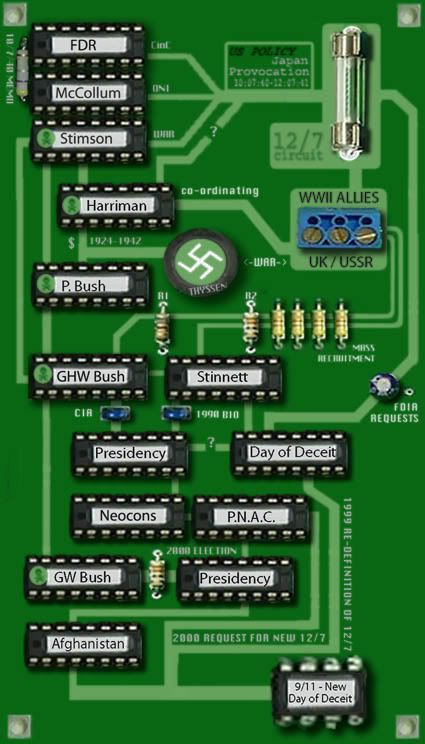
In the course of my research on 9/11, the "new Pearl Harbor," and its namesake original, I stumbled across an intriguing confluence of events suggesting the crafting of a backdrop "New Day of Deceit" myth - whether intentional or not - by the people surrounding George Bush sr. This became one of my favorite discoveries, and along with an earlier and sinister "perfect Bush circle" surrounding America's entry into WWII, here is the double loop in chart form I did up as a circuit board. Beneath that, find a brief explanation for the elements of the chart and the connections between them. Follow the link for more detailed sub-potst.


The Elements of the Chart:
President (FD) Roosevelt, Secretary of War Henry Stimson, and possibly Roosevelt's adviser and ambassador W. Averell Harriman (among others) acted on the Japan provocation plan put forth by Lt. Commander Arthur McCollum at the Office of Naval Intelligence. The eight-point plan solidified existing intentions to bring down the Pearl Harbor attack and give the US an excuse to officially enter the Second World War on the side of the British and the Soviets. In addition to fighting the Nazis and their Japanese allies, the attack allowed the creation of an enduring "military-industrial complex" among its other profound transformationsof American society and economy with effects up to the present time.

War Secretary Stimson meanwhile was a friend of the Bush family, originally headed by Samuel Bush, a muscleman who helped make sure weapons were shipped right for the World War I effort, a sort of proto-military-industrial complex/Merchants of Death kind of guy. By 1940 the family was headed by Samuel's son Prescott, a businessman and senator who maintained ties with Stimson. Bush was also a business partner in Averell Harriman's investment banking firm, involved along with Harriman's brother in the subsidiary Union Banking Corp. that was helping finance the Nazi war machine via Fritz Thyssen until forcibly shut down in late 1942.

Among those young Americans by then called to service in the War effort unleashed by 12/7 was Prescott's son George H.W. Bush (named after Prescott's father-in-law and Harriman-related business partner George Herbert Walker). Another young recruit, Robert Stinnett, served together with Bush in the same aerial reconnaissance unit on the USS San Jacinto. Whatever connections they formed were nurtured with Stinnett's authoring of "George Bush, his WWII Years" in 1990, used as a GOP fundraiser for Bush's re-election campaign in 1992. (hence the link from Stinnett to Bush as president). Stinnett dropped hints about his coming Pearl Harbor thesis in this paen, and after visiting Bush in the oval office, his investigation (coincidentally?) skyrocketed and formed into the groundbreaking Dec. 7 1999 Day of Deceit, which for the first time cited McCollum's plan and in my opinion finally gutted the official story, a victory he started rehashing every December 7 with a reminder article - they provoked and allowed what could well be called a "catastrophic and catalyzing event."

Ironically, Day of Deceit was first published just as the Project for the New American Century was getting serious with its military ambitions, in September 2000 prominently noting the utility of a "new Pearl Harbor," just months after Stinnett had re-defined the term to mean a provoked event designed to transform american opinion. This group is dominated by former Bush sr functionaries (Cheney et al, the hawk "renegades" we're told) and was forming the advisory basis for the presidency of Bush's son. Then they oversaw the most spectacularly acute failure of defense in American history - a new Pearl Harbor in spades - after alleged intense provocations in Afghanistan in mid-2001. Will a McCollum memo from January 2001 surface one day?

A curious and perhaps telling footnote to all this is Stinnett's about-face on Pearl Harbor in the period after 9/11. Perhaps it's simply a coincidence, but as questions over what Bush knew began to arise in 2002, Stinnett's argument and questions changed significantly, no longer mentioning the McCollum memo or provocation. There seems to be no problem with the solidity of his case, so why the back-off? Did someone get a pang of "degrees of separation anxiety?" If this sound silly to you, just take another look at that circuit board above and think about it. It's gotta mean something.

Perhaps the crafting of an ephemeral, controllable, limited-time-only official conspiracy theory? In what context could it possibly make sense to imply that they provoked and allowed the attack? Are they pleading to a lesser crime since they know they physically did it themselves? Is the New Day of Deceit designed to cover for Shadow 9/11 by providing a more logical explanation for the attack's success that still keeps external terrorists center stage?

Monday, January 1, 2007

NEVER MIND: STINNETT DROPS THE ISSUE

PROVOCATION ERASED, MCCOLLUM MEMO RE-CRYPTED
Adam Larson
Caustic Logic/The 12/7-9/11 Treadmill
December 26 2006


Day of Deceit author Robert Stinnett is a research fellow at the Independent Institute, an Oakland, CA-based conservative libertarian, anti-big government think tank. In addition to hosting Stinnett and his Pearl Harbor case and publishing books like “Against Leviathan,” they also feature as a fellow 9/11 skeptic and former Reagan economist Paul Craig Roberts. Via the Institute, Stinnett started to repeatedly explain and promote his arguments from Day of Deceit, starting with an event in May 2000 called “Pearl Harbor: Official Lies in an American War Tragedy?” [1] Later that year he wrote a commentary published to mark the 59th anniversary of “December 7, 1941: A Setup from the Beginning.” This piece explicitly mentioned “McCollum’s secret memo dated October 7, 1940, and recently obtained through the Freedom of Information Act.” He cited its eight points, the “centerpiece” of which was “keeping the might of the U.S. Fleet based in the Territory of Hawaii as a lure for a Japanese attack.” In this original piece, he listed two specific questions “at the top of the foreknowledge list: (1) whether President Franklin D. Roosevelt and his top military chieftains provoked Japan into an “overt act of war” directed at Hawaii, and (2) whether Japan’s military plans were obtained in advance by the United States but concealed from the Hawaiian military commanders, Admiral Husband E. Kimmel and Lieutenant General Walter Short so they would not interfere with the overt act.” [2] That is, the failure to intercept warnings was intentional and secondary to the provocation.

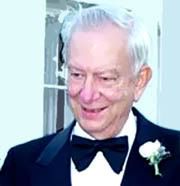
Robert Stinnett, if I'm not mistaken, at the White House in 1990
This December 2000 piece set a trend for anniversary commemorative articles. On the 60th anniversary of Pearl Harbor and just three months after 9/11, he published “Pentagon Still Scapegoats Pearl Harbor Fall Guys.” Again he posed the same two questions – was it provoked, and did they intercept messages. Again he made largely the same arguments as the previous year, prominently mentioning and explaining his exclusive evidence, the McCollum memo. [3]

But then something changed in 2002, curiously at just the same time the post-9/11 world and its questions of what Bush knew began to sink in. We can see a shift in direction in that his speech that year was five days early, on December 2. Still boldly titled “The Pearl Harbor Deception,” it was different in two ways than his presentations before 9/11 – First, his two questions had changed, now omitting provocation. “Two questions about the Japanese attack on Pearl Harbor have ignited a controversy that has burned for 60 years: Did U.S. naval cryptographers crack the Japanese naval codes before the attack? Did Japanese warships and their commanding admirals break radio silence at sea before the attack?” the second change I noticed is the lack of any reference to McCollum’s memo; he was leaving out what was the core of his argument, the primary thing that made it HIS argument. He was surrendering his edge. [4]

This was followed quickly by “The Truth about Pearl Harbor,” a January 30 2003 debate held at the Institute between Stinnett and foreknowledge denier Stephen Budiansky. It should be easy enough for Stinnett to win, since Budiansky argued the government line by citing only the old evidence, almost strictly code breaking (which he wrote the “complete” book on, as well as a book called “Closing the Door on Pearl Harbor”). Stinnett could have sunk Budiansky’s argument by illustrating the secondary nature of foresight when one is actively provoking something. Yet he did not, and played Budiansky’s game, keeping the very boring and tedious debate at the level of codes and of personal attacks over credibility. His presentation seems to consist of his December article, a word search of which shows that the name McCollum pops up, but only as a “James A. McCollum” cited as a source in the debate on code-breaking. The date of the memo, its author, its eight points, are totally absent. The words “provoke,” “provocation,” and various synonyms reveal nothing but the admission in the opening remarks by David Theroux that Stinnett had previously argued that “U.S. government leaders at the highest level not only knew that a Japanese attack was imminent, but that they had deliberately engaged in policies intended to provoke the attack.” In his “presentation” that day, Stinnett made no such argument. [5]

I'm sure he had very good reasons for the shift in course, but I can't say for sure what these are. It could be a case of someone finding out that the McCollum memo was maybe a forgery, forcing Stinnett to back off from it pending an investigation. I haven't heard of anyone from the swollen ranks of the 12/7 coverup apologists pointing this out, however, and to the best of my knowledge, the memo remains solid. The reason for dropping the issue could also be someone suffering "degrees of separation anxiety" and urging Stinnett to back off the hard case and leave Pearl Harbor intact.

He did, however, intriguingly point out in this twice-presented piece that “immediately after Day of Deceit appeared in bookstores in 1999, NSA began withdrawing pre-Pearl Harbor documents from the Crane Files housed in Archives II. This means the government decided to continue 60 years of Pearl Harbor censorship. As of January 2002, over two dozen NSA withdrawal notices have triggered the removal of Pearl Harbor documents from public inspection.” How ironic then that at about this same time Stinnett also started to censor himself. Though his book is still available and not removed from view at all, it’s as if Stinnett is trying to forget his core argument, or at least to stop reminding anyone of it. According to the Independent Institute’s website, Stinnett has written no more commentaries and given no more presentations in the four years since his forfeited debate with Budiansky. He seems to have retired from his pre-9/11 mission, and as far as I can tell he’s not spoken or typed the name Arthur McCollum since December 2001.

sources:
[1] independent Institute. Research Fellow: Robert B. Stinnett. http://www.independent.org/aboutus/person_detail.asp?id=514
[2] "December 7, 1941: A Setup from the Beginning." December 7, 2000. Robert B. Stinnett. Honolulu Advertiser. http://www.independent.org/newsroom/article.asp?id=103
[4] "Pentagon Still Scapegoats Pearl Harbor Fall Guys." December 7, 2001. Robert B. Stinnett. Providence Journal. http://www.independent.org/newsroom/article.asp?id=400
See [1].
[5] "The Truth About Pearl Harbor: A Debate." January 30, 2003 Robert B. Stinnett, Stephen Budiansky. http://www.independent.org/issues/article.asp?id=445
[6] http://www.independent.org/newsroom/article.asp?id=103

Sunday, December 10, 2006