Showing posts with label Feraday. Show all posts

Saturday, November 28, 2009

LIGHTLY EXPLOSION-DAMAGED

Two Scientists, a Purple Bag, and a Possible Clue
[Pan Am 103 Series]
Adam Larson / Caustic Logic
November 29 2009


Going through the court transcripts of the Lockerbie trial at Camp Zeist, one point of interest that I ran across concerns the testimony of RARDE scientist Allen Feraday. This was on June 15 2000, day 21 of the trial (read the LTBU daily report in .doc format, outlining some of the controversies). The witness himself reportedly has little in the line of formal qualifications, citing a “higher certificate in applied physics” as his qualifications; He’s still conceivably capable of brilliant professional work; but judging by some previous high-profile anti-terrorism cases he’s been involved in, he could be seen as more of a “manager” of evidence than a reasonable assessor of it.

Feraday’s scientific findings relating to the Lockerbie investigation are inextricably linked and confused with those of his underling, Dr. Thomas Hayes, who has a proper PhD. I don’t know the arrangement, but Ferraday mentions analysis of the luggage and clothing that “was essentially done relatively early on, by Dr. Hayes, and then, obviously, checked by me.” (p 3328) The two are more famous for their handling of the miraculous timer fragment PT/35(b); Hayes found it in a shirt collar and alerted Feraday, who passed the news on to Williamson, and thence to Henderson, Marquise, Thurman, “Orkin” and the history books. In testimony Feraday also clarified the interchangeable nature of their collaboration “I did not always, when I was looking at [evidence], make any difference between myself and Hayes” (p. 3332)

The prosecution generally seemed to feel the same way; their habit of asking questions of Feraday better suited for the earlier witness led Mr. Keen to lodge for private audience with the judges. Once Feraday was sent from the room, Keen argued in part:
According to the evidence of this witness, he prepared the final report on the basis of his examination of certain matters, and by considering Dr. Hayes' notes. What my learned friend appears to be inviting is hearsay evidence […] I object to the Crown canvassing hearsay evidence, even in the context of what is referred to as a joint report, in respect of such a matter. If they wish to take direct evidence on this issue, then they had ample opportunity of doing so with Dr. Hayes. And in my submission, it is not competent for them to take hearsay evidence on this matter from Mr. Feraday. (pp 3215-3216)

Nonetheless the questioning continued in a similar line, a hundred pages later coming to my point of interest, the unusual collaboration on another piece of evidence: a damaged piece of luggage, described as “a purple-coloured holdall” and labeled PH/137. This bag, Feraday had wrtten in his final report of 1989, had within it two metal fragments “which both originate from the primary IED suitcase,” so it should be of some interest. Mr. Keen for the Defense addressed Dr. Hayes' draft report during his questioning of Feraday. He cited page 23 as listing categories including "Likely Explosion Damaged Luggage,” and noted that one item listed in that heading is PH/137. Feraday confirmed these facts while comparing with his own copy.
Q So from Dr. Hayes' draft report -- and I think you just told us he prepared this part of the report -- we can see that he designated this as explosion-damaged luggage?
A I think it was lightly --
Q Lightly explosion-damaged luggage?
A Yes.
(pp 3330-3331)

This attitude would help explain Feraday’s own notes, Production 1498, in which Keen noted “that nowhere in the index” and in fact “nowhere in your examination notes does the item PH/137 appear.” The witness confirms to both “that's correct, sir. Yes.” Of course lightly blast-damaged was a fudging statement and further probing shows him to believe it wasn’t in the explosion damage at all. Next Mr, Keen pulled up a photograph of this item. (Production 181, photograph 91)
Q It is apparent, is it not, Mr. Feraday, that you have not signed the label as it is photographed in photograph 91?
A That's correct, sir. Yes.
Q But your signature now appears on the label PH/137 in court?
A Yes, sir.
Q When did you sign that label, Mr. Feraday?
A When I had the bag back to write this -- the final report.
Q And what date was that, Mr. Feraday?
A I can't tell you without looking it up again on a list, I'm afraid.
Q Are you saying that that was before December 1991?
A I think it must be, yes. I finished the report by then, so yes.
Q And are you saying that you examined PH/137 before you finished the report?
A Yes, sir.
Q Where are the notes of that examination, Mr. Feraday?
A Well, there aren't any, because as I said, I did not always, when I was looking at them, make any difference between myself and Hayes -- although in this instance I did, and I told him so, that in my opinion you couldn't necessarily put that in the explosion damage. I couldn't convince myself that it was explosion damage. Prior to that, Hayes had written this preliminary report for another purpose -- I think the Fatal Accident Inquiry --
(pp 3331-3333)

So if I’m reading this right, he disagrees with the actual PhD scientist, but did no detailed, documented, admissible examination of his own to back this up. He couldn't recall when he made his divergent inspection, but did immediately recall that he made no notes for it. His lack of notes in turn is justified "because" they agree on things, "although" not in this case. Got it.

Notes or not, the reason for Feraday’s divergence seems to be an unexplained lack of conviction, with which Hayes lodged no disagreement:
Q And you recall --
A Sorry, I'm waiting for the --
Q I don't think you had finished, Mr. Feraday, so do finish your answer if you wish.
A Sorry. I came to the conclusion that I couldn't myself put it in the explosion – necessarily in the explosion-damaged baggage. I'm not saying it isn't, but I couldn't convince myself. And I still can't. And for that reason, I had a word with Hayes, and we agreed to put it in the second section.
Q So you -- you recall discussing this with Dr. Hayes, do you?
A At some stage I discussed it with Dr. Hayes, but I can't remember exactly when or if, in fact, it was when the -- I wrote the final report. And then Hayes certainly came in, obviously, and read it all and then signed, and we went through each item then. We through the report, if you like, line by line.
Q Line by line, Mr. Feraday?
A Well, he read through it, obviously, line by line.
(pp 3333-3334)

This implies no disagreement; Hayes was able to check Feraday’s findings and found no problem with the exclusion of PH/137 that Feraday had already decided on and reported. Next, Mr. Keen turned to Feraday’s given reasoning, in that report, to support his agnosticism.
Q If you would like to turn for a moment, Mr. Feraday, to your report 181 at page 51.
A Yes, sir.
Q Now, we can read this section for ourselves, but I'd like to look in particular at the third paragraph on that page, which you corrected during your examination in chief chief [a meeting just before his questioning - ed] by proposing the insertion, after the fourth word in the first line, of the word "other"?
A Yes, sir.
Q Now, taking the paragraph, of course, in its context, can we read that corrected paragraph. It states: "As there are no other penetration holes in either the holdall or the plastics bag, it appears most likely that these two fragments, which both originate from the primary IED suitcase, were picked up and placed inside the plastics bag, which was then itself
placed inside the purple holdall for convenience of carriage."
A Yes, sir.
Q Now, I have to suggest, Mr. Feraday, that if you insert the word "other" into that paragraph in the context of this section, the paragraph is deprived of sense or content.
A Is ... ?
Q Deprived of any sense or content. It tells us absolutely nothing if you correct it in that way. What do you say to that?
A I am not sure what you mean. But what it would then say is as there are no other penetration -- at the top of the page, I am talking about the ragged horizontal cuts which, obviously, one can see as penetrations. I see them as cuts. Now, in dealing with, first of all, the holdall, there are no other penetration holes in it, other than those that I've already said about the cuts. And in the plastics bag, there were none, the plastics bag which contained the two fragments of metal from the suitcase. So I was left scratching my head as to how they can get inside there, in a plastics bag, if they didn't come through any part of the bag.
Q Do you --
A I can't convince myself they come through the ragged cuts.
Q You recollect the label attached to the plastics bag, Mr. Feraday, having said "two pieces of metal, charred, found within baggage."
A Yes, I do, sir.
Q And you recollect finding penetrations in the side of the bag that went right through to the interior of the bag?
A Horizontal cuts, yes, sir.
Q But you felt it pertinent to remind us that there were no other penetrations in the bag, Mr. Feraday; is that right?
A Not big enough for the -- for anything to do with the two pieces of metal. That's correct, sir, yes.
Q But the penetrations you'd already found were big enough for the penetration of the two bits of metal?
A Oh, yes, sir.

Q Well, that might be an appropriate point, My Lords, if there is to be a short adjournment.
LORD SUTHERLAND: Yes, very well. We'll adjourn for 15 minutes.
(3334-3336)


I can only paraphrase Michael Palin in The Holy Grail “what a strange person.” Mr. Feraday’s stated reasoning then seems to be that even though these shards could fit through the penetrations if explosively hurled there, he couldn't convince himself this was what happened and chose to think of them as surface "cuts." Who knows what caused these cuts - perhaps the hold-all fell through a tree before landing. And the two unrelated IED suitcase bits were found elsewhere and simply put in the bag far carrying, with no note about being found elsewhere. His report first supported this saying there were "no penetrations" in the bag, corrected only in his examination in chief (a meeting just before his questioning) to "no other pentrations," aside from the "cuts" that they probably did enter through.

His references to the plastic bag is curious. This would clearly seem an ad hoc evidence bag (probably not a proper one or he’d teerm it as such), into which the shards were placed after being found. This would be a careless and illogical move, but I don't see anything else making sense. Transferring these also into a bag they weren’t found in makes this faux pas worse – something Mr. Feraday should have reported rather than just using it as he did to remove the explosion from PH/137. A lack of damage to this evidence bag is also cited as a clue these didn't fly in thru the cuts: “[T]here are no other penetration holes […] in the plastics bag […] which contained the two fragments of metal from the suitcase. So I was left scratching my head as to how they can get inside there, in a plastics bag, if they didn't come through any part of the bag.” This in particular is a ridiculous non-sequitur, but another clue to Feraday this was not explosion damage.

In the most rational explanation for this thought process, perhaps he just meant, "obviously, the bomb didn't put these metal shards in the plastic bag, one of our people did. Therefore, they probably got the scraps from somewhere else, but threw them in there instead." And perhaps if we could see the evidence we'd see why he felt the shards did not just enter through the tears. But for whatever intention, he effectively erased this piece of evidence from the bomb site picture – where Dr. Hayes had already placed it - based on his unexplained solution.

Although he comes across looking incompetent – nearly always looking at the wrong exhibit and frequently befuddled - I suspect Feraday is not actually an idiot. Therefore, if he seems like one, he may be playing dumb and that's often a clue. However I simply don't have the information to know just what this might mean. Detailed information on loading procedures at Heathrow could tip us off to where this bag might have wound up. Was the location of this item relative to, say, the Bedford suitcase, troubling in some way? Considering Feraday's strained logic over this issue, I suspect we may be looking at a valuable clue, if just another on the pile indicating he was not playing on the level with this investigation.

Friday, October 23, 2009

PT/35 MOVE CLAIMS, pt. one

"IT WAS NEVER IN THE UNITED STATES?"
[Pan Am 103 Series]
Adam Larson / Caustic Logic
October 23 2009
last update 10/28


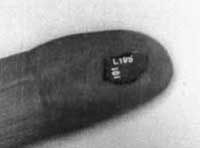
The recent hubbub regarding overly-mobile Lockerbie evidence started with Dutch journalist Gideon Levy’s early 2009 video Tegenlicht: Lockerbie Revisited. It’s a well-made video, with good music, some informative bits, and an unusual format of having interviewees watch and respond to recordings of others. Its prime focus was the crucial evidence PT/35(b), the Mebo timer fragment “tying” the bombing back to Libya. It’s therefore a little embarrassing that Levy announces another famous fragment, of general Toshiba circuit board displayed on a fingertip – as the article in question. This confusion surfaces elsewhere in the film, but manages to not become a big deal.

The main attraction that has generated some buzz was a curious discrepancy revealed and captured regarding the whereabouts of this historic find during the course of the investigation. As evidence from Scottish soil it was, should have been, in control of the Scottish police investigation, headed by the Senior Investigating Officer (SIO), a spot first held by Detective Chief Superintendent (DCS) John Orr (Strathclyde police, now Sir John Orr), and then by Orr's deputy, DCS Stuart Henderson (Lothian and Borders police, whom we meet below). The Scots would work in tandem with – but not give their evidence to – the American FBI's task force for the "SCOTBOM" investigation.

Officially the fragment was definitely taken outside Scotland - in the proper hands - to a RARDE lab at Kent, England and, as we’ve more recently had confirmed, to a private lab in Germany, both times for forensics testing. The understanding of then-Lord Advocate Lord Fraser of Carmyllie, which should have been quite good: “As far as I’m aware it’s always been in the UK,” he told Levy’s camera in 2008. He obviously didn’t know everything.

Besides the trips to England and Germany, which neither Lord Fraser nor Gideon Levy seemed aware of, there’s an alleged journey by this little blue key across the big blue sea to the United States. In the first of two interviews with Levy, FBI SCOTBOM chief Dick Marquise casually states that this one crucial piece of evidence, and nothing else, physically was brought to the FBI’s main lab in Washington.
“I’ll just tell you, not one piece - no I shouldn’t say that – the evidence – no, I’m not choosing my words carefully, I just want to make sure I say the right thing – all the evidence that was found in Lockerbie never made its way to be examined by the FBI laboratory. PT/35, as far as I remember, was the only piece of evidence that made its way to the laboratory, in the possession of a RARDE examiner. He brought it, he did the comparison, and he’s a scientist, and he took it back.”

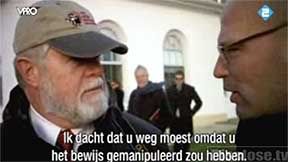
Well that's an interestingly worded twist to the story. FBI Special Agent James “Tom” Thurman, the man publicly credited with making the identification of the fragment as from a Libyan-supplied MST-13 timer, on June 15 1990, also made an appearance. Levy caught up with him, wearing his years well in retirement, at a December 2008 ceremony to marking the 20th anniversary of the Lockerbie disaster. Levy came across a bit wormy, in my opinion, using the solemn ceremony mostly to make Thurman squirm and deny he was dismissed from the FBI for altering evidence. More to the point, he challenged Thurman if comparing with a photo – as he has previously stated – was really scientific. Thus provoked, he responded:
Thurman: I did the real thing ... I had the real piece of evidence.
Levy: That pointed to Libya.
Thurman: Absolutely. Absolutely. The photograph was the first thing, then the real piece of evidence was brought over. And at that point –
Levy: It was – it was on your finger, the chip was on.
Thurman: At that point - then there was a one-to-one identification made. The real piece of evidence, to the timer, the MST-13 timer, was made in the FBI laboratory. It wasn’t just a photograph. The photograph started it, and then the authorities from England brought over the real piece of evidence. That piece of evidence was examined in the FBI laboratory, along with the MST-13. That examination was verified in the forensic science laboratory, in England. So, it wasn’t only my examination, it was verified by other peoples’ examination as well.
Suspicions condensing around the Thurman link here is natural; PT/35(b) was apparently taken outside normal channels to his lab, and put under the grip of a known manipulator of evidence. Problem is, the charges against him were not over physically altering physical evidence, but for his explosives unit allowing conclusions to be overstated in the prosecution’s favor, in multiple instances unrelated to this one. Agent Fred Whitehurst told Levy how Thurman altered his reports when he deemed that his own political science training trumped Whitehurst’s chemistry smarts.

This will and certainly should cast doubt on Thurman's general investigative even-handedness and his certainties over his own lab work (“I knew we had it,” it "absolutely, absolutely" implicates Libya, etc.). In fact why Thurman was selected is beyond me – any idiot with the two photos could affirm they’re the same, and this selectee has become a real liability. All the rage at the 1991 indictment, he was discredited and never called as a witness by the time of the big trial at camp Zeist in 2000.

But presenting this side-by-side with concerns over the “tampering with” of this evidence once taken somewhere dangerous is quite leading. The fact is, I can see no sign of tampering with the evidence, nor much of a reasons to suspect it. The problem is the thing itself, not where it was taken and who touched it in these dark corners.

At that same chilly cemetery, as the people were leaving to more private venues, Levy caught up again with Mr. Marquise, as it so happened accompanied by his Scottish counterpart DCS Henderson. When standing side-by-side with the prime guardian of that fragment Marquise was of a different recollection altogether from his first interview. Levy was granted an answer to one question, and that's about what he asked, for almost four minutes.
Levy: When I asked Lord Fraser about the circuit board, he said something that contradicted what you said. He said it had never been to the United States. And if it was in the United States, then he would have known.
Marquise: No, I don’t know that I told you the circuit board was in the United States.
Henderson: The circuit board was never in the United States.
Marquise: Let’s back up, we’re talking two different things. There was a circuit board of MST-13 timer in the United States, but the fragment PT/35 was never in the United States. Photographs of it were in the United States.”
Levy: It was never in the United States? (murmured agreement) Oh, I thought it was…
Marquise: No the fragment never came to the United States, but the circuit board was in the United States, because we had the MST-13 timer, which we turned over to the police in Scotland.
Levy: Ah, but but… Tom Thurman, who was here today, also said it was in the United States.
Marquise: No, he never said that.
Levy: No?
Marquise: The fragment PT/35 was not in the United States.
Levy: But it was in England, but it came…
Marquise: It never came to the United States
Levy: It never came to the United States.
Marquise: I don’t believe so – I’m 100% sure it was not here.
Levy: Oh, it has never been here.
Henderson: Never released out of evidence control of ourselves. Couldn’t afford to let something like that …
Levy: I thought it was brought in the possession of Alan Feraday.
Marquise: Feraday’s over in RARDE. He’s in England. It’s in his possession.
Levy: Yes, yes, but I thought he came – I thought you told me that it came in his possession to the United States.
Marquise: I don’t know that…
Henderson: His possession and my possession. But it was never released for any reason (inaudible).
Levy: And who are you?
Henderson: Detective Chief Superintendent Henderson, I conducted the investigation.
Levy: Okay. My name’s Gideon Levy, and I’m from Holland - from the Dutch television. So it has never been in the United States.
Henderson: Confirmed

From the video: Levy, Henderson, Marquise (l-r) discuss whether or not it was ever in the United States. But it wasn't? No, wasn't it?
Levy: At all.
Henderson: Couldn’t be, ‘cause it was such an important point of evidence it wasn’t possible to release it. It had to be contained to be produced to the Court, therefore you couldn’t afford to have it waved around for everybody to see because it could have got interfered with.
Levy: Aha
Henderson: So it was far too valuable to be other than made available – couldn’t be.
Levy: Okay
Henderson: Very valuable piece of evidence.
Levy: (shouting over) But you said it was in the possession of Alan Feraday and brought to the United States.
Marquise: You know, its – you’ll have to talk to Alan Feraday about what he brought to the United States. I don’t remember…
Henderson: Alan Feraday had it in his possession with me, but he did not release it to anyone
Marquise: No, no, no, he said bring it with him. Did he bring it to the, I don’t remember.
Henderson: No, they came to us to see it.
Marquise: Yes. I saw it – I saw it in London.
Levy: Oh, you saw it in London?
Henderson: They came to where we had it, see. Because it wasn’t possible to remove any evidence out of the jurisdiction of the – Scottish control.
Levy: So you were the same – you were the FBI investigator and you were the Scotish investigator. Ultimate inestigators.
Both: affirmations
Levy: Okay.
Henderson: That’s why I’m here, to go and see the relatives.
Marquise: We need to go.
Henderson: We’ll have to go. Pleasure to meet you, gentlemen.
Levy: Thank you very much.
Henderson: And by the way, there is no hidden holes to find because the culprit is in custody. (with a smile and wink) Take my word for it. Okay?

So I would come away from this with an impression that it may well have not been in the United States, whatever Marquise and Thurman said to same guy ten minutes earlier. But I’m weird hat way, denying Henderson’s bait that I imagine was dangling there. A more normal reaction would be to get a little confused, and for many to solve that by taking their own default position. Some would just dismiss this all as faulty memory two decades on, while others will surely latch onto it as more proof of a cover-up, or at least something to make some more noise over.

My main concern with PT/35(b) is that this much-fretted over fragment may have been planted outright to begin with, or at least has been overstated as direct evidence pointing only to Libya. This hullabaloo about where the possible fraud was carted to adds little to an understanding of either level of worthwhile inquiry.

Update, 10/28: Something I saw later that fits best here: Marquise's unacknowledged about face here was short-lived. In September 2009, months later with Henderson not present, he again affirmed an American trip. This was in a response to Gareth Peirce, and sent into Robert Black's blog. I haven't been able to verify it, so do please take a grain of salt:
Once he identified the fragment, he asked Alan Feraday to come to Washington. Feraday brought the original fragment of the timer with him and they both examined it under a microscope. They independently agreed it was identical to the MEBO timer. The fragment was never out of the control of Mr. Feraday and returned with him to the lab at RARDE.


Second update, Nov 24 2009: Mr. Marquise responds to the confusion that indeed the fragment did come to the US, and he and Henderson were both confused by the tone of Levy's Arlington ambush. Again from Black's Lockerbie Blog:
With regard to the "travel" of PT-35-- once again-- it was the sharing of information which led to the solution of this case. If the fragment had remained behind in Scotland, never shared, it would possibly be unidentified today. No one would ever have discovered it was a piece of one of 20 timers given to Libyan intelligence. It is clear no one ever attempted to "cover" that up-- I freely admitted it in my book, Mr. Henderson stated such in his precognition and I again said so to Mr. Levy. My "confusion" at Arlington last December over whether it had come to the US or not, was due more to the tone of the question, the setting and the allegation I may have lied to him when he first interviewed me. Unlike Mr. Megrahi, I do not tell lies when it comes to the evidence in this case. I said it right when Mr. Levy first interviewed me. We had nothing to hide because we did the right thing and there has never, never, never been one scintilla of proof that PT-35 was altered or changed in any way.

Sunday, October 4, 2009

MST-13 COMPARATIVE GRAPHICS no. 1

INVESTIGATORS’ VIEWS, 1989-90
[Pan Am 103 Series]
Adam Larson / Caustic Logic
October 5 2009
last update/edit 11/2/09


In this post I will relate all direct visual evidence, gathered from different sites, relating to the circuit board fragment found in the evidence of the Lockerbie bombing. These should be official photographs and documents, mostly from the British side of the investigation. My sources are a few, but mostly websites run by Mebo, the board’s manufacturers and confusing advocates in the trial and its controversies. At the risk of accepting bad evidence, I will accept these as accurte, if not the commentary, and simply lay them out in approximated chronological order with some of the available information on them.
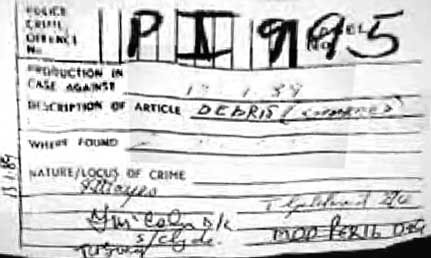
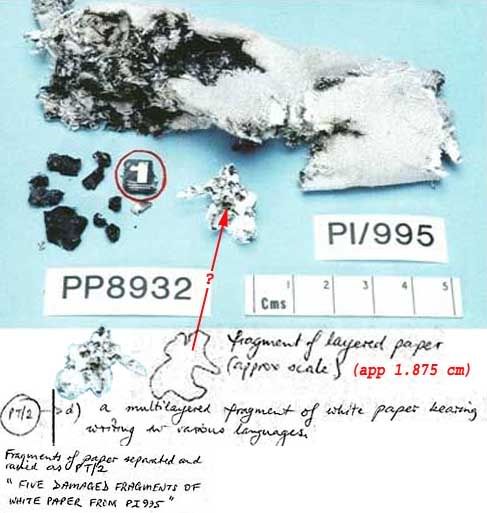
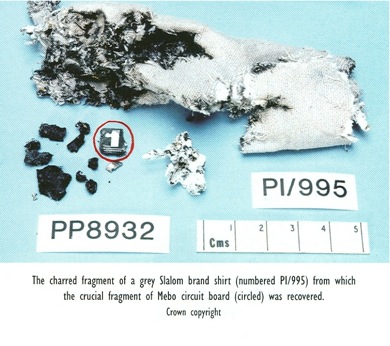
The fragment was allegedly first gathered by DCs Gilchrist and McColm, unseen within a piece of cloth logged in mid-January 1989 as item PI/995, “Cloth (charred).” Anomalously, the label was later changed with “debris” written right over “cloth.” In the 2000 trial, Gilchrist was asked about the overwriting; the judges found his explanations "at worst evasive and at best confusing," but found no "sinister connotation" in this (and neither do I, in particular). Note also how the date (13/1/89 as on the left side) seems faintly penciled in for "introduction in case against," and the loaction found line seems written over with invisible ink. The resolution on these is not good - here I took the full tag and a clearer zoom-in (original images page) and merged them for the best effect.

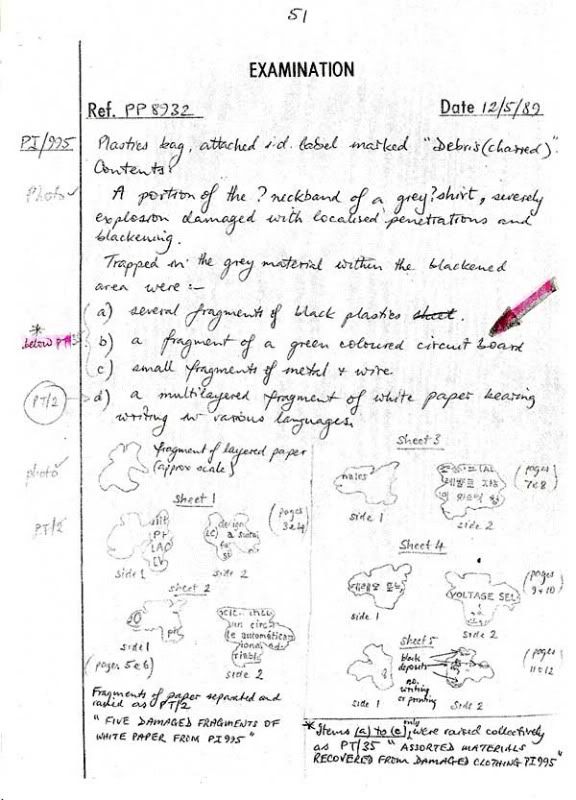
One signature on this cluttered tag seems to be Dr. Thomas Hayes [wiki] of RARDE (Royal Armament Research and Development Establishment), who analyzed this material more closely on May 12, 1989, according to his lab log (on page 51, left - r-click new window for readable view). This was the first mention anywhere of the pivotal timer fragment, as item b) at left. Reportedly, the pages following this in Hayes’ journal were renumbered, which he was unable to explain in later testimony. This could well mean this page was inserted after the fact, as widely speculated, to introduce a backdated paper trail for a later plant. It's a little sloppy to my eyes, and doesn’t add much detail to the record; there is nothing about the board other than a simple note of “a fragment of green coloured circuit board." He offers no drawing, no details. Note that the paper fragments, carefully re-sketched here (five sheets, 2 sides each, lower half of page), were identified early and given the evidence no. PT/2. The exploded electrics of items a-c, on the same page here, are "raised" collectively as PT/35 “assorted materials RECOVERED from clothing PI995.” (caps in original) I think this means 31 pieces of evidence were catalogued between these identifications allegedly noted on the same day.

The first photograph to be taken of the fateful fragment was reportedly taken, on or around September 12 1989, by Hayes, or by “RARDE photographer Heines.” according to different web pages sponsored by Mebo, the board’s confusing makers. (Hayes version, Heines version). This is three days prior to the September 15 Feraday letter (see below), leading some to suspect he took the picture then. Its acual date of capture seems to be prior to Hayes' May 12 entry, as the lumpy shape to the right of the fragment seems to be the paper fragments prior to being separated and drawn therein. The famous photo shows the shirt collar and all the evidence taken from it, with the circuit board chunk circled in red in the publicly available version. Considering the quality of blow-ups possible from this (see below) it is presumably 35mm, and not one of the "polaroids" mentioned below. (Original Image)

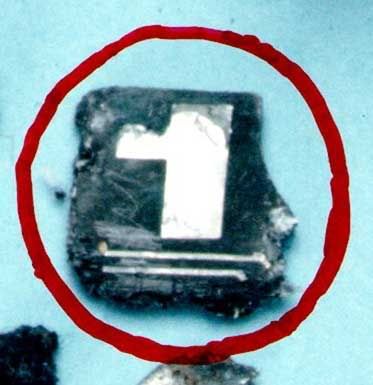
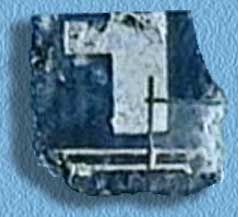
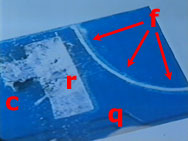
At left is the best blow-up of this available, from a higher resolution original than is up anywhere on the Internet. Here can be noted the “1” shaped touch pad, twin solder lines beneath this, the intact top edge, rounded corner, crumbly edges. The "etched" sideways “M" and "scratches" beneath it have been called clues of forgery, but likely are fibers of fabric like those clustered on the left side. The color of this board's coating plastic, described as green by RARDE people, and as evidently BROWN by Mebo missives, seems to me no particular color, but more precisely off-black or muted dark gray-blue with a slight greenish hue. It's probably supposed to be burnt, so green-blue seems closer than brown. (source)

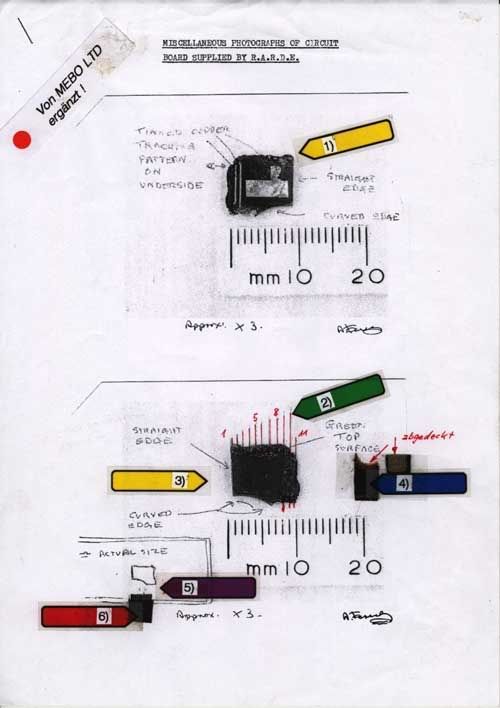
Another to take a crack at this fragment was Alan Feraday [wiki] the director at the time of DERA (Defense Evaluation and Research Agency), who at some point made a study using another shot, straight on, with another view of it flipped over on its back. Using enlarged photos (“approx X 3”), perhaps photocopied on paper, he added notes around the mirror-flipped dark shapes - the following are my best reading:
"straight edge" pointing to the straight top edge.
"curved edge" pointing to curved edge
"trimmed copper" pointing to solder lines. ("track pattern on underside" added)
"Green top surface" pointing to back view.

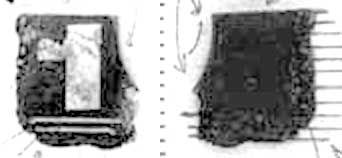
There isn’t much resolution here to work with, but that back view is totally unique. So I used a separate layer with maxxed out contrast to pop out all details (below, right). There seems to be a small bump corresponding to the middle of the touch pad, and some roughness (fracture? bubbling?) around the edges, quite a ways in at bottom and right. Otherwise little can be seen. image source

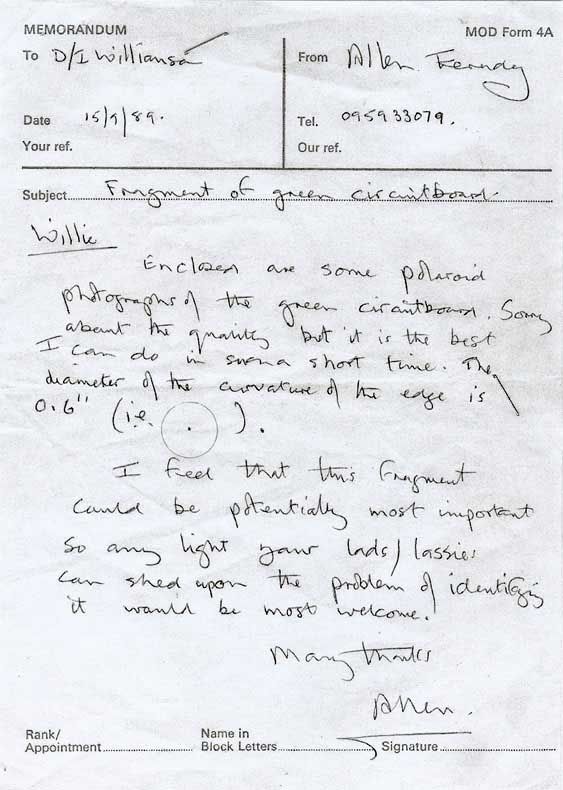
On September 15 1989, judging by the header, Feraday sent a memo to Detective Inspector William Williamson, a counterpart in the Dumfries and Galloway police (along with the FBI, they were the official investigators). This was to explain “some Polaroid photographs of the green circuit board,” which he found "potentially most important," depending on what ID the D&G could come up with. Feraday apologized for the quality of these pictures, noting “it is the best I can do in such a short time.” Some have presumed he was sending the circled photo above, but the use of plural photographs, could mean what he sent was the analysis above, having two photos in it. It’s not entirely clear what the rush was all about or why that precluded better pictures. (source)

Following this is a long gap in the timeline of what I've sorted out, from later '89 into early 1990. Investigators analyzed the fragment (though not for explosives residue), searched for matching board patterns, and so on. According to a Mebo site, on February 8, 1990 “a needle-thin section” was removed from the evidence, apparently for forensics work, “by Mr. French from CIBA-Geigy." Four days later, the site continues,
“Mr. Roderick MacDonald, withness no. 589, had been called into Strathclyde police-station to take some photographs of an allegedly Lockerbie-recovered MST-13 timer fragment with the allocated no: PT/35 (evidence: production no:1754) According to Court-documents, the alleged MST-13 timer fragment PT/35 was at that time no longer in its orginal condition and in one piece!” (source)

For a good trans-Atlantic, Anglo-American (sorry, Scots-American) investigation, it only seems appropriate to bring in some expertise from across the pond. Investigator Paul Foot (Flight from justice, PDF, page 11) reports a July 1990 call from FBI forensic authority and political scientist James "Tom" Thurman [wiki] offering a lead to DCI Williamson on the fragment Feraday told him of. Reportedly Feraday and Williamson both went to Virginia to meet him. Although some have said this fragment was physically taken there, and the controversy recently upped with Levy’s Lockerbie Revisited video, the preponderance of testimony suggests to me, so far, that it was just a photo. I may sort it out in a separate post.

At any rate, Thurman was able to get pictures also of a captured Libyan MST-13 timer and, on June 15 as he recalls (not July as Foot reported) found a perfect match to the fragment from Scotland. He kept some photos on file to show reporters later, including a giant blow-up, heavily blue-tinted, of the fragment, perhaps MacDonald's view. This is shown alongside a comparison board with unfilled solder lines and some odd spatterings off the touch pad. (this Mebo photo seems to be the same board Thurman compared to, here in odd color, a different angle, and labeled). The image at left also is from a Mebo graphic, with the backdrop only altered by me for aesthetic reasons. (Original Image) This is the earliest view I know of showing he top sliver missing, as well as the lower right corner cut out or at least deeply scored. Otherwise, it appears to be the same piece, if perhaps a bit bluer, probably due to photo tinting. Also note, the “M” is missing, supporting the idea it was a transitory fiber since cleaned off.

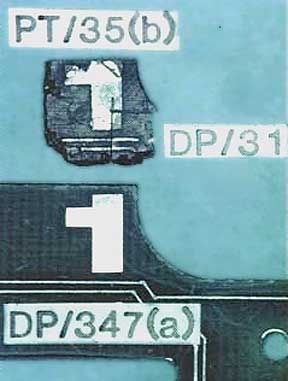
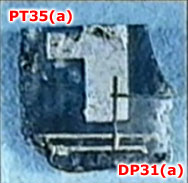
I’m still vague as to when the famous trial photo below was taken. Showing evidence PT/35(b) and, apparently, the separated corner labeled DP/31, compared to model DP/347(a), an intact MST-13 timer. This might seem the photo taken by MacDonald on Feb 12, which would leave one wondering why the trip to America if they already knew what to put it alongside. It may have been after Thurman’s ID in June, as a verification with cleaner sample, and done in 3-D. Or as some have stated, this side-by-side was done by Thurman himself, with access to both real items. Whenever, wherever, and by whomever it was captured, again with intense blue tinting of the whole evidence photo. Here I’ve color-corrected to the best (app) nexus of natural whites, standard blue backdrops, and fragment plastic color. I’m not sure where this model is from, but it’s clearly different from the one Thurman used for comparison.

In the end, counter-claims aside, the fragment looks the same throughout, other than the noted diminishings, so if any planting happened it was at the beginning, which could be later than the paperwork suggests. But the case was made and handed to us thusly: this was from the wreckage, near the bomb, perhaps part of it. It was handled carefully by trained and diligent professionals leaving a clear paper trail. It was rigorously matched, with photos AND microscopes, to a style used by Libyan operatives. And it all came down to a fragment of circuit board, and wound up appealing to the kind of late-90s popular TV fiction mentality needed to win crucial public/political support for the indictment. As agent Thurman bragged to the TV news just after the 1991 indictment, "when that identification was made, of the timer, I knew that we had it." Whether by accident or staging, it was brilliant theater.