Showing posts with label Pearl Harbor investigations. Show all posts

Wednesday, March 25, 2009

A "RESTRAINING" INFLUENCE

Adam Larson / Caustic Logic
The 12/7-9/11 Treadmill and Beyond
March 25 2009
Last update 4/2


WINDOW DRESSING
As outlined in a previous post, as of mid-1940, a “strong attitude” towards Japan was thought in Washington a useful means to deter further Asian or Pacific adventures. As also discussed there, Adm J.O. Richardson, Commander-in-Chief US Fleet (CinCUS), had been told that the Navy was to act out this attitude, and that the Pacific Fleet’s retention at Hawaii was part of this bit of theater. But being on the stage rather than behind it gives him more credibility, and this clout was staked on his finding this deterrent policy wrong-headed should have caused second thoughts in the Capitol. It apparently did not.

The posture of keeping the Fleet much nearer Japan was perhaps first explained in a May 27 letter from Chief of Naval Operations Harold Stark to Admiral Richardson in Hawaii, who called it "one of the most direct replies to any of my letters to him, although it was far from being as definitive as I would have liked:"
“Why are you in the Hawaiian area? Answer: You are there because of the deterrent effect which it is thought your presence may have on the Japs going into the East Indies. In previous letters I have hooked this up with the Italians going into the war. The connection is that with Italy in, it is thought the Japs might feel just that much freer to take independent action.”

Whatever its possible political impact, the posture was “valueless from the hard realities of war,” in Richardson’s mind, although it was was played out with the tools and personnel of war. In his 1958 memoirs he lamented that this “window dressing” was “assigned great weight” by the brains In Washuington [2], and labored to explain why it was wrong, starting with this banal observation:
“In my discussions in Washington, both within the Navy department and within the White House, it was constantly asserted that the presence of the fleet in Hawaiian waters was exerting a restraining influence on the Japanese. […] the statement might have had a factual basis […but...] it has always seemed odd to me that such an affirmative statement had not been made in the intervening years by some Japanese military officer occupying an important position in the Japanese governmental structure during this period.” [3]

The interpretation offered in an obscure Army history work on coalition warfare seems to offer two clues:
“The US Fleet […] received orders to remain at Pearl Harbor […] with the purpose of dissuading the Japanese Government from moving southward […] The War Department staff believed that a show of strength in the Pacific might be taken by the Japanese Government as an occasion to open hostilities. On this ground the Army planners strongly objected to leaving the Pacific Fleet at Pearl Harbor. […] The retention of the fleet in the Pacific might cause Japanese leaders to review and revise their plans, but it would act as a deterrent “only as long as other manifestations of government policy do not let it appear that the location of the fleet is only a bluff.” [4 – emph mine]

Richardson cited at least one example that’s exactly what was being allowed to appear - a mid-1940 Navy decision to recall all possible aviators from Pearl for further training in Florida. This left the islands and the fleet with even weaker aviation abilities, and it was done in the open. “Since this information […] was bound to become known to Japanese intelligence activities,” he surmised, “it was a sure giveaway to the Japanese that the U.S. governmental positioning of the fleet in Hawaii was one of bluff, and not of early combative action.” [5 – emph mine]

Stationed on a lonely string of rocky blisters on the vast surface of the Pacific, Richardson was more aware of the challenges - and threats – inherent in their position and predisposition. That the President and his cabinet truly just didn’t understand how to bluff correctly seems a stretch, and the CinCUS’ early protests are a vital clue that the deterrent agenda was likely never the motive at all. In summary, as Admiral Richardson told the Congressional investigation in November 1945:
"I stated that in my opinion the presence of the fleet in Hawaii might influence a civilian political government, but that Japan had a military government which knew that the fleet was undermanned, unprepared for war, and had no training or auxiliary ships without which it could not undertake active operations. Therefore, the presence of the Fleet in Hawaii could not exercise a restraining influence on Japanese action." [6 – emph mine]

Admittedly, this is all from one source on the purpose of the Fleet’s retention, since I only have this one cool hard-too-find original memoir book to peruse. But his opinions are invaluable, and his assessments were regarding the Fleet as he headed it, in mid-late 1940. From there on it only got less prepared with the detachments of 1941, starting with Admiral Richardson himself. He was detached from command at the end of January due in some sense or other to friction with the President, and replaced with Adm. Kimmel, to head the newly re-named Pacific Fleet, which was soon being pilfered and scattered. Edwin T. Layton, who served both commanders as intelligence chief, later offered this support to Richardson’s take on things:
“The seed of the disaster […] had been sown as Admiral Richardson had predicted the year before, when our foreign policy was allowed to dictate military strategy. This situation had resulted in a disastrous deterrent posture.”

The disaster was that any deterrence there may have been failed to hold in the face of Washington’s decision to cut off Japan’s oil flow in August 1941, and subsequent moves hastening their impulse to southern conquest to “save face,” not to mention their empire. It was at this point, Layton reckons, that the deterrent effect would be tested – the result: “Our bluff was called.” [7 - emphasis, again, is mine]

Sources: coming - lost some of my page citations

Thursday, March 12, 2009

BLAH BLAH WIND, BLAH BLAH BLAH

THE WINDS SET-UP, PART 1
Adam Larson / Caustic Logic
The 12/7-9/11 Treadmill and Beyond
March 15 2009
last edit/update 3/28


THE CODE SET-UP
Perhaps due to its poetic nature and readability enhancement it offers, the “winds code” system has figured widely into most accounts of the Pearl Harbor attack. And it cerianly became a part of the story that can’t be ignored, but not for the clues or hints of Haiku contained within. For purpose of American detectives at the time, the code proved good only for making a lot noise without any substance, indeed, like the wind.
"North wind cloudy" ("Kitano kaze kumori") = War with the USSR
"West wind clear" ("Nishi no kaze hare") = War with Great Britain
"East wind rain" ("Higashi no kaze ame") = War with the United States

These were the code phrases conveyed in the “set-up message,” sent encoded and encrypted (in the J-19 system) by Japan’s Foreign Ministry to its diplomatic posts around the world. It was intercepted by US intelligence on November 13, decrypted and read on the 28th, just before Tokyo’s stated deadline for a miracle of diplomacy (or else “things will happen automatically.”) The catchy clue was passed on to all relevant parties, including at Pearl Harbor - where it was among the few clues received, and that almost immediately.

This system was basically a back-up reminder to diplomatic staffs, in case regular communication lines should be cut, to take action consistent with the onset of warfare. These included destruction of codes and code machines and any secret files in the case of hostilities (real or imminent) with any combination of the three allied nations. Any expected delivery of the code words came to be known as a “winds execute” message to be embedded in routine weather reports. A prescribed pattern of repetition would be the tip-off the words truly mean war should be presumed.

Japan’s top spy in Hawaii, Takeo Yoshikawa claims he dismissed the Sunday morning attack as a US bombing exercise until he heard “east wind rain” repeated twice over his radio. At this cue, Time reported, “Yoshikawa immediately began burning his code books and other intelligence materials.” The evidence appears solid that those words were not transmitted before or during the attack, or ever.

ORIGINAL CLAIMS AND DISMISSALS
Yoshikawa’s memory is in a class of its own with no supporting accounts I know of, and no other evidence pointing to a Winds Execute transmission during the Pearl Harbor attack. Another oddball tack from the US intelligence arena had it that the message was transmitted days before then, when it might qualify as a viable warning. This has been the fuel for a second-tier construct often repeated in the foreknowledge discussion for decades.

The controversy we’ve inherited stems mostly from one source; the prime actor in this, at the time of the investigations in 1945-46, was Lt. Lawrence Safford; no lowly analyst, he in fact essentially founded the Navy’s cryptanalytic agency, OP-20-G, in 1936. To the Joint Congressional Committee, at least, Lt. Safford insisted he held and passed along a transcript of that message, with both east and west indicators in the patterns indicating war with both the US and Great Britain.

Lt. Safford couldn’t recall the exact date, but had it pinned at most likely December 4, and no copies or receipts could be found when he began looking in 1943. By early 1944 he was writing coded letters in search of verification, and citing a list of “about fifteen” existing witnesses. When investigators later received a copy of and followed-up on the list , the alleged witnesses claimed they never did see such a message. Beyond the immediate arena, the notions involved have, over the years, spurred charges of coercion and changed stories, cover-up of vital intelligence, disappeared documents, and general suspiciously senseless squabbling.

The Committee had to deal with at least some of that drama, and after much investigation gently dismissed Safford’s story. While remaining more open minded, the Committee’s dissenting minority report noted “The evidence before this Committee bearing on the interception of the activating message from Tokyo […] covers hundreds of pages. Admittedly the evidence is confusing and conflicting.” I’ll take this as advice then in glossing over the massive depths of this controversy.

The majority report was not so circumspect, and offered a fairly elegant explanation of this code’s irrelevance to the debate in three parts [emph mine]:
“[The winds code] was designed for use in the event ordinary commercial channels of communication were no longer available to Japan, a contemplation which did not materialize prior to Pearl Harbor.”

“Extensive evidence […] indicates that no genuine execute message was intercepted by or received in the War and Navy Departments prior to the attack on Pearl Harbor. Investigation conducted in Japan strongly indicates no execute message was dispatched before the attack and the British and Dutch, who were also monitoring for an execute message, have advised that no such message was intercepted.”

“Granting for purposes of discussion that a genuine execute message applying to the winds code was intercepted before December 7, we believe that such fact would have added nothing to what was already known concerning the critical character of our relations with the Empire of Japan.

It’s a summary brush-off, but expanded on in appendices, and offered in 1946. I see no reason to challenge these findings, although neither can I vouch for them. The third point – that this intelligence added nothing - is most important to my own tendency to move on. The clues offered if so were too vague to have been of any assistance to Pearl Harbor, offering nothing of precise time, location, or method of any attack. There may well be evidence of a cover-up over this, and there may have in fact been one. This would not, however, mean there was anything to actually cover-up other than an empty spot. If there’s any interest to me in this clue, it would be more on the level of disinformation, but that’s a side-track at the moment.

MICROCOSM MAINTAINED
That such a noisy situation did cause so much fuss in the years after the attack certainly does not mean there was any design to that end. The controversy, just by existing, would attract attention – and others have done their part to amplify the supposed relevance of this possible clue.

The New York Times described the winds code controversy, when it emerged, as a “bitter microcosm” of the investigations. “If there was such a message,” the influential paper opined, “the Washington military establishment would have been gravely at fault in not having passed it along.” And even covered it up, elaborately. Conversely, if the execute was truly never sent (or at least never received) supporters of Kimmel and Short “would have lost an important prop to their case.”

One might accuse the Times of setting up a false dichotomy to Kimmel's detriment, but the good Admiral himself claimed the thing in his defense, and to its chagrin. Apparently believing there had been a Dec 4 intercept as claimed by Safford, Kimmel told the Congressional Pearl Harbor Committee that if he had learned of this clue he “would have gone to sea with the fleet...and been in a good position to intercept the Japanese attack.” This appears to be little more than a self-serving boast, but perhaps understandable given the charges against him. A statement like this also couldn’t help but add to the shell of intrigue that allowed the winds execute controversy to continue on alongside more substantial clues.

1980s RESURGENCE; BRIGGS, COSTELLO, TOLAND, LAYTON
After a long simmer, the old contentions about Pearl Harbor re-surfaced in the late 1970s and especially early 80s, spurred largely by a round of declassification of evidentiary documents, and a slew of memoirs by aging participants nearing their own passing. At the outset of this period, another self-described witness to the winds execute message presaging US-Japanese hostilities stepped into the scene.

Ralph Briggs, a civilian intercept operator of OP-20-G had submitted to a recorded 1977 Naval history interview in which he claims he saw and copied the winds execute. When this interview was declassified in 1980, it made it into revisionist circles in little time; John Costello cited the twin cases of Safford and Briggs in the appendix to The Pacific War (1981), apparently corroborating the claim, and supporting cover-up. He reportedly backed off the charge once it was publicized and Brigg's version was shown to be inconsistent with Safford’s (or so I hear, again, I’m not going into the details here). But by then it was echoing further out.

East Wind, Rain… 
It was the Japanese code that meant war… 

Thus reads the back cover of John Toland's 1982 Infamy, which also called on Safford and Briggs and expanded the theme more explicitly as a primary part of his foreknowledge construct. The foreword lists the “crucial questions” about the attack, mentioning only one specific clue by name: “Had there truly been a “”winds” execute message in early December 1941? Had the nine investigations, in short, been an elaborate cover-up to place the blame primarily on Admiral Kimmel and General Short while whitewashing those in Washington?” Apparently no, and maybe, but this is not a good clue. I just got the book and already I know I'll have a hard time trusting it.

Pacific Fleet intelligence director as of Pearl Harbor, Rear Admiral Edwin T Layton, writing with the help of Costello in 1984, presents an interesting take. Layton was only certain that “no warning that a winds [execute] alert had been received was ever sent to us at Pearl Harbor.” He sides with Safford quite a bit throughout the book, points out that the issue "has been fiercely debated ever since,” spends six pages detailing the ins and outs of it, and leadingly refers to “the official effort to deny their ever was a winds intercept”

DISMISSALS, ROUND 2
From this 40th anniversary-era watershed, the old issue took on its most recent resurgence in the foreknowledge discussion, although it doesn’t seem to have stuck widely or for long. Robert Stinnett, in his 1999 Day of Deceit, perhaps the most widely-read recent revisionist tome, dismissed the issue out-of-hand. He seemed to hint at “the now discredited “Winds Code” as being disinformation to distract from his (unsupported AFAIK) allegation that ill-defined “naval codes” had been cracked, that may have (depending) revealed precise details of the attack:
“News of the “Winds Code” system created a media sensation during the congressional hearings. Reporters focused on the “Winds Code” and lost interest in the less fantastic naval intercepts. Eventually the controversy was dismissed when congress learned that the implementing weather message was never transmitted by Japan. By then the 5-Num dispatches had been forgotten.”

Somewhat echoing Stinnett, George Victor gets mentioned, since I bought his book The Pearl Harbor Myth (2007), hoax acceptance and all. He noted in a section on “secrecy and cover up” that “for sixty years, the [winds code] controversy distracted attention from warnings that specified Pearl Harbor as Japan’s target.” Yet he spends pages outlining in detail the stormy history of changed testimonies, apparent coercion and cover-up over the alleged receipt of the distraction without clarifying what he thinks we’re looking at.

With essentially the opposite viewpoint from Stinnett and Victor, Henry Clausen agrees in dismissing the weather controversy. A controversial but little-known special investigator for War Secretary Stimson in 1945 (who did get a detailed and semi-coherent criticism from Victor), he wrote in-depth of some of his findings in the 1990s. This was published as Pearl Harbor: Final Judgement [sic], (1992, written with Bruce Lee, app. first published in 2000?). His simple take on the issue at hand was that “the winds Code took on much greater proportions than I thought it should have.” It’s when he muses a bit on the big picture that we get an interesting insight that I will return to in another post:
“If someone wanted to create a role for the goddess of discord, and throw a golden apple over a fence to cause people to fight and waste time, the Winds Code was that golden apple. It was a red herring for men such as Safford, and Noyes, and Bratton and Sadtler to follow and let dominate their thinking.”

Finally, a recent in-depth study published by the National Security Agency’s Center for Cryptologic History seems to have put the last nail in the controversy’s coffin. And administered last rites, poured its concrete sarcophagus, and written the eulogy. In West Wind Clear [2008] Authors Robert J. Hanyok and the late David Mowry assembled what looks to be a surprisingly comprehensive document [the PDF weighs in at over 350 pages], fascinating, very detailed and loaded with original material, including dozens of raw intercepts reproduced as appendices. [PDF download link]

The interesting conclusion, from which the report draws its title, is that a winds execute message was in fact transmitted, recorded, and acted on – and it said West Wind Clear, or war with Great Britain, and it was transmitted a few hours after the attack on Oahu. I don’t have the time to read the whole thing, but I have cited a few facts from it for this piece, and it promises to leaves no doubt that Safford and Briggs are incorrect, and there was no value lost to the defenders of Pearl Harbor:
"Within the tempest of controversy about the nature and amount of available intelligence, especially communications intelligence, and its dissemination prior to the attack on Pearl Harbor, the Winds message imbroglio should have been no more than the smallest eddy."

THE WINDS SET-UP, PART 2
Having discussed this distraction from the 1940s to the present, the next installment will explain the more relevant role winds confusion played in December 1941.

Wednesday, March 11, 2009

BY SPECIAL REQUEST: THE MOVE TO HAWAII

Adam Larson / Caustic Logic
The 12/7-9/11 Treadmill and Beyond
March 10 2009
updated 3/26


It was not unusual at all when, on April 2 1940, the Pacific Fleet migrated en masse from its moorings in San Pedro, California, and steamed towards Hawaii. This was for a yearly ritual of their training process: a series of complex war games called a “Fleet Problem,” designed to experiment and find deficiencies to work out by next year. This usually took a month all told, followed by an easy return to the coast. The schedule for Fleet Problem XXI was to exercise in and around Pearl Harbor until May 9, and arrive back home by the 17th.

The Fleet’s movements and security in Hawaii, as in California, were overseen by Commander in Chief of the US Fleet (CINCUS) Adm. James O. Richardson (the Pacific Fleet to be headed by his successor, Kimmel, was not yet formed). As the exercises wrapped up and the time to depart neared, Adm Richardson was given a heads up that there would be a slight hitch. Though correspondence with his superior, Chief of Naval Operation Harold Stark, this was found to be, most likely, a delay of two weeks or less before they headed east.

As the original set-off date neared, Stark cabled Richardson on May 7 and asked him to announce, as he did, “I have requested permission to remain in Hawaiian waters to accomplish some things I wanted to do while here.” Of course he requested no such thing, and later wrote that repeating this “made a perfect “nitwit” out of me.”

At first, the stay was to be temporary but “for some time,” as Stark informed “Jo” on May 15. Through these back-and-forth letters, but without clear explanation, the stay gradually crystallized into “until further notice.” Hawaii was home, and the mission remained one of training, and serving some undefined political impulse Richardson – and apparently Stark - grappled with understanding. “The Italian situation is extremely delicate,” the CNO alerted the CINCUS at one point. “the two weeks ahead regarded as critical, then --- ????? nobody can answer the riddle just now.” Stark answered some questions and raised others with another letter on May 27 that Richardson called “one of the most direct replies to any of my letters to him, although it was far from being as definitive as I would have liked:"
“Why are you in the Hawaiian area? Answer: You are there because of the deterrent effect which it is thought your presence may have on the Japs going into the East Indies. In previous letters I have hooked this up with the Italians going into the war. The connection is that with Italy in, it is thought the Japs might feel just that much freer to take independent action.”


Immediately on learning of the planned delay, on May 1, Richardson requested an audience with the President to discuss the issue. He repeated his request until granted and traveled back to Washington in July. He met with Roosevelt on the afternoon of the 8th, and advised they were ill-positioned for war and under-manned, and Roosevelt in turn assured him the Fleet would not be sent to the Far East. In the days afterward, the CINCUS also met with a variety of colleagues and discussed the inadequacies of the forces given the world situation, the wrong-headed and “silly” war plans, etc. On the Fleet’s fate, he decided:
“[T]he top flight of officials in Washington believed that Japanese aggression could be restrained by a strong attitude on the part of the United States; that the retention of the Fleet in Hawaii was a reflection of this strong attitude […] I was told that the fleet would remain in Hawaii indefinitely – as long as required to support our diplomatic activity.”
However he felt about the decision, Hawaii was home and Richardson and his staff were faced with the challenge of securing the fleet and the base for an extended period of time. By placing so much so far forward for so long, the need for extraordinary measure of security had been heightened and would need to be met.

Thursday, February 12, 2009

THE MESSAGE WE MISSED?

Adam Larson / Caustic Logic
The 12/7-9/11 Treadmill and Beyond
February 12 2009
last edited 3/26


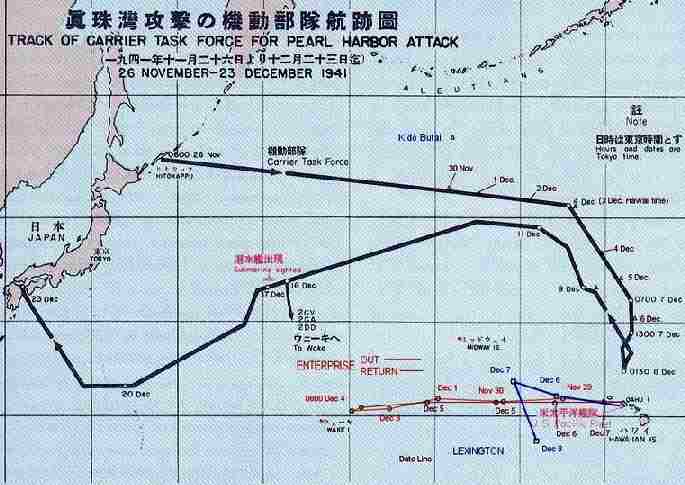
Throughout November 1941, as US-Japanese negotiations were secretly segueing into war maneuvers, the Japanese Navy mobilized to strike out across the Pacific at British, Dutch, and American interests. The last was tasked to a mighty force that had been assembled in secrecy at the 4-mile-wide hammer-head shaped Hitokappu Bay in the southern Kuril Islands (just north of Japan’s Hokkaido Island). By the middle of the month, would have been bustling with the “mobile striking force,” or Kido Butai, under the command of Admiral Chuichi Nagumo in his flagship Akagi; he was backed by 2 battleships, 2 heavy cruisers, 9 destroyers, 3 submarines, 8 train vessels, and, most tellingly, 6 aircraft carriers with about 360 combat-ready aircraft.

On the 25th, Fleet Admiral Yamamoto issued to Nagumi the fateful Combined Fleet Operations Order No. 5, ordering the force to set off for its intended target: - Pearl Harbor, Hawaii, and the bulk of the US Pacific Fleet moored there. The source from which I take this is the Joint Congressional Committee on Pearl Harbor, part 2 of their final report, published in 1946 [1]. Their telling reads as such:

”(a) The task force, keeping its movements strictly secret and maintaining close guard against submarines and aircraft, shall advance into Hawaiian waters and upon the very opening of hostilities, shall attack the main force of the United States Fleet in Hawaii and deal it a mortal blow. The first air raid is planned for dawn of X-day (exact date to be given by later order).

Upon completion of the air raid the task force, keeping close coordination and guarding against enemy counterattack, shall speedily leave the enemy waters and then return to Japan.

(b) Should it appear certain that Japanese-American negotiations will reach an amicable settlement prior to the commencement of hostile action, all the forces of the combined fleet are to be ordered to reassemble and return to their bases.

(c) The task force shall leave Hitokappu Bay on the morning of November 26 and advance to 42° N. And 170° E. (standing-by position) on the afternoon of December 4, Japan time, and speedily complete refueling. “


Clearly this order was crucial; it mentioned the target, the nature and location of the sneak attack, and the approximate date and time of day it would occur, just over two weeks later. If such information could have become available at that time to the US or to an ally inclined to share, the surprise could have been seen and pre-empted, or at least mitigated with some kind of proportional defense. None of this happened, of course, and the Kido Butai achieved total local surprise, which one may be tempted to accept as de facto evidence that the order remained hidden from American eyes at the time.

Such temptation should be resisted.

illustration using the given coordinates for stand-by position. This isn't quite right, as illustrated by the huge distance to travel the last leg. This probably means they modified the plan later, or had a further code in which one location actually mans another. A better map from Japanese sources can be seen at this page, and was used to make the more accurate and useful graphic below.
The Japanese Navy ordered the destruction of much of their records at war’s end, all copies of this order apparently being among the lost. Therefore, the Committee’s source for the wording they presented as evidence in 1946 would have to come from some other record(s) – hard copies that escaped the destruction order and fell into US hands, the memories of people who had written, read, or recieved the orders, or perhaps ‘our own copies,’ radio intercepts received by the US or an ally at the time but (presumably) decoded later.

In fact, the source the Committee cites is, essentially, anything but the third option. The order to sail is attributed to “Committee exhibit no. 8,” cited extensively throughout part two of their report when referencing Japanese plans or communications. Therein they explain:
“The chief sources of information concerning the attack are translations of captured Japanese documents, interrogations of prisoners of war, and reports submitted by general headquarters, supreme commander for the Allied Powers, comprising questionnaires filled out since VJ-day by former members of the Japanese naval high command. See committee exhibits Nos. 8, 8A, 8B, 8O, and 8D.” [2]
So it would seem that, even four years after the attack and the penetration of all Japanese codes, fuzzy memory and the odd scrap of paper was the best the Committee had access to. Apparently, we never got a copy of our own to decode and it was just lost into the ether. Admiral Edwin Layton concluded, after searching the available intercepts at the National Archive, “we evidently did not pick up Yamamoto’s 25 November sailing message” at all. [3] Note the judicious use of “evidently.”

The Pacific Fleet’s top intelligence officer at Pearl Harbor at that time, Layton published his own investigation at the end of his life, in the mid-1980s. Having found nothing of it in our archives, his source for the order to sail was “a reconstruction of events obtained from [the striking force’s] surviving commanders in 1945.” In particular, he cited the recollections of Capt. Mitsuo Fuchida, lead pilot of the actual air raid. This version is essentially the same as the above, with the exception of an “evening rendezvous” to refuel on Dec 3 Tokyo, not Hawaii time, and located at 40°N 170°E, two degrees south of the Committee’s findings. [4]

An Army Military History office document released in 1953 provides a whole string of communications surrounding the Kido Butai’s formation and intent, dating Nov 5 to Dec 2. While previous communications outlining the attack plan for Hawaii are recounted in great detail here, Yamamoto’s decisive Nov 25 order is provided only in a “general outline,” altering the standing-by position (from 165° to 170°) and ordering departure. Again, this document notes that “since all copies of these orders were destroyed prior to the end of the war, they have been reconstructed from personal notes and memory.” [5]

There is much debate among American researchers and little conclusive resolution as to how readable that code was to American cryptanalysts on December 7. The general mainstream consensus is that it was completely or essentially unreadable in the last days, as well as at the time of this pivotal order. The question of the code’s overall opacity as of November 25 1941 is one with no conclusive answer [hint - it was LESS likely to be readable on X-Day, and there are other nations whose own progress is uncertain]. The topic is shrouded in curiously dense secrecy and confusion (at least on my part), and will be the subject of a further post, or posts, after I’ve completed more research.

Sources:
[1] Investigation of the Pearl Harbor Attack. Report of the Joint Committee on the Investigation of the Pearl Harbor Attack. July 20 1946. Part II. Page 56. online - backup
[2] Ibid. Page 53.
[3] Layton, Edwin T. with Roger Pineau and John Costello "And I Was There": Pearl Harbor And Midway - Breaking the Secrets. William Morrow & Co. December 1985. Page 207.
[4] Ibid. Page 207.
[5] Japanese Monograph No. 97. PEARL HARBOR OPERATIONS: General Outline of Orders and Plans. Prepared by Military History Section Headquarters, Army Forces Far East. Distributed by Office of the Chief of Military History
Department of the Army. 19 February 1953. link