Adam Larson / Caustic Logic
The 12/7-9/11 Treadmill and Beyond
Feb 20 2009
last edited 2/24
A Question of Motive
When confronted with the “FDR knew” conspiracy theories, defenders of the dominant narrative sometimes point out as a logical flaw the ‘unanswered’ question of why Roosevelt or his advisers want to withhold intelligence and defenses from Hawaii if they had known the attack was coming? The truly naïve fall for the usually valid but simplistic presumption that losing ships and people is ‘a bad thing,’ and to be avoided. When they can get to the next level and adjust their cynicism goggles, concede the political opposition to be overcome and the importance of entering the war, it’s not hard to imagine an attack might have been desired. But these semi-rational coincidence theorists often stop the line of reasoning there, and contend that a foiled attack (or at least a met one) would have been sufficient for the cause.
For example, in his 1963 The Two Ocean War, Samuel Elliot Morrison dismissed the notion that FDR provoked or enabled the surprise attack, first by pointing out that “a little reflection” would show this “impossible,” since others would have to be involved, whom he names and finds too “loyal and honorable” to have participated. Besides this leap of faith, Morrison notes:
“More reflection might suggest that if Roosevelt and his cabinet ministers and armed service chiefs had schemed to get us into the war, their purpose would have been better served by warning the Hawaiian commanders in time to get the Fleet to sea and the planes airborne. Even a frustrated attempt to strike Pearl Harbor would have been sufficient cams [sic?] belli to satisfy the most isolationist congressman.”
That’s as bold and unsubstantiated a presumption as the first one. Another expression of this sentiment was offered in a 2001 Salon piece by Judith Greer, in which she stated that “no one has quite explained how being alert and prepared to beat off the attack would have significantly diminished its political effect.” The notion that “no one” has explained this is absurd; the reasoning is worked into nearly every explanation of the theory I have read, and that she is unaware of this is unlikely. What she seems to mean is ‘no one has offered an explanation I was willing to consider.’
Anatomy of a Useful Crisis
In case anyone would like to have it laid out again, I will illustrate in different ways the obvious and massive difference in “political effect” between a repulsed attack vs. the one we got. It may help to first realize what a big word “political” is in this context, and to consider the difference between the public attitudes of US and Great Britain, vis-avis fighting in the war. Few Americans can truly imagine the ”political” effect of actual Nazi bombs falling freely by the hundreds on the cities and baby carriages of Great Britain. Without the brutal daily reminders that made war a no-brainer, we’d have to suffice with, and maximize, a single such event to remember and keep remembering.
The first and foremost consideration is establishing the clarity of the aggressor/victim situation; the public would not tolerate our entry as an aggressor, but might be forced to concede to a ‘defensive’ war if the other side fired the first shot. Consider this line from the vague and misleading warning to Army commanders in the Pacific, sent Nov 27: “If hostilities cannot, repeat, cannot be avoided, the United States desires that Japan commit the first overt act.” This is not quite the order to ‘let yourself get shot’ that some present it as, but it does illustrate, at the least, that Washington explicitly desired a well-defined they-started-it beginning (to the extent they wanted a beginning at all, of course).
As it wound up, hostilities could not be avoided, and the Japanese fired hundreds of first shots. Our side managed but a few in return, quite obviously in defense, and the administration got their desired clarity in spades.
Once the evident moral conditions above are met, the scale of devastation works to your advantage, magnifying the outrage in direct proportion to the loss; a whole fleet crippled can provide the emotional steam to run a dozen such fleets.
Like ships, the number of dead is best in the high/painful range, since in the right hands, a frightening or depressing situation can be molded and used to mobilize a nation, so long as that nation feels otherwise vital enough to resist and change the situation. The one-sided surprise slaughter of thousands of young sailors would set a revenge charge in the American psyche to help keep America not just technically involved, but emotionally invested and their Congressional representatives likewise kept in line. Even the isolationists would be stuck in the pincer move.
By reminders it could continue to motivate throughout the war, instilling and nourishing a need to totally end the enemy so we can never be scratched like that again. FDR himself showed his awareness of this aspect immediately: “we will not only defend ourselves to the uttermost,” from that point on anyway, “but will make very certain that this form of treachery shall never endanger us again.” No one hits us without paying big, the American psyche demands. The promise was sort of finalized with Truman's first official statement after we vaporized Hiroshima and Nagasaki: "The Japanese began the war from the air at Pearl Harbor. They have been repaid many fold.”
Hypothetical Outcomes
An illustrative exercise for understanding the decisions made in Washington prior to the surprise is to consider the possibilities as they might have - play it out a bit, war-gaming style. You’re President Roosevelt, or any of his cabinet who would have to chose to join any conspiracy - in just the situation they were in, mid-late 1941. Europe is almost totally under Axis control, Japan is in control of a good portion of Asia and clearly preparing for more expansion. The Pacific Fleet wants to go back to the mainland, feeling exposed and edgy at Pearl, the US public and congress remain divided on entry to the war, perhaps leaning towards for, but not enthusiastically on average. You receive two or three solid clues that Japan plans to strike the exposed US Fleet (probably clues of their other simultaneous southward offensives as well) and you’re presented with two main options: get the intel to the people who need it to meet the threat, or don’t, and doom them to fulfill the terms of a maximized useful crisis, as outlined above. Here are four general possible outcomes to consider:
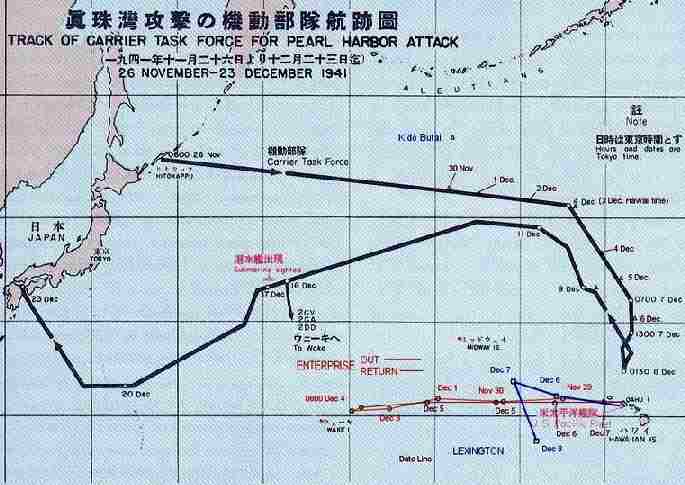
1) Tipped off of a Japanese sneak attack from the northwest, the Pacific Fleet readies itself – the carriers are brought back, all their planes armed and readied, guns loaded, radar manned and watched carefully, surveillance missions flown in the right direction. Spies on the island see all this mobilization and get word to Tokyo that surprise is lost, causing a last-minute order to abort the mission. The striking force retreats, and this attack is foiled, but the other prongs of Japans strike-out occur, including the Philippines, Shanghai, Thailand, and Midway Island, just hundreds of miles from Hawaii. US and Allied interests in Asia and the Pacific are threatened, the Philippinees fall, with US deaths, and America is jolted, but in both directions. Isolationists win, FDR croaks, an uncertain Truman put the fleet back in California to avoid a successful repeat, and the US remains neutral as the Axis make further progress yet. The US finally goes to war after a 1943 German air raid on New York launched from occupied Greenland, supplied from occupied Great Britain. It’s too late by then and we lose. But you get to avoid sacrificing innocent people.
2) Same as above, up to the US response - war is pushed through Congress based on the Philippines attack and thwarted designs on Hawaii. Headlines with the big type saying WAR do get to be seen, but the details are ambiguous, and only somewhat motivating. America thus enters WWII but forever tainted with the question ‘did the Japanese really intend to attack Pearl Harbor or did FDR make that part up?’
 3) You tip off the military and have a plan drawn up where the Harbor would be left quiet with Carriers instead moved out to sea, under a cover story, just far enough from spy eyes on the island to prevent the strike force from turning back. A mid-sized squad sorties from the Enterprise and spots them 400 mi nw of Hawaii. The carriers with destroyer support swing into place and the two sides engage in battle, sending planes against each other. Whatever the outcome, with a definite battle in place nearer Hawaii than the Japanese should have been, the aggression is obvious enough and outrage would be a bit more clear. Headlines might read “WAR: Jap force engaged off Hawaii: 2-300 US dead, fleet unharmed” So far this is looking like a decent proposal that allows a strong level of furor and still avoids sacrificing perhaps thousands of peacetime recruits in a unilateral massacre.
4) You keep the clues close and don’t share, keep the target vulnerable. Convince your subordinates to do the same, which is not as hard as normal, given the unusual stakes, the grim necessity, and the fact that it’s already rolling and there’s no way back. No reception or defense is prepared in Hawaii, a total surprise attack happens, dozens of hundreds of American sailors are killed. The battle is one-sided, the aggression and culpability 100% clear-cut, simple, undeniable, and massive in effect. The legal repercussions of the slaughter are near-automatic. Headlines read “WAR: Jap sneak attack on Hawaii: 3000 dead, Shocked US United, vows ‘absolute victory.’" The emotional surge channeled by moral certainty adds fuel and conviction to the embryonic war effort. So sustained, it doesn’t just exist but thrives and helps greatly in the Herculean task of smashing the Axis in both Europe and Asia.
The human costs are high, the moral issues troubling, and the limits on openness pretty obvious. Under normal circumstances, it would be hard to justify. But the payoff to the inevitable war effort is leaps and bounds beyond the other options, and in that dark winter at the apparent edge of global Fascist conquest, it might have seemed wise to cash in anything you had.
But Is It Memorable?
Having trouble deciding? Check these propaganda posters that were circulated after the real-world Pearl Harbor attack, which had the effect, if not the cause, of option 4. Unprovoked deceitful treachery, causing smoke and damage to a flag. We’re to remember, just like the loved ones of the fallen remember their loss. We should help fund the war in their sake, refuse to surrender, in the names of the dead, calling from Heaven, avenge them – defy the smoke of humiliating, emasculating defeat by working, fighting, sacrificing, firebombing to final victory.
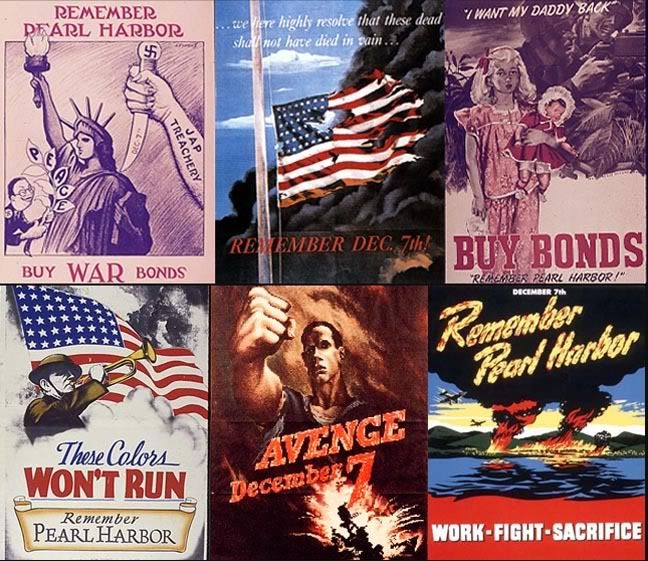 Now imagine if this kind of sentiment would fly nearly as well under the terms of possibilities 1 or 2 or 3. What would you propose instead to generate such a degree of public sentiment? Nice speeches with epic language? Or would you roll over to the isolationists and let the world burn around you? Careful now, if FDR did have these clues, and it seems he was waiting for them, he actually pondered the options without the crutch you have of saying “FDR didn’t know.”