Showing posts with label Iraq. Show all posts

Tuesday, December 15, 2009

IA 655 AND THE CESSATION OF THE IRAQ-IRAN WAR

[Pan Am 103 Series]
Adam Larson / Caustic Logic
December 15 2009 update 1/6/10


Note 1/6/10: Too many small errors to fix. Don't cite this piece but do feel free to follow leads and double-check.
---
Tonkin Gulf and the DESOTO Precedent
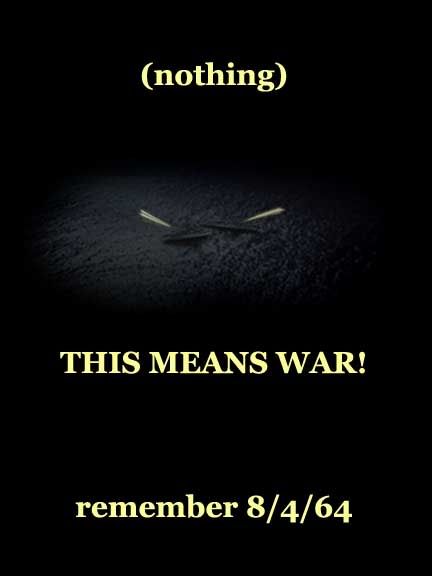
For some indirect insight on Lockerbie, allow me to turn to two prior events – one decades past, the other bare months. The title of this post is inspired by Edwin E. Moïse’s book “Tonkin Gulf and the Escalation of the Vietnam War.” (Chapel Hill /University of North Carolina Press. 1997. 255 pages). It was actually two Tonkin Gulf incidents, one overblown and the other complete fantasy, that enabled the widening of the conflict. These were sparked by a naval tactic called the “DESOTO patrol,” in which an unescorted destroyer specially equipped for communications surveillance, was sent as far as possible into the coastal waters of Communist Asia. The twin goals were to flaunt the enemy’s concept of territory while collecting intelligence for eventual hostile use. The missions were always marked by high tension. [Desoto patrols explained ]

Under Admiral Thomas H. Moorer’s guidance, such patrols were increased along the coast of North Vietnam in mid-1964, as US-engineered coastal raids (OPLAN 34-A) were also increased to put the DRV forces further on edge and stimulate “chatter” to analyze. The mission given to the USS Maddox in August has been described as “the delicate task of stimulating coastal defenses without provoking an attack,” a balance made harder by the added agitations. [1] The attack on the Maddox that was finally reported triggered a third and hidden (or unanticipated) power of the Desoto patrol – to start a war. And that crucial second attack didn’t even occur in reality - not for lack of trying.

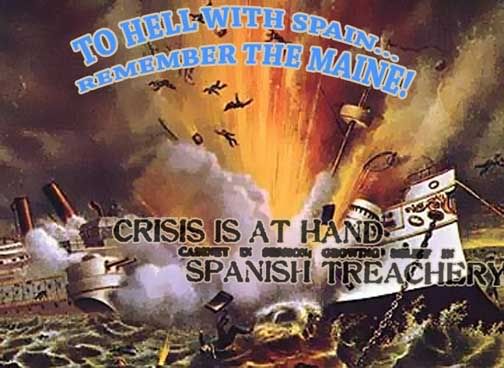
The escalated Vietnam War of course went sour over the years, in the shadow of that initial dubious incident. It was the same type of patrol the USS Pueblo was on when disastrously captured by the North Koreans in early 1968, and a possibly similar mission that led to the USS Liberty incident the year before that. These plus lesser mishaps led to a decision in 1968 to stop such missions. The awkward U.S. loss of Saigon, plus Watergate and so on, changed the political calculus of manufactured crises. The “Remember the Maine” mentality just wasn’t going to work in the 1970s.

But the same notion of highly-portable naval sovereignty, with all the firepower to enforce it, continued - in, for example, the Persian Gulf in the latter 1980s.

Different Gulf, Different Decade, Different Moves
After Iraq attacked Iran in 1980, with tacit U.S. approval, Washington took Iraq’s side to ensure it didn’t lose in the bitter, grueling war that ensued. Towards this end, the U.S. re-flagged as its own supply and oil vessels coming to or going from Iraq - largely Kuwaiti oil tankers. This made them off-limits to Iran’s attempt at blockade. In Operation Earnest Will, U.S. Naval forces escorted them as well, enforcing its own blockades while denying Iran’s. Instances of Americans opening fire on Iranian forces and facilities rose steadily as well as the conflict dragged on; Operation Praying Mantis responded to Iranian mining with escalated U.S. attacks on Iranian gunboats, oil platforms, and tankers on April 18 1988. [2]

The covert US-Iraq alliance had intensified in latter 1987. Ironically, this was following the accidental Iraqi air attack on the USS Stark – with 37 sailors killed, it proved exactly to Iraq what the USS Liberty incident was to Israel, but in miniature; American cooperation increased. Advisers went to Baghdad full time, originally to prevent further such mishaps, “but the end result,” explained a 1992 Nightline report on America’s secret war, “was that the United States helped Iraq conduct long-range strikes against key Iranian targets, using U.S. ships as navigational aids. “We became,” as one senior U.S. officer told us, “forward air controllers for the Iraqi air force.”” [3]

Two conjoined decision of Late April 1988, following Operation Praying Mantis, set the stage for the IA655 incident: the expansion of shipping protection in the Gulf to all neutral vessels and the dispatch of the USS Vincennes to bolster the force backing it up. [4] The high-tech vessel (a Ticonderoga class AEGIS guided missile cruiser, introduced 1985 and also called "Roboship") was equipped for advanced surveillance of just about every frequency except, apparently, civilian air control traffic. Its combat speciality was surface to air engagements, a poor fit for the surface-surface work it was sent for. But the more aggressive attitude in the Gulf was well embodied by The Vincennes’ commanding officer, Captain William C. Rogers; according to those who worked behind him in the Gulf he was overly-aggressive, but then he may have been privy to certain unusual standards they weren’t.

The details of the incident are still new to this author and beyond the scope of this article, but the story of how the Vincennes came to do battle with Flight 655 seems highly dubious. Around 10:00 local time, the cruiser’s amazing receivers picked up two distress calls from neutral vessels under attack by Iranian vessels, and sent it heliopter to look, which in turn reported being fired on. According to information uncovered by ABC Nightline and Newsweek, one of these signals was later denied by the boat’s captain – he never came under attack nor asked for help. The other was from a completely non-existent “Liberian” vessel. [5]

Both signals were themselves forgeries - pure radio signal fakery as part of a U.S. plot to draw Iranian vessels out to join in the fake melee and become exposed to counter-attack by the Navy. Lt. Col. Roger Charles told Nightline the Navy thus “enticed, in fact, entrapped the Iranian gunboats into a situation where we could then say that there’s been a hostile action by them … And that then allowed — under this kind of specious rule of loosened hot pursuit — us to take military action.” [6] It was to the aid of these ghosts that Captain Rogers sped, like a duck hunter headed to where the decoys were laid, ready to pop any attackers lured out or any threat to his expensive ship.

The Incident and the American Message to Iran
Into this dangerous situation flew Iran Air Flight 655. An Airbus A300B2 with 290 passengers aboard (mostly Iranians, including 66 children), it departed from Bandar Abbas at 10:17 for its 28-minute flight to Bahrain Airport. It seems the plane was talking normally with ground control (in English), was well within an established civilian air corridor, climbing up rather than swooping down for an attack, and transmitting the right civilian transponder code that clearly means don’t shoot. [7]

But the Vincennes had the wrong equipment to hear the control chatter, and apparently the wrong crew for everything else. They misread the transponder signals as being from a MiG fighter jet. They misread its location as several miles outside the civilian corridor. They somehow missed the civil flight listing that would identify it by flight number. They may have failed to properly transmit their warning signals, as the “fighter” refused to turn away. These and other errors all happened at the same time in that dense fog-bank of war effect that only materializes under peculiar conditions like this, and quite often benefits the U.S. of A in no-longer-surprising ways.

So to summarize, on this poorly-run duck hunt, they decided that a fighter jet had been lured out as well as the gunboats - and that’s a bigger and more exotic prize. So with all the storm of mental short-circuits aside, it made perfect sense to fire two missiles at it. 290 non-combatant souls were snuffed out – some in the explosion that made the plane disintegrate, the rest after a three-mile fall to hit the Gulf’s warm waters. Video shows the ship’s crew elated to have hit the bad guy – they weren’t told until hours later what they’d really done, and apparently they didn’t figure it out in the meantime, even with the ship's data records to review.

One overriding message the United States government sent to Iran, aside from vague “regret” over this accident, can be seen in its public pronouncements. Consider the last sentence of President Reagan’s first statement of July 3: “The only U.S. interest in the Persian Gulf is peace, and this tragedy reinforces the need to achieve that goal with all possible speed.” [8] It sounds nicely utopian, but it surely wasn’t meant that way. White House media handler Marlin Fitzwater made the message a little more explicitly a week later:
Only an end to the war, an objective we desire, can halt the immense suffering in the region and put an end to innocent loss of life. Our goal is peace in the Gulf and on land. We urge Iran and Iraq to work with the Security Council for an urgent comprehensive settlement of the war pursuant to Resolution 598. Meanwhile, United States forces will continue their mission in the area, keenly aware of the risks involved and ready to face them. [9]

That is, as the Iranians likely read it, wey’ll keep on shooting at anything that might possibly be a threat as long as we “have to” hang around there, which is until Iran surrenders. Charles Price, US Ambassador to UK later said “this incident wouldn’t have happened if Iran wasn’t, and hadn’t been in the process now for a long time, of attacking U.S. and other shipping in the Gulf.” [10] This is certainly a contributing factor, along with the U.S. decision to fake some of these attacks electronically and lure hem into a fight, the decision to equip, staff, and deploy the Vincennes in such a way that it became deadly to civil airliners, etc. For that matter it wouldn’t happen if the airplane had never been invented. So many variables and alternate outcomes riddle this case, that Price picked on Iran’s small role, played with such limited options, shows the issue at hand – their options were narrower yet and they’d better stop shooting altogether.

Iran Surrenders / A Leaf on the Wind
Since Iraq started the war in 1980, its course had been a grueling back and forth, with steady but modest Iranian gains into Iraqi territory by the end of 1987. UN Security Council Resolution 598 had called for a return to pre-war boundaries, making Iran reluctant to agree, even as the pain deepened. Then Iraq started another push-back in early 1988: long-range bombardment increased, and American assistance got more hands-on as well, as we’ve seen. The balance might have shifted back yet again but for what happened in July.

The shooting down of IA655 undoubtedly contributed to hastening Iran’s effective surrender. However, the precise role it played – minor, major, or peripheral, is difficult to know. Adding to new anxieties, just days after the incident, Iraqi forces “dropped chemical cyanide bombs” on the Kurdish village of Zardan on the Iranian side. Again hundreds were killed and “the enraged Iranians considered a huge rearming and nuclear weapons, but decided that this was beyond their means” by that time. [11] So July was a bad month for Iran - on top of the cumulative effects of years of similar woe, the loss of the Airbus to Americans in particular put a deeper fear than ever across the Persian mind. As an Iranian scholar stated at a conference hosted by the Woodrow Wilson Center (paraphrased)
“[A] turning point in Iran's thinking came with the shooting down of an Iranian passenger plane in July 1988 by the American cruiser USS Vincennes. That incident apparently led Ayatollah Khomeini to conclude that Iran could not risk the possibility of U.S. open combat operations against Iran and he decided it was time to end the conflict." [12]

There’s every reason to believe that’s just what the Americans wanted to get across, after the tragedy if not shortly before as well. This author is not eager to conclude there was any design to kill hundreds of innocents – but there are some very hard questions to address at another date.

The fighting did continue but Iran’s mindset was definitely shifting and quickly – hostilities officially and physically ended just six weeks after the Vincennes incident, on August 20. Iranian organized revenge meeting were already taking place by then, and their selected contractor groups were making their airliner radio bombs by the time the “Autumn Leaves” were shaken loose in Germany in October. It seems all too likely one of these Iranian grown leaves drifted right across the English Channel and lighted itself in the belly of PA103 on 21 December, less than six months after Captain Rogers’ duck hunt. A half hour after takeoff, it exacted an exact revenge, leaving 259 to deal with five miles of pure gravity however they did before dying against the cold winter soil of Scotland.

That, or the Iranians just gave up after the Germany bust, and the Libyans took their own incidental revenge for something else at just that time, as the FBI, CIA, USG, Scottish Police, Camp Zeist judges, and others claim to believe.

---
Sources:
[1] Rust, William. "The "phantom battle" that led to war; can it happen again?" US News and World Report. July 23, 1984. Posted online December 3 2005. http://www.usnews.com/usnews/news/articles/051203/3phantombattle.htm
[2]Operation Praying Mantis. Wikipedia. http://en.wikipedia.org/wiki/Operation_Praying_Mantis
[3, 5, 6] "The USS Vincennes: Public War, Secret War" ABC Nightline, Aired July 1 1992. Full Transcript, with extensive notes.
http://homepage.ntlworld.com/jksonc/docs/ir655-nightline-19920701.html
[4] Kelley, Stephen Andrew. Better Lucky Than Good: Operation Earnest Will as Gunboat Diplomacy. (Naval Postgraduate School. June 2007. PDF link:
http://stinet.dtic.mil/oai/oai?&verb=getRecord&metadataPrefix=html&identifier=ADA470423
[7, 8, 9] Ghasemi, Shapour. “Shooting Down Iran Air 655 [IA655]” Iran Chamber Society: History of Iran. 2004. http://www.iranchamber.com/history/articles/shootingdown_iranair_flight655.php
[10] The Maltese Double Cross - 32:00 mark
[11] http://en.wikipedia.org/wiki/Iran-Iraq_War
[12] http://wilsoncenter.org/index.cfm?fuseaction=news.print&news_id=90411&stoplayout=true

Wednesday, September 30, 2009

THE LONG RUN-UP TO BLAMING LIBYA

PAN AM 103, SYRIA, IRAQ, AND A TIMELINE OF BLAME: 1988-1991
[Pan Am 103 Series]
Adam Larson / Caustic Logic
September 30 2009
last update 10/3


Following the December 1988 Pan Am 103 bombing, the congruence of original clues that the investigation were following pointed quite clearly in one direction: to the Syria-based PFLPGC group, apparently commissioned by Iran as in-kind retaliation for the USS Vincenes incident. By late 1991 the focus had long-since shifted and had come to the indictment of two Libyans, sparking a long-simmering political dispute capped with a guilty verdict and life sentence for one of them (al Megrahi) handed down nine years later.

The timeline in between is a little murky, but the investigative shift appears to coincide, roughly, with the 1990-91 Gulf War. In this context, Iran was a force one wouldn’t want too much quarrel with while focusing on their more built-up neighbor. Syria, on Iraq’s other flank, had agreed to assist the U.S effort in line with the general mindset of the Arab League. Pursuing a terror group sponsored by Damascus over the bombing would be politically inconvenient. Coincidentally of course,as case expert Paul Foot noted, after the invasion of Kuwait in August 1990, “the official view of the disaster was that Syria had, in Bush's typically elegant phrase, 'taken a bum rap on this'; and that the people responsible for Lockerbie came from the one Arab state which had denounced the US role in the Gulf War: Libya.”

Col. Gadaffi's regime was already a convenient enemy known for supporting anti-American terrorism, and had their own poignant reasons for revenge – the death of scores of Libyans, including an adopted daughter of Gadaffi’s own, by U.S. bombing in 1986. And most of the clues pointing to a shift in blame started emerging, all on their own it might seem, well before the open saber rattling in the Gulf. Foot noted one of the earliest harbingers of a course change “in mid-March 1989, three months after Lockerbie,” when “George Bush rang Margaret Thatcher to warn her to 'cool it' on the subject.” Could this have been triggered by the Gulf War’s alliance system?

A 2008 BBC documentary agreed that as of mid-1989, “Britain’s biggest mass murder investigation looked like it was stalling,” unable to find the hard links to the PFLP necessary to continue. Countering the cynical conspiracy theorists that blame Gulf War politics, they report that clues pointing to Libya started coming in “from August 1989, twelve months before the invasion of Kuwait.” This, it went on, was an anomalous report from Frankfurt Airport suggesting an unaccompanied bag from Malta had gotten onto PA103 there; Malta points straight to Libya, Tripoli’s “backdoor to the West,” as the video puts it.

The most important clue would be the MST-13 timer fragment, identified in mid-1990, linked via its maker Mebo to Libyan intelligence. If the Libyans were not guilty, as seems the case, it’s almost necessary the fragment was planted. According to official paperwork (which is actually pretty dubious), this was no later than mid-May 1989, when it was first catalogued. Barring altered records, a plan to implicate Gadaffi’s team had to be in execution this early. Again, could this first huge step towards the Libyan guilt myth have been triggered by the coming showdown with the Butcher of Baghdad? Surely a rational thinker is looking here for less obvious outside reasons to look elsewhere, or simply... the evidence emerging?

Any explanation that relies solely on the coalition-building running up to Operation Desert Storm is bound to miss valuable leads; there had to be more at work with how the onetime PLFPGC suspects were handled; at least one of them was reportedly a CIA asset, and he and others had been released from prison with suspicious ease just after getting caught with bombs similar to what brought down 103, but shortly before it was brought down. Something looks embarrassing there no matter who you want to look at instead. And for what it’s worth, the pros of leaning against Libya in particular would be known and considered independently. But finally, I contend Gulf War-type thinking could also be a strong or central factor, even for the earliest of alleged shenanigans, and helps flesh out the "motive" category for any speculation.

This can be seen at the level where things seem almost "scripted" in grand strategic sweeps, a changing geopolitical zeitgeist some are privy to well before others. This timeline of the Iran-Iraq War shows the zeitgeist of mid-1988 was of the United States and its armed proxy Iraq working in tandem, partly intentional, partly accidental (or rather, the USS Vincennes incident) against a common foe. Like a tsunami the hits came down on Iran and its people, subduing Tehran into a weaker hand at the ceasefire finally agreed in late July. Almost exactly two years later the US was fighting against Iraq.

What happened in between? Most run-of-the-mill Gulf War timelines start with late May 1990 and Iraq's charges of economic warfare against Kuwait. One might guess some foreshadowing being picked up by American minds prior to this, but it's more than just shadows. The background I needed I already learned reading Ramsey Clark's The Fire This Time (1992). It’s a slanted work to be sure, but quite informative in its way. His intro timeline [p xxiv-xxv] goes into some relevant details missed by the ones I was seeing on the internet. Let's follow it backwards from May 1990 to see how far back the mindshift towards Iraq as the enemy goes:
February 1990 – General Schwwarzkopf testifies before the Senate of the need for the United States to increase its military presence in the Gulf region. He warns that “Iraq has the capability to militarily coerce its neighbors.”
January 1990 CENTCOM headqyuarters stages a game entitled Look, which tests War Plan 1002-90.
1989 War Plan 1002, originally conceived in 1981 to counter a supposed Soviet threat to the Persian Gulf, is adjusted to designate Iraq as the threat to the region. The plan is renamed War Plan 1002-90.
1988 [...] A ceaefire agreement is signed between Iran and Iraq in August. U.S. policy towards Iraq shifts dramatically. The Center for Strategic and International Studies begins a two-year study predicting the outcome of a war between the United States and Iraq.
On the evidence and time of the "dramatic" attitude shift, Clark started with the Iraqi chemical weapons attack on Halabja, March 1988. The horrifically illegal toxic slaughter of thousands of Kurds, many adults of whom had collaborated with the iranians, was largely ignored by western media and governments at the time, even after large Kurdish protests at the UN. [p 19-20] The zeitgeist of mid 1988, or simple ignorance, could explain these oversights.

Clark then noted it was on September 8, just three weeks after the Iran-Iraq cease fire, that the U.S. finally decided to announce that their erstwhile proxy had gassed a group of people that happened to be tied by ethnicity. A State Department spokesperson referred to the attack(s) (vaguely related) as “abhorrent and unjustifiable.” The same day, Iraq’s Foreign Minister was in town to meet Secretary of State Schultz, and had the chance to be barraged with unexpected questions and to respond weakly. Within a day of this well-placed slap. “the Senate unanimously voted to impose sanctions” on Iraq. Somehow this “never became law” but was seen as “a threat and a humiliation” by Iraq, and ultimately a harbinger of things to come.

So was the necessary mindset there and strong to make nice with Iraq's enemies even four months before the Lockerbie bombing? It was there, if requiring serious foresight to pick out early on. But the new zeitgeist had surely grown some in currency by, say, March '89. This does not mean it's the reason the blame shifted, but shouldn't be scratched as one of the birds to be killed with this stone.

Friday, June 19, 2009

9/19 BASIC GIST AND GRAPHICS

Adam Larson / Caustic Logic
June 18 2009


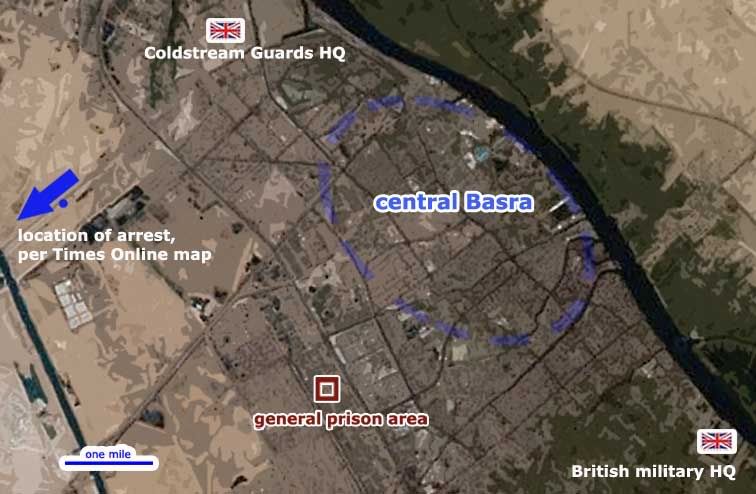
For quick reference, I present a post based entirely on an informative graphic published by the Times online about the "SAS rescue" of September 19 2005. First, my own maps I created based on theirs and satellite imagery, and then a timeline of the events marked on their map. This will serve as a basic run-down of the battle of the police station, from the British official perspective. It's the only one I've seen yet that offers times for much of anything, so Ive been using it as a source. My respects to its creators.

Above: Greater Basra, with British HQ locations, initial arrest, and later rescue locations indicated. (right-click, new window for larger view). Below: detail of the prison area and militia house the soldiers were rescued from.


THE RESCUE
Early on Monday Two British undercover soldiers are stopped at a checkpoint and arrested by the police.
10:40 Monday The soldiers put out an emergency call to say that they are in trouble. Troops are dispatched to assist them.
15:15 Cordon put into place around police station
16:30 Mob gathers, petrol bombs are thrown and two Warrior armored personnel carriers set on fire
19:26 More violence Known agitators seen leading another mob towards police station
20:50 Intelligence revealed that the soldiers have been moved away from the police station.
21:00 Decision is taken to attack the police compound and search for the two men
22:00 Force detached to search nearby villa. They force entry and, after a gunfight, rescue the soldiers.
0200 Yesterday Operation complete. Two freed prisoners flown to Baghdad for debriefing and three British soldiers treated for injuries.

Wednesday, June 17, 2009

9/19, THE FIRST HALF: THE ARREST

WHAT THE BASRA POLICE DISCOVERED
Adam Larson / Caustic Logic
June 17 2009


IN CUSTODY: A MURKY BEGINNING
In charge of security for the mostly-Shiite southern city of Basra, the British military enjoyed a generally placid command relative to, say, the Sunni triangle. Relations started worsening, however, in autumn of 2005, starting with three British soldiers killed in the first weeks of September. Several coalition arrests of prominent spiritual leaders on the 18th increased tensions, spurring protests and possibly further problems. The burden was shared, thankfully, with the Coalition’s Iraqi partners in peace and stability, like the Basra police force, who were also on guard as the morning of Monday, September 19 2005 drew up over them.

Accounts differ or are vague on almost all details about the events of that morning, starting at a time I’ve seen best narrowed down to “before dawn.” [1] The troubles began with two occupants of a well-used white car, similar to a later model Toyota Cressida. The car’s direction of travel is not clear from available sources, nor the location of this crossing-of-paths; it’s alternately been described as a police station or a police checkpoint. We do know that the two men inside sported traditional gauzy Arab shirts, short beards, curly black hair and some kind of head scarves, in an unspecified style. Of course these were disguises; they were really British Special Forces soldiers, generally reported as SAS, doing something undercover.

Accounts and reports differ on just what happened between the soldiers and the police attempting to halt them. It’s agreed by all that the men in the car fired shots at the police, but all other details remain murky. The first reports from Iraqi authorities were that at least two people had been shot, one fatally and one not. Later reports, for the most part, repeated these. Whether both were police or one civilian, and if so which was killed - variations have been reported. BBC's first is typical; the charge was "allegedly shooting dead a policeman and wounding another." [2]

About a week after the incident, “Iraqi police involved in their arrest” gave a Sydney Morning Herald reporter “detailed accounts of last Monday's events.” The article itself is a gratuitously slanted piece, taking every chance to imply that one of the thousand lurid Arab evils permeating the Basra system had to exculpate the Brits entirely (see below). Nonetheless, it cites:
Captain Ahmed al-Shimari, who was on duty last Monday, said the soldiers had been spotted taking photographs from a car. Three officers, Fadil Hadi, Allah al-Bazuni and Qutayba Sa'ami, ran towards the car. Mr Hadi fired two warning shots and the soldiers returned fire, hitting Mr Sa'ami in the leg. [3]

According to this version, that was the only injury caused by the soldiers. All reports of a death were errors – or worse – from hostile local officials. But whatever the details, somehow the two men were apprehended alive and taken to the local police station for questioning. By then it was discovered that under their terrorist-like garb the men were quite Caucasian – Chechens? One Basra official said “they refused to say what their mission was and suggested that we ask their commander.” [4] The closest they had to identification on them said the same thing – laminated cards saying "In an emergency, please call US and UK forces,” providing different phone numbers for Basra and two other cities in southern Iraq. [5]

A graphic provided by Times Online (London) indicates it wasn’t until 10:40 am – apparently with their “one phone call” – that the soldiers put in an emergency call to headquarters. [6] Soon British forces were talking with the Basra police captains and local officials; they acknowledged the two as their own, and negotiations for their release began, as a military detachment was assembled to back up their bargaining position.

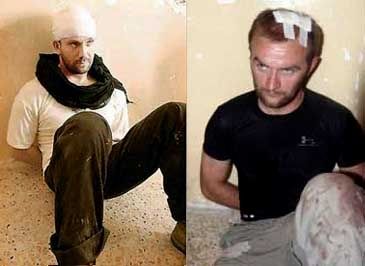
In the meantime, the two were held at the jail compound in southwest Basra, about midway between British military HQ and the Coldstream Guards HQ. In a room with yellow chipped-paint walls they sat hands-bound on an ugly “granite look” aggregate floor, as Arab news cameramen were allowed in to film them (see images above). [7] The two men were apparently beaten or injured in capture, though not badly, sporting bandaged heads. I would presume the blood staining the lighter haired guy’s pants is his own. Note the darker-haired guy has a black scarf around his neck; in later shots this is removed and he’s clearly been doused with water. Both carry an air of defiance, a thin smirk of nonchalance. I think they look pretty scared.

WEAPONS: STANDARD OR MASS DESTRUCTION?
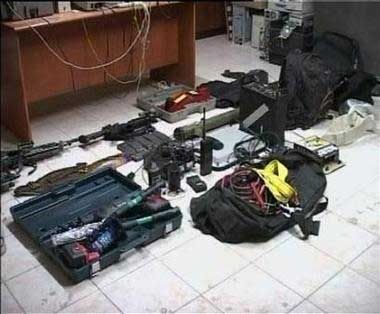
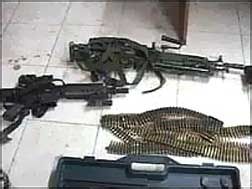
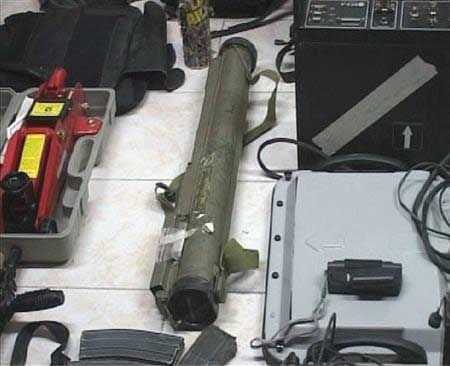
Also on display was their confiscated tool kit, including among a car jack, various rucksacks and plastic cases, BBC’s Reporter Richard Galpin acknowledged “assault rifles, a light machine gun, an anti-tank weapon, radio gear and medical kit.” Speaking with British forces, Galpin passed on that “this is thought to be standard kit for the SAS operating in such a theatre of operations.” [8] I'm not sure if that's ridiculous or not, but it seems a bit much for what a British diplomat in Basra told the authorities was "a run-of-the mill observation mission." [9] But hey, you never know when you'll run into an Al Qaeda tank.


Top: whole cache as shown by basra police. Middle right: shirts and wigs the soldiers used for disguise. Rest: close-ups of weapons. Right-click, new window for larger views.

There is little disagreement over the above weaponry, but the most important variable for understanding what happened that day, and what the police were thinking, is the possibility that the car was rigged with heavy explosives. Official British and friendly sources only acknowledge this has been reported. China’s Xinhua news agency reported on the 19th, citing an unnamed source at the Iraqi Interior ministry (which oversees the police), “the two soldiers were using a civilian car packed with explosives.” [10] Fattah al-Shaykh, member of the Iraqi National Assembly, told Al Jazeera as the crisis began of the “booby-trapped car laden with ammunition [that] was meant to explode in the centre of the city of Basra in the popular market.” [11]

Sheik Hassan al-Zarqani, a spokesperson for Shia leader Moqtada al-Sadr, quickly issued a press release telling the world "what our police found in their car was very disturbing — weapons, explosives and a remote control detonator […] These are the weapons of terrorists. We believe these soldiers were planning an attack on a market or other civilian targets, and thanks be to God they were stopped and countless lives were saved." Zarqani further alleged the disguise the men affected had been of Sadr’s militia, the Medhi (Mahdi) Army, and that they were to bear the blame for the planned bombing. [12] Zarqani’s release also addressed the British demands for the bombers’ release: “The police refused as they were considered to be planning terrorist attacks, and as they were disguised as members of the Mehdi Army, the police wanted to know who their target was.” [13]

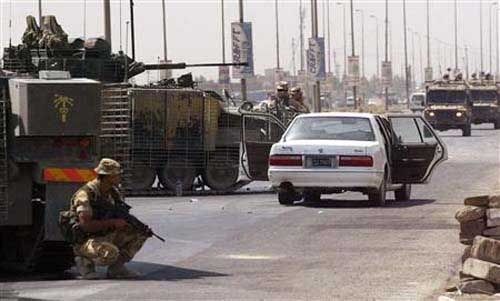
Many readers will deny these sources out-of-hand, and they do seem to have an untrustworthy bias-to-information ratio. I’m not so sure what the police or courts there said about the alleged bomb, and on what evidence. There are no photos or video taken of a bomb. One photograph connected by one researcher to this story [below] shows the car cordoned off by military vehicles as if it were dangerous itself. This photo was posted by researcher Sara Meyer shortly after the events, and I can’t find another source. It was coupled with an explanation, un-sourced, how the car “was later removed by the British.” [14]


TO MAKE BAIL OR BREAK JAIL?
There was at the time little to clarify what was the intent of the SAS men – “they refused to say what their mission was” and their commanders weren’t adding much. Similar but more open disagreement surrounds the intent of the police. They claimed to be holding suspicious men engaged in violent criminal behavior, and that fits a lot of the facts. However by parading cameras by them and such, one may sense a little more enthusiasm than simply protecting public safety would explain. The British military took the view – and quite firmly – that the Basra police force was infiltrated by anti-coalition militia sympathizers. Among the charges, the Sydney Morning Herald’s article named Police Captain Yasser al-Bahadli, “a known Mahdi Army sympathizer” as the overseer of the men’s captivity. [15] Their stated belief was thus that their soldiers were in grave danger of falling into enemy hands and must be released.

This concern could of course conceal some other motive for demanding their release, but whatever the case, the Ministry of Defense explained to home audiences how a seven-person military legal team had been dispatched to the prison to try and work things out that way. [16] Preparation for a larger extra-legal military effort were also set in motion. One diplomat, Karen McLuskie, told the Guardian "we explained clearly to the authorities that they were British forces on a run-of-the mill observation mission." [17] Certainly along the way they reminded their colleagues that “under Iraqi law,” as the BBC reported, “the soldiers should have been handed over to coalition authorities.” [18] The Brits pulled strings with the national government in Baghdad and reportedly got the Interior ministry, responsible for police, to issue an order for their Basra people to release the men. It would seem that this order was ignored by the involved locals.

Probably around this time, Brigadier John Lorimer "had good reason to believe that the lives of the soldiers were at risk,” as he told the BBC, and he decided to get “near the police station to help ensure their safety by providing a cordon.” [19] By a quarter after three a small force under Lorimer’s command was at the scene, and a security cordon established around the compound. [20].

In the meantime, anger in the streets had grown, based on whatever people had heard about the soldiers at the jail. It’s difficult to say if the reportedly slain officer, or the planned bombing, or simply the attempts of the British to circumvent Basra justice, was most paramount in anyone’s mind. The Independent reported “one witness said Iraqis were driving through the streets with loudhailers demanding that the soldiers should be kept in the police station, and then jailed.” [21] But some potent combination of factors mobilized dozens – then hundreds - to the jail for a spontaneous citizen’s assembly (or militia-sponsored mob, depending which side of Operation Iraqi Freedom you’re on). The villain Captain Yasser al-Bahadli, watched as the British tanks and roiling crowd gathered ouside the station, the Herald’s article reports, and “put out word two "Israelis" had been arrested - certain death had the mob reached them.” [22]

Despite all this, the authorities behaved as if all was under control and proceeding normally - A provincial council spokesman for Basra, Nnadhim al-Jabari, announced that the two captured soldiers “were likely to go before an Iraqi court,” the Independent reported. [23] But al-Jabari didn’t have all the facts; as it turns out, the suspects would not go in front of the judge. Eventually they went home, but where exactly they went in the following hours is of great interest and some mystery.
---
Sources:
[1, 4, 7, 21, 23] McCormack, Helen. "The day that Iraqi anger exploded in the face of the British occupiers." The Independent. September 20, 2005. http://www.commondreams.org/headlines05/0920-05.htm
[2, 8, 16] BBC news. "Iraq probe into soldier incident." 20 September 2005. http://news.bbc.co.uk/2/hi/middle_east/4264614.stm
[3, 15, 22] Rayment, Sean with special sorrespondents. “Britons had visions of their throats being cut.” Sydney Morning Herald. September 26 2005. http://www.smh.com.au/news/world/britons-had-visions-of-their-throats-being-cut/2005/09/25/1127586747136.html
[5, 9, 17] Mansour, Osama and Michael Howard. "Britain refuses apology and compensation for Iraqis caught up in Basra riots." The Guardian. September 26 2005. http://www.guardian.co.uk/world/2005/sep/26/military.iraq
[6, 20] http://www.timesonline.co.uk/article/0,,7374-1790311,00.html
[10] Xinhuanet. "Iraqi police detain two British soldiers in Basra." September 19 2005. http://news.xinhuanet.com/english/2005-09/19/content_3514065.htm
[11] Chossudovsky, Michel. “British "Undercover Soldiers" Caught driving Booby Trapped Car.”
http://www.globalresearch.ca/index.php?context=va&aid=972 (Text of report by Qatari Al-Jazeera satellite TV on 19 September)
[12, 13] Keefer, Michael. "Were British Special Forces Soldiers Planting Bombs in Basra? Suspicions Strengthened by Earlier Reports." http://www.globalresearch.ca/index.php?context=va&aid=994
[14] Meyer, Sara. Basra Shadowlands. Index Research.
October 19 2005.
http://indexresearch.blogspot.com/2005/10/basra-shadowlands.html
[18, 19] BBC News. "UK soldiers 'freed from militia'" http://news.bbc.co.uk/1/hi/world/middle_east/4262336.stm

Friday, September 19, 2008

FALSE-FLAGGING IRAQ? {MASTERLIST}


Adam Larson / Caustic Logic
June 26 2009


Main Incident: September 19 2005 - arrest of Britons accused of terrorist plans
Other Alleged Incidents: Various times from invasion in 2003 to present
Alleged provocateurs: Military forces of United States and United Kingdom, perhaps Israel
Casualties: Unknown
Outcome: Varied
Investigations: A bit fishy

I’ve been in a bit of a time-warp this year, looking to the past with its protective shield of years and of secrets already revealed. Suspicious events in the present are by comparison more threatening, playing out quite directly in the now – I started out my research into false-flag operations and such with current events and questions about September 11 – After my long awkward dance with “9/11 Truth” I don’t feel like trying to re-approach that pivot, but rather the period just this side of it, the resultant War on Terror/World War IV/Long War/War of Many Names era.

The most visible battleground for this so far has been the cities of Iraq, out of which have emerged allegations of - and perhaps evidence for –Coalition forces using false flag terrorist attacks blamed on insurgents. This would apparently be intended to help keep occupied Iraq just that way. There are questions all along about motives and evidence, and I’m just on the outer edge of the fray. Since I’m not afraid of finding nothing awry – I hope not to in this case – I’ll look at it as an alleged pattern worthy of examination. This post will organize others exploring charges allegations and evidence. Primarly I’m looking at issues surrounding the 9/19 2005 incident involving the British army and Basra police, but will explore other avenues as well.

The Posts:
9/19 Basic Gist and Graphics

9/19 The First Half: The Arrest

On the Soldiers' Mission