Showing posts with label Pearl Harbor. Show all posts

Wednesday, March 25, 2009

A "RESTRAINING" INFLUENCE

Adam Larson / Caustic Logic
The 12/7-9/11 Treadmill and Beyond
March 25 2009
Last update 4/2


WINDOW DRESSING
As outlined in a previous post, as of mid-1940, a “strong attitude” towards Japan was thought in Washington a useful means to deter further Asian or Pacific adventures. As also discussed there, Adm J.O. Richardson, Commander-in-Chief US Fleet (CinCUS), had been told that the Navy was to act out this attitude, and that the Pacific Fleet’s retention at Hawaii was part of this bit of theater. But being on the stage rather than behind it gives him more credibility, and this clout was staked on his finding this deterrent policy wrong-headed should have caused second thoughts in the Capitol. It apparently did not.

The posture of keeping the Fleet much nearer Japan was perhaps first explained in a May 27 letter from Chief of Naval Operations Harold Stark to Admiral Richardson in Hawaii, who called it "one of the most direct replies to any of my letters to him, although it was far from being as definitive as I would have liked:"
“Why are you in the Hawaiian area? Answer: You are there because of the deterrent effect which it is thought your presence may have on the Japs going into the East Indies. In previous letters I have hooked this up with the Italians going into the war. The connection is that with Italy in, it is thought the Japs might feel just that much freer to take independent action.”

Whatever its possible political impact, the posture was “valueless from the hard realities of war,” in Richardson’s mind, although it was was played out with the tools and personnel of war. In his 1958 memoirs he lamented that this “window dressing” was “assigned great weight” by the brains In Washuington [2], and labored to explain why it was wrong, starting with this banal observation:
“In my discussions in Washington, both within the Navy department and within the White House, it was constantly asserted that the presence of the fleet in Hawaiian waters was exerting a restraining influence on the Japanese. […] the statement might have had a factual basis […but...] it has always seemed odd to me that such an affirmative statement had not been made in the intervening years by some Japanese military officer occupying an important position in the Japanese governmental structure during this period.” [3]

The interpretation offered in an obscure Army history work on coalition warfare seems to offer two clues:
“The US Fleet […] received orders to remain at Pearl Harbor […] with the purpose of dissuading the Japanese Government from moving southward […] The War Department staff believed that a show of strength in the Pacific might be taken by the Japanese Government as an occasion to open hostilities. On this ground the Army planners strongly objected to leaving the Pacific Fleet at Pearl Harbor. […] The retention of the fleet in the Pacific might cause Japanese leaders to review and revise their plans, but it would act as a deterrent “only as long as other manifestations of government policy do not let it appear that the location of the fleet is only a bluff.” [4 – emph mine]

Richardson cited at least one example that’s exactly what was being allowed to appear - a mid-1940 Navy decision to recall all possible aviators from Pearl for further training in Florida. This left the islands and the fleet with even weaker aviation abilities, and it was done in the open. “Since this information […] was bound to become known to Japanese intelligence activities,” he surmised, “it was a sure giveaway to the Japanese that the U.S. governmental positioning of the fleet in Hawaii was one of bluff, and not of early combative action.” [5 – emph mine]

Stationed on a lonely string of rocky blisters on the vast surface of the Pacific, Richardson was more aware of the challenges - and threats – inherent in their position and predisposition. That the President and his cabinet truly just didn’t understand how to bluff correctly seems a stretch, and the CinCUS’ early protests are a vital clue that the deterrent agenda was likely never the motive at all. In summary, as Admiral Richardson told the Congressional investigation in November 1945:
"I stated that in my opinion the presence of the fleet in Hawaii might influence a civilian political government, but that Japan had a military government which knew that the fleet was undermanned, unprepared for war, and had no training or auxiliary ships without which it could not undertake active operations. Therefore, the presence of the Fleet in Hawaii could not exercise a restraining influence on Japanese action." [6 – emph mine]

Admittedly, this is all from one source on the purpose of the Fleet’s retention, since I only have this one cool hard-too-find original memoir book to peruse. But his opinions are invaluable, and his assessments were regarding the Fleet as he headed it, in mid-late 1940. From there on it only got less prepared with the detachments of 1941, starting with Admiral Richardson himself. He was detached from command at the end of January due in some sense or other to friction with the President, and replaced with Adm. Kimmel, to head the newly re-named Pacific Fleet, which was soon being pilfered and scattered. Edwin T. Layton, who served both commanders as intelligence chief, later offered this support to Richardson’s take on things:
“The seed of the disaster […] had been sown as Admiral Richardson had predicted the year before, when our foreign policy was allowed to dictate military strategy. This situation had resulted in a disastrous deterrent posture.”

The disaster was that any deterrence there may have been failed to hold in the face of Washington’s decision to cut off Japan’s oil flow in August 1941, and subsequent moves hastening their impulse to southern conquest to “save face,” not to mention their empire. It was at this point, Layton reckons, that the deterrent effect would be tested – the result: “Our bluff was called.” [7 - emphasis, again, is mine]

Sources: coming - lost some of my page citations

Wednesday, March 11, 2009

BY SPECIAL REQUEST: THE MOVE TO HAWAII

Adam Larson / Caustic Logic
The 12/7-9/11 Treadmill and Beyond
March 10 2009
updated 3/26


It was not unusual at all when, on April 2 1940, the Pacific Fleet migrated en masse from its moorings in San Pedro, California, and steamed towards Hawaii. This was for a yearly ritual of their training process: a series of complex war games called a “Fleet Problem,” designed to experiment and find deficiencies to work out by next year. This usually took a month all told, followed by an easy return to the coast. The schedule for Fleet Problem XXI was to exercise in and around Pearl Harbor until May 9, and arrive back home by the 17th.

The Fleet’s movements and security in Hawaii, as in California, were overseen by Commander in Chief of the US Fleet (CINCUS) Adm. James O. Richardson (the Pacific Fleet to be headed by his successor, Kimmel, was not yet formed). As the exercises wrapped up and the time to depart neared, Adm Richardson was given a heads up that there would be a slight hitch. Though correspondence with his superior, Chief of Naval Operation Harold Stark, this was found to be, most likely, a delay of two weeks or less before they headed east.

As the original set-off date neared, Stark cabled Richardson on May 7 and asked him to announce, as he did, “I have requested permission to remain in Hawaiian waters to accomplish some things I wanted to do while here.” Of course he requested no such thing, and later wrote that repeating this “made a perfect “nitwit” out of me.”

At first, the stay was to be temporary but “for some time,” as Stark informed “Jo” on May 15. Through these back-and-forth letters, but without clear explanation, the stay gradually crystallized into “until further notice.” Hawaii was home, and the mission remained one of training, and serving some undefined political impulse Richardson – and apparently Stark - grappled with understanding. “The Italian situation is extremely delicate,” the CNO alerted the CINCUS at one point. “the two weeks ahead regarded as critical, then --- ????? nobody can answer the riddle just now.” Stark answered some questions and raised others with another letter on May 27 that Richardson called “one of the most direct replies to any of my letters to him, although it was far from being as definitive as I would have liked:"
“Why are you in the Hawaiian area? Answer: You are there because of the deterrent effect which it is thought your presence may have on the Japs going into the East Indies. In previous letters I have hooked this up with the Italians going into the war. The connection is that with Italy in, it is thought the Japs might feel just that much freer to take independent action.”


Immediately on learning of the planned delay, on May 1, Richardson requested an audience with the President to discuss the issue. He repeated his request until granted and traveled back to Washington in July. He met with Roosevelt on the afternoon of the 8th, and advised they were ill-positioned for war and under-manned, and Roosevelt in turn assured him the Fleet would not be sent to the Far East. In the days afterward, the CINCUS also met with a variety of colleagues and discussed the inadequacies of the forces given the world situation, the wrong-headed and “silly” war plans, etc. On the Fleet’s fate, he decided:
“[T]he top flight of officials in Washington believed that Japanese aggression could be restrained by a strong attitude on the part of the United States; that the retention of the Fleet in Hawaii was a reflection of this strong attitude […] I was told that the fleet would remain in Hawaii indefinitely – as long as required to support our diplomatic activity.”
However he felt about the decision, Hawaii was home and Richardson and his staff were faced with the challenge of securing the fleet and the base for an extended period of time. By placing so much so far forward for so long, the need for extraordinary measure of security had been heightened and would need to be met.

Monday, February 23, 2009

THE CARRIERS CONTROVERSY

THOUGHTS ON WHERE, WHEN, AND WHY
Adam Larson / Caustic Logic
The 12/7-9/11 Treadmill and Beyond
Feb 23 2009
last update 3/29


Protection for Projection?
As of December 1941, the Pacific Fleet stood depleted, a victim of Atlantic-heavy deployment in solidarity with Great Britain. A scant three aircraft carriers were left between Japan and the west coast: USS Enterprise, USS Lexington, and USS Saratoga. There had been four, until the USS Yorktown was among the quarter of the Pacific fleet transferred to the Atlantic. With the depleted Pacific portion of the Fleet permanently based in Hawaii throughout 1941, these were generally stationed at Pearl Harbor, but when the attack of December 7 came, none of the three was there to be harmed.

As the dawn rose red, USS Enterprise was the closest, just over 200 miles west and on a return journey from Wake Island. The Lexington was much further out, en route to Midway; both were ferrying fighter jets to the islands (see below ). The Saratoga was 2000 miles east and far too busy to help cover their shifts; She had undergone modernization in Bremerton from January to April, "participated in a landing force exercise in May and made two trips to Hawaii between June and October as the diplomatic crisis with Japan came to a head," a Navy history explains. "When the Japanese struck at Pearl Harbor on 7 December 1941, Saratoga was just entering San Diego after an interim drydocking at Bremerton," for unspecified reasons. [1]

While there are apparent reasons for all these movements, the coincidence that Pearl Harbor would be left with absolutely no carriers at just the time of Japan’s sneak attack remains worthy of note and one of the prime areas of controversy in the ongoing debate over what happened and why. While this apparent coincidence cannot provide solid proof of foreknowledge, as a supplement to the already large body of evidence, it's worth an examination.

The much-re-posted “Pearl Harbor Myths” mini-article sums up this myth “The US carriers were hustled out of port just before the attack, to "save" them for a war that FDR already knew would be dominated by the flattop.” [2] While piece doesn’t do so, many have tackled this myth by arguing that the value of the aircraft carrier for naval warfare was not known at the time. Whatever someone may have claimed to recognize or not at one point or another is immaterial. The carrier in fact became the dominant weapon in the Pacific war, starting with the six that Japan’s Imperial Navy had sent towards Hawaii just before the US blithely sent its remaining two away from there on errands. graphic: timeline of carrier activity in and near Pearl Harbor 11/25-12/7 1941. Whichever country supplied them ,there was nearly always at least on carrier nearby. [r-click, new window for larger view
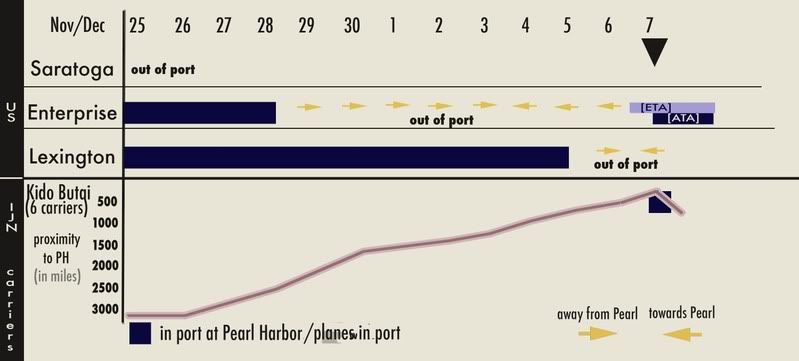
Any analyst worth his weight in Styrofoam should have foreseen the craft’s potential value in projecting air power, and any decision-makers involved in any provocation would have access to these views and choose to either ignore to act on them. Whatever was decided and by whatever means, the carriers were given special consideration and put in a special place, out of the harbor during the attack, and in fact projecting air power – just in the wrong direction.

Becoming a Way Station
There was a method to this madness, if it did ultimately prove a flawed and boneheaded method. The increasing likelihood of war with Japan in the second half of 1941 had caused the US War cabinet to look west and further west, right past Hawaii and the relatively exposed Pacific Fleet, to the distant Philippines, as the most likely flash point. There was a decision to pursue a deterrent bombing capability built up there, to turn the strategic liability into more of an asset, and a serious check on Japan's southward plans. [3] It involved suspending the normal and correct belief that the Philippines were indefensible, and this attitude was circumvented at just the right time to leave Hawaii as a neglected rear area rather than the critical front line.

What was lacking, ultimately, was enough planes to both defend the Philippines and offer a meaningful deterrent to other moves. This paradigm was still being pursued up until December 7, and in the process, Hawaii was neglected and treated, as Kimmel’s intel chief Edwin Layton put it, as ”only a way station to ferry B-17s to build up MacArthur’s forces” on Luzon. [4] When war looked more imminent, the pace of this process only quickened, while the military's joint board “resolved to reject the State Department’s hard-line proposals,” Layton explains, and “opposed “the issuance of an ultimatum to Japan,”” at least until the “imperfect threat" of the buildup was brought up to strength. [5]

Meanwhile, as the US military urged a façade of negotiation to cover their buildup against Japan's ambitions, Washington was shocked to learn of Japanese faux-diplomacy covering for a military build-up against US, UK and Dutch interests. What exactly this information was is a little uncertain, and will get a post of its own. But it became known in DC early on November 26, causing secretary of State Hull to “kick the whole [diplomacy] thing over” with an ultimatum they could not accept, and which he probably knew would spark the war. [6] This was the point when the US effectively decided to switch from talking to military preparations. Immediately after this, during November 26/27, the war council conferred and had warnings sent to all Pacific commanders pointing to possible Japanese attacks almost anywhere but Hawaii. And the two remaining aircraft carriers in Hawaii were requested to boost everything west of there “as soon as possible.” [7]

On November 28, Adm. Kimmel complied and sent the Enterprise, commanded by Admiral Halsey, and its accompanying warships to ferry 12 Grumman F4F-3 Wildcats to Wake Island. The task force began its return journey on December 4, and the following day, Lexington and its retinue set off towards Midway with 18 Vought SB2U-3 Vindicators. [8] These planes were to defend the Islands against Japanese moves and/or provide regional cover for 48 more B-17s to be flown trough there en route to the Philippines on December 7. [9] It's impossible to say if this bombers west strategy was purely a genuine military strategy or, at least in part, a smoke screen to give reason to the neglect of Hawaii - but it served the purposes of the latter, and the former was a miscalculation at best, with that final batch of bombers in fact helping mentally short-circuit radar defense at Pearl Harbor on just the wrong morning!

The Enterprise ETA Rebuttal
That attention seems thus drawn away from Pearl Harbor could be seen as supporting the “conspiracy theory” interpretation that Hawaii’s vulnerability was engineered. Further, it only makes sense to suspect the carriers’ locations would be worked into any such plans, and if so, then their absence seems to have been desired during the attack. There are arguments against this, and the best is the Enterprise; as the Pearl Harbor Myths pieces further explains:
“Enterprise was doing her best to get back into Pearl. Her first ETA was Saturday evening, but a storm delayed her. The next time set was 7 AM, 55 minutes before the attack started, but that proved too optimistic as well.”
When you’re dealing with high-stakes illusion, as we may be, a time written on paper does not a real plan make. The science of meterology was nothing then like it is now, but weather prediction was possible. I propose this ETA was fudged with a false presumption of clear sailing but knowing a storm would delay real arrival to (plus six, carry the five…) just after dawn on “X-day.” But the point gets a little better, that article explains, since the 12/6 arrival was scheduled back in August, well before anyone could have known about the Japanese plans to barely avoid:
"What really crushes the "carriers hustled out of port" myth is the fact that Enterprise was scheduled to be in port on Dec. 6th and 7th, as shown in the Employment Schedule promulgated in August, '41. No orders were ever recieved to change this. The mission to Wake was planned to coincide with the original schedule so that it would not be known that the island had recieved additional air support. The trip was kept secret, even the loading of the planes had a "cover story".
If it turns out the arrival time was set well in advance, then Dec 6 is a close coincidence that may then have been fudged upward similar to the above but with shove-off time set hours late, again wrongly presuming clear sailing, to get the carrier arriving back no earlier than the Japanese. Twice the estimates proved “too optimistic” for reality, and these erred guesses, apparently on Halsey's part, are all that gives the sense that one carrier was supposed to be back in time to join the party. But the reality, of course, is it just missed it, and reality is what matters to me.

Thrift or Thrown Game?
While I admit this fudged ETA business is quite speculative, it would serve to make the carrier absence look less suspicious, and give a hand to those who'd like to explain away these clues. That it does look dubious is testified by conspiracy theorists latching onto the “myth,” a natural impression which may have been predicted as a down-side to mitigate. If they knew it would look off, this raises the fair question of why the planners would risk such a move in the first place - carriers were valuable and scarce at the time, but ultimately expendable and easily replaceable in the post-attack climate. Given their utility alone it hardly seems worth the risk to have all of them out when at least one lost would look more natural. Thus “saving’” all three could hardly have been simple thrift, and this is likely only a secondary explanation. *

An obvious primary reason to consider, in keeping with the general thrust of this investigation, is to deplete Pearl Harbor's defenses. Minus the carriers and their decks full of fighting planes, the Japanese raiders quickly decimated almost all the remaining ground-based aircraft, which had been bunched to avoid against dread sabotage. The Enterprise returned 12 planes lighter but still holding most of its own fighters and bombers, which were close enough as the attack unfolded that they actually took part in the latter half of the defense. What kind of role they’d have played if fully in port is unsure; as it was, it seems Enterprise planes only took down one Japanese bird of the 29 lost in the attack, while losing several to enemy and understandably jumpy friendly fire. [10]

The people in the know seem to feel this carrier movement impeded the defense. Fleet intel chief Layton later summed up the effect of the carriers’ departure in that accidentally ironic way that could, with the slightest shift of view, mean exactly its opposite :
“That Stark, as well as Marshall, agreed to reduce the fighter strength at Pearl Harboor by half, and to run the risk that “there will be nothing left at Hawaii until replacements arrive,” was in itself evidence that whatever warning of Japan’s war moves had been received in Washington, it contained no hint of an attack on Pearl Harbor.” [11]

Prophecy Fulfilled
So with the defense aspect of carrier placements duly rendered ambiguous, let's return to the earlier point about the understood role of the carrier; if it was not seen prior to 12/7, it surely was after, and early probing into its potential can be seen in the curious “Doolittle Raid” of April ’42. It was just two weeks after December 7 that the President first told his war cabinet he wanted Japan proper bombed as soon as possible - partly to boost US morale but more so to shake Japan’s, and specifically as an answer to Pearl Harbor. ‘Sure, you can hit us in Hawaii,’ the message seemed to be, ‘but we can hit you at home.’ Lacking land bases close enough this early in the war, the raid was to be launched from a carrier, itself a move widely thought impossible for the larger bombers that would be needed. But after months of practice with B-25s and simulated carrier decks, they made it work, launched and rained some token destruction on Tokyo, and gave Japan its first hint of their grim future before crash-landing in or near free China. The just-completed carrier USS Hornet provided the deck for the raid, and the USS Enterprise showed up on time for its assigned escort duty on this symbolic revenge mission. [12]

By the time the raid was being planned, the ‘derelict’ Adm. Kimmel had been sacked and replaced with new Pacific Fleet commander Adm Chester Nimitz, the prophet and eventual hero of Pacific carrier warfare. Nimitz was destined for the spot, and seems to have foreseen more about the Pacific War than flat-top dominance. Earlier in 1941, he was tapped for command of Pacific Fleet, but perhaps on good advice from, say, Adm. Richardson (the outgoing CinCPAC to be replaced), turned it down, leaving the spot open for Kimmel. According to Nimitz’ son, in a 1996 History Channel documentary, the admiral said at the time:
"It is my guess that the Japanese are going to attack us in a surprise attack. There will be a revulsion in the country against all those in command at sea, and they will be replaced by people in positions of prominence ashore, and I want to be ashore, and not at sea, when that happens.” [13]

---
* To add to the thrift reason, we must consider not only the carriers but their escorts. I did a little research looking at this site on what was present on 12/7:
http://www.history.navy.mil/faqs/faq66-2.htm
and this one on what was away with the carriers:
http://www.history.navy.mil/faqs/faq66-9.htm

In Port:
Battleships – 8
Heavy Cruisers – 2
Light Crusiers – 6
Destroyers –30
Total = 46 war ships
Additional auxiliary ships, minesweepers, submarines, tenders, etc… 55

With the carrier task forces:
Two carriers, obviously
6 Heavy Cruisers
14 destroyers (split 9/5)
total = 22 war ships

So 3/4 of the heavy cruisers were absent, and about 1/3 of the destroyers. A 22 ship-reduction leaving 46 behind is about 1/3 detachment in sheer numbers, which is itself significant. About the quality and value of the classes of ships relative to each other I don't know - would this be the most valuable third? Layton's assessment [And I was There, p 263] is a little exaggerated, but informative:
"At this point [Dec 5-7], the disposition of of Kimmel's forces was as follows: All the carriers were at sea with specific missions. All the heavy cruisers and more than half of the fleet's destroyers were at sea protecting the carriers. Only the battle force - the old, slow battleships with their escorts of light cruisers and destroyers - was still at Pearl Harbor."

---
sources
[1] USS Saratoga CV 3. From: Dictionary of American Fighting Ships, published by the Naval Historical Center.
[2] “Pearl Harbor Myths”
[3] Layton, Edwin T. with Roger Pineau and John Costello "And I Was There": Pearl Harbor And Midway -- Breaking the Secrets."New York. Quill. 1985. P 171.
[4] Layton et al. P 170.
[5] Layton et al. P 177.
[6] Layton et al. PP 198-206
[7] Layton et al. 210
[8] See [1]
[9] Layton et al. 209
[10] Wikipedia. USS Enterprise (CVN-65)
[11] Layton et al. P 210.
[12] Wikipedia. Doolittle Raid.
[13] Conservapedia. McCollum Memo.

Wednesday, February 11, 2009

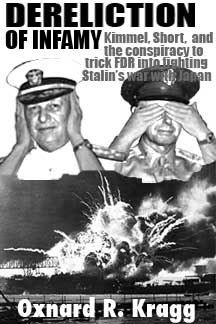
DERELICTION OF INFAMY

Adam Larson / Caustic Logic
The 12/7-9/11 Treadmill and Beyond
February 10 2009


Following is a re-post of an interesting 12/7 foreknowledge denier I stumbled upon, endorsing their own odd conspiracy theory in a bid to keep all blame away from FDR. I'm still researching the issue of Pearl Harbor, and not sure what to think in general, but I think this may all be hogwash.
---
Here it is 2009 and more than 65 years after the fact, there are those who still debate whether FDR knew anything about the pending attack on Pearl Harbor, December 7 1941. They don’t always come out and say it, but the gist of these arguments is that President Roosevelt was a traitor who consciously withheld information from Hawaii’s defenders to enable the Japanese attack and mobilize public support for US entry into World War II. The greatest generation did mobilize to knock down Japanese, Nazi, and Soviet aggression, but it was no thanks to any secret plan of the President. To anyone remotely reasonable, it should suffice to take a quick look at the people saying these things … the Holocaust-denying loons at Institute for Historical Review, the right-wingers at
John Birch Society
, 9/11 No-Planer-types, Marxists, paranoid NWO conspiratainers, Japs, of course, and crazy Japs.

It’s time to put the debate to bed. Speaking truth to such asshattery, noted director Jerry Bruckheimer once said “there’s a book that just came out which claims President Franklin D Roosevelt knew about the attack. That’s all bullshit. He didn’t know about the attack!” That book is probably Day of Deceit by Robert Stinnett, which actually said that Roosevelt and those around him desired, provoked, and allowed the attack. Oh, and knew. This is not far from a 9/11 style remote control attack by FDR himself... wait for part 2. It should be quite clear between Stinnett and Bruckheimer who knows what he’s talking about here - One wrote a stupid book based on stupid paranoid research, the other made a massively expensive and epic movie about the attack, which was nominated for five golden Raspberry awards, won an Academy Award for sound effects, and would surely have nabbed the historical accuracy and patriotic inspiration awards if they existed.

This simple fact guts Stinnett’s case and the myriad like it - FDR certainly couldn’t have arranged the attack if he didn’t even know about it. Which he didn’t, as has already been established. President Frank was a morally correct, upstanding gentleman and “former Naval Person” himself. He was certainly taken by surprise when the yellow rats snuck in and smashed the Navy, just like Admirals Kimmel and Short are widely thought to have been, but without that troubling “dereliction.”

Which brings us to a serious point about historical accountability – those at the time of the attack charged with investigating rightly pointed the blame at the failed defenders of the fleet, if they were a bit soft, referring only to “dereliction of duty.” But in recent decades there’s been a politically correct move to exonerate the names of these two negligent commanders – having their ranks reinstated after they both failed to prepare the Harbor and fleet despite several specific warnings. This is a troubling trend.

Independent resercher Oxnard R Kragg, in his recent book “Dereliction of Infamy,” reasons there can be no coincidence in Short and Kimmel both being “asleep at the switch” at the same time, just as everyone else was trying to raise the alarm for them about the obvious Japanese mobilization. This is a compelling point, and to back it up, Kragg has uncovered serious evidence that both commanders were secretly Communists, and probably agents of the Comintern! Previously unseen documents offered by Kragg make it more than likely the duo was in league with the USSR, to trick FDR from the inside into fighting the Japanese. The idea was that this would free up Stalin’s eastern front with Japan so he could focus on fighting the Nazis in Europe. As a perhaps intended side-effect, the attack forced the US to enter the war not just against the Japanese but the Germans as well, a fight in which many American soldiers were killed and the onset of the Cold War ensured.
All of this was avoidable, given existing islolationist sentiment, and the President’s own widely-stated desire to keep America out of the war at all costs. Recall the President’s pained words once his peace was shattered by Japanese bombers, that 12/7 would live in “infamy.” The Japs got off the hook easy – a little firebombing, two nukes, an occupation, and forced protectorate/tributary status and national techno-slavery, and you’re paid up, seems to have been our appeasement deal there. There are those that disingenuously try to pin the remaining domestic blame on FDR, and hardly anyone left with the courage to keep it where it belongs – on the traitors who sold us out from within. If history has taught me anything, and it hasn’t, a day cannot live in infamy by ignoring the dereliction at the heart of it.
---
ALL KIDDING ASIDE, The 12/7-9/11 Treadmill is back in operation after a hiatus of - dang! Two years! Keep an eye on this page.

Monday, January 1, 2007

NEVER MIND: STINNETT DROPS THE ISSUE

PROVOCATION ERASED, MCCOLLUM MEMO RE-CRYPTED
Adam Larson
Caustic Logic/The 12/7-9/11 Treadmill
December 26 2006


Day of Deceit author Robert Stinnett is a research fellow at the Independent Institute, an Oakland, CA-based conservative libertarian, anti-big government think tank. In addition to hosting Stinnett and his Pearl Harbor case and publishing books like “Against Leviathan,” they also feature as a fellow 9/11 skeptic and former Reagan economist Paul Craig Roberts. Via the Institute, Stinnett started to repeatedly explain and promote his arguments from Day of Deceit, starting with an event in May 2000 called “Pearl Harbor: Official Lies in an American War Tragedy?” [1] Later that year he wrote a commentary published to mark the 59th anniversary of “December 7, 1941: A Setup from the Beginning.” This piece explicitly mentioned “McCollum’s secret memo dated October 7, 1940, and recently obtained through the Freedom of Information Act.” He cited its eight points, the “centerpiece” of which was “keeping the might of the U.S. Fleet based in the Territory of Hawaii as a lure for a Japanese attack.” In this original piece, he listed two specific questions “at the top of the foreknowledge list: (1) whether President Franklin D. Roosevelt and his top military chieftains provoked Japan into an “overt act of war” directed at Hawaii, and (2) whether Japan’s military plans were obtained in advance by the United States but concealed from the Hawaiian military commanders, Admiral Husband E. Kimmel and Lieutenant General Walter Short so they would not interfere with the overt act.” [2] That is, the failure to intercept warnings was intentional and secondary to the provocation.

Robert Stinnett, if I'm not mistaken, at the White House in 1990
This December 2000 piece set a trend for anniversary commemorative articles. On the 60th anniversary of Pearl Harbor and just three months after 9/11, he published “Pentagon Still Scapegoats Pearl Harbor Fall Guys.” Again he posed the same two questions – was it provoked, and did they intercept messages. Again he made largely the same arguments as the previous year, prominently mentioning and explaining his exclusive evidence, the McCollum memo. [3]

But then something changed in 2002, curiously at just the same time the post-9/11 world and its questions of what Bush knew began to sink in. We can see a shift in direction in that his speech that year was five days early, on December 2. Still boldly titled “The Pearl Harbor Deception,” it was different in two ways than his presentations before 9/11 – First, his two questions had changed, now omitting provocation. “Two questions about the Japanese attack on Pearl Harbor have ignited a controversy that has burned for 60 years: Did U.S. naval cryptographers crack the Japanese naval codes before the attack? Did Japanese warships and their commanding admirals break radio silence at sea before the attack?” the second change I noticed is the lack of any reference to McCollum’s memo; he was leaving out what was the core of his argument, the primary thing that made it HIS argument. He was surrendering his edge. [4]

This was followed quickly by “The Truth about Pearl Harbor,” a January 30 2003 debate held at the Institute between Stinnett and foreknowledge denier Stephen Budiansky. It should be easy enough for Stinnett to win, since Budiansky argued the government line by citing only the old evidence, almost strictly code breaking (which he wrote the “complete” book on, as well as a book called “Closing the Door on Pearl Harbor”). Stinnett could have sunk Budiansky’s argument by illustrating the secondary nature of foresight when one is actively provoking something. Yet he did not, and played Budiansky’s game, keeping the very boring and tedious debate at the level of codes and of personal attacks over credibility. His presentation seems to consist of his December article, a word search of which shows that the name McCollum pops up, but only as a “James A. McCollum” cited as a source in the debate on code-breaking. The date of the memo, its author, its eight points, are totally absent. The words “provoke,” “provocation,” and various synonyms reveal nothing but the admission in the opening remarks by David Theroux that Stinnett had previously argued that “U.S. government leaders at the highest level not only knew that a Japanese attack was imminent, but that they had deliberately engaged in policies intended to provoke the attack.” In his “presentation” that day, Stinnett made no such argument. [5]

I'm sure he had very good reasons for the shift in course, but I can't say for sure what these are. It could be a case of someone finding out that the McCollum memo was maybe a forgery, forcing Stinnett to back off from it pending an investigation. I haven't heard of anyone from the swollen ranks of the 12/7 coverup apologists pointing this out, however, and to the best of my knowledge, the memo remains solid. The reason for dropping the issue could also be someone suffering "degrees of separation anxiety" and urging Stinnett to back off the hard case and leave Pearl Harbor intact.

He did, however, intriguingly point out in this twice-presented piece that “immediately after Day of Deceit appeared in bookstores in 1999, NSA began withdrawing pre-Pearl Harbor documents from the Crane Files housed in Archives II. This means the government decided to continue 60 years of Pearl Harbor censorship. As of January 2002, over two dozen NSA withdrawal notices have triggered the removal of Pearl Harbor documents from public inspection.” How ironic then that at about this same time Stinnett also started to censor himself. Though his book is still available and not removed from view at all, it’s as if Stinnett is trying to forget his core argument, or at least to stop reminding anyone of it. According to the Independent Institute’s website, Stinnett has written no more commentaries and given no more presentations in the four years since his forfeited debate with Budiansky. He seems to have retired from his pre-9/11 mission, and as far as I can tell he’s not spoken or typed the name Arthur McCollum since December 2001.

sources:
[1] independent Institute. Research Fellow: Robert B. Stinnett. http://www.independent.org/aboutus/person_detail.asp?id=514
[2] "December 7, 1941: A Setup from the Beginning." December 7, 2000. Robert B. Stinnett. Honolulu Advertiser. http://www.independent.org/newsroom/article.asp?id=103
[4] "Pentagon Still Scapegoats Pearl Harbor Fall Guys." December 7, 2001. Robert B. Stinnett. Providence Journal. http://www.independent.org/newsroom/article.asp?id=400
See [1].
[5] "The Truth About Pearl Harbor: A Debate." January 30, 2003 Robert B. Stinnett, Stephen Budiansky. http://www.independent.org/issues/article.asp?id=445
[6] http://www.independent.org/newsroom/article.asp?id=103