WHERE MOïSE AND I DISAGREE
Adam Larson / Caustic Logic
June 10 2009
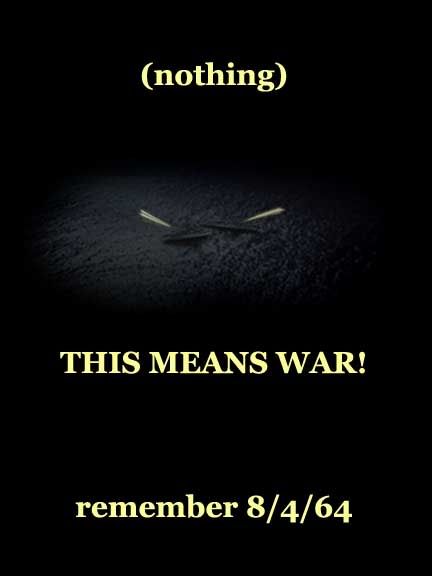
Since it’s all I have to offer anyway, I will momentarily skip out on further analysis and state my opinions on the Gulf of Tonkin Incident, Okay, I’ll cite a few supports, but the point is this might suffice as my final post on the subject, which is quick, since I’ve only put up three previously. I'm not even tempted to make any cool graphics for this one, after looking at the endless nonsensical scribbles Edwin E. Moïse had to wade through to re-construct the reality behind the two-hour circus of blunders.
From a cursory skim of some of the evidence, I find the faint possibility that some real vessels firing real torpedoes were involved, at least in the first part of the reported two-hour attack. This is the only aspect that might mean anything new; it would to me strongly imply a false flag operation involving RVN torpedo boats on a heavily-modified OPLAN 34-A raid. However, such a possibility raises many questions, and my guess is that it would not hold enough water to bother looking into it.
Aside from this intriguing distant possibility, I see little need to examine the actual non-events of August 4, 1964. All reputable and most non-reputable sources by now agree, from the overwhelming body of evidence, that no attack took place where one was claimed and aggressively pushed as the pretext for an endlessly escalating yet endlessly losing war of choice. Among all the surviving then-experts at NSA, CIA, Pentagon, various fleet commands, etc., one can find no surviving belief in the reality of this history-making engagement. Moïse’s Tonkin Gulf and the Escalation of the Vietnam War cites “profoundly disturbing” attempts by the U.S. Navy, as late as 1986, to pass the alleged attack off as real with an impressive-looking official history. [p xii] By now however even the Navy has given up the cause; as researcher John Prados explained in 2004, “the history of U.S. destroyers carried on the Navy's official website no longer contains any reference to a naval engagement having occurred on August 4.” [Prados]
Remaining questions encompass the area of unprovables – what did the active parties think and believe as they set this faux pas into motion? Opinions will differ, as mine and Moïse’s do; he feels the second attack reports were “not a deliberate fabrication” by the United States, as the North Vietnamese charged at the time. “I was quite sure that President Johnson had been making an honest mistake when he bombed the DRV in “retaliation” for an action the DRV had not committed.” [p xv] That author admits being embarrassed explaining this view to his Vietnamese hosts, who surely rolled their eyes, mentally at least. I’m not convinced he really believes that interpretation, what with former White House advisors and top generals and the like to interview, it might serve one well to avoid making such bold accusations – even if they seem warranted.
Of course he was also speaking with much of the epically befuddled destroyer crews who honestly believed the string of BS they reported that night. He doesn’t seem to feel anyone consciously made up anything, and proceeds examining how such massively erred reports originated absent any dishonesty. I’ve already expressed the possibility that the destroyer crews consciously made up the attack, and this would explain the consistency of error that reigned during the two hours an impossible attack was being reported. This is not a case I’ve seen anyone else make, and of course it’s entirely possible that an amazing string of errors in the tense climate triggered the hysteria after all. As the Pentagon set about constructing the story they’d stick with, the pressure from Washington to deliver an attack may have effected the crew only subconsciously, making their continued misinformation just more honest mistakes. Human memory can be, or can be presumed to be, infinitely strange.
Whatever the mindset behind the reports, it’s the pressure from above that matters - the suction of retaliation already in progress, that pulled out a bit more evidence, to the extent it even mattered once the wind was blowing that way. The force of that shift is clearly illustrated by President Johnson’s haste to hit back before figuring out whether there was really an engagement or not on August 4. The first draft of the Tonkin Gulf Resolution was done up and discussed with some in Congress within nine hours of the first reports, and retaliatory air strikes underway five hours after that. And those were considered far behind schedule.
The military moved along the path blazed by the President’s decisive headlong rush to war. From what I’ve read, they did this with private reservations about the pretext, but otherwise with gusto and enthusiasm and no outward doubt. The first order of business was too get hostilities opened, the second to establish their collective cover story for the pretext, which wound up being a half-ass amalgamation of carefully screened evidence. This is the essence of fabrication, in its original sense. Separate threads were somehow brought together and were consciously woven by a pre-designated pattern; a “fabric” was undeniably formed, and a major and brutal war was then sewn from that fabric.
But was it deliberate? Moïse found “no evidence,” nor any “reason to suppose” anyone in the Washington leadership had any doubts about the incident during the crucial three days between its occurrence and the passage of the Tonkin Gulf Resolution. He did find evidence that President Johnson had passed from doubts about the attack’s veracity to little doubt it was all bogus within “a few days” of the incident, with his famous “flying fish” comment. [p. 210-211] Defense Secretary Robert MacNamara was initially and for a long time publicly certain their pretext was sound, privately expressing some doubts years later, and only deciding out loud that it was probably not real in 1995. He was clearly aware from at least mid-September 1964 that the President didn’t believe his own case, according to recorded conversations between the two declassified in 2001.
My opinion is if these people were inclined to any caution, they must have at least suspected the attack was unreal, grossly exaggerated, unverified, or something other than what they presented it as. Downplaying genuine doubts and presenting something other than what happened is, in a sense anyway, “deliberate fabrication.” Again, there is no way to prove whether LBJ, MacNamara, any of their subordinates or advisers or the generals and planners and escalators or the destroyer crews themselves knew they were selling bullshit. They might have honestly thought it was something wholesome and real, not realizing the stink. In my opinion, it all comes down to how fucking stupid you believe these guys were.
Sources:
Moïse, Edwin E. “Tonkin Gulf and the Escalation of the Vietnam War.” Chapel Hill (University of North Carolina Press). 1997. 255 pages
Prados, John. Essay: 40th Anniversary of the Gulf of Tonkin Incident. National Security Archive, George Washington University. Posted August 4 2004. http://www.gwu.edu/~nsarchiv/NSAEBB/NSAEBB132/essay.htm
Showing posts with label LBJ. Show all posts
Showing posts with label LBJ. Show all posts
Wednesday, June 10, 2009


Tuesday, June 9, 2009
THE PRESIDENT’S HASTE
BLAZING THE TRAIL TO WAR
Adam Larson / Caustic Logic
June 9 2009
PRIME-TIME MATERIAL
In his 1997 book Tonkin Gulf and the Escalation of the Vietnam War, Edwin E. Moïse made an excruciatingly thorough examination of all available information and found “no evidence,” nor any “reason to suppose” President Johnson or Defense Secretary MacNamara had any doubts about the reported incident during the crucial three days before passage of the Tonkin Gulf Resolution. [p 210] Of course the evidence was always ambiguous, contradictory, and unlikely at best, and all the doubts they needed were available to such high officials from the get-go. Instead, as Moïse writes:
Retaliatory bombing is serious, and should only be done based on verifiable, logical evidence of something to retaliate for. Very few if any doubts should be allowed, not “many,” as Commander Herrick warned along with his report. If you wait for daylight to look for evidence, as Herrick recommended, but find none, that should strengthen, not weaken, the doubts. Some solid visual contacts at least should be required, some damage to the ships verified as not caused by the other ship. Something resembling what the DRV was even capable of might be a good benchmark, and another that the August 4 reports failed to meet.
If one wants to avoid an honest mistake, a little time should be allowed to figure out questions like the above. But the President had his plan and his timeline; having been handed the attack reports conveniently at the working day’s beginning, he committed to go to war with it, to have strikes underway and announced live on national TV before too much of the nation was asleep for the night.
To fit this schedule, LBJ put immense pressure on the Defense Department to gather any verification possible and prepare counter-strikes for launch as early as possible. The military scrambled, complting a surface scan for evidence of a battle (negative), bringing in a second aircraft carrier, flying in extra jets, fueling, arming, target selection, pre-reconaissance, rules of engagement, so on. MacNamara and Johnson grew impatient as the evening deepened over the eastern seaboards and stated threatening their westward audiences. [p 214-16]
”AS I SPEAK…”
Once the air attacks were apparently, arguably, underway enough, the President was on the air at 11:37pm – about fourteen hours after first learning of the alleged attack. He announced to the world:
In fact, the attacks were about to begin, and LBJ jumping the gun to make the late news slot put the retaliatory mission in jeopardy. In fact, Vietnamese records reveal that whatever defenses they did erect against the air strikes were based on interception of this speech, which aired live well before the planes were in striking range, and just before the first radar readings were reported. [p 222]
That haste had only limited effect on the mission’s success and losses, but the brinksmanship is telling. Politics dictating military strategy Is nothing new, but it didn’t just set the timing of retaliation – it also guided what the military would have to “decide” about what happened in the Gulf that night.
VIETNAM BURNING OR WASHINGTON?
Once the first 24 hours had passed, it may have seemed to some that their job, aside from executing retaliation, was to find support for the vital war effort and the President’s snap decisions. There was certainly no order to this effect, but reality is capable of writing its own script once decided on and set in motion. The belli was rolling, and the casus would have to justify it, and the alternative may have looked rather ugly and dangerous to career military men.
Evidence was gathered, mostly at the hands of skilled Pentagon lawyers who “redebriefed” all classes of witnesses extracting legally admissible clues [p 186-187] Defense Department, Joint Chiefs, Pacific Fleet, etc. had their initial doubts, but allowed them to be quickly corrected by partial sightings, supporting intercepts (some just doctored together), more testimony and recollections and opinions leaning towards a genuine engagement, and most importantly “the flow.”
Johnson’s haste, which set the tempo of all this, might be effected by his famous engagement at the time in pressing domestic issues. All summer had been consumed with passing the Civil Rights Bill and related issues of the Freedom Summer era. Some in the south took it as a bit like a war, and three enemy agents – civil rights activists James Chaney, Andrew Goodman, and Michael Schwermer - had suspiciously disappeared in Mississippi in late June. News that their bodies had been found by the FBI task force there reached the President on the night of the 4th, as he was waiting to announce the air strikes. [p. 216]
The episode of their killing – as fictitiously portrayed in 1988 movie Mississippi Burning - offers an interesting metaphor for what happened in Washington a month later. It’s been a while since I’ve seen the film, but I recall in the dead of night, the assassins with their police powers catch the three men driving alone on a back road and get them pulled over, unjustly harass them on some bogus explanation, and then begin the brutal violence. It’s painfully obvious this is the kind of infringement that gets you in trouble if witnesses talk about it. At this point it becomes clear they have passed all possibility of turning back on the course they’ve set, and one participant drawls with sinister pleasure something to the effect “well, we’re in it now boys!” However it really happened, the killers shot all three men dead, hid the bodies, concoct alibis and flaunted the feds, essentially declaring a war they would eventually lose.
---
Source: Moïse, Edwin E. “Tonkin Gulf and the Escalation of the Vietnam War.” Chapel Hill (University of North Carolina Press). 1997. 255 pages
Adam Larson / Caustic Logic
June 9 2009
PRIME-TIME MATERIAL
In his 1997 book Tonkin Gulf and the Escalation of the Vietnam War, Edwin E. Moïse made an excruciatingly thorough examination of all available information and found “no evidence,” nor any “reason to suppose” President Johnson or Defense Secretary MacNamara had any doubts about the reported incident during the crucial three days before passage of the Tonkin Gulf Resolution. [p 210] Of course the evidence was always ambiguous, contradictory, and unlikely at best, and all the doubts they needed were available to such high officials from the get-go. Instead, as Moïse writes:
“McGeorge Bundy has said that President Johnson decided at an early hour on August 4 – from his description of the timing, this might even have been before the shooting started, when all Johnson had were reports that the destroyers might be attacked – to use the incident as an occasion to get Congress to pass what was to become known as the Tonkin Gulf Resolution. […] Johnson had made up his mind. He had done so without first asking whether it was absolutely certain that an attack had actually occurred. [...] MacNamara [in seeking verification of the attack] was “asking on behalf of a president who had already committed himself to having a resolution and a speech and had the air time.”" [p 209]
Retaliatory bombing is serious, and should only be done based on verifiable, logical evidence of something to retaliate for. Very few if any doubts should be allowed, not “many,” as Commander Herrick warned along with his report. If you wait for daylight to look for evidence, as Herrick recommended, but find none, that should strengthen, not weaken, the doubts. Some solid visual contacts at least should be required, some damage to the ships verified as not caused by the other ship. Something resembling what the DRV was even capable of might be a good benchmark, and another that the August 4 reports failed to meet.
If one wants to avoid an honest mistake, a little time should be allowed to figure out questions like the above. But the President had his plan and his timeline; having been handed the attack reports conveniently at the working day’s beginning, he committed to go to war with it, to have strikes underway and announced live on national TV before too much of the nation was asleep for the night.
To fit this schedule, LBJ put immense pressure on the Defense Department to gather any verification possible and prepare counter-strikes for launch as early as possible. The military scrambled, complting a surface scan for evidence of a battle (negative), bringing in a second aircraft carrier, flying in extra jets, fueling, arming, target selection, pre-reconaissance, rules of engagement, so on. MacNamara and Johnson grew impatient as the evening deepened over the eastern seaboards and stated threatening their westward audiences. [p 214-16]
”AS I SPEAK…”
Once the air attacks were apparently, arguably, underway enough, the President was on the air at 11:37pm – about fourteen hours after first learning of the alleged attack. He announced to the world:
“[R]enewed hostile actions against United States ships on the high seas in the Gulf of Tonkin have today required me to order the military forces of the United States to take action in reply. […] That reply is being given as I speak to you tonight. Air action is now in execution…”
In fact, the attacks were about to begin, and LBJ jumping the gun to make the late news slot put the retaliatory mission in jeopardy. In fact, Vietnamese records reveal that whatever defenses they did erect against the air strikes were based on interception of this speech, which aired live well before the planes were in striking range, and just before the first radar readings were reported. [p 222]
That haste had only limited effect on the mission’s success and losses, but the brinksmanship is telling. Politics dictating military strategy Is nothing new, but it didn’t just set the timing of retaliation – it also guided what the military would have to “decide” about what happened in the Gulf that night.
VIETNAM BURNING OR WASHINGTON?
Once the first 24 hours had passed, it may have seemed to some that their job, aside from executing retaliation, was to find support for the vital war effort and the President’s snap decisions. There was certainly no order to this effect, but reality is capable of writing its own script once decided on and set in motion. The belli was rolling, and the casus would have to justify it, and the alternative may have looked rather ugly and dangerous to career military men.
Evidence was gathered, mostly at the hands of skilled Pentagon lawyers who “redebriefed” all classes of witnesses extracting legally admissible clues [p 186-187] Defense Department, Joint Chiefs, Pacific Fleet, etc. had their initial doubts, but allowed them to be quickly corrected by partial sightings, supporting intercepts (some just doctored together), more testimony and recollections and opinions leaning towards a genuine engagement, and most importantly “the flow.”
Johnson’s haste, which set the tempo of all this, might be effected by his famous engagement at the time in pressing domestic issues. All summer had been consumed with passing the Civil Rights Bill and related issues of the Freedom Summer era. Some in the south took it as a bit like a war, and three enemy agents – civil rights activists James Chaney, Andrew Goodman, and Michael Schwermer - had suspiciously disappeared in Mississippi in late June. News that their bodies had been found by the FBI task force there reached the President on the night of the 4th, as he was waiting to announce the air strikes. [p. 216]
The episode of their killing – as fictitiously portrayed in 1988 movie Mississippi Burning - offers an interesting metaphor for what happened in Washington a month later. It’s been a while since I’ve seen the film, but I recall in the dead of night, the assassins with their police powers catch the three men driving alone on a back road and get them pulled over, unjustly harass them on some bogus explanation, and then begin the brutal violence. It’s painfully obvious this is the kind of infringement that gets you in trouble if witnesses talk about it. At this point it becomes clear they have passed all possibility of turning back on the course they’ve set, and one participant drawls with sinister pleasure something to the effect “well, we’re in it now boys!” However it really happened, the killers shot all three men dead, hid the bodies, concoct alibis and flaunted the feds, essentially declaring a war they would eventually lose.
---
Source: Moïse, Edwin E. “Tonkin Gulf and the Escalation of the Vietnam War.” Chapel Hill (University of North Carolina Press). 1997. 255 pages
Tuesday, June 2, 2009
USS MADDOX ATTACK REPORTS
HERRICK’S WORDS AND TWO TRANSLATIONS
Adam Larson / Caustic Logic
June 2 2009
last edit 6/5 2am
THE STAGE IS SET: HERRICK TO ELLSBERG
When I was debating Pearl Harbor at the JREF forum a few months back, Screw Loose Change co-creator “Brainster” countered any design for loss on FDR’s part with the observation that “zero US deaths on the USS Maddox led to [the war in] Vietnam.” “Too true!” I responded eagerly, knowing just enough about this incident, continuing:
This passing thought came back to a point when I learned – last night - that Daniel Ellsberg, the Pentagon insider-turned dissident who was among the chief actors in the war’s undoing - was there as it started on the wrong foot. In his memoirs he reveals he was the man at the Pentagon who first received Captain Herrick’s reports about the attack, opening his book on the war of lies with this episode, and so I’ll open my Tonkin Gulf inquiry here as well.
I’m having a hard time locating any clear versions of these early communications besides snippets like these re-printed from obscure works, but their gist is clear – a major prolonged attack supported by many fast-moving reports.
MANY DOUBTS/MY TRANSLATION
About an hour after the last battle message, however, there came a “full stop,” Ellsberg recalls. “A message arrived that took back not quite all of it, but enough of it to put everything earlier in question.” [3] This follow-up message introducing doubts is more widely quoted and read thus:
Well this is certainly a bizarre thing to say after an hours-long battle one had barely survived. This incongruous uncertainty triggered what witer Eric Alterman called “a flurry of pointed inquiries from the highest levels of the Pentagon” [5] which in turn prompted another rosier report with more evidence of attack after all:
Captain Herrick seems to be operating here in a world different from the three-dimensional one we all inhabit, and his words are less reflection of coherent truth than impressionist brush strokes suggesting a possible reality that could be taken or left. From my intuition and the moderate amount I know about this incident, he seems to be saying “we were viciously attacked, maybe, probably not, but maybe, definitely we think – look, we don’t know, if you think we did then we did. Check it out yourselves, if you want, but that’s our report. We got attacked. Can we go home now?”
Rendering an accurate translation takes a knowledge of context, foremost the “Desoto patrol” that had both Maddox and its danger-zone company Turner Joy sent again into this Gulf to spy and to defy attacks. This was carried out alongside “OPLAN 34A” provocations feeding off-Desoto intel and stirring up more. Some stimulated reactions, the President had already decided, could only be met with military firmness. Maddox had been attacked two days before, on August 2. LBJ seemed to feel he needed two such events in order to get firm while seeming well-justified, and the provoke-then-patrol system was continued.
The Maddox was given a partner, Turner Joy for the mission of the 4th and promised air cover. Herrick had been alerted of new 34A provocations, and received Pentagon warnings of another imminent attack, and yet his protests to just cancel it as an “unacceptable risk” were denied. Thus the captains of both ships were given every reason to both worry about torpedo strikes and sinking, and to think about why they were being exposed to such danger. It seems possible that this inspired them to simply imagine the inevitable attack hoping - perhaps unconsciously - that a false report would give the leadership what it wanted without the pain and death of a real attack. This is just an uniformed impression from a cynical blogger, but there it is.
THE BASTARD PIMP LBJ’S TRANSLATION
President Johnson and his top aides all claimed to believe the attack reports, at least at first, when it mattered. But LBJ’s words on September 18 show he was aware there was no attack, that his own case upon which the war was escalating by his choice, was fraudulent. White House recordings, released in 2001, transcribed by Eric Alterman for his book When Presidents Lie. In a discussion with Secretary of Defense MacNamara, Johnson reminds him that “you just came in … a few weeks ago and said that “Damn, they are launching an attack on us – they are firing on us.” When we got through with all the firing we concluded maybe they hadn’t fired at all.” [7] This is both an accurate summary of what happened in the Gulf, and a metaphor for the larger movement of the national “we” and its reaction of retaliatory bombing and resolution-passing.
“I have found over the years that we see and we hear and we imagine a lot of things in the form of stacks and shots and people running at us,” he sad, apparently explaining why the erred reports both make sense and annoy him. It would “make us very vulnerable,” he told MacNamara, if it that were the case here, and the reported attack they were then starting a war over “just wasn’t true at all.” He shows signs of believing just this, while proceeding full-tilt in that vulnerability. “It looks like to me they would hear a shot or see a shot or do something before they get worked up […] I want to be tough where we … are justified being tough … But I sure want more caution on the part of these admirals and these destroyer commanders … about whether they are being fired on or not.” [8]
He seemed less concerned with the truthfulness of the reports than with their ambiguity. “I don't know why in the hell, some time or other, they can't be sure that they are being attacked.” There are only two alternatives to flase attack reports, and it’s not clear which he’s looking for – no attacks, as had been happening so far with Hanoi trying to avoid a confrontation, or true reports of real attacks. [9]
Finally, this bastard summoned the chutzpah to re-state himself thus: “I don’t want them just being some change o’life woman running up and saying that, by God, she was being raped just because a man walks into the room!” [10] This from the man who approved and endorsed the system that had their “women” regularly sent into rooms already crowded with leering, pornography-addled men (buzzed-to-drunk on liquor air-dropped just before their women arrived) – to “assert their right as women to go where they please” and study the psycho-sexual behavior of the "men" in the "room."
By God, the President doesn’t want to hear some prudish false charges. Under the circumstances, should a real rape be so hard to come by? Or at least a more convincing made-up one? Those Texas knuckles are aching to make contact with a genuine rapist’s face! If the guys in the Gulf made the call I outlined above, it worked in the end, and the beatings did commence, even if the chief was frustrated with his silly little "women."
Sources:
[1] http://forums.randi.org/showthread.php?t=136679&page=2
[2], [3] Ellsberg, Daniel. Secrets: A Memoir of Vietnam and the Pentagon Papers Chapter one. http://www.kean.edu/~ggluck/EllsbergChapterOne.htm
[4, 5, 6] Alterman, Eric. When Presidents Lie. Viking. 2004.Page 188.
[7, 8, 9, 10] Alterman. pp 201-202.
Adam Larson / Caustic Logic
June 2 2009
last edit 6/5 2am
THE STAGE IS SET: HERRICK TO ELLSBERG
When I was debating Pearl Harbor at the JREF forum a few months back, Screw Loose Change co-creator “Brainster” countered any design for loss on FDR’s part with the observation that “zero US deaths on the USS Maddox led to [the war in] Vietnam.” “Too true!” I responded eagerly, knowing just enough about this incident, continuing:
“And look at how well that war went! Can you imagine if FDR had tried to base WWfrigginII on some fake out boat incident deep inside Japan's sphere of influence? You think hippies on campus caused a problem, right wingers have guns and such... I know it sounds a stretch to say the event shapes the war, but on some level it does, the question is how much.” [1]
This passing thought came back to a point when I learned – last night - that Daniel Ellsberg, the Pentagon insider-turned dissident who was among the chief actors in the war’s undoing - was there as it started on the wrong foot. In his memoirs he reveals he was the man at the Pentagon who first received Captain Herrick’s reports about the attack, opening his book on the war of lies with this episode, and so I’ll open my Tonkin Gulf inquiry here as well.
”On Tuesday morning, August 4, 1964, my first full day on my new job in the Pentagon, a courier came into the outer office with an urgent cable for my boss. He'd been running. The secretaries told him Assistant Secretary John McNaughton was out of the office; he was down the hall with Secretary of Defense Robert McNamara. They pointed him to me, his new Special Assistant. The courier handed me the cable and left. It was easy to see, as I read it, why he had been running.
It was from Captain John J. Herrick, the commodore of a two-destroyer flotilla in the Tonkin Gulf, off North Vietnam in the South China Sea. He said he was under attack by North Vietnamese patrol boats and he had opened fire on them.
[…] Within ten minutes he was back to me with another cable from the same series: "Am under continuous torpedo attack." […] A few minutes later, Herrick reported another torpedo had run by him, and that two more were in the water. […] The messages were vivid. [...] "Have. . . successfully avoided at least six torpedoes."
Nine torpedoes had been fired at his ships, fourteen, twenty-six: the sea was awash with torpedoes. More attacking boats had been hit, at least one sunk. This action wasn't ending after forty minutes or an hour. It was going on, ships dodging and firing in choppy seas, planes overhead firing rockets at locations given them by the Turner Joy's radar, for an incredible two hours before the stream of continuous combat updates finally ended.” [2]
I’m having a hard time locating any clear versions of these early communications besides snippets like these re-printed from obscure works, but their gist is clear – a major prolonged attack supported by many fast-moving reports.
MANY DOUBTS/MY TRANSLATION
About an hour after the last battle message, however, there came a “full stop,” Ellsberg recalls. “A message arrived that took back not quite all of it, but enough of it to put everything earlier in question.” [3] This follow-up message introducing doubts is more widely quoted and read thus:
“Review of action makes many recorded contacts and torpedoes fired appear doubtful. Freak weather effects and over-eager sonarman may have accounted for many reports. No actual visual sightings by Maddox. Suggest complete evaluation before any further action.” [4]
Well this is certainly a bizarre thing to say after an hours-long battle one had barely survived. This incongruous uncertainty triggered what witer Eric Alterman called “a flurry of pointed inquiries from the highest levels of the Pentagon” [5] which in turn prompted another rosier report with more evidence of attack after all:
"Further recap reveals Turner Joy fired upon by small-caliber guns and illuminated by searchlight. Joy tracked two sets of contacts. Fired on 13 contacts. Claim positive hits 1, 1 sunk, probabe hits 3. Joy also reports no actual visual sightings or wake. Have no recap of aircraft sightings but seemed to be few. Entire action leaves many doubts except for apparent attempted ambush at beginning. Suggest thorough reconnaissance in daylight by aircraft.” [6]
Captain Herrick seems to be operating here in a world different from the three-dimensional one we all inhabit, and his words are less reflection of coherent truth than impressionist brush strokes suggesting a possible reality that could be taken or left. From my intuition and the moderate amount I know about this incident, he seems to be saying “we were viciously attacked, maybe, probably not, but maybe, definitely we think – look, we don’t know, if you think we did then we did. Check it out yourselves, if you want, but that’s our report. We got attacked. Can we go home now?”
Rendering an accurate translation takes a knowledge of context, foremost the “Desoto patrol” that had both Maddox and its danger-zone company Turner Joy sent again into this Gulf to spy and to defy attacks. This was carried out alongside “OPLAN 34A” provocations feeding off-Desoto intel and stirring up more. Some stimulated reactions, the President had already decided, could only be met with military firmness. Maddox had been attacked two days before, on August 2. LBJ seemed to feel he needed two such events in order to get firm while seeming well-justified, and the provoke-then-patrol system was continued.
The Maddox was given a partner, Turner Joy for the mission of the 4th and promised air cover. Herrick had been alerted of new 34A provocations, and received Pentagon warnings of another imminent attack, and yet his protests to just cancel it as an “unacceptable risk” were denied. Thus the captains of both ships were given every reason to both worry about torpedo strikes and sinking, and to think about why they were being exposed to such danger. It seems possible that this inspired them to simply imagine the inevitable attack hoping - perhaps unconsciously - that a false report would give the leadership what it wanted without the pain and death of a real attack. This is just an uniformed impression from a cynical blogger, but there it is.
THE BASTARD PIMP LBJ’S TRANSLATION
President Johnson and his top aides all claimed to believe the attack reports, at least at first, when it mattered. But LBJ’s words on September 18 show he was aware there was no attack, that his own case upon which the war was escalating by his choice, was fraudulent. White House recordings, released in 2001, transcribed by Eric Alterman for his book When Presidents Lie. In a discussion with Secretary of Defense MacNamara, Johnson reminds him that “you just came in … a few weeks ago and said that “Damn, they are launching an attack on us – they are firing on us.” When we got through with all the firing we concluded maybe they hadn’t fired at all.” [7] This is both an accurate summary of what happened in the Gulf, and a metaphor for the larger movement of the national “we” and its reaction of retaliatory bombing and resolution-passing.
“I have found over the years that we see and we hear and we imagine a lot of things in the form of stacks and shots and people running at us,” he sad, apparently explaining why the erred reports both make sense and annoy him. It would “make us very vulnerable,” he told MacNamara, if it that were the case here, and the reported attack they were then starting a war over “just wasn’t true at all.” He shows signs of believing just this, while proceeding full-tilt in that vulnerability. “It looks like to me they would hear a shot or see a shot or do something before they get worked up […] I want to be tough where we … are justified being tough … But I sure want more caution on the part of these admirals and these destroyer commanders … about whether they are being fired on or not.” [8]
He seemed less concerned with the truthfulness of the reports than with their ambiguity. “I don't know why in the hell, some time or other, they can't be sure that they are being attacked.” There are only two alternatives to flase attack reports, and it’s not clear which he’s looking for – no attacks, as had been happening so far with Hanoi trying to avoid a confrontation, or true reports of real attacks. [9]
Finally, this bastard summoned the chutzpah to re-state himself thus: “I don’t want them just being some change o’life woman running up and saying that, by God, she was being raped just because a man walks into the room!” [10] This from the man who approved and endorsed the system that had their “women” regularly sent into rooms already crowded with leering, pornography-addled men (buzzed-to-drunk on liquor air-dropped just before their women arrived) – to “assert their right as women to go where they please” and study the psycho-sexual behavior of the "men" in the "room."
By God, the President doesn’t want to hear some prudish false charges. Under the circumstances, should a real rape be so hard to come by? Or at least a more convincing made-up one? Those Texas knuckles are aching to make contact with a genuine rapist’s face! If the guys in the Gulf made the call I outlined above, it worked in the end, and the beatings did commence, even if the chief was frustrated with his silly little "women."
Sources:
[1] http://forums.randi.org/showthread.php?t=136679&page=2
[2], [3] Ellsberg, Daniel. Secrets: A Memoir of Vietnam and the Pentagon Papers Chapter one. http://www.kean.edu/~ggluck/EllsbergChapterOne.htm
[4, 5, 6] Alterman, Eric. When Presidents Lie. Viking. 2004.Page 188.
[7, 8, 9, 10] Alterman. pp 201-202.
Monday, May 4, 2009
USS LIBERTY OFFICIAL INVESTIGATIONS
13, 12, 11, 10… COUNTDOWN TO TRUTH?
Adam Larson / Caustic Logic
May 1 2009
last update 5/4
A NUMBERS GAME
Terence O’Keefe, a writer for he Washington Report on Middle East Affairs, in a December 2003 article, took aim at – and sunk – a key argument of pro-Israel obfuscation artist Jay. A Cristol. In his 2002 book The Liberty Incident, O’Keefe explains, Cristol’s “mantra” was that "thirteen investigations have all exonerated Israel" for their 1967 attack. [1] I’m past my “viewing limit” for the book, but O’Keefee did offer a numbered run-down of them (largely reproduced below), which I’m relying on for my critique.
To get 13, and he could have actually claimed 14, Cristol includes three self-exonerating Israeli reports. The first two reports, Ram Ron’s and Yerushalmi’s, from 1967, are actually lumped together as one entry; as O’Keefe explains and my partial examination confirms, these were not investigations at all but part of an internal Israeli process to find if anyone in particular should be charged with crimes. They concluded there was no negligence in the incident acute enough for a trial. The second was an IDF “official” history in response to renewed controversy in the United States. It may have had an investigative element, but was primarily a synthesis, with wider circulation, of the 1967 reports. [2] In all three, the fact that the incident was purely mistake was the first assumption, and was never questioned or examined.
Considering that Cristol’s primary target audience is American, it would make sense then to just drop the two Israeli non-investigation, and focus on the US investigations, which would seem to number eleven. He apparently did at one point, and this assemblage echoed around the infoverse - Alison Weir wrote for Counterpunch in June 2007 to analyze USA Today's first-ever news story on the Liberty. Reporter Oren Dorell talked only with analysts “with ties to Israel,” and while he did feature survivor accounts, these were pre-empted with the caveat “Israel has always insisted the attack was a case of mistaken identity, and 11 U.S. investigations over the years have reached the same conclusion." [3] The list Weir recounts is O’Keefe’s findings minus the two Israeli entries.
One critic noted how at a 2004 book signing, “the haughty Cristol persisted with his bogus argument, at the signing, that there has been "seven investigations" that have exonerated Israel. (In his book, he claimed thirteen! Go figure.)” [4] Cristol’s site currently explains “after ten official US investigations (including five congressional investigations), there was never any evidence that the attack was made with knowledge that the target was a US ship.” [5] There has been some semantics-playing by Liberty supporters, about the lack of Congressional = lack of governmental, but the "mantra" on that side is there have been NO Congressional investigations, let alone five. [see below for details] The Numbers game aside, there have been investigations by elements of the U.S. government regarding the incident, and all have avoided outright claims of hostile intentions towards the US. They also do little else of any relevance to the question.
NAVAL COURT OF INQUIRY; “TOTALLY INADEQUATE”
Among the U.S. investigations, the first in time, scope, power, and importance is the Naval Court of Inquiry, ordered even before the Liberty finished its slow journey to safe harbor. Admiral John McCain II was put in charge of finding what went wrong; as commander of U.S. naval forces in Europe, he had wide subpoena authority and other tools available. These he passed on to his deputy, Admiral Isaac Kidd, who would preside over the Court. His first order of business, appropriate to an investigation, was to tell the Liberty crew to keep quiet. Unlike normal, however, Kidd’s stern injunctions were taken as permanent.
All in all, it appears the Court treated the attacks as they might an inevitable act of nature – the questions were only how to keep ships away from those areas in the future, and tips on how to handle flooding, document security, medical triage, etc… Liberty survivor John Hrankowski has called the NCOI “a farce,” largely from failing to go “into the Israeli aspect. Israel was never queried about it." A site run by CAMERA (Center for Accuracy in Middle East Reporting in America) responded to this complaint “In fact, the Court of Inquiry was primarily focused on the actions of the Liberty’s crew, and thus quite properly did not include Israeli testimony.” [6] The same site lists its findings as “mistaken identity,” as if this means much of anything in the context.
John Crewdson’s historic Chicago Tribune article from 2007 concurred, stating “the court’s charge was narrow: to determine whether any shortcomings on the part of the Liberty’s crew had contributed to the injuries and deaths that resulted from the attack. McCain gave Kidd’s investigators a week to complete the job.” [7] Actually their purview was, or became, wider than this, covering the US military beyond the Liberty’s deck as well as speculative forays into other areas. NCOI’s fifty-two total findings of fact largely concern communications errors that left Liberty crawling in harm’s way, itself an interesting issue.
The inquiry did little, and could be expected to do little to exonerate the Israelis, since "it was not the responsibility of the court to rule on the culpability of the attackers, and no evidence was heard from the attacking nation." [8] They do acknowledge how Tel Aviv “set forth 7 points of rationale to explain,” but they gathered nothing of their own from the Israeli end, and from these papers “there are no available indications that the attack was intended against a U.S. Ship.” Finding 48 did acknowledge “LIBERTY apparently experienced a phenomenon identified as electronic jamming of her voice radio just prior to and during air attack,” which many say indicates they knew to jam U.S. frequencies. Nonetheless, the Court’s “available evidence combines to indicate the attack on LIBERTY on 8 June was in fact a case of mistaken identity.” [9]
Capt. Ward Boston, who had been the chief legal counsel to the Court of Inquiry, later denounced the process (his own part included, it seems) as a fraud. Once presumably tasked with drafting legal opinions on Israel’s offered explanations, and thus setting the Inquiry’s tone, decades later confessed he was in fact “certain" the IDF "were well aware that the ship was American." As O’Keefe explained:
Boston has said - in no uncertain terms - that this view was shared by his boss, the NCOI’s president, Adm. Kidd. "The evidence was clear. Both Admiral Kidd and I believed with certainty that this attack [...] was a deliberate effort to sink an American ship and murder its entire crew." [11] To be fair, Kidd was dead by the time of these statements and unable to verify. Adm. McCain has never spoken up like this that I’ve heard, but, as O’Keefe found at least one more dissenter from high up in the investigation: “Rear Adm. Merlin Staring, the Navy’s former judge advocate general, was asked to assess the American inquiry’s report before it was sent to Washington. But Staring said it was taken from him when he began to question some aspects of the report. He describes it now as “a hasty, superficial, incomplete and totally inadequate inquiry.” [12]
This is not such a good track record for this pivotal no-confidence-voted non-exoneration. But never mind what they men involved really think, they once were persuaded to put their names on a report that put some nice exculpatory quotes at the very top of their findings, when these “facts” were never “found,” but rather “sent” by the Israelis themselves.
THE REST
Aside from the NCOI, that leaves ten once-alleged US investigations (and nine current) that “absolved Israel.” Here I’ll list O’Keefe’s explanations, renumbered for effect, starting at 2 since the NCOI was #1. The first two below I haven't studied yet, but no. 4 is juicy...
In fact, Clifford's report does reach conclusions, but they are highly intelligent, restrained, and nuanced. The report is strident in its denouncement of "a flagrant act of gross negligence for which the Israeli Government should be held completely responsible, and the Israeli military personnel involved should be punished." And he mentions that there is a "theory," not yet disproved, "that the highest echelons of the Israeli Government were aware of the Liberty's true identity or of the fact that an attack on her was taking place." However, he finds that "The information thus far available does not reflect" that possibility, and that to know if any information not yet available might reflect this, "would necessitate a degree of access to Israeli personnel and information which in all likelihood can never be achieved." Another astute observation from this report, in line with my own and well-put:
Interestingly, when Clifford summarizes Israel's explanations, the word "mistake" is always joined with quotation marks. He's also been quoted as saying "I do not know to this day at what level the attack on the Liberty was authorized and I think it is unlikely that the full truth will ever come out." So yeah, Clifford once put his name on a paper that said basically "well, we don't have PROOF of a conspiracy, but..." Great, keep the "exonerations" rolling in, this is stupendous amusement.
According to this, one of his alleged exculpations was a letter about a potential investigation that he was shown – for advice – that eventually was scuttled. Thus Cristol may have killed it himself, and then claimed it “exonerated Israel!” So that’s six *congressional investigations*; and since the good judge is currently citing five, one must wonder which of the two allegedly non-existent ones he’s dropped and which he’s still reporting as true. CAMERA’s USS Liberty page is less inclusive, citing “at least six government investigations which reached relevant conclusions as to the facts of the attack.” A noble gesture, to consider whether their findings are “relevant,” but unfortunately the site lists as one of the six “House Armed Services Committee, 1991/1992 - No support for claims attack was intentional.” Until I get a copy of the book, I have CAMERA’s explanation that “after a one year investigation the matter was closed, the investigators evidently finding nothing to support conspiracy claims or any Israeli intentions to attack a US ship”. I’ll reserve further comment until I’ve examined the controversy more closely.
So that’s it, the baker's dozen of case-closings that have left this case more closed to questions than the West Bank is to Palestinian exiles. Of course there is at least one professional-level but private investigation which, outside the control of Tel Aviv and the White House, is worthless as evidence and to be utterly ignored.
rest coming...
Adam Larson / Caustic Logic
May 1 2009
last update 5/4
A NUMBERS GAME
Terence O’Keefe, a writer for he Washington Report on Middle East Affairs, in a December 2003 article, took aim at – and sunk – a key argument of pro-Israel obfuscation artist Jay. A Cristol. In his 2002 book The Liberty Incident, O’Keefe explains, Cristol’s “mantra” was that "thirteen investigations have all exonerated Israel" for their 1967 attack. [1] I’m past my “viewing limit” for the book, but O’Keefee did offer a numbered run-down of them (largely reproduced below), which I’m relying on for my critique.
To get 13, and he could have actually claimed 14, Cristol includes three self-exonerating Israeli reports. The first two reports, Ram Ron’s and Yerushalmi’s, from 1967, are actually lumped together as one entry; as O’Keefe explains and my partial examination confirms, these were not investigations at all but part of an internal Israeli process to find if anyone in particular should be charged with crimes. They concluded there was no negligence in the incident acute enough for a trial. The second was an IDF “official” history in response to renewed controversy in the United States. It may have had an investigative element, but was primarily a synthesis, with wider circulation, of the 1967 reports. [2] In all three, the fact that the incident was purely mistake was the first assumption, and was never questioned or examined.
Considering that Cristol’s primary target audience is American, it would make sense then to just drop the two Israeli non-investigation, and focus on the US investigations, which would seem to number eleven. He apparently did at one point, and this assemblage echoed around the infoverse - Alison Weir wrote for Counterpunch in June 2007 to analyze USA Today's first-ever news story on the Liberty. Reporter Oren Dorell talked only with analysts “with ties to Israel,” and while he did feature survivor accounts, these were pre-empted with the caveat “Israel has always insisted the attack was a case of mistaken identity, and 11 U.S. investigations over the years have reached the same conclusion." [3] The list Weir recounts is O’Keefe’s findings minus the two Israeli entries.
One critic noted how at a 2004 book signing, “the haughty Cristol persisted with his bogus argument, at the signing, that there has been "seven investigations" that have exonerated Israel. (In his book, he claimed thirteen! Go figure.)” [4] Cristol’s site currently explains “after ten official US investigations (including five congressional investigations), there was never any evidence that the attack was made with knowledge that the target was a US ship.” [5] There has been some semantics-playing by Liberty supporters, about the lack of Congressional = lack of governmental, but the "mantra" on that side is there have been NO Congressional investigations, let alone five. [see below for details] The Numbers game aside, there have been investigations by elements of the U.S. government regarding the incident, and all have avoided outright claims of hostile intentions towards the US. They also do little else of any relevance to the question.
NAVAL COURT OF INQUIRY; “TOTALLY INADEQUATE”
Among the U.S. investigations, the first in time, scope, power, and importance is the Naval Court of Inquiry, ordered even before the Liberty finished its slow journey to safe harbor. Admiral John McCain II was put in charge of finding what went wrong; as commander of U.S. naval forces in Europe, he had wide subpoena authority and other tools available. These he passed on to his deputy, Admiral Isaac Kidd, who would preside over the Court. His first order of business, appropriate to an investigation, was to tell the Liberty crew to keep quiet. Unlike normal, however, Kidd’s stern injunctions were taken as permanent.
All in all, it appears the Court treated the attacks as they might an inevitable act of nature – the questions were only how to keep ships away from those areas in the future, and tips on how to handle flooding, document security, medical triage, etc… Liberty survivor John Hrankowski has called the NCOI “a farce,” largely from failing to go “into the Israeli aspect. Israel was never queried about it." A site run by CAMERA (Center for Accuracy in Middle East Reporting in America) responded to this complaint “In fact, the Court of Inquiry was primarily focused on the actions of the Liberty’s crew, and thus quite properly did not include Israeli testimony.” [6] The same site lists its findings as “mistaken identity,” as if this means much of anything in the context.
John Crewdson’s historic Chicago Tribune article from 2007 concurred, stating “the court’s charge was narrow: to determine whether any shortcomings on the part of the Liberty’s crew had contributed to the injuries and deaths that resulted from the attack. McCain gave Kidd’s investigators a week to complete the job.” [7] Actually their purview was, or became, wider than this, covering the US military beyond the Liberty’s deck as well as speculative forays into other areas. NCOI’s fifty-two total findings of fact largely concern communications errors that left Liberty crawling in harm’s way, itself an interesting issue.
The inquiry did little, and could be expected to do little to exonerate the Israelis, since "it was not the responsibility of the court to rule on the culpability of the attackers, and no evidence was heard from the attacking nation." [8] They do acknowledge how Tel Aviv “set forth 7 points of rationale to explain,” but they gathered nothing of their own from the Israeli end, and from these papers “there are no available indications that the attack was intended against a U.S. Ship.” Finding 48 did acknowledge “LIBERTY apparently experienced a phenomenon identified as electronic jamming of her voice radio just prior to and during air attack,” which many say indicates they knew to jam U.S. frequencies. Nonetheless, the Court’s “available evidence combines to indicate the attack on LIBERTY on 8 June was in fact a case of mistaken identity.” [9]
Capt. Ward Boston, who had been the chief legal counsel to the Court of Inquiry, later denounced the process (his own part included, it seems) as a fraud. Once presumably tasked with drafting legal opinions on Israel’s offered explanations, and thus setting the Inquiry’s tone, decades later confessed he was in fact “certain" the IDF "were well aware that the ship was American." As O’Keefe explained:
“[Boston and the Court] found that the attack was deliberate, but reported falsely that it was not because they were directed by the president of the United States and the secretary of defense to report falsely. So the findings are fraudulent. Yet these fraudulent findings were the basis for several other reports that followed.” [10]
Boston has said - in no uncertain terms - that this view was shared by his boss, the NCOI’s president, Adm. Kidd. "The evidence was clear. Both Admiral Kidd and I believed with certainty that this attack [...] was a deliberate effort to sink an American ship and murder its entire crew." [11] To be fair, Kidd was dead by the time of these statements and unable to verify. Adm. McCain has never spoken up like this that I’ve heard, but, as O’Keefe found at least one more dissenter from high up in the investigation: “Rear Adm. Merlin Staring, the Navy’s former judge advocate general, was asked to assess the American inquiry’s report before it was sent to Washington. But Staring said it was taken from him when he began to question some aspects of the report. He describes it now as “a hasty, superficial, incomplete and totally inadequate inquiry.” [12]
This is not such a good track record for this pivotal no-confidence-voted non-exoneration. But never mind what they men involved really think, they once were persuaded to put their names on a report that put some nice exculpatory quotes at the very top of their findings, when these “facts” were never “found,” but rather “sent” by the Israelis themselves.
THE REST
Aside from the NCOI, that leaves ten once-alleged US investigations (and nine current) that “absolved Israel.” Here I’ll list O’Keefe’s explanations, renumbered for effect, starting at 2 since the NCOI was #1. The first two below I haven't studied yet, but no. 4 is juicy...
2. The Joint Chiefs of Staff Report of June 1967: This was an inquiry into the mishandling of several messages intended for the ship. It was not an investigation into the attack. It did not exonerate Israel, because it did not in any way consider the question of culpability.
3. CIA report of June 13, 1967: This interim report, completed five days after the attack, reported "our best judgment [is] that the attack...was a mistake." No investigation was conducted, and no first-hand evidence was collected. Then-CIA Director Richard Helms concluded and later reported in his autobiography that the attack was planned and deliberate.
4. Clark Clifford report of July 18, 1967: Clark Clifford was directed by Lyndon Johnson to review the Court of Inquiry report and the interim CIA report and "not to make an independent inquiry." His was merely a summary of other fallacious reports, not an "investigation"... The report reached no conclusions and did not exonerate Israel... On the contrary, Clifford wrote later that he regarded the attack as deliberate.
In fact, Clifford's report does reach conclusions, but they are highly intelligent, restrained, and nuanced. The report is strident in its denouncement of "a flagrant act of gross negligence for which the Israeli Government should be held completely responsible, and the Israeli military personnel involved should be punished." And he mentions that there is a "theory," not yet disproved, "that the highest echelons of the Israeli Government were aware of the Liberty's true identity or of the fact that an attack on her was taking place." However, he finds that "The information thus far available does not reflect" that possibility, and that to know if any information not yet available might reflect this, "would necessitate a degree of access to Israeli personnel and information which in all likelihood can never be achieved." Another astute observation from this report, in line with my own and well-put:
"That the Liberty could have been mistaken for the Egyptian supply ship El Quseir is unbelievable. El Quseir has one-fourth the displacement of the Liberty, roughly half the beam, is 180 feet shorter, and is very differently configured. The Liberty's unusual antenna array and hull markings should have been visible to low-flying aircraft and torpedo boats. In the heat of battle the Liberty was able to identify one of the attacking torpedo boats as Israeli and to ascertain its hull number. In the same circumstances, trained Israeli naval personnel should have been able easily to see and identify the larger hull markings on the Liberty."
Interestingly, when Clifford summarizes Israel's explanations, the word "mistake" is always joined with quotation marks. He's also been quoted as saying "I do not know to this day at what level the attack on the Liberty was authorized and I think it is unlikely that the full truth will ever come out." So yeah, Clifford once put his name on a paper that said basically "well, we don't have PROOF of a conspiracy, but..." Great, keep the "exonerations" rolling in, this is stupendous amusement.
5. National Security Agency Report, 1981: Upon the publication in 1980 of "Assault on the Liberty" by James Ennes, the National Security Agency completed a detailed account of the attack. The report drew no conclusions, although its authors did note that the deputy director dismissed the Israeli excuse (the Yerushalmi report) as "a nice whitewash." The report did not exonerate Israel.This one is available though I haven't studied it. But speaking of "whitewash," just open the PDF, drag the scroll bar down and just hold it – how long til the flashing white of hundreds of redacted pages put you to sleep?
6. and 7. Two Senate meetings: The Committee on Foreign Relations meeting of 1967 and Senate Armed Services Committee meeting of 1968 were hearings on unrelated matters which clearly skeptical members used to castigate representatives of the administration under oath before them. Typical questions were, "Why can't we get the truth about this?" They were not "investigations" at all, but budget hearings, and reported no conclusions concerning the attack. They did not exonerate Israel.That’s four of the five touted “congressional investigations.” Two were more ad-hoc discussions than anything; there were certainly no findings published. The latter two do only concern communications problems, as per the JCS report, and so solely American in scope. The last does appear more what I’d consider an investigation, one apparently planned for the purpose, but again irrelevant to Israel’s intentions.
8. House Appropriations Committee meeting of April and May 1968: This was a budget committee meeting which explored the issue of lost messages intended for the ship. It was not an investigation and reported no conclusions concerning the attack.
9. House Armed Services Committee Review of Communications, May 1971: Liberty communications were discussed along with other communications failures. The committee reported no conclusions concerning the attack.
10. Senate Select Committee on Intelligence, 1979/1981: [Miami bankruptcy judge A. Jay Cristol, author of a book exonerating Israel] claims that the committee investigated the attack and exonerated Israel, yet he has been unable to provide minutes, a report or other evidence of such an investigation. Rules of the select committee require that any committee investigation be followed by a report. There is no report of such an investigation; ergo, there was no such investigation.Ouch, Congressional “investigation” no. 5 just does not exist, or at least has been brought into unanswered doubt. I confess I haven’t looked into this accusation closely – it hardly seems worthwhile given how the known investigations have panned out. Five congressional investigations is actually then informal discussions-cum-probes with no power, mandate, research or findings. Two just discuss communications on the US side and not what the attackers did or why. The fifth apparently never happened back in 1979 or 81. But what’s this, there’s more? That’s right, the 11th US investigation, and the 6th Congressional one:
11. House Armed Services Committee meeting of 1991/1992: Though cited by Mr. Cristol as an investigation which exonerates Israel, the U.S. government reports no record of such an investigation. Cristol claims that the investigation resulted from a letter to Rep. Nicholas Mavroules from Joe Meadors, then-president of the USS Liberty Veterans Association, seeking Mavroules' support. Instead of responding to Liberty veterans, however, Congressman Mavroules referred the matter to Mr. Cristol for advice. Survivors heard nothing further. Meadors' letter was never answered. The U.S. government reports that there has been no such investigation.
According to this, one of his alleged exculpations was a letter about a potential investigation that he was shown – for advice – that eventually was scuttled. Thus Cristol may have killed it himself, and then claimed it “exonerated Israel!” So that’s six *congressional investigations*; and since the good judge is currently citing five, one must wonder which of the two allegedly non-existent ones he’s dropped and which he’s still reporting as true. CAMERA’s USS Liberty page is less inclusive, citing “at least six government investigations which reached relevant conclusions as to the facts of the attack.” A noble gesture, to consider whether their findings are “relevant,” but unfortunately the site lists as one of the six “House Armed Services Committee, 1991/1992 - No support for claims attack was intentional.” Until I get a copy of the book, I have CAMERA’s explanation that “after a one year investigation the matter was closed, the investigators evidently finding nothing to support conspiracy claims or any Israeli intentions to attack a US ship”. I’ll reserve further comment until I’ve examined the controversy more closely.
So that’s it, the baker's dozen of case-closings that have left this case more closed to questions than the West Bank is to Palestinian exiles. Of course there is at least one professional-level but private investigation which, outside the control of Tel Aviv and the White House, is worthless as evidence and to be utterly ignored.
rest coming...
Subscribe to:
Posts (Atom)