BLUEPRINT NO, IMPORTANT CLUE, YES
Adam Larson / Caustic Logic
The 12/7-9/11 Treadmill and Beyond
First posted March 15 2009
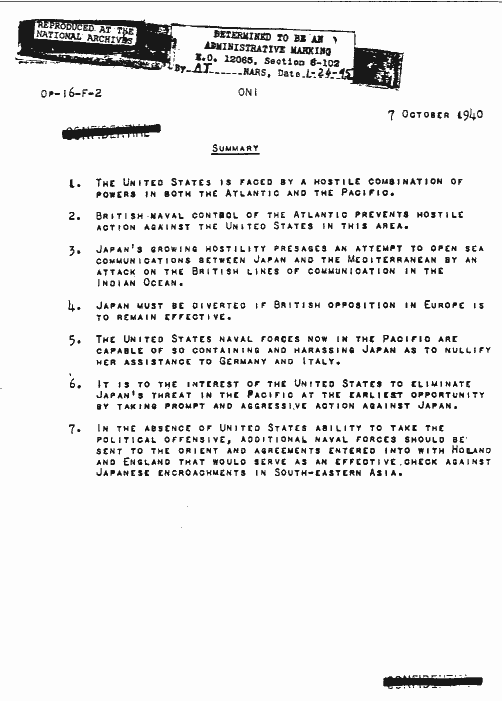
last updated 3/17BLOWING OFF THE DUSTThe McCollum Memo is the most common name given to a 6-page pre-Pearl Harbor document, signed by Lt. Com. Arthur H. McCollum of Office of Naval Intelligence, and dated October 7, 1940. It was numbered OP-16-F-2, headed ONI, Memorandum for the Director, meaning Director Naval Intelligence RADM Walter Anderson. Although there are possible questions about the memo’s authenticity, like most everyone else who hears of it, I tend to accept it as a genuine piece of history. This unique clue remained unknown until declassified in 1994, the better part of a century after it was written, and well after all the ‘decisive’ books on the attack (
At Dawn We Slept, etc.) had emerged in the 1980s.
The document was then obtained by researcher Robert Stinnett using the Freedom Of Information Act (FOIA). He describes receiving bundles of documents not seen since 1941, “covered with dust, tightly bunched together in the boxes and tied with unusual waxed twine.” [1] He quickly recognized this one as a vital clue never seen before, and worked it into his mammoth book
Day of Deceit: The Truth About FDR and Pearl Harbor. As Stinnett interpreted the thinking behind the eight actions proposed in the memo, McCollum “felt that war with Japan was inevitable and that the United States should provoke it at a time which suited US interests.” [2]
Whatever the book’s other merits or drawbacks, it does contain – in fact opens with - this new and compelling piece of the puzzle. It certainly caught my attention as I started the book, and I was dazzled enough to call it a "smoking gun" of FDR’s foreknowledge and provocation, in
an older article this one will replace. I was not alone in that prognosis, but the reality is more ambiguous than that, and well worth a closer look.
[the actual document as found
here - r-click, new window for readable sized view. Red underline on page 4 apparently added to the scan. "Act" being omitted from that line of type but penciled in is in the original.]


 BY THESE MEANS: THE CONTENTS
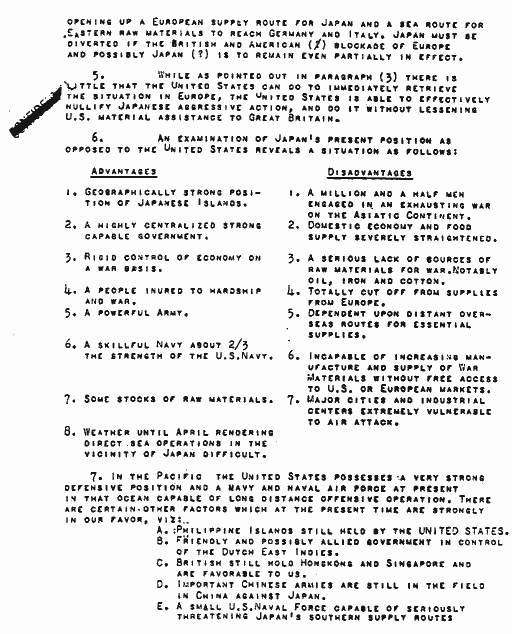
 In the first few pages, the less famous major portion, McCollum outlines the world situation, with the totalitarian powers in charge of all Europe except Great Britain, aided as much as possible by the US in her resistance. He mentions attempts to subvert, propagandize, and "confuse" the US into a purely defensive posture, Latin American meddling and Pacific moves by Japan against British supply lines in Asia. Perhaps reflecting the dark times, McCollum actually predicts the USSR will more than likely side with the Axis sooner or later.
To bring the danger home, he predicts that if England should fall, this super-Axis would quite likely attack America next, making war a likely matter of when, not if. McCollum calls for meeting the threat head-on with "prompt, warlike action" in either theater (Atlantic or Pacific). He feels the Tripartite Pact leaves "no ground on which to doubt" the three totalitarian powers will go to war with the US if entering as a full ally of the UK or "should she attempt to forcibly interfere with Japan's aims in the orient." To keep Britain's lines open, he proposed that Japan should be "diverted or neutralized." He then outlines the strategic situation of the US vs. Japanese position in the Pacific, called for detailed arrangements with Britain and Netherlands and a "prompt and early declaration of war."
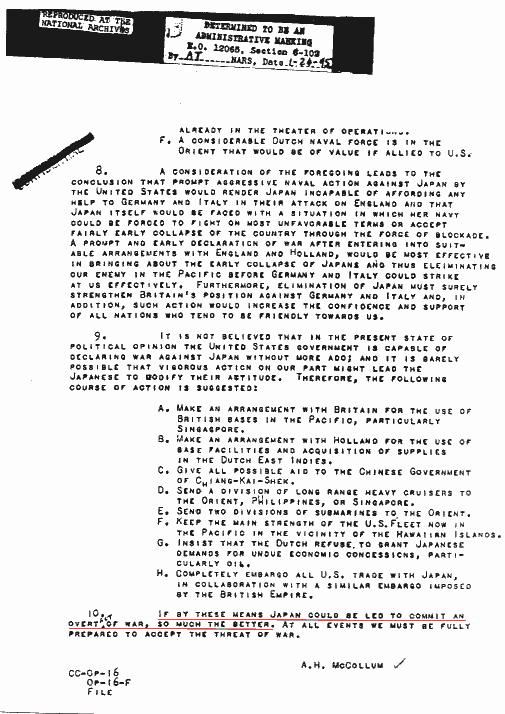
Finally he wraps it up with point 9, which is what the conspiracy theorists drool over, and not without reason:
It is not believed that in the present state of political opinion the United States government is capable of declaring war against Japan without more ado; and it is barely possible that vigorous action on our part might lead the Japanese to modify their attitude. Therefore, the following course of action is suggested:
A. Make an arrangement with Britain for the use of British bases in the pacific, particularly Singapore.
B. Make an arrangement with Holland for use of base facilities and acquisition of supplies in the Dutch East Indies.
C. Give all possible aid to the Chinese government of Chiang Kai-shek.
D. Send a division of long-range heavy cruisers to the Orient, Philippines, or Singapore.
E. Send two divisions of submarines to the Orient.
F. Keep the main strength of the US Fleet, now in the Pacific, in the vicinity of the Hawaiian islands.
G. Insist that the Dutch refuse to grant Japanese demands for undue economic concessions, particularly oil.
H. Completely embargo all trade with Japan, in collaboration with a similar embargo imposed by the British Empire.
If by these means Japan could be led to commit an overt act of war, so much the better. At all events we must be fully prepared to accept the threat of war.
In essence, then, the McCollum memo offers a list of actions proposed because Japan wasn't changing and more "ado" would be needed before FDR was "capable" of declaring war. Hawaii is mentioned. An overt act of war is mentioned. It would be hindsight historicism to just draw a straight line between them, but there they are side-by-side: The fleet at Pearl is in fact in the list of "means" by which Japan might be "led" to "do some fool thing," as FDR once put it, and start a war on the Pacific.
The troubling phrase "so much the better" implies two things to me:
1) It's not the main purpose. To be "better" is to be other than the thing you've been referring to. The main purpose seems to be to prepare for war in the Pacific since it should and perhaps might materialize soon.
2) Better implies it is to the same ends as the main purpose. The whole thing is about war, and how to get into it. Having them fire the first shot would be "better" than us doing it, from a legalistic and moralistic perspective.
Just from the contents, the Eight-Action Memo (as it’s also called) does not look anything like a finalized ‘blueprint’ for the ultimate Pearl Harbor provocation plan. It is however instructive of the type and level of thought going on in Washington at the time, and could with the smallest shift of view
become such a template for tragedy, as Stinnett’s and my own and others’ gut reactions to the memo testify.
RIPPLES THROUGH REALITYThis telling packet was of course addressed to, and intended to be seen by, DNI Anderson, at the very least. Stinnett claims it was also addressed to Dudley Knox, an ONI strategist of great repute, who left his mark as having seen it. Knox endorsed McCollum's proposal in general but, in forwarding his thoughts to Anderson, added the caveat “we should not precipitate anything in the Orient.” [3 - see also document above, page 6] Beyond this, Stinnett could find no paper trail for the document, aside from a diary entry from Assistant Secretary of State Breckenridge Long - dated Oct 7 1940 - that he felt “little by little we will face a situation which will bring us into conflict with Japan.” This had been triggered, Stinnett sums, when he that day “learned of a series of steps involving the US Navy and that one included concentrating the fleet at Honolulu.” [4]
There are also less direct clues of this thinking bleeding into the following 14-month string of ‘fatally flawed’ real-world decisions regarding Japan. FDR was reportedly fond of the idea, as proposed in action D, of putting some US vessels outside their normal zones and into areas of Japanese interest. CNO Stark recalled the President favoring “pop-up Cruises,” saying something like “I just want them to keep popping up here and there and keep the Japs guessing. I don’t mind losing one or two cruisers, but do not take a chance on losing five or six.” Three such missions, including to a prime IJN training ground near Honshu, were carried out from March-July 1941. All ended without any overt act of war. [5]
In late July action H was more nearly approached – by a leap and not a step – with an embargo on the most vital petroleum exports to Japan. The oil embargo is universally accepted as one of the prime factors toppling their equilibrium irreversibly towards major war in SE Asia, at least sooner than otherwise would happen. I'm not conversant enough with the details of which other actions were followed, but action F, keeping the Pacific part of the US Fleet at Hawaii, was faithfully held to for the duration. At the time, the prime obstacle to this was the man tasked with defending the fleet while there – CinCUS Admiral James O. Richardson. He had earlier
butted heads with the President personally over the issue, and As McCollum typed his points, the Admiral was en route to Washington for one last talk with FDR.
THE DAY AFTER: RICHARDSON GETS A WHIFF?Direct evidence that the President ever read McCollum's memorandum is not known, but its prime addressee, DNI Anderson, was a close military adviser to the president, and Stinnett reports that McCollum himself was a regular routing officer for Navy intelligence to be delivered to Roosevelt, often directly and in person. [6] The exact relationship between these proposals and any White House policy would be interesting but at present impossible to know. It could be that these ideas directly shaped an unwritten policy we don't know of, or that they helped in some aspects to form a nebulous plan. It may have offered more a mental framework or attitude than it did concrete steps, and it's quite possible that FDR was already in that groove and just asked McCollum to write up something to help clarify the issues and options. That it never even reached the boss himself is possible, but somehow seems doubtful.
The connection Stinnett drew, and that I feel worthy of consideration, is with FDR's meeting with Adm. Richardson on October 8, the day after he had perhaps read the memo. “Jo” Richardson was back at the President’s request, which itself offers a clue the memo was perhaps requested by FDR. By the Admiral’s recollection they essentially just argued the same points as in July, and FDR was even more adamant that the fleet was exerting a deterrent effect in Hawaii and must stay, no matter what the CinCUS said. More intriguingly, Richardson recalled this meeting for the Congressional investigation in 1945, and mentioned:
Later I asked the President if we were going to enter the war. He replied that if the Japanese attacked Thailand, or the Kra peninsula, or the Dutch East Indies we would not enter the war, that if they even attacked the Philippines he doubted whether we would enter the war, but that they could not always avoid making mistakes and that as the war continued and the area of operations expanded sooner or later they would make a mistake and we would enter the war. [7]
Where might such a potent mistake be goofed into existence? Even the Philippines wouldn’t do it, so he wasn’t thinking Guam, or Johnston Island, but something would eventually suffice for war… this leaves as candidates Panama, California, Alaska, Seattle…. Oh, Hawaii…
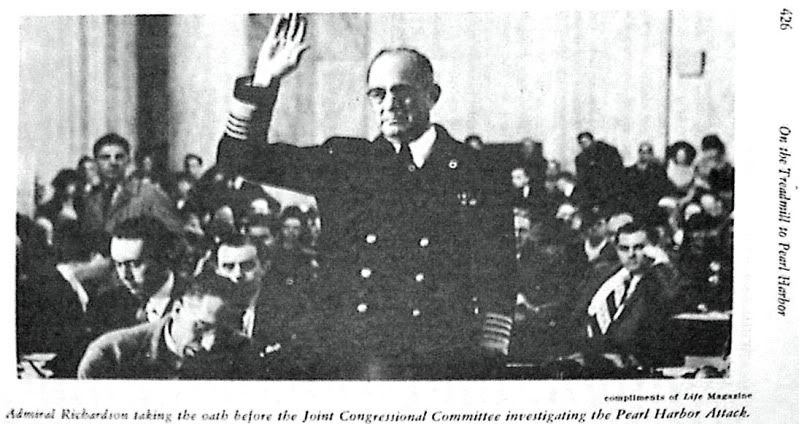 [as published in On The Treadmill to Pearl Pearl Harbor: The Memoirs of Admiral James O Richardson]
Admiral Richardson held back from the Committee, but published in his memoirs, a note connected to this statement about a 'mistake': "This caused me to think that he meant sooner or later the Japanese would commit an overt act against the U.S., with the result that the citizens of the United States would be willing to enter the war." He followed this with a damning estimate of the President's "real intentions or beliefs in the matter, which were that
we would be at war with Japan in due time, and that he was willing for some ship of the Navy to be the victim of a Japanese “mistake.”" [8]
Thus a seasoned and patriotic Commander-in-Chief’s real thoughts after meeting the President disturbingly complement the gist of the McCollum memo as seen by 21st century paranoids. And the thought was formed the day after the memo was written. That the President himself likely saw the paper just before the Admiral comes as close as anything to showing the mood set with those eight actions ran right through FDR on its way down that treadmill to Pearl Harbor. He's asserting the new mooring was a deterrent, when it had just been explicitly outlined as
a "means" that could possibly "lead" Japan to an "overt act of war." That is not called a deterrent, except in euphemism. He's also leaving a roughly Hawaii shaped blank spot in the list of places a Japanese “mistake” might in fact mean war, as he insisted on keeping that hole filled with the fleet. We cannot at this point know if these two strands are directly connected. But if they are, that's about all you'd need to know. It's an awfully big question mark.
---
AddendaFOIA: Considering how well the above fits, and the general unreliability of Stinnett, I'm wondering if the memo is authentic after all. I am planning (but have not yet filed) a Freedom of Information Act request with the National Archives to see if I can verify it or get a negative hit. News will likely be a bit slow and will get its own post, with a link in this space, so bookmark it!
Response to review of Day of Deceit: I just read
Phil Jacobson's pan and I'm sure he's primarily correct on radio silence, naval codes, and other points. However his take on the memo was weak. Here I'll respond point-by-point:
One of the centerpieces of his argument is an October 1940 memorandum by then Lieutenant Commander McCollum of ONI in response to the September 1940 signing of the Tripartite Pact by Germany, Italy and Japan and not as any blueprint for initiating war with Germany and Japan.
Au contraire [sp]... The response was to exploit the treaty to enter the war. "Prompt warlike action," the eight actions, all against Japan, with "an overt act of war" as a bonus, but either way we'd be at war, prob. against all three Axis powers.
McCollum recognized the danger to the western powers if Japan was able to connect up with Germany and Italy through Asia and suggested eight actions designed to contain Japan generally and to keep her from making such connection with its other Axis partners.
Kinda - there's no talk of 'linking up,' but rather a joint closing of Britain's supply lines, Euro-Axis at Suez, Asia-Axis at Singapore/etc. area. 'Contain' is actually referred to as 'divert' and 'neutralize.'
Unfortunately, the book seizes on an off hand comment that is not one of the main points of the memo as the springboard for its conspiracy theory. That comment was if the eight proposed actions designed to contain Japan should by chance cause Japan to commit an overt act of war, so much the better.
Yeah, that's not the main goal, it's
better than it. Better than what? Unprovoked "prompt warlike action." Us entering as aggressors without being attacked first. These are clearly the two desired outcomes, one being better.
No proof of any official implementation of this mid-level memo is provided.
No proof that it was only "mid-level" is provided, nor that it was not acted on, or considered among other points in the President's mind.
Furthermore, Stinnett improperly ascribes McCollum's office as "an element of Station US (by which he means OP-20-G), a secret American cryptographic center located at the main naval headquarters" in an effort to tie McCollum closer to OP-20-G than he actually was before WWII.
Probably correct, sounds like a Stinnett move.
A non-cryptologic fallacy of the book is the fact that Roosevelt had no assurance that Germany would declare war on the U.S. if the Japanese did attack Pearl Harbor thus negating any reasonable conspiratorial design to get the U.S. into war with Germany by forcing Japan to attack the U.S.
How is that a fallacy? He had no guarantee, per se, but doesn't a good leader ever take a calculated risk? McCollum had in fact worked against this fallacy, in the memo in question, by pointing out the Pact leaves "no ground on which to doubt" the three totalitarian powers will go to war with the US if entering as a full ally of the UK or "should she attempt to forcibly interfere with Japan's aims in the orient." And that's exactly how it went down.
---
Sources:
[1] Stinnett, Robert B. “The Pearl Harbor Deception.” Presentation at the Independent Institute. December 2, 2002. http://www.independent.org/newsroom/article.asp?id=127
[2] Stinnett, Robert B. Day of Deceit: The Truth about FDR and Pearl Harbor. New York. Touchstone. 2000. Page 8.
[3] Day of Deceit p 9
[4] Day of Deceit p 14
[5] Day of Deceit p 9-10
[6] Day of Deceit pp 8, 15
[7] Pearl Harbor Hearing, Part 1, pp. 265-68. As cited by Richardson, Treadmill (see below) p 428.
[8]. On the Treadmill to Pearl Harbor: The Memoirs of Admiral James O. Richardson, Admiral, US Navy (retired) as told to Vice Admiral George C. Dyer. Naval History Division, Department of the Navy. Washington D.C. 1973. Page 427.