Showing posts with label Malta. Show all posts

Friday, January 22, 2010

HARRY BELL AND PAUL GAUCI ON THE DATE OF PURCHASE

TWO SHOCKING ADMISSIONS
[Pan Am 103 Series]
Adam Larson / Caustic Logic
January 23 2010


Among other points raised in a letter re-posted by Victims of Pan Am 103 Inc., Richard Marquise mused: “It was strange that of all the people in the world, Mr. Megrahi was in Malta the same day the clothing was purchased and was there the same day the bomb left on its fateful journey.” (emphasis mine)
I reminded him of the statement in the comments section at Professor Back’s blog, and posed the following five questions to him. Apparently he never caught them, as he never offered an answer.

1) Is it not strange that of all the days in the subset November 23 and December 7 you and the investigation had to pick the latter as the best fit for the purchase, even though that choice requires badly misreading the actual evidence?
2) What did the SCCRC find about the Christmas light going up?
3) What do local weather records say for rainfall on Dec 7 vs. Nov 23?
4) What do football schedules (Rome-Dresden) say about Paul’s absence at 6:50 pm? What does Paul say?
5) Why doesn’t November 23 work again, aside from Megrahi not being there?

For those who don't know, the clothes thought to have been packed around the bomb that took down PA 103, were traced to a shop in Malta and shopkeeper Tony Gauci, who eventually took $2 million to recall the purchase for investigators. He famously decided the accused al Megrahi resembled the purchaser a bit, and supposedly gave a date that made it at least possible for the accused to have made the buy.

The date was of key importance, and the absence of Gauci's brother, Paul, at the time of the purchase was a key to narrowing that down. Paul was at home in the evening to watch a football game, which was narrowed down to one of two Rome-Dresden matches, on November 23 or December 7 1988. For the earlier date, the accused purchaser, al Megrahi, has a solid alibi of being not on the island. For the latter date, he was present, and the prosecution decided the purchase occurred on December 7. Many have suspected it was Megrahi's presence, and not the clues provided by the Gaucis, that caused them to chose the date. This would seem a hard point to prove, but not at all difficult to indicate. (The following points will be more fully explained and sourced elsewhere - this is just a summary.)

The purchaser Tony remembered came at around ten 'til 7 pm, as Paul was watching his game at home. The December 7 game was aired app. 1-3pm local, while November 23's was aired app. 7-9 pm local. The math is clear. Tony recalled specifically the Christmas lights in his neighborhood were not yet up. As the Scottish Criminal Case Review Commission (SCCRC) found years later through new evidence, those lights went up on December 6, meaning his memory if on December 7 would have been recalling they were up, had just gone up. On the 23rd, the neighborhood was still dark and cheerless, as he first recalled the evening. He recalled the purchaser bought an umbrella to deal with the rain outside. Weather records show appreciable but light rainfall in Silema the evening of November 23, but December 7 shows up dry as a bone for that time frame and all day, Island-wide.

Is that confusing, unclear, or ambiguous? The investigators were later clear that December 7 was the obvious choice and the true one, but seem to have been confused, admitting it when pressed. Detective Inspector Harry Bell, who headed the Scottish police effort on Malta and was the main contact point for the Gaucis, was interviewed in 2006 by the SCCRC. Some extracts were re-printed in Megrahi's rock-solid grounds of appeal. Excerpts from there:
DI Bell SCCRC interview (25-26/7/06)
"...The evidence of the football matches was confusing and in the end we did not manage to bottom it out..."
"...I am asked whether at the time I felt that the evidence of the football matches was strongly indicative of 7th December 1988 as the purchase date. No, I did not. Both dates 23rd Nov & 7th Dec 1988 looked likely.
"...It really has to be acknowledged how confusing this all was. No date was signficant for me at the time. Ultimately it was the applicant's [Megrahi’s] presence on the island on 7th December 1988 that persuaded me that the purchase took place on that date. Paul specified 7th December when I met with him on 14th December 1989 and I recorded this..."
[Source: Grounds of Appeal]

The bolded is a shocking admission of just what many had guessed. And then, almost as an afterthought (and a quick one I'd venture) "Paul specified 7th December" as the right day, during a meeting of "14th December 1989." He even has the date memorized! No direct quotes provided there of this meeting. But two months earlier, in a 19 October meeting with the same Harry Bell, he clearly specified the other day. In a police report obtained by Private Eye and published in Paul Foot's 2000 booklet Lockerbie, the Flight from Justice, Mr. Gauci said:
“I was shown a list of European football matches I know as UEFA. I checked all the games and dates. I am of the opinion that the game I watched on TV was on 23 November, 1988: SC Dynamo Dresden v AS Roma. On checking the 7th December 1988, I can say that I watched AS Roma v Dynamo Dresden in the afternoon. All the other games were played in the evening. I can say for certain I watched the Dresden v Roma game. On the basis that there were two games played during the afternoon of 23 November and only one on the afternoon of 7th December, I would say that the 23rd November 1988 was the date in question.” [Foot, 2000, p 21]

If indeed the man was specifying the desired date two months later, that's a second admission from Bell. By December 1989 at the latest, they were trying to implicate al Megrahi, and had been trying to long enough that Paul Gauci had taken the hint.

This makes it clear why, despite his specific and useful memory, Paul was not called to give evidence at trial, and reports like this from 19 October were likewise not produced. He did however manage to secure a $1 million payment himself, probably informal sharing rights on his brothers two mil, and the same DoJ witness relocation/protection/silencing program as his brother. Three million will buy a lot of shrimp for the barbie, and it already bought the Americans one of four planks they needed to get their political fantasy to become legal reality.

Wednesday, January 13, 2010

A THREE-YEAR TEST DRIVE, PARKED 8 YEARS, AND THEN A HIGH-SPEED CRASH, pt 1

A.M. GIAKA'S SKELETON OF FANTASY
[Pan Am 103 Series]
Adam Larson / Caustic Logic
completed January 22 2010


Note: what follows is the first half of a looong working essay I just had to see up even before it's done. It covers from Giaka's defection to the start of trial preparations in 1999. Part two will be long-delayed, but will call on Giaka's direct testimony via trial transcripts.
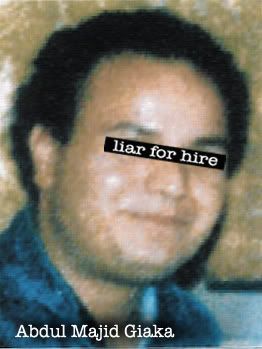
A Missing Link
Among the sources collecting the evidence against Abdelbaset al Megrahi (and/or his accused accomplice Lamin Fhimah), most mention the same three “keys to the solution of the case” given by the FBI’s lead investigator on the SCOTBOM case, Richard Marquise, in his 2006 book. He gives these as Tony Gauci, “the Mebo chip,” and the souvenir printout of the Frankfurt luggage records taken by Bogomiras Erac, which was strangely “the only record” anyone could find of this vital information. [Marquise p 210] There are other peripheral clues of importance, but few with the resonance, clarity, and specificity of these three as indicators of Libya’s guilt, via the two accused.

But missing from such formulations is a fourth and most important key – Abdul Majid Giaka [different spellings have been used], a Libyan intelligence defector turned intelligence asset for the U.S. side of the investigation. In fact, in coming on board four months before the Lockerbie bombing, Giaka’s connections with Malta, Luga Airport, and Libyan intelligence put him in a prime position to be the first to mention both accused - to his CIA handlers - in the first place. The majority of everything he said has by now been discredited and shown to be fabrication – at best enabled and at worst demanded by his American friends.

Giaka’s intelligence was transformed to evidence with some CIA/FBI alchemy, tying several loose ends together and, in essence, providing the skeleton for the ‘Libyan villains’ case to stand on. The defector’s tales underpinned the US/UK joint indictment, the years-long extradition wrangle, and was finally brought as far as the Scottish Court as Camp Zeist in 2000. But as we’ll see, it went no further and has been mentioned as little as possible since.

Effective Defector Detected
Abdul Majid started this journey as a self-described disaffected Libyan perturbed by Tripoli’s terroristic ways and Gaddafi’s Masonic schemes. A low-level intelligence agent with the JSO, and stationed on Malta, he approached the US embassy there in August 1988 offering his services. Paul Foot’s seminal 2000 booklet Lockerbie: Flight From Justice explains how this started a “long series of meetings with American intelligence officials in Malta,” 41 secret meetings total, spanning almost three years from “September 1988, the same month he started getting regular payments from the CIA.” [Foot]

For $1,000 US per month, rising to $1,500, he wasn't a huge payback at first. “His information was patchy and unreliable,” Foot reported. “He pretended he was a senior official in the Libyan intelligence organisation JSO though in reality (as the Americans quickly realised) he was a former garage mechanic who helped to maintain JSO vehicles.” The BBC Conspiracy Files program in 2008 treated this subject fairly, and summed up “not so much double-oh-seven, more WD40.” [CF 44:20] He had however “graduated to the exalted position of assistant station manager for Libyan Arab Airlines,” Foot concedes, work carried out at Luqa International Airport, on the island's near-south side.

Giaka was given the code-name "puzzle piece" by his CIA handlers, [CF, 43:29] at least one which also worked at the airport, under cover as a baggage handler. [LTBU 8/29] The agent kept tabs on him, writing cables back to the CIA that named the subject in code as “P/1” (and referred to the JSO as ESO). P/1’s job there involved aircraft security, “but he is also obliged to assist ESO operatives transitting or on missions to Malta,” according to a copy shown on the Conspiracy Files. That’s a reasonably rich source for intel reports, but the agent noted Giaka “has been a “shirker” while in Malta, generally dodging ESO assignments since his Luqa appointment.” [CF 44:12]

Whatever the defector’s shortfalls, in October 1988 he reported his first big lead – Lamin Fhimah, a “JSO agent” also working at the airport, kept eight pounds of TNT in a locked desk drawer of an office. Paul Foot again relates how two months later in December (whether before or after the Lockerbie bombing is unclear) “he was asked about the movements of JSO officials through Luqa airport. He replied that a man he regarded as a senior JSO officer, Abdelbasset Ali Mohamed Al Megrahi, had passed through Luqa airport on 7 December.” [Foot] The names may not have meant much at first among Giaka’s other intelligence, but as soon as investigators were willing to consider a Libyan link, and it was found that both were also present on Malta December 20, the eventual suspects were clearly on file and ready to drop in place even before 1988 had closed.

Giaka and America Rescue Each Other
By the beginning of September 1989 the investigation’s scope was narrowing in, of all places, on Malta. The oddly-delayed Frankfurt printout revealed in mid-August an unaccompanied bag from Malta had apparently gone onto PA103A. At the same time, the tattered Maltese clothes from inside that bag had led to Maltese shopkeeper Tony Gauci, who gave his first statement about the buyer on September 1. But Giaka was probably not told these things as, on September 4th Foot maintains, “his CIA handlers in Malta told Giaka he was “on trial” until the next New Year (1990).” [Foot]
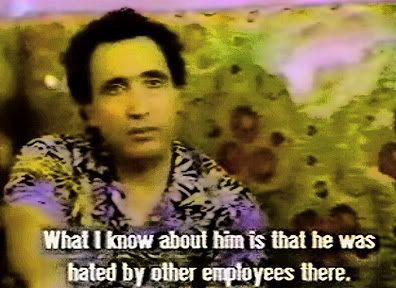
The informant likely grew nervous as his bridges to America became more precarious, his bridges on Malta stood burned, and his bridges back to Libya were threatening. The 1994 film The Maltese Double Cross featured interviews with both accused, who indeed knew Giaka, at least in passing. Megrahi confirmed he did security work there, and “he was hated by other employees there.” Fhimah added “He behaved badly towards the employees working with us, in dealing with passengers. The Maltese airport authorities know this.” [MDC 1:28:10-1:31:28] Some bias might be expected of course, but others interviewed for the film vouched that he was irresponsible, a partier and amasser of debts. And he wasn’t going to be getting any more popular trying to sell intelligence to the CIA.

One anonymous Libyan related for the film how Giaka was put up for transfer at some point: “they asked him to return back to Libya because his contract finished, for his staying in Malta.” Apparently desperate to maintain his situation there and his possible ticket away from Libya, Giaka asked the CIA to pay for a surgery to injure his arm so he wouldn’t be called away to serve in the Libyan Army. [Foot] They apparently consented and “after a few days,” the anomymous source said “[Giaka] came here after the hotel and he had a plaster on his hand” which he said was from falling down the stairs. This seemed to help him “get an extension of around three or four months to stay here.” [MDC 1:31:15]

By 1991, the regular cables were describing P/1 as “a shattered person” who “does not want to be part of the security apparatus and is certainly milking any of his contacts, including us, for whatever he can get.” [NYT] The Americans were ready to milk back - the fruit was ripe and dripping with urgent ‘get-me-outta-here’ intel possibilities. Perhaps realizing that Giaka really was the best they were going to get, the decision was made by July 11, when the Department of Justice told Mr. Giaka they would “accept or reject him" as a witness "based on his response to their Inquiries,” which would be done at leisure within the United States. The very next day, Foot writes,
“Giaka, to his intense gratification, was taken off Malta by an American warship, and interrogated there by an FBI officer, Hal Hendershot. Before long he was safe in the US where he was later joined by his wife. He was paid a regular salary in exchange for constant interrogations by the CIA and the FBI. What he told them plainly satisfied them.

In October, in conditions of great secrecy, he gave evidence to a US Grand Jury. The result, in November 1991, was a detailed indictment charging Megrahi and Fhimah with murder by planting a bomb in a suitcase on a flight from Malta to Frankfurt and thence to London – and the explosion over Lockerbie.”
[Foot]

The World Dances to the Fantasist Tune (Played Real Loud)
The United States government for this point forward until now, without interruption, has accepted the core of this indictment as unassailable truth. The findings of Libyan guilt via al Megrahi and Fhhimah and others not named, the findings found primarily in Giaka’s words, has been the basis of economic sanction, diplomatic pressures, approval of clandestine operations, public vilification of Libya allowing more of the same to pass, and so on.

Most of the world was rather surprised at the turn of events, running counter to all the old evidence that made more sense and involved no Libyans. And was, of course, highly inconvenient for the Americans. Naturally, suspicions of cover-up flourished, especially in the UK. This was primarily channeled into an intriguing “CIA drug-running” cluster of theories (which this author considers a huge distraction) that got its biggest boost with an April 1992 cover story in Time magazine.

A Department of State press release from the same month sought to counter growing confusion at home and abroad by calmly laying out the facts in a press release. The Suitcase itself, fairly non-descript and not directly accounted for anywhere in the luggage records of three airports, was prime evidence at the time, thanks to Giaka’s incredible contributions.
“Forensic analysis has identified the bag that contained the Pan Am 103 bomb as a brown, hard-sided Samsonite suitcase. The following evidence links Al-Megrahi and Fhimah to the suitcase:
-- Al-Megrahi, traveling in alias, arrived in Valletta with Fhimah from Libya on the evening of 20 December 1988--the day before the bombing. Fhimah, the former manager of the LAA office in Valletta, retained full access to the airport. Al-Megrahi and Fhimah brought a large, brown hard-sided Samsonite suitcase with them into Malta on that occasion.
[DoS]
They make it sound like the Fact they had such a suitcase is evidence they planted the bomb, but in reality, Giaka’s intelligence was the only evidence they had such a suitcase. This emerges chronologically, below. That his stories wound up matching the emerging evidence at the scene is highly troubling – the similarities are from neither truth (as we’ll see) nor likely from coincidence. It seems Mr P/1 served as a two-way intelligence conduit - milking the CIA so they could re-milk him – helping them launder propaganda into intelligence and, via FBI acceptance of that, into evidence ready for trial.

The top man who promoted Giaka as evidence, and the most likely to be fully aware of such unethical activities, would have been Vincent Cannistraro, senior director of the CIA’s own Lockerbie investigation until October 1990 [Ashton] . He continued promoting the story line he'd helped write in the years between indictment and trial. For a 1995 BBC program, he described the case modestly as:
“… overwhelming … conclusive … tremendous amount of evidence … mind boggling amount of detail … that will allow the prosecutors to present the chronology of the operation from its very inception … describe and in almost excruciating detail exactly how they made the bomb, how they secreted it, how they got it on board the aircraft, and I think that's a fairly strong case.” [FS]
His favorite part that he singled out for emphasis in that interview was “they have a live witness for one thing, who would be presented in a court of law.” [FS] Cannistraro bravely spoke to The Maltese Double Cross, again pimping Giaka, just not yet by name: “a former member of the Libyan Intelligence Service who has defected” into Justice Department witness protection, “so he would be used in a trial of Fhimah and Megrahi.” [MDC, 1:28:25]

Such a trial was demanded, in the US or Scotland, based the much-hyped amazing case. The demand was repeated often, and with force, befitting a mighty nation’s drive for truth and justice for the 270 dead. Faced with such confidence, people and whole nations started falling for it. Those comprising the UN Security Council at the moment, in particular, were collectively convinced enough to enforce the indictment with sanctions.

In 1992 and 1993, Security Council resolutions 748 and 883 imposed and tightened embargoes, diplomatic restrictions, and various other punishments. Aircraft equipment and supplies in particular were squeezed on, putting al Megrahi to work on the gray market (the likely cause behind his "suspicious" Zurich office and Swiss bank account). It was under this prolonged duress that Libya eventually relented to a compromise solution. By late 1998 the framework of a trial was established, and in April 1999 the accused were flown to the special Scottish court in neutral Netherlands. Megrahi and Fhimah were arrested at “Camp Zeist” and set to await their trial. Sanctions were immediately suspended, under threat of re-enforcement.

All this was based on an alarming mass acceptance of the American/Scottish case, in turn largely built up on “accepting” Giaka’s intelligence as evidence. The suspects, the suitcase, the materials, the plans, and the evil behind the Pan Am 103 plot were all attested to by a desperate defector, in trade for a steady paycheck, a maimed hand, and a new life in America. It had all wowed the grand jury and secured the indictment, but now that Cannistraro’s dares had paid off, it would be challenged for once, and before the whole world at that. At stake were these claims, in "job resume" format. Most of these were unknown to the public at the time, but about to see the light of day:

- Giaka’s own credentials/authority: JSO agent, high-level, secret files department – related to former King Idriss - hates Gaddafi - aware of Masonic plots between Libya and Malta.

- Has a long-standing friendship with Ezzadin Hinshiri, director of the central security section, JSO (allegedly involved in buying the MST-13 timers as used in the bombing, including an order placed for 40 more just two days before the bombing!)

- Long-standing friendship with Said Rashid, head of the operations section, JSO (also involved, allegedly, in timer acquisition and other wickedness)

- Acquaintance with Abdullah Senussi, the head of operations administration for the JSO. (convicted in absentia in 1989 for using that role to blow up an airplane (not 103). Also, Gaddafi's brother-in-law.)

– Can describe the high-level JSO connections of the accused – worked directly under the first accused – hated his boss - can testify to their movements at the airport – able to read clues from them, ranging from subtle to fictitious, revealing their plot.

– Was asked by Said Rashid, in 1986, to write a report on whether a bomb cold be put on a British plane - had someone else look, who said yeah so he wrote the report saying so. The upper levels mulled the idea over...

- Turned said report in via his boss, “Lockerbie bomber” Megrahi, who definitely saw it. Megrahi later mentioned the idea back to Giaka and said “don’t rush things.”

- Can testify to Fhimah’s personal handling of explosives, in his desk, which were overseen by Megrahi, for the JSO.

- Was invited to the final plotters’ meeting as Megrahi and Fhimah met at Luqa airport on the day of the Lockerbie bombing, with a suitcase just like the one that would do that explosion hours later, after having come in from Malta (other evidence covered that, obviously). That’s the clincher for sure.

- Has defected safely from the murderous regime, after a grueling three-year initiation, and can therefore finally reveal the secrets he held of the devious, random, and surprisingly unselfconscious scheming that climaxed five miles above Scotland four days before Christmas. That - is - evil. Thank God they've got a witness who saw it all, ready to go before the judges...

---
Sources:
[Ashton] http://www.copi.com/articles/lockerbie.html
[CF] "The Conspiracy Files: Lockerbie." Prod/Dir Guy Smith, Ex Prod Sam Anstiss, Narr Caroline Catz. BBC Two. First Aired 31 August 2008. http://video.google.com/videoplay?docid=-327765978162851498&hl=en#
[Foot] Foot, Paul, Lockerbie: Flight From Justice. Published 2000 by Private Eye. https://secure2.subscribeonline.co.uk/PEYE/digital_downloads.cfm
[FS] Frontline Scotland: "Silence Over Lockerbie" Reporter: Shelley JofreProducer: Murdoch Rodgers. Aired 1995. Transcript accessed at: http://plane-truth.com/Aoude/geocities/silence.html
[LTBU 8/29] Connelly, Clare. "Controversy Over CIA Cables Continues." 29 August 2000. Lockerbie Trial Briefing Unit. .doc link: http://www.gla.ac.uk/media/media_78571_en.doc
[MDC] The Maltese Double Cross. Produced, written, and directed by Allan Francovich, Hemar Enterprises, November 1994. http://video.google.com/videoplay?docid=7160854996287567609&ei=EAtQS8iUNYOYqQPjnaka&q=Maltese+Double+Cross+&hl=en
[Marquise] Marquise, Richard. SCOTBOM: Evidence and the Lockerbie Investigation, Algora Publishing. Sept. 1, 2006. 268 pages.
http://books.google.com/books?id=JKLT360G_zAC&pg=PA119&lpg=PA119&dq=Marquise+SCOTBOM&source=bl&ots=WGsIBNTRDo&sig=ZkD5iwHr
[NYT] McNeil, Donald, Jr. “Defense in Lockerbie Trial Undermines a Key Witness.” New York Times. September 28, 2000. Accessed at:
http://plane-truth.com/Documents/Defense%20in%20Lockerbie%20Trial%20Undermines%20a%20Key%20Witness.htm

Thursday, December 10, 2009

ANOTHER CALL ON MALTA

ADMIT IT ALREADY!
[Pan Am 103 Series]
Adam Larson / Caustic Logic
December 11 2009


Note: The Following does not necessarily reflect the author's true views in all regards

The Status Quo
Two previous posts explained al Megrahi’s Malta-based plot to destroy Pan Am 103. First we witnessed the keen memory and staunch bravery of eyewitness Anthony Gauci, standing alone against an uncaring island subdued by Libyan barbarians. Next I chronicled the complete subjugation of Air Malta and its security operations at Luqa Airport, allowing the PA103 bomb to hurtle uncontrollably to Lockerbie. And finally, at the end of the second piece, I just started hinting at their infuriating denials after the fact that any such plot ever did pierce their magical force field.

It’s noteworthy that Air Malta has avoided the notoriety and bankruptcy that sunk Pan Am following this disaster. How, when their initial “failure” is what gave Pan Am its chance to fail as well? As usual in a world rife with anti-American plots, the true villain escapes unharmed, allowed to live and thrive, while the innocent passerby is shot to death. The distatsteful status quo is thus the Americans got their (little fish) bad guy, but lost a major airline, while the Libyans have paid up and admitted responsibility, while cynically denying responsibility, and all Malta had to do was keep quiet on its part. It’s a more than fair deal for the government in Velletta, and one should think they’d be grateful. And normally they act that way.

Demands of the Disgruntled
Some have agitated to upset that stasis, but so far the calls on Malta are quite one-sided, encouraging them to “clear their name” of the Lockerbie taint altogether. These pleas usually come from a small, well-known group of people who would like to de-blame Libya itself. Now if that doesn’t illustrate the axis of malice between Velletta and Triploi, nothing does.

Just in the last couple of months, Lockerbie trial “architect” and general grumpy gus Professor Robert Black piped up in late August. He opined “the Maltese government should be pressing very hard within the EU for an enquiry into Lockerbie,” and criticized the Scottish judges for accepting that Megrahi’s bag from Malta ever existed.

On 25 October that one UN guy, Köchler, that was at the trial and said some bad stuff about it, called for a Maltese probe of Gauci in particular: "If they are committed to the rule of law, the Maltese authorities should open their own investigation and interrogate Mr Gauci," One must wonder how much Gaddaffy is paying Herr Köchler to get at the hero of Silema like the lurking Libyans never were able to?

Never Enough Proof
The Maltese authorities have really done a great job “clearing their name” without the encouragement, but with it they went haywire. On 31 October the UK Daily Telegraph reported “Malta to investigate evidence of key Lockerbie witness.” This was based on an unnamed “Maltese legal official” who said “Tony Gauci is an area where we have to investigate more thoroughly and we are preparing for this. There was never enough proof, to be frank, on the circumstances of his evidence and there is pressure coming from many quarters on Malta to move to resolve the issue." There’s not enough proof in the world, apparently.

The following day, 1 November, the Justice Department specifically denied such preparations, disowning any comment that may have been made. However, their press release took the chance to repeat the infuriating claim that since 1988, the Maltese government has "always maintained the bomb which downed Pan Am flight 103 had not departed from Malta and ample proof of this was produced.” Oh, so now the mountain of proof of a Maltese-origin bomb, that’s “never enough,” is trumped by that tired old paperwork? It becomes clearer.

To top off this cowardly dodge, on the same day, Prime Mnister Gonzi affirmed their disinterest in Gauci. “Over the years we cooperated with every investigation,” he explained, which is technically true. But like the others, he ignores the terrorist plots hatched there that were uncovered by these efforts. “Our position,” he pronounced, “was always that Malta had nothing to do with the terrorist attack.” Well they did host the whole thing except the explosion, so presumably he means nothingconsciously to do with it. But this too is in doubt. When asked if his decision not to re-question Gauci was due to pressure from the U.S., Gonzi replied “it is totally untrue.” Indeed, their own embarrassment seems more at stake than America’s in again contrasting Tony’s sharp eye with the complacent approach everyone else in Malta takes towards the Libyans.

I’d like to quote Stuart Henderson, that proper Scottish copper who led the whole police investigation of Lockerbie. He wasn’t specifically referring to any of the Maltese vomiting this vile venom above when he spoke about Megrahi's release in August. But those who doubt the official story, as most Maltese seem to, “make my blood boil” and are “an insult to our police officers … an insult to the Americans, to the Germans, to the Swiss and the Maltese officers.” That’s right, you guys are slandering your own who helped prove just exactly how the Libyans killed 270 with a bomb your lame-ass airport just “missed” and somehow you can’t just admit it.

Another Call and Surely Not the Last
But it didn’t end there, as proved by a 29 November letter, urging Malta to “defend itself,” issued by the Orwellianly-named “Justice for Megrahi campaign.” The letter was signed by, among others, British MPs Tom Dalyell and Teddy Taylor, plus Noam Chomsky - all outspoken Leftist weirdos who argue that Megrahi is an innocent little lamb framed by “the West” (i.e. – the New World Order, aka “Illuminati”). Professor Chomsky, not surprisingly, called the proper conviction based on proof of a terrorist mass murderer "a remarkable illustration of the conformism and obedience of intellectual opinion in the West". Oh, Chomsky… yawn-skip-yawn-skip-yawn-skip… "I think the trial was very seriously flawed,” he further opined to the Times of Malta, “including crucially the alleged role of Malta. There is every reason to call for a very serious independent inquiry." Certainly Triploi has the roster for it drafted already, and a few more bought souls from now we might see Justice turned on its head, to Chomsky’s delight.

And finally to quote again then Minister of Home Affairs, Tonio Borg, quite a while back in early 2000: "We have no proof that these two Libyan suspects were involved in anything illegal in Malta regarding this case, particularly the placing of this bomb on Air Malta Flight ... 180.” I had hoped he would be fired since then, especially after the trial at camp Zeist shortly put the lie to such claims. Rather, he’s prospered just like Air Malta; since then he’s been Minister of Foreign Affairs and of Justice (ironically), and is currently honored with the titles Deputy Leader of the Nationalist Party, leader of the House of Representatives, and Deputy Prime Minister. Would Germany have been tolerated promoting its holocaust deniers like this?

The Final Call: Pull Malta Back From the Dark Side
Clearly this talk of a UN inquiry, under Libyan control, torturing Tony Gauci into recanting his story, and all the rest, has got to stop. That is hardly worth mentioning outright it's so elemental. But while we’re at it, we must ask if this tiny, easily manipulated island nation was really just used by the Libyans against its will? Or have they been swayed to the dark side all along? The petitioners seem to bet on the latter.

Historically, the Maltese are notoriously soft on Islam, and perhaps by now sympathetic to the anti-American Jihad. At the very least they’re likely to slide that way if Libya’s evil grip is allowed to continue unaddressed. Therefore, let’s make it more explicit and issue a new international call on Malta to “Admit it! You're Tripoli's little pet and happy about it!” Sign the informal petition by leaving a comment below. We are all Americans now, worldwide, and we will get our perps, be they Libyan, Maltese, and also otherwise. The case is open!

I specifically speak to Brits – Scots, Welsh, English, Etc. It must be asked if all this was caused by the UK letting go of the island’s hand in this world crowded with evil. Recall that after you freed Malta from the Freemason French, you cared for them and left your names all over, until you set them loose in the hippie 1960’s. But as usual permissiveness breeds wickedness and by 1988, planes were falling on the UK itself due to losing Malta. If those people can’t behave responsibly and face up to the consequences of their long dance with Libya, perhaps independence should be seriously re-considered.
---

Wednesday, December 9, 2009

WHILE MALTA SLEPT?

HOW MALTA LET LOCKERBIE HAPPEN
[Pan Am 103 Series]
Adam Larson / Caustic Logic
December 9 2009


Note: The Following does not necessarily reflect the author's true views in all regards

A previous post addressed the fateful clothes purchase by Lockerbie bomber al Megrahi on the island of Malta, well-known as occurring on December 7 1988 at the Gauci family’s shop Mary’s House. But this is only a sliver of the terrorist mastermind’s larger plot with many steps taken all within a few square miles around Silema, under the watchless eye of the Maltese authorities - especially at nearby Luqa airport where the main action went down.

Abdelbaset al Megrahi was a Libyan intelligence bigwig personally carrying out some hair-brained revenge by Col Gaddaffy for a two-year old US bombing of Libya that had killed his adopted daughter. Megrahi had connections at Luqa airport via his own Libyan Arab Airlines links, but the experts agree he could not likely do this all alone without at least one accomplice inside the airport. His exactly one (known) accomplice, Lamin Khalifa Fhimah, also worked for LAA at Luqa and was a Libyan intelligence operative, high-level.

Of course Fhimah was later found not guilty on a technicality, that being the evidence against him, and the other incredible details flowing from star witness Abdulmajid Giaka, was found “inadmissible” by the three presiding judges. This was one of their more cautious and wimpy moves – a key witness ignored over a few piddling doubts raised by the defense about his meager repayments and the doubts of some memo-writer.

To be clear on this point, the prosecution and the CIA (who first worked the witness) have always known Mr, Giaka was honest and credible, with high-level connections at Luqa and in Libyan intelligence, and a knowledge both vast and intimate of the Megrahi-Fhimah plot. The judges didn’t specifically counter this, and any disinterested observer can note his story is still effectively true, as it mirrored the prosecution case. For the prime example, Giaka swears he saw both accused arrive at the airport with a mysterious brown Samsonite suitcase. That’s dynamite info, and all the other evidence proves they did exactly this. That his story so closely resembles that truth can hardly be coincidence, and his dismissal is but a technicality.

Giaka also alerted his handlers of genuine clues that panned out, like Fhimah’s diary entry noting he needed to get “TAGGS” (in English but misspelled). What business would an airline employee have with luggage tags besides planning to use one of them (with a few spares to practice on) to get a bomb onto PA103? It’s been suggested the diary explains he was taking sample tags to a local printer to get more made, but the question that begs an answer then is why write something this boring in your diary when you could jot down clues to your terrorist plot? In English? The critics cannot answer that.

Within that brown suitcase Giaka saw, we know Megrahi had the bomb, ready made with a flexible Mebo timer the Libyans were famous for having by then, packed into a radio with the memorable clothes and umbrella he didn’t need anymore. Fully confident in his ability to walk right through Luqa airport, he decided to send this bundle of malice right from there, correctly presuming gross negligence would repeatedly fail to stop it on its complex chosen path. It was perhaps the sheer arrogance of those “above the law” that made Megrahi time the bomb to just deny the ocean’s anonymity, and leave these scattered clues to be found on land and traced back to Mebo and Gauci and himself. It all makes sense in hindsight, and fits established and understood patterns of criminal behavior. For example, the professionals who write up James Bond villains know just this type all too well and should not be surprised at such mundane contrivances.

As to how this perfectly predictable plot continued on to fruition unopposed, that’s more troubling. All it took to penetrate “Mary’s House” and buy just the right clothes was a little money. It was Luqa Airport that really mattered, and that too proved easy enough for a determined mastermind to part like the Red Sea. The airline Air Malta ran security there, essentially the host airline. Air Malta security director Wilfred Borg has been quite defensive, always speaking up about their “stringent policies” of double-checking the number of bags, and reconciling each with the right passengers. They have produced the documentation for investigators and news cameras alike, to “prove” their case. But paper is just so darn thin as evidence when clearly a bag with a bomb DID come out of Malta.

Unaccompanied bags are not allowed, so couldn’t happen, the logic ran. Strangely, the Matlese police agreed as if they know anything about airports. Outside “experts” like Denis Phipps, former security director for British Airways, have found these records “reliable,” and as showing 55 pieces of luggage, all claimed by 39 passengers, with none unaccompanied. The answer, presuming for argument’s sake these are legitimate records, is that the 56th bag was simply not documented. Why would a terrorist be so stupid and arrogant as to allow his bomb bag to de recorded on the official paperwork to be traced back?

KM180 landed in Frankfurt at mid-day, and it was there the suitcase wormed its way onto PA103, using…. Yep, that “TAGG.” These magical tickets were the perfect tool; in the 1980s, airports routinely searched only bags without tags. One with proper tags was considered “good to go” and sent along. The proof it was sent along was provided by the diligent German Federal Police, BKA, who had sprung into action within days of the crash. It was widely reported in Germany that Flight 103 originated in Frankfurt, which it only sort-of did. So it’s understandable they would visit the airport, as they did on or around Christmas at the latest, looking for the luggage records, computer files and paper forms, relating to 103 and what went on it.

Now it’s no secret that police can goof things up and usually do. They forgot to get the records for what went onto Flight 103 when they were there, and the airport deleted that data a few days later with no official backup or paper copies kept. Luckily, a souvenir printout that an upright employee handed to the BKA in late January proved that an unaccompanied bag was routed from KM180 onto the ‘first leg’ of Flight 103. The BKA investigated the airport again and agreed, six months later alerting Scottish police. And that, good people, is solid proof of an unaccompanied bag from Malta, no matter what the Maltese and their apologists claim.

Few have the guts to openly verbalize the presumption one must make on considering all this. One exception is Vincent Cannistraro, head of the CIA’s Lockerbie investigation, who had been tenaciously telling the truth about Libya for years already before working with Giaka to ‘simulate’ it. In a 1994 documentary (Frontline Scotland: Silence over Lockerbie), Cannistraro told the truth about their northern island possession, masterfully dismissing the claims of Air Malta and their ilk:
“They have vindicated themselves on paper in terms of the security procedures, but if their security personnel are suborned by hostile intelligence service, and they are completely vulnerable to whatever that hostile service would want to put on their aircraft, with baggage tags, without baggage tags. Once you have basically infiltrated the security apparatus there is no barrier to doing exactly what Fhimah and Megrahi DID." (emph. Mine)

They aren't saying it aloud like this, these days, but that MUST still be the official story stood by in Washington and London. Malta was suborned into letting Lockerbie happen and have at least tacitly helped confuse this basic fact. Consider this outrageous claim by Malta's Minister of Home Affairs, Tonio Borg (any relation to the compromised Wilfred Borg, hmmm?): "We have no proof that these two Libyan suspects were involved in anything illegal in Malta regarding this case, particularly the placing of this bomb on Air Malta Flight ... 180.” The suspicious security breach, which they could just admit to but disown as a mistake, was now to be compounded with an equally dubious refusal to admit their … failure? It’s seeming less and less like a failure and Borg is sounding sort of like a German railroadman denying his part in the Holocaust.

Disingenuous and disgusting. I hope he's been fired or at least demoted since then.

To be continued...

Monday, December 7, 2009

REMEMBER REMEMBER SEVEN DECEMBER

THE BABYGRO TREASON AND PLOT
[Pan Am 103 Series]
Adam Larson / Caustic Logic
December 7 2009
updated Dec 10


Note: The Following does not necessarily reflect the author's true views in all regards

Today, December 7 2009, marks an inauspicious anniversary in American history. Yes, December 7, 1988 was the date of purchase by convicted Lockerbie bomber al Megrahi of the Maltese clothes stuffed around the bomb he used to take down PanAm 103. 21 years ago today, he made a fateful purchase from one Anthony Gauci, then of Silema Malta, a purchase Gauci remembered all too well. This we know because of a nice confluence of clues that investigators were clever enough to recognize and rigorous enough to assemble into nice neat indicator of a design out of Tripoli.

The mystery shopper was eventually found to sort of be resembled by al Megrahi (once his face was famous enough). Everyone had at one point decided Gauci had sold the stuff to Mr. Abu Talb, a suspect found in possession of more Maltese clothes. While memory is never perfect, time usually improves it and by the year 2000 Gauci was able to point to el Megrahi in court, when the man was sitting in the dock in the special accused gown costume. Justice was served, thanks to Gauci’s sharp memory and clear conscience. This purchaser did originally seem at least four inches taller, broader of build and perhaps darker in complexion than Megrahi, and perhaps 20 years older than either him or Talb. But again, this just shows the natural variation of eyewitness testimony and is not suspicious in the least.

The date which I mark is known as the fateful one because Megrahi was known to be on Malta that day and on no others that mach Mr. Gauci’s given clues. Tony, as some call him, recalled the setting for investigators. It was near closing time, around 6pm. It would be dark, and he recalled it was raining outside. Tony recalled he was alone in the shop, as .his brother Paul had gone home early for a football match (Rome-Dresden). Such a match was aired on December 7 at 1pm, and over by about 3:00. Paul apparently did some other thing after the game hat kept him from returning to help close. It’s fine. The Christmas lights were already up.

The purchaser bought many unusual clothing items, with little care to if they fit or made sense. He seemed like a Christmas shopper, a Libyan one, with “more money than time.” The list of items bought was initially unsure and contradictory to the evidence found scorched and scattered across Scotland. But the roster was generally ironed out over 20-ish interviews with Scottish police (many of them still not erased from view), and agreement was reached that the mystery shopper bought too much of the unusual selection in the bomb bag to be coincidence.

The blue “baby gro” is the most memorable of the clothes. Its own tag said made in Malta, and Maltese Gauci recalled selling it for Megrahi’s Maltese plot. By relating to babies it also shows two important clues: it reflects megrahi’s awareness that this was revenge for the U.S. bombing that killed Gaddafi’s 4-year-old adopted daughter, who may have worn such an outfit when younger. A handy timeline also shows the clear relation – the 103 bombing happened after that 1986 attack, clearly showing the cause and effect relation. The choice also shows how Megrahi was aware that children exist and might be killed in his plot, as they were. It was a sinister final touch for the bomb stuffing that just screamed Libyan guilt and wickedness of spirit.

The only item of utility the buyer picked up was an umbrella, since it was raining enough to warrant one. Local weather records show no appreciable rain in Silema that day, but these aren’t always perfect, perhaps kept poorly in Malta. In fact, that records don’t show this is a vital clue that Maltese authorities might have willfully altered these to cover up their failures. Perhaps they missed the rain on accident after all, but it rained December 7 and that same umbrella Megrahi bought for that was packed and found at the crash site. This suspicious behavior is therefore a good clue of Megrahi’s guilt and Malta’s (unwitting?) complicity.

Open-minded investigators did heavily consider November 23 as another fit for Tony’s evidence – it had appreciable rainfall recorded, and a Rome-Dresden football match from 5-7 pm local, a better fit for Paul being absent still at 6pm. But Megrahi was clearly not there on that day, so that can’t be it. Football times and dates you just don’t get wrong, but Malta’s weather records are now suspect, so Dec 7 it must be, with unrecorded rain and Paul gone not for the game but for post-game activities. And I for one see no reason that the babygro treason should ever be forgot, especially since the mass murderer has been "compassionately" sent home to plot more American deaths. I will in fact elaborate on Megrahi's Maltese plot and the strange failure of Malta as a whole to prevent it or even admit the truth afterwards. This behavior demands a response.
---
Note: A helpful reader has alerted me that I forgot to address an important point, being Mr. Gauci's payments following his many statements and testimony. Yes, he did receive a small reimbursement, in relative to his troubles; I've read his accounts, and Libyans were hanging around, looking at him and not buying anything. To face such dangers you need some money. It's not a perfect world, obviously. I'm not sure on the amount, I think it was at least a few thousand dollars, and it wasn't even mentioned at all until after Tony had given the police all their information, so any question of influence or leading is ridiculous. In fact, to keep him honest, they had led Gauci to believe he'd be unable to receive ANY money, and in fact made to pay the police a £8 "witness processing fee." It worked, elicited the purest strain of truth, and the gesture of faith was repaid, modestly. Thank you for the reminder, anonymous reader, to toss this straw-man argument aside.

Tuesday, November 17, 2009

FROM ZURICH TO MALTA TO TRIPOLI TO MALTA TO…

A DECEMBER DANCE OF ACCUSER AND ACCUSED
[Pan Am 103 Series]
Adam Larson / Caustic Logic
rough draft posted November 16 2009


One of the stranger patterns I’ve seen recently in connection to the Lockerbie case is the tight web of alleged movements of the two accused - and of Mebo co-founder Edwin Bollier - in the days preceding the PA103 attack. To start with, the close connection between the first accused, al Megrahi, and Mr. Bollier’s company is no secret. From the Camp Zeist Opinion of the Court [hereafter "verdict", paragraphs 54 and 88]:
[54] We also accept Mr Bollier’s evidence, supported by documentation, that MEBO rented an office in their Zurich premises some time in 1988 to the firm ABH in which the first accused and one Badri Hassan were the principals. They explained to Mr Bollier that they might be interested in taking a share in MEBO or in having business dealings with MEBO. …
[88] [Megrahi] also appears to have been involved in military procurement. He was involved with Mr Bollier, albeit not specifically in connection with MST timers, and had along with Badri Hassan formed a company which leased premises from MEBO and intended to do business with MEBO.

The questionable choreography begins when the Libyans had just finished employing the Mebo MST-13 in a carefully packed Malta-themed gift bag they had set to drop bits all across western Great Britain. In case the trail wasn’t obvious enough, they decided then to bring the talkative Mr. Bollier back to remind him with a new attempt to purchase a double order of the same nifty gadgets. The court cited Bollier’s evidence that Badri Hassan, Megrahi’s partner in ABH, “came to MEBO’s offices in Zurich at the end of November or early in December 1988 and asked the firm to supply forty MST-13 timers for the Libyan Army.” [verdict, para 46] Megrahi was apparently on a visit to Zurich at the same time, and from there the dance begins. Below is a timeline, compiled from a variety of sources, to illustrate how strange the patterns are.

> Nov 20 – Dec 20 Megrahi and Fhimah “did between 20 November and 20 December 1988, both dates inclusive, at the said premises occupied by MEBO AG, in Zurich aforesaid, … order and attempt to obtain delivery of 40 further such timers from the said firm of MEBO AG [indictment, para J]
> Around Dec 1 – Hassan’s order, in Zurich, for forty MST-13 timers. [Verdict, para 88]
> Early December - Megrahi had “traveled to Zurich in early December.” [Wallace]
> Dec 7-9 - Megrahi stays at the Holiday Inn in Silema, Malta. December 7 is the date the court decided he bought the Maltese clothes from talkative shopkeeper Tony Gauci at nearby Mary's House. [verdict, para 88]
> Dec 5 and 15 – Having no MST-13 timers on hand, Bollier buys 40 of the Olympus make instead, in two batches, on the open market. [verdict, para 88]
> Dec 15 – Fhimah diary entry “Abdelbaset coming from Zurich” [Lockerbie.ch]
> Dec 16 Bollier books a flight to Tripoli to bring the wrong timers [Verdict, para 88]
> Dec 17 – Megrahi returns to Malta on the 17th “and then on to Tripoli Libya, where Lamen Fhimah joined him.” [Wallace]
> Dec 18 - Bollier flies to Tripoli, meets no one, leaves timers at office of one Ezzadin Hinshiri [Verdict, para 88]
> Dec 19 - Hinshiri said that he wanted MST-13 timers and that the Olympus timers were too expensive. “Nevertheless, he retained the timers and directed Mr Bollier to go to the first accused’s office in the evening in order to get payment for them. From about 6.00pm Mr Bollier sat outside that office for two hours,” but “did not see the first accused,” being of course Megrahi. [Verdict, para 88]
> Dec 18-20 “in Tripoli aforesaid, and elsewhere in Switzerland and Libya,” Megrahi and Fhimah did “order and attempt to obtain delivery of 40 further such [MST-13] timers from the said firm of MEBO AG.” [indictment, para J]
> Dec 18-20 “we accept that Mr Bollier visited Tripoli between 18 and 20 December in order to sell timers to the Libyan army, because that is substantially vouched by documentary evidence and it was not challenged in evidence.” [Verdict, para 88]
> Dec 20 – “Al Megrahi was instructed by his boss Ibrahim Bishari to travel to Malta on December 20, 1988 for a security order (not in connection with the bombing of PanAm 103)” [Bollier]
> Dec 20 – “Abdel Baset and Lamen Fhimah returned to Malta on 20 December” with an alias for Megrahi and the bomb suitcase. [Wallace]
> Dec 20 – After a final dispute with Hinshiri, Bollier returns home with his Olympus timers, “flying by direct flight to Zurich rather than via Malta (as he had expected) where he would have had to spend that night.” [Verdict, para 88]
> Dec 20 (presumably) – “On his return to Zurich Mr Bollier claimed to have discovered that one of the timers had been set for a time and a day of the week which were relevant to the time when there was an explosion on board PA103.” Herr Meister confirmed this to the court. Libyans had been fiddling with them, absent-mindedly… the court dismissed Mebo’s claims as “so inconsistent that we are wholly unable to accept any of it.” [verdict, para 46]
> Dec 20: Upon returning to Zurich, Bollier is said to have testified in 2000 "a suitcase which had been in the Mebo office prior to Mr Bollier's departure, which the witness understood belonged to Mr Badri Hassan, was not seen again after Mr Bollier left on this trip." [LTBU]
> Dec 20: [indictment, (m)] (both accused) “did on 20 December 1988 at Luqa Airport, Malta enter Malta” with Megrahi under alias Abdusamad, and both “did there and then cause a suitcase to be introduced to Malta.”
> Dec 20-21: [Indictment, (n)] Megrahi “did on 20 and 21 December 1988 reside at the Holiday Inn, Sliema, aforesaid under the false identity of Ahmed Khalifa Abdusamad.


Bollier has added to this tight web of movements across the Mediterranean in those fateful days, in response to recent comments by myself and others at Professor Black’s Lockerbie case blog (this post, in comments beneath). His messages there are a complex mix of German and mixed English; one relevant part in German renders roughly as “today we know that the new order at the end of 1988 "to produce for the Libyan army, immediately further 40 pieces of MST-13 timers from a person; H.B." on behalf same western security services one made!” H.B. could be Badri Hassan, but this seems to imply that a Western agency placed the order (through him?). Perhaps these were the same folks who compelled Hinshiri or whoever to program PA103’s explode time into one of his Olympuses. And what ever DID happen to that suitcase, Mr. Bollier?
Documents indicate that originally the CIA and an other western intelligence service planned also to involve Edwin Bollier (MEBO Ltd.) together with Mr. Abdelbaset Al Megrahi into the PanAm 103 plot!

Edwin Bollier was told at the check-in at Tripoli airport that his already booked direct flight with Swissair to Zurich on December 20,1988 was fully booked and he should travel via Malta to Switzerland on the same day - the same flight on which Abdelbaset Al Megrahi was booked (*flight KM 107, on December 20, 1988 from Tripoli to Malta). According to a new statement Megrahi did not know that Bollier was planned to travel on the same flight as he was !

Bollier was suspicious because he didn't see many people on the airport and went to the Swissair Station Manager who told him that there were many empty seats on the Swissair flight to Zurich. So he took the direct flight to Zurich on December 20, 1988. Only Abdelbaset Al Megrahi (alias Ahmed Khalifa Abdusamad) traveled with flight KM 107 from Tripoli to Malta on December 20, 1988.

Therefore Bollier was not in Malta on the same day as Abdelbaset Al Megrahi. The CIA was confronted with a new situation and the same intelligence people decided to involve the station manager of 'Libyan Arab Airways' , Mr. Lamin Khalifa Fhimah, into the complot.

*Al Megrahi was instructed by his boss Ibrahim Bishari to travel to Malta on December 20, 1988 for a security order (not in connection with the bombing of PanAm 103) ...
On September 14, 1997 former foreign minister, Ibrahim Bishari, died in a car crash in Egypt ...
[Bollier]

Strangely for someone so nearly “framed” in the web set for Libya, Bollier was the first to try implicating Libya for the bombing of Flight 103 at all, with a letter delivered to American authorities in January 1989, well before they started finding any clues pointing that way. [see for example, verdict, para 47] This he claims he was compelled to write by - gasp! - Western agencies acting then through him to implicate Libya, a claim he’s made before and elaborates on in the same comments (worth a read for serious scholars). This letter and the claims around it will deserve their own post eventually, but something is entirely not level here, and Bollier is entirely too at the center of it. Somehow this whole byzantine Mediterranean waltz leaves me with the words and mood of the 80s poets Wham in Careless Whispers:
"Now I'm never gonna dance again, guilty feet have got no rhythm. Though it's easy to pretend, I know you're not a fool..."
---

Sources:
[verdict]
[Wallace] Rodney Wallace Lockerbie the story and the lessons 2001 page 62
[Lockerbie.ch]
[Indictment] Actually I think that's a verdict http://www.terrorismcentral.com/Library/Legal/HCJ/Lockerbie/TheIndictment.html
[Bollier]
[LTBU] Lockerbie Trial Briefing Unit: report 78554 - 16th June 2000. Original site:
http://www.gla.ac.uk/departments/schooloflaw/news/lockerbietrialbriefingunit/
text doc direct link: http://www.gla.ac.uk/media/media_78554_en.doc

Wednesday, October 14, 2009

FRANKFURT AIRPORT RECORDS

PAPERWORK: HARD, SOFT, AND NONE
[Pan Am 103 Series]
Adam Larson / Caustic Logic
October 14 2009
last update 10/15


"The records from Frankfurt were by no means complete."
- Denis Phipps, former head of security, British Airways, in The Maltese Doublecross

The Frankfurt Connection: A Grand Narrative
As connective tissue in the fraudulent case against al Megrahi and Libya as the perpetrators of the Lockerbie bombing, nothing carries more weight than the faint line from one plane to another traced by an odd little computer printout from Frankfurt, West Germany. I’ve already noted the most poignant aspect of this evidence for me; that it was received in such an abnormal way AND not in any of the standard, proper ways. This suspect but key evidence is said to show a piece of unaccompanied interline luggage, thought to be the one with the bomb in it, moving through Frankfurt Airport’s system on that fateful December 21, 1988, onto PanAm103A. This was a feeder flight into the real Flight 103, a separate plane waiting at Heathrow Airport in London, ready to shoot for New York.

In actuality it takes a few documents aside from this main printout to put the whole link together, as explained below. But the picture that emerges is quite precise; to summarize the Opinion [PDF link] of the special Scottish Court at Camp Zeist, delivered in 2001 after examining the available records and testimony:

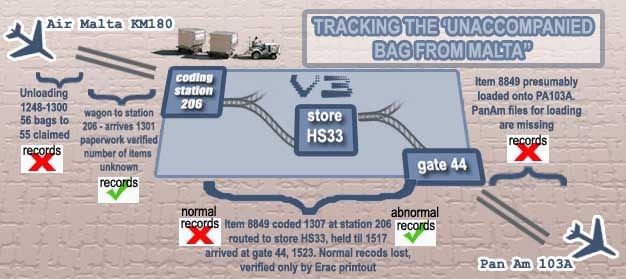
Air Malta flight KM180 arrived from Luqa Airport, Malta, and reached its parking position at 12:48GMT. The plane was unloaded between then and 13:00, and one wagon of baggage from it arrived, at 13:01, at one of two main luggage facilities, designated “V3.” This baggage and nothing else was then coded at station 206 within V3 starting in three minutes at 1304 and running probably six minutes until 1310. One particular item was coded at 13:07 into container no. 8849. It was then routed down to one of several luggage stores, HS33, for two hours until moved at 15:17 to gate B044 and later, presumably, loaded onboard 103A before its 16:53 departure. No passenger transferred from the air Malta flight to the PanAm one, so the bag thus illustrated was of the dreaded “unaccompanied” variety.

The System (I Think)
From what I gather of the whole airport system, it could be broken down to two parts; the topside is a zone of tarmac and wheels, counters, hands, wagons, and airplane cargo holds. Hard paperwork is kept for topside transactions, and activities are overseen by actual people held responsible. The Court explained “baggage for most airlines was handled by the airport authority, but PanAm had their own security and baggage handling staff.” This is key to record-keeping; the airport and the airline each would then have responsibility for keeping track of their own efforts, and both should be called on in the investigation.

From the planes, luggage is carted to a coding station, where items are placed on bar-code numbered trays (containers), one item per tray, and the computers take over. The bottomside then is what the Court described as “a computer controlled automated baggage handling system” that I gather ran beneath the airport. This vast electro-mechanic system automatically routed coded items along roller conveyors and through switching stations, at key spots scanned and logged. This system connected coding stations to the various stores, and apparently up to gates, after which they re-emerged topside and then to the connecting aircraft’s hold. Not bad for 1988.

On the paperwork kept to track this complex arrangement, the court explained “the computer itself retained a record of the items sent through the system so that it was possible, for a limited period, to identify all the items of baggage sent through the system to a particular flight. After some time, however, that information would be lost from the system.” [emph mine] One would presume law enforcement and investigative agencies would be aware of that fact.

Records on the KM180 End
Production 1068: The court’s point [29] denotes this for “the evidence of Joachim Koscha, who was one of the managers of the baggage system at Frankfurt in 1988” It was his evidence that established KM180’s arrival and unloading time, 12:48-13:00. They do also cite a “record,” but provided no direct citation. It almost seems they’re just citing his memory, when normally paper records were kept.

Denis Phipps, former head of security, British Airways, who has closely inspected the primary records of different airlines and airports connected to the disaster. He said in The Maltese Doublecross [video, 1994] “the records from Frankfurt were by no means complete." Among his concerns:
“There was no record of who unloaded that flight KM180 when it arrived at Frankfurt. We don't know who the loaders were. There was no record of the number of bags that were actually unloaded from that flight. There were no records that I could find.”
He was trying to bolster Air Malta’s reasonable claims that all 55 bags on that flight were accompanied and claimed by its 39 passengers, and none could have gone on to 103. Thus the official story here is that there was one more bag than Air Malta admits to. That Phipps found no records to support that, and the court failed to specify any, are bad omens for that damning charge.

production 1092: This is an “interline writer’s sheet” filled out by Andreas Schreiner was in charge of monitoring the arrival of baggage at V3 That bears to record one wagon of baggage from KM180 arriving at V3 at 13:01.Within V3 are seven coding stations, where luggage is placed into bar-code numbered trays to enter bottomside. They cite the sheet’s contents in table form and it seems like they had these records at hand.

Mr Schreiner’s evidence expanded beyond this, to explanations for the the Lords of how coding “would generally begin three to five minutes after the arrival of the baggage at V3,” and that “luggage was always delivered from one flight only” at any given time. The basis for these points must be taken on the man’s word, but they help simplify the Prosecution’s case. Station 206 at 13:04-13:10 means KM180 baggage and nothing else. Simple common sense would dictate a breach of this standard MO is at least possible. A stronger retort was published in Time magazine in 1992, relating a FBI memo following a look at the airport’s records and methods:
On a guided tour of the baggage area in September 1989, it was disclosed, detective inspector Watson McAteer of the Scottish police and FBI special agent Lawrence G. Whitaker "observed an individual approach Coding Station 206 with a single piece of luggage, place the luggage in a luggage container, encode a destination into the computer and leave without making any notation on a duty sheet." This convinced the two investigators that a rogue suitcase could have been "sent to Pan Am 103 either before or after the unloading of Air Malta 180."
This bag would thus appear to investigators to have been part of whatever planeload they were coding there at the time. The same could be at work with our item 8849. The conclusion of this report, sent back to Washington: “"There remains the possibility that no luggage was transferred from Air Malta 180 to Pan Am 103."

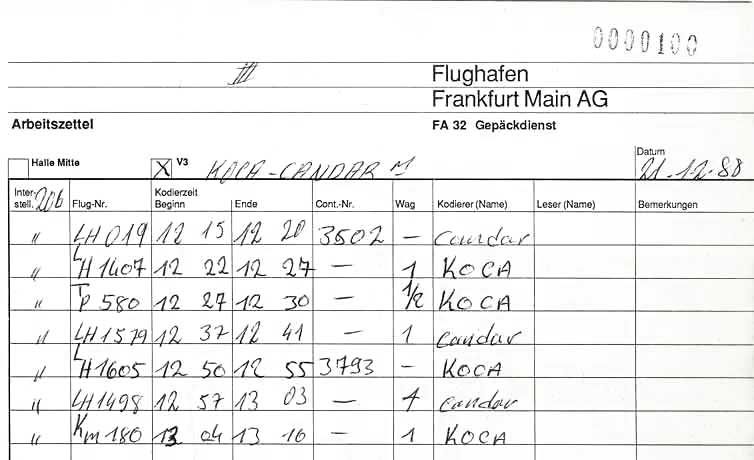
Production 1061: This was identified by witnesses Mr Schreiner and Mr Koscha “as a work sheet completed by a coder to record baggage with which he dealt.” The name of the coder in question was Koca, who was not called as a witness.” Pity, since the document shows us little detail. The court again showed this data in tabular form. Here thanks to Mebo I have an image of the evidence in question [see below]. The signatures alternate Koca and Candar, listing either container numbers or numbers of wagons of luggage, the flight number it’s from, time they started coding, and stop time. The relevant line is the last one – one wagon of luggage from KM180 started coding at 13:04, and ended at a time disputed as 13:10 or 13:16.

The difference between the a 1310 reading and a 1316 one does not affect the link with the central printout showing 8849 coded at 1307. But as eminent investigator Paul Foot notes “If the end-time was 13.16 this left a gaping hole in time when other bags may have been encoded through the same station that did not come from Malta at all.” With the worksheet here we can compare some previous codings “Beginn” to “Ende” for the previous six flights: 5 min, 5 min, 3 min, 9 min, 5 min, and 6 min, to process one wagon or one container of baggage. (the apparent “4” is probably a “1” written over a dash). And finally, either six or twelve minutes for one wagon from KM180. Unless there was something weird that screwed up the pattern (which is entirely possible), I’m calling the end time 13:10 and moving on. The hole was as big as it was, other things could well get through, but the most likely item at 206 in that time is still a bag from Malta.

Records on the PA103A End: A Blanked-Out System
Production 1062: This is the court’s code for some unspecified “documentary evidence” that “the aircraft used for PA103A arrived from Vienna (as flight PA124) and was placed at position 44, from which it left for London at 1653.” I’ll accept that as valid, but note the ambiguity of citation.

Production 1060:
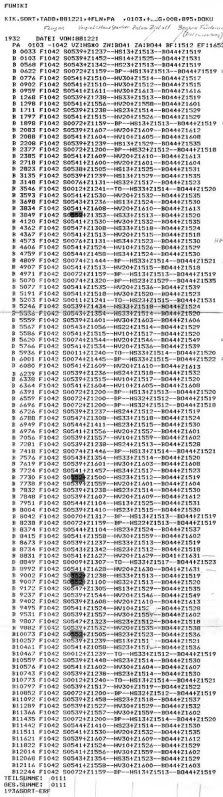
This is the famous printout of the late-sought tracking data on bags destined for the PanAm flight, on a whim saved from oblivion by the diligent Mrs. Erac. [see left – r-click, new window for readable size] Obviously this covers the broad computer-managed middle stage rather than “the 103A end.” But as it is, this is the only known link showing that item 8849 continued towards the fatal feeder flight. It’s the single document that allows “the inference," drawn by the Scottish Judges, "that an item which came in on KM180 was transferred to and left on PA103A.”

It’s not that there should be more; the one record is to be expected. The unexpected is no one official got to it before it was deleted, and we had to rely on a memento copy from someone’s locker. We’re told. And the investigation was lucky to get that after a curious delay of 7-8 months.

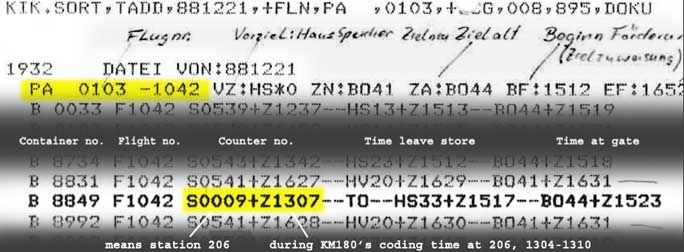
What it shows, briefly, is 111 items listed numerically by container no. The relevant portions are highlighted in the condensed version below. PA103A is referred to herein as F1042. The relevant item 8849 was coded at station S0009, which it’s been determined means station 206, at 1307. That is a fit with KM180’s load. It then goes to Gate B044 at 1523, the same few-minute span most of it arrived. What happened from there is outside the computerized system and not recorded here.


Production Null: This is the designation – none – given to PanAm’s loading records for flight 103A. Holding to previous patterns, we’re back to tarmac and wheels space, and there should be records kept at gates 44 and 41 regarding the luggage items received and loaded onto the planes at each gate. There should be a verification that item 8849 was among them, and that it was then loaded to the plane.

Obviously the Airport authority couldn’t offer this to the court, as it wasn’t their job to load a PanAm plane or to log what they don’t do. There’s no mention in the Court’s opinion of what PanAm provided to the case; they went bankrupt in late 1991, so it’s natural they didn’t send anyone to the 2000 trial. But judging by Marquise, they also added nothing to the 1989-91 investigation, at least regarding the crucial Frankfurt link. The court adds nothing to that, only citing "evidence [...] that no baggage was left at the gate" in reasoning that " it can be inferred that all items sent there were loaded." Again, a non-admission admission that they don't really have the evidence they should.

Positive confirmation of this lack of records can be found in The Maltese Double-Cross (same section linked above). According to Michael Jones, Pan Am’s security chief with the London office [emph mine]:
I went to Frankfurt airport on 23rd of January 1989, to look for documents in relation to the preparation of Flight 103 from Frankfurt to London, and particularly the cargo and baggage loading plan, who was responsible for loading the plane and what their duties were, but these documents were missing from the daily file. … If the original documents had been taken by the authorities, and by that I mean the police, then it would be normal practice for a copy to be retained in the Pan Am file.

We have a date – one month after the disaster, and the crucial files for this plane are reportedly gone by this time. No one I know of has reported seeing them since. The computer tracking system was also gone to nearly all eyes as of January and on through August before it resurfaced to lead the case in a new direction. It would appear that investigators before that clue had no data on what went onto that plane that fed into the other plane. This in itself is a little-known but major scandal, quite likely its own crime scene that could not be traced back to foreign terrorists. Therefore, it’s to remain little-known.

Graphic Representation


Sources:
- Lords Sutherland, Coulsfield, MacLean, Case No: 1475/99. OPINION OF THE COURT delivered by Lord Sutherland in causa HER MAJESTY’S ADVOCATE v ABDELBASET ALI MOHMED AL MEGRAHI and AL AMIN KHALIFA FHIMAH. Delivered January 31 2001. PDF or txt file available at: http://www.scotcourts.gov.uk/library/lockerbie/index.asp
- The Maltese Double Cross - Lockerbie. Film, Hemar Enterprises, 1994, 156 minutes. Written, produced, and directed by Allan Francovich. Wikipedia page
- Rowan, Roy. Pan Am 103: Why did they Die? Time. April 27 1992http://www.time.com/time/magazine/article/0,9171,975399-1,00.html