Showing posts with label 9/19 incident. Show all posts

Thursday, June 25, 2009

ON THE MISSION OF THE 9/19 SOLDIERS

HE WHO DARES WHAT?
Adam Larson / Caustic Logic
[False-Flagging Iraq series]
June 25 2009
incomplete


When two British Special Forces soldiers were arrested in Basra on September 19 2005, many questions were raised. Among the most important is the nature of the mission they were on that brought them into violent confrontation with their erstwhile allies, the local police, and in turn brought the local British forces smashing through the police and the local "lynch mob" to get them back, killing around a dozen Iraqis along the way. This had better be good...

We know the two men were (believed to be) part of the UK Army Special Air Service (SAS), an elite force famous for bold raids behind enemy lines and operating under the motto “Who Dares, Wins.” If so, what were they daring to do on this day? A Basra official, Mohammed al-Abadi, complained the soldiers “refused to say what their mission was and suggested that we ask their commander.” [1] To my knowledge, they never got an answer from above either. Different solutions to the riddle have been offered in the days afterwards, before the issue went into longtime hibernation mode. Below I’ll explore the four broad categories of theory.

1) False-Flagging Basra
The first category was the first we heard in detail - those peculiar locals saw the darkest version, that the SAS men were involved in false flag terrorism. Those with known grudges were the most vocal; Sheik Hassan al-Zarqani, a spokesman for rebel leader Moqtada al-Sadr, issued a press release saying “we believe these soldiers were planning an attack on a market or other civilian targets,” that this attack was to be a car-bombing, that they were “disguised as members of the Mehdi Army” (Sadr’s own group), and that the police refused to release the imposters since “they were considered to be planning terrorist attacks.” [2]

Many others far from the fray have concluded – or alluded to - the same; one critic called it “a clear instance of a foreign power attempting to fabricate a terrorist attack. Why else would the soldiers be dressed as Arabs if not to frame them? Why have a car laden with explosives if you don't plan to use them for destructive purposes?” [3] There are of course other reasons to dress like someone besides framing them, and other reasons – if few – for driving an explosive car. There’s no direct evidence I’m aware of for a booby-trapped car. There IS evidence of people stating this as fact, and for same people already believing the Coalition was behind the public bombings (this “previous reports confirm” or “prior-bias weakens” question will get its own post later).

There may have been a bomb as “reported” after all, with the evidence hushed-up afterwards, but I’m leaning the other way – the later lack of clues reveals the first reports were probably just opinionated propaganda. These reports being false doesn’t rule out some other planned provocation, which they were armed enough for, but absent a bomb there’s less reason to suspect such. Therefore, this case as I understand it does little to directly support the coalition false-flag theory.

2) Routine Intelligence Work
The UK Telegraph reported initially “the SAS men are thought to have been on a close observation patrol when they were stopped at a checkpoint.” The same piece explains how “soldiers have been told not to stop if challenged while working under-cover, as insurgents often masquerade as police officers.” [4] It would seem unlikely they were told to shoot while not stopping, although it seems that’s what they did. It makes perfect sense however that soldiers decked out as militants should not stop for possible militants disguised as police – especially since they’d already shot one of the real, militia-sympathizing Basra police officers.

Another paper, The Scotsman reported that “that the soldiers were part of an "undercover special forces detachment" in Basra to "bridge the intelligence void” and “gather human intelligence during counter-terrorist missions."” [5] One diplomat told the Guardian "We explained clearly to the authorities that they were British forces on a run-of-the mill observation mission." [6] Of course to observe out in the world It helps to blend in, hence the wigs and gauzy stuff; light-skinned as they were, Chechens might have been a good cover. Then they just panicked and started shooting at militia-police.

These are all boring missions that hardly seem worthy of such a cloak and dagger moment as 9/19. Sometimes however reality is just that – the boring choice. That hasn’t kept some from offering some enhanced versions…

3) Special Missions That Make Neat Political Points
Other sources narrow down the intelligence mission to Investigating a police-militia link, police corruption, torture, cat mutilations, and other such evils. The Herald: “Sources say the British soldiers […] were looking at infiltration of the city’s police by the followers of the outspoken Shi’ite cleric, Moqtada al Sadr.” [7] The Times, September 21: “The two soldiers are believed to have been investigating a corrupt police unit in Basra who were colluding with Shia militia leaders. Some of the men who later interrogated them are believed to be part of this same unit.” [8] Indeed, their mission proved spectacularly successful in flushing out such links, even though it seems to have gone terribly awry to do so.

In October, the Telegraph reported they finally “can reveal […] the real story,” which was that the soldiers were “spying on a senior police commander who was torturing prisoners with an electric drill.” That's certainly horrifying, and the paper described their mission as investigating “who was behind the reign of terror" at the very jail they wound up inside of. Brigadier John Lorimer, the man who oversaw the soldiers’ controversial rescue, told the paper the jail he ordered smashed down was a “very nasty place.” [9] A good way to find out what happens in the jail is to go inside it, but this was apparently not the plan, or else the costly rescue mission would not be called in to stop the process.

Another story with broader political implications and some detail to support it, was stopping roadside bombs coming in from Iran. The Sunday Times reported on the 25th, just four days after revealing their militia-police-corruption mission, that the soldiers were really “engaged in a “secret war” against insurgents bringing sophisticated bombs into the country from Iran.” [10] The deadly new bombs were made in a known Iranian style, meaning they must be from Iran. Therefore, “a 24-strong SAS team has been working out of Basra to provide a safety net to stop the bombers getting into the city from Iran,” said one source. “The aim is to identify routes used by insurgents and either capture or kill them.” [11] This system involved remote surveillance by human and electronic sensors along the routes into Basra. The Times graphic does show them headed towards the desert outside of town. “A source” also told the Times the pair was en route to another patrol to bring them “more tools and fire power” (which might explain their overabundance of weaponry) and to stop and do some surveillance, sort of along the way. [12]

Or perhaps their real mission, concealed by these more mundane stories, is the case made by the News Herlad Review on the 23rd that these “brave soldiers” were looking for the missing Weapons of Mass Destruction the war was first based on, and in the process:
“searching for clues of a suspected axis between Saddam Hussein’s regime, Al Qaeda in Iraq and elsewhere, corrupt police, Iranians, North Koreans, and Satan himself. Sources say the men were startlingly close to finding the missing link. when the devil’s minions closed in and took them to the local prison, which is believed to house one of the portals to Hell used to communicate master plans.” [13]


4) None of the Above
For my money, I’m going with “none of the above/undecided.” Of course any of the non-sinister mission types given above, could very well have caused the initial arrest situation, if natural mistrust and anxiety, perhaps some sloppiness, or simple bad luck enter the picture. However, given their hanging around police facilities and openness with firearms, it seems quite possible they were supposed to be arrested - like a dye marker injected into a system to gauge how it works.

My own hunch, or interesting hypothesis anyway, is that the mission these men were on was something involving competing interests, power and leverage, and an acutely uncertain level of trust. The trust of course failed badly however you slice it, which brings me to a point made by Micheal Keefer, writing for the Center for Research on Globalization:
"To remove these men from any danger of interrogation by their own supposed allies in the government the British are propping up […] tends, if anything, to support the view that this episode involved something much darker and more serious than a mere flare-up of bad tempers at a check-point." [14]
Hardly anyone would disagree there was more to it than that; it’s the origins of the ominous intentions over which opinions differ. I’m seeing at least some darkness on both sides, if more acutely within the Basra police; in fact I feel queasy thinking of all the others passing through their hands without an armored division being sent to fetch them back. And that’s even without believing the drill torture stories.

The abuse allegations and other political points above – police-militia-Iran links - were also floated on this story’s current whether or not that was an original reason. In particular the charges of militia sympathies and cooperation were well-proven by the incident, as it was reported. Of course the strangely blatant murder of a militia-police-link-reporting journalist by militia-police-link-assassins the very same day sure didn’t help. [15] Who decided the timing on that? The earlier murder of militia-police-link-reporter Steven Vincent had already set the trend in August. [16] The British army’s later destruction in late 2006 of another Basra jail - by bombs – exposed torture and inhumane conditions inside, strengthening the narrative further. [17] But the case of 9/19 above all, involving such a stark contrast between “allies” as well as a man on fire, is what brought to a head in the British mind the hopeless depths of Basra’s wickedness and thence to the plans for withdrawal.

If those two guys being on some alleged psychological operation doesn’t seem to make sense, it’s worth asking if the normal rules really apply in this case. The original suspicions of bombing had the intent of retaining control through fake terror – Gladio in Mesopotamia. In the end what happened served brilliantly to tilt the scale towards the British relinquishing responsibility for the south of Iraq. And it may even have been intended that way. If you’re going to leave anyway, why not make a few points towards your myth of “why we gave up in Iraq” on your departure?
---
Sources:
[1, 4] Blomfield, Adrian and Thomas Harding “Troops free SAS men from jail.” The Telegraph. September 20 2005.
http://news.telegraph.co.uk/news/main.jhtml?xml=/news/2005/09/20/wirq20.xml
[2, 14] Keefer, Michael. "Were British Special Forces Soldiers Planting Bombs in Basra? Suspicions Strengthened by Earlier Reports." Center for Research on Globalization. September 25 2005. http://www.globalresearch.ca/index.php?context=va&aid=994
[3] Hutaff, Matt. “Fake Terrorism Is a Coalition's Best Friend.” The Simon. September 20 2005. www.thesimon.com/magazine/articles/canon_fodder/0961_fake_terrorism_coalition_best_friend.html
[5] Ahmed, Nafeez. “Caught red-handed: British Undercover Operatives in Iraq. Zarqawi, eat your heart out.” The Raw Story. September 23 2005. http://rawstory.com/news/2005/CAUGHT_RED__0923.html
[6] Mansour, Osama and Michael Howard. "Britain refuses apology and compensation for Iraqis caught up in Basra riots." The Guardian. September 26 2005. http://www.guardian.co.uk/world/2005/sep/26/military.iraq
[7] Nimmo, Kurt. “British “Pseudo-Gang” Terrorists Exposed in Basra.” Another Day in the Empire. September 20 2005. http://www.uruknet.info/?p=15936
[8] McGrory, Daniel. “Police station raid was diversion as SAS squad rescued comrades.” The Sunday Times. September 21 2005.
http://www.timesonline.co.uk/tol/news/world/iraq/article568898.ece
[9] Rayment, Sean. “Captured SAS men 'spying on drill torturer.'”The Telegraph. October 16 2005. http://www.telegraph.co.uk/news/uknews/1500740/Captured-SAS-men-spying-on-drill-torturer.html
[10, 11, 12] Smith, Michael and Ali Rifat. “SAS in secret war against Iranian agents.” The Sunday Times. September 25, 2005.
http://www.timesonline.co.uk/tol/news/uk/article570571.ece
[13] Don’t be silly; of course I made it up. But it does seem to fit the pattern, doesn’t it?
[15] Knickmeyer, Elen and Jonathan Finer. “British Smash Into Iraqi Jail To Free 2 Detained Soldiers.” Washington Post Foreign Service. Tuesday, September 20, 2005; Page A01. http://www.washingtonpost.com/wp-dyn/content/article/2005/09/19/AR2005091900572.html?nav=rss_world
[16] Worth, Robert F. “Reporter Working for Times Abducted and Slain in Iraq .” New York Times. September 20 2005. http://www.nytimes.com/2005/09/20/international/middleeast/20basra.html
[17] Santora, Marc. “British Soldiers Storm Iraqi Jail, Citing Torture.” New York Times. December 26 2006. http://www.nytimes.com/2006/12/26/world/middleeast/26iraq.html

Friday, June 19, 2009

9/19 BASIC GIST AND GRAPHICS

Adam Larson / Caustic Logic
June 18 2009


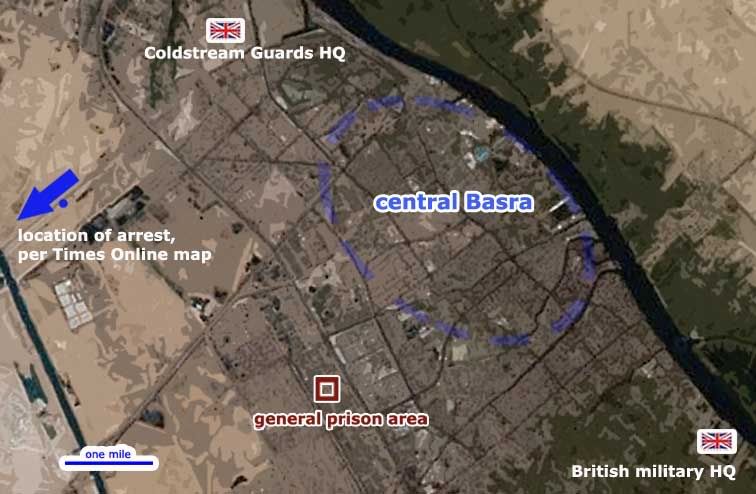
For quick reference, I present a post based entirely on an informative graphic published by the Times online about the "SAS rescue" of September 19 2005. First, my own maps I created based on theirs and satellite imagery, and then a timeline of the events marked on their map. This will serve as a basic run-down of the battle of the police station, from the British official perspective. It's the only one I've seen yet that offers times for much of anything, so Ive been using it as a source. My respects to its creators.

Above: Greater Basra, with British HQ locations, initial arrest, and later rescue locations indicated. (right-click, new window for larger view). Below: detail of the prison area and militia house the soldiers were rescued from.


THE RESCUE
Early on Monday Two British undercover soldiers are stopped at a checkpoint and arrested by the police.
10:40 Monday The soldiers put out an emergency call to say that they are in trouble. Troops are dispatched to assist them.
15:15 Cordon put into place around police station
16:30 Mob gathers, petrol bombs are thrown and two Warrior armored personnel carriers set on fire
19:26 More violence Known agitators seen leading another mob towards police station
20:50 Intelligence revealed that the soldiers have been moved away from the police station.
21:00 Decision is taken to attack the police compound and search for the two men
22:00 Force detached to search nearby villa. They force entry and, after a gunfight, rescue the soldiers.
0200 Yesterday Operation complete. Two freed prisoners flown to Baghdad for debriefing and three British soldiers treated for injuries.

Wednesday, June 17, 2009

9/19, THE FIRST HALF: THE ARREST

WHAT THE BASRA POLICE DISCOVERED
Adam Larson / Caustic Logic
June 17 2009


IN CUSTODY: A MURKY BEGINNING
In charge of security for the mostly-Shiite southern city of Basra, the British military enjoyed a generally placid command relative to, say, the Sunni triangle. Relations started worsening, however, in autumn of 2005, starting with three British soldiers killed in the first weeks of September. Several coalition arrests of prominent spiritual leaders on the 18th increased tensions, spurring protests and possibly further problems. The burden was shared, thankfully, with the Coalition’s Iraqi partners in peace and stability, like the Basra police force, who were also on guard as the morning of Monday, September 19 2005 drew up over them.

Accounts differ or are vague on almost all details about the events of that morning, starting at a time I’ve seen best narrowed down to “before dawn.” [1] The troubles began with two occupants of a well-used white car, similar to a later model Toyota Cressida. The car’s direction of travel is not clear from available sources, nor the location of this crossing-of-paths; it’s alternately been described as a police station or a police checkpoint. We do know that the two men inside sported traditional gauzy Arab shirts, short beards, curly black hair and some kind of head scarves, in an unspecified style. Of course these were disguises; they were really British Special Forces soldiers, generally reported as SAS, doing something undercover.

Accounts and reports differ on just what happened between the soldiers and the police attempting to halt them. It’s agreed by all that the men in the car fired shots at the police, but all other details remain murky. The first reports from Iraqi authorities were that at least two people had been shot, one fatally and one not. Later reports, for the most part, repeated these. Whether both were police or one civilian, and if so which was killed - variations have been reported. BBC's first is typical; the charge was "allegedly shooting dead a policeman and wounding another." [2]

About a week after the incident, “Iraqi police involved in their arrest” gave a Sydney Morning Herald reporter “detailed accounts of last Monday's events.” The article itself is a gratuitously slanted piece, taking every chance to imply that one of the thousand lurid Arab evils permeating the Basra system had to exculpate the Brits entirely (see below). Nonetheless, it cites:
Captain Ahmed al-Shimari, who was on duty last Monday, said the soldiers had been spotted taking photographs from a car. Three officers, Fadil Hadi, Allah al-Bazuni and Qutayba Sa'ami, ran towards the car. Mr Hadi fired two warning shots and the soldiers returned fire, hitting Mr Sa'ami in the leg. [3]

According to this version, that was the only injury caused by the soldiers. All reports of a death were errors – or worse – from hostile local officials. But whatever the details, somehow the two men were apprehended alive and taken to the local police station for questioning. By then it was discovered that under their terrorist-like garb the men were quite Caucasian – Chechens? One Basra official said “they refused to say what their mission was and suggested that we ask their commander.” [4] The closest they had to identification on them said the same thing – laminated cards saying "In an emergency, please call US and UK forces,” providing different phone numbers for Basra and two other cities in southern Iraq. [5]

A graphic provided by Times Online (London) indicates it wasn’t until 10:40 am – apparently with their “one phone call” – that the soldiers put in an emergency call to headquarters. [6] Soon British forces were talking with the Basra police captains and local officials; they acknowledged the two as their own, and negotiations for their release began, as a military detachment was assembled to back up their bargaining position.

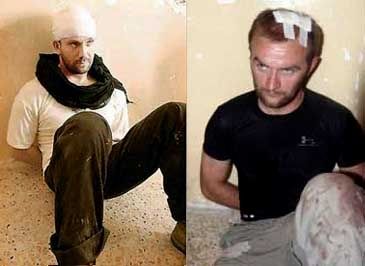
In the meantime, the two were held at the jail compound in southwest Basra, about midway between British military HQ and the Coldstream Guards HQ. In a room with yellow chipped-paint walls they sat hands-bound on an ugly “granite look” aggregate floor, as Arab news cameramen were allowed in to film them (see images above). [7] The two men were apparently beaten or injured in capture, though not badly, sporting bandaged heads. I would presume the blood staining the lighter haired guy’s pants is his own. Note the darker-haired guy has a black scarf around his neck; in later shots this is removed and he’s clearly been doused with water. Both carry an air of defiance, a thin smirk of nonchalance. I think they look pretty scared.

WEAPONS: STANDARD OR MASS DESTRUCTION?
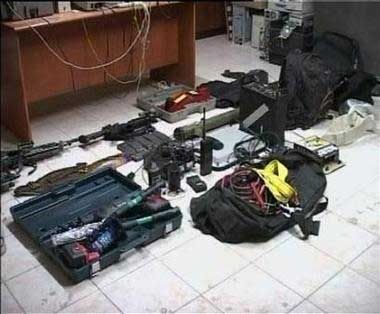
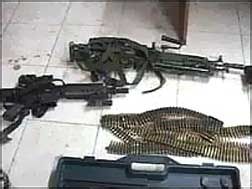
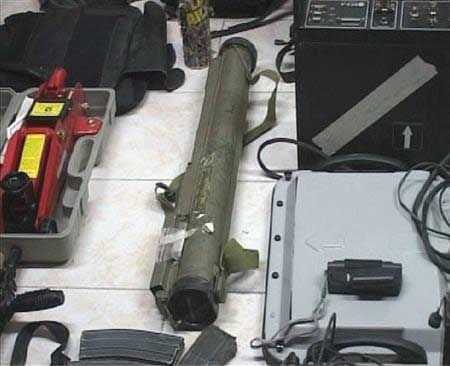
Also on display was their confiscated tool kit, including among a car jack, various rucksacks and plastic cases, BBC’s Reporter Richard Galpin acknowledged “assault rifles, a light machine gun, an anti-tank weapon, radio gear and medical kit.” Speaking with British forces, Galpin passed on that “this is thought to be standard kit for the SAS operating in such a theatre of operations.” [8] I'm not sure if that's ridiculous or not, but it seems a bit much for what a British diplomat in Basra told the authorities was "a run-of-the mill observation mission." [9] But hey, you never know when you'll run into an Al Qaeda tank.


Top: whole cache as shown by basra police. Middle right: shirts and wigs the soldiers used for disguise. Rest: close-ups of weapons. Right-click, new window for larger views.

There is little disagreement over the above weaponry, but the most important variable for understanding what happened that day, and what the police were thinking, is the possibility that the car was rigged with heavy explosives. Official British and friendly sources only acknowledge this has been reported. China’s Xinhua news agency reported on the 19th, citing an unnamed source at the Iraqi Interior ministry (which oversees the police), “the two soldiers were using a civilian car packed with explosives.” [10] Fattah al-Shaykh, member of the Iraqi National Assembly, told Al Jazeera as the crisis began of the “booby-trapped car laden with ammunition [that] was meant to explode in the centre of the city of Basra in the popular market.” [11]

Sheik Hassan al-Zarqani, a spokesperson for Shia leader Moqtada al-Sadr, quickly issued a press release telling the world "what our police found in their car was very disturbing — weapons, explosives and a remote control detonator […] These are the weapons of terrorists. We believe these soldiers were planning an attack on a market or other civilian targets, and thanks be to God they were stopped and countless lives were saved." Zarqani further alleged the disguise the men affected had been of Sadr’s militia, the Medhi (Mahdi) Army, and that they were to bear the blame for the planned bombing. [12] Zarqani’s release also addressed the British demands for the bombers’ release: “The police refused as they were considered to be planning terrorist attacks, and as they were disguised as members of the Mehdi Army, the police wanted to know who their target was.” [13]

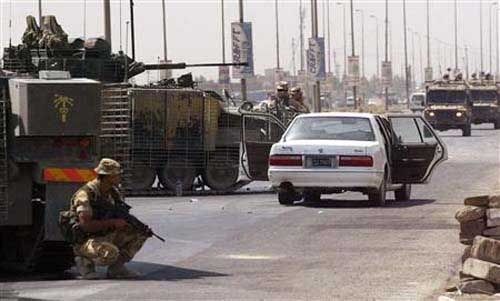
Many readers will deny these sources out-of-hand, and they do seem to have an untrustworthy bias-to-information ratio. I’m not so sure what the police or courts there said about the alleged bomb, and on what evidence. There are no photos or video taken of a bomb. One photograph connected by one researcher to this story [below] shows the car cordoned off by military vehicles as if it were dangerous itself. This photo was posted by researcher Sara Meyer shortly after the events, and I can’t find another source. It was coupled with an explanation, un-sourced, how the car “was later removed by the British.” [14]


TO MAKE BAIL OR BREAK JAIL?
There was at the time little to clarify what was the intent of the SAS men – “they refused to say what their mission was” and their commanders weren’t adding much. Similar but more open disagreement surrounds the intent of the police. They claimed to be holding suspicious men engaged in violent criminal behavior, and that fits a lot of the facts. However by parading cameras by them and such, one may sense a little more enthusiasm than simply protecting public safety would explain. The British military took the view – and quite firmly – that the Basra police force was infiltrated by anti-coalition militia sympathizers. Among the charges, the Sydney Morning Herald’s article named Police Captain Yasser al-Bahadli, “a known Mahdi Army sympathizer” as the overseer of the men’s captivity. [15] Their stated belief was thus that their soldiers were in grave danger of falling into enemy hands and must be released.

This concern could of course conceal some other motive for demanding their release, but whatever the case, the Ministry of Defense explained to home audiences how a seven-person military legal team had been dispatched to the prison to try and work things out that way. [16] Preparation for a larger extra-legal military effort were also set in motion. One diplomat, Karen McLuskie, told the Guardian "we explained clearly to the authorities that they were British forces on a run-of-the mill observation mission." [17] Certainly along the way they reminded their colleagues that “under Iraqi law,” as the BBC reported, “the soldiers should have been handed over to coalition authorities.” [18] The Brits pulled strings with the national government in Baghdad and reportedly got the Interior ministry, responsible for police, to issue an order for their Basra people to release the men. It would seem that this order was ignored by the involved locals.

Probably around this time, Brigadier John Lorimer "had good reason to believe that the lives of the soldiers were at risk,” as he told the BBC, and he decided to get “near the police station to help ensure their safety by providing a cordon.” [19] By a quarter after three a small force under Lorimer’s command was at the scene, and a security cordon established around the compound. [20].

In the meantime, anger in the streets had grown, based on whatever people had heard about the soldiers at the jail. It’s difficult to say if the reportedly slain officer, or the planned bombing, or simply the attempts of the British to circumvent Basra justice, was most paramount in anyone’s mind. The Independent reported “one witness said Iraqis were driving through the streets with loudhailers demanding that the soldiers should be kept in the police station, and then jailed.” [21] But some potent combination of factors mobilized dozens – then hundreds - to the jail for a spontaneous citizen’s assembly (or militia-sponsored mob, depending which side of Operation Iraqi Freedom you’re on). The villain Captain Yasser al-Bahadli, watched as the British tanks and roiling crowd gathered ouside the station, the Herald’s article reports, and “put out word two "Israelis" had been arrested - certain death had the mob reached them.” [22]

Despite all this, the authorities behaved as if all was under control and proceeding normally - A provincial council spokesman for Basra, Nnadhim al-Jabari, announced that the two captured soldiers “were likely to go before an Iraqi court,” the Independent reported. [23] But al-Jabari didn’t have all the facts; as it turns out, the suspects would not go in front of the judge. Eventually they went home, but where exactly they went in the following hours is of great interest and some mystery.
---
Sources:
[1, 4, 7, 21, 23] McCormack, Helen. "The day that Iraqi anger exploded in the face of the British occupiers." The Independent. September 20, 2005. http://www.commondreams.org/headlines05/0920-05.htm
[2, 8, 16] BBC news. "Iraq probe into soldier incident." 20 September 2005. http://news.bbc.co.uk/2/hi/middle_east/4264614.stm
[3, 15, 22] Rayment, Sean with special sorrespondents. “Britons had visions of their throats being cut.” Sydney Morning Herald. September 26 2005. http://www.smh.com.au/news/world/britons-had-visions-of-their-throats-being-cut/2005/09/25/1127586747136.html
[5, 9, 17] Mansour, Osama and Michael Howard. "Britain refuses apology and compensation for Iraqis caught up in Basra riots." The Guardian. September 26 2005. http://www.guardian.co.uk/world/2005/sep/26/military.iraq
[6, 20] http://www.timesonline.co.uk/article/0,,7374-1790311,00.html
[10] Xinhuanet. "Iraqi police detain two British soldiers in Basra." September 19 2005. http://news.xinhuanet.com/english/2005-09/19/content_3514065.htm
[11] Chossudovsky, Michel. “British "Undercover Soldiers" Caught driving Booby Trapped Car.”
http://www.globalresearch.ca/index.php?context=va&aid=972 (Text of report by Qatari Al-Jazeera satellite TV on 19 September)
[12, 13] Keefer, Michael. "Were British Special Forces Soldiers Planting Bombs in Basra? Suspicions Strengthened by Earlier Reports." http://www.globalresearch.ca/index.php?context=va&aid=994
[14] Meyer, Sara. Basra Shadowlands. Index Research.
October 19 2005.
http://indexresearch.blogspot.com/2005/10/basra-shadowlands.html
[18, 19] BBC News. "UK soldiers 'freed from militia'" http://news.bbc.co.uk/1/hi/world/middle_east/4262336.stm