Showing posts with label Germany. Show all posts

Monday, November 23, 2009

THE TESTIMONY OF BOGOMIRA ERAC

Camp Zeist, Netherlands, 30 August 2000
[Pan Am 103 Series]
Adam Larson / Caustic Logic
November 22 2009


The following is the first online posting of the full testimony, before the special Scottish Court at Camp Zeist , Netherlands, of Frankfurt Airport employee Bogomira Erac. Her importance to the Lockerbie investigation was previously explained in another post. This somewhat short discussion is extracted from Day 47 (of 86 days) of the full digital transcripts I just received copies of. Transcripts: Day 47, 30 August 2000, pages 6659-6671 (re-formatted with page numbers marking page breaks)

6659
MR. TURNBULL: The next witness, My Lords, is number 787 on the list, Bogomira Erac, who will give evidence in German.
THE MACER: Witness number 787 on the Crown list, Your Lordship, Bogomira Erac.
WITNESS: BOGOMIRA ERAC, sworn
LORD SUTHERLAND: Advocate Depute.
EXAMINATION IN CHIEF BY MR. TURNBULL:
Q Are you Bogomira Erac?
A Yes.
Q And do you live in Germany?
A Yes.
Q What age are you?
A 57.
Q Where were you born, please?
A In Crnomelj, Slovenia, in ex-Yugoslavia.
Q And did you live there for some time before living in Germany?
A I lived in Slovenia until '66.
Q Thank you. Do you now work at Frankfurt Airport?
A Since the 1st of January 2000, I am no longer working at Frankfurt Airport.
Q When did you begin working at Frankfurt

6660
Airport?
A On the 1st of May 1974 I started to work for a firm, and then in '75, I started to work for the Frankfurt Airport directly.
Q When you worked -- I'm sorry, was the firm you mentioned called ISI?
A Yes. The first firm was ISI from Berlin, and the one which I now work for is the FAG, Frankfurt.
Q What was your job when you worked with ISI at Frankfurt?
A I was a programmer when I worked for ISI. I also did some operating. And when I started out with FAG, I started out as a programmer, and later I did operating.
Q Did the firm ISI develop the software that was used to control the baggage conveyancing system at Frankfurt Airport?
A Yes.
Q So from your first involvement with Frankfurt Airport, have you worked with the baggage

6661
conveyancing system?
A Yes.
Q And were you working at Frankfurt Airport in December of 1988?
A Yes.
Q And did you work as an operator in the computer system at that time?
A Yes. Yes.
Q Was that the same department as Kurt Berg?
A Yes.
Q Was he your supervisor?
A Yes, he was my supervisor.
Q In December of 1988, was it possible to ask the computer to print out information about the baggage sent to a particular flight?
A Could you please repeat the question once again?
Q Was it possible to ask the computer to print out details of the baggage sent to an outgoing flight?
A Yes, that was possible.
Q And for how long would that information be kept in the computer?
A The information was kept in the computer

6662
for a few days; however, for various appraisal processes, we copied the data onto two boards. We switched between one and the other.
Q All right. Were you working in the computer department on the 21st of December of 1988?
A Yes, I was on the late shift.
Q And what time did you finish?
A Officially, we stopped at 22.00 hours, but we finished around about a quarter of an hour earlier, and so we were allowed to leave earlier, if we had finished our work earlier.
Q When did you hear about the crash of flight 103?
A I heard about it in my car when I was driving away from the airport.
Q And did you realise that that was a flight that had been handled during your shift?
A On the news it said the plane came from Frankfurt, and actually, I didn't know anything further about it. I thought it was a direct flight. I didn't know anything more than that.
Q And did you think that it had been one of the flights that had been dealt with during your shift?
A I was sure about that time, the

6663
afternoon we had dealt with all of the planes which were leaving Frankfurt in the afternoon.
Q Were you working the next day?
A Yes, I was doing the late shift the next day as well.
Q And did people at the airport speak about the crash?
A Yes, we talked a lot about this crash. In fact, that was virtually all that people talked about.
Q Did you decide to do something with the computer?
A Well, actually, it was quite late on. We've got -- we had a television in our unit. It's the news, I saw the images.
Q And did you then decide to make an inquiry in the computer system?
A Well, I was actually curious about that flight. A day earlier there had not been any problems, so I was interested to see how much luggage there had been. And so it was really because I was curious that I made a printout.
Q What did you make a printout of?
A I've got a KIK computer, and I made a

6664
printout of the plane from the day before, on the 21st of December.
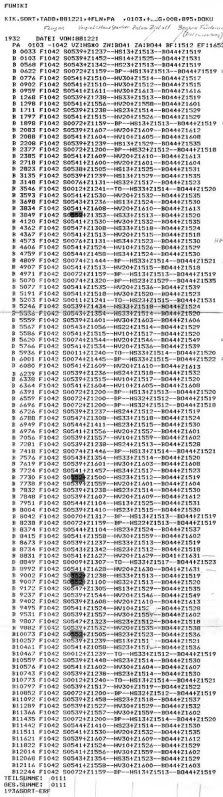
Q Would you look at the screen with me, to Production 1060, image 1, please. Can we magnify to the top, please. Thank you. Do you recognise this document, Mrs. Erac?
A One moment, please. I've got to put my spectacles on.
Q Can we see the flight number?
A Yes. Yes, you can see the flight number.
Q And is it flight Pan Am 103?
A Yes, it's flight Pan Am 103, 1988, from December 21st was the date. It indicates the counter where the luggage for Pan Am 103 was checked in.
Q And is this the information that you asked the computer to print out?
A Yes, that's the information I wanted about the luggage which went through the luggage transportation system for that flight.
Q What did you do with the computer printout?
A Well, I took a look at it, and I was really surprised that so few pieces of luggage had been checked in whilst there were so many passengers on

6665
board. Generally, at that time of the year -- at that time, anyway -- Americans had much more luggage. I took a look to see whether all of the items of luggage came out of the system, the ones that had been checked in, and whether they were on time. And I saw that as far as the computer was concerned, nothing remained in Frankfurt.
Q Did you realise at the time that the Frankfurt flight had connected with a larger aircraft in London?
A No, I only found out about that later on.
Q All right. So once you had finished looking at the computer printout, did you give it to anyone?
A No. No. I didn't see anything problematic.
Q What did you do with the computer printout, then?
A No one instructed me to make this computer printout. I just did it for myself because I was curious about the way in which the flight had been dispatched, so I took a look at it, and then I kept it as a souvenir, one might say. I hung it up in my cupboard.

6666
Q Were you due to take some holiday leave about this time?
A A few days later, I went to Slovenia. That was what I did every year; I went to Slovenia for the New Year.
Q Do you recollect when you returned to Frankfurt?
A I think it would have been around about the 15th of January, perhaps one day before that.
Q Did there come a stage when you told Mr. Berg that you had the printout?
A That was around a week later. When I went to Frankfurt again, I was on the early shift. It was sometime between the 20th and the 25th of January.
Q Thank you. Did you give the printout to Mr. Berg at that time?
A Yes, I gave Mr. Berg this printout, because I'd realised that there was actually no other documentation available.
Q Did he ask you to check the computer at that stage to see if there was any more information available?
A In the computer -- well, there was -- the data was there for one week, and after that they were written over. Mr. Berg just asked me to take a

6667
look in the archive in order to see whether there were teletype printouts. These were the things which came automatically from the computer. But I couldn't find anything.
Q Would there be any record of the baggage sent to flight 103 if you hadn't made this printout?
A Not so far as I know.
Q Thank you.
LORD SUTHERLAND: Mr. Taylor.
MR. TAYLOR: I think Mr. Davidson is leading on this issue, My Lord, but I have no questions.
LORD SUTHERLAND: Mr. Davidson.
MR. BURNS: I have a number of questions, My Lord.
LORD SUTHERLAND: Very well, Mr. Burns.
CROSS-EXAMINATION BY MR. BURNS:
Q Mrs. Erac, can I ask you, please, something about the procedure in relation to the computers.
A Yes, go ahead.
Q In 1988, am I right in thinking that at the beginning of each day the baggage conveyancing system computers needed to be switched on?
A The computers were all switched on. We didn't switch them off at all, but every day we started

6668
anew, working with the standardized state, so that was with the baggage -- I believe it was a KIK computer where the data were stored. They were stored in that computer for a few days, and it would be possible then to copy the data onto disks.
Q All right. What I really am interested in knowing is whether, at the beginning of each day, the time needed to be entered into the computer system.
A Yes, at the start, the date and the time had to be put into the computer.
Q And the time would be taken, would it, from the person's watch, or an office clerk, at the time when the time was entered into the computer?
A I'm afraid I haven't quite understood what you mean with this question. Could you please repeat the question?
Q Where would the operator get the time which was entered into the computer at the stage we are talking about?
A You get the time from the main clock in the computer, or from one's own watch, or from another clock.
Q Now, during the course of the day, would the time that the computer showed start to deviate from the time that the clock showed, for instance?

6669
A Yes, that's correct, but it's a physical phenomenon. Computer time, after about 4.00 or 5.00 in the afternoon, one would note differences of two or three minutes, let's say. It's a physical phenomenon. We were aware of this. It's because of the frequencies.
Q All right. So because of the electrical frequencies that powered the computer --
A Yes.
Q -- the computer time would deviate from other times shown on, for instance, clocks or watches; is that the position?
A Yes, there were small deviations.
Q Do you know whether the power company had been -- by December 1988 had been contacted about these problems in the power -- in the electrical frequencies?
A Well, I wasn't actually in charge of that. I didn't deal with the hardware side of things. I don't know whether they had been contacted.
Q Could the deviation between computer and clock time increase beyond three minutes?
A Well, you have to know which time you are referring to; not in such general terms, but at what time are you referring to?

6670
Q Well, you've told us that by 4.00 or 5.00, the time difference would be two or three minutes. What I am interested to know is whetherit's -- the difference ever became more than three minutes.
A Well, I didn't really pay much attention to these differentials, because I was in charge of the luggage side of things for the software, not of the hardware.
Q Thank you very much indeed.
LORD SUTHERLAND: Mr. Davidson.
MR. DAVIDSON: No questions, My Lord.
LORD SUTHERLAND: Advocate Depute.
RE-EXAMINATION BY MR. TURNBULL:
Q Can I ask you one more thing, please,
Mrs. Erac. Whose job was it to set the time on the computer in the morning?
A Well, it was the operators when we started the computers.
Q Did you sometimes do it?
A Yes, almost every morning, either my colleague or myself.
Q When you were doing it, where did you get the time to enter into the computer?
A Well, from the clock in the computer, or

6671
sometimes from my watch. But that was identical, really. I presume, anyway.
Q Was there another computer, then, apart
from the one that you were setting the time for?
A Well, I'd like to know exactly what computer you are referring to when you refer to this other computer.
Q You mentioned, I think, getting the time from the clock in the main computer; is that correct?
A Well, in the central computer we entered the time, and the central computer then transmitted the time to the KIK computer, or the other computers.
Q I see. Thank you.
LORD SUTHERLAND: Thank you, Mrs. Erac. That's all.

Friday, November 6, 2009

FRANKFURT AIRPORT RECORDS pt. 2

COLEMAN'S CONTRIBUTIONS
[Pan Am 103 Series]
Adam Larson / Caustic Logic
November 6 2009
rough draft


In a previous post I outlined the publicly available records and lack thereof for the crucial Frankfurt link in the (alleged) Malta-Lockerbie bomb route. Previously I'd missed a major resource, Lester Coleman and Daniel Goddard's's epic 1993 book Trail of the Octopus. It was just published for the first time in the US, apparently on shortened form, so that may differ from the previous online posting of the relevant chapter 7. In this, he starts with the investigative shift from the PFLPGC to Libya, in conjunction with the earlier decision that the bomb had probably come from Frankfurt.
The first requirement was to get the Germans to cooperate, and the only way to do that was to show that the bomb had gone aboard Flight 103 in Frankfurt due to circumstances beyond their control. A possible solution was to show that the bronze Samsonite suitcase containing the bomb had been fed into the system at some other airport, and that it was therefore a failure on Pan Am's part which had allowed it to go aboard Flight 103 in Frankfurt without an accompanying passenger. If this could be 'proved', then the German authorities would be no more to blame than the British at Heathrow, who had also allowed the bag to be transferred from one aircraft to another for the trans-Atlantic leg of the flight. [emph mine]

The German federal police (BKA) were taken to task for some slowness; "After Detective Chief Superintendent John Orr had taken them to task in March 1989, for dragging their feet, the BKA in April sent him the files on the PFLP-GC cell they had broken up some eight weeks before the disaster..." At that time, or so I've heard, the BKA were already sitting on something that would eventually cut the previous PFLP-GC line off at the knees. This is of course the Erac printout supposedly held in private hands until at least mid-January, then handed to the BKA who didn't hand it over to the Scottish police until sometime in August. The foot-dragging had only just started in March, and their first slow moves - failing to try and get the records themselves before the airport people brought them a copy, is of the most interest to me.

What was needed to divert attention away from Frankfurt into politically safer channels was some 'new' evidence, preferably linked to the hard forensic evidence that had already been established and which, by association, would lend credibility to it. And as the police officers engaged in the field investigation could not be counted upon to cooperate in a political fix, that evidence had to be 'found' in a plausible way, even at the cost of further inter-agency bickering.

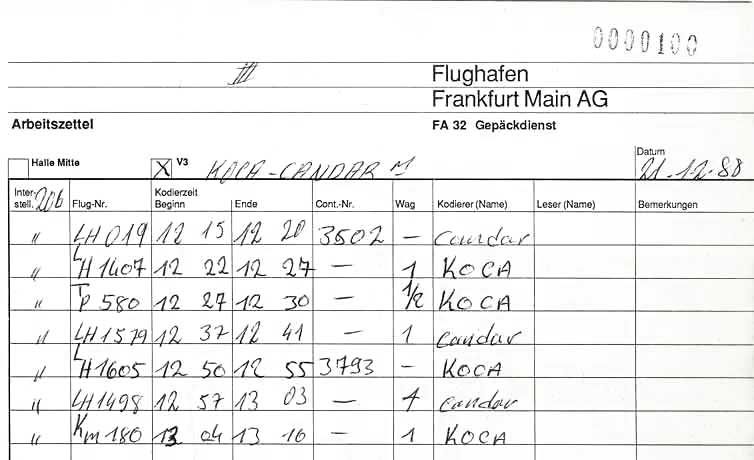
On 17 August 1989, eight months after the disaster, Chief Detective Superintendent John Orr received from the BKA what was said to be a computer print-out of the baggage-loading list for Pan Am Flight 103A from Frankfurt to London on the afternoon of 21 December 1988. Attached to this were two internal reports, dated 2 February 1989, describing the inquiries that BKA officers had made about the baggage-handling system at the airport. Also provided were two worksheets, one typewritten, the other handwritten, that were said to have been prepared on 21 December by airport workers at key points on the conveyor-belt network.

In the margin of the computer print-out, a penciled cross drew particular attention to bag number B8849 - that is the 8849th bag to be logged into the computerized system at Terminal B that day. By reference to the worksheets, B8849 could be shown to have arrived in Frankfurt by a scheduled Air Malta flight from Luqa airport and to have been 'interlined' through to Flight 103. But neither the Air Malta nor the Pan Am passenger lists showed anybody who had booked a through flight from Luqa to New York that day. In other words, bag B8849 had arrived from Malta unaccompanied but tagged for New York and had been loaded aboard Flight 103 without being matched with a passenger. And as the job of matching bags with passengers is the responsibility of the airline, not of the airport authorities or of the host government, Pan Am had plainly been guilty of lax security amounting to 'wilful misconduct'.

This tied in nicely with the forensic evidence, which had already shown that the bomb had been hidden in a Samsonite suitcase filled with an assortment of clothing made in Malta, including a baby's blue romper suit. [...] Two weeks after the BKA released the Frankfurt baggage print-out, two of Detective Chief Superintendent John Orr's men returned to Malta and, with the help of the manufacturers, traced the clothing to a shop in Sliema.

And from Silema to the Gaucis' shop and from there to history. Fishing for data points, 17 August is the date of the police report about the Malta-pointing printout. Attached were "two internal reports, dated 2 February 1989, describing the inquiries that BKA officers had made about the baggage-handling system at the airport." These I'd love to read. The date seems to be after they had the printout handed over. Any records of any earlier efforts, fruitful or not, remain under wraps. This new development sparked investigations of the airport by FBI and Scots through September and October, pretty much just as their German counterparts did months earlier, and as neither apparently bothered to do before being rung up with the news.

On the two worksheets from December 21, the handwritten one would have to be the station 206 log, with KM180's coding signed for by Mr. Koca. The "typrewritten" one is new to me, and would be interesting to learn more about. It wouldn't be included unless it had some relevance to item 8849, and probably not typed unless it was part of the computer system. And on the numbering, it seems this was not a sequentially-generated number system, but permanent ID for physical trays scattered at random. It was simply tray no. 8849 that this bag was (allegedly) put in. But I'm really no expert.

Coleman followed closely both the Lockerbie investigation and the liability cases against Pan Am that led to its downfall, almost concurrent with the Libyan indictment in late-1991. Along the way, he got a good look at what records the airline did and didn't keep at Frankfurt, as well as raising questions about the umber of of insidious unaccompanied bags thereon:
More particularly, there were problems with the computer records and worksheets from Frankfurt. For one thing, they did not tally with Pan Am's own baggage records, which although questionable as to their accuracy, were at least compiled in good faith. To this day no one knows exactly how many pieces of luggage there were aboard the doomed flight or consequently whether they have all been recovered or accounted for. Nobody even knows exactly how many suitcases were in the luggage pallet that contained the one with the bomb -- it was 45 or 46 -- or how many of these were brought in by the feeder flight from Frankfurt. (The number was also thought to include not one but four unaccompanied bags.)

The BKA estimate that 'about' 135 bags were sent through to the baggage room below the departure gate of Flight 103A, …. There were no records of luggage sent directly to the departure gate, nor of interline luggage taken directly from one aircraft to another, nor of bags belonging to first-class passengers.

Of the 135 bags mentioned by the BKA, 111 had been logged on the Frankfurt computer and about 24 taken directly to the aircraft from three other connecting Pan Am flights. The list compiled by Pan Am at its check-in desks, however, showed not 111 but 117 items of luggage, and the discrepancy has not been convincingly cleared up to this day.

The book evidences exactly my own incredulity over this alleged episode:
If the new Malta/Libyan theory was to replace the established Iran/PFLP-GC scenario, it was necessary, first of all, to believe that no one thought to ask for the baggage-loading lists for Flight 103A as soon as terrorist action was suspected -- which was almost at once.

It was necessary to believe that no one in any of the British, German and American police, intelligence and accident inquiry agencies who had a hand in investigating the disaster, or anyone who was in any way involved with airport management or security at Frankfurt or London, thought to secure the baggage lists as the one indispensable tool that would be needed to unravel the mystery of how the bomb got aboard.

It was necessary to believe that the only person who considered the lists to be at all important was a lowly computer operator at Frankfurt airport.

I can't accept these premises. Either investigators never came for the crucial evidence before its normal deletion, or it was deleted too early. THAT is why the printout wound up being the only and much-delayed record of the movements of the key bag. I suspect the printout lost NO corroboration in this early deletion. How early? According to this last snippet I'll share, the BKA had eight days to act under normal circumstances. Should have taken one or less.
The Observer's chief reporter, John Merritt, described how this came about in a story published almost two years after the disaster.
He wrote, on 17 November 1991:
A major breakthrough in the hunt for the Lockerbie bombers came to light only because of the quick thinking of a conscientious computer operator at Frankfurt airport.
The vital computer evidence, proving conclusively that the bag from Malta, identified as Item B8849, was on board as the airliner was blasted apart on the last stage of its journey from Heathrow to New York would have been lost forever if the woman operator had not kept her own record.
Acting on her own initiative, the woman, an employee of the Frankfurt Airport Company, who for legal reasons cannot be named, was working at the computer system known as KIK on the day of the disaster. She knew records relating to baggage loaded on to flights were kept in the system for only a limited time [eight days] before being wiped. So when she returned to work the next day she made her own print-out of the information and placed it in her locker before going on holiday.
On her return, weeks later, she was surprised to learn that no one had shown any interest in the computer records. She passed the print-out to her baggage section leader who gave it to investigators from the West German Bundeskriminalamt. But it was not until mid-August, eight months after the bombing, that the German authorities turned over this information to Scottish police in charge of the investigation.
The woman employee's role became known only last week when lawyers for families of the American victims took evidence from her in Germany. She had kept her own copy of the print-out and still had it in her locker.

Most of the rest of the chapter is a lengthy analysis of Juval Aviv's Interfor report. Coleman seems perhaps too accepting of this every-little-detail expose on how the bomb went on there, and I just haven't the patience to sort that wheat from that chaff. This is more than enough fiber and food for now.

Wednesday, October 14, 2009

FRANKFURT AIRPORT RECORDS

PAPERWORK: HARD, SOFT, AND NONE
[Pan Am 103 Series]
Adam Larson / Caustic Logic
October 14 2009
last update 10/15


"The records from Frankfurt were by no means complete."
- Denis Phipps, former head of security, British Airways, in The Maltese Doublecross

The Frankfurt Connection: A Grand Narrative
As connective tissue in the fraudulent case against al Megrahi and Libya as the perpetrators of the Lockerbie bombing, nothing carries more weight than the faint line from one plane to another traced by an odd little computer printout from Frankfurt, West Germany. I’ve already noted the most poignant aspect of this evidence for me; that it was received in such an abnormal way AND not in any of the standard, proper ways. This suspect but key evidence is said to show a piece of unaccompanied interline luggage, thought to be the one with the bomb in it, moving through Frankfurt Airport’s system on that fateful December 21, 1988, onto PanAm103A. This was a feeder flight into the real Flight 103, a separate plane waiting at Heathrow Airport in London, ready to shoot for New York.

In actuality it takes a few documents aside from this main printout to put the whole link together, as explained below. But the picture that emerges is quite precise; to summarize the Opinion [PDF link] of the special Scottish Court at Camp Zeist, delivered in 2001 after examining the available records and testimony:

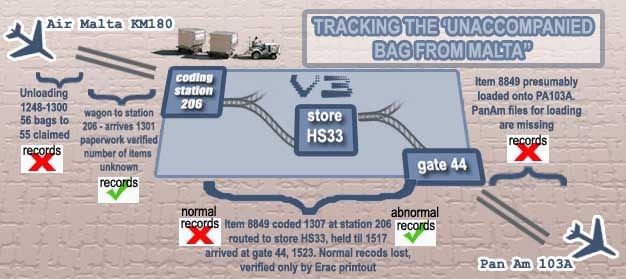
Air Malta flight KM180 arrived from Luqa Airport, Malta, and reached its parking position at 12:48GMT. The plane was unloaded between then and 13:00, and one wagon of baggage from it arrived, at 13:01, at one of two main luggage facilities, designated “V3.” This baggage and nothing else was then coded at station 206 within V3 starting in three minutes at 1304 and running probably six minutes until 1310. One particular item was coded at 13:07 into container no. 8849. It was then routed down to one of several luggage stores, HS33, for two hours until moved at 15:17 to gate B044 and later, presumably, loaded onboard 103A before its 16:53 departure. No passenger transferred from the air Malta flight to the PanAm one, so the bag thus illustrated was of the dreaded “unaccompanied” variety.

The System (I Think)
From what I gather of the whole airport system, it could be broken down to two parts; the topside is a zone of tarmac and wheels, counters, hands, wagons, and airplane cargo holds. Hard paperwork is kept for topside transactions, and activities are overseen by actual people held responsible. The Court explained “baggage for most airlines was handled by the airport authority, but PanAm had their own security and baggage handling staff.” This is key to record-keeping; the airport and the airline each would then have responsibility for keeping track of their own efforts, and both should be called on in the investigation.

From the planes, luggage is carted to a coding station, where items are placed on bar-code numbered trays (containers), one item per tray, and the computers take over. The bottomside then is what the Court described as “a computer controlled automated baggage handling system” that I gather ran beneath the airport. This vast electro-mechanic system automatically routed coded items along roller conveyors and through switching stations, at key spots scanned and logged. This system connected coding stations to the various stores, and apparently up to gates, after which they re-emerged topside and then to the connecting aircraft’s hold. Not bad for 1988.

On the paperwork kept to track this complex arrangement, the court explained “the computer itself retained a record of the items sent through the system so that it was possible, for a limited period, to identify all the items of baggage sent through the system to a particular flight. After some time, however, that information would be lost from the system.” [emph mine] One would presume law enforcement and investigative agencies would be aware of that fact.

Records on the KM180 End
Production 1068: The court’s point [29] denotes this for “the evidence of Joachim Koscha, who was one of the managers of the baggage system at Frankfurt in 1988” It was his evidence that established KM180’s arrival and unloading time, 12:48-13:00. They do also cite a “record,” but provided no direct citation. It almost seems they’re just citing his memory, when normally paper records were kept.

Denis Phipps, former head of security, British Airways, who has closely inspected the primary records of different airlines and airports connected to the disaster. He said in The Maltese Doublecross [video, 1994] “the records from Frankfurt were by no means complete." Among his concerns:
“There was no record of who unloaded that flight KM180 when it arrived at Frankfurt. We don't know who the loaders were. There was no record of the number of bags that were actually unloaded from that flight. There were no records that I could find.”
He was trying to bolster Air Malta’s reasonable claims that all 55 bags on that flight were accompanied and claimed by its 39 passengers, and none could have gone on to 103. Thus the official story here is that there was one more bag than Air Malta admits to. That Phipps found no records to support that, and the court failed to specify any, are bad omens for that damning charge.

production 1092: This is an “interline writer’s sheet” filled out by Andreas Schreiner was in charge of monitoring the arrival of baggage at V3 That bears to record one wagon of baggage from KM180 arriving at V3 at 13:01.Within V3 are seven coding stations, where luggage is placed into bar-code numbered trays to enter bottomside. They cite the sheet’s contents in table form and it seems like they had these records at hand.

Mr Schreiner’s evidence expanded beyond this, to explanations for the the Lords of how coding “would generally begin three to five minutes after the arrival of the baggage at V3,” and that “luggage was always delivered from one flight only” at any given time. The basis for these points must be taken on the man’s word, but they help simplify the Prosecution’s case. Station 206 at 13:04-13:10 means KM180 baggage and nothing else. Simple common sense would dictate a breach of this standard MO is at least possible. A stronger retort was published in Time magazine in 1992, relating a FBI memo following a look at the airport’s records and methods:
On a guided tour of the baggage area in September 1989, it was disclosed, detective inspector Watson McAteer of the Scottish police and FBI special agent Lawrence G. Whitaker "observed an individual approach Coding Station 206 with a single piece of luggage, place the luggage in a luggage container, encode a destination into the computer and leave without making any notation on a duty sheet." This convinced the two investigators that a rogue suitcase could have been "sent to Pan Am 103 either before or after the unloading of Air Malta 180."
This bag would thus appear to investigators to have been part of whatever planeload they were coding there at the time. The same could be at work with our item 8849. The conclusion of this report, sent back to Washington: “"There remains the possibility that no luggage was transferred from Air Malta 180 to Pan Am 103."

Production 1061: This was identified by witnesses Mr Schreiner and Mr Koscha “as a work sheet completed by a coder to record baggage with which he dealt.” The name of the coder in question was Koca, who was not called as a witness.” Pity, since the document shows us little detail. The court again showed this data in tabular form. Here thanks to Mebo I have an image of the evidence in question [see below]. The signatures alternate Koca and Candar, listing either container numbers or numbers of wagons of luggage, the flight number it’s from, time they started coding, and stop time. The relevant line is the last one – one wagon of luggage from KM180 started coding at 13:04, and ended at a time disputed as 13:10 or 13:16.

The difference between the a 1310 reading and a 1316 one does not affect the link with the central printout showing 8849 coded at 1307. But as eminent investigator Paul Foot notes “If the end-time was 13.16 this left a gaping hole in time when other bags may have been encoded through the same station that did not come from Malta at all.” With the worksheet here we can compare some previous codings “Beginn” to “Ende” for the previous six flights: 5 min, 5 min, 3 min, 9 min, 5 min, and 6 min, to process one wagon or one container of baggage. (the apparent “4” is probably a “1” written over a dash). And finally, either six or twelve minutes for one wagon from KM180. Unless there was something weird that screwed up the pattern (which is entirely possible), I’m calling the end time 13:10 and moving on. The hole was as big as it was, other things could well get through, but the most likely item at 206 in that time is still a bag from Malta.

Records on the PA103A End: A Blanked-Out System
Production 1062: This is the court’s code for some unspecified “documentary evidence” that “the aircraft used for PA103A arrived from Vienna (as flight PA124) and was placed at position 44, from which it left for London at 1653.” I’ll accept that as valid, but note the ambiguity of citation.

Production 1060:
This is the famous printout of the late-sought tracking data on bags destined for the PanAm flight, on a whim saved from oblivion by the diligent Mrs. Erac. [see left – r-click, new window for readable size] Obviously this covers the broad computer-managed middle stage rather than “the 103A end.” But as it is, this is the only known link showing that item 8849 continued towards the fatal feeder flight. It’s the single document that allows “the inference," drawn by the Scottish Judges, "that an item which came in on KM180 was transferred to and left on PA103A.”

It’s not that there should be more; the one record is to be expected. The unexpected is no one official got to it before it was deleted, and we had to rely on a memento copy from someone’s locker. We’re told. And the investigation was lucky to get that after a curious delay of 7-8 months.

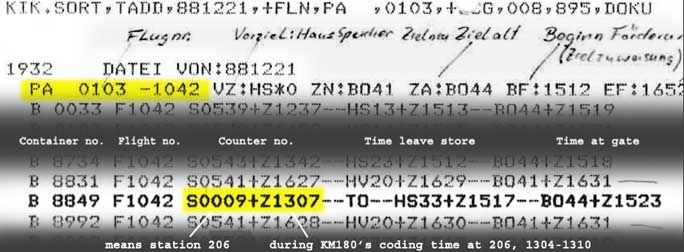
What it shows, briefly, is 111 items listed numerically by container no. The relevant portions are highlighted in the condensed version below. PA103A is referred to herein as F1042. The relevant item 8849 was coded at station S0009, which it’s been determined means station 206, at 1307. That is a fit with KM180’s load. It then goes to Gate B044 at 1523, the same few-minute span most of it arrived. What happened from there is outside the computerized system and not recorded here.


Production Null: This is the designation – none – given to PanAm’s loading records for flight 103A. Holding to previous patterns, we’re back to tarmac and wheels space, and there should be records kept at gates 44 and 41 regarding the luggage items received and loaded onto the planes at each gate. There should be a verification that item 8849 was among them, and that it was then loaded to the plane.

Obviously the Airport authority couldn’t offer this to the court, as it wasn’t their job to load a PanAm plane or to log what they don’t do. There’s no mention in the Court’s opinion of what PanAm provided to the case; they went bankrupt in late 1991, so it’s natural they didn’t send anyone to the 2000 trial. But judging by Marquise, they also added nothing to the 1989-91 investigation, at least regarding the crucial Frankfurt link. The court adds nothing to that, only citing "evidence [...] that no baggage was left at the gate" in reasoning that " it can be inferred that all items sent there were loaded." Again, a non-admission admission that they don't really have the evidence they should.

Positive confirmation of this lack of records can be found in The Maltese Double-Cross (same section linked above). According to Michael Jones, Pan Am’s security chief with the London office [emph mine]:
I went to Frankfurt airport on 23rd of January 1989, to look for documents in relation to the preparation of Flight 103 from Frankfurt to London, and particularly the cargo and baggage loading plan, who was responsible for loading the plane and what their duties were, but these documents were missing from the daily file. … If the original documents had been taken by the authorities, and by that I mean the police, then it would be normal practice for a copy to be retained in the Pan Am file.

We have a date – one month after the disaster, and the crucial files for this plane are reportedly gone by this time. No one I know of has reported seeing them since. The computer tracking system was also gone to nearly all eyes as of January and on through August before it resurfaced to lead the case in a new direction. It would appear that investigators before that clue had no data on what went onto that plane that fed into the other plane. This in itself is a little-known but major scandal, quite likely its own crime scene that could not be traced back to foreign terrorists. Therefore, it’s to remain little-known.

Graphic Representation


Sources:
- Lords Sutherland, Coulsfield, MacLean, Case No: 1475/99. OPINION OF THE COURT delivered by Lord Sutherland in causa HER MAJESTY’S ADVOCATE v ABDELBASET ALI MOHMED AL MEGRAHI and AL AMIN KHALIFA FHIMAH. Delivered January 31 2001. PDF or txt file available at: http://www.scotcourts.gov.uk/library/lockerbie/index.asp
- The Maltese Double Cross - Lockerbie. Film, Hemar Enterprises, 1994, 156 minutes. Written, produced, and directed by Allan Francovich. Wikipedia page
- Rowan, Roy. Pan Am 103: Why did they Die? Time. April 27 1992http://www.time.com/time/magazine/article/0,9171,975399-1,00.html

Thursday, October 8, 2009

A DILIGENT PROGRAMMER

ERAC AND HER PRINTOUT: DIFFERENT STORIES
[Pan Am 103 Series]
Adam Larson / Caustic Logic
October 8 2009
last update 10/9


LUGGAGE LINK
Collectively, the evidence used to convict Abdelbaset Al Megrahi for the bombing of Pan Am 103 indicates a Libyan-made bomb, placed by the "Libyan intelligence operative" into a specially packed brown Samsonite suitcase at Luqa airport onto Air Malta flight KM180, tagged to be transferred unaccompanied onto Pan Am 103 to blow up right around the Scottish coastline. The results could only be approximately controlled, given potential delays between thee planes and three airports.

To date the only positive evidence such a bag was even on the first of the three alleged planes is the tenuous conclusion that it later left that plane onto the second and third. The case linking back to Libya via Malta (Libya’s “backdoor to the West”) is entirely based on circumstantial clues, starting with the clothing of Maltese make, apparently packed around the bomb, followed by the timer fragment found to boldly point to Libya. Eventually some testimony was bought/mangled from witnesses like Gauci and Giaka to support the middle link of a loose bag from Malta traceable to Libyan *super-spook* al Megrahi. But this wasn’t pursued until after they had secured some kind of evidence for the bag itself.

In between Malta and the fields of southern Scotland, there might have been, and probably should have been, nothing but speculation to flesh out the official story. As it turns out, or so we’re told, Frankfurt Airport, which had supplied a feeder flight to 103, routinely destroyed its computerized luggage tracking records after a short period of just one week. Unless this means an office-fridge-style cleanout (say, every Friday at 5:00) we can presume a logical 7-day storage – enough time to retrieve anything in a special situation like this. But no one retrieved it in time, even for Pan Am 103, which had been loaded with passengers and luggage partially at that airport and was all over the news well within 24 hours for having blow the heck up.

Not that it mattered; apparently, no attempt was even made to look at such records in the first months after the incident. But by luck and fate an anomalous copy did surface, fairly early in the (looong) investigation, and made its own way to the German police and thence onto the FBI SCOTBOM investigation. It showed just the bag that the other points could later lean against to strengthen the case that emerged. “That was a key part of the investigation, which allowed us to link a bag from Malta to Frankfurt, through London and then obviously on to Lockerbie,” FBI SCOTBOM chief Richard Marquise has said [CF 6:50]. And it’s a half-decent clue, just far from conclusive and perhaps not even honest.

VERSION ONE: GATHERING EVIDENCE
This was provided, primarily, by Bogomira Erac, a computer programmer and baggage handler there on the fateful day. Her paperwork and testimony were pivotal to the prosecution case when brought before the Scottish Court at camp Zeist. Scottish revisionist Ian ferguson claims she “testified at the original trial under the pseudonym Madame X.” [IF] I can find no support for that, and the final verdict (opinion of the Court, issued Jan. 2001) referred to her by name.

Having “realised that PA103A had departed during her period on duty,” the Court summarized therein, Erac “was interested in the amount of baggage on the Frankfurt flight, and on the following morning she decided to take a printout of the information as to baggage held on the computer.” She was looking for "any useful information," but "did not at once identify any.” [OC, point [30]] She could not likely know what this data did or didn’t say without other data sources, and she did not hand it over to those who could put it in context, so its vital clues lingered unrealized.

Investigative journalist Paul Foot, one of the few people to sit through the whole Lockerbie trial, came away with about the same impression as the court, in that Erac had printed this out herself for informational purposes. Referring to the record, he wrote in his seminal 2001 report Lockerbie: The Flight from Justice:
“This was printed out on the day after the Lockerbie bombing by Bogomir Erac, who was in charge of the software for the baggage system at Frankfurt. She recovered the print-out in case it revealed anything interesting about the luggage loaded on to flight 103A to Heathrow, which linked to the separate and doomed flight 103.” [PF 18]
FBI SCOTBOM chief investigator Ricahrd Marquise, in his 2006 book, took a different view of Bogomira’s interest in the facts; “more for curiosity than anything else, she kept it in her desk for about three weeks. She was later asked by her supervisor to look for baggage records in the computer, but they were purged every week.” [RM 210] But apparently this request came after these three weeks, showing up this unnamed supervisor as both a sluggish thinker and epically ignorant of their own storage policies to bother pursuing this avenue so late. Luckily there was still the paper copy, again no thanks to procedure.

VERSION TWO: OUT OF MEMORY
Mrs. Erac told the BBC in a 2008 video interview (see left) that not only was the data deleted, their paper backups were tossed in short order as well. “We usually destroyed all the printouts. And I was just about ready to do that with this one,” the “diligent” Mrs. Erac told the camera sent for The Conspiracy Files. [CF 5:42] Had she simply forgotten that she had specifically printed this one for factual reference? But of course she didn’t clear out this deadwood; “on the spur of the moment, I just picked it up and put it on the table,” perhaps remembering why it existed. She then decided to hold onto it for sentimental reasons “in memory of the people who were on the plane." With moist eyes scanning towards Gott in Himmel she recalls this, “and then I threw it in my locker.”

In this version, it wasn’t until much later that she changed gears on the issue; “the weeks went by and to Bogomira’s surprise, no one came to ask for the printout,” the video’s narration runs. “Realizing it could be useful, she eventually went to her supervisor.” Having reversed the initiative for the meeting from that reported above, Erac next has the supervisor protesting “but the baggage list doesn’t exist anymore!” When she handed it over, “he was very, very surprised.”

THE FIRST OF FOUR KEYS
So sometime in January 1989 these two were aware of this list’s existence but presumably not its implications. The unnamed supervisor then turned it over to the BKA German Federal Police who in turn sat on it awhile before handing it over to the Lockerbie investigation sometime in August 1989, at least seven months after they’d started work. [CF 4:45]

It was a breakthrough in the case, as FBI chief Marquise wrote in his 2006 book SCOTBOM, “her printout was the only record. This was as much a key to the solution of the case as Tony Gauci or the Mebo chip.” [RM 210] He neglected to mention a fourth key, the damning testimony of witness Giaka. In fact, the evidence from Frankfurt is crucial in that without it they had no evidence (aside from Giaka) for the bomb being anywhere but Heathrow to Lockerbie. And like these other key points (aside from Giaka), which all came after the printout, there are question marks over this evidence.

1) No backup records: Deleting all copies of the data in question sounds like a dubious policy. That this one list is just good luck is itself a bad sign. That the policy was not abridged in the case of this flight, with a copy saved for investigators, is just bizarre or untrue.
2) Corollary lack of interest in looking for such records: officially the bomb in the biggest terrorism investigation in ever got on PA103 via Frankfurt, Even with a week and all the world's investigating agencies to think about it, no one checked the relevant records to see if that might be the case? The official story here, that no one checked and were dismayed by the lack of records is itself dismaying. I’m not at all sure this is really the case.
3) Conflicting stories: Did the supervisor ask Erac to look up info, or did he presume it was gone until she approached him? Did she print this out herself, or save a regular print-up? Did she save it as a memento, for personal research, or for the investigation? Time is obviously a factor, but is it the main one in these shifting details?
4) Long delays: They add up – three weeks, a few moths, and collectively, the time from unknown to openly known stretches into something like a year. Coincidentally, this could provide time to track down the info desired, to run through possible cases and scenarios and implications, and for what was desired to settle into place. If the FBI worked that way. Politically.

The printout timeline thus bears a strangely parallel course to that of the MST-13 timer chip; first found in January 89, realized as evidence in May, and puzzled over for a full year, documented with well-spaced memos, before identified as “Libyan.”

Questions about its provenance aside, the paperwork is not as clear as made out and far less decisive. Showing only a bag originating at a certain place (station 206 of “V3”) at a certain time (13:07GMT) before being put on the feeder to London. Other records would have to be called on, linking KM108 and its bags to this station 206 in order to form the full Air Malta-Pan Am link that emerged. Apparently these more obscure records, not directly touching PA103A, were not routinely destroyed, and were made available to the prosecution with no luck cited. What all these airport records say and what they can’t say will be the subject of another post.
---
Sources:
[CF] The Conspiracy Files: Lockerbie. BBC Two. Aired 31 August 2008. Prod/Dir Guy Smith, Ex Prod Sam Anstiss, Narr Caroline Catz. Youtube posting, part 3, time stamps indicated above.
http://www.youtube.com/watch?v=J55ryLvGEE4&feature=related
[IF] Ferguson, Ian. "The judges got it wrong" From the Sunday Times, Malta. May 10 2009. Reposted at Robet Black's blog: http://lockerbiecase.blogspot.com/2009/05/from-sunday-times-malta.html
[OC] Lords Sutherland, Coulsfield, MacLean, Case No: 1475/99. OPINION OF THE COURT delivered by LORD SUTHERLAND
in causa HER MAJESTY’S ADVOCATE v ABDELBASET ALI MOHMED AL MEGRAHI and AL AMIN KHALIFA FHIMAH. Delivered January 31 2001. PDF file available at: http://www.scotcourts.gov.uk/library/lockerbie/index.asp
[PF] Foot, Paul. Lockerbie: The Flight From Justice. PDF, 32 pages, published 2001, Private Eye. 6 Carlisle Street, London, W1D 3BN. Available for purchase (5£) https://secure2.subscribeonline.co.uk/PEYE/digital_downloads.cfm
[RM] Marquise, Richard. SCOTBOM, 2006.

Tuesday, February 17, 2009

FORMER NAVAL PERSONS

CHURCHILL, ROOSEVELT, AND VOYAGES TO WAR
Adam Larson / Caustic Logic
The 12/7-9/11 Treadmill and Beyond
February 16 2009


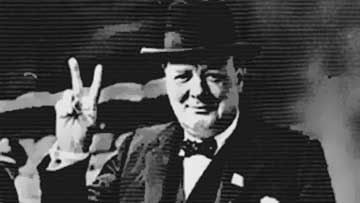
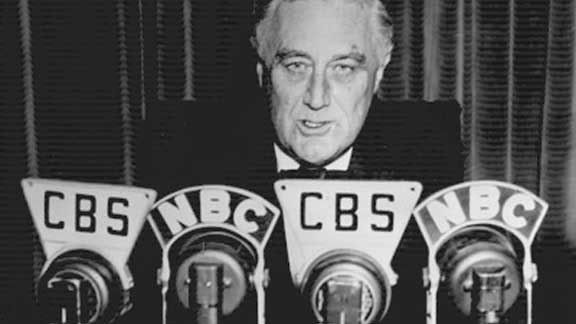
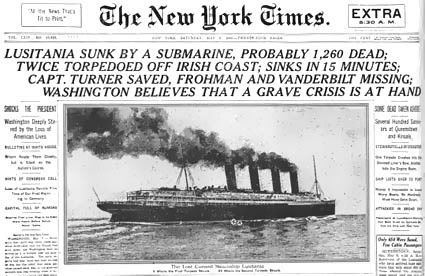
When the RMS Lusitania went down on May 7 1915 en route from New York to London, hit by a German U-boat and dragging down 1200 mostly English-speaking souls, two Naval personalities of great future importance watched from either side of the Atlantic. On one side of the pond, Winston Churchill had just set off from being the First Lord of the Admiralty and directly into the intensifying fray in a variety of war-related posts, on and off the battlefield. Across the way, A young Franklin D. Roosevelt was Assistant Secretary of the Navy, who among others urged US entry into the war following the attack.

There is some circumstantial evidence that Churchill, in his influential admiralty post, played a large role in steering the Germans towards downing the “livebait” Lusitania. British researcher Colin Simpson indicated this in a 1972 book; others were involved as well, on both sides of the Atlantic, and with the tacit approval of President Woodrow Wilson, worked to ensure what Churchill might have called a “maneuver which brings an ally into the field.” Roosevelt remained with, and helped guide, the Navy as the US prepared to enter the field and throughout the remainder of the war, re-learning again an old Roosevelt family secret – there’s nothing like a sunken boat to get a nation marching to war.

In 1939 the Britain-Germany feud again broke out in a big way and a war leader was needed in London to replace the ousted PM Chamberlain. Roosevelt was by then President of a decidedly neutral-minded and depression-racked US, prophetically urging his reluctant countrymen to rally against the new German threat. As World War II finally turned over from menace to inescapable reality in Europe, he reached out and offered his endorsement to Churchill as new Prime Minister. The sentiment was shared by Britain as a whole, and Churchill stepped in to bolster and brace the shaken British people. Now the two sat across the ocean as leaders not of Navies, but of nations bound together (at the head, if not yet the body) in opposition to Hitler’s Germany. It was at this time the two publicly formed what the FDR Library’s website describes as:

“one of the most extraordinary relationships in political history, a relationship marked by an intimate correspondence unparalleled among national leaders, a relationship which, in due course, would lead to the establishment of a military alliance unique among sovereign states.”

In particular, they bonded over their common Navy pedigree, and Churchill became known to Roosevelt by the nickname ‘Former Naval Person’ as they considered how to get the decidedly neutral ally maneuvered into the field against the Germans yet again. There were known methods to call on, but both the stakes and the resistance were higher than ever. A single ship would not likely suffice.

In late January 1940, three months before Churchill was finally elected, FDR sent his secretary Edwin Watson to fetch some documents from President Woodrow Wilson’s files. For whatever reason, Watson sent back specifically, and it seems exclusively, “the original manifest of the SS Lusitania” along with a note saying “I was afraid to [open it] until you had seen it.” This may mean nothing, but Colin Simpson found this original manifest years later not in its original place, but among FDR’s personal papers. [Simpson, Colin. The Lusitania. Little, Brown and Company, Boston. First US edition. Hardcover. 1973. pp 5, 267]

Wednesday, May 7, 2008

THE LUSITANIA {masterlist}

The sinking by German submarine of the HMS Lusitania in early 1915 was the formative event in drawing the United states into World War I. Like other such events, the deadly U-boat attack off the Old Head of Kinsale has been haunted from the beginning by allegations of conspiracy. And like so many others, sadly, the suspicions are well-founded and probably true.

This post is to organize all the sub-posts on the subject. No posts are up yet but are in the works. Most of my information is from Colin simpson's 1972 book "The Lusitania: Finally, the Startling Truth about One of the Most Fateful of All Disasters of the Sea." {Boston, Little and Brown, First American Edition, 1973}

HMS Lusitania Facts:
Premier ocean liner of its times, the "Greyhound of the Sea." Operated by the British Cunard shipping line, named for a province of Spain under the Roman Empire, it was first launched on June 7 1906. Nearly 800 feet long, capable of carrying 2200 passengers, a crew of 850, and hundreds of tons of supplies at a top speed of 26.7 knots. Early in World War I the ship was lent out to the British war effort against Germany; she made a regular circuit to New York and back, carrying supplies from the US under its "arsenal of Democracy" policy. This violated a German blockade, and repeated warnings from the German end were buried as the ship entered on its final voyage in May 1915 and sailed right into a German trap, the path to which had been cleared and paved by the British Navy, in hopes of drawing America into the war. On May 7 the Lusitania was sunk by German U-Boat at a cost of 1,200 lives, many American, many wealthy and prominent. There was further delay before the US entered the Great War - internal disputes and the 1916 election had to pass first, but it was the Lusitania barbarity that was always the political and emotional underpinning of America's campaign in Europe.

Wikipedia article: http://en.wikipedia.org/wiki/RMS_Lusitania

Wednesday, February 27, 2008

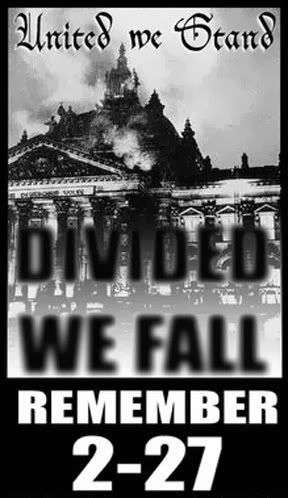
REMEMBER 2/27: THE REICHSTAG FIRE {masterlist}

This post will organize and link to the several posts needed to convey the subtance, contzt, and effects of the Reichstag Fire in Berlin, Germany, February 27 1933. Initially blamed on Communist radicals hoping to conquer Germany from within, the burning of the government's meeting place was later found to have been engineered by the Nazis themselves. The fire shocked the nation and served as an enabling act for Chancellor Adolph Hitler to tighten his and his cronies' grip on power and begin the march towards the Third Reich, the Holocaust, and World War II.

- Desperate Times/The Gathering Storm: 1933 Germany: aftermath of World War I, the great depression, increasing resentment and nationalism, and the Rise of Hitler.

- The Revolution Bursts Into Flames: To quote rapper Paris, "See the Reichstag Burn, see the public buy it."

- Shadow 2/27, Skeptics, and the verdict of History

- Gleichschaltung - Consolidating Power

And the rest is history...

Saturday, December 16, 2006

2-27 II: THE REVOLUTION BURSTS INTO FLAMES

The Communists certainly would have liked to take over Germany, and some held high positions of power already there – among the country’s rank-and-file, party membership was growing as it did everywhere during the Depression, Capitalism’s darkest hour. While the actual nature of the threat posed is still unclear, it was not nearly as immediate as the Nazis wanted people to believe it was. Goebels wanted to crack down on the Communists and remove the Nazis’ main domestic power rival. As he noted in his diary, “we lay down the line for the fight against the Red Terror.” But the time was not yet ripe; “The Bolshevik attempt at Revolution must first burst into flames.” [1]

Then, just 28 days after Hitler was appointed chancellor, on the night of February 27, the Reichstag, the home of the parliamentary government, was gutted by a massive fire, and Germany would never be the same again. The Reichstag building was empty, in recess since December and awaiting reopening for the election. Hitler was dining with Goebbels when Goebbels (soon to be Propaganda minister) got a call – the Reichstag was on fire. Thinking it an exaggeration, he ignored it at first, but then followed up and found out it was for real. President Hindenburg was dining with Vice-Chancellor Franz Von Papen, just around the corner from the Reichstag at the exclusive Herrenklub and could actually see the glow from the fire. All raced to the scene. Goering was already there, shouting “this is a Communist crime against the new government! This is the beginning of the Communist Revolution! We must not wait a minute. We will show no mercy. Every Communist official must be shot, where he is found.” [2]
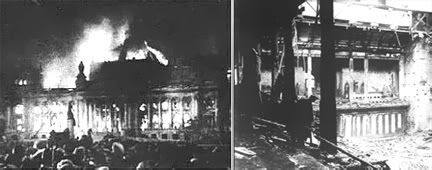
The Reichstag burning and the aftermath inside

At 9:15 PM smoke was seen pouring from the building, and ten minutes later, as the first firemen arrived on the scene, the fire was raging out of control. At 9:30 there was a “tremendous explosion” and the huge central chamber was filled with flames. The fire quickly raced out of control, and left standing only a gutted shell of the building. [3] The attack killed no one, but certainly provided a shocking symbol of destruction and national vulnerability that changed the tone of election week dramatically.

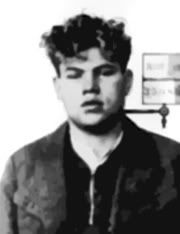
Marinus Van Der Lubbe. Picture and info from Wikipedia.
The act of arson was blamed at the time on a young Dutch Communist named Marinus van der Lubbe, arrested dazed and shirtless at the scene minutes after the police arrived. (he apparently used his shirt to start the fire) Wikipedia explains that the 23-year old Van Der Lubbe had “a history of taking responsibility for things he had not done” to spare others. He admitted to starting the massive fire by himself, with only his shirt and some gasoline. That one man was able to ignite such a powerful and explosive fire in the headquarters of the national government, under Goering’s nose but without inside help, seems unlikely. Nonetheless, the mentally ill Van Der Lubbe stubbornly insisted he and he alone was responsible. Ultimately the court proved subservient to the Nazis and the man was convicted, beheaded and buried in an unmarked grave.

But while they bought his admission, Nazi officials refused to believe Van Der Lubbe acted alone. This Goering and the others stressed; after all, this was the “beginning of the Communist Revolution,” so clearly he had to have supporters. A local branch of the Comintern (Communist International) was implicated as the conspiracy probe widened, though the Leipzig Supreme Court was able to establish no connection between the Comintern delegates and the actual crime. [4] But such minutiae escaped much of the German public, for whom the nature of the threat was obvious. The solution – the Nazi way – also became obvious to more people than ever as the March 5 election drew near. Either way, Hitler and his disciples decided, this time they would have their coveted majority. Either he would win, or they would go ahead with their coup.

With this contingency plan in mind, the Nazis played fast and loose with the political rhetoric. On March 3, just two days before the election Goering delivered a rousing campaign speech in which he promised the voters “my measures will not be crippled by any judicial thinking… I don’t have to worry about justice; my mission is only to destroy and exterminate, nothing more! …Certainly I shall use the power of the state and the police to the utmost, my dear Communists, so don’t draw any false conclusions; but the struggle to the death, in which my fist will grasp your necks, I shall lead with those down there – the Brownshirts.” [5] While this likely lost him some Communist votes, he probably had the Brownshirt vote locked up after that speech, and when the election came around, the National Socialist Party managed to take 52% of the seats.

Sources:
[1] Shirer, William. The Rise and Fall of the Third Reich: A History of Nazi Germany. New York. Crest Books. 7th Printing. July 1965. Page 267. [2] Page 268.
[3], [4] Swigart, Soren. “The Reichstag Fire.” The World at War. http://worldatwar.net/event/reichstagsbrand/
[5] Nazi Conspiracy and Aggression Volume IV. Document No. 1856-PS. http://www.yale.edu/lawweb/avalon/imt/document/nca_vol4/1856-ps.htm

Thursday, November 30, 2006

2-27 II: DESPERATE TIMES

GERMANY 1933: THE SYNCHRONIZATION BEGINS

January 1933 – Berlin. The Great Depression grips the world, Germany more tightly than most places. Having lost the bitter Word War and been forced to sign the Versailles peace treaty. Under the terms of the Versailles peace treaty that closed World War I, Germany had to disarm and dismantle its military machinery. The nation was forced to render substantial reparations payments to France, Russia, the U.K and the U.S., and the political process was controlled largely by the victorious nations in a sort of indirect joint occupation. The Depression, on top of a war-damaged economy and reparations, caused hyper-inflation had German workers literally taking wheelbarrows to the bank to cash their paychecks. People were starving and freezing to death in significant numbers. A sense of resentment and humiliation permeated post-war German society. This in turn threatened to spill over into revolution.

The USSR, recently disconnected from the recently-crippled capitalist economy, was largely unaffected by Great Depression. Under Stalin’s harsh rule, the Soviet Union in fact grew, something that did not go unnoticed in the long bread lines of the U.S., Great Britain, or Germany. Just before the United States instituted its own brand of moderate socialism (in the form of the New Deal) the lesson had already been learned and absorbed elsewhere. Many in the West turned to Socialism or Communism as the answer to the obvious shortfalls of Capitalism. The USSR did not fail to capitalize on this growing sentiment, and actively worked to foment revolution among the disaffected masses across Europe and in the U.S. In Europe, Capitalism lashed back – with Fascism, which had already made a distinct showing with the ascendancy of Mussolini in Italy.

In the frustrating environment of 1930’s Germany, nationalism and xenophobia surged, and Adolf Hitler rose on that surge, promising to re-claim the “honor” and martial glory of a humiliated nation. Inspired by Musolini’s example, Hitler and his allies manipulated the truth and pushed lies, using thug tactics whenever necessary and political maneuvers when possible, bringing forth their bold and uncompromising vision of a renewed German Empire. National Socialism drew members from the growing left wing with the language of Socialism, but steered their new recruits in a nationalistic direction. Proponents of Naziism, as it came to be shortened, promised to shake off the "foreign-controlled" Weimar regime and the oppressive terms of Versailles. Eventually, this would be broadened into a renewal of the old German-centered “Holy Roman Empire” – the Third Reich.

Hindenburg
Paul Von Hindenburg, Reichpresident 1925-1934.

Hitler ran for President of Germany on the Nazi platform, in a bitter contest with incumbent President Paul Von Hindenburg. Hitler gained points by accusing Hindenburg of bowing to foreign pressure and selling out the fatherland and in the end, neither candidate won a clear majority. In a March 11 run-off election, Hitler lost solidly to Hindenburg, and Prussian police in fact seized documents that showed the Nazis had placed SA troops all over Berlin, in preparation for an all-out coup in the event of a Hitler victory. (1)


hello down there
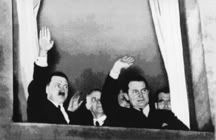
Chancellor Hitler and Herman Goerring "waving" to supporters, January 30, 1933.

The resourceful and well-connected Hitler, while briefly tarnished by the conspirator image, quickly remade himself. Over the next year he and his supporters grew their power base and wriggled higher into the levels of power. With deft political maneuvering, Hitler was appointed as Chancellor, reluctantly, by President Hindenburg on January 30, 1933. (2) He teamed up with fellow Nazi and president of the Reichstag (something like Senate Majority Leader) Hermann Goering. Playing coalition politics and outflaniking everyone, they went to work within days on the early phase of their “synchronization”, a euphemism for the transformation of the political system to incorporate an all-powerful central government under Nazi control. (3)

One party that suffered a major defeat at Versailles was the German armaments industry. Weapons makers like Krupp and I.G. Farben, put out of business by the ban on all weapons of war, were reassured that the Nazi way was their way. In a private meeting Goering’s Reichstag President’s Palace, February 20, these leading industrialists were assured that “National Socialism” did not mean Communism. Indeed, if given the chance, they would break the back of Communism and organized labor in Germany (and democracy to boot), and re-assert Germany’s age-old military values and Imperial ambitions. Hitler and Goerring collected an immediate $3 million Deutsche Marks in cash donations, with promises of more to come. Hitler said “now we stand before the last election.” (4) But before that last election, to be precise, before March 5th, two eventful weeks would unfold and utterly transform Germany’s power structure.

Sources:
[1]Shirer, William. The Rise and Fall of the Third Reich: A History of Nazi Germany. New York. Crest Books. 7th Printing. July 1965. Page 224.
[2] See[1]. Page 262.
[3] Wikipedia. Herman Goering. http://en.wikipedia.org/wiki/Goering
[4] See[1]. Page 265-266