Thursday, December 31, 2009

ON LIBYA'S ADMISSION OF "RESPONSIBILITY"

AND MORE BBC MANIPULATIONS
[Pan Am 103 Series]
Adam Larson / Caustic Logic
December 31 2009


I recently started an interesting discussion thread at the JREF forum, fishing for thoughts on why people believe the official line on the Lockerbie bombing so fervently. I hadn't yet encountered any serious questions in the course of previous brilliant and provocative discussions - just a few drive-by statements supporting Megrahi's and Col. Gaddafy's absolute guilt, but never accompanied by evidence of any real knowledge. Among the questions and counter-points I suggested people could offer, if they knew anything, was "Libya admitted responsibility and paid out billions of dollars!" And if they had asked, I would answer like this:

There is no doubt that the Libyan government did issue a statement admitting responsibility, and agreed to pay compensation, among other measures, in 2003. It was an explicit pre-condition, inssted by Washington, to having broad UN sanctions lifted. Triploi has always defended its innocence of Lockerbie, but to function in the global economy, they had to do something. Here they managed to not explicitly break the rule, and using careful (cynical?) wordplay, managed to accept responsibility without admitting guilt. Sanctions were lifted.

There’s been much oxymoronic harping on this in the West as both an admission of guilt and an arrogant refusal to admit their guilt. The BBC’s 2008 Conspiracy Files episode on Lockerbie is a brilliant example. “For those that believe al Megrahi was framed,” snarls the narrator, Carolyn Katz, “one fact remains hard to explain away. Libya agreed to award substantial compensation for Lockerbie. Sanctions were then lifted.” Well, ignoring that they just answered their own stumper of a question, it’s a good question, and they continue: “Tripoli accepted responsibility for what it called “the Lockerbie incident.” But does it admit guilt?” Of course not, and by pretending there’s some disconnect, they’ve primed the audience to see the darkest of cynicism at work. Oops, how did that happen?

Under Prolonged Duress
Following he indictment of Libyan agents al Megrahi and Fhimah in late 1991, a process itself twisted with political machinations and riddled with a million broken questions marks, the Security Council moved to enforce the official truth with sanctions. Resolution 748 of 31 March 1992 imposed an arms and air embargo, diplomatic restrictions, and establishment of a sanctions committee. The committee’s work led to Resolution 883 of 11 November 1993, toughening sanctions. This measure “approved the freezing of Libyan funds and financial resources in other countries,” reports globalpolicy.org, “and banned the provision to Libya of equipment for oil refining and transportation.”

By late August 1998 the framework of a trial was established, and used as the measure of Resolution 1192, agreeing to suspend sanctions once the suspects were handed over to the special Scottish court in the Nehterlands at Camp Zeist. Tripoli made it happen, with help from luminaries like Prince Sultan of Saudi Arabia and Nelson Mandela of Africa. Megrahi and Fhimah were flown on a special flight to the Netherlands in early April, and on the 5th were official arrested at Camp Zeist and set to await their trial. Sanctions were immediately suspended, under threat of re-enforcement (that never did materialize).

Many suspect this was never “supposed” to happen, as the evidence behind the indictment was too weak to stand up at Trial. The Crown's prosecutors managed to swing it somehow, but it took nearly two years from the handover, and a display of mental gymnastics worthy of the Realpolitik Olympics in the scale and skill of it. On January 31 2001, the three-judge panel made it official – Megrahi was legally guilty for the plot, and Fhimah was not guilty.

From there, many insisted sanctions should be lifted to reflect Libya’s good faith through this process. But Bush and Blair balked, demanding an admission of responsibility and compensation to victims’ families before they went past suspension. It was a letter, dated 15 August 2003, from Libya’s Permanent Representative to the President of the Council Ahmed A. Own, that paved the way. Own's letter explains “the Libyan Arab Jamahiriya,” as Libya calls itself, “has sought to cooperate in good faith throughout the past years” on solving the problems made theirs “resulting from the Lockerbie incident.” It was in this spirit that they “facilitated the bringing to justice of the two suspects charged with the bombing of Pan Am 103 and accepts responsibility for the actions of its officials.”

The letter also pledged Libya to cooperate with any further investigations, and to settle all compensation claims with haste, and to join the international “War on Terrorism.” It was widely (and reservedly) hailed as a bold… statement. But still evasive. It doesn’t clearly state anywhere the suspects or any Libyans were in any way actually guilty of the “incident.” Nonetheless, after a month of discussion in the Security Council, sanctions were lifted on Sept. 12 2003. France and the US insisted on abstaining, but it was otherwise a unanimous vote of 13. (source) The United States’ own sanctions would remain in full force due to the general evilness of col. Gaddafy, US officials made clear. (Additional normalizations did happen in 2007).

The Blood Libel Edits
Despite his portrayals as a crazed prophet of death, Moammar Gadaffi proved a shrewd and patient pragmatist in all this. He can't have ever believed his nation actually did the crime, but against "guilty" as a legal truth, he accepted they had no choice but to do “the time.” It’s a type of bind known to breed passive-aggressive tendencies. The Colonel’s son and likely successor Saif al Islam al Gaddafi seemed to understand it, when he was interviewed at home for the Conspiracy Files programme.
Q - Does Libya accept responsibility for the attack on Lockerbie?
A - Yes. We wrote a letter to the Security Council, saying that we are responsible for the acts of our employees, or people. But it doesn’t mean that we did it, in fact.
Q - So to be very clear on this, what you’re saying is that you accept responsibility, but you’re not admitting that you did it.
A - Of course.
(edit)
Q - That’s… to many people will sound like a very cynical way to conduct your relationship with the outside world.
A - What can you do? Without writing that letter, you will not be able to get out of the sanction.
Q - So this statement was just word play. It wasn’t an admission of guilt.
A - No. I admit that we play with the words. And we had to. We had to. There was no other… solution.

The BBC are masters, among others, of careful editing, and it helped bolster their whole “you don’t admit you’re guilty” thing where people have to explain there’s nothing to “admit” (or fail to explain that, as happened here). Thus he could, with a little imagination, appear to be saying “we don’t admit it, buuuuut of course we did it, you already know that.” Note the cut that removed some of his words from the middle of the exchange, unlikely to have been irrelevant. Thus is clearly established a cynical payout ($2.7 billion) and bit of semantics to buy up and slough off their non-admitted guilt so they could resume trade. They got away with Lockerbie using money and words and are laughing at us and making more money!

Immediately after “there was no other solution,” the video cuts right to the interviewer asking “so it was like blood money if you like,” which seems to be referring to what was just shown. But really it refers to the American victims' families, whose “money, money, money, money” attitude (well-known and spearheaded by Victims of PA103 Inc.) was “materialistic,” “greedy,” and amounted to “trading with the blood of their sons and daughters.” But with the magic of editing, it can seem to mean so much more!
---

Monday, December 28, 2009

LOCKERBIE QUOTES DUMP

These are the people you've been ignoring so far.


Please see the updated list at my new Lockerbie blog: No One Seriously Doubts the Libyan's Guilt?

Thursday, December 24, 2009

KEEPING THE POLITICS OUT OF ARLINGTON

"THANK YOU, FRANK..."
[Pan Am 103 Series]
Adam Larson / Caustic Logic
December 24 2009


FRANK DUGGAN LEADS THE NEW BATTLE
In recent moths a loud new presence has dominated the U.S. government side of the Lockerbie discussion - Frank Duggan, current President of the board of “Victims of Pan Am 103, Inc.” (hereafter “the Corporation”). In an excellent article for The Scotsman, John Forsyth explains how long before his current headlining of the official “American Families Group,” Duggan’s connection started in August 1989 with his appointment, by President Bush, as "Liaison to the Families" on the President's Commission on Aviation Security and Terrorism. [1] [do please note his involvement did not start with losing anyone in the crash – he is not himself a victim of 103]. Duggan described this to Forsythe as "the Cadillac of commissions” due to “the quality of its work and the number of recommendations, some 60 of them if I recall." Its report, issued 15 May 1990, according to the Corporation’s website, “describ[ed] the lapses in security by Pan Am and the FAA and decried the lack of 'national will' to fight terrorism.” [2]

Mr Duggan maintained his contacts with the families over the years as the blame officially shifted to Libya, as leverage and negotiations led to the trial at Camp Zeist and a partial victory with Megrahi’s conviction. But only in 2008 did he become president of the Victims of Pan Am 103 Inc., which had in the years since proven a highly effective lobbying group, trading leverage for settlements from Pan Am and Libya, netting billions for survivors, lawyers, PR, board members, and so on. It doesn’t seem their shares were publicly traded, but Duggan told Forsyth:
"I could not say no to them. I told them I didn't think there was much more to do. Legally and politically the battle was over. Libya was recognized and compensation had been paid. Then they released Al Megrahi and a 20-year-old story was back on the front pages again." [3]

These developments needn’t have been a surprise to those who followed the news. In June 2007 the Scottish Criminal Case Review Commission had announced Megrahi may have “suffered a miscarriage of justice” and should have his appeal heard. Duggan’s election/appointment was clearly after this omen, and perhaps (I don’t know the date) after the prisoner’s September 2008 diagnosis with advanced, terminal cancer. That would be two bad signs – “compassionate release” was known of at the time, as were prisoner transfer deals already being discussed. The increased publicity following the convict’s eventual release and inevitable “hero’s welcome” would, predictably, stimulate both anger and also attention to the case. With all this plus more evidence than ever available, 2008 was a year rife with threats to the official stasis – time to circle the wagons if ever there was one.

And Duggan is well equipped for verbal battle, tackling the growing ranks of official story critics as “Libya shills,” a “shameless band of conspiracy mavens,” and “no worse than Holocaust deniers who will not accept the facts before their faces”. [4] He told Forsyth he’s “through trying to reason with Prof Black or MSP Grahame," reasoning that seems to consist of repeating the most basic of decontextualized facts, straw man fallacies, and ad hominem attacks. [5] He also seems to suffer from a lack of sarcasm recognition. [6]

THE FRIAR'S STAND
Earnestness of the wrong kind however he's got a nose for, and used it in preparing for the 21st anniversary service, held Monday at Arlington National Cemetery. As in years past, the somber occasion was largely organized by the Victims’ Corporation, but this year’s ceremony happened under this new shadow of no one behind bars and newly loud questions upsetting the usual calm.

Shadows are cold places to be in December, as Friar Pat Keegans knew 21 years ago, and as he was just reminded. He was parish priest of Lockerbie at the time Flight 103 came down nearby. Through natural outreach following the disaster, he connected early with many of the victim’s families, becoming especially in-tune with Dr. Jim Swire, who has steadfastly denied the official Libyan villain storyline. Nonetheless, Duggan explains “in previous years, we have asked [Keegans] if he would like us to read a statement from him, as a number of US families are very fond of him.” [7]

These past submissions were presumably read to those gathered, and since he was invited back this year, I suspect any support for Megrahi’s innocence was muted if present at all, and tolerable with he safety of his conviction and imprisonment. But on the 21st anniversary, the divide of the Lockerbie Line was more pronounced, and Friar Keegans stated in part:

I want to say very clearly that I believe, irrespective of guilt or innocence, the release of Abdelbasset al-Megrahi on the grounds of compassion was the right decision. […] I hold that it was the right decision to make and it took great courage. The doubts concerning the conviction, the evidence and the reliability of witnesses have been well documented and led to an appeal.
...
I know that this is not the view generally held within the United States of America; however it a belief held by me and many others in Scotland who have been closely and personally involved since that dark day of December 21st 1988. I do believe that he is an innocent man and that in time the truth of that will emerge. But he was not released because of doubt concerning his conviction. He was released on strict legal grounds and because of the important element of Christian compassion which has influenced the legal systems of Scotland and Europe.
[8]

It’s his feeling and opinion, tastefully stated without pushing it down any throats. Should the introduction of questions somehow lessen the importance of remembering the lost? Of course not – variant opinions should be embraced as part of the eternal search for truth these guys are always on about. But that‘s not really the issue, now, is it?

NOT A PLACE FOR POLITICS
The friar’s statement was pre- screened by Mr. Duggan and the Corporation, and it clearly rubbed them the wrong way. It may have been cast in a different tone than in previous years, or perhaps just the different circumstances had changed the standards. “We would have read his note this year,” Duggan explained in an e-mail to another journalist, “except that it was deemed by the Board, not by me, to be inappropriate for a memorial service.” [9] He made the distinction due to reports it was his own decision - in fact it would seem to be systemic to the Corporation. Doubts had no place in "a day to remember 270 innocent souls murdered in an act of state sponsored terrorism,” [10] so “Fr Keegans' note was sent out to the families on our mailing list rather than read at the cemetery on December 21st.” [11] So it's not outright censorship, but Keegans was denied a very tall soapbox for his "controversial" beliefs (another "Libya shill," and the world's getting crowded with them).

I don’t have the Corporation’s rules book in front of me, but from Duggan’s characterization, we have as reasons for the decision to nix Keegan's statement the following: “It is not a day for politics, a discussion of the bomber's trial and conviction or of his health." And “We try to avoid any political statements or any discussions of the convicted bomber." Friar Keegans’ remarks are “politics” in a real sense, using a platform to amplify his message of conscience. And political interpretations are not a good fit at the solemn parts, with the silence pierced by a ringing bell and the names of the victims. To penetrate that sanctified space with an upsetting statement of Megrahi’s innocence would be tasteless.

But of course no one ever suggested Keegans’ remarks would be said in that part of the ceremony. The other presenters did, as I had guessed they would, speak well past that hallowed point, into the anger or sense of justice or injustice emanating from the attack. Ignoring any hint of the false premise of the official story is tacitly accepting it as the de facto basis of all the post-remembrance activity. What was finally spoken was far worse than tacit acceptance, and in retrospect it’s just a bit clearer than before the ceremony that the dismissal of certain “political” views was nothing if not political in itself.

BRENNAN’S VERY TALL SOAPBOX
It would not take long to test these rules in action. President Obama sent John O. Brennan, Assistant to the President for Homeland Security and Counterterrorism, to represent the team at the cemetery. It’s not clear whether he had his comments pre-screened, or used any coercive force to demand his lopsided views got a prominent airing on the backs of others’ sorrow. Whatever the case, the results are a horrific breach of memorial protocol.
Thank you, Frank, for your introduction and for your stewardship of this incredible organization ... on behalf of President Obama, and on behalf of his administration, let me say this. The evidence was clear. The trial was fair. The guilt of Abdel Basset Ali al-Megrahi was proven beyond a reasonable doubt. His conviction stands. The sentence was just. And nothing—not his unjustified release and certainly not a deplorable scene on a tarmac in Tripoli—will ever change those facts or wash the guilt from his hands or from the hands of those who assisted him in carrying out this heinous crime.[12]

The mention of "those who assisted him" is of course highly political, aiming the cartoon narrative (with a 50% conviction rate so far) at Libya in general. The "unjustified" release, actually justified on established "compassionate grounds" by the prisoner's near-death state, is a verbotten reference (in the negative) to Megrahi's health issues and "controversial" release. In another jab at this issue, Brennan quipped
Indeed, for any who truly seek it, it is here, in Arlington, among this gathering of families and friends, where you will find “compassionate grounds.” And that is where your government will always be — here, with you and your families.

Wow, that doesn't sound manipulative in the slightest! Solemn and loving memorial with no political spin whatsoever! I suppose Mr. Duggan will announce his regret that the Administration chose his event to air its controversial views? Would that really be too much to ask since the mission here is accomplished anyways? It needn't be, and perhaps can't be, sincere even. To just flat ignore, or tacitly approve, this violation, would show some real temerity, audacity. gall, chuztpah, impudence, nerve, forvovenhed, طيش, تهور, unbesonnenheit, наглость, 蛮勇, and shameless brazen double-standarded effrontery and hypocrisy. On behalf of the Obama administration of course.
---

Sources:
[1, 3, 5] Forsyth, John. "After 21 years no end in sight to wrangles over Lockerbie." The Scotsman. 21 December 2009. http://news.scotsman.com/opinion/After-21-years-no-end.5926777.jp
[2]http://www.victimsofpanamflight103.org/node/8
[4] http://lockerbiecase.blogspot.com/2009/12/lockerbie-doubters-branded-holocaust.html
[6] http://12-7-9-11.blogspot.com/2009/12/another-call-on-malta.html
[7] http://lockerbiecase.blogspot.com/2009/12/compare-and-contrast.html
[8] http://lockerbiecase.blogspot.com/2009/12/fr-keegans-remarks-are-not-being.html
[12] http://lockerbiecase.blogspot.com/2009/12/arlington-address-by-john-o-brennan.html

Tuesday, December 15, 2009

IA 655 AND THE CESSATION OF THE IRAQ-IRAN WAR

[Pan Am 103 Series]
Adam Larson / Caustic Logic
December 15 2009 update 1/6/10


Note 1/6/10: Too many small errors to fix. Don't cite this piece but do feel free to follow leads and double-check.
---
Tonkin Gulf and the DESOTO Precedent
For some indirect insight on Lockerbie, allow me to turn to two prior events – one decades past, the other bare months. The title of this post is inspired by Edwin E. Moïse’s book “Tonkin Gulf and the Escalation of the Vietnam War.” (Chapel Hill /University of North Carolina Press. 1997. 255 pages). It was actually two Tonkin Gulf incidents, one overblown and the other complete fantasy, that enabled the widening of the conflict. These were sparked by a naval tactic called the “DESOTO patrol,” in which an unescorted destroyer specially equipped for communications surveillance, was sent as far as possible into the coastal waters of Communist Asia. The twin goals were to flaunt the enemy’s concept of territory while collecting intelligence for eventual hostile use. The missions were always marked by high tension. [Desoto patrols explained ]

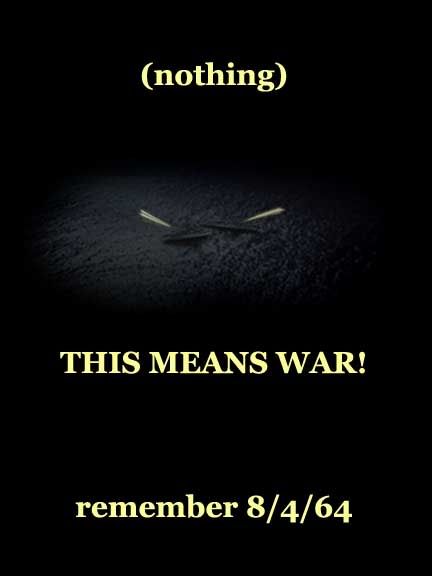
Under Admiral Thomas H. Moorer’s guidance, such patrols were increased along the coast of North Vietnam in mid-1964, as US-engineered coastal raids (OPLAN 34-A) were also increased to put the DRV forces further on edge and stimulate “chatter” to analyze. The mission given to the USS Maddox in August has been described as “the delicate task of stimulating coastal defenses without provoking an attack,” a balance made harder by the added agitations. [1] The attack on the Maddox that was finally reported triggered a third and hidden (or unanticipated) power of the Desoto patrol – to start a war. And that crucial second attack didn’t even occur in reality - not for lack of trying.

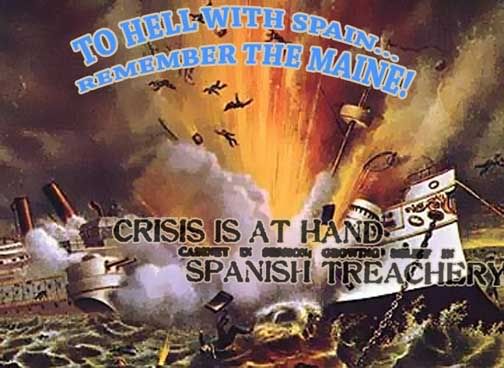
The escalated Vietnam War of course went sour over the years, in the shadow of that initial dubious incident. It was the same type of patrol the USS Pueblo was on when disastrously captured by the North Koreans in early 1968, and a possibly similar mission that led to the USS Liberty incident the year before that. These plus lesser mishaps led to a decision in 1968 to stop such missions. The awkward U.S. loss of Saigon, plus Watergate and so on, changed the political calculus of manufactured crises. The “Remember the Maine” mentality just wasn’t going to work in the 1970s.

But the same notion of highly-portable naval sovereignty, with all the firepower to enforce it, continued - in, for example, the Persian Gulf in the latter 1980s.

Different Gulf, Different Decade, Different Moves
After Iraq attacked Iran in 1980, with tacit U.S. approval, Washington took Iraq’s side to ensure it didn’t lose in the bitter, grueling war that ensued. Towards this end, the U.S. re-flagged as its own supply and oil vessels coming to or going from Iraq - largely Kuwaiti oil tankers. This made them off-limits to Iran’s attempt at blockade. In Operation Earnest Will, U.S. Naval forces escorted them as well, enforcing its own blockades while denying Iran’s. Instances of Americans opening fire on Iranian forces and facilities rose steadily as well as the conflict dragged on; Operation Praying Mantis responded to Iranian mining with escalated U.S. attacks on Iranian gunboats, oil platforms, and tankers on April 18 1988. [2]

The covert US-Iraq alliance had intensified in latter 1987. Ironically, this was following the accidental Iraqi air attack on the USS Stark – with 37 sailors killed, it proved exactly to Iraq what the USS Liberty incident was to Israel, but in miniature; American cooperation increased. Advisers went to Baghdad full time, originally to prevent further such mishaps, “but the end result,” explained a 1992 Nightline report on America’s secret war, “was that the United States helped Iraq conduct long-range strikes against key Iranian targets, using U.S. ships as navigational aids. “We became,” as one senior U.S. officer told us, “forward air controllers for the Iraqi air force.”” [3]

Two conjoined decision of Late April 1988, following Operation Praying Mantis, set the stage for the IA655 incident: the expansion of shipping protection in the Gulf to all neutral vessels and the dispatch of the USS Vincennes to bolster the force backing it up. [4] The high-tech vessel (a Ticonderoga class AEGIS guided missile cruiser, introduced 1985 and also called "Roboship") was equipped for advanced surveillance of just about every frequency except, apparently, civilian air control traffic. Its combat speciality was surface to air engagements, a poor fit for the surface-surface work it was sent for. But the more aggressive attitude in the Gulf was well embodied by The Vincennes’ commanding officer, Captain William C. Rogers; according to those who worked behind him in the Gulf he was overly-aggressive, but then he may have been privy to certain unusual standards they weren’t.

The details of the incident are still new to this author and beyond the scope of this article, but the story of how the Vincennes came to do battle with Flight 655 seems highly dubious. Around 10:00 local time, the cruiser’s amazing receivers picked up two distress calls from neutral vessels under attack by Iranian vessels, and sent it heliopter to look, which in turn reported being fired on. According to information uncovered by ABC Nightline and Newsweek, one of these signals was later denied by the boat’s captain – he never came under attack nor asked for help. The other was from a completely non-existent “Liberian” vessel. [5]

Both signals were themselves forgeries - pure radio signal fakery as part of a U.S. plot to draw Iranian vessels out to join in the fake melee and become exposed to counter-attack by the Navy. Lt. Col. Roger Charles told Nightline the Navy thus “enticed, in fact, entrapped the Iranian gunboats into a situation where we could then say that there’s been a hostile action by them … And that then allowed — under this kind of specious rule of loosened hot pursuit — us to take military action.” [6] It was to the aid of these ghosts that Captain Rogers sped, like a duck hunter headed to where the decoys were laid, ready to pop any attackers lured out or any threat to his expensive ship.

The Incident and the American Message to Iran
Into this dangerous situation flew Iran Air Flight 655. An Airbus A300B2 with 290 passengers aboard (mostly Iranians, including 66 children), it departed from Bandar Abbas at 10:17 for its 28-minute flight to Bahrain Airport. It seems the plane was talking normally with ground control (in English), was well within an established civilian air corridor, climbing up rather than swooping down for an attack, and transmitting the right civilian transponder code that clearly means don’t shoot. [7]

But the Vincennes had the wrong equipment to hear the control chatter, and apparently the wrong crew for everything else. They misread the transponder signals as being from a MiG fighter jet. They misread its location as several miles outside the civilian corridor. They somehow missed the civil flight listing that would identify it by flight number. They may have failed to properly transmit their warning signals, as the “fighter” refused to turn away. These and other errors all happened at the same time in that dense fog-bank of war effect that only materializes under peculiar conditions like this, and quite often benefits the U.S. of A in no-longer-surprising ways.

So to summarize, on this poorly-run duck hunt, they decided that a fighter jet had been lured out as well as the gunboats - and that’s a bigger and more exotic prize. So with all the storm of mental short-circuits aside, it made perfect sense to fire two missiles at it. 290 non-combatant souls were snuffed out – some in the explosion that made the plane disintegrate, the rest after a three-mile fall to hit the Gulf’s warm waters. Video shows the ship’s crew elated to have hit the bad guy – they weren’t told until hours later what they’d really done, and apparently they didn’t figure it out in the meantime, even with the ship's data records to review.

One overriding message the United States government sent to Iran, aside from vague “regret” over this accident, can be seen in its public pronouncements. Consider the last sentence of President Reagan’s first statement of July 3: “The only U.S. interest in the Persian Gulf is peace, and this tragedy reinforces the need to achieve that goal with all possible speed.” [8] It sounds nicely utopian, but it surely wasn’t meant that way. White House media handler Marlin Fitzwater made the message a little more explicitly a week later:
Only an end to the war, an objective we desire, can halt the immense suffering in the region and put an end to innocent loss of life. Our goal is peace in the Gulf and on land. We urge Iran and Iraq to work with the Security Council for an urgent comprehensive settlement of the war pursuant to Resolution 598. Meanwhile, United States forces will continue their mission in the area, keenly aware of the risks involved and ready to face them. [9]

That is, as the Iranians likely read it, wey’ll keep on shooting at anything that might possibly be a threat as long as we “have to” hang around there, which is until Iran surrenders. Charles Price, US Ambassador to UK later said “this incident wouldn’t have happened if Iran wasn’t, and hadn’t been in the process now for a long time, of attacking U.S. and other shipping in the Gulf.” [10] This is certainly a contributing factor, along with the U.S. decision to fake some of these attacks electronically and lure hem into a fight, the decision to equip, staff, and deploy the Vincennes in such a way that it became deadly to civil airliners, etc. For that matter it wouldn’t happen if the airplane had never been invented. So many variables and alternate outcomes riddle this case, that Price picked on Iran’s small role, played with such limited options, shows the issue at hand – their options were narrower yet and they’d better stop shooting altogether.

Iran Surrenders / A Leaf on the Wind
Since Iraq started the war in 1980, its course had been a grueling back and forth, with steady but modest Iranian gains into Iraqi territory by the end of 1987. UN Security Council Resolution 598 had called for a return to pre-war boundaries, making Iran reluctant to agree, even as the pain deepened. Then Iraq started another push-back in early 1988: long-range bombardment increased, and American assistance got more hands-on as well, as we’ve seen. The balance might have shifted back yet again but for what happened in July.

The shooting down of IA655 undoubtedly contributed to hastening Iran’s effective surrender. However, the precise role it played – minor, major, or peripheral, is difficult to know. Adding to new anxieties, just days after the incident, Iraqi forces “dropped chemical cyanide bombs” on the Kurdish village of Zardan on the Iranian side. Again hundreds were killed and “the enraged Iranians considered a huge rearming and nuclear weapons, but decided that this was beyond their means” by that time. [11] So July was a bad month for Iran - on top of the cumulative effects of years of similar woe, the loss of the Airbus to Americans in particular put a deeper fear than ever across the Persian mind. As an Iranian scholar stated at a conference hosted by the Woodrow Wilson Center (paraphrased)
“[A] turning point in Iran's thinking came with the shooting down of an Iranian passenger plane in July 1988 by the American cruiser USS Vincennes. That incident apparently led Ayatollah Khomeini to conclude that Iran could not risk the possibility of U.S. open combat operations against Iran and he decided it was time to end the conflict." [12]

There’s every reason to believe that’s just what the Americans wanted to get across, after the tragedy if not shortly before as well. This author is not eager to conclude there was any design to kill hundreds of innocents – but there are some very hard questions to address at another date.

The fighting did continue but Iran’s mindset was definitely shifting and quickly – hostilities officially and physically ended just six weeks after the Vincennes incident, on August 20. Iranian organized revenge meeting were already taking place by then, and their selected contractor groups were making their airliner radio bombs by the time the “Autumn Leaves” were shaken loose in Germany in October. It seems all too likely one of these Iranian grown leaves drifted right across the English Channel and lighted itself in the belly of PA103 on 21 December, less than six months after Captain Rogers’ duck hunt. A half hour after takeoff, it exacted an exact revenge, leaving 259 to deal with five miles of pure gravity however they did before dying against the cold winter soil of Scotland.

That, or the Iranians just gave up after the Germany bust, and the Libyans took their own incidental revenge for something else at just that time, as the FBI, CIA, USG, Scottish Police, Camp Zeist judges, and others claim to believe.

---
Sources:
[1] Rust, William. "The "phantom battle" that led to war; can it happen again?" US News and World Report. July 23, 1984. Posted online December 3 2005. http://www.usnews.com/usnews/news/articles/051203/3phantombattle.htm
[2]Operation Praying Mantis. Wikipedia. http://en.wikipedia.org/wiki/Operation_Praying_Mantis
[3, 5, 6] "The USS Vincennes: Public War, Secret War" ABC Nightline, Aired July 1 1992. Full Transcript, with extensive notes.
http://homepage.ntlworld.com/jksonc/docs/ir655-nightline-19920701.html
[4] Kelley, Stephen Andrew. Better Lucky Than Good: Operation Earnest Will as Gunboat Diplomacy. (Naval Postgraduate School. June 2007. PDF link:
http://stinet.dtic.mil/oai/oai?&verb=getRecord&metadataPrefix=html&identifier=ADA470423
[7, 8, 9] Ghasemi, Shapour. “Shooting Down Iran Air 655 [IA655]” Iran Chamber Society: History of Iran. 2004. http://www.iranchamber.com/history/articles/shootingdown_iranair_flight655.php
[10] The Maltese Double Cross - 32:00 mark
[11] http://en.wikipedia.org/wiki/Iran-Iraq_War
[12] http://wilsoncenter.org/index.cfm?fuseaction=news.print&news_id=90411&stoplayout=true

Thursday, December 10, 2009

ANOTHER CALL ON MALTA

ADMIT IT ALREADY!
[Pan Am 103 Series]
Adam Larson / Caustic Logic
December 11 2009


Note: The Following does not necessarily reflect the author's true views in all regards

The Status Quo
Two previous posts explained al Megrahi’s Malta-based plot to destroy Pan Am 103. First we witnessed the keen memory and staunch bravery of eyewitness Anthony Gauci, standing alone against an uncaring island subdued by Libyan barbarians. Next I chronicled the complete subjugation of Air Malta and its security operations at Luqa Airport, allowing the PA103 bomb to hurtle uncontrollably to Lockerbie. And finally, at the end of the second piece, I just started hinting at their infuriating denials after the fact that any such plot ever did pierce their magical force field.

It’s noteworthy that Air Malta has avoided the notoriety and bankruptcy that sunk Pan Am following this disaster. How, when their initial “failure” is what gave Pan Am its chance to fail as well? As usual in a world rife with anti-American plots, the true villain escapes unharmed, allowed to live and thrive, while the innocent passerby is shot to death. The distatsteful status quo is thus the Americans got their (little fish) bad guy, but lost a major airline, while the Libyans have paid up and admitted responsibility, while cynically denying responsibility, and all Malta had to do was keep quiet on its part. It’s a more than fair deal for the government in Velletta, and one should think they’d be grateful. And normally they act that way.

Demands of the Disgruntled
Some have agitated to upset that stasis, but so far the calls on Malta are quite one-sided, encouraging them to “clear their name” of the Lockerbie taint altogether. These pleas usually come from a small, well-known group of people who would like to de-blame Libya itself. Now if that doesn’t illustrate the axis of malice between Velletta and Triploi, nothing does.

Just in the last couple of months, Lockerbie trial “architect” and general grumpy gus Professor Robert Black piped up in late August. He opined “the Maltese government should be pressing very hard within the EU for an enquiry into Lockerbie,” and criticized the Scottish judges for accepting that Megrahi’s bag from Malta ever existed.

On 25 October that one UN guy, Köchler, that was at the trial and said some bad stuff about it, called for a Maltese probe of Gauci in particular: "If they are committed to the rule of law, the Maltese authorities should open their own investigation and interrogate Mr Gauci," One must wonder how much Gaddaffy is paying Herr Köchler to get at the hero of Silema like the lurking Libyans never were able to?

Never Enough Proof
The Maltese authorities have really done a great job “clearing their name” without the encouragement, but with it they went haywire. On 31 October the UK Daily Telegraph reported “Malta to investigate evidence of key Lockerbie witness.” This was based on an unnamed “Maltese legal official” who said “Tony Gauci is an area where we have to investigate more thoroughly and we are preparing for this. There was never enough proof, to be frank, on the circumstances of his evidence and there is pressure coming from many quarters on Malta to move to resolve the issue." There’s not enough proof in the world, apparently.

The following day, 1 November, the Justice Department specifically denied such preparations, disowning any comment that may have been made. However, their press release took the chance to repeat the infuriating claim that since 1988, the Maltese government has "always maintained the bomb which downed Pan Am flight 103 had not departed from Malta and ample proof of this was produced.” Oh, so now the mountain of proof of a Maltese-origin bomb, that’s “never enough,” is trumped by that tired old paperwork? It becomes clearer.

To top off this cowardly dodge, on the same day, Prime Mnister Gonzi affirmed their disinterest in Gauci. “Over the years we cooperated with every investigation,” he explained, which is technically true. But like the others, he ignores the terrorist plots hatched there that were uncovered by these efforts. “Our position,” he pronounced, “was always that Malta had nothing to do with the terrorist attack.” Well they did host the whole thing except the explosion, so presumably he means nothingconsciously to do with it. But this too is in doubt. When asked if his decision not to re-question Gauci was due to pressure from the U.S., Gonzi replied “it is totally untrue.” Indeed, their own embarrassment seems more at stake than America’s in again contrasting Tony’s sharp eye with the complacent approach everyone else in Malta takes towards the Libyans.

I’d like to quote Stuart Henderson, that proper Scottish copper who led the whole police investigation of Lockerbie. He wasn’t specifically referring to any of the Maltese vomiting this vile venom above when he spoke about Megrahi's release in August. But those who doubt the official story, as most Maltese seem to, “make my blood boil” and are “an insult to our police officers … an insult to the Americans, to the Germans, to the Swiss and the Maltese officers.” That’s right, you guys are slandering your own who helped prove just exactly how the Libyans killed 270 with a bomb your lame-ass airport just “missed” and somehow you can’t just admit it.

Another Call and Surely Not the Last
But it didn’t end there, as proved by a 29 November letter, urging Malta to “defend itself,” issued by the Orwellianly-named “Justice for Megrahi campaign.” The letter was signed by, among others, British MPs Tom Dalyell and Teddy Taylor, plus Noam Chomsky - all outspoken Leftist weirdos who argue that Megrahi is an innocent little lamb framed by “the West” (i.e. – the New World Order, aka “Illuminati”). Professor Chomsky, not surprisingly, called the proper conviction based on proof of a terrorist mass murderer "a remarkable illustration of the conformism and obedience of intellectual opinion in the West". Oh, Chomsky… yawn-skip-yawn-skip-yawn-skip… "I think the trial was very seriously flawed,” he further opined to the Times of Malta, “including crucially the alleged role of Malta. There is every reason to call for a very serious independent inquiry." Certainly Triploi has the roster for it drafted already, and a few more bought souls from now we might see Justice turned on its head, to Chomsky’s delight.

And finally to quote again then Minister of Home Affairs, Tonio Borg, quite a while back in early 2000: "We have no proof that these two Libyan suspects were involved in anything illegal in Malta regarding this case, particularly the placing of this bomb on Air Malta Flight ... 180.” I had hoped he would be fired since then, especially after the trial at camp Zeist shortly put the lie to such claims. Rather, he’s prospered just like Air Malta; since then he’s been Minister of Foreign Affairs and of Justice (ironically), and is currently honored with the titles Deputy Leader of the Nationalist Party, leader of the House of Representatives, and Deputy Prime Minister. Would Germany have been tolerated promoting its holocaust deniers like this?

The Final Call: Pull Malta Back From the Dark Side
Clearly this talk of a UN inquiry, under Libyan control, torturing Tony Gauci into recanting his story, and all the rest, has got to stop. That is hardly worth mentioning outright it's so elemental. But while we’re at it, we must ask if this tiny, easily manipulated island nation was really just used by the Libyans against its will? Or have they been swayed to the dark side all along? The petitioners seem to bet on the latter.

Historically, the Maltese are notoriously soft on Islam, and perhaps by now sympathetic to the anti-American Jihad. At the very least they’re likely to slide that way if Libya’s evil grip is allowed to continue unaddressed. Therefore, let’s make it more explicit and issue a new international call on Malta to “Admit it! You're Tripoli's little pet and happy about it!” Sign the informal petition by leaving a comment below. We are all Americans now, worldwide, and we will get our perps, be they Libyan, Maltese, and also otherwise. The case is open!

I specifically speak to Brits – Scots, Welsh, English, Etc. It must be asked if all this was caused by the UK letting go of the island’s hand in this world crowded with evil. Recall that after you freed Malta from the Freemason French, you cared for them and left your names all over, until you set them loose in the hippie 1960’s. But as usual permissiveness breeds wickedness and by 1988, planes were falling on the UK itself due to losing Malta. If those people can’t behave responsibly and face up to the consequences of their long dance with Libya, perhaps independence should be seriously re-considered.
---

Wednesday, December 9, 2009

WHILE MALTA SLEPT?

HOW MALTA LET LOCKERBIE HAPPEN
[Pan Am 103 Series]
Adam Larson / Caustic Logic
December 9 2009


Note: The Following does not necessarily reflect the author's true views in all regards

A previous post addressed the fateful clothes purchase by Lockerbie bomber al Megrahi on the island of Malta, well-known as occurring on December 7 1988 at the Gauci family’s shop Mary’s House. But this is only a sliver of the terrorist mastermind’s larger plot with many steps taken all within a few square miles around Silema, under the watchless eye of the Maltese authorities - especially at nearby Luqa airport where the main action went down.

Abdelbaset al Megrahi was a Libyan intelligence bigwig personally carrying out some hair-brained revenge by Col Gaddaffy for a two-year old US bombing of Libya that had killed his adopted daughter. Megrahi had connections at Luqa airport via his own Libyan Arab Airlines links, but the experts agree he could not likely do this all alone without at least one accomplice inside the airport. His exactly one (known) accomplice, Lamin Khalifa Fhimah, also worked for LAA at Luqa and was a Libyan intelligence operative, high-level.

Of course Fhimah was later found not guilty on a technicality, that being the evidence against him, and the other incredible details flowing from star witness Abdulmajid Giaka, was found “inadmissible” by the three presiding judges. This was one of their more cautious and wimpy moves – a key witness ignored over a few piddling doubts raised by the defense about his meager repayments and the doubts of some memo-writer.

To be clear on this point, the prosecution and the CIA (who first worked the witness) have always known Mr, Giaka was honest and credible, with high-level connections at Luqa and in Libyan intelligence, and a knowledge both vast and intimate of the Megrahi-Fhimah plot. The judges didn’t specifically counter this, and any disinterested observer can note his story is still effectively true, as it mirrored the prosecution case. For the prime example, Giaka swears he saw both accused arrive at the airport with a mysterious brown Samsonite suitcase. That’s dynamite info, and all the other evidence proves they did exactly this. That his story so closely resembles that truth can hardly be coincidence, and his dismissal is but a technicality.

Giaka also alerted his handlers of genuine clues that panned out, like Fhimah’s diary entry noting he needed to get “TAGGS” (in English but misspelled). What business would an airline employee have with luggage tags besides planning to use one of them (with a few spares to practice on) to get a bomb onto PA103? It’s been suggested the diary explains he was taking sample tags to a local printer to get more made, but the question that begs an answer then is why write something this boring in your diary when you could jot down clues to your terrorist plot? In English? The critics cannot answer that.

Within that brown suitcase Giaka saw, we know Megrahi had the bomb, ready made with a flexible Mebo timer the Libyans were famous for having by then, packed into a radio with the memorable clothes and umbrella he didn’t need anymore. Fully confident in his ability to walk right through Luqa airport, he decided to send this bundle of malice right from there, correctly presuming gross negligence would repeatedly fail to stop it on its complex chosen path. It was perhaps the sheer arrogance of those “above the law” that made Megrahi time the bomb to just deny the ocean’s anonymity, and leave these scattered clues to be found on land and traced back to Mebo and Gauci and himself. It all makes sense in hindsight, and fits established and understood patterns of criminal behavior. For example, the professionals who write up James Bond villains know just this type all too well and should not be surprised at such mundane contrivances.

As to how this perfectly predictable plot continued on to fruition unopposed, that’s more troubling. All it took to penetrate “Mary’s House” and buy just the right clothes was a little money. It was Luqa Airport that really mattered, and that too proved easy enough for a determined mastermind to part like the Red Sea. The airline Air Malta ran security there, essentially the host airline. Air Malta security director Wilfred Borg has been quite defensive, always speaking up about their “stringent policies” of double-checking the number of bags, and reconciling each with the right passengers. They have produced the documentation for investigators and news cameras alike, to “prove” their case. But paper is just so darn thin as evidence when clearly a bag with a bomb DID come out of Malta.

Unaccompanied bags are not allowed, so couldn’t happen, the logic ran. Strangely, the Matlese police agreed as if they know anything about airports. Outside “experts” like Denis Phipps, former security director for British Airways, have found these records “reliable,” and as showing 55 pieces of luggage, all claimed by 39 passengers, with none unaccompanied. The answer, presuming for argument’s sake these are legitimate records, is that the 56th bag was simply not documented. Why would a terrorist be so stupid and arrogant as to allow his bomb bag to de recorded on the official paperwork to be traced back?

KM180 landed in Frankfurt at mid-day, and it was there the suitcase wormed its way onto PA103, using…. Yep, that “TAGG.” These magical tickets were the perfect tool; in the 1980s, airports routinely searched only bags without tags. One with proper tags was considered “good to go” and sent along. The proof it was sent along was provided by the diligent German Federal Police, BKA, who had sprung into action within days of the crash. It was widely reported in Germany that Flight 103 originated in Frankfurt, which it only sort-of did. So it’s understandable they would visit the airport, as they did on or around Christmas at the latest, looking for the luggage records, computer files and paper forms, relating to 103 and what went on it.

Now it’s no secret that police can goof things up and usually do. They forgot to get the records for what went onto Flight 103 when they were there, and the airport deleted that data a few days later with no official backup or paper copies kept. Luckily, a souvenir printout that an upright employee handed to the BKA in late January proved that an unaccompanied bag was routed from KM180 onto the ‘first leg’ of Flight 103. The BKA investigated the airport again and agreed, six months later alerting Scottish police. And that, good people, is solid proof of an unaccompanied bag from Malta, no matter what the Maltese and their apologists claim.

Few have the guts to openly verbalize the presumption one must make on considering all this. One exception is Vincent Cannistraro, head of the CIA’s Lockerbie investigation, who had been tenaciously telling the truth about Libya for years already before working with Giaka to ‘simulate’ it. In a 1994 documentary (Frontline Scotland: Silence over Lockerbie), Cannistraro told the truth about their northern island possession, masterfully dismissing the claims of Air Malta and their ilk:
“They have vindicated themselves on paper in terms of the security procedures, but if their security personnel are suborned by hostile intelligence service, and they are completely vulnerable to whatever that hostile service would want to put on their aircraft, with baggage tags, without baggage tags. Once you have basically infiltrated the security apparatus there is no barrier to doing exactly what Fhimah and Megrahi DID." (emph. Mine)

They aren't saying it aloud like this, these days, but that MUST still be the official story stood by in Washington and London. Malta was suborned into letting Lockerbie happen and have at least tacitly helped confuse this basic fact. Consider this outrageous claim by Malta's Minister of Home Affairs, Tonio Borg (any relation to the compromised Wilfred Borg, hmmm?): "We have no proof that these two Libyan suspects were involved in anything illegal in Malta regarding this case, particularly the placing of this bomb on Air Malta Flight ... 180.” The suspicious security breach, which they could just admit to but disown as a mistake, was now to be compounded with an equally dubious refusal to admit their … failure? It’s seeming less and less like a failure and Borg is sounding sort of like a German railroadman denying his part in the Holocaust.

Disingenuous and disgusting. I hope he's been fired or at least demoted since then.

To be continued...

Monday, December 7, 2009

REMEMBER REMEMBER SEVEN DECEMBER

THE BABYGRO TREASON AND PLOT
[Pan Am 103 Series]
Adam Larson / Caustic Logic
December 7 2009
updated Dec 10


Note: The Following does not necessarily reflect the author's true views in all regards

Today, December 7 2009, marks an inauspicious anniversary in American history. Yes, December 7, 1988 was the date of purchase by convicted Lockerbie bomber al Megrahi of the Maltese clothes stuffed around the bomb he used to take down PanAm 103. 21 years ago today, he made a fateful purchase from one Anthony Gauci, then of Silema Malta, a purchase Gauci remembered all too well. This we know because of a nice confluence of clues that investigators were clever enough to recognize and rigorous enough to assemble into nice neat indicator of a design out of Tripoli.

The mystery shopper was eventually found to sort of be resembled by al Megrahi (once his face was famous enough). Everyone had at one point decided Gauci had sold the stuff to Mr. Abu Talb, a suspect found in possession of more Maltese clothes. While memory is never perfect, time usually improves it and by the year 2000 Gauci was able to point to el Megrahi in court, when the man was sitting in the dock in the special accused gown costume. Justice was served, thanks to Gauci’s sharp memory and clear conscience. This purchaser did originally seem at least four inches taller, broader of build and perhaps darker in complexion than Megrahi, and perhaps 20 years older than either him or Talb. But again, this just shows the natural variation of eyewitness testimony and is not suspicious in the least.

The date which I mark is known as the fateful one because Megrahi was known to be on Malta that day and on no others that mach Mr. Gauci’s given clues. Tony, as some call him, recalled the setting for investigators. It was near closing time, around 6pm. It would be dark, and he recalled it was raining outside. Tony recalled he was alone in the shop, as .his brother Paul had gone home early for a football match (Rome-Dresden). Such a match was aired on December 7 at 1pm, and over by about 3:00. Paul apparently did some other thing after the game hat kept him from returning to help close. It’s fine. The Christmas lights were already up.

The purchaser bought many unusual clothing items, with little care to if they fit or made sense. He seemed like a Christmas shopper, a Libyan one, with “more money than time.” The list of items bought was initially unsure and contradictory to the evidence found scorched and scattered across Scotland. But the roster was generally ironed out over 20-ish interviews with Scottish police (many of them still not erased from view), and agreement was reached that the mystery shopper bought too much of the unusual selection in the bomb bag to be coincidence.

The blue “baby gro” is the most memorable of the clothes. Its own tag said made in Malta, and Maltese Gauci recalled selling it for Megrahi’s Maltese plot. By relating to babies it also shows two important clues: it reflects megrahi’s awareness that this was revenge for the U.S. bombing that killed Gaddafi’s 4-year-old adopted daughter, who may have worn such an outfit when younger. A handy timeline also shows the clear relation – the 103 bombing happened after that 1986 attack, clearly showing the cause and effect relation. The choice also shows how Megrahi was aware that children exist and might be killed in his plot, as they were. It was a sinister final touch for the bomb stuffing that just screamed Libyan guilt and wickedness of spirit.

The only item of utility the buyer picked up was an umbrella, since it was raining enough to warrant one. Local weather records show no appreciable rain in Silema that day, but these aren’t always perfect, perhaps kept poorly in Malta. In fact, that records don’t show this is a vital clue that Maltese authorities might have willfully altered these to cover up their failures. Perhaps they missed the rain on accident after all, but it rained December 7 and that same umbrella Megrahi bought for that was packed and found at the crash site. This suspicious behavior is therefore a good clue of Megrahi’s guilt and Malta’s (unwitting?) complicity.

Open-minded investigators did heavily consider November 23 as another fit for Tony’s evidence – it had appreciable rainfall recorded, and a Rome-Dresden football match from 5-7 pm local, a better fit for Paul being absent still at 6pm. But Megrahi was clearly not there on that day, so that can’t be it. Football times and dates you just don’t get wrong, but Malta’s weather records are now suspect, so Dec 7 it must be, with unrecorded rain and Paul gone not for the game but for post-game activities. And I for one see no reason that the babygro treason should ever be forgot, especially since the mass murderer has been "compassionately" sent home to plot more American deaths. I will in fact elaborate on Megrahi's Maltese plot and the strange failure of Malta as a whole to prevent it or even admit the truth afterwards. This behavior demands a response.
---
Note: A helpful reader has alerted me that I forgot to address an important point, being Mr. Gauci's payments following his many statements and testimony. Yes, he did receive a small reimbursement, in relative to his troubles; I've read his accounts, and Libyans were hanging around, looking at him and not buying anything. To face such dangers you need some money. It's not a perfect world, obviously. I'm not sure on the amount, I think it was at least a few thousand dollars, and it wasn't even mentioned at all until after Tony had given the police all their information, so any question of influence or leading is ridiculous. In fact, to keep him honest, they had led Gauci to believe he'd be unable to receive ANY money, and in fact made to pay the police a £8 "witness processing fee." It worked, elicited the purest strain of truth, and the gesture of faith was repaid, modestly. Thank you for the reminder, anonymous reader, to toss this straw-man argument aside.

Saturday, November 28, 2009

LIGHTLY EXPLOSION-DAMAGED

Two Scientists, a Purple Bag, and a Possible Clue
[Pan Am 103 Series]
Adam Larson / Caustic Logic
November 29 2009


Going through the court transcripts of the Lockerbie trial at Camp Zeist, one point of interest that I ran across concerns the testimony of RARDE scientist Allen Feraday. This was on June 15 2000, day 21 of the trial (read the LTBU daily report in .doc format, outlining some of the controversies). The witness himself reportedly has little in the line of formal qualifications, citing a “higher certificate in applied physics” as his qualifications; He’s still conceivably capable of brilliant professional work; but judging by some previous high-profile anti-terrorism cases he’s been involved in, he could be seen as more of a “manager” of evidence than a reasonable assessor of it.

Feraday’s scientific findings relating to the Lockerbie investigation are inextricably linked and confused with those of his underling, Dr. Thomas Hayes, who has a proper PhD. I don’t know the arrangement, but Ferraday mentions analysis of the luggage and clothing that “was essentially done relatively early on, by Dr. Hayes, and then, obviously, checked by me.” (p 3328) The two are more famous for their handling of the miraculous timer fragment PT/35(b); Hayes found it in a shirt collar and alerted Feraday, who passed the news on to Williamson, and thence to Henderson, Marquise, Thurman, “Orkin” and the history books. In testimony Feraday also clarified the interchangeable nature of their collaboration “I did not always, when I was looking at [evidence], make any difference between myself and Hayes” (p. 3332)

The prosecution generally seemed to feel the same way; their habit of asking questions of Feraday better suited for the earlier witness led Mr. Keen to lodge for private audience with the judges. Once Feraday was sent from the room, Keen argued in part:
According to the evidence of this witness, he prepared the final report on the basis of his examination of certain matters, and by considering Dr. Hayes' notes. What my learned friend appears to be inviting is hearsay evidence […] I object to the Crown canvassing hearsay evidence, even in the context of what is referred to as a joint report, in respect of such a matter. If they wish to take direct evidence on this issue, then they had ample opportunity of doing so with Dr. Hayes. And in my submission, it is not competent for them to take hearsay evidence on this matter from Mr. Feraday. (pp 3215-3216)

Nonetheless the questioning continued in a similar line, a hundred pages later coming to my point of interest, the unusual collaboration on another piece of evidence: a damaged piece of luggage, described as “a purple-coloured holdall” and labeled PH/137. This bag, Feraday had wrtten in his final report of 1989, had within it two metal fragments “which both originate from the primary IED suitcase,” so it should be of some interest. Mr. Keen for the Defense addressed Dr. Hayes' draft report during his questioning of Feraday. He cited page 23 as listing categories including "Likely Explosion Damaged Luggage,” and noted that one item listed in that heading is PH/137. Feraday confirmed these facts while comparing with his own copy.
Q So from Dr. Hayes' draft report -- and I think you just told us he prepared this part of the report -- we can see that he designated this as explosion-damaged luggage?
A I think it was lightly --
Q Lightly explosion-damaged luggage?
A Yes.
(pp 3330-3331)

This attitude would help explain Feraday’s own notes, Production 1498, in which Keen noted “that nowhere in the index” and in fact “nowhere in your examination notes does the item PH/137 appear.” The witness confirms to both “that's correct, sir. Yes.” Of course lightly blast-damaged was a fudging statement and further probing shows him to believe it wasn’t in the explosion damage at all. Next Mr, Keen pulled up a photograph of this item. (Production 181, photograph 91)
Q It is apparent, is it not, Mr. Feraday, that you have not signed the label as it is photographed in photograph 91?
A That's correct, sir. Yes.
Q But your signature now appears on the label PH/137 in court?
A Yes, sir.
Q When did you sign that label, Mr. Feraday?
A When I had the bag back to write this -- the final report.
Q And what date was that, Mr. Feraday?
A I can't tell you without looking it up again on a list, I'm afraid.
Q Are you saying that that was before December 1991?
A I think it must be, yes. I finished the report by then, so yes.
Q And are you saying that you examined PH/137 before you finished the report?
A Yes, sir.
Q Where are the notes of that examination, Mr. Feraday?
A Well, there aren't any, because as I said, I did not always, when I was looking at them, make any difference between myself and Hayes -- although in this instance I did, and I told him so, that in my opinion you couldn't necessarily put that in the explosion damage. I couldn't convince myself that it was explosion damage. Prior to that, Hayes had written this preliminary report for another purpose -- I think the Fatal Accident Inquiry --
(pp 3331-3333)

So if I’m reading this right, he disagrees with the actual PhD scientist, but did no detailed, documented, admissible examination of his own to back this up. He couldn't recall when he made his divergent inspection, but did immediately recall that he made no notes for it. His lack of notes in turn is justified "because" they agree on things, "although" not in this case. Got it.

Notes or not, the reason for Feraday’s divergence seems to be an unexplained lack of conviction, with which Hayes lodged no disagreement:
Q And you recall --
A Sorry, I'm waiting for the --
Q I don't think you had finished, Mr. Feraday, so do finish your answer if you wish.
A Sorry. I came to the conclusion that I couldn't myself put it in the explosion – necessarily in the explosion-damaged baggage. I'm not saying it isn't, but I couldn't convince myself. And I still can't. And for that reason, I had a word with Hayes, and we agreed to put it in the second section.
Q So you -- you recall discussing this with Dr. Hayes, do you?
A At some stage I discussed it with Dr. Hayes, but I can't remember exactly when or if, in fact, it was when the -- I wrote the final report. And then Hayes certainly came in, obviously, and read it all and then signed, and we went through each item then. We through the report, if you like, line by line.
Q Line by line, Mr. Feraday?
A Well, he read through it, obviously, line by line.
(pp 3333-3334)

This implies no disagreement; Hayes was able to check Feraday’s findings and found no problem with the exclusion of PH/137 that Feraday had already decided on and reported. Next, Mr. Keen turned to Feraday’s given reasoning, in that report, to support his agnosticism.
Q If you would like to turn for a moment, Mr. Feraday, to your report 181 at page 51.
A Yes, sir.
Q Now, we can read this section for ourselves, but I'd like to look in particular at the third paragraph on that page, which you corrected during your examination in chief chief [a meeting just before his questioning - ed] by proposing the insertion, after the fourth word in the first line, of the word "other"?
A Yes, sir.
Q Now, taking the paragraph, of course, in its context, can we read that corrected paragraph. It states: "As there are no other penetration holes in either the holdall or the plastics bag, it appears most likely that these two fragments, which both originate from the primary IED suitcase, were picked up and placed inside the plastics bag, which was then itself
placed inside the purple holdall for convenience of carriage."
A Yes, sir.
Q Now, I have to suggest, Mr. Feraday, that if you insert the word "other" into that paragraph in the context of this section, the paragraph is deprived of sense or content.
A Is ... ?
Q Deprived of any sense or content. It tells us absolutely nothing if you correct it in that way. What do you say to that?
A I am not sure what you mean. But what it would then say is as there are no other penetration -- at the top of the page, I am talking about the ragged horizontal cuts which, obviously, one can see as penetrations. I see them as cuts. Now, in dealing with, first of all, the holdall, there are no other penetration holes in it, other than those that I've already said about the cuts. And in the plastics bag, there were none, the plastics bag which contained the two fragments of metal from the suitcase. So I was left scratching my head as to how they can get inside there, in a plastics bag, if they didn't come through any part of the bag.
Q Do you --
A I can't convince myself they come through the ragged cuts.
Q You recollect the label attached to the plastics bag, Mr. Feraday, having said "two pieces of metal, charred, found within baggage."
A Yes, I do, sir.
Q And you recollect finding penetrations in the side of the bag that went right through to the interior of the bag?
A Horizontal cuts, yes, sir.
Q But you felt it pertinent to remind us that there were no other penetrations in the bag, Mr. Feraday; is that right?
A Not big enough for the -- for anything to do with the two pieces of metal. That's correct, sir, yes.
Q But the penetrations you'd already found were big enough for the penetration of the two bits of metal?
A Oh, yes, sir.

Q Well, that might be an appropriate point, My Lords, if there is to be a short adjournment.
LORD SUTHERLAND: Yes, very well. We'll adjourn for 15 minutes.
(3334-3336)


I can only paraphrase Michael Palin in The Holy Grail “what a strange person.” Mr. Feraday’s stated reasoning then seems to be that even though these shards could fit through the penetrations if explosively hurled there, he couldn't convince himself this was what happened and chose to think of them as surface "cuts." Who knows what caused these cuts - perhaps the hold-all fell through a tree before landing. And the two unrelated IED suitcase bits were found elsewhere and simply put in the bag far carrying, with no note about being found elsewhere. His report first supported this saying there were "no penetrations" in the bag, corrected only in his examination in chief (a meeting just before his questioning) to "no other pentrations," aside from the "cuts" that they probably did enter through.

His references to the plastic bag is curious. This would clearly seem an ad hoc evidence bag (probably not a proper one or he’d teerm it as such), into which the shards were placed after being found. This would be a careless and illogical move, but I don't see anything else making sense. Transferring these also into a bag they weren’t found in makes this faux pas worse – something Mr. Feraday should have reported rather than just using it as he did to remove the explosion from PH/137. A lack of damage to this evidence bag is also cited as a clue these didn't fly in thru the cuts: “[T]here are no other penetration holes […] in the plastics bag […] which contained the two fragments of metal from the suitcase. So I was left scratching my head as to how they can get inside there, in a plastics bag, if they didn't come through any part of the bag.” This in particular is a ridiculous non-sequitur, but another clue to Feraday this was not explosion damage.

In the most rational explanation for this thought process, perhaps he just meant, "obviously, the bomb didn't put these metal shards in the plastic bag, one of our people did. Therefore, they probably got the scraps from somewhere else, but threw them in there instead." And perhaps if we could see the evidence we'd see why he felt the shards did not just enter through the tears. But for whatever intention, he effectively erased this piece of evidence from the bomb site picture – where Dr. Hayes had already placed it - based on his unexplained solution.

Although he comes across looking incompetent – nearly always looking at the wrong exhibit and frequently befuddled - I suspect Feraday is not actually an idiot. Therefore, if he seems like one, he may be playing dumb and that's often a clue. However I simply don't have the information to know just what this might mean. Detailed information on loading procedures at Heathrow could tip us off to where this bag might have wound up. Was the location of this item relative to, say, the Bedford suitcase, troubling in some way? Considering Feraday's strained logic over this issue, I suspect we may be looking at a valuable clue, if just another on the pile indicating he was not playing on the level with this investigation.

Monday, November 23, 2009

THE TESTIMONY OF BOGOMIRA ERAC

Camp Zeist, Netherlands, 30 August 2000
[Pan Am 103 Series]
Adam Larson / Caustic Logic
November 22 2009


The following is the first online posting of the full testimony, before the special Scottish Court at Camp Zeist , Netherlands, of Frankfurt Airport employee Bogomira Erac. Her importance to the Lockerbie investigation was previously explained in another post. This somewhat short discussion is extracted from Day 47 (of 86 days) of the full digital transcripts I just received copies of. Transcripts: Day 47, 30 August 2000, pages 6659-6671 (re-formatted with page numbers marking page breaks)

6659
MR. TURNBULL: The next witness, My Lords, is number 787 on the list, Bogomira Erac, who will give evidence in German.
THE MACER: Witness number 787 on the Crown list, Your Lordship, Bogomira Erac.
WITNESS: BOGOMIRA ERAC, sworn
LORD SUTHERLAND: Advocate Depute.
EXAMINATION IN CHIEF BY MR. TURNBULL:
Q Are you Bogomira Erac?
A Yes.
Q And do you live in Germany?
A Yes.
Q What age are you?
A 57.
Q Where were you born, please?
A In Crnomelj, Slovenia, in ex-Yugoslavia.
Q And did you live there for some time before living in Germany?
A I lived in Slovenia until '66.
Q Thank you. Do you now work at Frankfurt Airport?
A Since the 1st of January 2000, I am no longer working at Frankfurt Airport.
Q When did you begin working at Frankfurt

6660
Airport?
A On the 1st of May 1974 I started to work for a firm, and then in '75, I started to work for the Frankfurt Airport directly.
Q When you worked -- I'm sorry, was the firm you mentioned called ISI?
A Yes. The first firm was ISI from Berlin, and the one which I now work for is the FAG, Frankfurt.
Q What was your job when you worked with ISI at Frankfurt?
A I was a programmer when I worked for ISI. I also did some operating. And when I started out with FAG, I started out as a programmer, and later I did operating.
Q Did the firm ISI develop the software that was used to control the baggage conveyancing system at Frankfurt Airport?
A Yes.
Q So from your first involvement with Frankfurt Airport, have you worked with the baggage

6661
conveyancing system?
A Yes.
Q And were you working at Frankfurt Airport in December of 1988?
A Yes.
Q And did you work as an operator in the computer system at that time?
A Yes. Yes.
Q Was that the same department as Kurt Berg?
A Yes.
Q Was he your supervisor?
A Yes, he was my supervisor.
Q In December of 1988, was it possible to ask the computer to print out information about the baggage sent to a particular flight?
A Could you please repeat the question once again?
Q Was it possible to ask the computer to print out details of the baggage sent to an outgoing flight?
A Yes, that was possible.
Q And for how long would that information be kept in the computer?
A The information was kept in the computer

6662
for a few days; however, for various appraisal processes, we copied the data onto two boards. We switched between one and the other.
Q All right. Were you working in the computer department on the 21st of December of 1988?
A Yes, I was on the late shift.
Q And what time did you finish?
A Officially, we stopped at 22.00 hours, but we finished around about a quarter of an hour earlier, and so we were allowed to leave earlier, if we had finished our work earlier.
Q When did you hear about the crash of flight 103?
A I heard about it in my car when I was driving away from the airport.
Q And did you realise that that was a flight that had been handled during your shift?
A On the news it said the plane came from Frankfurt, and actually, I didn't know anything further about it. I thought it was a direct flight. I didn't know anything more than that.
Q And did you think that it had been one of the flights that had been dealt with during your shift?
A I was sure about that time, the

6663
afternoon we had dealt with all of the planes which were leaving Frankfurt in the afternoon.
Q Were you working the next day?
A Yes, I was doing the late shift the next day as well.
Q And did people at the airport speak about the crash?
A Yes, we talked a lot about this crash. In fact, that was virtually all that people talked about.
Q Did you decide to do something with the computer?
A Well, actually, it was quite late on. We've got -- we had a television in our unit. It's the news, I saw the images.
Q And did you then decide to make an inquiry in the computer system?
A Well, I was actually curious about that flight. A day earlier there had not been any problems, so I was interested to see how much luggage there had been. And so it was really because I was curious that I made a printout.
Q What did you make a printout of?
A I've got a KIK computer, and I made a

6664
printout of the plane from the day before, on the 21st of December.
Q Would you look at the screen with me, to Production 1060, image 1, please. Can we magnify to the top, please. Thank you. Do you recognise this document, Mrs. Erac?
A One moment, please. I've got to put my spectacles on.
Q Can we see the flight number?
A Yes. Yes, you can see the flight number.
Q And is it flight Pan Am 103?
A Yes, it's flight Pan Am 103, 1988, from December 21st was the date. It indicates the counter where the luggage for Pan Am 103 was checked in.
Q And is this the information that you asked the computer to print out?
A Yes, that's the information I wanted about the luggage which went through the luggage transportation system for that flight.
Q What did you do with the computer printout?
A Well, I took a look at it, and I was really surprised that so few pieces of luggage had been checked in whilst there were so many passengers on

6665
board. Generally, at that time of the year -- at that time, anyway -- Americans had much more luggage. I took a look to see whether all of the items of luggage came out of the system, the ones that had been checked in, and whether they were on time. And I saw that as far as the computer was concerned, nothing remained in Frankfurt.
Q Did you realise at the time that the Frankfurt flight had connected with a larger aircraft in London?
A No, I only found out about that later on.
Q All right. So once you had finished looking at the computer printout, did you give it to anyone?
A No. No. I didn't see anything problematic.
Q What did you do with the computer printout, then?
A No one instructed me to make this computer printout. I just did it for myself because I was curious about the way in which the flight had been dispatched, so I took a look at it, and then I kept it as a souvenir, one might say. I hung it up in my cupboard.

6666
Q Were you due to take some holiday leave about this time?
A A few days later, I went to Slovenia. That was what I did every year; I went to Slovenia for the New Year.
Q Do you recollect when you returned to Frankfurt?
A I think it would have been around about the 15th of January, perhaps one day before that.
Q Did there come a stage when you told Mr. Berg that you had the printout?
A That was around a week later. When I went to Frankfurt again, I was on the early shift. It was sometime between the 20th and the 25th of January.
Q Thank you. Did you give the printout to Mr. Berg at that time?
A Yes, I gave Mr. Berg this printout, because I'd realised that there was actually no other documentation available.
Q Did he ask you to check the computer at that stage to see if there was any more information available?
A In the computer -- well, there was -- the data was there for one week, and after that they were written over. Mr. Berg just asked me to take a

6667
look in the archive in order to see whether there were teletype printouts. These were the things which came automatically from the computer. But I couldn't find anything.
Q Would there be any record of the baggage sent to flight 103 if you hadn't made this printout?
A Not so far as I know.
Q Thank you.
LORD SUTHERLAND: Mr. Taylor.
MR. TAYLOR: I think Mr. Davidson is leading on this issue, My Lord, but I have no questions.
LORD SUTHERLAND: Mr. Davidson.
MR. BURNS: I have a number of questions, My Lord.
LORD SUTHERLAND: Very well, Mr. Burns.
CROSS-EXAMINATION BY MR. BURNS:
Q Mrs. Erac, can I ask you, please, something about the procedure in relation to the computers.
A Yes, go ahead.
Q In 1988, am I right in thinking that at the beginning of each day the baggage conveyancing system computers needed to be switched on?
A The computers were all switched on. We didn't switch them off at all, but every day we started

6668
anew, working with the standardized state, so that was with the baggage -- I believe it was a KIK computer where the data were stored. They were stored in that computer for a few days, and it would be possible then to copy the data onto disks.
Q All right. What I really am interested in knowing is whether, at the beginning of each day, the time needed to be entered into the computer system.
A Yes, at the start, the date and the time had to be put into the computer.
Q And the time would be taken, would it, from the person's watch, or an office clerk, at the time when the time was entered into the computer?
A I'm afraid I haven't quite understood what you mean with this question. Could you please repeat the question?
Q Where would the operator get the time which was entered into the computer at the stage we are talking about?
A You get the time from the main clock in the computer, or from one's own watch, or from another clock.
Q Now, during the course of the day, would the time that the computer showed start to deviate from the time that the clock showed, for instance?

6669
A Yes, that's correct, but it's a physical phenomenon. Computer time, after about 4.00 or 5.00 in the afternoon, one would note differences of two or three minutes, let's say. It's a physical phenomenon. We were aware of this. It's because of the frequencies.
Q All right. So because of the electrical frequencies that powered the computer --
A Yes.
Q -- the computer time would deviate from other times shown on, for instance, clocks or watches; is that the position?
A Yes, there were small deviations.
Q Do you know whether the power company had been -- by December 1988 had been contacted about these problems in the power -- in the electrical frequencies?
A Well, I wasn't actually in charge of that. I didn't deal with the hardware side of things. I don't know whether they had been contacted.
Q Could the deviation between computer and clock time increase beyond three minutes?
A Well, you have to know which time you are referring to; not in such general terms, but at what time are you referring to?

6670
Q Well, you've told us that by 4.00 or 5.00, the time difference would be two or three minutes. What I am interested to know is whetherit's -- the difference ever became more than three minutes.
A Well, I didn't really pay much attention to these differentials, because I was in charge of the luggage side of things for the software, not of the hardware.
Q Thank you very much indeed.
LORD SUTHERLAND: Mr. Davidson.
MR. DAVIDSON: No questions, My Lord.
LORD SUTHERLAND: Advocate Depute.
RE-EXAMINATION BY MR. TURNBULL:
Q Can I ask you one more thing, please,
Mrs. Erac. Whose job was it to set the time on the computer in the morning?
A Well, it was the operators when we started the computers.
Q Did you sometimes do it?
A Yes, almost every morning, either my colleague or myself.
Q When you were doing it, where did you get the time to enter into the computer?
A Well, from the clock in the computer, or

6671
sometimes from my watch. But that was identical, really. I presume, anyway.
Q Was there another computer, then, apart
from the one that you were setting the time for?
A Well, I'd like to know exactly what computer you are referring to when you refer to this other computer.
Q You mentioned, I think, getting the time from the clock in the main computer; is that correct?
A Well, in the central computer we entered the time, and the central computer then transmitted the time to the KIK computer, or the other computers.
Q I see. Thank you.
LORD SUTHERLAND: Thank you, Mrs. Erac. That's all.

Tuesday, November 17, 2009

FROM ZURICH TO MALTA TO TRIPOLI TO MALTA TO…

A DECEMBER DANCE OF ACCUSER AND ACCUSED
[Pan Am 103 Series]
Adam Larson / Caustic Logic
rough draft posted November 16 2009


One of the stranger patterns I’ve seen recently in connection to the Lockerbie case is the tight web of alleged movements of the two accused - and of Mebo co-founder Edwin Bollier - in the days preceding the PA103 attack. To start with, the close connection between the first accused, al Megrahi, and Mr. Bollier’s company is no secret. From the Camp Zeist Opinion of the Court [hereafter "verdict", paragraphs 54 and 88]:
[54] We also accept Mr Bollier’s evidence, supported by documentation, that MEBO rented an office in their Zurich premises some time in 1988 to the firm ABH in which the first accused and one Badri Hassan were the principals. They explained to Mr Bollier that they might be interested in taking a share in MEBO or in having business dealings with MEBO. …
[88] [Megrahi] also appears to have been involved in military procurement. He was involved with Mr Bollier, albeit not specifically in connection with MST timers, and had along with Badri Hassan formed a company which leased premises from MEBO and intended to do business with MEBO.

The questionable choreography begins when the Libyans had just finished employing the Mebo MST-13 in a carefully packed Malta-themed gift bag they had set to drop bits all across western Great Britain. In case the trail wasn’t obvious enough, they decided then to bring the talkative Mr. Bollier back to remind him with a new attempt to purchase a double order of the same nifty gadgets. The court cited Bollier’s evidence that Badri Hassan, Megrahi’s partner in ABH, “came to MEBO’s offices in Zurich at the end of November or early in December 1988 and asked the firm to supply forty MST-13 timers for the Libyan Army.” [verdict, para 46] Megrahi was apparently on a visit to Zurich at the same time, and from there the dance begins. Below is a timeline, compiled from a variety of sources, to illustrate how strange the patterns are.

> Nov 20 – Dec 20 Megrahi and Fhimah “did between 20 November and 20 December 1988, both dates inclusive, at the said premises occupied by MEBO AG, in Zurich aforesaid, … order and attempt to obtain delivery of 40 further such timers from the said firm of MEBO AG [indictment, para J]
> Around Dec 1 – Hassan’s order, in Zurich, for forty MST-13 timers. [Verdict, para 88]
> Early December - Megrahi had “traveled to Zurich in early December.” [Wallace]
> Dec 7-9 - Megrahi stays at the Holiday Inn in Silema, Malta. December 7 is the date the court decided he bought the Maltese clothes from talkative shopkeeper Tony Gauci at nearby Mary's House. [verdict, para 88]
> Dec 5 and 15 – Having no MST-13 timers on hand, Bollier buys 40 of the Olympus make instead, in two batches, on the open market. [verdict, para 88]
> Dec 15 – Fhimah diary entry “Abdelbaset coming from Zurich” [Lockerbie.ch]
> Dec 16 Bollier books a flight to Tripoli to bring the wrong timers [Verdict, para 88]
> Dec 17 – Megrahi returns to Malta on the 17th “and then on to Tripoli Libya, where Lamen Fhimah joined him.” [Wallace]
> Dec 18 - Bollier flies to Tripoli, meets no one, leaves timers at office of one Ezzadin Hinshiri [Verdict, para 88]
> Dec 19 - Hinshiri said that he wanted MST-13 timers and that the Olympus timers were too expensive. “Nevertheless, he retained the timers and directed Mr Bollier to go to the first accused’s office in the evening in order to get payment for them. From about 6.00pm Mr Bollier sat outside that office for two hours,” but “did not see the first accused,” being of course Megrahi. [Verdict, para 88]
> Dec 18-20 “in Tripoli aforesaid, and elsewhere in Switzerland and Libya,” Megrahi and Fhimah did “order and attempt to obtain delivery of 40 further such [MST-13] timers from the said firm of MEBO AG.” [indictment, para J]
> Dec 18-20 “we accept that Mr Bollier visited Tripoli between 18 and 20 December in order to sell timers to the Libyan army, because that is substantially vouched by documentary evidence and it was not challenged in evidence.” [Verdict, para 88]
> Dec 20 – “Al Megrahi was instructed by his boss Ibrahim Bishari to travel to Malta on December 20, 1988 for a security order (not in connection with the bombing of PanAm 103)” [Bollier]
> Dec 20 – “Abdel Baset and Lamen Fhimah returned to Malta on 20 December” with an alias for Megrahi and the bomb suitcase. [Wallace]
> Dec 20 – After a final dispute with Hinshiri, Bollier returns home with his Olympus timers, “flying by direct flight to Zurich rather than via Malta (as he had expected) where he would have had to spend that night.” [Verdict, para 88]
> Dec 20 (presumably) – “On his return to Zurich Mr Bollier claimed to have discovered that one of the timers had been set for a time and a day of the week which were relevant to the time when there was an explosion on board PA103.” Herr Meister confirmed this to the court. Libyans had been fiddling with them, absent-mindedly… the court dismissed Mebo’s claims as “so inconsistent that we are wholly unable to accept any of it.” [verdict, para 46]
> Dec 20: Upon returning to Zurich, Bollier is said to have testified in 2000 "a suitcase which had been in the Mebo office prior to Mr Bollier's departure, which the witness understood belonged to Mr Badri Hassan, was not seen again after Mr Bollier left on this trip." [LTBU]
> Dec 20: [indictment, (m)] (both accused) “did on 20 December 1988 at Luqa Airport, Malta enter Malta” with Megrahi under alias Abdusamad, and both “did there and then cause a suitcase to be introduced to Malta.”
> Dec 20-21: [Indictment, (n)] Megrahi “did on 20 and 21 December 1988 reside at the Holiday Inn, Sliema, aforesaid under the false identity of Ahmed Khalifa Abdusamad.


Bollier has added to this tight web of movements across the Mediterranean in those fateful days, in response to recent comments by myself and others at Professor Black’s Lockerbie case blog (this post, in comments beneath). His messages there are a complex mix of German and mixed English; one relevant part in German renders roughly as “today we know that the new order at the end of 1988 "to produce for the Libyan army, immediately further 40 pieces of MST-13 timers from a person; H.B." on behalf same western security services one made!” H.B. could be Badri Hassan, but this seems to imply that a Western agency placed the order (through him?). Perhaps these were the same folks who compelled Hinshiri or whoever to program PA103’s explode time into one of his Olympuses. And what ever DID happen to that suitcase, Mr. Bollier?
Documents indicate that originally the CIA and an other western intelligence service planned also to involve Edwin Bollier (MEBO Ltd.) together with Mr. Abdelbaset Al Megrahi into the PanAm 103 plot!

Edwin Bollier was told at the check-in at Tripoli airport that his already booked direct flight with Swissair to Zurich on December 20,1988 was fully booked and he should travel via Malta to Switzerland on the same day - the same flight on which Abdelbaset Al Megrahi was booked (*flight KM 107, on December 20, 1988 from Tripoli to Malta). According to a new statement Megrahi did not know that Bollier was planned to travel on the same flight as he was !

Bollier was suspicious because he didn't see many people on the airport and went to the Swissair Station Manager who told him that there were many empty seats on the Swissair flight to Zurich. So he took the direct flight to Zurich on December 20, 1988. Only Abdelbaset Al Megrahi (alias Ahmed Khalifa Abdusamad) traveled with flight KM 107 from Tripoli to Malta on December 20, 1988.

Therefore Bollier was not in Malta on the same day as Abdelbaset Al Megrahi. The CIA was confronted with a new situation and the same intelligence people decided to involve the station manager of 'Libyan Arab Airways' , Mr. Lamin Khalifa Fhimah, into the complot.

*Al Megrahi was instructed by his boss Ibrahim Bishari to travel to Malta on December 20, 1988 for a security order (not in connection with the bombing of PanAm 103) ...
On September 14, 1997 former foreign minister, Ibrahim Bishari, died in a car crash in Egypt ...
[Bollier]

Strangely for someone so nearly “framed” in the web set for Libya, Bollier was the first to try implicating Libya for the bombing of Flight 103 at all, with a letter delivered to American authorities in January 1989, well before they started finding any clues pointing that way. [see for example, verdict, para 47] This he claims he was compelled to write by - gasp! - Western agencies acting then through him to implicate Libya, a claim he’s made before and elaborates on in the same comments (worth a read for serious scholars). This letter and the claims around it will deserve their own post eventually, but something is entirely not level here, and Bollier is entirely too at the center of it. Somehow this whole byzantine Mediterranean waltz leaves me with the words and mood of the 80s poets Wham in Careless Whispers:
"Now I'm never gonna dance again, guilty feet have got no rhythm. Though it's easy to pretend, I know you're not a fool..."
---

Sources:
[verdict]
[Wallace] Rodney Wallace Lockerbie the story and the lessons 2001 page 62
[Lockerbie.ch]
[Indictment] Actually I think that's a verdict http://www.terrorismcentral.com/Library/Legal/HCJ/Lockerbie/TheIndictment.html
[Bollier]
[LTBU] Lockerbie Trial Briefing Unit: report 78554 - 16th June 2000. Original site:
http://www.gla.ac.uk/departments/schooloflaw/news/lockerbietrialbriefingunit/
text doc direct link: http://www.gla.ac.uk/media/media_78554_en.doc