Former post pulled 3/19/09
This was a badly flawed piece, mostly from relying too heavily on Stinnett (whose book is largely bunk) and from general ignorance. The McCollum memo is still a vital piece of evidence, however, and now has a much better analysis that can be seen here. Please check it out.
Monday, January 1, 2007


NEVER MIND: STINNETT DROPS THE ISSUE
PROVOCATION ERASED, MCCOLLUM MEMO RE-CRYPTED
Adam Larson
Caustic Logic/The 12/7-9/11 Treadmill
December 26 2006
Day of Deceit author Robert Stinnett is a research fellow at the Independent Institute, an Oakland, CA-based conservative libertarian, anti-big government think tank. In addition to hosting Stinnett and his Pearl Harbor case and publishing books like “Against Leviathan,” they also feature as a fellow 9/11 skeptic and former Reagan economist Paul Craig Roberts. Via the Institute, Stinnett started to repeatedly explain and promote his arguments from Day of Deceit, starting with an event in May 2000 called “Pearl Harbor: Official Lies in an American War Tragedy?” [1] Later that year he wrote a commentary published to mark the 59th anniversary of “December 7, 1941: A Setup from the Beginning.” This piece explicitly mentioned “McCollum’s secret memo dated October 7, 1940, and recently obtained through the Freedom of Information Act.” He cited its eight points, the “centerpiece” of which was “keeping the might of the U.S. Fleet based in the Territory of Hawaii as a lure for a Japanese attack.” In this original piece, he listed two specific questions “at the top of the foreknowledge list: (1) whether President Franklin D. Roosevelt and his top military chieftains provoked Japan into an “overt act of war” directed at Hawaii, and (2) whether Japan’s military plans were obtained in advance by the United States but concealed from the Hawaiian military commanders, Admiral Husband E. Kimmel and Lieutenant General Walter Short so they would not interfere with the overt act.” [2] That is, the failure to intercept warnings was intentional and secondary to the provocation.
This December 2000 piece set a trend for anniversary commemorative articles. On the 60th anniversary of Pearl Harbor and just three months after 9/11, he published “Pentagon Still Scapegoats Pearl Harbor Fall Guys.” Again he posed the same two questions – was it provoked, and did they intercept messages. Again he made largely the same arguments as the previous year, prominently mentioning and explaining his exclusive evidence, the McCollum memo. [3]
But then something changed in 2002, curiously at just the same time the post-9/11 world and its questions of what Bush knew began to sink in. We can see a shift in direction in that his speech that year was five days early, on December 2. Still boldly titled “The Pearl Harbor Deception,” it was different in two ways than his presentations before 9/11 – First, his two questions had changed, now omitting provocation. “Two questions about the Japanese attack on Pearl Harbor have ignited a controversy that has burned for 60 years: Did U.S. naval cryptographers crack the Japanese naval codes before the attack? Did Japanese warships and their commanding admirals break radio silence at sea before the attack?” the second change I noticed is the lack of any reference to McCollum’s memo; he was leaving out what was the core of his argument, the primary thing that made it HIS argument. He was surrendering his edge. [4]
This was followed quickly by “The Truth about Pearl Harbor,” a January 30 2003 debate held at the Institute between Stinnett and foreknowledge denier Stephen Budiansky. It should be easy enough for Stinnett to win, since Budiansky argued the government line by citing only the old evidence, almost strictly code breaking (which he wrote the “complete” book on, as well as a book called “Closing the Door on Pearl Harbor”). Stinnett could have sunk Budiansky’s argument by illustrating the secondary nature of foresight when one is actively provoking something. Yet he did not, and played Budiansky’s game, keeping the very boring and tedious debate at the level of codes and of personal attacks over credibility. His presentation seems to consist of his December article, a word search of which shows that the name McCollum pops up, but only as a “James A. McCollum” cited as a source in the debate on code-breaking. The date of the memo, its author, its eight points, are totally absent. The words “provoke,” “provocation,” and various synonyms reveal nothing but the admission in the opening remarks by David Theroux that Stinnett had previously argued that “U.S. government leaders at the highest level not only knew that a Japanese attack was imminent, but that they had deliberately engaged in policies intended to provoke the attack.” In his “presentation” that day, Stinnett made no such argument. [5]
I'm sure he had very good reasons for the shift in course, but I can't say for sure what these are. It could be a case of someone finding out that the McCollum memo was maybe a forgery, forcing Stinnett to back off from it pending an investigation. I haven't heard of anyone from the swollen ranks of the 12/7 coverup apologists pointing this out, however, and to the best of my knowledge, the memo remains solid. The reason for dropping the issue could also be someone suffering "degrees of separation anxiety" and urging Stinnett to back off the hard case and leave Pearl Harbor intact.
He did, however, intriguingly point out in this twice-presented piece that “immediately after Day of Deceit appeared in bookstores in 1999, NSA began withdrawing pre-Pearl Harbor documents from the Crane Files housed in Archives II. This means the government decided to continue 60 years of Pearl Harbor censorship. As of January 2002, over two dozen NSA withdrawal notices have triggered the removal of Pearl Harbor documents from public inspection.” How ironic then that at about this same time Stinnett also started to censor himself. Though his book is still available and not removed from view at all, it’s as if Stinnett is trying to forget his core argument, or at least to stop reminding anyone of it. According to the Independent Institute’s website, Stinnett has written no more commentaries and given no more presentations in the four years since his forfeited debate with Budiansky. He seems to have retired from his pre-9/11 mission, and as far as I can tell he’s not spoken or typed the name Arthur McCollum since December 2001.
sources:
[1] independent Institute. Research Fellow: Robert B. Stinnett. http://www.independent.org/aboutus/person_detail.asp?id=514
[2] "December 7, 1941: A Setup from the Beginning." December 7, 2000. Robert B. Stinnett. Honolulu Advertiser. http://www.independent.org/newsroom/article.asp?id=103
[4] "Pentagon Still Scapegoats Pearl Harbor Fall Guys." December 7, 2001. Robert B. Stinnett. Providence Journal. http://www.independent.org/newsroom/article.asp?id=400
See [1].
[5] "The Truth About Pearl Harbor: A Debate." January 30, 2003 Robert B. Stinnett, Stephen Budiansky. http://www.independent.org/issues/article.asp?id=445
[6] http://www.independent.org/newsroom/article.asp?id=103
Adam Larson
Caustic Logic/The 12/7-9/11 Treadmill
December 26 2006
Day of Deceit author Robert Stinnett is a research fellow at the Independent Institute, an Oakland, CA-based conservative libertarian, anti-big government think tank. In addition to hosting Stinnett and his Pearl Harbor case and publishing books like “Against Leviathan,” they also feature as a fellow 9/11 skeptic and former Reagan economist Paul Craig Roberts. Via the Institute, Stinnett started to repeatedly explain and promote his arguments from Day of Deceit, starting with an event in May 2000 called “Pearl Harbor: Official Lies in an American War Tragedy?” [1] Later that year he wrote a commentary published to mark the 59th anniversary of “December 7, 1941: A Setup from the Beginning.” This piece explicitly mentioned “McCollum’s secret memo dated October 7, 1940, and recently obtained through the Freedom of Information Act.” He cited its eight points, the “centerpiece” of which was “keeping the might of the U.S. Fleet based in the Territory of Hawaii as a lure for a Japanese attack.” In this original piece, he listed two specific questions “at the top of the foreknowledge list: (1) whether President Franklin D. Roosevelt and his top military chieftains provoked Japan into an “overt act of war” directed at Hawaii, and (2) whether Japan’s military plans were obtained in advance by the United States but concealed from the Hawaiian military commanders, Admiral Husband E. Kimmel and Lieutenant General Walter Short so they would not interfere with the overt act.” [2] That is, the failure to intercept warnings was intentional and secondary to the provocation.
 |
But then something changed in 2002, curiously at just the same time the post-9/11 world and its questions of what Bush knew began to sink in. We can see a shift in direction in that his speech that year was five days early, on December 2. Still boldly titled “The Pearl Harbor Deception,” it was different in two ways than his presentations before 9/11 – First, his two questions had changed, now omitting provocation. “Two questions about the Japanese attack on Pearl Harbor have ignited a controversy that has burned for 60 years: Did U.S. naval cryptographers crack the Japanese naval codes before the attack? Did Japanese warships and their commanding admirals break radio silence at sea before the attack?” the second change I noticed is the lack of any reference to McCollum’s memo; he was leaving out what was the core of his argument, the primary thing that made it HIS argument. He was surrendering his edge. [4]
This was followed quickly by “The Truth about Pearl Harbor,” a January 30 2003 debate held at the Institute between Stinnett and foreknowledge denier Stephen Budiansky. It should be easy enough for Stinnett to win, since Budiansky argued the government line by citing only the old evidence, almost strictly code breaking (which he wrote the “complete” book on, as well as a book called “Closing the Door on Pearl Harbor”). Stinnett could have sunk Budiansky’s argument by illustrating the secondary nature of foresight when one is actively provoking something. Yet he did not, and played Budiansky’s game, keeping the very boring and tedious debate at the level of codes and of personal attacks over credibility. His presentation seems to consist of his December article, a word search of which shows that the name McCollum pops up, but only as a “James A. McCollum” cited as a source in the debate on code-breaking. The date of the memo, its author, its eight points, are totally absent. The words “provoke,” “provocation,” and various synonyms reveal nothing but the admission in the opening remarks by David Theroux that Stinnett had previously argued that “U.S. government leaders at the highest level not only knew that a Japanese attack was imminent, but that they had deliberately engaged in policies intended to provoke the attack.” In his “presentation” that day, Stinnett made no such argument. [5]
I'm sure he had very good reasons for the shift in course, but I can't say for sure what these are. It could be a case of someone finding out that the McCollum memo was maybe a forgery, forcing Stinnett to back off from it pending an investigation. I haven't heard of anyone from the swollen ranks of the 12/7 coverup apologists pointing this out, however, and to the best of my knowledge, the memo remains solid. The reason for dropping the issue could also be someone suffering "degrees of separation anxiety" and urging Stinnett to back off the hard case and leave Pearl Harbor intact.
He did, however, intriguingly point out in this twice-presented piece that “immediately after Day of Deceit appeared in bookstores in 1999, NSA began withdrawing pre-Pearl Harbor documents from the Crane Files housed in Archives II. This means the government decided to continue 60 years of Pearl Harbor censorship. As of January 2002, over two dozen NSA withdrawal notices have triggered the removal of Pearl Harbor documents from public inspection.” How ironic then that at about this same time Stinnett also started to censor himself. Though his book is still available and not removed from view at all, it’s as if Stinnett is trying to forget his core argument, or at least to stop reminding anyone of it. According to the Independent Institute’s website, Stinnett has written no more commentaries and given no more presentations in the four years since his forfeited debate with Budiansky. He seems to have retired from his pre-9/11 mission, and as far as I can tell he’s not spoken or typed the name Arthur McCollum since December 2001.
sources:
[1] independent Institute. Research Fellow: Robert B. Stinnett. http://www.independent.org/aboutus/person_detail.asp?id=514
[2] "December 7, 1941: A Setup from the Beginning." December 7, 2000. Robert B. Stinnett. Honolulu Advertiser. http://www.independent.org/newsroom/article.asp?id=103
[4] "Pentagon Still Scapegoats Pearl Harbor Fall Guys." December 7, 2001. Robert B. Stinnett. Providence Journal. http://www.independent.org/newsroom/article.asp?id=400
See [1].
[5] "The Truth About Pearl Harbor: A Debate." January 30, 2003 Robert B. Stinnett, Stephen Budiansky. http://www.independent.org/issues/article.asp?id=445
[6] http://www.independent.org/newsroom/article.asp?id=103
Wednesday, December 27, 2006
NORTHWOODS III: NORTHWOODS 2001?
An informed citizenry being central to a working democracy, we were never informed of Northwoods; neither Lemnitzer nor McNamara burst Americans’ bubble by publicizing this in any way and it remained a dirty little secret at the time and for decades to come. The memo was in fact ordered destroyed and erased, but somehow one copy survived in an archive somewhere. It was finally declassified in the mid-1990s, apparently part of the post-Oliver Stone “JFK” conspiracy craze that forced Clinton’s hand to release a number of Kennedy-era secret papers.
In April 2001 this copy made it to the eyes of the public in the pages of the massive Body of Secrets: Anatomy of the Ultra-Secret National Security Agency. Its author James Bamford has worked for ABC World News Tonight as senior Washington Investigative Reporter, and had already written his groundbreaking The Puzzle Palace (1982), the first book published about the hitherto top-secret National Security Agency. Worried about the NSA’s unveiling to the eyes of the world, the Reagan administration initially blocked the book’s publication. But it was finally published and Bamford was in fact invited back for more, with Body of Secrets again primarily about the now less-secret NSA. The chapters are named after parts of the body, with the Northwoods-related chapter being “Fists.” Bamford included this JCS plot, not even part of the NSA anatomy, to illustrate tensions between Lemnitzer’s military plan for Cuba and the slicker approach of NSA and CIA-types, which was more favored by Kennedy.
So clearly the JCS had “quietly slipped over the edge,” but the sole existing evidence of that slippage, the one salvaged copy of Operation Northwoods, sat just as quietly for decades until April 2001, just five months before the September 11 attacks, offering a strangely-timed glimpse into the dark machinations of Lemnitzer’s Joint Chiefs.
Submitted for your approval (props to Serling): On the morning of September 11 2001, Vice-Chairman Richard Myers was standing-in as JCS Chairman, his boss having departed that very morning for pre-arranged business in Europe. Myers took the helm in the same post once held by Lemnitzer just as the day’s Joint Chiefs-NORAD war game “Vigilant Warrior,” and the first hijacking of the morning, began. As Mike Ruppert explains in his 2004 Crossing the Rubicon, it seems any war game with the word “warrior” attached involved “live-fly” planes, possibly drones, feigning hijack symptoms. Two days after this curious confluence of events, Myers was promoted to permanent JCS Chairman, as previously scheduled.
This doesn’t necessarily prove anything, but it’s interesting to note that McNamara and Rumsfeld are two very different people. And clearly, Myers will now be on board to defend the official story of 9/11. He found himself in a curious spot (an integral part of the chain of command in emergencies like 9/11) at a curious time (five months after Northwoods was first publicized and minutes before the attacks began). Thus whether he was involved with the operation or not, he may be the first to go down if the official story should collapse; so far he has done nothing to upset that official story.
But Northwoods proposed limited and tightly-controlled fake attacks, mostly in remote military installations, along the lines of a scaled-down Pearl Harbor. It did not promote multiple simultaneous fake attacks ranging over the northeastern U.S. mainland, nor planes flying into the military’s own headquarters, nor skyscrapers imploding and blanketing Manhattan in concrete and bone dust. Lemnitzer probably did not envision the “helpful” casualty lists to take seven to ten pages of U.S. papers, nor for the “wave of national indignation” to be of such tsunami proportions. Northwoods provides just a hint of Shadow 9/11 – bigger, uglier thinking and better technology would be required to pull off such a spectacular brand of inside job, and the stakes would have to be bigger than Cuba.
In April 2001 this copy made it to the eyes of the public in the pages of the massive Body of Secrets: Anatomy of the Ultra-Secret National Security Agency. Its author James Bamford has worked for ABC World News Tonight as senior Washington Investigative Reporter, and had already written his groundbreaking The Puzzle Palace (1982), the first book published about the hitherto top-secret National Security Agency. Worried about the NSA’s unveiling to the eyes of the world, the Reagan administration initially blocked the book’s publication. But it was finally published and Bamford was in fact invited back for more, with Body of Secrets again primarily about the now less-secret NSA. The chapters are named after parts of the body, with the Northwoods-related chapter being “Fists.” Bamford included this JCS plot, not even part of the NSA anatomy, to illustrate tensions between Lemnitzer’s military plan for Cuba and the slicker approach of NSA and CIA-types, which was more favored by Kennedy.
So clearly the JCS had “quietly slipped over the edge,” but the sole existing evidence of that slippage, the one salvaged copy of Operation Northwoods, sat just as quietly for decades until April 2001, just five months before the September 11 attacks, offering a strangely-timed glimpse into the dark machinations of Lemnitzer’s Joint Chiefs.
Submitted for your approval (props to Serling): On the morning of September 11 2001, Vice-Chairman Richard Myers was standing-in as JCS Chairman, his boss having departed that very morning for pre-arranged business in Europe. Myers took the helm in the same post once held by Lemnitzer just as the day’s Joint Chiefs-NORAD war game “Vigilant Warrior,” and the first hijacking of the morning, began. As Mike Ruppert explains in his 2004 Crossing the Rubicon, it seems any war game with the word “warrior” attached involved “live-fly” planes, possibly drones, feigning hijack symptoms. Two days after this curious confluence of events, Myers was promoted to permanent JCS Chairman, as previously scheduled.
This doesn’t necessarily prove anything, but it’s interesting to note that McNamara and Rumsfeld are two very different people. And clearly, Myers will now be on board to defend the official story of 9/11. He found himself in a curious spot (an integral part of the chain of command in emergencies like 9/11) at a curious time (five months after Northwoods was first publicized and minutes before the attacks began). Thus whether he was involved with the operation or not, he may be the first to go down if the official story should collapse; so far he has done nothing to upset that official story.
But Northwoods proposed limited and tightly-controlled fake attacks, mostly in remote military installations, along the lines of a scaled-down Pearl Harbor. It did not promote multiple simultaneous fake attacks ranging over the northeastern U.S. mainland, nor planes flying into the military’s own headquarters, nor skyscrapers imploding and blanketing Manhattan in concrete and bone dust. Lemnitzer probably did not envision the “helpful” casualty lists to take seven to ten pages of U.S. papers, nor for the “wave of national indignation” to be of such tsunami proportions. Northwoods provides just a hint of Shadow 9/11 – bigger, uglier thinking and better technology would be required to pull off such a spectacular brand of inside job, and the stakes would have to be bigger than Cuba.
9/99 part II: THE RYAZAN INCIDENT
The deadly string of apartment block bombings could have been worse. Amid this climate of crisis, on September 22 at 9:15 pm, an alert citizen of Ryazan coming home from work watched three people load several large bags of powder from a mysteriously marked car into the basement of his apartment building. He called it in to local police, and the Interior Ministry's UVD division in Ryazan confirmed the worst fears – the bags were filled with the explosive Hexogen, which had taken out the other buildings, and connected to a timer set to spark at 5:30 am. They evacuated the building and defused the bomb without incident, and the near-miss was all the buzz on the morning of the 23rd. This time the car was seen, its passengers identifiable, and the hunt for suspects was on. By the 24th they were reported as cornered, their car found and arrests imminent. [1]
Curiously, new FSB chief Patrushev revealed on the 24th that the bags had contained only sugar and had been planted as a readiness drill to see if people would catch the next attack in time. It was perhaps a ill-advised in its timing, but it was only a drill, and they found the sugar and succeded splendidly. Give yourselves a pat on the back. Of course since the ‘drill’ was an FSB operation, the Chechen "terrorists" who unloaded the bags were actually just FSB employees and so went unmolested as the government closed its case. FSB spokesman Alexander Zdanovich led the media campaign to explain away the incident as the official inestigation confirmed the official story and the official suspects were dragged before a kangaroo court and convicted.
FSB officers went to the building the "drill" was run on: one woman said "several people from the FSB came to see us, led by a colonel. They apologized. They said that they hadn't known anything either." [2] But the FSB later rebuffed lawsuits by people who had heart attacks and suffered long-term stress from the scare. Officially, the Ryazan incident, first framed as a failed attack, has been largely erased. For example, the Wikipedia article sites the duration of the September bombing spree as two weeks - Sept. 4-16. Ryazan is thus not part of it.
On the 23rd, as it still looked like terrorism and with the first air raids commencing in Chechnya, PM Putin stated about the failed "attack:” “As for the events in Ryazan, I don't think there was any kind of failure involved. […] This is absolutely the correct response. No panic, no sympathy for the bandits. This is the mood for fighting them to the very end. Until we win. And we shall win.” [5] He knew by then to start hinting at a readiness drill, but to still keep it vague enough to appear as maybe-terrorism to feed the all-important war drive, which would partly bury the following day's FSB "admission" long enough to let it get obscured beneath the official investigation.
Sources:
[1] Reynolds, Maura. “Ryazan Fears Darker Truth of Bombings.” The Moscow Times. January 18, 2000.
http://eng.terror99.ru/publications/013.htm
[2] “The Ryazan Story.” Excerpts from "Blowing Up Russia: Terror from Within" by Yuri Felshtinsky and Alexander Litvinenko
http://eng.terror99.ru/publications/080.htm
[3] Borisova, Yevgenia. "No Proof Chechens Blew Up Buildings." Moscow Times. March 17, 2000. http://www.cdi.org/russia/johnson/4174.html
[4] See [3]
[5] See [2]
Curiously, new FSB chief Patrushev revealed on the 24th that the bags had contained only sugar and had been planted as a readiness drill to see if people would catch the next attack in time. It was perhaps a ill-advised in its timing, but it was only a drill, and they found the sugar and succeded splendidly. Give yourselves a pat on the back. Of course since the ‘drill’ was an FSB operation, the Chechen "terrorists" who unloaded the bags were actually just FSB employees and so went unmolested as the government closed its case. FSB spokesman Alexander Zdanovich led the media campaign to explain away the incident as the official inestigation confirmed the official story and the official suspects were dragged before a kangaroo court and convicted.
FSB officers went to the building the "drill" was run on: one woman said "several people from the FSB came to see us, led by a colonel. They apologized. They said that they hadn't known anything either." [2] But the FSB later rebuffed lawsuits by people who had heart attacks and suffered long-term stress from the scare. Officially, the Ryazan incident, first framed as a failed attack, has been largely erased. For example, the Wikipedia article sites the duration of the September bombing spree as two weeks - Sept. 4-16. Ryazan is thus not part of it.
On the 23rd, as it still looked like terrorism and with the first air raids commencing in Chechnya, PM Putin stated about the failed "attack:” “As for the events in Ryazan, I don't think there was any kind of failure involved. […] This is absolutely the correct response. No panic, no sympathy for the bandits. This is the mood for fighting them to the very end. Until we win. And we shall win.” [5] He knew by then to start hinting at a readiness drill, but to still keep it vague enough to appear as maybe-terrorism to feed the all-important war drive, which would partly bury the following day's FSB "admission" long enough to let it get obscured beneath the official investigation.
Sources:
[1] Reynolds, Maura. “Ryazan Fears Darker Truth of Bombings.” The Moscow Times. January 18, 2000.
http://eng.terror99.ru/publications/013.htm
[2] “The Ryazan Story.” Excerpts from "Blowing Up Russia: Terror from Within" by Yuri Felshtinsky and Alexander Litvinenko
http://eng.terror99.ru/publications/080.htm
[3] Borisova, Yevgenia. "No Proof Chechens Blew Up Buildings." Moscow Times. March 17, 2000. http://www.cdi.org/russia/johnson/4174.html
[4] See [3]
[5] See [2]
Saturday, December 16, 2006
2-27 II: THE REVOLUTION BURSTS INTO FLAMES
The Communists certainly would have liked to take over Germany, and some held high positions of power already there – among the country’s rank-and-file, party membership was growing as it did everywhere during the Depression, Capitalism’s darkest hour. While the actual nature of the threat posed is still unclear, it was not nearly as immediate as the Nazis wanted people to believe it was. Goebels wanted to crack down on the Communists and remove the Nazis’ main domestic power rival. As he noted in his diary, “we lay down the line for the fight against the Red Terror.” But the time was not yet ripe; “The Bolshevik attempt at Revolution must first burst into flames.” [1]
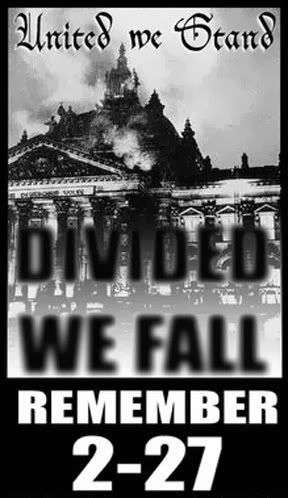
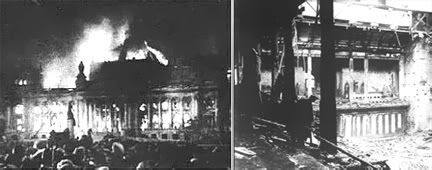
Then, just 28 days after Hitler was appointed chancellor, on the night of February 27, the Reichstag, the home of the parliamentary government, was gutted by a massive fire, and Germany would never be the same again. The Reichstag building was empty, in recess since December and awaiting reopening for the election. Hitler was dining with Goebbels when Goebbels (soon to be Propaganda minister) got a call – the Reichstag was on fire. Thinking it an exaggeration, he ignored it at first, but then followed up and found out it was for real. President Hindenburg was dining with Vice-Chancellor Franz Von Papen, just around the corner from the Reichstag at the exclusive Herrenklub and could actually see the glow from the fire. All raced to the scene. Goering was already there, shouting “this is a Communist crime against the new government! This is the beginning of the Communist Revolution! We must not wait a minute. We will show no mercy. Every Communist official must be shot, where he is found.” [2]
At 9:15 PM smoke was seen pouring from the building, and ten minutes later, as the first firemen arrived on the scene, the fire was raging out of control. At 9:30 there was a “tremendous explosion” and the huge central chamber was filled with flames. The fire quickly raced out of control, and left standing only a gutted shell of the building. [3] The attack killed no one, but certainly provided a shocking symbol of destruction and national vulnerability that changed the tone of election week dramatically.
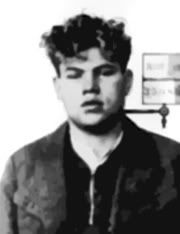
The act of arson was blamed at the time on a young Dutch Communist named Marinus van der Lubbe, arrested dazed and shirtless at the scene minutes after the police arrived. (he apparently used his shirt to start the fire) Wikipedia explains that the 23-year old Van Der Lubbe had “a history of taking responsibility for things he had not done” to spare others. He admitted to starting the massive fire by himself, with only his shirt and some gasoline. That one man was able to ignite such a powerful and explosive fire in the headquarters of the national government, under Goering’s nose but without inside help, seems unlikely. Nonetheless, the mentally ill Van Der Lubbe stubbornly insisted he and he alone was responsible. Ultimately the court proved subservient to the Nazis and the man was convicted, beheaded and buried in an unmarked grave.
But while they bought his admission, Nazi officials refused to believe Van Der Lubbe acted alone. This Goering and the others stressed; after all, this was the “beginning of the Communist Revolution,” so clearly he had to have supporters. A local branch of the Comintern (Communist International) was implicated as the conspiracy probe widened, though the Leipzig Supreme Court was able to establish no connection between the Comintern delegates and the actual crime. [4] But such minutiae escaped much of the German public, for whom the nature of the threat was obvious. The solution – the Nazi way – also became obvious to more people than ever as the March 5 election drew near. Either way, Hitler and his disciples decided, this time they would have their coveted majority. Either he would win, or they would go ahead with their coup.
With this contingency plan in mind, the Nazis played fast and loose with the political rhetoric. On March 3, just two days before the election Goering delivered a rousing campaign speech in which he promised the voters “my measures will not be crippled by any judicial thinking… I don’t have to worry about justice; my mission is only to destroy and exterminate, nothing more! …Certainly I shall use the power of the state and the police to the utmost, my dear Communists, so don’t draw any false conclusions; but the struggle to the death, in which my fist will grasp your necks, I shall lead with those down there – the Brownshirts.” [5] While this likely lost him some Communist votes, he probably had the Brownshirt vote locked up after that speech, and when the election came around, the National Socialist Party managed to take 52% of the seats.
Sources:
[1] Shirer, William. The Rise and Fall of the Third Reich: A History of Nazi Germany. New York. Crest Books. 7th Printing. July 1965. Page 267. [2] Page 268.
[3], [4] Swigart, Soren. “The Reichstag Fire.” The World at War. http://worldatwar.net/event/reichstagsbrand/
[5] Nazi Conspiracy and Aggression Volume IV. Document No. 1856-PS. http://www.yale.edu/lawweb/avalon/imt/document/nca_vol4/1856-ps.htm
Then, just 28 days after Hitler was appointed chancellor, on the night of February 27, the Reichstag, the home of the parliamentary government, was gutted by a massive fire, and Germany would never be the same again. The Reichstag building was empty, in recess since December and awaiting reopening for the election. Hitler was dining with Goebbels when Goebbels (soon to be Propaganda minister) got a call – the Reichstag was on fire. Thinking it an exaggeration, he ignored it at first, but then followed up and found out it was for real. President Hindenburg was dining with Vice-Chancellor Franz Von Papen, just around the corner from the Reichstag at the exclusive Herrenklub and could actually see the glow from the fire. All raced to the scene. Goering was already there, shouting “this is a Communist crime against the new government! This is the beginning of the Communist Revolution! We must not wait a minute. We will show no mercy. Every Communist official must be shot, where he is found.” [2]
 |
At 9:15 PM smoke was seen pouring from the building, and ten minutes later, as the first firemen arrived on the scene, the fire was raging out of control. At 9:30 there was a “tremendous explosion” and the huge central chamber was filled with flames. The fire quickly raced out of control, and left standing only a gutted shell of the building. [3] The attack killed no one, but certainly provided a shocking symbol of destruction and national vulnerability that changed the tone of election week dramatically.
 |
But while they bought his admission, Nazi officials refused to believe Van Der Lubbe acted alone. This Goering and the others stressed; after all, this was the “beginning of the Communist Revolution,” so clearly he had to have supporters. A local branch of the Comintern (Communist International) was implicated as the conspiracy probe widened, though the Leipzig Supreme Court was able to establish no connection between the Comintern delegates and the actual crime. [4] But such minutiae escaped much of the German public, for whom the nature of the threat was obvious. The solution – the Nazi way – also became obvious to more people than ever as the March 5 election drew near. Either way, Hitler and his disciples decided, this time they would have their coveted majority. Either he would win, or they would go ahead with their coup.
With this contingency plan in mind, the Nazis played fast and loose with the political rhetoric. On March 3, just two days before the election Goering delivered a rousing campaign speech in which he promised the voters “my measures will not be crippled by any judicial thinking… I don’t have to worry about justice; my mission is only to destroy and exterminate, nothing more! …Certainly I shall use the power of the state and the police to the utmost, my dear Communists, so don’t draw any false conclusions; but the struggle to the death, in which my fist will grasp your necks, I shall lead with those down there – the Brownshirts.” [5] While this likely lost him some Communist votes, he probably had the Brownshirt vote locked up after that speech, and when the election came around, the National Socialist Party managed to take 52% of the seats.
Sources:
[1] Shirer, William. The Rise and Fall of the Third Reich: A History of Nazi Germany. New York. Crest Books. 7th Printing. July 1965. Page 267. [2] Page 268.
[3], [4] Swigart, Soren. “The Reichstag Fire.” The World at War. http://worldatwar.net/event/reichstagsbrand/
[5] Nazi Conspiracy and Aggression Volume IV. Document No. 1856-PS. http://www.yale.edu/lawweb/avalon/imt/document/nca_vol4/1856-ps.htm
Friday, December 15, 2006
12/7 part I: AMERICA AT A CROSSROADS
As the great ideological struggles of the mid-20th Century began to play themselves out in Europe, the United States was in the midst of the Great Depression, and one had to look no farther than the nearest bread line to get the feeling the old system wasn’t working. But the disaffected nation seemed at cross-odds with itself as to what side, if any, it was on. The country was divided right and left, with growing sympathies towards Stalin and Hitler amid a shrinking but intensifying core of principled isolationists. Wall Street was enamored of the fascists - first Mussolini, then Hitler – and their promises to roll back the influence of Communism in Europe. Moral and material support flowed to the axis, mostly kept secret at the time. A Congressional Committee later uncovered the letters of Col. William Taylor from 1932-33, explaining “German political associations, like the Nazis and others, are nearly all armed with American [guns] The principal arms coming from America are Thompson submachine guns and revolvers. The number is great.” [1] These shipments were largely from Remington, and came at a time when the Weimer Republic was struggling for survival against the Nazis.
In early 1933, just as Hitler’s “National Socialists” finally took over in Germany with their guns and thugs and engineered Reichstag fire, a new U.S. President, Franklin D, Roosevelt, was sworn-in. Upon entering office, Roosevelt established his Socialist-style New Deal, angering the financial establishment. Some factions on Wall Street and in the military with Fascist sympathies in fact allegedly plotted to overthrow FDR in 1934, but this was brought to light and led to a congressional investigation in November into what many called the “business plot” (more below). [2] 1934 was already the year of the “Merchants of Death,” the title both of a book blaming arms-makers for WWI, and the nickname for another Congressional investigation into the munitions industry in question for arming the Nazis and their allies. [3] Under the leadership Gerald Nye and with general counsel Alger Hiss, the committee was in operation through 1936, eventually finding that World War I was not engineered by the munitions industry. [4]
But still, Merchants of Death was soon joined by another pivotal book in redefining WWI: Brigadier General Smedley Butler’s 1935 War is a Racket (“the only one in which the profits arte reckoned in dollars and the losses in lives”). [5] The decorated WWI commander and reformed “racketeer for capitalism” insisted America should simply strengthen its defenses and stay out of the coming war in Europe. Butler, unlike many other isolationists, was not a Nazi sympathizer in any way, but an avowed leftist who believed in “taking Wall Street by the throat” to pay WWI soldiers’ bonus pay. [6] He had also been central in publicizing the alleged “Business Plot” against FDR, having curiously been invited to join it despite his known slant and big mouth.
The Congress seemed dispose to agree with Butler's and the public's sentiment; neutrality acts were passed from 1935-37 and isolationism reigned as Americans struggled to stay out of another engineered World War. But conflict just kept getting more inevitable as the Axis got stronger and bolder - with continued American aid. Munitions assistance was limited after 1934, but the Nazis were in power by then and fully capable of making their own excellent weapons. But financial assistance for Germany’s Third Reich continued from New York by, for example, Chase National Bank of Manhattan, as explained by Charles Higham in Trading with the Enemy (1983). Of course there was Henry Ford, the well-known Nazi supporter and anti-Semite who approved the construction of trucks to assist the German occupation in France through its French subsidiary Opel in 1940-41. [7] The crimes of the Rockefeller-owned Standard Oil of New Jersey in supporting the Reich are epic, assisting the German Army, Navy, and Air Force with their fuel and petrochemical needs through numerous arrangements. Higham summarized: “[T]he heartbreaking truth is that a number of financial and industrial figures of World War II and several members of the government served the cause of money before the cause of patriotism. While aiding the United States’ war effort, they also aided Nazi Germany’s.” [8]
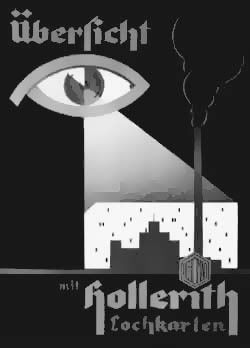
A key technology that helped Nazi Germany be so ruthlessly efficient was provided by International Business Machines (IBM). As Edwin Black illustrated in his 2001 IBM and the Holocaust, the company’s German subsidiary Dehomag manufactured thousands of punch-card machines, proto-computers that greatly sped-up the Reich’s data processing. With full support from and handsome (if complicated) profits to IBM headquarters, Dehomag’s machines were used in everything from a race-based census to tracking materiel for warfare, to the movement of people to concentration camps and gas chambers. The 5-digit prisoner coding system for these machines was in fact the origin of the famous tattoos at Auschwitz. [9] IBM continues to base its own holocaust denials on the argument that Dehomag was no longer connected to IBM at the time, but the factual record Black presented indicates otherwise.
Of course eventuall Germany signed a mutual defense clause with Japan, then Japan was maneuvered into attacking the US, which was soon at war against the Third Reich and set to turning back its grip on Europe. The War triggered an immediate rush to build a mighty war machine on the shoulders of the once-villified “merchants of death” who were able to reform themselves by fighting the Nazis they’d helped build up, and were paid well for their services. It’s not necessarily that Smedley Butler was right and War is simply a racket engineered for profit, but if it were, this is about how it would be done: build up the Axis and withhold from the Allies in phase one, and once a crisis is reached, cut the Axis off (but only at the last possible moment) and start supplying the Allies as they gear up to move in on the worldwide battlefronts created by years of well supplied Axis aggression.
Sources:
[1] Tarpley, Webster G. and Anton Chaitkin. George Bush: The Unauthorized Biography. Chapter - II - The Hitler Project. Accessed online at: http://www.tarpley.net/bush2.htm
[2] Parfrey, Adam. “How a Military Hero Blew the whistle on Corporate Malfeasance.” Foreword to the 2003 Feral House edition of War is a Racket by Smedley D. Butler (1935) Pages 10-18.
[3] Phillips, Kevin. American Dynasty: Aristocracy, Fortune, and Deceit in the House of Bush. New York. Viking Penguin. 2004. Page 259.
[4] “Nye Committee.” Wikipedia. http://en.wikipedia.org/wiki/Nye_Committee
[5] Butler, Smedley D. “War is a Racket.” 1935. Re-released under original title with additional material: Los Angeles. Feral House. 2003. Page 23
[6] See [2]. Page 8.
[7] Higham, Charles. Trading with the Enemy: an Expose of the Nazi-American Money plot, 1933-1949. New York, Delacorte Press, 1983. Second Printing.. Page xv.
[8] See [7]. Page xiii.
[9] Black, Edwin. “IBM and the Holocaust: The Strategic Alliance Between Nazi Germany and America’s Most Powerful Corporation.” Three Rivers Press. March 2002. Page 352.
In early 1933, just as Hitler’s “National Socialists” finally took over in Germany with their guns and thugs and engineered Reichstag fire, a new U.S. President, Franklin D, Roosevelt, was sworn-in. Upon entering office, Roosevelt established his Socialist-style New Deal, angering the financial establishment. Some factions on Wall Street and in the military with Fascist sympathies in fact allegedly plotted to overthrow FDR in 1934, but this was brought to light and led to a congressional investigation in November into what many called the “business plot” (more below). [2] 1934 was already the year of the “Merchants of Death,” the title both of a book blaming arms-makers for WWI, and the nickname for another Congressional investigation into the munitions industry in question for arming the Nazis and their allies. [3] Under the leadership Gerald Nye and with general counsel Alger Hiss, the committee was in operation through 1936, eventually finding that World War I was not engineered by the munitions industry. [4]
But still, Merchants of Death was soon joined by another pivotal book in redefining WWI: Brigadier General Smedley Butler’s 1935 War is a Racket (“the only one in which the profits arte reckoned in dollars and the losses in lives”). [5] The decorated WWI commander and reformed “racketeer for capitalism” insisted America should simply strengthen its defenses and stay out of the coming war in Europe. Butler, unlike many other isolationists, was not a Nazi sympathizer in any way, but an avowed leftist who believed in “taking Wall Street by the throat” to pay WWI soldiers’ bonus pay. [6] He had also been central in publicizing the alleged “Business Plot” against FDR, having curiously been invited to join it despite his known slant and big mouth.
The Congress seemed dispose to agree with Butler's and the public's sentiment; neutrality acts were passed from 1935-37 and isolationism reigned as Americans struggled to stay out of another engineered World War. But conflict just kept getting more inevitable as the Axis got stronger and bolder - with continued American aid. Munitions assistance was limited after 1934, but the Nazis were in power by then and fully capable of making their own excellent weapons. But financial assistance for Germany’s Third Reich continued from New York by, for example, Chase National Bank of Manhattan, as explained by Charles Higham in Trading with the Enemy (1983). Of course there was Henry Ford, the well-known Nazi supporter and anti-Semite who approved the construction of trucks to assist the German occupation in France through its French subsidiary Opel in 1940-41. [7] The crimes of the Rockefeller-owned Standard Oil of New Jersey in supporting the Reich are epic, assisting the German Army, Navy, and Air Force with their fuel and petrochemical needs through numerous arrangements. Higham summarized: “[T]he heartbreaking truth is that a number of financial and industrial figures of World War II and several members of the government served the cause of money before the cause of patriotism. While aiding the United States’ war effort, they also aided Nazi Germany’s.” [8]
 |
Of course eventuall Germany signed a mutual defense clause with Japan, then Japan was maneuvered into attacking the US, which was soon at war against the Third Reich and set to turning back its grip on Europe. The War triggered an immediate rush to build a mighty war machine on the shoulders of the once-villified “merchants of death” who were able to reform themselves by fighting the Nazis they’d helped build up, and were paid well for their services. It’s not necessarily that Smedley Butler was right and War is simply a racket engineered for profit, but if it were, this is about how it would be done: build up the Axis and withhold from the Allies in phase one, and once a crisis is reached, cut the Axis off (but only at the last possible moment) and start supplying the Allies as they gear up to move in on the worldwide battlefronts created by years of well supplied Axis aggression.
Sources:
[1] Tarpley, Webster G. and Anton Chaitkin. George Bush: The Unauthorized Biography. Chapter - II - The Hitler Project. Accessed online at: http://www.tarpley.net/bush2.htm
[2] Parfrey, Adam. “How a Military Hero Blew the whistle on Corporate Malfeasance.” Foreword to the 2003 Feral House edition of War is a Racket by Smedley D. Butler (1935) Pages 10-18.
[3] Phillips, Kevin. American Dynasty: Aristocracy, Fortune, and Deceit in the House of Bush. New York. Viking Penguin. 2004. Page 259.
[4] “Nye Committee.” Wikipedia. http://en.wikipedia.org/wiki/Nye_Committee
[5] Butler, Smedley D. “War is a Racket.” 1935. Re-released under original title with additional material: Los Angeles. Feral House. 2003. Page 23
[6] See [2]. Page 8.
[7] Higham, Charles. Trading with the Enemy: an Expose of the Nazi-American Money plot, 1933-1949. New York, Delacorte Press, 1983. Second Printing.. Page xv.
[8] See [7]. Page xiii.
[9] Black, Edwin. “IBM and the Holocaust: The Strategic Alliance Between Nazi Germany and America’s Most Powerful Corporation.” Three Rivers Press. March 2002. Page 352.
Remember the Maine, Forget the Treachery
In 1895, revolutions broke out in both Cuba and the Philippines, then Spanish colonial possessions. The Spanish dispatched General Valeriano “Butcher” Weyler to take over Cuba and suppress the “Insurrectos.” Soon death squads, concentration camps and the like made headlines in the U.S. Both the sugar industry and humanitarian sentiment were upset by this instability, and calls for intervention grew. In 1896, the recently created Office of Naval Intelligence drafted a plan should war with Spain be ignited over these developing issues. The plan recommended simultaneously attacking Spanish colonial holdings in the Philippines and in the Caribbean. The conclusion, apparently, was that the U.S. would win handily and could easily seize these strategic possessions.
In March 1897, President William McKinley was sworn in, replacing Grover Cleveland, who had vowed neutrality in the Cuban affair. McKinley was taunted by the war hawks in government, finance and the media for his own failure to go to war right away. But the gears kept turning at the Navy, under Secretary John Long and his assistant Secretary Theodore Roosevelt; by the end of June, the Navy had adopted the 1896 war plan. In August, Long went on vacation, leaving Roosevelt at the helm. President McKinley invited Teddy for at least two personal discussions, at which time the acting Secretary acquainted the President with the ONI’s suggestions. [1] McKinley was apparently impressed with both Teddy and the plan.
Lacking a pretext for such a war, someone in Navy leadership ordered the state-of-the-art battleship U.S.S. Maine to visit Havana Harbor in December. The mission of the Maine is not entirely clear – some sources say it was to evacuate Americans if war broke out, but others point out that the ship would have little room for evacuees, loaded as it was with tons of ammunition. As George J.A. O’Toole described it: “a friendly visit, the Americans blandly proclaimed; a welcome one, the Spanish replied with frigid propriety.” [2] The Maine’s appearance in late January 1898 was grudgingly accepted in Cuba; it moored for a few uneventful weeks until the night of February 15, when the ship was rocked by two powerful explosions, setting off the ammunition on board, and quickly sunk at a cost of about 260 sailors and officers dead.

After the explosion, the wreck of the U.S.S. Maine in 1900. Credit: Jackson, William Henry, photographer. "Wreck of the U.S.S. Maine." Detroit Publishing Company ca. 1900. Touring Turn-of-the-Century America: Photographs from the Detroit Publishing Company, 1880-1920, Library of Congress.
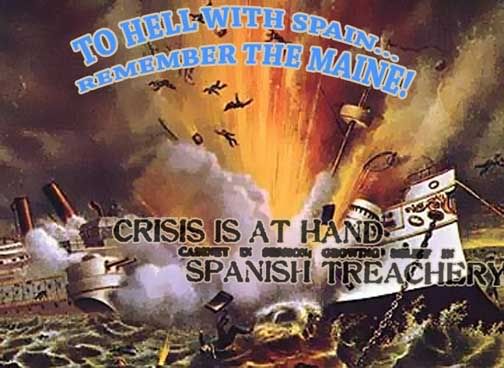
The 2-15 blast was painted at the time as certain Spanish sabotage, ignoring that Spain had no hope of winning a war and no reason for starting one. Yet the “yellow press,” notably the Hearst papers, hyped-up the celebrated battleship’s destruction into a vicious war drive. The famous cry, of course, was “To Hell with Spain! Remember the Maine!” Some, like Samuel Clemens and Andrew Carnegie, were royally pissed at the nascent U.S. imperialism this “splendid little war” evidenced. But despite the protests, “Butcher” Weyler and the bloody sabotaging Spaniards were easily stopped.
The new American possession of the Philippines soon saw its own, larger butchery under the U.S. Army, and Hawaii was annexed as a coaling station to support the war in the Philippines. Puerto Rico has lobbied to become a state of the Union like Hawaii, but with no Pearl Harbor moment of their own, they languish in a semi-colonial status as a military firing range. Cuba’s fate was left complex, with independence so long as the U.S. Navy could maintain a toehold at Guantanamo Bay, which is still in use despite four decades of Castro’s rule, and has of course been back in the news lately as a “legal Black Hole” for the prisoners of WWIV.
As for the Spanish treachery that “started the game” at Havana Harbor and led to all of this, initial inquiries upheld the official story that the Maine was sunk with a submerged mine, presumably Spanish. In 1912 the ship was moved and sunk in the deeper sea, effectively burying the evidence. It wasn’t until the 1970s that the evidence was again dredged up by Admiral Rickover, whose commission decided the blast was probably caused by a coal-room fire, presumably an accident, that set off the ammunition aboard. This is now the generally accepted theory, but I would note that it was a well-timed accident that the Maine should blow up, of all times and places, right after it had docked in soon-to-be-enemy waters for murky reasons, allowing that two-year-old plan to go into effect to the great benefit of U.S. policy.
Theodore Roosevelt, who had sold the President on this plan, resigned his desk job soon after 2-15, going to Cuba and strenuously getting his picture taken on San Juan Hill with his much-publicized “Rough Riders.” As president McKinley rode his swift and profitable victory into a second term in the 1900 election, Teddy joined him as vice president, sworn-in in March 1901. After McKinley was gunned down by a crazed anarchist six months later, Teddy was speaking softly while carrying the big stick of the U.S. presidency with three and a half years ahead of him and no vice president to worry about.
---
Sources:
[1] O’Toole, G.J.A. "The Spanish War: An American Epic 1898." New York. WW Norton. 1989. Pages 100-102.
[2] See [1] O’Toole. Page 21.
In March 1897, President William McKinley was sworn in, replacing Grover Cleveland, who had vowed neutrality in the Cuban affair. McKinley was taunted by the war hawks in government, finance and the media for his own failure to go to war right away. But the gears kept turning at the Navy, under Secretary John Long and his assistant Secretary Theodore Roosevelt; by the end of June, the Navy had adopted the 1896 war plan. In August, Long went on vacation, leaving Roosevelt at the helm. President McKinley invited Teddy for at least two personal discussions, at which time the acting Secretary acquainted the President with the ONI’s suggestions. [1] McKinley was apparently impressed with both Teddy and the plan.
Lacking a pretext for such a war, someone in Navy leadership ordered the state-of-the-art battleship U.S.S. Maine to visit Havana Harbor in December. The mission of the Maine is not entirely clear – some sources say it was to evacuate Americans if war broke out, but others point out that the ship would have little room for evacuees, loaded as it was with tons of ammunition. As George J.A. O’Toole described it: “a friendly visit, the Americans blandly proclaimed; a welcome one, the Spanish replied with frigid propriety.” [2] The Maine’s appearance in late January 1898 was grudgingly accepted in Cuba; it moored for a few uneventful weeks until the night of February 15, when the ship was rocked by two powerful explosions, setting off the ammunition on board, and quickly sunk at a cost of about 260 sailors and officers dead.
After the explosion, the wreck of the U.S.S. Maine in 1900. Credit: Jackson, William Henry, photographer. "Wreck of the U.S.S. Maine." Detroit Publishing Company ca. 1900. Touring Turn-of-the-Century America: Photographs from the Detroit Publishing Company, 1880-1920, Library of Congress.
The 2-15 blast was painted at the time as certain Spanish sabotage, ignoring that Spain had no hope of winning a war and no reason for starting one. Yet the “yellow press,” notably the Hearst papers, hyped-up the celebrated battleship’s destruction into a vicious war drive. The famous cry, of course, was “To Hell with Spain! Remember the Maine!” Some, like Samuel Clemens and Andrew Carnegie, were royally pissed at the nascent U.S. imperialism this “splendid little war” evidenced. But despite the protests, “Butcher” Weyler and the bloody sabotaging Spaniards were easily stopped.
The new American possession of the Philippines soon saw its own, larger butchery under the U.S. Army, and Hawaii was annexed as a coaling station to support the war in the Philippines. Puerto Rico has lobbied to become a state of the Union like Hawaii, but with no Pearl Harbor moment of their own, they languish in a semi-colonial status as a military firing range. Cuba’s fate was left complex, with independence so long as the U.S. Navy could maintain a toehold at Guantanamo Bay, which is still in use despite four decades of Castro’s rule, and has of course been back in the news lately as a “legal Black Hole” for the prisoners of WWIV.
As for the Spanish treachery that “started the game” at Havana Harbor and led to all of this, initial inquiries upheld the official story that the Maine was sunk with a submerged mine, presumably Spanish. In 1912 the ship was moved and sunk in the deeper sea, effectively burying the evidence. It wasn’t until the 1970s that the evidence was again dredged up by Admiral Rickover, whose commission decided the blast was probably caused by a coal-room fire, presumably an accident, that set off the ammunition aboard. This is now the generally accepted theory, but I would note that it was a well-timed accident that the Maine should blow up, of all times and places, right after it had docked in soon-to-be-enemy waters for murky reasons, allowing that two-year-old plan to go into effect to the great benefit of U.S. policy.
Theodore Roosevelt, who had sold the President on this plan, resigned his desk job soon after 2-15, going to Cuba and strenuously getting his picture taken on San Juan Hill with his much-publicized “Rough Riders.” As president McKinley rode his swift and profitable victory into a second term in the 1900 election, Teddy joined him as vice president, sworn-in in March 1901. After McKinley was gunned down by a crazed anarchist six months later, Teddy was speaking softly while carrying the big stick of the U.S. presidency with three and a half years ahead of him and no vice president to worry about.
---
Sources:
[1] O’Toole, G.J.A. "The Spanish War: An American Epic 1898." New York. WW Norton. 1989. Pages 100-102.
[2] See [1] O’Toole. Page 21.
Wednesday, December 13, 2006
TRADING WITH THE ENEMY: BUSH FAMILY DEEP HISTORY
After the investigative rush of 1934-1936, probes into Nazi-connected activity sloughed-off - but that’s not to say the Nazi support sloughed-off any. But as war neared, Justice Department investigations into “German-connected companies” were re-established by the Roosevelt administration in mid-1941. These went into overdrive after the 12-7 attack and congressional passage of the Trading with the Enemy Act which came within weeks. It was not limited to arms-makers this time.
In March 1942 an additional special Senate committee started hearings on those doing business in Nazi Germany. Within the month, Kevin Phillips explains in American Dynasty, Stimson asked the President “to stop the investigations because they would interfere with companies engaged in the war effort.” The Senate committee apparently was stopped, but other investigations under the Trading with the Enemy Act were unaffected and rolled on. Phillips noted “none of this would have been happy news for Prescott Bush,” who was indeed ‘engaged in the war effort.’ [1]
Webster Tarpley and Anton Chaitkin, in their 1990 classic George Bush: the Unauthorized Biography, capture the irony of the situation seven months later. One of those investigations Stimson had been unable to prevent eventually nabbed his friend’s corporation.
“In October 1942, ten months after entering World War II, America was preparing its first assault against Nazi military forces. Prescott Bush was managing partner of Brown Brothers Harriman. His 18-year-old son George, the future U.S. President, had just begun training to become a naval pilot. On Oct. 20, 1942, the U.S. government ordered the seizure of Nazi German banking operations in New York City which were being conducted by Prescott Bush. '' [2]
The government took over the Union Banking Corporation (UBC), in which Bush was one of twelve directors. The original order from the alien properties custodian described UBC as “a New York corporation [...] all of which shares are held for the benefit of [...] members of the Thyssen family, [and] is property of nationals [...] of a designated enemy country. '' [3] This “Thyssen family” was in essence Fritz Thyssen, a politically important German steel baron, one of the top players in Germany’s military-industrial complex, and an ardent, two-decade Nazi supporter. He had published a book in 1941 called I Paid Hitler,” admitting he had been funding the Nazi party since late 1923. [4]
The Union Banking Corporation, according to Kevin Phillips, was in fact established on Thyssen’s behalf in 1924 by W. Averell Harriman and his partner George Herbert Walker. [5] The framework from which UBC was formed was W.A. Harriman & Co. (later part of Brown Brothers Harriman), a Wall Street investment and banking firm established in 1919. Walker’s son-in-law Prescott Bush, who, like Harriman, was a member of Skull and Bones, was brought in as a junior partner in 1926 and quickly rose in rank to partner. [6] (Note: George H. Walker, it should be noted, was not himself a “bonesman,” but his descendents would be, and Prescott’s son would soon carry the very name “George Herbert Walker” into the society’s ranks.)
Unlike Walker and Bush, Harriman was a Democrat, and had very, very high connections. He would somehow play a pivotal role in the War; President Roosevelt’s personal, unofficial, floating ambassador to Stalin’s Soviet Union and Churchill’s UK. From February 1941 and on, Harriman regularly hobnobbed with the allied leaders under instructions to report directly to the White House, bypassing normal diplomatic channels and Congressional approval. He maintained this special role throughout the war, attending all of the wartime conferences and twice going on missions to arrange increased aid to the Soviet Union. In October 1943 he got his first official appointment as ambassador to the USSR, just one year after the seizure of the Union Banking Corporation that had helped bankroll, among other things, the Nazi’s invasion of Russia. [7] Averell never left the board of Brown Brothers Harriman during this time, remaining a partner until 1946. [8] Yet he was apparently never mentioned in orders against the company’s subsidiaries, which finally had to be closed down by force nearly a year after America entered the war and nearly two years after Harriman himself had entered it.
Tarpley and Chaitkin list the shareholders of Union Banking Corporation mentioned in the October 1942 order. The majority shareholder was E. Roland Harriman, chairman and director of UBC and Averell’s brother. He held 3,991 shares. The authors explain “this is “Bunny” Harriman, described by Prescott Bush as a place holder who didn’t get much into banking affairs; Prescott managed his personal investments” Prescott himself, and all other shareholders besides “Bunny,” held only one token share apiece, presumably to allow them to sit in on decisions but limit their culpability. [9] And isn’t that the magic of a corporation anyway? The list also included two Dutch men (also with one share each) who managed the Nazi end of the business. (The Netherlands was at the time under German occupation.) It was these men’s Dutch bank that nominally “controlled” UBC and also handled Thyssen’s donations to the Nazi party. [10]
According to Kevin Phillips in American Dynasty, Brown Brothers Harriman-Nazi-connected property was seized during the course of late 1942, just as American forces were preparing for major combat in North Africa. These seizures started in August with the Hamburg-Amerika line, partly owned by a corporation controlled by Harriman and Walker. Then there was the seizure in October of UBC’s assets, which netted Bunny Harriman, Prescott Bush, and others as we’ve seen. In November, the last entity, the Silesian-American Corporation, was seized. [11] This was a holding company through which, Tarpley and Chaitkin explain, “the Harriman firms […] bought a one-third interest in the principal German-owned coal and zinc mines in Poland,” the other two-thirds of which were held by Friedrich Flick, another top Nazi industrialist who worked with Thyssen. [12]
The investigative report prior to the government crackdown explained the significance of Brown Brothers Harriman’s role: “Since September 1939, these properties have been in the possession of and have been operated by the German government and have undoubtedly been of considerable assistance to that country in its war effort.” [13]
For its part, the Union Banking Corp., which Prescott Bush had directed since 1934, eventually helped Thyssen finance what would become 30-50% of German national output for various materials (like pig iron, heavy plate armor, and explosives), which were used liberally in the conquest of Europe. [14] Like the others who helped create the formidable Nazi menace America would be forced to fight, Bush was not punished, but rather was rewarded. Prescott Bush somehow went on to be a U.S. Senator (R-CT), and his son a Senator (R-TX), CIA Director and U.S. President, his grandson a Governor (R-TX) and U.S. President… Somehow, what should have been a name that draws spittle to the lips was carried all the way to the White House where it seems intent on staying.
So anyway, the Union Banking Corporation continued operations into late 1941, as Pearl Harbor neared. Both Prescott’s business partner Averell Harriman and his friend Henry Stimson were working personally with FDR as he labored to provoke a Japanese attack and manage America’s entry into the War. It’s also worth noting that all three of these men, Stimson, Harriman, and Bush, shared the bond of secrecy that comes with induction into Skull and Bones. We can neither prove nor rule out that Prescott had, through either of these channels or elsewhere, learned by this time that 12/7 was about to happen under FDR’s provocations – and either way, the attack and America’s entry into the war eventually disrupted his profitable dealings with Thyssen. It can only be wondered what his son George knew or suspected or felt about Roosevelt’s decision as he enlisted to avenge the engineered attack and fight the allies of the man his father had helped get in power. Probably no hard feelings. Business was business after all.
Sources:
[1] Phillips, Kevin. “American Dynasty: Aristocracy, Fortune, and the Politics of Deceit in the House of Bush.” New York. Viking. 2004. Page 39.
[2] Tarpley, Webster G. and Anton Chaitkin. George Bush: The Unauthorized Biography. Chapter - II - The Hitler Project. Accessed online at: http://www.tarpley.net/bush2.htm
[3] See [2].
[4] See [2].
[5] See [1]. Page 180.
[6] “Prescott Bush.” Wikipedia. Accessed September 28, 2005 at: http://en.wikipedia.org/wiki/Prescott_S._Bush
[7] “W. Averell Harriman.” The Reader’s Companion to American History. Houghton Mifflin. Accessed September 27, 2005 at: http://college.hmco.com/history/readerscomp/rcah/html/ah_040400_harrimanwave.htm
[8] Truman Presidential Museum and Library. “Profile of W. Averell Harriman.” Accessed September 28, 2005 at: http://www.trumanlibrary.org/profile/viewpro.php?pid=87
[9] See [2].
[10] See [1]. Page 180.
[11] See [1]. Page 39.
[12], [13], [14], See [2].
In March 1942 an additional special Senate committee started hearings on those doing business in Nazi Germany. Within the month, Kevin Phillips explains in American Dynasty, Stimson asked the President “to stop the investigations because they would interfere with companies engaged in the war effort.” The Senate committee apparently was stopped, but other investigations under the Trading with the Enemy Act were unaffected and rolled on. Phillips noted “none of this would have been happy news for Prescott Bush,” who was indeed ‘engaged in the war effort.’ [1]
Webster Tarpley and Anton Chaitkin, in their 1990 classic George Bush: the Unauthorized Biography, capture the irony of the situation seven months later. One of those investigations Stimson had been unable to prevent eventually nabbed his friend’s corporation.
“In October 1942, ten months after entering World War II, America was preparing its first assault against Nazi military forces. Prescott Bush was managing partner of Brown Brothers Harriman. His 18-year-old son George, the future U.S. President, had just begun training to become a naval pilot. On Oct. 20, 1942, the U.S. government ordered the seizure of Nazi German banking operations in New York City which were being conducted by Prescott Bush. '' [2]
The government took over the Union Banking Corporation (UBC), in which Bush was one of twelve directors. The original order from the alien properties custodian described UBC as “a New York corporation [...] all of which shares are held for the benefit of [...] members of the Thyssen family, [and] is property of nationals [...] of a designated enemy country. '' [3] This “Thyssen family” was in essence Fritz Thyssen, a politically important German steel baron, one of the top players in Germany’s military-industrial complex, and an ardent, two-decade Nazi supporter. He had published a book in 1941 called I Paid Hitler,” admitting he had been funding the Nazi party since late 1923. [4]
 |
Unlike Walker and Bush, Harriman was a Democrat, and had very, very high connections. He would somehow play a pivotal role in the War; President Roosevelt’s personal, unofficial, floating ambassador to Stalin’s Soviet Union and Churchill’s UK. From February 1941 and on, Harriman regularly hobnobbed with the allied leaders under instructions to report directly to the White House, bypassing normal diplomatic channels and Congressional approval. He maintained this special role throughout the war, attending all of the wartime conferences and twice going on missions to arrange increased aid to the Soviet Union. In October 1943 he got his first official appointment as ambassador to the USSR, just one year after the seizure of the Union Banking Corporation that had helped bankroll, among other things, the Nazi’s invasion of Russia. [7] Averell never left the board of Brown Brothers Harriman during this time, remaining a partner until 1946. [8] Yet he was apparently never mentioned in orders against the company’s subsidiaries, which finally had to be closed down by force nearly a year after America entered the war and nearly two years after Harriman himself had entered it.
Tarpley and Chaitkin list the shareholders of Union Banking Corporation mentioned in the October 1942 order. The majority shareholder was E. Roland Harriman, chairman and director of UBC and Averell’s brother. He held 3,991 shares. The authors explain “this is “Bunny” Harriman, described by Prescott Bush as a place holder who didn’t get much into banking affairs; Prescott managed his personal investments” Prescott himself, and all other shareholders besides “Bunny,” held only one token share apiece, presumably to allow them to sit in on decisions but limit their culpability. [9] And isn’t that the magic of a corporation anyway? The list also included two Dutch men (also with one share each) who managed the Nazi end of the business. (The Netherlands was at the time under German occupation.) It was these men’s Dutch bank that nominally “controlled” UBC and also handled Thyssen’s donations to the Nazi party. [10]
According to Kevin Phillips in American Dynasty, Brown Brothers Harriman-Nazi-connected property was seized during the course of late 1942, just as American forces were preparing for major combat in North Africa. These seizures started in August with the Hamburg-Amerika line, partly owned by a corporation controlled by Harriman and Walker. Then there was the seizure in October of UBC’s assets, which netted Bunny Harriman, Prescott Bush, and others as we’ve seen. In November, the last entity, the Silesian-American Corporation, was seized. [11] This was a holding company through which, Tarpley and Chaitkin explain, “the Harriman firms […] bought a one-third interest in the principal German-owned coal and zinc mines in Poland,” the other two-thirds of which were held by Friedrich Flick, another top Nazi industrialist who worked with Thyssen. [12]
The investigative report prior to the government crackdown explained the significance of Brown Brothers Harriman’s role: “Since September 1939, these properties have been in the possession of and have been operated by the German government and have undoubtedly been of considerable assistance to that country in its war effort.” [13]
For its part, the Union Banking Corp., which Prescott Bush had directed since 1934, eventually helped Thyssen finance what would become 30-50% of German national output for various materials (like pig iron, heavy plate armor, and explosives), which were used liberally in the conquest of Europe. [14] Like the others who helped create the formidable Nazi menace America would be forced to fight, Bush was not punished, but rather was rewarded. Prescott Bush somehow went on to be a U.S. Senator (R-CT), and his son a Senator (R-TX), CIA Director and U.S. President, his grandson a Governor (R-TX) and U.S. President… Somehow, what should have been a name that draws spittle to the lips was carried all the way to the White House where it seems intent on staying.
So anyway, the Union Banking Corporation continued operations into late 1941, as Pearl Harbor neared. Both Prescott’s business partner Averell Harriman and his friend Henry Stimson were working personally with FDR as he labored to provoke a Japanese attack and manage America’s entry into the War. It’s also worth noting that all three of these men, Stimson, Harriman, and Bush, shared the bond of secrecy that comes with induction into Skull and Bones. We can neither prove nor rule out that Prescott had, through either of these channels or elsewhere, learned by this time that 12/7 was about to happen under FDR’s provocations – and either way, the attack and America’s entry into the war eventually disrupted his profitable dealings with Thyssen. It can only be wondered what his son George knew or suspected or felt about Roosevelt’s decision as he enlisted to avenge the engineered attack and fight the allies of the man his father had helped get in power. Probably no hard feelings. Business was business after all.
Sources:
[1] Phillips, Kevin. “American Dynasty: Aristocracy, Fortune, and the Politics of Deceit in the House of Bush.” New York. Viking. 2004. Page 39.
[2] Tarpley, Webster G. and Anton Chaitkin. George Bush: The Unauthorized Biography. Chapter - II - The Hitler Project. Accessed online at: http://www.tarpley.net/bush2.htm
[3] See [2].
[4] See [2].
[5] See [1]. Page 180.
[6] “Prescott Bush.” Wikipedia. Accessed September 28, 2005 at: http://en.wikipedia.org/wiki/Prescott_S._Bush
[7] “W. Averell Harriman.” The Reader’s Companion to American History. Houghton Mifflin. Accessed September 27, 2005 at: http://college.hmco.com/history/readerscomp/rcah/html/ah_040400_harrimanwave.htm
[8] Truman Presidential Museum and Library. “Profile of W. Averell Harriman.” Accessed September 28, 2005 at: http://www.trumanlibrary.org/profile/viewpro.php?pid=87
[9] See [2].
[10] See [1]. Page 180.
[11] See [1]. Page 39.
[12], [13], [14], See [2].
Sunday, December 10, 2006
Wednesday, December 6, 2006
NORTHWOODS II: SPECIAL DISTRIBUTION - THE PLAN
Before all this could come about, there was at least one more major development regarding Cuba that brings us to the central thread of this book. Bamford wrote “although no one in Congress could have known at the time, Lemnitzer and the Joint Chiefs had quietly slipped over the edge.” [1] They were not through with Cuba - one plan had failed, theirs had not yet been tried. They even had a plan to win public support for this war at all costs, and it was called “Operation Northwoods.” Like the CIA’s Bay of Pigs plan, the roots of Northwoods go back to the twilight of Eisenhower’s term. On January 3, Eisenhower told Lemnitzer and others that, as Bamford explains, “he would move against Castro before [Kennedy’s] inauguration if only the Cubans gave him a really good excuse.” [2] It didn’t happen in time for Eisenhower, but on the 19th, the day before Kennedy was sworn in, new Joint Chiefs chairman Lemnitzer gave his approval to a proposal that would eventually morph into this sinister plan to provide that “really good excuse.” [3]
The origin of the name “Northwoods” is not clear, but is possibly a reference to the London suburb of Northwood, home of the Permanent Joint Headquarters (PJHQ), the British equivalent of the JCS, possibly indicating a British connection or inspiration. In March 1962, Operation Northwoods was completed, and Lemnitzer signed off on it. The “special distribution” document opened:
”As requested by Chief of Operations, Cuba project, the Joint Chiefs of Staff are to indicate brief but precise description of pretexts which they consider would provide justification for US military intervention in Cuba.” [4]
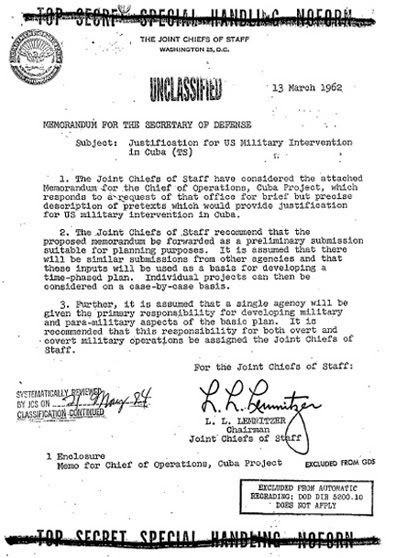
Wikipedia article on Northwoods
Destabilizing or toppling Castro’s regime and the re-subduction of Cuba was still American policy in general, and Northwoods itself was part of a larger, Kennedy-supported “Cuba Project.” But this report went beyond the pale, promoting harassment and a threatening posture to elicit an attack “since,” the memo states, “it would seem desirable to use legitimate provocation as the basis for US military intervention.” [5] But of course Cuba was not Japan, and Castro was not Tojo, and so the report focused more on the backup plans. These were more cynical than anything FDR or Arthur McCollum, the author of his Japan provocation policy, would have dreamed up - if Cuba failed to be provoked into a “mistake,” the JCS proposed providing a pretext themselves in a false flag operation and blaming Cuba for it.
They suggested what they candidly described as a “remember the Maine” incident, the sinking of a U.S. ship in Guantanamo Bay to be blamed on Castro. Mock attacks on U.S. bases by friendly Cubans dressed as Castro forces, the planting of “plastic bombs” in Miami, Washington, and elsewhere, and even the sinking of a boatload of Cuban refugees (“real or simulated”) were mentioned. In fact, a little death would be useful - the report noted that “casualty lists in U.S. newspapers would cause a helpful wave of national indignation.” [6] While they never planned to shoot him down themselves, Northwoods did suggest that, should John Glenn’s space capsule accidentally crash as he attempted the first American orbit of the earth, this could be blamed on Cuba as well. [7]
In all, Northwoods offered dozens of variations on the theme, but the ones regarding aircraft bear a look here. For what it’s worth, all these are neatly contained in pages nine to eleven (that is, 9-11). These received extra attention perhaps because they did not involve deaths at all, simply high-tech aerial acrobats and cynical trickery. Point six, for example, mentions use of “an F-86, properly painted” to simulate a Cuban MIG (Soviet-made) fighter jet, and that “reasonable copies of the MIG could be produced from US resources in about three months.” It mentioned that the “destruction of U.S. military drone aircraft” by these MIG replicas could look convincingly like a Cuban attack. Keep in mind that drone means remote-controlled and pilotless.
Point eight is especially interesting and elaborate. Here is an extended citation (emphasis mine throughout):
“It is possible to create an incident which will demonstrate convincingly that a Cuban aircraft has attacked and shot down a chartered civil airliner en route from the United States to Jamaica, Guatemala, Panama, or Venezuela. The destination would be chosen only to cause the flight plan route to cross Cuba. The passengers could be a group of college students off on a holiday or any grouping of persons with a common interest to support chartering a non-scheduled flight.
a. An aircraft at Elgin AFB would be painted and numbered as an exact duplicate for a civil registered aircraft belonging to a CIA proprietary organization in the Miami area. At a designated time the duplicate would be substituted for the actual civil aircraft and would be loaded with the selected passengers, all boarded under carefully prepared aliases. The actual registered aircraft would then be converted to a drone.
b. Take off times of the drone aircraft and the actual aircraft will be scheduled to allow a rendezvous south of Florida. From the rendezvous point the passenger carrying aircraft will descend to minimum altitude and go directly into an auxiliary field at Elgin AFB where arrangements will have been made to evacuate the passengers and return the aircraft to its original status. The drone aircraft meanwhile will continue to fly the filed flight plan. When over Cuba, the drone will begin transmitting the international distress frequency a “MAY DAY” message stating he is under attack by Cuban MIG aircraft. The transmission will be interrupted by destruction of the aircraft which will be triggered by radio signal. This will allow ICAO radio stations in the Western Hemisphere to tell the US what has happened to the aircraft instead of the US trying to “sell” the incident.”
Points seven and nine also deal with such aircraft-related deceit. These three pages contain several elements of “silly” 9-11 conspiracy theories, even some of the ones I don’t necessarily buy:
- Destruction of remote control drone jets
- Aircraft “rendezvous,” crossing paths to confuse radar and swap drones for manned flights
- Aliases, false paint jobs, and CIA “proprietary companies” to allow pilots, passengers and planes to “disappear”
- Training missions as cover
- Planted evidence of a nonexistent attack
- Manipulated flight data and radio transmissions
- Remote controlled explosives
All of these were presented as real possibilities in a real and proven JCS-sponsored conspiracy. No theory here. The plan suggested the provocations occur “within the time frame of the next few months” and closed with the recommendation that the entire deal be carried out by the Joint Chiefs themselves. [8] After reviewing the memo, Lemnitzer signed it and pitched it to Kennedy’s military representative, General Maxwell Taylor, on March 13, 1962. What exactly happened during the meeting is unknown, but it only took three days for President Kennedy to inform Lemnitzer that the game was over; there was no longer a possibility of overt U.S. force against Cuba. Still the Joint Chiefs persisted, insisting to Defense Secretary McNamara that the war needed to begin soon. McNamara responded by rejecting nearly everything they sent his way. [9]
Within months, Lemnitzer would be denied another term as chairman and transferred to another job. This was not much of a demotion – he was named Commander of U.S. forces in Europe in November 1962 and was appointed Supreme Allied Commander of NATO the following January. [10] He retired from the military in 1969, and in 1975 was selected by President Ford to serve on the Rockefeller Commission, looking into Rockefeller-connected, illegal CIA projects (like the MK Ultra mind control experiments) overseen by his old partner Allen Dulles at the CIA. [11]
But as for Lemnitzer’s own illegal activities - was Northwoods a unique example, or are such “special distribution” recommendations actually common? The report noted on page four “it is assumed that there will be similar submissions from other agencies and that these inputs will be used as a basis for developing a time-phased plan.” [12] It appears that even as far as this “Cuba Project” was concerned, Northwoods was not alone, and they probably knew this from previous experience - its uniqueness therefore may lie not its existence but in its eventual publication.
In fact Bamford notes Northwoods as a precedent for events to come. On the subject of the Gulf of Tonkin incident, the August 1964 alleged attack by North Vietnamese forces on American ships that led to direct U.S. involvement in the Vietnam War, he wrote:
“In light of the Operation Northwoods documents, it is clear that deceiving the public and trumping up wars for Americans to fight and die in was standard, approved policy at the highest levels of the Pentagon. […] One needs only replace “Guanantanamo Bay” with “Tonkin Gulf,” and “Cuba” with “North Vietnam.” The Gulf of Tonkin incident may or may not have been stage-managed, but the senior Pentagon leadership at the time was clearly capable of such deceit.” [13]
Bamford described Northwoods as “what may be the most corrupt plan ever created by the U.S. government.” [14] But that’s not to stay it didn’t have stiff competition, nor that other nations at other times have not trumped the JCS, nor that the U.S. itself hasn’t trumped this in the period after the book’s release. To act like Lemnitzer and his people invented such cynical thinking is disingenuous – such deceit is standard operating procedure for politicians and leaders worldwide and throughout history. But this report shatters the belief that America is somehow different, protected by a bubble of Democracy.
The origin of the name “Northwoods” is not clear, but is possibly a reference to the London suburb of Northwood, home of the Permanent Joint Headquarters (PJHQ), the British equivalent of the JCS, possibly indicating a British connection or inspiration. In March 1962, Operation Northwoods was completed, and Lemnitzer signed off on it. The “special distribution” document opened:
”As requested by Chief of Operations, Cuba project, the Joint Chiefs of Staff are to indicate brief but precise description of pretexts which they consider would provide justification for US military intervention in Cuba.” [4]
Wikipedia article on Northwoods
Destabilizing or toppling Castro’s regime and the re-subduction of Cuba was still American policy in general, and Northwoods itself was part of a larger, Kennedy-supported “Cuba Project.” But this report went beyond the pale, promoting harassment and a threatening posture to elicit an attack “since,” the memo states, “it would seem desirable to use legitimate provocation as the basis for US military intervention.” [5] But of course Cuba was not Japan, and Castro was not Tojo, and so the report focused more on the backup plans. These were more cynical than anything FDR or Arthur McCollum, the author of his Japan provocation policy, would have dreamed up - if Cuba failed to be provoked into a “mistake,” the JCS proposed providing a pretext themselves in a false flag operation and blaming Cuba for it.
They suggested what they candidly described as a “remember the Maine” incident, the sinking of a U.S. ship in Guantanamo Bay to be blamed on Castro. Mock attacks on U.S. bases by friendly Cubans dressed as Castro forces, the planting of “plastic bombs” in Miami, Washington, and elsewhere, and even the sinking of a boatload of Cuban refugees (“real or simulated”) were mentioned. In fact, a little death would be useful - the report noted that “casualty lists in U.S. newspapers would cause a helpful wave of national indignation.” [6] While they never planned to shoot him down themselves, Northwoods did suggest that, should John Glenn’s space capsule accidentally crash as he attempted the first American orbit of the earth, this could be blamed on Cuba as well. [7]
In all, Northwoods offered dozens of variations on the theme, but the ones regarding aircraft bear a look here. For what it’s worth, all these are neatly contained in pages nine to eleven (that is, 9-11). These received extra attention perhaps because they did not involve deaths at all, simply high-tech aerial acrobats and cynical trickery. Point six, for example, mentions use of “an F-86, properly painted” to simulate a Cuban MIG (Soviet-made) fighter jet, and that “reasonable copies of the MIG could be produced from US resources in about three months.” It mentioned that the “destruction of U.S. military drone aircraft” by these MIG replicas could look convincingly like a Cuban attack. Keep in mind that drone means remote-controlled and pilotless.
Point eight is especially interesting and elaborate. Here is an extended citation (emphasis mine throughout):
“It is possible to create an incident which will demonstrate convincingly that a Cuban aircraft has attacked and shot down a chartered civil airliner en route from the United States to Jamaica, Guatemala, Panama, or Venezuela. The destination would be chosen only to cause the flight plan route to cross Cuba. The passengers could be a group of college students off on a holiday or any grouping of persons with a common interest to support chartering a non-scheduled flight.
a. An aircraft at Elgin AFB would be painted and numbered as an exact duplicate for a civil registered aircraft belonging to a CIA proprietary organization in the Miami area. At a designated time the duplicate would be substituted for the actual civil aircraft and would be loaded with the selected passengers, all boarded under carefully prepared aliases. The actual registered aircraft would then be converted to a drone.
b. Take off times of the drone aircraft and the actual aircraft will be scheduled to allow a rendezvous south of Florida. From the rendezvous point the passenger carrying aircraft will descend to minimum altitude and go directly into an auxiliary field at Elgin AFB where arrangements will have been made to evacuate the passengers and return the aircraft to its original status. The drone aircraft meanwhile will continue to fly the filed flight plan. When over Cuba, the drone will begin transmitting the international distress frequency a “MAY DAY” message stating he is under attack by Cuban MIG aircraft. The transmission will be interrupted by destruction of the aircraft which will be triggered by radio signal. This will allow ICAO radio stations in the Western Hemisphere to tell the US what has happened to the aircraft instead of the US trying to “sell” the incident.”
Points seven and nine also deal with such aircraft-related deceit. These three pages contain several elements of “silly” 9-11 conspiracy theories, even some of the ones I don’t necessarily buy:
- Destruction of remote control drone jets
- Aircraft “rendezvous,” crossing paths to confuse radar and swap drones for manned flights
- Aliases, false paint jobs, and CIA “proprietary companies” to allow pilots, passengers and planes to “disappear”
- Training missions as cover
- Planted evidence of a nonexistent attack
- Manipulated flight data and radio transmissions
- Remote controlled explosives
All of these were presented as real possibilities in a real and proven JCS-sponsored conspiracy. No theory here. The plan suggested the provocations occur “within the time frame of the next few months” and closed with the recommendation that the entire deal be carried out by the Joint Chiefs themselves. [8] After reviewing the memo, Lemnitzer signed it and pitched it to Kennedy’s military representative, General Maxwell Taylor, on March 13, 1962. What exactly happened during the meeting is unknown, but it only took three days for President Kennedy to inform Lemnitzer that the game was over; there was no longer a possibility of overt U.S. force against Cuba. Still the Joint Chiefs persisted, insisting to Defense Secretary McNamara that the war needed to begin soon. McNamara responded by rejecting nearly everything they sent his way. [9]
Within months, Lemnitzer would be denied another term as chairman and transferred to another job. This was not much of a demotion – he was named Commander of U.S. forces in Europe in November 1962 and was appointed Supreme Allied Commander of NATO the following January. [10] He retired from the military in 1969, and in 1975 was selected by President Ford to serve on the Rockefeller Commission, looking into Rockefeller-connected, illegal CIA projects (like the MK Ultra mind control experiments) overseen by his old partner Allen Dulles at the CIA. [11]
But as for Lemnitzer’s own illegal activities - was Northwoods a unique example, or are such “special distribution” recommendations actually common? The report noted on page four “it is assumed that there will be similar submissions from other agencies and that these inputs will be used as a basis for developing a time-phased plan.” [12] It appears that even as far as this “Cuba Project” was concerned, Northwoods was not alone, and they probably knew this from previous experience - its uniqueness therefore may lie not its existence but in its eventual publication.
In fact Bamford notes Northwoods as a precedent for events to come. On the subject of the Gulf of Tonkin incident, the August 1964 alleged attack by North Vietnamese forces on American ships that led to direct U.S. involvement in the Vietnam War, he wrote:
“In light of the Operation Northwoods documents, it is clear that deceiving the public and trumping up wars for Americans to fight and die in was standard, approved policy at the highest levels of the Pentagon. […] One needs only replace “Guanantanamo Bay” with “Tonkin Gulf,” and “Cuba” with “North Vietnam.” The Gulf of Tonkin incident may or may not have been stage-managed, but the senior Pentagon leadership at the time was clearly capable of such deceit.” [13]
Bamford described Northwoods as “what may be the most corrupt plan ever created by the U.S. government.” [14] But that’s not to stay it didn’t have stiff competition, nor that other nations at other times have not trumped the JCS, nor that the U.S. itself hasn’t trumped this in the period after the book’s release. To act like Lemnitzer and his people invented such cynical thinking is disingenuous – such deceit is standard operating procedure for politicians and leaders worldwide and throughout history. But this report shatters the belief that America is somehow different, protected by a bubble of Democracy.
Saturday, December 2, 2006
9/99 part I: PUTIN'S GODSEND
 |
He adapted himself in other ways, serving quietly and efficiently in the Post-Communist government of his hometown, St. Petersburg, promoting international relations and foreign investment. In 1996 the promising technocrat was summoned to Moscow to serve in the national government. After two years of proving himself at various posts in Yeltsin’s second administration, Putin took the lofty appointment of director of the Federal Security Service of the Russian Federation (FSB, for Federal'naya Sluzhba Bezopasnosti), successor to the Russian KGB, which had fallen on hard times.
After helping revive the FSB, in 1999 he added another job title to his resume - head of the Security Council, an office of the President’s that “drafts policy proposals on defending the vital interests of individuals, society and the state against internal or external threats.” Putin worked diligently to keep Russians safe, drafting proposals on how to deal with, for example, the problem of Chechnya (at the time de facto independent after the First Chechen War of 1994-96), while overseeing the FSB’s efforts to prevent, for example, Chechen terrorism. He had to resign both posts, on Yeltsin’s orders, with Nikolai Platonovich Patrushev taking his place at FSB. He was not being sacked, of course, but promoted to head his own government; on August 9, Putin switched over to the Kremlin to become Prime Minister of the Russian Federation. But as the fifth prime minister in a year-and-a-half of economic and political chaos, his chances of political survival seemed slim.
But then something happened - Just as Putin was being sworn in, Muslim militants from Chechnya invaded the neighboring region of Dagestan (on Russia’s Caspian coast) and less than a month after he left it, the FSB proved unable to prevent the war from coming home. A wave of sophisticated, powerful bomb attacks rocked Russia; the worst were apartment bombings in Moscow on September 9 (9/9/99) on Guryanov Street, killing 94, and on Kashirskoye Shosse on the 13th, killing 119. Along with an earlier bombing on the 4th in Dagestan (at Buinaksk, which also suffered a second bombing on the 13th) and a later one on the 16th at Volgodonsk, just over 300 lives were terminated beneath concrete slabs as they slept and many thousands were injured or emotionally traumatized. A nation of millions was shocked and enraged; it was Russia’s mini-9/11, but with no exact date it became known as 9/99 for the month and year of the attacks.
Yeltsin and Putin solidified their power base by taking a firm and simple stand – bombs began falling on Chechnya on September 23, a week after the Volgodonsk attack and the day of a foiled sixth bombing at Ryazan (later deemed a training mission when it was revealed that FSB personnell were responsible). The ground invasion of the southern republic began on the last day of September, a fierce renewal of the previous war set to re-claim Chachnya for Moscow and gave Putin a support base as a hard line defender of Russians from terror, boosting his popularity immensely.
While not formally associated with any party, he was supported by the newly formed Edinstvo (unity) party, which won the most seats in the Duma elections of December 1999. Yeltsin, in failing health and falling popularity, saw that the leadership was strong and had the support of the new Duma, and so stepped down and appointed Putin Acting President on December 31, 1999. Once confirmed by election in March 2000, Putin officially became the second President of the Post-Soviet Russian Federation, a remarkably swift rise to power to announce a very interesting turn of the century.
Thursday, November 30, 2006
2-27 II: DESPERATE TIMES
GERMANY 1933: THE SYNCHRONIZATION BEGINS
January 1933 – Berlin. The Great Depression grips the world, Germany more tightly than most places. Having lost the bitter Word War and been forced to sign the Versailles peace treaty. Under the terms of the Versailles peace treaty that closed World War I, Germany had to disarm and dismantle its military machinery. The nation was forced to render substantial reparations payments to France, Russia, the U.K and the U.S., and the political process was controlled largely by the victorious nations in a sort of indirect joint occupation. The Depression, on top of a war-damaged economy and reparations, caused hyper-inflation had German workers literally taking wheelbarrows to the bank to cash their paychecks. People were starving and freezing to death in significant numbers. A sense of resentment and humiliation permeated post-war German society. This in turn threatened to spill over into revolution.
The USSR, recently disconnected from the recently-crippled capitalist economy, was largely unaffected by Great Depression. Under Stalin’s harsh rule, the Soviet Union in fact grew, something that did not go unnoticed in the long bread lines of the U.S., Great Britain, or Germany. Just before the United States instituted its own brand of moderate socialism (in the form of the New Deal) the lesson had already been learned and absorbed elsewhere. Many in the West turned to Socialism or Communism as the answer to the obvious shortfalls of Capitalism. The USSR did not fail to capitalize on this growing sentiment, and actively worked to foment revolution among the disaffected masses across Europe and in the U.S. In Europe, Capitalism lashed back – with Fascism, which had already made a distinct showing with the ascendancy of Mussolini in Italy.
In the frustrating environment of 1930’s Germany, nationalism and xenophobia surged, and Adolf Hitler rose on that surge, promising to re-claim the “honor” and martial glory of a humiliated nation. Inspired by Musolini’s example, Hitler and his allies manipulated the truth and pushed lies, using thug tactics whenever necessary and political maneuvers when possible, bringing forth their bold and uncompromising vision of a renewed German Empire. National Socialism drew members from the growing left wing with the language of Socialism, but steered their new recruits in a nationalistic direction. Proponents of Naziism, as it came to be shortened, promised to shake off the "foreign-controlled" Weimar regime and the oppressive terms of Versailles. Eventually, this would be broadened into a renewal of the old German-centered “Holy Roman Empire” – the Third Reich.
Hitler ran for President of Germany on the Nazi platform, in a bitter contest with incumbent President Paul Von Hindenburg. Hitler gained points by accusing Hindenburg of bowing to foreign pressure and selling out the fatherland and in the end, neither candidate won a clear majority. In a March 11 run-off election, Hitler lost solidly to Hindenburg, and Prussian police in fact seized documents that showed the Nazis had placed SA troops all over Berlin, in preparation for an all-out coup in the event of a Hitler victory. (1)
The resourceful and well-connected Hitler, while briefly tarnished by the conspirator image, quickly remade himself. Over the next year he and his supporters grew their power base and wriggled higher into the levels of power. With deft political maneuvering, Hitler was appointed as Chancellor, reluctantly, by President Hindenburg on January 30, 1933. (2) He teamed up with fellow Nazi and president of the Reichstag (something like Senate Majority Leader) Hermann Goering. Playing coalition politics and outflaniking everyone, they went to work within days on the early phase of their “synchronization”, a euphemism for the transformation of the political system to incorporate an all-powerful central government under Nazi control. (3)
One party that suffered a major defeat at Versailles was the German armaments industry. Weapons makers like Krupp and I.G. Farben, put out of business by the ban on all weapons of war, were reassured that the Nazi way was their way. In a private meeting Goering’s Reichstag President’s Palace, February 20, these leading industrialists were assured that “National Socialism” did not mean Communism. Indeed, if given the chance, they would break the back of Communism and organized labor in Germany (and democracy to boot), and re-assert Germany’s age-old military values and Imperial ambitions. Hitler and Goerring collected an immediate $3 million Deutsche Marks in cash donations, with promises of more to come. Hitler said “now we stand before the last election.” (4) But before that last election, to be precise, before March 5th, two eventful weeks would unfold and utterly transform Germany’s power structure.
Sources:
[1]Shirer, William. The Rise and Fall of the Third Reich: A History of Nazi Germany. New York. Crest Books. 7th Printing. July 1965. Page 224.
[2] See[1]. Page 262.
[3] Wikipedia. Herman Goering. http://en.wikipedia.org/wiki/Goering
[4] See[1]. Page 265-266
January 1933 – Berlin. The Great Depression grips the world, Germany more tightly than most places. Having lost the bitter Word War and been forced to sign the Versailles peace treaty. Under the terms of the Versailles peace treaty that closed World War I, Germany had to disarm and dismantle its military machinery. The nation was forced to render substantial reparations payments to France, Russia, the U.K and the U.S., and the political process was controlled largely by the victorious nations in a sort of indirect joint occupation. The Depression, on top of a war-damaged economy and reparations, caused hyper-inflation had German workers literally taking wheelbarrows to the bank to cash their paychecks. People were starving and freezing to death in significant numbers. A sense of resentment and humiliation permeated post-war German society. This in turn threatened to spill over into revolution.
The USSR, recently disconnected from the recently-crippled capitalist economy, was largely unaffected by Great Depression. Under Stalin’s harsh rule, the Soviet Union in fact grew, something that did not go unnoticed in the long bread lines of the U.S., Great Britain, or Germany. Just before the United States instituted its own brand of moderate socialism (in the form of the New Deal) the lesson had already been learned and absorbed elsewhere. Many in the West turned to Socialism or Communism as the answer to the obvious shortfalls of Capitalism. The USSR did not fail to capitalize on this growing sentiment, and actively worked to foment revolution among the disaffected masses across Europe and in the U.S. In Europe, Capitalism lashed back – with Fascism, which had already made a distinct showing with the ascendancy of Mussolini in Italy.
In the frustrating environment of 1930’s Germany, nationalism and xenophobia surged, and Adolf Hitler rose on that surge, promising to re-claim the “honor” and martial glory of a humiliated nation. Inspired by Musolini’s example, Hitler and his allies manipulated the truth and pushed lies, using thug tactics whenever necessary and political maneuvers when possible, bringing forth their bold and uncompromising vision of a renewed German Empire. National Socialism drew members from the growing left wing with the language of Socialism, but steered their new recruits in a nationalistic direction. Proponents of Naziism, as it came to be shortened, promised to shake off the "foreign-controlled" Weimar regime and the oppressive terms of Versailles. Eventually, this would be broadened into a renewal of the old German-centered “Holy Roman Empire” – the Third Reich.
 |
Hitler ran for President of Germany on the Nazi platform, in a bitter contest with incumbent President Paul Von Hindenburg. Hitler gained points by accusing Hindenburg of bowing to foreign pressure and selling out the fatherland and in the end, neither candidate won a clear majority. In a March 11 run-off election, Hitler lost solidly to Hindenburg, and Prussian police in fact seized documents that showed the Nazis had placed SA troops all over Berlin, in preparation for an all-out coup in the event of a Hitler victory. (1)
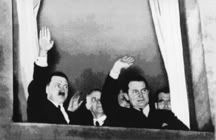 |
The resourceful and well-connected Hitler, while briefly tarnished by the conspirator image, quickly remade himself. Over the next year he and his supporters grew their power base and wriggled higher into the levels of power. With deft political maneuvering, Hitler was appointed as Chancellor, reluctantly, by President Hindenburg on January 30, 1933. (2) He teamed up with fellow Nazi and president of the Reichstag (something like Senate Majority Leader) Hermann Goering. Playing coalition politics and outflaniking everyone, they went to work within days on the early phase of their “synchronization”, a euphemism for the transformation of the political system to incorporate an all-powerful central government under Nazi control. (3)
One party that suffered a major defeat at Versailles was the German armaments industry. Weapons makers like Krupp and I.G. Farben, put out of business by the ban on all weapons of war, were reassured that the Nazi way was their way. In a private meeting Goering’s Reichstag President’s Palace, February 20, these leading industrialists were assured that “National Socialism” did not mean Communism. Indeed, if given the chance, they would break the back of Communism and organized labor in Germany (and democracy to boot), and re-assert Germany’s age-old military values and Imperial ambitions. Hitler and Goerring collected an immediate $3 million Deutsche Marks in cash donations, with promises of more to come. Hitler said “now we stand before the last election.” (4) But before that last election, to be precise, before March 5th, two eventful weeks would unfold and utterly transform Germany’s power structure.
Sources:
[1]Shirer, William. The Rise and Fall of the Third Reich: A History of Nazi Germany. New York. Crest Books. 7th Printing. July 1965. Page 224.
[2] See[1]. Page 262.
[3] Wikipedia. Herman Goering. http://en.wikipedia.org/wiki/Goering
[4] See[1]. Page 265-266
Thursday, November 23, 2006
NORTHWOODS I: LEMNITZER THE LANDMINE
TENSE TIMES IN THE CHICKEN HOUSE
1961: The Cold War was nearing its zenith of insanity, people were getting at each other’s throats over how to deal with the USSR and its two new and troubling satellites: Sputnik and Cuba. By the end of 1960, the Soviets had taken the lead in the emerging space race and opened a new storefront just eighty miles from Florida, and the first worries over the apparently fictitious “misile gap,” a widening margin by which the Soviets were thought to have us out-armed, had been aired. Concerns were growing on the political right about communist infiltration at home, with some insisting that this was a more immediate menace even than the Soviet Union itself. And then to top this off there was the big political re-shuffling that accompanied the tumultuous 1960 presidential election.
General Lyman L. Lemnitzer (US Army) was a troubled man. Maybe it was the excess of Ls in his name, maybe it was just the tense times. He had been a military protégé of General Eisenhower in World War II, helping plan the early invasions of North Africa and Sicily. At war’s end he was involved in securing the surrender of the Axis leadership, working closely with Allen Dulles, who would later head the CIA; Lemnitzer has been accused of helping some former Nazis move to South America, and he helped others to stay behind in Europe, under the auspices of NATO, as spies against the USSR. [1]
By 1960, Lemnitzer was chief of staff for the Army, and Eisenhower was finishing his second term as President of the U.S. In November it became clear that Democrat John F. Kennedy, not Eisenhower’s vice president Richard Nixon, would be the next president; at this point, Eisenhower turned to his old aide Lemnitzer, appointing him Chairman of the Joint Chiefs of Staff, the highest military post in the country, in regular contact with the president. According to James Bamford in Body of Secrets (2001) Lemnitzer’s view of Eisenhower at this time of this promotion reportedly “bordered on reverence.” By leaving Lemnitzer behind, Bamford wrote, “Eisenhower would have a window onto the next administration,” and as would become clear in due time, Lemnitzer would also “become a landmine in the Kennedy administration.” [2]
Lyman was a hard line anti-Communist, an immaculate planner and control freak. According to Bamford, upon becoming chairman, “he sent out elaborate instructions outlining exactly how his fellow chiefs were to autograph group pictures – they were to sign their names directly under his, and they must follow his slant.” [3] He was reportedly not pleased to be working under Kennedy, and he wasn’t the only one. Fears were widespread, especially in the military, that Kennedy, his brother, and the rest of their team were inexperienced, liberal, and/or soft on communism. These concerns were very serious, and would come to a head very quickly over response to the revolution in Cuba.
Planning for the elimination of Fidel Castro's new regime had already begun under Eisenhower; as Kennedy came to office, two primary models prevailed, one backed by the military, one backed by the still-new CIA. Kennedy wanted no proof of American involvement, fearing that would antagonize the Soviet Union and world opinion. Thus he preferred the sneakier CIA model, based on the earlier and successful CIA-led operations that overthrew the Presidents of Iran and Guatemala. This was the basic model that came to be - injecting a force of nominally independent Cuban exiles back into their homeland, and hoping that they unite the oppressed peasantry behind themselves and march on Havana. No American forces or aid was to be seen, but secret training and arming was done in the southern U.S. and - surprise - the recently-re-subdued Guatemala. [4]
Lemnitzer and those of like mind felt that Kennedy underestimated the Castro regime, which was starting to receive military supplies and pilot training from the communist government of Czechoslovakia. “Time is working against us,” Lemnitzer told Kennedy at their first meeting on January 25. [5] He felt that America had to risk direct military involvement if they wanted success, and predicted that if the CIA’s sloppy plan were used, it would end in disaster. [6] It was used, and it failed spectacularly in mid-April, just three months after Kennedy was sworn in. The failed invasion, even though it was not planned by Kennedy himself, displayed to some exactly the inexperience they feared, and the invasion, while very hard on the anti-Castro forces who were mowed down, was very soft on Castro himself.
While the military mistrusted the Kennedies, much of the public and their Congress at the time were worried about the military. Eisenhower himself had warned in his farewell address, January 17 1961, of the dangers of the “military industrial complex.” He emphasized the need for “an alert and knowledgeable citizenry” to “never let the weight of this combination endanger our liberties or democratic processes.” Such fears were widespread in the following years, as evidenced by the later success of the 1964 film Seven Days in May. Starring Kirk Douglas and written by Rod Serling, the film was about a military coup against a president perceived as soft on communism, led by the Joint Chiefs of Staff.
Congress stepped in with a 1961 Senate Foreign Relations Committee investigation of right-wing activity in the military, and Lemnitzer himself came under their microscope. Among the most critical of the JCS chairman in the hearings was Sen. Al Gore sr. (D-TN) Citing recent right-wing military revolts and coups in France and elsewhere, the committee published a report on their findings of a “considerable danger” in the “education and propaganda activities of military personnel.” [7]
The committee also called for an investigation of possible ties between Lemnitzer himself and right-wing groups like the John Birch Society (JBS) and his awareness of the activities of former Major General Edwin Walker. Walker was a right-winger accused of pushing racist ideas and JBS propaganda on his subordinates. He had resigned when singled out by Defense Secretary Robert McNamara in April 1961, becoming more vocal in his charges that Communists had infiltrated the administration. [8] Walker made a failed bid for Governor of Texas in 1962, losing badly to Tom Connally. In 1963 he began “Operation Midnight Ride,” an evangelical anti-communist crusade. [9] At this time Walker and his aides say he was being trailed and spied on by mysterious men, one of whom allegedly shot at him on April 10 but by pure luck missed Walker's head. The crime went unsolved for over eight months before the FBI, Dallas PD, and Walker himself identified the gunman as none other than Lee Harvey Oswald, the master marksman who had just blown off the President's head. [10] Hmmm…
As Kennedy came to power amid the Bay of Pigs fiasco, in late April 1961 he met with General Douglas MacArthur. According to Kennedy aide Theodore Sorenson, MacArthur told Kennedy “the chickens are coming home to roost, and you happen to have just moved into the chicken house.” [11] And of course the evolving Cuba situation would soon lead to the Missile Crisis of 1962, followed by the 1963 murder of president Kennedy before the nation’s eyes, allegedly by Walker’s stalker, providing the most vivid national trauma for nearly four decades.
But I'm no expert in this field and this is all a bit of an aside from the story of Lyman L. Lemnitzer and Operation Northwoods, to which we turn in the next post.
Sources:
[1] Petit, Andres. “Operation Northwoods: Joint Chiefs of Staff USA.” AfroCubaWeb. Last Modified August 20, 2004. Accessed November 13 2005 at: http://www.afrocubaweb.com//news/northwoods/northwoods.htm
[2] Bamford, James. Body of Secrets: Anatomy of the Super-Secret National Security Agency. New York. Anchor Books. First Anchor Books edition. 2002. Pages 67, 68
[3] See [2]. Page 73.
[4] "Bay of Pigs Invasion." Wikipedia. http://en.wikipedia.org/wiki/Bay_of_Pigs_Invasion
[5] See [2]. Page 72.
[6] See [2]. Page 73.
[7] See [2]. Page 80.
[8] See [2]. Page 79.
[9] “Edwin Walker.” Wikipedia. Accessed November 1, 2005 at: http://en.wikipedia.org/wiki/Edwin_Walker
[10] North, Mark. Act of Treason: The Role of J. Edgar Hoover in the Assassination of President Kennedy. New York. Carroll and Graf Publishers, Inc. First Carroll and Graf edition. 1991. Page 255
[11] Tarpley, Webster G. and Anton Chaitkin. George Bush, the Unauthorized Biography. Ch VIII-b: The Bay of Pigs and the Kennedy Assassination. Accessed November 8, 2005 at: http://www.tarpley.net/bush8b.htm
1961: The Cold War was nearing its zenith of insanity, people were getting at each other’s throats over how to deal with the USSR and its two new and troubling satellites: Sputnik and Cuba. By the end of 1960, the Soviets had taken the lead in the emerging space race and opened a new storefront just eighty miles from Florida, and the first worries over the apparently fictitious “misile gap,” a widening margin by which the Soviets were thought to have us out-armed, had been aired. Concerns were growing on the political right about communist infiltration at home, with some insisting that this was a more immediate menace even than the Soviet Union itself. And then to top this off there was the big political re-shuffling that accompanied the tumultuous 1960 presidential election.
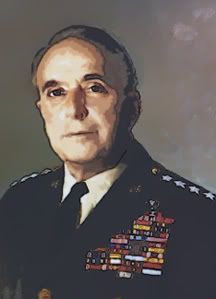 |
By 1960, Lemnitzer was chief of staff for the Army, and Eisenhower was finishing his second term as President of the U.S. In November it became clear that Democrat John F. Kennedy, not Eisenhower’s vice president Richard Nixon, would be the next president; at this point, Eisenhower turned to his old aide Lemnitzer, appointing him Chairman of the Joint Chiefs of Staff, the highest military post in the country, in regular contact with the president. According to James Bamford in Body of Secrets (2001) Lemnitzer’s view of Eisenhower at this time of this promotion reportedly “bordered on reverence.” By leaving Lemnitzer behind, Bamford wrote, “Eisenhower would have a window onto the next administration,” and as would become clear in due time, Lemnitzer would also “become a landmine in the Kennedy administration.” [2]
Lyman was a hard line anti-Communist, an immaculate planner and control freak. According to Bamford, upon becoming chairman, “he sent out elaborate instructions outlining exactly how his fellow chiefs were to autograph group pictures – they were to sign their names directly under his, and they must follow his slant.” [3] He was reportedly not pleased to be working under Kennedy, and he wasn’t the only one. Fears were widespread, especially in the military, that Kennedy, his brother, and the rest of their team were inexperienced, liberal, and/or soft on communism. These concerns were very serious, and would come to a head very quickly over response to the revolution in Cuba.
Planning for the elimination of Fidel Castro's new regime had already begun under Eisenhower; as Kennedy came to office, two primary models prevailed, one backed by the military, one backed by the still-new CIA. Kennedy wanted no proof of American involvement, fearing that would antagonize the Soviet Union and world opinion. Thus he preferred the sneakier CIA model, based on the earlier and successful CIA-led operations that overthrew the Presidents of Iran and Guatemala. This was the basic model that came to be - injecting a force of nominally independent Cuban exiles back into their homeland, and hoping that they unite the oppressed peasantry behind themselves and march on Havana. No American forces or aid was to be seen, but secret training and arming was done in the southern U.S. and - surprise - the recently-re-subdued Guatemala. [4]
Lemnitzer and those of like mind felt that Kennedy underestimated the Castro regime, which was starting to receive military supplies and pilot training from the communist government of Czechoslovakia. “Time is working against us,” Lemnitzer told Kennedy at their first meeting on January 25. [5] He felt that America had to risk direct military involvement if they wanted success, and predicted that if the CIA’s sloppy plan were used, it would end in disaster. [6] It was used, and it failed spectacularly in mid-April, just three months after Kennedy was sworn in. The failed invasion, even though it was not planned by Kennedy himself, displayed to some exactly the inexperience they feared, and the invasion, while very hard on the anti-Castro forces who were mowed down, was very soft on Castro himself.
While the military mistrusted the Kennedies, much of the public and their Congress at the time were worried about the military. Eisenhower himself had warned in his farewell address, January 17 1961, of the dangers of the “military industrial complex.” He emphasized the need for “an alert and knowledgeable citizenry” to “never let the weight of this combination endanger our liberties or democratic processes.” Such fears were widespread in the following years, as evidenced by the later success of the 1964 film Seven Days in May. Starring Kirk Douglas and written by Rod Serling, the film was about a military coup against a president perceived as soft on communism, led by the Joint Chiefs of Staff.
Congress stepped in with a 1961 Senate Foreign Relations Committee investigation of right-wing activity in the military, and Lemnitzer himself came under their microscope. Among the most critical of the JCS chairman in the hearings was Sen. Al Gore sr. (D-TN) Citing recent right-wing military revolts and coups in France and elsewhere, the committee published a report on their findings of a “considerable danger” in the “education and propaganda activities of military personnel.” [7]
The committee also called for an investigation of possible ties between Lemnitzer himself and right-wing groups like the John Birch Society (JBS) and his awareness of the activities of former Major General Edwin Walker. Walker was a right-winger accused of pushing racist ideas and JBS propaganda on his subordinates. He had resigned when singled out by Defense Secretary Robert McNamara in April 1961, becoming more vocal in his charges that Communists had infiltrated the administration. [8] Walker made a failed bid for Governor of Texas in 1962, losing badly to Tom Connally. In 1963 he began “Operation Midnight Ride,” an evangelical anti-communist crusade. [9] At this time Walker and his aides say he was being trailed and spied on by mysterious men, one of whom allegedly shot at him on April 10 but by pure luck missed Walker's head. The crime went unsolved for over eight months before the FBI, Dallas PD, and Walker himself identified the gunman as none other than Lee Harvey Oswald, the master marksman who had just blown off the President's head. [10] Hmmm…
As Kennedy came to power amid the Bay of Pigs fiasco, in late April 1961 he met with General Douglas MacArthur. According to Kennedy aide Theodore Sorenson, MacArthur told Kennedy “the chickens are coming home to roost, and you happen to have just moved into the chicken house.” [11] And of course the evolving Cuba situation would soon lead to the Missile Crisis of 1962, followed by the 1963 murder of president Kennedy before the nation’s eyes, allegedly by Walker’s stalker, providing the most vivid national trauma for nearly four decades.
But I'm no expert in this field and this is all a bit of an aside from the story of Lyman L. Lemnitzer and Operation Northwoods, to which we turn in the next post.
Sources:
[1] Petit, Andres. “Operation Northwoods: Joint Chiefs of Staff USA.” AfroCubaWeb. Last Modified August 20, 2004. Accessed November 13 2005 at: http://www.afrocubaweb.com//news/northwoods/northwoods.htm
[2] Bamford, James. Body of Secrets: Anatomy of the Super-Secret National Security Agency. New York. Anchor Books. First Anchor Books edition. 2002. Pages 67, 68
[3] See [2]. Page 73.
[4] "Bay of Pigs Invasion." Wikipedia. http://en.wikipedia.org/wiki/Bay_of_Pigs_Invasion
[5] See [2]. Page 72.
[6] See [2]. Page 73.
[7] See [2]. Page 80.
[8] See [2]. Page 79.
[9] “Edwin Walker.” Wikipedia. Accessed November 1, 2005 at: http://en.wikipedia.org/wiki/Edwin_Walker
[10] North, Mark. Act of Treason: The Role of J. Edgar Hoover in the Assassination of President Kennedy. New York. Carroll and Graf Publishers, Inc. First Carroll and Graf edition. 1991. Page 255
[11] Tarpley, Webster G. and Anton Chaitkin. George Bush, the Unauthorized Biography. Ch VIII-b: The Bay of Pigs and the Kennedy Assassination. Accessed November 8, 2005 at: http://www.tarpley.net/bush8b.htm
Subscribe to:
Posts (Atom)