Sunday, March 29, 2009

A THIN DIET FOR KIMMEL - AND GENDA

A BREAKDOWN OF PACIFIC FLEET DEPLETION, APRIL-DECEMBER 1941
Adam Larson / Caustic Logic
The 12/7-9/11 Treadmill and Beyond
March 29 2009


A key point I’ve been making in my posts here and at the JREF forum has been the logic behind the alleged decision by president Roosevelt to not just allow or provoke a Japanese attack on Hawaii, but to specifically want it to be a defenseless slaughter with heavy losses of personnel and ships. Militarily of course that would be an unmitigated disaster, but politically it would be, and was, a triumph. I have a dedicated post to explain that sinister logic.

Along the way I’ve been stepping around a general ignorance of the actual Naval losses, of just what FDR might have been willing to sacrifice - in the line of vital ships - to get the nation riled up for war. I had a feeling that a precise cataloging of the number and type of ships at Pearl Harbor during 1941 would be a daunting bit of work. But using a few different sources I was able to get approximate numbers that all fit each other perfectly, making it a pretty good catalog for my purposes, and a guideline for measuring the shrinking of the vulnerable Pacific Fleet and its alleged deterrent potential.

I did a little research looking first at some details from Prange et al. At Dawn We Slept [2000 edition] regarding what was taken from Kimmel’s corral earlier in 1941 to support a vital buildup in the Atlantic to shore up England’s desperate line against the Nazis.

On April 20 Carrier USS Yorktown and an escort of five destroyers was sent (one days after the rest, apparently a rear-guard) [p 130] Carrier strenth at Pearl reduced by 1/3.
On April 26 Stark alerted Kimmel “shortly a considerable detachment from your fleet will be brought to the Atlantic “ [p 131]
The movement began May 19 and continued for three days, [132] ultimately including three Battleships (NM, MS, ID), four light cruisers, and a dozen more destroyers. [133] "During the summer additional forays would cost Kimmel three oilers, three transports, and a number of auxiliaries – a total of sixteen ships. All in all, Kimmel lost about one-fourth of his Pacific Fleet […] more ships than the Japanese destroyed at Pearl Harbor. What priceless irony!”
[133]

I read the numbers offered therein as adding up to a total of 41 ships sent to the Atlantic in the spring and summer of 1941, 25 war ships (battleships, cruisers, destroyers, carriers) and sixteen others (which I’m calling “auxiliary” to simplify). This total is given as about 1/4 reduction of the fleet at Pearl.

41 = .25x, x = 164 Total prior to this, reading literally.
164-41 = 123 remaining after these losses.
I’ve decided 68 of these were war ships and 55 auxiliary (see below).

After this first round of attrition, Admiral Kimmel complained to his boss, CNO Stark, about the loss of forces in May. By mid-September, the CinCPAC's ship-hunger had triggered a request for at least two battleships returned to deter Japan. In At Dawn We Slept, Prange et al. reason these were unlikely to do the trick, if anything could, and having two more battleships to damage would only have "made such enthusiastic airmen as Genda fairly smack their lips in anticipation.” [242]

Auxiliary losses stopped after the summer, but a further 22 warships, including both carriers, were peeled off between November 26 and December 5 for carrier task forces. These were to protect the movement of 25 aircraft for Wake and Midway Islands, a special request from Washington, approved by Kimmel, and ironically occurring just as six of Japan’s carriers were moving there to replace them. Removed from harm’s way were 6 Heavy Cruisers (3 with each carrier), 14 destroyers (split 9/5), and of course the Enterprise and Lexington. [source - Navy]

After this final depletion, there remained in port: 8 Battleships, 2 Heavy Cruisers, 6 Light Crusiers, 30 Destroyers
Total = 46 war ships
55 Additional auxiliary ships (minesweepers, submarines, tenders, etc)
46 + 55 = 101 total ships when the zeros rounded the horn.
101 + 22 detached in task forces = 123 total before 11/26. That’s what I found the 1/4 reduction of mid-year had left.
[source - Navy].

As a total non-expert in naval matters, I cannot give a worthwhile assessment of the value of the classes of war ships, for either force availability or loss availability. The corroborating numbers above however show a total reduction from 164 to 101 ships, or a 38% overall numerical loss during the seven months before the attack. When we consider the auxiliary vessels are less valuable as either targets or as assets to move, it becomes clear their more stable numbers are muffling the real issue; the location of prized war ships. While only 16 various smaller ships were shuffled out in 1941, a total of 47 destroyers and larger were moved out as of December 7, including almost all heavy cruisers and of course all three once-available carriers. This number is not only more than the Japanese sunk, but slightly more warships than they had to shoot at.

In summary, before the Japanese were able to sneak up on it, the Pacific Fleet's battle force was cut in half, and I would guess the less valuable half is what was left for the torpedos. With what seems a bit of mathematical hyperbole, but a better feel for naval systems, the estimate of Layton et al, gives an idea of the pickings that were left after the repeated withdrawals of Naval power [And I was There, 1985, p 263]:
"At this point [Dec 5], the disposition of of Kimmel's forces was as follows: All the carriers were at sea with specific missions. All the heavy cruisers and more than half of the fleet's destroyers were at sea protecting the carriers. Only the battle force - the old, slow battleships with their escorts of light cruisers and destroyers - was still at Pearl Harbor."

Friday, March 27, 2009

PEARL HARBOR DISCUSSIONS

Adam Larson / Caustic Logic
The 12/7-9/11 Treadmill and Beyond
Last update March 27 2009


This post will serve as the hub for my discussion forum threads, so far at the prestigious JREF forum. For those who don't know, that's the James Randi Educational Foundation, notoriously unfriendly to conspiracy theories. I'm putting up a heck of a fight, which is unlike me, schooling and being schooled. If I'm wrong, so be it, but nothing in particular has shown up yet...

[by order of importance and/or length or fame of thread]
Why do you not believe/discuss the Pearl Harbor Cts? - my main discussion thread - started March 2, 237 posts as of 3/27 and still quite active. Covers most major issues, notable emphasis on McCollum Memo, Adm. Richardson, the Carriers, issues of motive (why surprise when you can start the war fighting?)

Pearl Harbor and JN-25B - questions- More in-depth into the main Japanese naval code and questions about its readability prior to the PH attack - Started Feb 16, 61 posts

Winds Execute Controversy - Passing on news that the NSA had again debunked the Winds Execute warning received story - nothing new, 6 posts, started Feb 26. I did a good post on it here.

Wednesday, March 25, 2009

A "RESTRAINING" INFLUENCE

Adam Larson / Caustic Logic
The 12/7-9/11 Treadmill and Beyond
March 25 2009
Last update 4/2


WINDOW DRESSING
As outlined in a previous post, as of mid-1940, a “strong attitude” towards Japan was thought in Washington a useful means to deter further Asian or Pacific adventures. As also discussed there, Adm J.O. Richardson, Commander-in-Chief US Fleet (CinCUS), had been told that the Navy was to act out this attitude, and that the Pacific Fleet’s retention at Hawaii was part of this bit of theater. But being on the stage rather than behind it gives him more credibility, and this clout was staked on his finding this deterrent policy wrong-headed should have caused second thoughts in the Capitol. It apparently did not.

The posture of keeping the Fleet much nearer Japan was perhaps first explained in a May 27 letter from Chief of Naval Operations Harold Stark to Admiral Richardson in Hawaii, who called it "one of the most direct replies to any of my letters to him, although it was far from being as definitive as I would have liked:"
“Why are you in the Hawaiian area? Answer: You are there because of the deterrent effect which it is thought your presence may have on the Japs going into the East Indies. In previous letters I have hooked this up with the Italians going into the war. The connection is that with Italy in, it is thought the Japs might feel just that much freer to take independent action.”

Whatever its possible political impact, the posture was “valueless from the hard realities of war,” in Richardson’s mind, although it was was played out with the tools and personnel of war. In his 1958 memoirs he lamented that this “window dressing” was “assigned great weight” by the brains In Washuington [2], and labored to explain why it was wrong, starting with this banal observation:
“In my discussions in Washington, both within the Navy department and within the White House, it was constantly asserted that the presence of the fleet in Hawaiian waters was exerting a restraining influence on the Japanese. […] the statement might have had a factual basis […but...] it has always seemed odd to me that such an affirmative statement had not been made in the intervening years by some Japanese military officer occupying an important position in the Japanese governmental structure during this period.” [3]

The interpretation offered in an obscure Army history work on coalition warfare seems to offer two clues:
“The US Fleet […] received orders to remain at Pearl Harbor […] with the purpose of dissuading the Japanese Government from moving southward […] The War Department staff believed that a show of strength in the Pacific might be taken by the Japanese Government as an occasion to open hostilities. On this ground the Army planners strongly objected to leaving the Pacific Fleet at Pearl Harbor. […] The retention of the fleet in the Pacific might cause Japanese leaders to review and revise their plans, but it would act as a deterrent “only as long as other manifestations of government policy do not let it appear that the location of the fleet is only a bluff.” [4 – emph mine]

Richardson cited at least one example that’s exactly what was being allowed to appear - a mid-1940 Navy decision to recall all possible aviators from Pearl for further training in Florida. This left the islands and the fleet with even weaker aviation abilities, and it was done in the open. “Since this information […] was bound to become known to Japanese intelligence activities,” he surmised, “it was a sure giveaway to the Japanese that the U.S. governmental positioning of the fleet in Hawaii was one of bluff, and not of early combative action.” [5 – emph mine]

Stationed on a lonely string of rocky blisters on the vast surface of the Pacific, Richardson was more aware of the challenges - and threats – inherent in their position and predisposition. That the President and his cabinet truly just didn’t understand how to bluff correctly seems a stretch, and the CinCUS’ early protests are a vital clue that the deterrent agenda was likely never the motive at all. In summary, as Admiral Richardson told the Congressional investigation in November 1945:
"I stated that in my opinion the presence of the fleet in Hawaii might influence a civilian political government, but that Japan had a military government which knew that the fleet was undermanned, unprepared for war, and had no training or auxiliary ships without which it could not undertake active operations. Therefore, the presence of the Fleet in Hawaii could not exercise a restraining influence on Japanese action." [6 – emph mine]

Admittedly, this is all from one source on the purpose of the Fleet’s retention, since I only have this one cool hard-too-find original memoir book to peruse. But his opinions are invaluable, and his assessments were regarding the Fleet as he headed it, in mid-late 1940. From there on it only got less prepared with the detachments of 1941, starting with Admiral Richardson himself. He was detached from command at the end of January due in some sense or other to friction with the President, and replaced with Adm. Kimmel, to head the newly re-named Pacific Fleet, which was soon being pilfered and scattered. Edwin T. Layton, who served both commanders as intelligence chief, later offered this support to Richardson’s take on things:
“The seed of the disaster […] had been sown as Admiral Richardson had predicted the year before, when our foreign policy was allowed to dictate military strategy. This situation had resulted in a disastrous deterrent posture.”

The disaster was that any deterrence there may have been failed to hold in the face of Washington’s decision to cut off Japan’s oil flow in August 1941, and subsequent moves hastening their impulse to southern conquest to “save face,” not to mention their empire. It was at this point, Layton reckons, that the deterrent effect would be tested – the result: “Our bluff was called.” [7 - emphasis, again, is mine]

Sources: coming - lost some of my page citations

Monday, March 16, 2009

THE MCCOLLUM MEMO - ANALYSIS

BLUEPRINT NO, IMPORTANT CLUE, YES
Adam Larson / Caustic Logic
The 12/7-9/11 Treadmill and Beyond
First posted March 15 2009
last updated 3/17


BLOWING OFF THE DUST
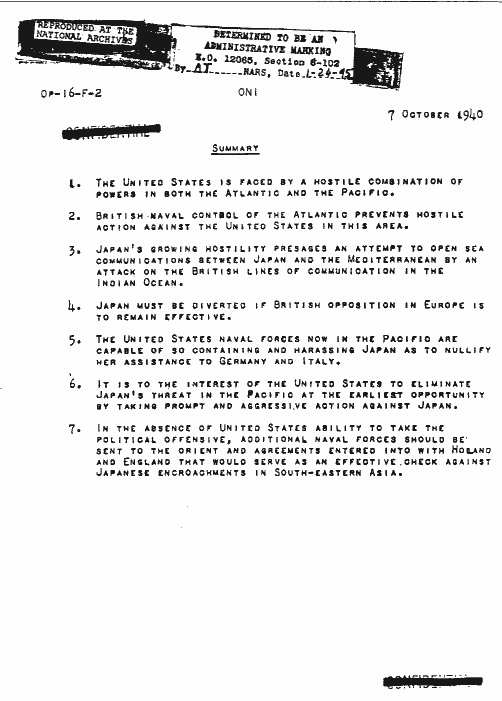
The McCollum Memo is the most common name given to a 6-page pre-Pearl Harbor document, signed by Lt. Com. Arthur H. McCollum of Office of Naval Intelligence, and dated October 7, 1940. It was numbered OP-16-F-2, headed ONI, Memorandum for the Director, meaning Director Naval Intelligence RADM Walter Anderson. Although there are possible questions about the memo’s authenticity, like most everyone else who hears of it, I tend to accept it as a genuine piece of history. This unique clue remained unknown until declassified in 1994, the better part of a century after it was written, and well after all the ‘decisive’ books on the attack (At Dawn We Slept, etc.) had emerged in the 1980s.

The document was then obtained by researcher Robert Stinnett using the Freedom Of Information Act (FOIA). He describes receiving bundles of documents not seen since 1941, “covered with dust, tightly bunched together in the boxes and tied with unusual waxed twine.” [1] He quickly recognized this one as a vital clue never seen before, and worked it into his mammoth book Day of Deceit: The Truth About FDR and Pearl Harbor. As Stinnett interpreted the thinking behind the eight actions proposed in the memo, McCollum “felt that war with Japan was inevitable and that the United States should provoke it at a time which suited US interests.” [2]

Whatever the book’s other merits or drawbacks, it does contain – in fact opens with - this new and compelling piece of the puzzle. It certainly caught my attention as I started the book, and I was dazzled enough to call it a "smoking gun" of FDR’s foreknowledge and provocation, in an older article this one will replace. I was not alone in that prognosis, but the reality is more ambiguous than that, and well worth a closer look.

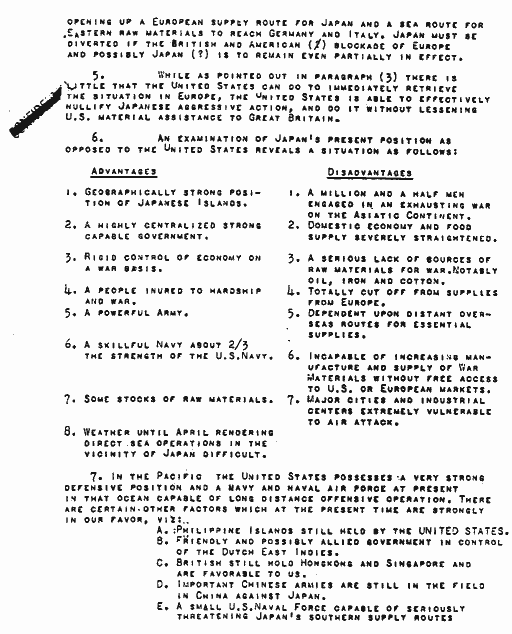
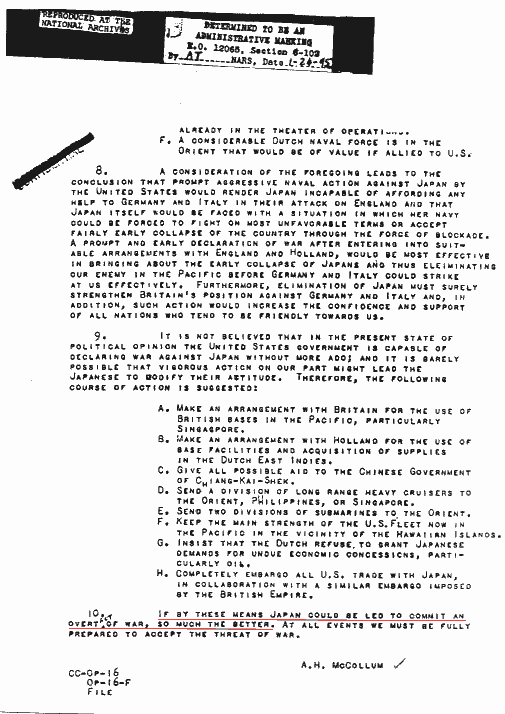
[the actual document as found here - r-click, new window for readable sized view. Red underline on page 4 apparently added to the scan. "Act" being omitted from that line of type but penciled in is in the original.]




BY THESE MEANS: THE CONTENTS
In the first few pages, the less famous major portion, McCollum outlines the world situation, with the totalitarian powers in charge of all Europe except Great Britain, aided as much as possible by the US in her resistance. He mentions attempts to subvert, propagandize, and "confuse" the US into a purely defensive posture, Latin American meddling and Pacific moves by Japan against British supply lines in Asia. Perhaps reflecting the dark times, McCollum actually predicts the USSR will more than likely side with the Axis sooner or later.

To bring the danger home, he predicts that if England should fall, this super-Axis would quite likely attack America next, making war a likely matter of when, not if. McCollum calls for meeting the threat head-on with "prompt, warlike action" in either theater (Atlantic or Pacific). He feels the Tripartite Pact leaves "no ground on which to doubt" the three totalitarian powers will go to war with the US if entering as a full ally of the UK or "should she attempt to forcibly interfere with Japan's aims in the orient." To keep Britain's lines open, he proposed that Japan should be "diverted or neutralized." He then outlines the strategic situation of the US vs. Japanese position in the Pacific, called for detailed arrangements with Britain and Netherlands and a "prompt and early declaration of war."

Finally he wraps it up with point 9, which is what the conspiracy theorists drool over, and not without reason:
It is not believed that in the present state of political opinion the United States government is capable of declaring war against Japan without more ado; and it is barely possible that vigorous action on our part might lead the Japanese to modify their attitude. Therefore, the following course of action is suggested:

A. Make an arrangement with Britain for the use of British bases in the pacific, particularly Singapore.
B. Make an arrangement with Holland for use of base facilities and acquisition of supplies in the Dutch East Indies.
C. Give all possible aid to the Chinese government of Chiang Kai-shek.
D. Send a division of long-range heavy cruisers to the Orient, Philippines, or Singapore.
E. Send two divisions of submarines to the Orient.
F. Keep the main strength of the US Fleet, now in the Pacific, in the vicinity of the Hawaiian islands.
G. Insist that the Dutch refuse to grant Japanese demands for undue economic concessions, particularly oil.
H. Completely embargo all trade with Japan, in collaboration with a similar embargo imposed by the British Empire.

If by these means Japan could be led to commit an overt act of war, so much the better. At all events we must be fully prepared to accept the threat of war.
In essence, then, the McCollum memo offers a list of actions proposed because Japan wasn't changing and more "ado" would be needed before FDR was "capable" of declaring war. Hawaii is mentioned. An overt act of war is mentioned. It would be hindsight historicism to just draw a straight line between them, but there they are side-by-side: The fleet at Pearl is in fact in the list of "means" by which Japan might be "led" to "do some fool thing," as FDR once put it, and start a war on the Pacific.

The troubling phrase "so much the better" implies two things to me:
1) It's not the main purpose. To be "better" is to be other than the thing you've been referring to. The main purpose seems to be to prepare for war in the Pacific since it should and perhaps might materialize soon.
2) Better implies it is to the same ends as the main purpose. The whole thing is about war, and how to get into it. Having them fire the first shot would be "better" than us doing it, from a legalistic and moralistic perspective.

Just from the contents, the Eight-Action Memo (as it’s also called) does not look anything like a finalized ‘blueprint’ for the ultimate Pearl Harbor provocation plan. It is however instructive of the type and level of thought going on in Washington at the time, and could with the smallest shift of view become such a template for tragedy, as Stinnett’s and my own and others’ gut reactions to the memo testify.

RIPPLES THROUGH REALITY
This telling packet was of course addressed to, and intended to be seen by, DNI Anderson, at the very least. Stinnett claims it was also addressed to Dudley Knox, an ONI strategist of great repute, who left his mark as having seen it. Knox endorsed McCollum's proposal in general but, in forwarding his thoughts to Anderson, added the caveat “we should not precipitate anything in the Orient.” [3 - see also document above, page 6] Beyond this, Stinnett could find no paper trail for the document, aside from a diary entry from Assistant Secretary of State Breckenridge Long - dated Oct 7 1940 - that he felt “little by little we will face a situation which will bring us into conflict with Japan.” This had been triggered, Stinnett sums, when he that day “learned of a series of steps involving the US Navy and that one included concentrating the fleet at Honolulu.” [4]

There are also less direct clues of this thinking bleeding into the following 14-month string of ‘fatally flawed’ real-world decisions regarding Japan. FDR was reportedly fond of the idea, as proposed in action D, of putting some US vessels outside their normal zones and into areas of Japanese interest. CNO Stark recalled the President favoring “pop-up Cruises,” saying something like “I just want them to keep popping up here and there and keep the Japs guessing. I don’t mind losing one or two cruisers, but do not take a chance on losing five or six.” Three such missions, including to a prime IJN training ground near Honshu, were carried out from March-July 1941. All ended without any overt act of war. [5]

In late July action H was more nearly approached – by a leap and not a step – with an embargo on the most vital petroleum exports to Japan. The oil embargo is universally accepted as one of the prime factors toppling their equilibrium irreversibly towards major war in SE Asia, at least sooner than otherwise would happen. I'm not conversant enough with the details of which other actions were followed, but action F, keeping the Pacific part of the US Fleet at Hawaii, was faithfully held to for the duration. At the time, the prime obstacle to this was the man tasked with defending the fleet while there – CinCUS Admiral James O. Richardson. He had earlier butted heads with the President personally over the issue, and As McCollum typed his points, the Admiral was en route to Washington for one last talk with FDR.

THE DAY AFTER: RICHARDSON GETS A WHIFF?
Direct evidence that the President ever read McCollum's memorandum is not known, but its prime addressee, DNI Anderson, was a close military adviser to the president, and Stinnett reports that McCollum himself was a regular routing officer for Navy intelligence to be delivered to Roosevelt, often directly and in person. [6] The exact relationship between these proposals and any White House policy would be interesting but at present impossible to know. It could be that these ideas directly shaped an unwritten policy we don't know of, or that they helped in some aspects to form a nebulous plan. It may have offered more a mental framework or attitude than it did concrete steps, and it's quite possible that FDR was already in that groove and just asked McCollum to write up something to help clarify the issues and options. That it never even reached the boss himself is possible, but somehow seems doubtful.

The connection Stinnett drew, and that I feel worthy of consideration, is with FDR's meeting with Adm. Richardson on October 8, the day after he had perhaps read the memo. “Jo” Richardson was back at the President’s request, which itself offers a clue the memo was perhaps requested by FDR. By the Admiral’s recollection they essentially just argued the same points as in July, and FDR was even more adamant that the fleet was exerting a deterrent effect in Hawaii and must stay, no matter what the CinCUS said. More intriguingly, Richardson recalled this meeting for the Congressional investigation in 1945, and mentioned:
Later I asked the President if we were going to enter the war. He replied that if the Japanese attacked Thailand, or the Kra peninsula, or the Dutch East Indies we would not enter the war, that if they even attacked the Philippines he doubted whether we would enter the war, but that they could not always avoid making mistakes and that as the war continued and the area of operations expanded sooner or later they would make a mistake and we would enter the war. [7]
Where might such a potent mistake be goofed into existence? Even the Philippines wouldn’t do it, so he wasn’t thinking Guam, or Johnston Island, but something would eventually suffice for war… this leaves as candidates Panama, California, Alaska, Seattle…. Oh, Hawaii…
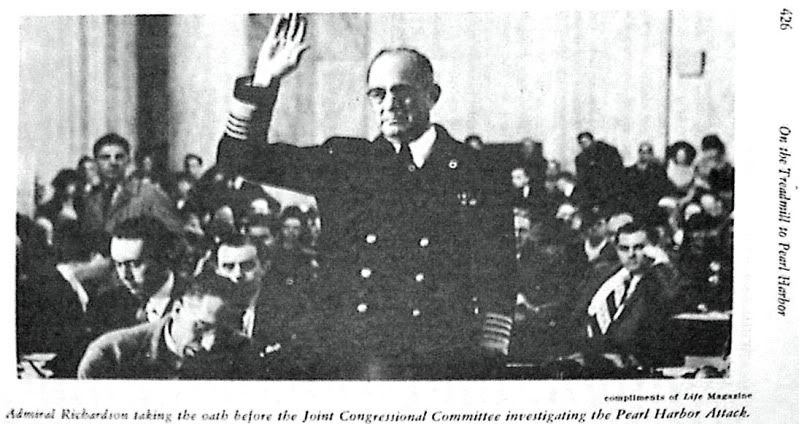
[as published in On The Treadmill to Pearl Pearl Harbor: The Memoirs of Admiral James O Richardson]

Admiral Richardson held back from the Committee, but published in his memoirs, a note connected to this statement about a 'mistake': "This caused me to think that he meant sooner or later the Japanese would commit an overt act against the U.S., with the result that the citizens of the United States would be willing to enter the war." He followed this with a damning estimate of the President's "real intentions or beliefs in the matter, which were that we would be at war with Japan in due time, and that he was willing for some ship of the Navy to be the victim of a Japanese “mistake.”" [8]

Thus a seasoned and patriotic Commander-in-Chief’s real thoughts after meeting the President disturbingly complement the gist of the McCollum memo as seen by 21st century paranoids. And the thought was formed the day after the memo was written. That the President himself likely saw the paper just before the Admiral comes as close as anything to showing the mood set with those eight actions ran right through FDR on its way down that treadmill to Pearl Harbor. He's asserting the new mooring was a deterrent, when it had just been explicitly outlined as a "means" that could possibly "lead" Japan to an "overt act of war." That is not called a deterrent, except in euphemism. He's also leaving a roughly Hawaii shaped blank spot in the list of places a Japanese “mistake” might in fact mean war, as he insisted on keeping that hole filled with the fleet. We cannot at this point know if these two strands are directly connected. But if they are, that's about all you'd need to know. It's an awfully big question mark.

---
Addenda

FOIA: Considering how well the above fits, and the general unreliability of Stinnett, I'm wondering if the memo is authentic after all. I am planning (but have not yet filed) a Freedom of Information Act request with the National Archives to see if I can verify it or get a negative hit. News will likely be a bit slow and will get its own post, with a link in this space, so bookmark it!

Response to review of Day of Deceit: I just read Phil Jacobson's pan and I'm sure he's primarily correct on radio silence, naval codes, and other points. However his take on the memo was weak. Here I'll respond point-by-point:
One of the centerpieces of his argument is an October 1940 memorandum by then Lieutenant Commander McCollum of ONI in response to the September 1940 signing of the Tripartite Pact by Germany, Italy and Japan and not as any blueprint for initiating war with Germany and Japan.
Au contraire [sp]... The response was to exploit the treaty to enter the war. "Prompt warlike action," the eight actions, all against Japan, with "an overt act of war" as a bonus, but either way we'd be at war, prob. against all three Axis powers.
McCollum recognized the danger to the western powers if Japan was able to connect up with Germany and Italy through Asia and suggested eight actions designed to contain Japan generally and to keep her from making such connection with its other Axis partners.
Kinda - there's no talk of 'linking up,' but rather a joint closing of Britain's supply lines, Euro-Axis at Suez, Asia-Axis at Singapore/etc. area. 'Contain' is actually referred to as 'divert' and 'neutralize.'
Unfortunately, the book seizes on an off hand comment that is not one of the main points of the memo as the springboard for its conspiracy theory. That comment was if the eight proposed actions designed to contain Japan should by chance cause Japan to commit an overt act of war, so much the better.
Yeah, that's not the main goal, it's better than it. Better than what? Unprovoked "prompt warlike action." Us entering as aggressors without being attacked first. These are clearly the two desired outcomes, one being better.
No proof of any official implementation of this mid-level memo is provided.
No proof that it was only "mid-level" is provided, nor that it was not acted on, or considered among other points in the President's mind.
Furthermore, Stinnett improperly ascribes McCollum's office as "an element of Station US (by which he means OP-20-G), a secret American cryptographic center located at the main naval headquarters" in an effort to tie McCollum closer to OP-20-G than he actually was before WWII.

Probably correct, sounds like a Stinnett move.
A non-cryptologic fallacy of the book is the fact that Roosevelt had no assurance that Germany would declare war on the U.S. if the Japanese did attack Pearl Harbor thus negating any reasonable conspiratorial design to get the U.S. into war with Germany by forcing Japan to attack the U.S.

How is that a fallacy? He had no guarantee, per se, but doesn't a good leader ever take a calculated risk? McCollum had in fact worked against this fallacy, in the memo in question, by pointing out the Pact leaves "no ground on which to doubt" the three totalitarian powers will go to war with the US if entering as a full ally of the UK or "should she attempt to forcibly interfere with Japan's aims in the orient." And that's exactly how it went down.
---
Sources:
[1] Stinnett, Robert B. “The Pearl Harbor Deception.” Presentation at the Independent Institute. December 2, 2002. http://www.independent.org/newsroom/article.asp?id=127
[2] Stinnett, Robert B. Day of Deceit: The Truth about FDR and Pearl Harbor. New York. Touchstone. 2000. Page 8.
[3] Day of Deceit p 9
[4] Day of Deceit p 14
[5] Day of Deceit p 9-10
[6] Day of Deceit pp 8, 15
[7] Pearl Harbor Hearing, Part 1, pp. 265-68. As cited by Richardson, Treadmill (see below) p 428.
[8]. On the Treadmill to Pearl Harbor: The Memoirs of Admiral James O. Richardson, Admiral, US Navy (retired) as told to Vice Admiral George C. Dyer. Naval History Division, Department of the Navy. Washington D.C. 1973. Page 427.

Thursday, March 12, 2009

BLAH BLAH WIND, BLAH BLAH BLAH

THE WINDS SET-UP, PART 1
Adam Larson / Caustic Logic
The 12/7-9/11 Treadmill and Beyond
March 15 2009
last edit/update 3/28


THE CODE SET-UP
Perhaps due to its poetic nature and readability enhancement it offers, the “winds code” system has figured widely into most accounts of the Pearl Harbor attack. And it cerianly became a part of the story that can’t be ignored, but not for the clues or hints of Haiku contained within. For purpose of American detectives at the time, the code proved good only for making a lot noise without any substance, indeed, like the wind.
"North wind cloudy" ("Kitano kaze kumori") = War with the USSR
"West wind clear" ("Nishi no kaze hare") = War with Great Britain
"East wind rain" ("Higashi no kaze ame") = War with the United States

These were the code phrases conveyed in the “set-up message,” sent encoded and encrypted (in the J-19 system) by Japan’s Foreign Ministry to its diplomatic posts around the world. It was intercepted by US intelligence on November 13, decrypted and read on the 28th, just before Tokyo’s stated deadline for a miracle of diplomacy (or else “things will happen automatically.”) The catchy clue was passed on to all relevant parties, including at Pearl Harbor - where it was among the few clues received, and that almost immediately.

This system was basically a back-up reminder to diplomatic staffs, in case regular communication lines should be cut, to take action consistent with the onset of warfare. These included destruction of codes and code machines and any secret files in the case of hostilities (real or imminent) with any combination of the three allied nations. Any expected delivery of the code words came to be known as a “winds execute” message to be embedded in routine weather reports. A prescribed pattern of repetition would be the tip-off the words truly mean war should be presumed.

Japan’s top spy in Hawaii, Takeo Yoshikawa claims he dismissed the Sunday morning attack as a US bombing exercise until he heard “east wind rain” repeated twice over his radio. At this cue, Time reported, “Yoshikawa immediately began burning his code books and other intelligence materials.” The evidence appears solid that those words were not transmitted before or during the attack, or ever.

ORIGINAL CLAIMS AND DISMISSALS
Yoshikawa’s memory is in a class of its own with no supporting accounts I know of, and no other evidence pointing to a Winds Execute transmission during the Pearl Harbor attack. Another oddball tack from the US intelligence arena had it that the message was transmitted days before then, when it might qualify as a viable warning. This has been the fuel for a second-tier construct often repeated in the foreknowledge discussion for decades.

The controversy we’ve inherited stems mostly from one source; the prime actor in this, at the time of the investigations in 1945-46, was Lt. Lawrence Safford; no lowly analyst, he in fact essentially founded the Navy’s cryptanalytic agency, OP-20-G, in 1936. To the Joint Congressional Committee, at least, Lt. Safford insisted he held and passed along a transcript of that message, with both east and west indicators in the patterns indicating war with both the US and Great Britain.

Lt. Safford couldn’t recall the exact date, but had it pinned at most likely December 4, and no copies or receipts could be found when he began looking in 1943. By early 1944 he was writing coded letters in search of verification, and citing a list of “about fifteen” existing witnesses. When investigators later received a copy of and followed-up on the list , the alleged witnesses claimed they never did see such a message. Beyond the immediate arena, the notions involved have, over the years, spurred charges of coercion and changed stories, cover-up of vital intelligence, disappeared documents, and general suspiciously senseless squabbling.

The Committee had to deal with at least some of that drama, and after much investigation gently dismissed Safford’s story. While remaining more open minded, the Committee’s dissenting minority report noted “The evidence before this Committee bearing on the interception of the activating message from Tokyo […] covers hundreds of pages. Admittedly the evidence is confusing and conflicting.” I’ll take this as advice then in glossing over the massive depths of this controversy.

The majority report was not so circumspect, and offered a fairly elegant explanation of this code’s irrelevance to the debate in three parts [emph mine]:
“[The winds code] was designed for use in the event ordinary commercial channels of communication were no longer available to Japan, a contemplation which did not materialize prior to Pearl Harbor.”

“Extensive evidence […] indicates that no genuine execute message was intercepted by or received in the War and Navy Departments prior to the attack on Pearl Harbor. Investigation conducted in Japan strongly indicates no execute message was dispatched before the attack and the British and Dutch, who were also monitoring for an execute message, have advised that no such message was intercepted.”

“Granting for purposes of discussion that a genuine execute message applying to the winds code was intercepted before December 7, we believe that such fact would have added nothing to what was already known concerning the critical character of our relations with the Empire of Japan.

It’s a summary brush-off, but expanded on in appendices, and offered in 1946. I see no reason to challenge these findings, although neither can I vouch for them. The third point – that this intelligence added nothing - is most important to my own tendency to move on. The clues offered if so were too vague to have been of any assistance to Pearl Harbor, offering nothing of precise time, location, or method of any attack. There may well be evidence of a cover-up over this, and there may have in fact been one. This would not, however, mean there was anything to actually cover-up other than an empty spot. If there’s any interest to me in this clue, it would be more on the level of disinformation, but that’s a side-track at the moment.

MICROCOSM MAINTAINED
That such a noisy situation did cause so much fuss in the years after the attack certainly does not mean there was any design to that end. The controversy, just by existing, would attract attention – and others have done their part to amplify the supposed relevance of this possible clue.

The New York Times described the winds code controversy, when it emerged, as a “bitter microcosm” of the investigations. “If there was such a message,” the influential paper opined, “the Washington military establishment would have been gravely at fault in not having passed it along.” And even covered it up, elaborately. Conversely, if the execute was truly never sent (or at least never received) supporters of Kimmel and Short “would have lost an important prop to their case.”

One might accuse the Times of setting up a false dichotomy to Kimmel's detriment, but the good Admiral himself claimed the thing in his defense, and to its chagrin. Apparently believing there had been a Dec 4 intercept as claimed by Safford, Kimmel told the Congressional Pearl Harbor Committee that if he had learned of this clue he “would have gone to sea with the fleet...and been in a good position to intercept the Japanese attack.” This appears to be little more than a self-serving boast, but perhaps understandable given the charges against him. A statement like this also couldn’t help but add to the shell of intrigue that allowed the winds execute controversy to continue on alongside more substantial clues.

1980s RESURGENCE; BRIGGS, COSTELLO, TOLAND, LAYTON
After a long simmer, the old contentions about Pearl Harbor re-surfaced in the late 1970s and especially early 80s, spurred largely by a round of declassification of evidentiary documents, and a slew of memoirs by aging participants nearing their own passing. At the outset of this period, another self-described witness to the winds execute message presaging US-Japanese hostilities stepped into the scene.

Ralph Briggs, a civilian intercept operator of OP-20-G had submitted to a recorded 1977 Naval history interview in which he claims he saw and copied the winds execute. When this interview was declassified in 1980, it made it into revisionist circles in little time; John Costello cited the twin cases of Safford and Briggs in the appendix to The Pacific War (1981), apparently corroborating the claim, and supporting cover-up. He reportedly backed off the charge once it was publicized and Brigg's version was shown to be inconsistent with Safford’s (or so I hear, again, I’m not going into the details here). But by then it was echoing further out.

East Wind, Rain… 
It was the Japanese code that meant war… 

Thus reads the back cover of John Toland's 1982 Infamy, which also called on Safford and Briggs and expanded the theme more explicitly as a primary part of his foreknowledge construct. The foreword lists the “crucial questions” about the attack, mentioning only one specific clue by name: “Had there truly been a “”winds” execute message in early December 1941? Had the nine investigations, in short, been an elaborate cover-up to place the blame primarily on Admiral Kimmel and General Short while whitewashing those in Washington?” Apparently no, and maybe, but this is not a good clue. I just got the book and already I know I'll have a hard time trusting it.

Pacific Fleet intelligence director as of Pearl Harbor, Rear Admiral Edwin T Layton, writing with the help of Costello in 1984, presents an interesting take. Layton was only certain that “no warning that a winds [execute] alert had been received was ever sent to us at Pearl Harbor.” He sides with Safford quite a bit throughout the book, points out that the issue "has been fiercely debated ever since,” spends six pages detailing the ins and outs of it, and leadingly refers to “the official effort to deny their ever was a winds intercept”

DISMISSALS, ROUND 2
From this 40th anniversary-era watershed, the old issue took on its most recent resurgence in the foreknowledge discussion, although it doesn’t seem to have stuck widely or for long. Robert Stinnett, in his 1999 Day of Deceit, perhaps the most widely-read recent revisionist tome, dismissed the issue out-of-hand. He seemed to hint at “the now discredited “Winds Code” as being disinformation to distract from his (unsupported AFAIK) allegation that ill-defined “naval codes” had been cracked, that may have (depending) revealed precise details of the attack:
“News of the “Winds Code” system created a media sensation during the congressional hearings. Reporters focused on the “Winds Code” and lost interest in the less fantastic naval intercepts. Eventually the controversy was dismissed when congress learned that the implementing weather message was never transmitted by Japan. By then the 5-Num dispatches had been forgotten.”

Somewhat echoing Stinnett, George Victor gets mentioned, since I bought his book The Pearl Harbor Myth (2007), hoax acceptance and all. He noted in a section on “secrecy and cover up” that “for sixty years, the [winds code] controversy distracted attention from warnings that specified Pearl Harbor as Japan’s target.” Yet he spends pages outlining in detail the stormy history of changed testimonies, apparent coercion and cover-up over the alleged receipt of the distraction without clarifying what he thinks we’re looking at.

With essentially the opposite viewpoint from Stinnett and Victor, Henry Clausen agrees in dismissing the weather controversy. A controversial but little-known special investigator for War Secretary Stimson in 1945 (who did get a detailed and semi-coherent criticism from Victor), he wrote in-depth of some of his findings in the 1990s. This was published as Pearl Harbor: Final Judgement [sic], (1992, written with Bruce Lee, app. first published in 2000?). His simple take on the issue at hand was that “the winds Code took on much greater proportions than I thought it should have.” It’s when he muses a bit on the big picture that we get an interesting insight that I will return to in another post:
“If someone wanted to create a role for the goddess of discord, and throw a golden apple over a fence to cause people to fight and waste time, the Winds Code was that golden apple. It was a red herring for men such as Safford, and Noyes, and Bratton and Sadtler to follow and let dominate their thinking.”

Finally, a recent in-depth study published by the National Security Agency’s Center for Cryptologic History seems to have put the last nail in the controversy’s coffin. And administered last rites, poured its concrete sarcophagus, and written the eulogy. In West Wind Clear [2008] Authors Robert J. Hanyok and the late David Mowry assembled what looks to be a surprisingly comprehensive document [the PDF weighs in at over 350 pages], fascinating, very detailed and loaded with original material, including dozens of raw intercepts reproduced as appendices. [PDF download link]

The interesting conclusion, from which the report draws its title, is that a winds execute message was in fact transmitted, recorded, and acted on – and it said West Wind Clear, or war with Great Britain, and it was transmitted a few hours after the attack on Oahu. I don’t have the time to read the whole thing, but I have cited a few facts from it for this piece, and it promises to leaves no doubt that Safford and Briggs are incorrect, and there was no value lost to the defenders of Pearl Harbor:
"Within the tempest of controversy about the nature and amount of available intelligence, especially communications intelligence, and its dissemination prior to the attack on Pearl Harbor, the Winds message imbroglio should have been no more than the smallest eddy."

THE WINDS SET-UP, PART 2
Having discussed this distraction from the 1940s to the present, the next installment will explain the more relevant role winds confusion played in December 1941.

Wednesday, March 11, 2009

BY SPECIAL REQUEST: THE MOVE TO HAWAII

Adam Larson / Caustic Logic
The 12/7-9/11 Treadmill and Beyond
March 10 2009
updated 3/26


It was not unusual at all when, on April 2 1940, the Pacific Fleet migrated en masse from its moorings in San Pedro, California, and steamed towards Hawaii. This was for a yearly ritual of their training process: a series of complex war games called a “Fleet Problem,” designed to experiment and find deficiencies to work out by next year. This usually took a month all told, followed by an easy return to the coast. The schedule for Fleet Problem XXI was to exercise in and around Pearl Harbor until May 9, and arrive back home by the 17th.

The Fleet’s movements and security in Hawaii, as in California, were overseen by Commander in Chief of the US Fleet (CINCUS) Adm. James O. Richardson (the Pacific Fleet to be headed by his successor, Kimmel, was not yet formed). As the exercises wrapped up and the time to depart neared, Adm Richardson was given a heads up that there would be a slight hitch. Though correspondence with his superior, Chief of Naval Operation Harold Stark, this was found to be, most likely, a delay of two weeks or less before they headed east.

As the original set-off date neared, Stark cabled Richardson on May 7 and asked him to announce, as he did, “I have requested permission to remain in Hawaiian waters to accomplish some things I wanted to do while here.” Of course he requested no such thing, and later wrote that repeating this “made a perfect “nitwit” out of me.”

At first, the stay was to be temporary but “for some time,” as Stark informed “Jo” on May 15. Through these back-and-forth letters, but without clear explanation, the stay gradually crystallized into “until further notice.” Hawaii was home, and the mission remained one of training, and serving some undefined political impulse Richardson – and apparently Stark - grappled with understanding. “The Italian situation is extremely delicate,” the CNO alerted the CINCUS at one point. “the two weeks ahead regarded as critical, then --- ????? nobody can answer the riddle just now.” Stark answered some questions and raised others with another letter on May 27 that Richardson called “one of the most direct replies to any of my letters to him, although it was far from being as definitive as I would have liked:"
“Why are you in the Hawaiian area? Answer: You are there because of the deterrent effect which it is thought your presence may have on the Japs going into the East Indies. In previous letters I have hooked this up with the Italians going into the war. The connection is that with Italy in, it is thought the Japs might feel just that much freer to take independent action.”


Immediately on learning of the planned delay, on May 1, Richardson requested an audience with the President to discuss the issue. He repeated his request until granted and traveled back to Washington in July. He met with Roosevelt on the afternoon of the 8th, and advised they were ill-positioned for war and under-manned, and Roosevelt in turn assured him the Fleet would not be sent to the Far East. In the days afterward, the CINCUS also met with a variety of colleagues and discussed the inadequacies of the forces given the world situation, the wrong-headed and “silly” war plans, etc. On the Fleet’s fate, he decided:
“[T]he top flight of officials in Washington believed that Japanese aggression could be restrained by a strong attitude on the part of the United States; that the retention of the Fleet in Hawaii was a reflection of this strong attitude […] I was told that the fleet would remain in Hawaii indefinitely – as long as required to support our diplomatic activity.”
However he felt about the decision, Hawaii was home and Richardson and his staff were faced with the challenge of securing the fleet and the base for an extended period of time. By placing so much so far forward for so long, the need for extraordinary measure of security had been heightened and would need to be met.

Thursday, February 26, 2009

THE BOMB PLOT MESSAGES

ATTENTION TO DETAIL DULY IGNORED
Adam Larson / Caustic Logic
The 12/7-9/11 Treadmill and Beyond
Feb 26 2009


Note: All information for this piece was extracted from Layton, Edwin T. with Roger Pineau and John Costello "And I Was There": Pearl Harbor And Midway -- Breaking the Secrets. New York, Quill, 1985. Chapter 14, pp 161-168.

Ensign Takeo Yoshikawa was Japan’s top spy on Honolulu in 1941, a resourceful Navy intelligence operative working at the consulate under an alias, and a prolific source of detailed information. For eight months he scoped out Pearl Harbor, completely undetected it would seem, and the US Pacific Fleet that had been permanently tacked-on there. He reportedvia Consul Nagao Kita, who sent the info back to Tokyo via wireless radio signals, encoded and enciphered.

On September 24 a curiously detailed request was sent to Honolulu with a mission for Yoshikawa; it read in part:
"The waters (of Pearl Harbor) are to be divided roughly into five
sub-areas […] With regard to warships and aircraft carriers, we would like to have you report on those […] we would like to have you make mention of the fact when there are two or more vessels along side the same wharf.)"
The requested facts were gathered and Kita supplied the first installation of details five days later, establishing a code system for different locations and ships. This was not a one-time deal, but required regular updates in the form of weekly “ships-in-harbor reports.” As war loomed ever nearer during 1941, these were upped to bi-weekly, and eventually daily transmissions to keep the military as updated as possible.

According to the US Fleet’s intelligence director at the time, RADM Edwin Layton, this communication was carried out using the code-and-cipher system known to US cryptographers as J-19. This was a penetrated and readable code, but the intercepts had to be printed and mailed unread to Washington via courier, then at least some of them were decrypted and read. Layton says these were given lower priority than the higher-volume Purple system messages. Diplomats in Washington, the Philippines, and most other places used this more famously open method, while Honolulu’s oddball J-19 system meant that, for example, five times the number of Manila messages as Honolulu were read at this time.

The Army’s crypto unit broke the original ‘divide-the-waters’ message on October 9, while the Navy cracked the 1st response giving the coordinates the next day. While these later became known as the 'bomb plot’ messages (plots, or coordinates, for use in a bombing attack), this was not necessarily obvious without hindsight, as is often pointed out. But at least one official considered among the possibilities at the time “a plan for sabotage … a plan for a submarine attack …. or it might be a plan for an air attack.” Any of these is worthy of concern and worth more analysis and dissemination to, for example, Pearl Harbor.

As the man charged with defending the fleet, CINCPAC ADM Kimmell said if He'd heard about this string of reports, it “would have radically changed the estimate of the situation made by me and my staff.” Referring to these and other J-19 messages that offered supporting clues, Layton wrote “neither the Fourteenth Naval District nor our headquarters was ever told about these early signs” which clearly indicated hostile scheming, and summed up that “the failure of the office of naval operations to ensure that the bomb plot messages were sent to us at Pearl Harbor was blind stupidity at the least, and gross negligence at the best.”

The scoffer will be tempted to call this just more sour grapes from another wheel-sleeper-atter with 20/20 hindsight. But in reality, there is a proper way to interpret this material; I’m not the expert to say what that is, but I tend to support the view that this should have been recognized as “vital intelligence,” and a blessing to have. The main tip-off for any analyst must have been the change from the usual spy pattern of reporting ship movements, a natural class of general intelligence, to passing on the precise locations of ships at rest. There can be little use for this unless they wanted to do something to the ships in those locations. The harbor and fleet, and eventually the whole surrounding base area, had an invisible tactical grid placed over it; it was known and planned around by the Japanese military. If it had been known at Pearl Harbor, it would have led to a different kind of reception on 12/7 or, more likely, an early cancellation, or re-scheduling.

Layton’s book explains how some in the intelligence circuit (Kirk, Safford, others) pressed their superiors to inform Pearl of these clues and/or put the HYPO station there to work on decoding the messages for themselves. Either seems reasonable, since the plots were being sent from their soil and concerning their ships. But these requests were specifically blocked by others, the book asserts, notably Navy communications chief Leigh Noyes, who told them he was “not going to tell any district commandant how to run his job!” Such fine details cannot be decisively established, but however it happened, it’s clear the messages were received in Washington and not received in Hawaii.

Memories of how that bottleneck happened are not entirely clear; in the investigations, some recalled the series of messages clearly and professed an “impression” that these were somehow sent to Pearl. One Army officer testified that these were just another series of messages among thousands, but did confess it was the only such conversation among those so specific “in the sense of dividing any particular waters.” He didn’t bother sending it to General Short at Pearl Harbor, tasked with defending those waters. Theodore Wilkinson, a brief interim director of the Office of Naval Intelligence, did recall what seems to be the bomb plot “information system.” Wilkinson told the Joint Congressional Committee he felt this material didn’t warrant being sent to Pearl Harbor as it showed nothing more that “the nicety of detail of intelligence” they were gathering – about how to attack Pearl Harbor, as it turns out.

At the highest levels most consistently placed in the center of the “folly” and “tragic miscalculations” leading up the the attack, the denial gets the most specific. Chief of Naval Operations Stark, and his self-appointed intel distributor Turner both professed to not recalling the messages at all, and dismissing the significance if they had seen or heard of them as showing the Japanese "attention to detail". [they love to, um, make really accurate scale models of our harbors, and - um - real-world accurate ship placements worked in. Yeah, it's a zen thing…]. I didn’t see what if any response Gen. Marshall, the Army’s Chief of Staff, offered to the messages, but it was likely similar.

So there you have it – it was vital and available, but Washington was - too bureaucratic - or something? Someone please help me understand (comments open – link at bottom). Because in my paranoid confusion, it looks like a bit the top decision-makers wanted to sideline the whole issue away from reality for the moment. The White House mantra after the surprise attack was that the clues all pointed further west and nearer Japan; no designs on the ‘impregnable fortress’ of Hawaii were considered credible – ergo, these counter-points to the mantra must simply not be clues, and only Kimmel, Layton, etc. are making it look a big deal afterwards, in order to shift the blame from their own random inexplicable human failures. But hey, we won, no hard feelings, we’re all Human, and so on…

Monday, February 23, 2009

THE CARRIERS CONTROVERSY

THOUGHTS ON WHERE, WHEN, AND WHY
Adam Larson / Caustic Logic
The 12/7-9/11 Treadmill and Beyond
Feb 23 2009
last update 3/29


Protection for Projection?
As of December 1941, the Pacific Fleet stood depleted, a victim of Atlantic-heavy deployment in solidarity with Great Britain. A scant three aircraft carriers were left between Japan and the west coast: USS Enterprise, USS Lexington, and USS Saratoga. There had been four, until the USS Yorktown was among the quarter of the Pacific fleet transferred to the Atlantic. With the depleted Pacific portion of the Fleet permanently based in Hawaii throughout 1941, these were generally stationed at Pearl Harbor, but when the attack of December 7 came, none of the three was there to be harmed.

As the dawn rose red, USS Enterprise was the closest, just over 200 miles west and on a return journey from Wake Island. The Lexington was much further out, en route to Midway; both were ferrying fighter jets to the islands (see below ). The Saratoga was 2000 miles east and far too busy to help cover their shifts; She had undergone modernization in Bremerton from January to April, "participated in a landing force exercise in May and made two trips to Hawaii between June and October as the diplomatic crisis with Japan came to a head," a Navy history explains. "When the Japanese struck at Pearl Harbor on 7 December 1941, Saratoga was just entering San Diego after an interim drydocking at Bremerton," for unspecified reasons. [1]

While there are apparent reasons for all these movements, the coincidence that Pearl Harbor would be left with absolutely no carriers at just the time of Japan’s sneak attack remains worthy of note and one of the prime areas of controversy in the ongoing debate over what happened and why. While this apparent coincidence cannot provide solid proof of foreknowledge, as a supplement to the already large body of evidence, it's worth an examination.

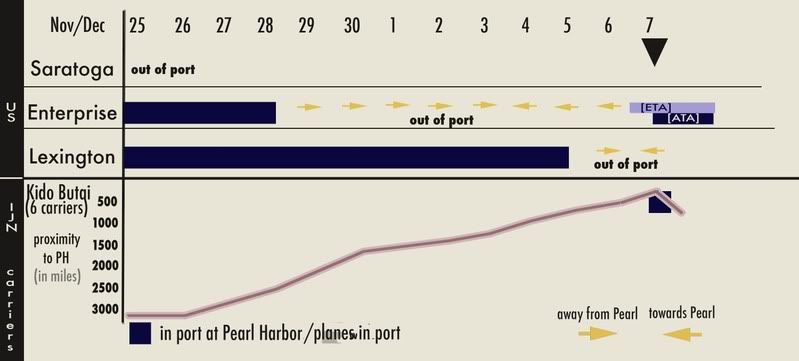
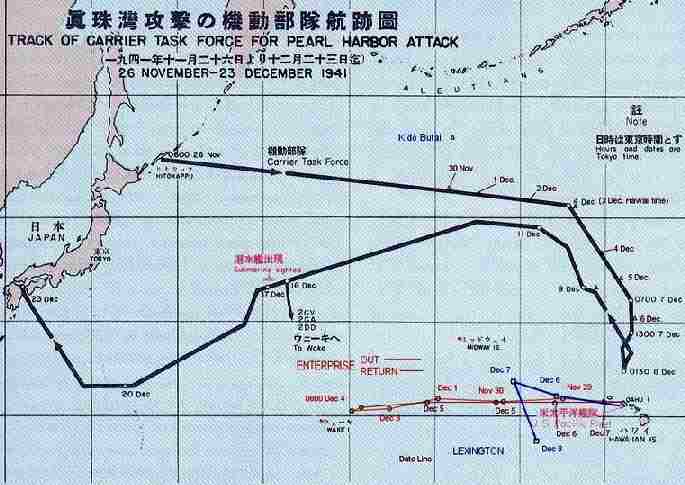
The much-re-posted “Pearl Harbor Myths” mini-article sums up this myth “The US carriers were hustled out of port just before the attack, to "save" them for a war that FDR already knew would be dominated by the flattop.” [2] While piece doesn’t do so, many have tackled this myth by arguing that the value of the aircraft carrier for naval warfare was not known at the time. Whatever someone may have claimed to recognize or not at one point or another is immaterial. The carrier in fact became the dominant weapon in the Pacific war, starting with the six that Japan’s Imperial Navy had sent towards Hawaii just before the US blithely sent its remaining two away from there on errands. graphic: timeline of carrier activity in and near Pearl Harbor 11/25-12/7 1941. Whichever country supplied them ,there was nearly always at least on carrier nearby. [r-click, new window for larger view

Any analyst worth his weight in Styrofoam should have foreseen the craft’s potential value in projecting air power, and any decision-makers involved in any provocation would have access to these views and choose to either ignore to act on them. Whatever was decided and by whatever means, the carriers were given special consideration and put in a special place, out of the harbor during the attack, and in fact projecting air power – just in the wrong direction.

Becoming a Way Station
There was a method to this madness, if it did ultimately prove a flawed and boneheaded method. The increasing likelihood of war with Japan in the second half of 1941 had caused the US War cabinet to look west and further west, right past Hawaii and the relatively exposed Pacific Fleet, to the distant Philippines, as the most likely flash point. There was a decision to pursue a deterrent bombing capability built up there, to turn the strategic liability into more of an asset, and a serious check on Japan's southward plans. [3] It involved suspending the normal and correct belief that the Philippines were indefensible, and this attitude was circumvented at just the right time to leave Hawaii as a neglected rear area rather than the critical front line.

What was lacking, ultimately, was enough planes to both defend the Philippines and offer a meaningful deterrent to other moves. This paradigm was still being pursued up until December 7, and in the process, Hawaii was neglected and treated, as Kimmel’s intel chief Edwin Layton put it, as ”only a way station to ferry B-17s to build up MacArthur’s forces” on Luzon. [4] When war looked more imminent, the pace of this process only quickened, while the military's joint board “resolved to reject the State Department’s hard-line proposals,” Layton explains, and “opposed “the issuance of an ultimatum to Japan,”” at least until the “imperfect threat" of the buildup was brought up to strength. [5]

Meanwhile, as the US military urged a façade of negotiation to cover their buildup against Japan's ambitions, Washington was shocked to learn of Japanese faux-diplomacy covering for a military build-up against US, UK and Dutch interests. What exactly this information was is a little uncertain, and will get a post of its own. But it became known in DC early on November 26, causing secretary of State Hull to “kick the whole [diplomacy] thing over” with an ultimatum they could not accept, and which he probably knew would spark the war. [6] This was the point when the US effectively decided to switch from talking to military preparations. Immediately after this, during November 26/27, the war council conferred and had warnings sent to all Pacific commanders pointing to possible Japanese attacks almost anywhere but Hawaii. And the two remaining aircraft carriers in Hawaii were requested to boost everything west of there “as soon as possible.” [7]

On November 28, Adm. Kimmel complied and sent the Enterprise, commanded by Admiral Halsey, and its accompanying warships to ferry 12 Grumman F4F-3 Wildcats to Wake Island. The task force began its return journey on December 4, and the following day, Lexington and its retinue set off towards Midway with 18 Vought SB2U-3 Vindicators. [8] These planes were to defend the Islands against Japanese moves and/or provide regional cover for 48 more B-17s to be flown trough there en route to the Philippines on December 7. [9] It's impossible to say if this bombers west strategy was purely a genuine military strategy or, at least in part, a smoke screen to give reason to the neglect of Hawaii - but it served the purposes of the latter, and the former was a miscalculation at best, with that final batch of bombers in fact helping mentally short-circuit radar defense at Pearl Harbor on just the wrong morning!

The Enterprise ETA Rebuttal
That attention seems thus drawn away from Pearl Harbor could be seen as supporting the “conspiracy theory” interpretation that Hawaii’s vulnerability was engineered. Further, it only makes sense to suspect the carriers’ locations would be worked into any such plans, and if so, then their absence seems to have been desired during the attack. There are arguments against this, and the best is the Enterprise; as the Pearl Harbor Myths pieces further explains:
“Enterprise was doing her best to get back into Pearl. Her first ETA was Saturday evening, but a storm delayed her. The next time set was 7 AM, 55 minutes before the attack started, but that proved too optimistic as well.”
When you’re dealing with high-stakes illusion, as we may be, a time written on paper does not a real plan make. The science of meterology was nothing then like it is now, but weather prediction was possible. I propose this ETA was fudged with a false presumption of clear sailing but knowing a storm would delay real arrival to (plus six, carry the five…) just after dawn on “X-day.” But the point gets a little better, that article explains, since the 12/6 arrival was scheduled back in August, well before anyone could have known about the Japanese plans to barely avoid:
"What really crushes the "carriers hustled out of port" myth is the fact that Enterprise was scheduled to be in port on Dec. 6th and 7th, as shown in the Employment Schedule promulgated in August, '41. No orders were ever recieved to change this. The mission to Wake was planned to coincide with the original schedule so that it would not be known that the island had recieved additional air support. The trip was kept secret, even the loading of the planes had a "cover story".
If it turns out the arrival time was set well in advance, then Dec 6 is a close coincidence that may then have been fudged upward similar to the above but with shove-off time set hours late, again wrongly presuming clear sailing, to get the carrier arriving back no earlier than the Japanese. Twice the estimates proved “too optimistic” for reality, and these erred guesses, apparently on Halsey's part, are all that gives the sense that one carrier was supposed to be back in time to join the party. But the reality, of course, is it just missed it, and reality is what matters to me.

Thrift or Thrown Game?
While I admit this fudged ETA business is quite speculative, it would serve to make the carrier absence look less suspicious, and give a hand to those who'd like to explain away these clues. That it does look dubious is testified by conspiracy theorists latching onto the “myth,” a natural impression which may have been predicted as a down-side to mitigate. If they knew it would look off, this raises the fair question of why the planners would risk such a move in the first place - carriers were valuable and scarce at the time, but ultimately expendable and easily replaceable in the post-attack climate. Given their utility alone it hardly seems worth the risk to have all of them out when at least one lost would look more natural. Thus “saving’” all three could hardly have been simple thrift, and this is likely only a secondary explanation. *

An obvious primary reason to consider, in keeping with the general thrust of this investigation, is to deplete Pearl Harbor's defenses. Minus the carriers and their decks full of fighting planes, the Japanese raiders quickly decimated almost all the remaining ground-based aircraft, which had been bunched to avoid against dread sabotage. The Enterprise returned 12 planes lighter but still holding most of its own fighters and bombers, which were close enough as the attack unfolded that they actually took part in the latter half of the defense. What kind of role they’d have played if fully in port is unsure; as it was, it seems Enterprise planes only took down one Japanese bird of the 29 lost in the attack, while losing several to enemy and understandably jumpy friendly fire. [10]

The people in the know seem to feel this carrier movement impeded the defense. Fleet intel chief Layton later summed up the effect of the carriers’ departure in that accidentally ironic way that could, with the slightest shift of view, mean exactly its opposite :
“That Stark, as well as Marshall, agreed to reduce the fighter strength at Pearl Harboor by half, and to run the risk that “there will be nothing left at Hawaii until replacements arrive,” was in itself evidence that whatever warning of Japan’s war moves had been received in Washington, it contained no hint of an attack on Pearl Harbor.” [11]

Prophecy Fulfilled
So with the defense aspect of carrier placements duly rendered ambiguous, let's return to the earlier point about the understood role of the carrier; if it was not seen prior to 12/7, it surely was after, and early probing into its potential can be seen in the curious “Doolittle Raid” of April ’42. It was just two weeks after December 7 that the President first told his war cabinet he wanted Japan proper bombed as soon as possible - partly to boost US morale but more so to shake Japan’s, and specifically as an answer to Pearl Harbor. ‘Sure, you can hit us in Hawaii,’ the message seemed to be, ‘but we can hit you at home.’ Lacking land bases close enough this early in the war, the raid was to be launched from a carrier, itself a move widely thought impossible for the larger bombers that would be needed. But after months of practice with B-25s and simulated carrier decks, they made it work, launched and rained some token destruction on Tokyo, and gave Japan its first hint of their grim future before crash-landing in or near free China. The just-completed carrier USS Hornet provided the deck for the raid, and the USS Enterprise showed up on time for its assigned escort duty on this symbolic revenge mission. [12]

By the time the raid was being planned, the ‘derelict’ Adm. Kimmel had been sacked and replaced with new Pacific Fleet commander Adm Chester Nimitz, the prophet and eventual hero of Pacific carrier warfare. Nimitz was destined for the spot, and seems to have foreseen more about the Pacific War than flat-top dominance. Earlier in 1941, he was tapped for command of Pacific Fleet, but perhaps on good advice from, say, Adm. Richardson (the outgoing CinCPAC to be replaced), turned it down, leaving the spot open for Kimmel. According to Nimitz’ son, in a 1996 History Channel documentary, the admiral said at the time:
"It is my guess that the Japanese are going to attack us in a surprise attack. There will be a revulsion in the country against all those in command at sea, and they will be replaced by people in positions of prominence ashore, and I want to be ashore, and not at sea, when that happens.” [13]

---
* To add to the thrift reason, we must consider not only the carriers but their escorts. I did a little research looking at this site on what was present on 12/7:
http://www.history.navy.mil/faqs/faq66-2.htm
and this one on what was away with the carriers:
http://www.history.navy.mil/faqs/faq66-9.htm

In Port:
Battleships – 8
Heavy Cruisers – 2
Light Crusiers – 6
Destroyers –30
Total = 46 war ships
Additional auxiliary ships, minesweepers, submarines, tenders, etc… 55

With the carrier task forces:
Two carriers, obviously
6 Heavy Cruisers
14 destroyers (split 9/5)
total = 22 war ships

So 3/4 of the heavy cruisers were absent, and about 1/3 of the destroyers. A 22 ship-reduction leaving 46 behind is about 1/3 detachment in sheer numbers, which is itself significant. About the quality and value of the classes of ships relative to each other I don't know - would this be the most valuable third? Layton's assessment [And I was There, p 263] is a little exaggerated, but informative:
"At this point [Dec 5-7], the disposition of of Kimmel's forces was as follows: All the carriers were at sea with specific missions. All the heavy cruisers and more than half of the fleet's destroyers were at sea protecting the carriers. Only the battle force - the old, slow battleships with their escorts of light cruisers and destroyers - was still at Pearl Harbor."

---
sources
[1] USS Saratoga CV 3. From: Dictionary of American Fighting Ships, published by the Naval Historical Center.
[2] “Pearl Harbor Myths”
[3] Layton, Edwin T. with Roger Pineau and John Costello "And I Was There": Pearl Harbor And Midway -- Breaking the Secrets."New York. Quill. 1985. P 171.
[4] Layton et al. P 170.
[5] Layton et al. P 177.
[6] Layton et al. PP 198-206
[7] Layton et al. 210
[8] See [1]
[9] Layton et al. 209
[10] Wikipedia. USS Enterprise (CVN-65)
[11] Layton et al. P 210.
[12] Wikipedia. Doolittle Raid.
[13] Conservapedia. McCollum Memo.

Friday, February 20, 2009

THE BATTLE OF PEARL HARBOR: ALTERNATE OUTCOMES

IT TAKES A LOT TO "LIVE IN INFAMY'
Adam Larson / Caustic Logic
The 12/7-9/11 Treadmill and Beyond
Feb 20 2009
last edited 2/24


A Question of Motive
When confronted with the “FDR knew” conspiracy theories, defenders of the dominant narrative sometimes point out as a logical flaw the ‘unanswered’ question of why Roosevelt or his advisers want to withhold intelligence and defenses from Hawaii if they had known the attack was coming? The truly naïve fall for the usually valid but simplistic presumption that losing ships and people is ‘a bad thing,’ and to be avoided. When they can get to the next level and adjust their cynicism goggles, concede the political opposition to be overcome and the importance of entering the war, it’s not hard to imagine an attack might have been desired. But these semi-rational coincidence theorists often stop the line of reasoning there, and contend that a foiled attack (or at least a met one) would have been sufficient for the cause.

For example, in his 1963 The Two Ocean War, Samuel Elliot Morrison dismissed the notion that FDR provoked or enabled the surprise attack, first by pointing out that “a little reflection” would show this “impossible,” since others would have to be involved, whom he names and finds too “loyal and honorable” to have participated. Besides this leap of faith, Morrison notes:

“More reflection might suggest that if Roosevelt and his cabinet ministers and armed service chiefs had schemed to get us into the war, their purpose would have been better served by warning the Hawaiian commanders in time to get the Fleet to sea and the planes airborne. Even a frustrated attempt to strike Pearl Harbor would have been sufficient cams [sic?] belli to satisfy the most isolationist congressman.”

That’s as bold and unsubstantiated a presumption as the first one. Another expression of this sentiment was offered in a 2001 Salon piece by Judith Greer, in which she stated that “no one has quite explained how being alert and prepared to beat off the attack would have significantly diminished its political effect.” The notion that “no one” has explained this is absurd; the reasoning is worked into nearly every explanation of the theory I have read, and that she is unaware of this is unlikely. What she seems to mean is ‘no one has offered an explanation I was willing to consider.’

Anatomy of a Useful Crisis
In case anyone would like to have it laid out again, I will illustrate in different ways the obvious and massive difference in “political effect” between a repulsed attack vs. the one we got. It may help to first realize what a big word “political” is in this context, and to consider the difference between the public attitudes of US and Great Britain, vis-avis fighting in the war. Few Americans can truly imagine the ”political” effect of actual Nazi bombs falling freely by the hundreds on the cities and baby carriages of Great Britain. Without the brutal daily reminders that made war a no-brainer, we’d have to suffice with, and maximize, a single such event to remember and keep remembering.

The first and foremost consideration is establishing the clarity of the aggressor/victim situation; the public would not tolerate our entry as an aggressor, but might be forced to concede to a ‘defensive’ war if the other side fired the first shot. Consider this line from the vague and misleading warning to Army commanders in the Pacific, sent Nov 27: “If hostilities cannot, repeat, cannot be avoided, the United States desires that Japan commit the first overt act.” This is not quite the order to ‘let yourself get shot’ that some present it as, but it does illustrate, at the least, that Washington explicitly desired a well-defined they-started-it beginning (to the extent they wanted a beginning at all, of course).

As it wound up, hostilities could not be avoided, and the Japanese fired hundreds of first shots. Our side managed but a few in return, quite obviously in defense, and the administration got their desired clarity in spades.

Once the evident moral conditions above are met, the scale of devastation works to your advantage, magnifying the outrage in direct proportion to the loss; a whole fleet crippled can provide the emotional steam to run a dozen such fleets.

Like ships, the number of dead is best in the high/painful range, since in the right hands, a frightening or depressing situation can be molded and used to mobilize a nation, so long as that nation feels otherwise vital enough to resist and change the situation. The one-sided surprise slaughter of thousands of young sailors would set a revenge charge in the American psyche to help keep America not just technically involved, but emotionally invested and their Congressional representatives likewise kept in line. Even the isolationists would be stuck in the pincer move.

By reminders it could continue to motivate throughout the war, instilling and nourishing a need to totally end the enemy so we can never be scratched like that again. FDR himself showed his awareness of this aspect immediately: “we will not only defend ourselves to the uttermost,” from that point on anyway, “but will make very certain that this form of treachery shall never endanger us again.” No one hits us without paying big, the American psyche demands. The promise was sort of finalized with Truman's first official statement after we vaporized Hiroshima and Nagasaki: "The Japanese began the war from the air at Pearl Harbor. They have been repaid many fold.”

Hypothetical Outcomes
An illustrative exercise for understanding the decisions made in Washington prior to the surprise is to consider the possibilities as they might have - play it out a bit, war-gaming style. You’re President Roosevelt, or any of his cabinet who would have to chose to join any conspiracy - in just the situation they were in, mid-late 1941. Europe is almost totally under Axis control, Japan is in control of a good portion of Asia and clearly preparing for more expansion. The Pacific Fleet wants to go back to the mainland, feeling exposed and edgy at Pearl, the US public and congress remain divided on entry to the war, perhaps leaning towards for, but not enthusiastically on average. You receive two or three solid clues that Japan plans to strike the exposed US Fleet (probably clues of their other simultaneous southward offensives as well) and you’re presented with two main options: get the intel to the people who need it to meet the threat, or don’t, and doom them to fulfill the terms of a maximized useful crisis, as outlined above. Here are four general possible outcomes to consider:

1) Tipped off of a Japanese sneak attack from the northwest, the Pacific Fleet readies itself – the carriers are brought back, all their planes armed and readied, guns loaded, radar manned and watched carefully, surveillance missions flown in the right direction. Spies on the island see all this mobilization and get word to Tokyo that surprise is lost, causing a last-minute order to abort the mission. The striking force retreats, and this attack is foiled, but the other prongs of Japans strike-out occur, including the Philippines, Shanghai, Thailand, and Midway Island, just hundreds of miles from Hawaii. US and Allied interests in Asia and the Pacific are threatened, the Philippinees fall, with US deaths, and America is jolted, but in both directions. Isolationists win, FDR croaks, an uncertain Truman put the fleet back in California to avoid a successful repeat, and the US remains neutral as the Axis make further progress yet. The US finally goes to war after a 1943 German air raid on New York launched from occupied Greenland, supplied from occupied Great Britain. It’s too late by then and we lose. But you get to avoid sacrificing innocent people.

2) Same as above, up to the US response - war is pushed through Congress based on the Philippines attack and thwarted designs on Hawaii. Headlines with the big type saying WAR do get to be seen, but the details are ambiguous, and only somewhat motivating. America thus enters WWII but forever tainted with the question ‘did the Japanese really intend to attack Pearl Harbor or did FDR make that part up?’
3) You tip off the military and have a plan drawn up where the Harbor would be left quiet with Carriers instead moved out to sea, under a cover story, just far enough from spy eyes on the island to prevent the strike force from turning back. A mid-sized squad sorties from the Enterprise and spots them 400 mi nw of Hawaii. The carriers with destroyer support swing into place and the two sides engage in battle, sending planes against each other. Whatever the outcome, with a definite battle in place nearer Hawaii than the Japanese should have been, the aggression is obvious enough and outrage would be a bit more clear. Headlines might read “WAR: Jap force engaged off Hawaii: 2-300 US dead, fleet unharmed” So far this is looking like a decent proposal that allows a strong level of furor and still avoids sacrificing perhaps thousands of peacetime recruits in a unilateral massacre.

4) You keep the clues close and don’t share, keep the target vulnerable. Convince your subordinates to do the same, which is not as hard as normal, given the unusual stakes, the grim necessity, and the fact that it’s already rolling and there’s no way back. No reception or defense is prepared in Hawaii, a total surprise attack happens, dozens of hundreds of American sailors are killed. The battle is one-sided, the aggression and culpability 100% clear-cut, simple, undeniable, and massive in effect. The legal repercussions of the slaughter are near-automatic. Headlines read “WAR: Jap sneak attack on Hawaii: 3000 dead, Shocked US United, vows ‘absolute victory.’" The emotional surge channeled by moral certainty adds fuel and conviction to the embryonic war effort. So sustained, it doesn’t just exist but thrives and helps greatly in the Herculean task of smashing the Axis in both Europe and Asia.

The human costs are high, the moral issues troubling, and the limits on openness pretty obvious. Under normal circumstances, it would be hard to justify. But the payoff to the inevitable war effort is leaps and bounds beyond the other options, and in that dark winter at the apparent edge of global Fascist conquest, it might have seemed wise to cash in anything you had.

But Is It Memorable?
Having trouble deciding? Check these propaganda posters that were circulated after the real-world Pearl Harbor attack, which had the effect, if not the cause, of option 4. Unprovoked deceitful treachery, causing smoke and damage to a flag. We’re to remember, just like the loved ones of the fallen remember their loss. We should help fund the war in their sake, refuse to surrender, in the names of the dead, calling from Heaven, avenge them – defy the smoke of humiliating, emasculating defeat by working, fighting, sacrificing, firebombing to final victory.
Now imagine if this kind of sentiment would fly nearly as well under the terms of possibilities 1 or 2 or 3. What would you propose instead to generate such a degree of public sentiment? Nice speeches with epic language? Or would you roll over to the isolationists and let the world burn around you? Careful now, if FDR did have these clues, and it seems he was waiting for them, he actually pondered the options without the crutch you have of saying “FDR didn’t know.”

Tuesday, February 17, 2009

FORMER NAVAL PERSONS

CHURCHILL, ROOSEVELT, AND VOYAGES TO WAR
Adam Larson / Caustic Logic
The 12/7-9/11 Treadmill and Beyond
February 16 2009


When the RMS Lusitania went down on May 7 1915 en route from New York to London, hit by a German U-boat and dragging down 1200 mostly English-speaking souls, two Naval personalities of great future importance watched from either side of the Atlantic. On one side of the pond, Winston Churchill had just set off from being the First Lord of the Admiralty and directly into the intensifying fray in a variety of war-related posts, on and off the battlefield. Across the way, A young Franklin D. Roosevelt was Assistant Secretary of the Navy, who among others urged US entry into the war following the attack.

There is some circumstantial evidence that Churchill, in his influential admiralty post, played a large role in steering the Germans towards downing the “livebait” Lusitania. British researcher Colin Simpson indicated this in a 1972 book; others were involved as well, on both sides of the Atlantic, and with the tacit approval of President Woodrow Wilson, worked to ensure what Churchill might have called a “maneuver which brings an ally into the field.” Roosevelt remained with, and helped guide, the Navy as the US prepared to enter the field and throughout the remainder of the war, re-learning again an old Roosevelt family secret – there’s nothing like a sunken boat to get a nation marching to war.

In 1939 the Britain-Germany feud again broke out in a big way and a war leader was needed in London to replace the ousted PM Chamberlain. Roosevelt was by then President of a decidedly neutral-minded and depression-racked US, prophetically urging his reluctant countrymen to rally against the new German threat. As World War II finally turned over from menace to inescapable reality in Europe, he reached out and offered his endorsement to Churchill as new Prime Minister. The sentiment was shared by Britain as a whole, and Churchill stepped in to bolster and brace the shaken British people. Now the two sat across the ocean as leaders not of Navies, but of nations bound together (at the head, if not yet the body) in opposition to Hitler’s Germany. It was at this time the two publicly formed what the FDR Library’s website describes as:

“one of the most extraordinary relationships in political history, a relationship marked by an intimate correspondence unparalleled among national leaders, a relationship which, in due course, would lead to the establishment of a military alliance unique among sovereign states.”

In particular, they bonded over their common Navy pedigree, and Churchill became known to Roosevelt by the nickname ‘Former Naval Person’ as they considered how to get the decidedly neutral ally maneuvered into the field against the Germans yet again. There were known methods to call on, but both the stakes and the resistance were higher than ever. A single ship would not likely suffice.

In late January 1940, three months before Churchill was finally elected, FDR sent his secretary Edwin Watson to fetch some documents from President Woodrow Wilson’s files. For whatever reason, Watson sent back specifically, and it seems exclusively, “the original manifest of the SS Lusitania” along with a note saying “I was afraid to [open it] until you had seen it.” This may mean nothing, but Colin Simpson found this original manifest years later not in its original place, but among FDR’s personal papers. [Simpson, Colin. The Lusitania. Little, Brown and Company, Boston. First US edition. Hardcover. 1973. pp 5, 267]

Thursday, February 12, 2009

THE MESSAGE WE MISSED?

Adam Larson / Caustic Logic
The 12/7-9/11 Treadmill and Beyond
February 12 2009
last edited 3/26


Throughout November 1941, as US-Japanese negotiations were secretly segueing into war maneuvers, the Japanese Navy mobilized to strike out across the Pacific at British, Dutch, and American interests. The last was tasked to a mighty force that had been assembled in secrecy at the 4-mile-wide hammer-head shaped Hitokappu Bay in the southern Kuril Islands (just north of Japan’s Hokkaido Island). By the middle of the month, would have been bustling with the “mobile striking force,” or Kido Butai, under the command of Admiral Chuichi Nagumo in his flagship Akagi; he was backed by 2 battleships, 2 heavy cruisers, 9 destroyers, 3 submarines, 8 train vessels, and, most tellingly, 6 aircraft carriers with about 360 combat-ready aircraft.

On the 25th, Fleet Admiral Yamamoto issued to Nagumi the fateful Combined Fleet Operations Order No. 5, ordering the force to set off for its intended target: - Pearl Harbor, Hawaii, and the bulk of the US Pacific Fleet moored there. The source from which I take this is the Joint Congressional Committee on Pearl Harbor, part 2 of their final report, published in 1946 [1]. Their telling reads as such:

”(a) The task force, keeping its movements strictly secret and maintaining close guard against submarines and aircraft, shall advance into Hawaiian waters and upon the very opening of hostilities, shall attack the main force of the United States Fleet in Hawaii and deal it a mortal blow. The first air raid is planned for dawn of X-day (exact date to be given by later order).

Upon completion of the air raid the task force, keeping close coordination and guarding against enemy counterattack, shall speedily leave the enemy waters and then return to Japan.

(b) Should it appear certain that Japanese-American negotiations will reach an amicable settlement prior to the commencement of hostile action, all the forces of the combined fleet are to be ordered to reassemble and return to their bases.

(c) The task force shall leave Hitokappu Bay on the morning of November 26 and advance to 42° N. And 170° E. (standing-by position) on the afternoon of December 4, Japan time, and speedily complete refueling. “


Clearly this order was crucial; it mentioned the target, the nature and location of the sneak attack, and the approximate date and time of day it would occur, just over two weeks later. If such information could have become available at that time to the US or to an ally inclined to share, the surprise could have been seen and pre-empted, or at least mitigated with some kind of proportional defense. None of this happened, of course, and the Kido Butai achieved total local surprise, which one may be tempted to accept as de facto evidence that the order remained hidden from American eyes at the time.

Such temptation should be resisted.

illustration using the given coordinates for stand-by position. This isn't quite right, as illustrated by the huge distance to travel the last leg. This probably means they modified the plan later, or had a further code in which one location actually mans another. A better map from Japanese sources can be seen at this page, and was used to make the more accurate and useful graphic below.
The Japanese Navy ordered the destruction of much of their records at war’s end, all copies of this order apparently being among the lost. Therefore, the Committee’s source for the wording they presented as evidence in 1946 would have to come from some other record(s) – hard copies that escaped the destruction order and fell into US hands, the memories of people who had written, read, or recieved the orders, or perhaps ‘our own copies,’ radio intercepts received by the US or an ally at the time but (presumably) decoded later.

In fact, the source the Committee cites is, essentially, anything but the third option. The order to sail is attributed to “Committee exhibit no. 8,” cited extensively throughout part two of their report when referencing Japanese plans or communications. Therein they explain:
“The chief sources of information concerning the attack are translations of captured Japanese documents, interrogations of prisoners of war, and reports submitted by general headquarters, supreme commander for the Allied Powers, comprising questionnaires filled out since VJ-day by former members of the Japanese naval high command. See committee exhibits Nos. 8, 8A, 8B, 8O, and 8D.” [2]
So it would seem that, even four years after the attack and the penetration of all Japanese codes, fuzzy memory and the odd scrap of paper was the best the Committee had access to. Apparently, we never got a copy of our own to decode and it was just lost into the ether. Admiral Edwin Layton concluded, after searching the available intercepts at the National Archive, “we evidently did not pick up Yamamoto’s 25 November sailing message” at all. [3] Note the judicious use of “evidently.”

The Pacific Fleet’s top intelligence officer at Pearl Harbor at that time, Layton published his own investigation at the end of his life, in the mid-1980s. Having found nothing of it in our archives, his source for the order to sail was “a reconstruction of events obtained from [the striking force’s] surviving commanders in 1945.” In particular, he cited the recollections of Capt. Mitsuo Fuchida, lead pilot of the actual air raid. This version is essentially the same as the above, with the exception of an “evening rendezvous” to refuel on Dec 3 Tokyo, not Hawaii time, and located at 40°N 170°E, two degrees south of the Committee’s findings. [4]

An Army Military History office document released in 1953 provides a whole string of communications surrounding the Kido Butai’s formation and intent, dating Nov 5 to Dec 2. While previous communications outlining the attack plan for Hawaii are recounted in great detail here, Yamamoto’s decisive Nov 25 order is provided only in a “general outline,” altering the standing-by position (from 165° to 170°) and ordering departure. Again, this document notes that “since all copies of these orders were destroyed prior to the end of the war, they have been reconstructed from personal notes and memory.” [5]

There is much debate among American researchers and little conclusive resolution as to how readable that code was to American cryptanalysts on December 7. The general mainstream consensus is that it was completely or essentially unreadable in the last days, as well as at the time of this pivotal order. The question of the code’s overall opacity as of November 25 1941 is one with no conclusive answer [hint - it was LESS likely to be readable on X-Day, and there are other nations whose own progress is uncertain]. The topic is shrouded in curiously dense secrecy and confusion (at least on my part), and will be the subject of a further post, or posts, after I’ve completed more research.

Sources:
[1] Investigation of the Pearl Harbor Attack. Report of the Joint Committee on the Investigation of the Pearl Harbor Attack. July 20 1946. Part II. Page 56. online - backup
[2] Ibid. Page 53.
[3] Layton, Edwin T. with Roger Pineau and John Costello "And I Was There": Pearl Harbor And Midway - Breaking the Secrets. William Morrow & Co. December 1985. Page 207.
[4] Ibid. Page 207.
[5] Japanese Monograph No. 97. PEARL HARBOR OPERATIONS: General Outline of Orders and Plans. Prepared by Military History Section Headquarters, Army Forces Far East. Distributed by Office of the Chief of Military History
Department of the Army. 19 February 1953. link