Tuesday, May 12, 2009

UNABLE TO PURSUE

THE MYTH OF FIGHTER DISPATCH
Adam Larson / Caustic Logic
May 12 2009
incomplete


So far in my studies on the USS Liberty incident, there has been a general acceptance among apologists as to when and why fighter aircraft were called in. The Motor Torpedo Boats were first dispatched to ‘investigate’ the erred shelling reports, and it was supposedly their erred radar reading that added the urgency only fighters could answer – another escalation based on error, typical of friendly fire incidents. I’m not familiar with the full body of evidence and arguments, but I’ll cite two of the most prominent that I have in front of me. Michael B. Oren’s 2000 article Case Closed explained:
"The torpedo boats gave chase, but even at their maximum speed of 36 knots, they did not expect to overtake their target before it reached Egypt. Rahav therefore alerted the air force, and two Mirage III fighters were diverted from the Suez Canal, northeast to the sea."[1]

Judge Jay A. Cristol’s 2003 The Liberty Incident likewise reasoned “if the Liberty continued at twenty-eight knots, as the Israeli naval force thought,” then the MTB’s current 36 knots could not close the gap before the enemy reached ‘home port.’ Their top speed of 42 might have sufficed, but still… Being fond of discussing some ‘rivalry’ between Isreali air force and navy, Cristol reasons as others have, “if the Israeli Navy had believed it could reach and overtake the target, it is inconceivable that the navy would have called for help from the air force.” Cristol cites the Stella Maris log entry: “Division 914 is reporting that targets are sailing west at 30 knots. An order was made to double check speed. He can not chase them. Suggests dispatch aircraft.” [2]

The aircraft arrived shortly, misidentified Liberty as a destroyer and blew the hell out of the hull and the American kids on it. It might then seem a tragic result of a natural response to a reasonable radar error. The reality of the evidence is that this dispatch of combat-ready aircraft was agreed to well before the navy knew what the radar returns would tell them. The MTB division’s log book shows for the 1321 entry “Div asked sea/3 “When will aircraft be dispatched?” Sea/3 answered, “When we have radar contact.”" Sea/3 means Stella Maris. The next entry was twenty minutes later, reporting said contact. [3]

This log makes no mention of the speed or heading, nor a request for aircraft. Instead, it just notes that jets are now on their way, directed to make radio contact once there. It seems to me the MTB and Sea/3 logs are offset about four minutes, so the div’s 1321 corresponds to Sea/3’s 1317: “Shelling of El Arish from the sea is continuing. It was reported to Moshe Oren and he was ordered to tune into air/sea channels 86 and 186 as our aircraft are en route.” 1320’s entry is a similar repetition, and 1343 has “MTB Div has a contact. Looks like it is maneuvering.” THEN the 1347 entry cited by Cristol, that the div was requesting air assistance because of the target’s speed. [4]

That the dispatch was already planned, and the jets already on their way before radar contact was made, to read Sea/3, could have non-conspiratorial reasons; perhaps it was presumed or guessed that the target would be too fast. To divert aircraft while in heavy combat mode is not done lightly, but this either seemed a serious danger, or was a serious operation of some kind and warranted a pre-arranged dispatch “just in case.”

However, this only heightens the surreality of the radar reading that only confirmed what the command had already decided. I'm no expert, but I'll say flat out that a 28 knot reading for a five-knots vessel is not at all likely; I’ve still seen no plausible reason a several minute radar watch should result in a nearly 600% error of speed, plus a 23 degree heading error indicating it had an Egyptian home. That this whole radar contact business looks like just a formality for a pre-decided course multiplies this troubling reality sixfold again.

Neither Judge Cristol nor Michael Oren mentions this pre-existing agreement. As I noted there could be an honest explanations, but there are already so many errors and questionable decisions to explain, it’s understandable they would just wait for the part where the ‘request’ was made, since that fits more simply and gracefully with the natural flow-of-errors narrative. It does not fit as well with the truth.


Sources:
[1]Oren, Michael B. The 'USS Liberty': Case Closed. Azure, Spring 2000. http://web.archive.org/web/20000917231200/http://www.azure.org.il/9-Oren.htm
[2] Cristol, Jay A. The Liberty Incident: The 1967 Israeli Attack on the U.S. Navy Spy Ship. Brasseys, 2003. Page 39.
[3] Israeli Defense Forces. Division 914 war log. WARL914. June 8 1967. PDF available at: http://www.thelibertyincident.com/israellogs.html
[4] Israeli Defense Forces. Sea Section/3 war log. WARLN. June 8 1967. PDF available at above link.

Tuesday, May 5, 2009

USS LIBERTY AIR ATTACK TRANSCRIPTS

Adam Larson / Caustic Logic
First Posted May 5 2009
Updated July 21 2009


Here I'll do something I rarely do by re-posting another article in its entirety with no comment. What follows is a transcript of communications between the fighter jets attacking the Liberty and their ground controllers. It was first published in the Jerusalem Post in 2004, but is only openly available on the internet in places like this discussion forum post, where I first found it, and where important and inexplicable "errors" are sometimes introduced. I purchased this direct from the JPost archive on July 11, and forgot to update this post right away (I'd previously used the erred version linked above, issue discussed in another post). My main interest here is the actual transcripts, which seem essentially authentic if quite possibly edited, so I left out the surrounding article, including pilot Spector's controversial remarks (this can all be found intact here). It was just waaaay too long a post with all included.
Liberty revisited: the attack
Arieh O'Sullivan Jun. 4, 2004

[...]
The pilots speak only before and after they act. There are full minutes of almost total silence and you know that men are being killed.
The only sound is of an automated female voice reading out the time every 20 seconds: "The time is now 14 and two minutes."
There are two tapes, one of the radio transmissions between the pilots and controllers, and the other of telephone conversations between the chief air controller and regional air controllers. The audiotapes themselves were not released. The following transcript is a mix of the two tapes into one transcript, which explains the time overlaps.
Cast of characters
Homeland - Air controllers
Kislev - chief air controller at general headquarters in Tel Aviv
Menahem - chief air controller at Air Control South
Yigal - Menahem's deputy
Robert - chief air controller at Air Control Central
Shimon - Robert's deputy
LK - Capt. Lazar Karni, weapons system officer
Kursa - two-ship formation of Mirage IIICJs commanded by Capt. Yiftah Spector
Royal - two-ship formation of Super-Mysteres that made the second run on Liberty
Nixon - two-ship formation of Mysteres armed with bombs for third strike
Pagoda - three torpedo boats commanded by Lt.-Cmdr. Moshe Oren
Migdal - one of the three torpedo boats that communicates with the pilots
Background
The Navy has just identified a mysterious vessel off El Arish possibly shelling the ammunition depot on the beach. It dispatched three torpedo boats against it, but has asked the Air Force to intercept the ship.

13:50
Kislev: Yigal, you have a ship at 26 (site designation). Take Kursa over there. If it's a warship then screw it.
Yigal: Clear
13:51
Unknown: Wait a minute, Kislev. The Navy says that our torpedo boats are in the area and are called Pagoda. They're on frequency 186.
Kislev: If it is a warship, you can attack. There are two of our torpedo boats there and they want [the pilots] to either see them or contact them on frequency 186. (There were actually three boats.) Robert, do you have Royal?
Robert: Royal?
Shimon: He is at Hava 16 (grid coordinates). That's route 15.
Kislev: Robert, take Royal along the coast so that if Kursa identifies, then he'll be able to go in, too.
Robert: All right.
Kislev: Menahem, how much fuel does Kursa have? Menahem: He has a lot. About a minute ago he had 3,000 (liters).
13:52
Kursa: What's the range? Seven turns, 040 degrees. Roger, I'll stay on 19 and 9 (frequencies). How do you call the torpedo boats? Pagoda? Kursa 9 and 3.
13:53
Kursa: Homeland, keep on directing me to the place.
Homeland: 045 degrees, 20 miles. Ah, can you see them at the moment?
13:54
Kursa: Affirmative, it looks longer by eyesight.
LK: What is this? Americans? (The weapons system officer in general headquarters blurted out in what he later testified was a hunch.)
Shimon: Where are Americans?
Kislev: Robert, what are you saying? (Quickly disregarding the comment, Kislev moves on.)
Kislev: Does he see more torpedo boats north of him?
13:55
Kislev: Menahem, if there are three torpedo boats, then this could be ours. (He is aware of the correct number of boats now.)
Shimon: Pay attention, Kursa
13:55
Kursa: Pagoda from Kursa. Migdal?
Migdal: Affirmative
Kursa: Are you attacking some ship now?
Migdal: We're on our way to one.
Kursa: OK. I'll come and give you a hand. Where are you?
Kursa: Migdal from Kursa. Are you there? There is no need. Bring yourselves up some 10-15 kilometers from the ship. Is it in the direction of your home?
Kursa: I see you on a right turn. Why are you turning? It's not in that direction.
Migdal: OK, all right. Affirmative Affirmative.
13:56
Migdal: Can you identify the target?
Kursa: Can you identify his target, Migdal?
Kursa: She's running from you in the direction of El Arish, correction, Port Said. What is it? What is it? A destroyer? A patrol boat? What is it?
Migdal: Kursa, Can you manage to identify it?
Kursa: I can't identify it, but in any case it's a military ship.
Migdal: OK, what is it?
Kursa: It has one mast and one smokestack.
Migdal: Roger.
Kursa: It has one mast up front.
13:56
Shimon: Menahem, Kursa is calling you.
Shimon: He says he is starting to strafe them.
Menahem: I told him that if it is a warship then he has authorization to attack. That was the last command.
Kislev: Menahem.
Menahem: Does he have authorization to attack?
Kislev: He does. If this is a warship then yes. Royal is to be directed to there.
Menahem: OK.
Kislev: Send Royal over there with bombs
Robert: On what frequency are you attacking?
Shimon: She's running away from this. (He says this as he monitors the Liberty on his radar screen.)
Kislev: Menahem, after he attacks, have him explain to Royal how to find her.
Shimon: She's fleeing very fast.
Kislev: OK, attack.
Shimon: Robert, have Royal call us on 19.
Robert: Royal to you on 19.
13:57
Shimon: Just a second, Kislev, we see the ship. (On radar.) That's one hell of a ship.
Robert: Menahem, I'm passing 105th [Super Mysteres squadron] to you on 19. Royal (over) El Arish at 20 (20,000 feet).
Kislev: Menahem, have (Kursa) tell us if there is anti-aircraft fire.
13:58
Kislev: Menahem, nu?
Menahem: We're asking him. She's not shooting back.
Kislev: Not shooting? Give me 19. (His voice has a puzzled expression.)
13:59
Kursa: We've hit her a lot... but maybe she is doing it (putting out smoke) on purpose, I don't know. Oil is spilling out into the water. I'm in eye contact. Great! Wonderful! She's burning! She's burning!
Menahem: Did you hear? He's hit her a lot. There's a lot of black smoke. There's an oil leak into the water. He's continuing.
Kislev: Was there any anti-aircraft fire on him?
Menahem: She's burning! The warship is burning! Menahem: Shmulik, she's burning! The moment Kursa is finished we're sending in Royal. (He uses Kislev's first name, Shmulik, in his excitement.)
Kislev: That's right, to sink her. (He says this flatly.)
Menahem: To sink her, OK.
14:00
Royal: Eye contact with the target. Eye contact with Kursa. Royal requests 15 (15,000 feet).
Kursa: OK, Kursa is coming in... you a bit further in. I'll go in the direction OK. (His comments are to his wingman.)
Kursa: I think she is putting out smoke on purpose. It's coming out of the smokestack. OK. I'm finished, too. The ship is really burning. There is a large fire and a lot of black smoke.
14:01
Kursa: Royal, your altitude? We're at 5 (5,000 feet).
Royal: You're east, right?
Kursa: We're south of the ship.
14:01
Kislev: Menahem.
Menahem: We're sending in Royal.
Kislev: Good.
Robert: (garbled) this ship?
Kislev: Menahem, if Royal has napalm it would be more efficient.
14:02
Kursa: Affirmative.
Royal: Not ours?
Royal: Homeland, can you hear? Call Homeland on 19. Ask if it's allowed to go in.
Royal: I understand, do not go in. Fine. We're circling above the ship at 15 (15,000 feet). Tell him that the Navy will be arriving before us. I can see.
14:02
Shimon: Menahem, Royal is calling you.
Menahem: He got off the line
Kursa: I've got him. (Kursa is relaying to control for Royal.)
Royal: Does Royal have permission? (20 empty seconds pass.)
Shimon: Kislev, there's doubt as to the identification.
Kislev: If there is a doubt, don't attack.
Shimon: Don't attack, Menahem.
Robert: Pay attention. There is doubt as to the identification. (Robert consults with a naval liaison officer in his headquarters.)
Kislev: What does that mean?
Robert: OK, you can go in. (Apparently resolving the issue with the Navy.)
Kislev: You may go in.
Kursa: Affirmative, you have permission, Royal.
14:02
Royal: Sausages, in the middle and up in one pass. Two together. (He instructs his wingman on dropping the napalm.) We'll come in from the rear. Watch out for the masts. Don't hit the masts, careful of the masts. I'll come in from her left, you come behind me.
Shimon: Next formation - get a briefing on what took place.
14:03
Robert: Authorized to sink her?
Kislev: You can sink her.
Shimon: Royal is exchanging words. They started chatting.
Robert: One Eight (sector coordinates) that is not the ship. Wait a minute
14:04
Kislev: Menahem, Is he screwing her?
Menahem: He's going down on her with napalm all the time.
Kislev: You don't need any more for the ship. Enough.
Menahem: There is no need. Our forces are there. The Navy's there, too.
Shimon: It'll be worth it just for the insurance.
Kislev: But napalm went there.
Unknown: What does napalm do (to a ship)?
14:04
Royal: on the right side of the stern...
14:05
Royal wingman: You've missed by an undershot.
Royal: a deep gash
14:05
Kislev: What is Kursa reporting? Was there any anti- aircraft fire?
Menahem: I've passed him on to 33 (frequency) and asked for a report.
Kislev: Robert, ask Kursa if there was any anti- aircraft fire.
Robert: Kislev, the Navy asks not to sink her completely. They want to get close and have a look.
Shimon: Have them rescue the people with the torpedo boats to help.
Robert: OK, finish with this formation. The torpedoes are coming up to them.
14:06
Kislev: What does Kursa say?
Robert: I'm telling you already. This is easier than (shooting down) MiGs.
Kislev: What is the situation now?
Unknown: I don't know. Two (Royal wingman) hit the ship with (napalm) and now he's strafing.
14:07
Royal: Fine, pull up.
Royal: I'm behind you. Careful of her antennas.
14:08
Royal: Homeland from Royal, how do you hear me? She has some kind of marking, P30 and something.
Kislev: Robert, take formation 116 (Nixon) out there too.
Robert: Good.
Menahem Her marking (He is cut off by Kislev.)
Kislev: Yes I heard. We are checking.
14:09
Royal: Homeland, if you could have a two-ship formation with bombs (here) before the Navy arrives then it would be a mitzva. Otherwise the Navy will be here in 10 minutes.
Shimon: Before the Navy arrives, it will be a mitzva.
Kislev: In the meantime take formation 116 (Nixon). Who is checking this? (The mysterious markings on the ship.)
Shimon: Royal reported that it would be a mitzva before the Navy comes!
Kislev: Look for a flag if they can see one. Have Royal look. See if they can identify her with a flag.
14:10
Royal: Twelve o'clock... look higher. Now left, slowly, slowly a bit faster so it will stay external, OK?
14:10
Robert: Kislev, they (the Navy) are asking us not to do anything else about her. They want to take her. It's a pity to sink her. I want to receive an answer.
Kislev: No, no. We are attacking meanwhile.
14:11
Robert: Menahem, is Royal leaving?
Menahem: Not yet. Just a moment. He is reporting something.
Kislev: OK, attack, Menahem. (He orders Nixon in for a third strike.)
Robert: Menahem, has Royal left?
Menahem: Not yet.
14:11
Royal: Homeland from Royal, do you read me? Pay attention. This ship's markings are Charlie-Tango-Romeo 5. There is no flag on her! She looks like a minesweeper with that marking. Roger, I'm leaving her. I'm staying around one more minute. (The Liberty's correct markings were GTR- 5.)
14:12
Robert: What altitude? What altitude is Royal reaching?
Menahem: Charlie-Senator-Romeo. (He incorrectly recalls CSR-5.)
Kislev: Leave her! (His flat tone changes dramatically as he realizes this was no Egyptian ship.)
Robert: Leave her. What ship is this?
Kislev: Leave her. (He says tersely). Menahem, report the approximate damage. (Redirect) 116 to its original mission.
14:13
Royal: Homeland, there's external fire on her, a lot of hits on her upper parts. People are jumping into the water. She's not shooting at all. She has hardly any armaments on her. She's going full steam towards the north.
Kislev: Shimon, Robert. We're sending two helicopters to them.
Robert: Good. Clear. I am dispatching helicopters.
14:14
Menahem: Kislev, what country?
Kislev: Apparently American.

Monday, May 4, 2009

USS LIBERTY OFFICIAL INVESTIGATIONS

13, 12, 11, 10… COUNTDOWN TO TRUTH?
Adam Larson / Caustic Logic
May 1 2009
last update 5/4


A NUMBERS GAME
Terence O’Keefe, a writer for he Washington Report on Middle East Affairs, in a December 2003 article, took aim at – and sunk – a key argument of pro-Israel obfuscation artist Jay. A Cristol. In his 2002 book The Liberty Incident, O’Keefe explains, Cristol’s “mantra” was that "thirteen investigations have all exonerated Israel" for their 1967 attack. [1] I’m past my “viewing limit” for the book, but O’Keefee did offer a numbered run-down of them (largely reproduced below), which I’m relying on for my critique.

To get 13, and he could have actually claimed 14, Cristol includes three self-exonerating Israeli reports. The first two reports, Ram Ron’s and Yerushalmi’s, from 1967, are actually lumped together as one entry; as O’Keefe explains and my partial examination confirms, these were not investigations at all but part of an internal Israeli process to find if anyone in particular should be charged with crimes. They concluded there was no negligence in the incident acute enough for a trial. The second was an IDF “official” history in response to renewed controversy in the United States. It may have had an investigative element, but was primarily a synthesis, with wider circulation, of the 1967 reports. [2] In all three, the fact that the incident was purely mistake was the first assumption, and was never questioned or examined.

Considering that Cristol’s primary target audience is American, it would make sense then to just drop the two Israeli non-investigation, and focus on the US investigations, which would seem to number eleven. He apparently did at one point, and this assemblage echoed around the infoverse - Alison Weir wrote for Counterpunch in June 2007 to analyze USA Today's first-ever news story on the Liberty. Reporter Oren Dorell talked only with analysts “with ties to Israel,” and while he did feature survivor accounts, these were pre-empted with the caveat “Israel has always insisted the attack was a case of mistaken identity, and 11 U.S. investigations over the years have reached the same conclusion." [3] The list Weir recounts is O’Keefe’s findings minus the two Israeli entries.

One critic noted how at a 2004 book signing, “the haughty Cristol persisted with his bogus argument, at the signing, that there has been "seven investigations" that have exonerated Israel. (In his book, he claimed thirteen! Go figure.)” [4] Cristol’s site currently explains “after ten official US investigations (including five congressional investigations), there was never any evidence that the attack was made with knowledge that the target was a US ship.” [5] There has been some semantics-playing by Liberty supporters, about the lack of Congressional = lack of governmental, but the "mantra" on that side is there have been NO Congressional investigations, let alone five. [see below for details] The Numbers game aside, there have been investigations by elements of the U.S. government regarding the incident, and all have avoided outright claims of hostile intentions towards the US. They also do little else of any relevance to the question.

NAVAL COURT OF INQUIRY; “TOTALLY INADEQUATE”
Among the U.S. investigations, the first in time, scope, power, and importance is the Naval Court of Inquiry, ordered even before the Liberty finished its slow journey to safe harbor. Admiral John McCain II was put in charge of finding what went wrong; as commander of U.S. naval forces in Europe, he had wide subpoena authority and other tools available. These he passed on to his deputy, Admiral Isaac Kidd, who would preside over the Court. His first order of business, appropriate to an investigation, was to tell the Liberty crew to keep quiet. Unlike normal, however, Kidd’s stern injunctions were taken as permanent.

All in all, it appears the Court treated the attacks as they might an inevitable act of nature – the questions were only how to keep ships away from those areas in the future, and tips on how to handle flooding, document security, medical triage, etc… Liberty survivor John Hrankowski has called the NCOI “a farce,” largely from failing to go “into the Israeli aspect. Israel was never queried about it." A site run by CAMERA (Center for Accuracy in Middle East Reporting in America) responded to this complaint “In fact, the Court of Inquiry was primarily focused on the actions of the Liberty’s crew, and thus quite properly did not include Israeli testimony.” [6] The same site lists its findings as “mistaken identity,” as if this means much of anything in the context.

John Crewdson’s historic Chicago Tribune article from 2007 concurred, stating “the court’s charge was narrow: to determine whether any shortcomings on the part of the Liberty’s crew had contributed to the injuries and deaths that resulted from the attack. McCain gave Kidd’s investigators a week to complete the job.” [7] Actually their purview was, or became, wider than this, covering the US military beyond the Liberty’s deck as well as speculative forays into other areas. NCOI’s fifty-two total findings of fact largely concern communications errors that left Liberty crawling in harm’s way, itself an interesting issue.

The inquiry did little, and could be expected to do little to exonerate the Israelis, since "it was not the responsibility of the court to rule on the culpability of the attackers, and no evidence was heard from the attacking nation." [8] They do acknowledge how Tel Aviv “set forth 7 points of rationale to explain,” but they gathered nothing of their own from the Israeli end, and from these papers “there are no available indications that the attack was intended against a U.S. Ship.” Finding 48 did acknowledge “LIBERTY apparently experienced a phenomenon identified as electronic jamming of her voice radio just prior to and during air attack,” which many say indicates they knew to jam U.S. frequencies. Nonetheless, the Court’s “available evidence combines to indicate the attack on LIBERTY on 8 June was in fact a case of mistaken identity.” [9]

Capt. Ward Boston, who had been the chief legal counsel to the Court of Inquiry, later denounced the process (his own part included, it seems) as a fraud. Once presumably tasked with drafting legal opinions on Israel’s offered explanations, and thus setting the Inquiry’s tone, decades later confessed he was in fact “certain" the IDF "were well aware that the ship was American." As O’Keefe explained:
“[Boston and the Court] found that the attack was deliberate, but reported falsely that it was not because they were directed by the president of the United States and the secretary of defense to report falsely. So the findings are fraudulent. Yet these fraudulent findings were the basis for several other reports that followed.” [10]

Boston has said - in no uncertain terms - that this view was shared by his boss, the NCOI’s president, Adm. Kidd. "The evidence was clear. Both Admiral Kidd and I believed with certainty that this attack [...] was a deliberate effort to sink an American ship and murder its entire crew." [11] To be fair, Kidd was dead by the time of these statements and unable to verify. Adm. McCain has never spoken up like this that I’ve heard, but, as O’Keefe found at least one more dissenter from high up in the investigation: “Rear Adm. Merlin Staring, the Navy’s former judge advocate general, was asked to assess the American inquiry’s report before it was sent to Washington. But Staring said it was taken from him when he began to question some aspects of the report. He describes it now as “a hasty, superficial, incomplete and totally inadequate inquiry.” [12]

This is not such a good track record for this pivotal no-confidence-voted non-exoneration. But never mind what they men involved really think, they once were persuaded to put their names on a report that put some nice exculpatory quotes at the very top of their findings, when these “facts” were never “found,” but rather “sent” by the Israelis themselves.

THE REST
Aside from the NCOI, that leaves ten once-alleged US investigations (and nine current) that “absolved Israel.” Here I’ll list O’Keefe’s explanations, renumbered for effect, starting at 2 since the NCOI was #1. The first two below I haven't studied yet, but no. 4 is juicy...
2. The Joint Chiefs of Staff Report of June 1967: This was an inquiry into the mishandling of several messages intended for the ship. It was not an investigation into the attack. It did not exonerate Israel, because it did not in any way consider the question of culpability.

3. CIA report of June 13, 1967: This interim report, completed five days after the attack, reported "our best judgment [is] that the attack...was a mistake." No investigation was conducted, and no first-hand evidence was collected. Then-CIA Director Richard Helms concluded and later reported in his autobiography that the attack was planned and deliberate.

4. Clark Clifford report of July 18, 1967: Clark Clifford was directed by Lyndon Johnson to review the Court of Inquiry report and the interim CIA report and "not to make an independent inquiry." His was merely a summary of other fallacious reports, not an "investigation"... The report reached no conclusions and did not exonerate Israel... On the contrary, Clifford wrote later that he regarded the attack as deliberate.

In fact, Clifford's report does reach conclusions, but they are highly intelligent, restrained, and nuanced. The report is strident in its denouncement of "a flagrant act of gross negligence for which the Israeli Government should be held completely responsible, and the Israeli military personnel involved should be punished." And he mentions that there is a "theory," not yet disproved, "that the highest echelons of the Israeli Government were aware of the Liberty's true identity or of the fact that an attack on her was taking place." However, he finds that "The information thus far available does not reflect" that possibility, and that to know if any information not yet available might reflect this, "would necessitate a degree of access to Israeli personnel and information which in all likelihood can never be achieved." Another astute observation from this report, in line with my own and well-put:
"That the Liberty could have been mistaken for the Egyptian supply ship El Quseir is unbelievable. El Quseir has one-fourth the displacement of the Liberty, roughly half the beam, is 180 feet shorter, and is very differently configured. The Liberty's unusual antenna array and hull markings should have been visible to low-flying aircraft and torpedo boats. In the heat of battle the Liberty was able to identify one of the attacking torpedo boats as Israeli and to ascertain its hull number. In the same circumstances, trained Israeli naval personnel should have been able easily to see and identify the larger hull markings on the Liberty."

Interestingly, when Clifford summarizes Israel's explanations, the word "mistake" is always joined with quotation marks. He's also been quoted as saying "I do not know to this day at what level the attack on the Liberty was authorized and I think it is unlikely that the full truth will ever come out." So yeah, Clifford once put his name on a paper that said basically "well, we don't have PROOF of a conspiracy, but..." Great, keep the "exonerations" rolling in, this is stupendous amusement.
5. National Security Agency Report, 1981: Upon the publication in 1980 of "Assault on the Liberty" by James Ennes, the National Security Agency completed a detailed account of the attack. The report drew no conclusions, although its authors did note that the deputy director dismissed the Israeli excuse (the Yerushalmi report) as "a nice whitewash." The report did not exonerate Israel.
This one is available though I haven't studied it. But speaking of "whitewash," just open the PDF, drag the scroll bar down and just hold it – how long til the flashing white of hundreds of redacted pages put you to sleep?
6. and 7. Two Senate meetings: The Committee on Foreign Relations meeting of 1967 and Senate Armed Services Committee meeting of 1968 were hearings on unrelated matters which clearly skeptical members used to castigate representatives of the administration under oath before them. Typical questions were, "Why can't we get the truth about this?" They were not "investigations" at all, but budget hearings, and reported no conclusions concerning the attack. They did not exonerate Israel.
8. House Appropriations Committee meeting of April and May 1968: This was a budget committee meeting which explored the issue of lost messages intended for the ship. It was not an investigation and reported no conclusions concerning the attack.
9. House Armed Services Committee Review of Communications, May 1971: Liberty communications were discussed along with other communications failures. The committee reported no conclusions concerning the attack.
That’s four of the five touted “congressional investigations.” Two were more ad-hoc discussions than anything; there were certainly no findings published. The latter two do only concern communications problems, as per the JCS report, and so solely American in scope. The last does appear more what I’d consider an investigation, one apparently planned for the purpose, but again irrelevant to Israel’s intentions.
10. Senate Select Committee on Intelligence, 1979/1981: [Miami bankruptcy judge A. Jay Cristol, author of a book exonerating Israel] claims that the committee investigated the attack and exonerated Israel, yet he has been unable to provide minutes, a report or other evidence of such an investigation. Rules of the select committee require that any committee investigation be followed by a report. There is no report of such an investigation; ergo, there was no such investigation.
Ouch, Congressional “investigation” no. 5 just does not exist, or at least has been brought into unanswered doubt. I confess I haven’t looked into this accusation closely – it hardly seems worthwhile given how the known investigations have panned out. Five congressional investigations is actually then informal discussions-cum-probes with no power, mandate, research or findings. Two just discuss communications on the US side and not what the attackers did or why. The fifth apparently never happened back in 1979 or 81. But what’s this, there’s more? That’s right, the 11th US investigation, and the 6th Congressional one:
11. House Armed Services Committee meeting of 1991/1992: Though cited by Mr. Cristol as an investigation which exonerates Israel, the U.S. government reports no record of such an investigation. Cristol claims that the investigation resulted from a letter to Rep. Nicholas Mavroules from Joe Meadors, then-president of the USS Liberty Veterans Association, seeking Mavroules' support. Instead of responding to Liberty veterans, however, Congressman Mavroules referred the matter to Mr. Cristol for advice. Survivors heard nothing further. Meadors' letter was never answered. The U.S. government reports that there has been no such investigation.

According to this, one of his alleged exculpations was a letter about a potential investigation that he was shown – for advice – that eventually was scuttled. Thus Cristol may have killed it himself, and then claimed it “exonerated Israel!” So that’s six *congressional investigations*; and since the good judge is currently citing five, one must wonder which of the two allegedly non-existent ones he’s dropped and which he’s still reporting as true. CAMERA’s USS Liberty page is less inclusive, citing “at least six government investigations which reached relevant conclusions as to the facts of the attack.” A noble gesture, to consider whether their findings are “relevant,” but unfortunately the site lists as one of the six “House Armed Services Committee, 1991/1992 - No support for claims attack was intentional.” Until I get a copy of the book, I have CAMERA’s explanation that “after a one year investigation the matter was closed, the investigators evidently finding nothing to support conspiracy claims or any Israeli intentions to attack a US ship”. I’ll reserve further comment until I’ve examined the controversy more closely.

So that’s it, the baker's dozen of case-closings that have left this case more closed to questions than the West Bank is to Palestinian exiles. Of course there is at least one professional-level but private investigation which, outside the control of Tel Aviv and the White House, is worthless as evidence and to be utterly ignored.

rest coming...

USS MAINE PRELUDES: WAR PLANS

SOURCE INFO COMPILED
Adam Larson / Caustic Logic
May 3 2009


In the process of fleshing out my previous thoughts on the USS Maine incident, this post will serve to gather some clues to fill in the "war games" angle. I'd only caught a glimpse of this before in a book by G.J.A. O'Toole, but it left me noticing how the "splendid little war" had been planned out at least two years in advance of the fortuitous pretext blasting its way into history. In my 2006 barely-researched essay I wrote in part:
In 1896, the recently created Office of Naval Intelligence drafted a plan should war with Spain be ignited over these developing issues. The plan recommended simultaneously attacking Spanish colonial holdings in the Philippines and in the Caribbean. The conclusion, apparently, was that the U.S. would win handily and could easily seize these strategic possessions.
[...]
[T]he gears kept turning at the Navy, under Secretary John Long and his assistant Secretary Theodore Roosevelt; by the end of June, the Navy had adopted the 1896 war plan. In August, Long went on vacation, leaving Roosevelt at the helm. President McKinley invited Teddy for at least two personal discussions, at which time the acting Secretary acquainted the President with the ONI’s suggestions. McKinley was apparently impressed with both Teddy and the plan.
[...]
I would note that it was a well-timed accident that the Maine should blow up, of all times and places, right after it had docked in soon-to-be-enemy waters for murky reasons, allowing that two-year-old plan to go into effect to the great benefit of U.S. policy.

So with this hint at what I'm looking for details regarding, here are some credible sources adding light to that dim awareness:
“After the renewal of the Cuban insurrection in 1895, officers of the Navy War College and the Office of Naval Intelligence drew up and then revised a series of war plans for the fleet in case the United States and Spain went to war. All three major parties endorsed freedom for Cuba during the election campaign of 1896, and the Spanish government would not end its pacification campaign or negotiate away its colonies, hence this planning was prudent. While President William McKinley and the State Department attempted to come to terms with Spain, a Navy War Board of five senior officers reviewed and revised the basic plan drafted in 1896. Essentially, the Navy War Board envisioned offensive operations against the Spanish fleet in the Caribbean and in the western pacific near another Spanish colony, the Philippine Islands. A defeat in the Caribbean would isolate Cuba and blockade the Spanish armies in Cuba and Puerto Rico, while a victory in the Philippines would allow the American government to hold Manila hostage until a peace was negotiated.” [2]

“Although the Navy War Board did not plan any specific operations to seize temporary bases, its plan implied that such actions might be necessary. In any event, by the end of 1897 the Navy Department had a fairly accurate vision of its responsibilities in 1898.” [3]

"When the Cuban insurrection broke out the following year, the officers in charge at the Naval War College believed that it was important to undertake a full-scale study of a Spanish-American conflict. They gave the class of 1895 a "special problem" concerning war with Spain where the objective was to secure independence for Cuba. The plan [was] submitted to the Navy Department in January 1896 [...] The Office of Naval Intelligence entered the planning effort later in 1896. Lieutenant William Kimball prepared a plan that focussed on a tight naval blockade of Cuba [...] supporting attacks against Manila and the Spanish coast [...] According to Kimball's plan, only if these efforts failed to bring about peace, would the army land in Cuba and operate against Havana. The Naval War College criticized the plan [but] endorsed the idea to use the Asiatic Squadron against Spanish forces in the Philippines, and this element would reappear in later plans.
[...]
Secretary of the Navy Hilary Herbert [convened] a board in the summer of 1896 to draft a separate plan for war with Spain. Like the Kimball plan, the Ramsay Board focused on the a naval blockade, but added the deep water ports of Puerto Rico to those of Cuba. [more details...] Finally, the European Squadron should be reinforced by ships from the U.S. and the Asiatic Squadron, and together operate against the Spanish coast after capturing the Canary Islands as an advance base.
[...]
Perhaps confused by the different positions in the existing plans, the new Secretary of the Navy, John Long, convened his own War Planning Board under Commander in Chief of the North Atlantic Station, Rear Admiral Montgomery Sicard, in June 1897. Chief Intelligence Officer Lieutenant Commander Richard Wainwright was the only member who had served on the previous board. The Sicard Board endorsed the War College idea that joint operations against Havana would be necessary to end the war. Therefore, the plan called for the early seizure of Matanzas, sixty miles east of Havana, to serve as a base of operations against the latter, and to deliver arms to the Cuban insurgents.
[...]
When war between the United States and Spain appeared unavoidable following the destruction of USS Maine in Havana harbor on 15 February 1898, the Navy Department had a solid body of plans and documents honed by four years of debate by its leading officers. Although the realities of war would force several modifications, many of the concepts laid out in the Sicard Plan were implemented
[...]
[N]early every plan called for the purchase or charter of merchant vessels to serve as auxiliary cruisers, colliers, and transports. The data furnished in appended lists and the inspiration to act quickly served as a basis for decision making in those crucial weeks prior to war. [...] The destruction of the Maine propelled the department into action. Assistant Secretary of the Navy Theodore Roosevelt organized a Board of Auxiliary Vessels [...] On 9 March Congress passed a $50 million emergency defense appropriation bill, and the Navy Department began to acquire vessels.
[4]

"Roosevelt and his expansionist friends, led by Senator Henry Cabot Lodge, lobbied successfully for his appointment as Assistant Secretary of the Navy after McKinley's victory in 1896--despite McKinley's views that TR was too pugnacious. Coming to office several years into the Cuban insurgency, TR's top priority was expelling Spain from the Americas, but he had to contend with a variety of naval war plans on how to do it. In the event of war, the Office of Naval Intelligence advocated an attack on not only Cuba but also the Philippines to force a Spanish war indemnity and to tie down their fleet. The Naval War College planned for a defensive coastal war if Britain joined Spain in defending Cuba, but an attack against Spain itself if Britain stayed out. Typically, TR favored the most aggressive option--attacking Spanish forces more or less everywhere." [5]

“In 1896-97, [ONI] chief intelligence officer Lt. Comdr. Richard Wainwright, and his staff officer Lt. William W. Kimball, expanded a war plan begun at the Naval War College […] Wainwright also sent Lt. Comdr. George L. Dyer in 1897 as the first full-time U.S. naval attaché to Madrid. Wainwright collaborated closely with the Assistant Secretary of the Navy Theodore Roosevelt in developing clandestine U.S. war preparations, the secret purchase of armaments and warships overseas, and development of a spy network in Europe. Roosevelt corresponded with naval attachés Lt. Comdr. John C. Colwell in London and Lt. William S. Sims in Paris. Colwell and Sims operated a string of civilian spies with a “Secret Service Emergency Fund” sent directly by Assistant Secretary of the navy Roosevelt, probably without the knowledge of either the secretary of the navy or the president.” [6]

!!!
Sources:
[1] O'Toole, G.J.A. The Spanish War: An American Epic 1898. New York. WW Norton. 1989. Pages 100-102.
[2] Millett, Allan Reed. Semper Fidelis: The History of the United States Marine Corps. Simon and Schuster, 1991. p.128 Google Books.
[3] Ibid. p 129.
[4] Hayes, Mark L. War Plans and Preparations and Their Impact on U.S. Naval Operations in the Spanish-American War. Early History Branch, Naval Historical Center. Paper presented March 23 1998.
[5] Parker, Tom The Realistic Roosevelt. The National Interest, Fall 2004.
[6] Beadle, Benjamin R., ed. The War of 1898 and U.S. Interventions, 1898-1934: An Encyclopedia. Google Books p 235.

Friday, May 1, 2009

USS LIBERTY ATTACK GRAPHICS

Adam Larson / Caustic Logic
April 30 2009


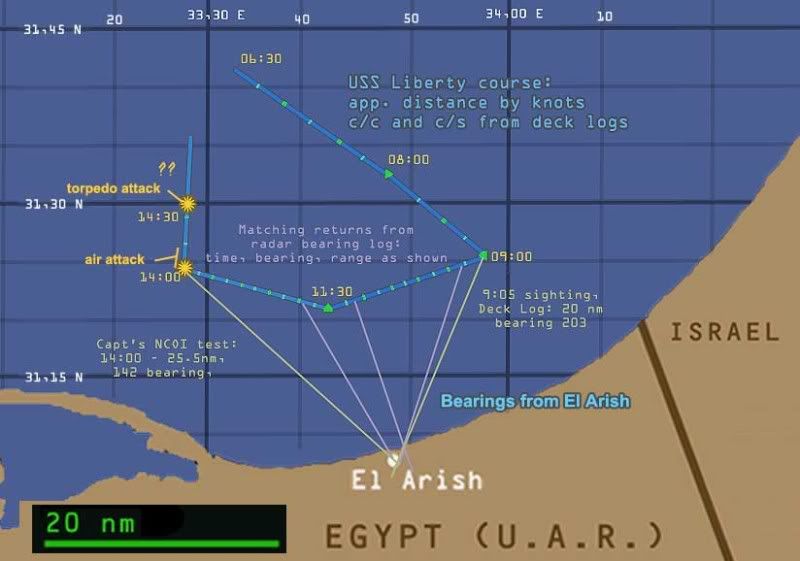
[r-click, new window for full-size view] USS Liberty course from 6 am until the end of the attack. 20 nautical mile scale, land contours from Google maps, lat long intersections set using Earth Tools. Path first set roughly from various graphics. Liberty speed and course changes derived from the Deck Log, lengths of each leg set by knots, marked at 15 min intervals. All approximate, and ignoring small momentary changes. 9:00-11:30 stretch fine-tuned with Liberty's radar bearing log and its readings from El Arish minaret, plus deck log and captain's recollection.
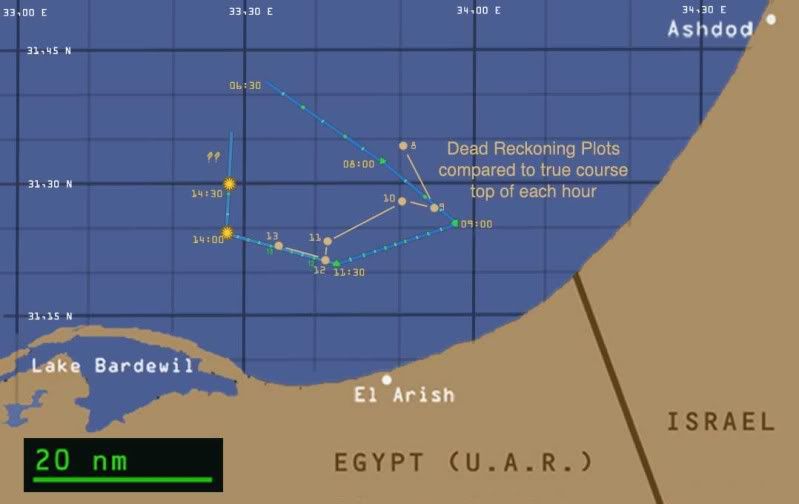
I hoped the plots from the Dead Reckoning Table would help pin down the exact course, but no luck.
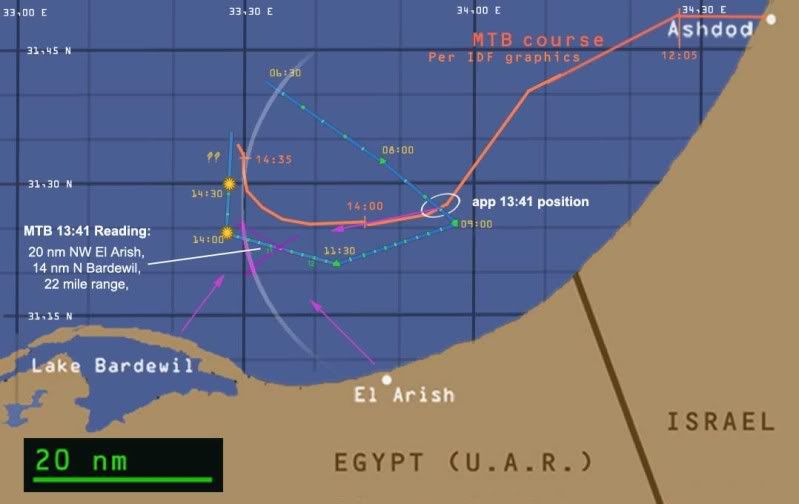
Motor Torpedo boats app. path based on IDF graphics, generally supported by MTB logs. Location of their radar return at 13:41 (inside the magenta triangle) matches the Liberty, but the heading and speed they decided on were way off, which remains an unresolved mystery.
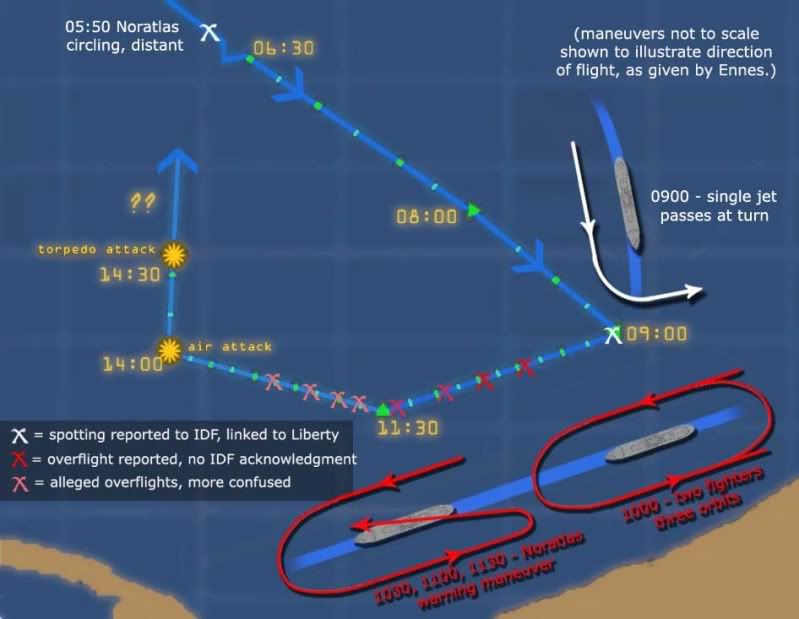
Analysis of pre-attack aerial surveillance. Various sources.

Sunday, April 26, 2009

BOAT-TO-BOAT RECOGNITION

USS LIBERTY SIGHTS THE MTBS AND VICE-VERSA
Adam Larson / Caustic Logic
April 26 2009
last edit 5/2


When discussing the prolonged, coordinated IDF blitzkrieg attack on the USS Liberty, the whole “fog of war” “mistaken identity” explanation is routinely tossed out as the catch-all reason. Such people will easily suggest, essentially, that friendly fire incidents happens so often it’s a wonder anyone ever recognizes anything effectively when at war. I sense these theorists have entered their own fog once exposed to the details; the real IDF philosophy was apparently to misidentify the ship repeatedly at every turn, to start shooting immediately and keep shooting until you know who you’re shooting, and remain incredibly obtuse about figuring that out the whole way. Ain’t nothing friendly about that.

On the Liberty, in contrast, great care was taken to accurately identify the SoBs strafing and napalming her crew. Only one side in this battle seemed amazingly confused about what was going on, and the other was operating in the real world. “Fog” is more diffuse than this, bunching in spots of course, but only so densely, and drifting across lines in a natural flow. This is a proper zero-visibility “cloud front of war” - swift, heavy with storm, and driven out over the sea by some unseen wind, right ahead of the prime actors in what mechanically happened – the three motor torpedo boats (MTBs) that first tagged the Liberty for attack and very nearly sunk her.

FIRST CONTACT - BEFORE VISUAL
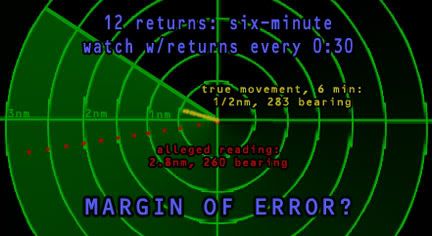
Designated Division 914, and code-named Pagoda, the three swift light craft were already well en route to the scene for an unspecified mission, when first alerted of their target at 13:30 [1]. It was of course framed as a suspect Egyptian warship, and shortly thereafter, at 13:41, they made first radar contact with some vessel at a range (distance) of 22 miles, almost due west of them [2]. Although what these returns told them [see below] has nothing to do with the Liberty, they were apparently what the hunters followed up to the prey.

Being the larger target, it makes sense the Liberty was seen first by the other party. She wasn’t long behind, however, and their radar operators spotted the smaller MTBs ten minutes later, at 13:51. This showed as three small surface craft, 16 nautical miles distant on a relative bearing of 82 degrees. [3] They had the correct location, number, and size of the targets, the proper bearing and range and presumably the right speed. These are the building blocks of proper identification by radar. But far from visual range, they had no ID yet nor any idea of hostility headed their way – it would be another five minutes or so before IDF jets appeared and started strafing.

Now things were a lot more foggy on the Israeli end – apparently a side-effect of being on the offensive. This is the first of several mis-identifications, as the returns were somehow interpreted as showing the craft at 28-30 knots, nearly six time the Liberty’s actual speed. They also calculated, and double-checked, a significantly different initial heading than the Liberty was on, and a change of direction shortly after being spotted, which the Liberty also did not do. These incorrect calls brought in fighter planes to catch the apparent enemy ship speeding to Egyptian Port at Said, and slow it down with repeated air attacks from 1358-1411.

FACE-TO-FACE
It wasn’t until well after these attacks that the Liberty and the MTBs were within visual range, at about 14:20. Three small fast boats appeared, fitting the radar profile with no surprise. An apparently Israeli flag, small, but enough baby blue to guess, was seen from about 2000 yards, according to the Captain. "MTB believed to be flying Star of david flag. Flag quite small." [4] During closer passes, one badge number at least was noted in the Captain’s first situation after attack report: “Hull number of one boat was 206-17.” [5]

Ensign David Lucas was the one who made this call, and when asked about this entry during the Naval Court of Inquiry, explained the number was taken down from “approximately 500 yards.” Referring to a photograph in Jane’s Fighting Ships, perhaps the same one shown here, Lucas said it “appears to be the exact same one that I identified. If I had had a camera and taken a picture of it, I would have gotten the same angle, […] what I thought to be 17, I found out later from Mr. Bennett, when I examined this book, that it was an Israeli symbol.” [6]
In particular, it seems to be the Hebrew letter teit; the three boats of Division 914 are sometimes designated T-204, T-203, and T-206. The given length for these craft is about 93 feet, making the numbers about 2.5 feet high, and the total designation block about ten feet long, clearly visible from 500 yards. In comparison, the Liberty's overall GTR5 lettering block measured about twenty-five by ten feet, and would be visible from a much further distance.

On their way there, the MTB crew say they felt they were racing towards an Egyptian Z-Class destroyer, based on the shelling reports, the ‘observed’ radar speed, and even initial Air Force reports in the attack. When they got to it they quickly realized that was wrong. Israeli historian Michael Oren explained how Division Commander Moshe Oen (no relation?) "could see that it could not be the destroyer that had supposedly shelled El-Arish. Rather, he believed, it was a slower-moving vessel that had either serviced that destroyer or evacuated enemy soldiers from the beach.” [7] Thus any second thoughts this gave them were quickly corrected – it was just a different Arab ship. The important but overlooked corrolary of this is the IDF’s jets had already spent twenty minutes attacking the wrong vessel and the 30-knots shore attacker was slipping away behind the distraction. This seems, from the records I've examined (all available) to have been no concern of the IDF, as they continued their attack against the easy mark in lieu of a threat they seemed to know never really existed.

The MTB crew only had access to a slim volume detailing known vessels of surrounding Arab nations, leaving them clueless about the wide world of non-Arab vessels, like the one before them. [8] Looking for the best fit therein, they Michael Oren explained:
“Consulting his naval intelligence manual, [Commander Moshe Oren] concluded that the vessel in front of him - its deck line, midship bridge and smokestack - resembled the Egyptian freighter El-Quseir. The officers of the other two boats reached the same conclusion independently, and followed Oren into battle formation.” [9 - emph mine].
Simply “resembling” a possible enemy ship should never be a reason to attack; even if they were unable to gauge the Liberty’s true size and find it to be nearly twice the length and more than thrice the overall displacement of the one in their book, considering them equal in size, much did not fit. The giant middle mast must have been added along with numerous large antennae, the mid-ship structure had been built way up, the smokestack straightened and moved forward, portholes removed, and her overall shape significantly changed. [See also K.J. Halliwell's excellent analysis at the USS Liberty Inquiry site]. But otherwise, aside from the massive size difference, it definitely resembled the El Quseir. And if this was the closest fit they could find, the proper conclusion would be this was not an Arab ship at all. El Quseir, left and USS Liberty, not to scale. The numbers in the book and their own eyes gave them every chance to gauge the difference.

LIGHTS AND BULLETS
One method of gaining more information about the ship was, quite simply, to ask them, using internationally accepted light signals. Oren related the official Israeli version of the light conversation:
“At 6,000 meters, Oren's T-204 flagship paused and signaled "AA" - "identify yourself." Due to damaged equipment, McGonagle could only reply in kind, AA, with a hand-held Aldis lamp. Oren remembered receiving a similar response from the Egyptian destroyer Ibrahim al-Awwal, captured by the Israeli navy in the 1956 war, and was sure that he now faced an enemy ship.”[10]
The equipment was indeed damaged – all installed signal lights but one were shot away in the attack, by accident or design, leaving them with one tiny light six inches in diameter and nowhere near powerful enough to shine through the thick smoke roiling up from the air attack. [11] I’ve seen no evidence or reason to suspect the small light was only capable of signaling “AA.” And that's certainly not what the crew recalled sending.

Another source (Hank Roth) explained how crew member Udi Erell gave the signal as "AAA," but clearly "saw the response flickering through the smoke four miles away." [emph mine] Again the reference was made to this well-known indication of Egyptian bad-guy-ism, circa 1956. Their own identity was their best defense for the Liberty to throw out there, and in fact, the piece continues: "the Americans on the bridge of the Liberty would later state that the signals flashed were the ship's name and its international call sign, not what the Israelis believed they saw.” [12]

Oren’s article has the signaling done from 2.5 miles, Roth says four miles, and both agree that their signals were readable at that great distance, though the thick smoke, and so were the Liberty's responses. In fact, Captain McGonagle’s testimony to the Naval Court of inquiry seems to mean neither side signaled anything at this time, and common sense would indicate neither should be readable in the circumstances. First, he was asked when “the patrol boats were attempting to communicate with flashing light.”
“A. This was definitely after the torpedo attack.
Q. The flashing lights from the boats were after the torpedo attack?
A. Yes, that is correct. […] The first signaling that I observed was the unsuccessful attempts to determine what they were signaling us, and of course, we did not have a chance to answer back to them. This was after the torpedo attacks.
[13]

This implies the attackers made no attempt to communicate with the ship, which contradicts the MTB crew’s testimony. However it also goes against McGonagle’s own summary of event presented to the NCOIA Prior to the first shot, as the MTBs first sauntered up:
”When the boats reached an approximate range of 2,000 yards, the center boat of the formation was signaling to us. Also, at this range, it appeared that they were flying an Israeli flag. This was later verified. It was not possible to read the signals from the center torpedo boat because of the intermittent blocking of view by smoke and flames.” [14]
This is supported by the NCOI’s chronology from the deck log, putting these signals at 14:28, and the signaling distance as 2,000 feet, much closer than the Israelis stated. [15] This development was followed by the Captain's order to the guns to hold fire, which was followed by a few rounds fired by two guns. Personally I don’t buy the crew's story of how those guns started shooting, but that’s an aside. By jittery/pissed-off sailor, captain's order misunderstood, napalm-induced anomaly, or some combination, it happened. McGonagle understood “I am sure that [the MTBs] felt that they were under fire from USS LIBERTY. At this time, they opened fire with their gun mounts and in a matter of seconds, one torpedo was noted crossing astern of the ship at about 25 yards.” [16]

The MTB Log records “detected firing flashes” at 14:35, apparently taken as a negative response to their own flashing. They then recorded the identification as El Quiser at 14:37, and their counter-attack commencing at 14:40, first torpedo launched at 14:43. [17] On the other hand, the Liberty’s logs from the deck to the boiler room show machine gun fire on both sides at 14:30/31, the first torpedo miss at 14:34, and the unambiguous deep impact at 14:35. [18] These could be troubling contradictions or could just indicate the MTBs' clocks were 5-10 minutes ahead.

Roth’s source for the initial identifying signals from Liberty were apparently later ones sent at closer range, with a more powerful light rigged up after the torpedo attack. The Chief Communications Technician, Harold J. Thompson, related this exchange as “US Naval Ship - US Naval Ship.” “do you need help.” “no, thank you.” “Do you want us to standby?” “no, thank you.” “good luck.” [19] Captain McGonagle recalled on another occasion hoisting a flag meaning that steering was erratic and they should keep away. [20] There is much here to be confused about, but it seems likely the MTBs did signal prior to the attack, but they didn’t wait for - and perhaps didn't want - an answer.

HOW SLOW THE LEARNING CURVE?
So many clues were missed up to this point – the initial surprise on finding something other than the guilty destroyer, something too slow and unarmed, already over-attacked on the idea it was one. Time to re-think? No, being close enough to shoot, they also risked being close enough to see the 13-foot holiday colors US flag, well-extended as the Liberty was cruising into the wind by now. They could have seen the large hull lettering on the side, well below the obscuring deck fires, should have been visible from miles off. The pre-torpedo order from headquarters alerting the MTBs to hold fire, per confusion about the ID, failed to reach commander Oren. [21]

Eventually of course they did learn of the ship’s identity, but accounts differ as to what the final tip-off was and when it came. Michael Oren cites a cut-loose life raft as the first clue: “one of those rafts, picked up by T-203, was found to bear U.S. Navy markings - the first indication that Oren had that the ship might be American.” [emph mine] That certainly seems a clue worth considering, and apparently “his suspicions mounted when while circling the badly listing ship, Oren confronted the designation GTR-5. But still no flag was spotted, and it would take another half an hour, until 3:30 p.m., to establish the vessel's identity.” [22]

This all was occurring, then, around 15:00, 25 minutes after the torpedo hit. The deck log and NCOI chronology places the light signals regarding assistance at 15:03, the time they were told that they’d just attacked a “US Naval Ship.” Still unsure, as Roth explained “drawing closer to the burning vessel, they were able to make out a flag. It was not opened by a breeze and could not immediately be identified, but it was clearly not Egyptian." What could it be? Crewmember Udi Erell “saw a splash of red on the flag and heard a report being sent back to Haifa that the vessel might be Russian.” [23] Since Egypt’s flag is three solid stripes of black, white and red, and the Soviet flag is almost nothing but red, a simple “splash” should have been enough to cause yet more concern, on top of the US rafts and non-Arabic, non-Cyrillic lettering, and the crew insisting they were Americans. "Dang, this keeps getting more confusing. Hey you guys, I know this sounds crazy, but… what if these guys are Americans?"

Shlomo Erell was the IDF Navy’s chief of staff, and had been out of the office during the horribly bungled attack, and only heard about it after the shooting was done. Upon his return to the loop, things started making sense again. Erell later recalled reports on the flag, presumably from his son Udi’s commander in Division 914, Moshe Oren. “It was clear to me she couldn’t have made 28 knots and so I asked for definite identification. Then they reported the flag was going up, and being hoisted. Then the first identification was Soviet [chuckles] so I said come closer, he came closer, and identified it as an American ship.” [24]

The American flag they’d be seeing was the large “holiday colors” McGonnagle testified were raised as soon as the MTBs came into view, well before the torpedoing, and over an hour before the attackers finally noticed it. There is no record of a flag, other than the one about steering, going up anytime after this, so any memory of seeing the stars and stripes rising is impossible. So in case it sounded hyperbolic at the beginning, let me recap: the IDF philosophy here seems to be misidentify the ship at every turn, start shooting immediately and keep shooting until you know who you’re shooting, and remain incredibly obtuse about figuring that out the whole way.

Sources:
[1], [3], [15], [18] US Naval Court of Inquiry Exhibit 27: Chronology of Events. Found in a PDF document available here: http://www.thelibertyincident.com/docs/timeline.pdf
[2] Algon, IDF, 1982. http://www.gtr5.com/evidence/idfhr.htm
[4] USS Liberty Deck Log – logs 1-24, pp 14 in this packet: http://www.thelibertyincident.com/docs/Logs1-24.pdf
[5] McGonagle, William. Captain, USN. Situation Following Air Attack. Navy message. Filed 8 June 1967, 5:15PM UTC.
http://www.nsa.gov/public_info/_files/uss_liberty/liberty_messages/situation_following_attack.pdf
[6] Naval Court of Inquiry, record of proceedings, page 27. http://www.gtr5.com/evidence/ncoi.pdf
[7], [9], [10], [21], [22] Oren, Michael B. The 'USS Liberty': Case Closed. Azure, Spring 2000. http://web.archive.org/web/20000917231200/http://www.azure.org.il/9-Oren.htm
[8]http://www.thelibertyincident.com/ship-ident.html
[11]. [13] See 6, p 34.
[12], [23] Article re-published by Liberty Survivors Association as "Hank Roth, Israeli Apologist." Jan 20 1997 http://www.ussliberty.org/roth.htm
[14], [16] See 6, p 44
[17] Division 914 War Log. http://www.thelibertyincident.com/israellogs.html
[19] See 6, p. 88
[20] See 3, p 22
[24] Dead in the Water. BBC Documentary, 2002. Christopher Mitchell Dir. around 35:00 mark in this apparent 2006 update: http://video.google.com/videoplay?docid=-3319663041501647311
Wednesday, April 22, 2009

USS LIBERTY LOGS ANALYSIS

AND OTHER PRIMARY SOURCES
Adam Larson / Caustic Logic
April 22 2009
working copy - incomplete


I'm starting this post to keep track of what I learn from the USS Liberty's official mission-related paperwork and other primary sources. The main exhibit here is the deck log, which I found at this site [second packet, PDF]. These were filed along with other ships' logs as evidence for the Navy's Liberty attack court of inquiry (NCOI), whose final report is another prime source. My first point of interest was to find radar logs in particular, or anything showing whether or not other vessels were recorded around them before the attack. So far it doesn't seem so, but I have some sorted data worth sharing.


[r-click, new window for full view]
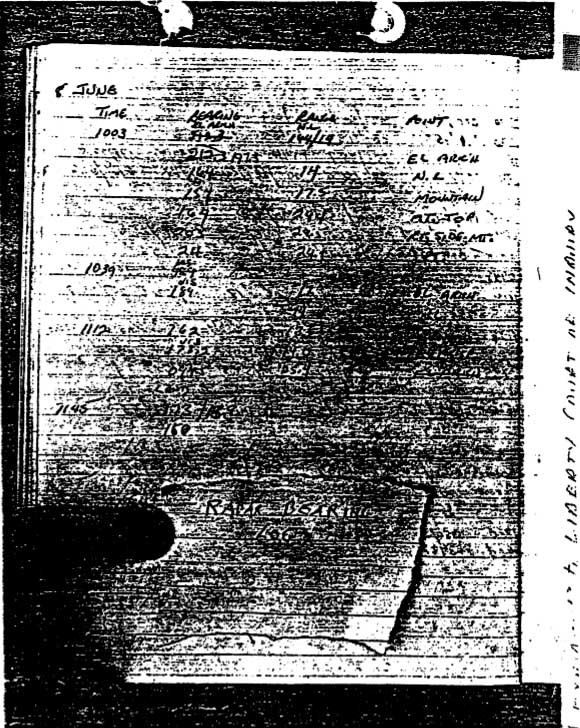
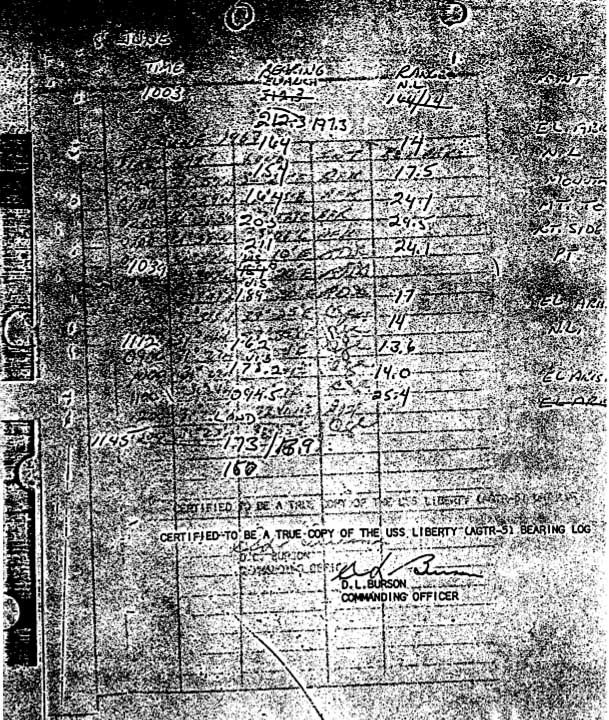
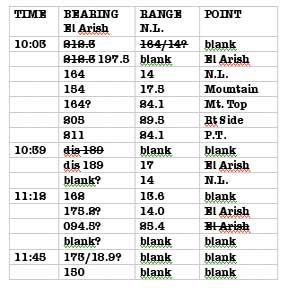
As you can see, these have not held up too well in the copying regimen. The first page is a hand-held photo of the bearing log, with a thumb and a scrap of paper covering half the page. The second is a flat 'scan,' which is more uniformly readable except that it was apparently written on tracing paper which here is over a lat-long graph. It's a bizarre effect, and a bit unprofessional, it seems, for a Navy court of inquiry. Trying to sort it out, I decided the lat-long one runs hourly from 00:00(midnight) through 13:00. Apparently they got distracted sometime before the 1400 entry. It's simply time, lat, long, INT (initials), and ??? column, left blank anyway. A large portion of the entries are obscured, others simply unreadable at this exposure and resolution. And I'm sure the data is available elsewhere and of no huge interest. [Update: K.J. Halliwell's got a perfectly clear copy of this available as the 'dead reckoning chart'here.]
The overlay is the log I'm interested in, without the covering paper or thumb, and we see nothing was missing except "Certified to be a true copy of the USS Liberty (AGR-5) Bearing Log." Transcribed at left, this only shows navigational use of radar - taking bearings on land objects (usually the minaret at El-Arish), and nearest shoreline along that line. Time intervals are apparently ten minutes per line on average, only sporadically labeled, screwy at the beginning. Since the steady course at five knots means one nautical mile was passed every twelve minutes, that may be the interval here. Either way, the last line with no point or range but a bearing of 150, would correspond with 11:50-12:00 depending. End-of-shift sloppiness? I don't see any further logs showing activity in the PM. I'm currently using these to fine tune my map of the route taken, and will post it when complete.

Capt McGonagle to the NCOI Confirmation that the bearing log from 12:00 on is not "available."
"LTJG PAINTER came onto the bridge after general quarters to assume the watch as the officer of the deck. As he assumed the officer of the deck watch, he indicated that he was having difficulty in obtaining an accurate ship's fix. At that time, and the time was approximately 1400, I personally sighted the Minaret at El Arish to be on a bearing of 142 from the ship and the range as I recall from the radar was approximately 25.5 miles. I do not know that this radar range can be verified from the records available at this time."


For visibility range, we have Ensign David Lucas, who was apparently in charge of surface lookouts, and told the NCOI between 1200 and 1300, “more smoke was visible and the land itself was barely visible. This was through the telescope or high powered binoculars on the 04 level.” Nearest Land was about 20 nm distant, first less then more, during this time. Regarding sightings of ships, which would be more challenging than spotting the edge of a continent:
"[The lookouts] had received refresher training, this was sometime since we left Rota on the 2nd of June, and had been refreshed on reporting all surface contacts to include relative bearing, approximate range, and target angle. Had also been given refreshers on reporting aircraft properly, on elevation, what angle, other factors pertaining to properly reporting all surface and air contacts to the officer of the deck. This had been stressed heavily in the first week in June, before we did reach our operating area.”
Officer of the deck's notes [packet 2, pp 3-4] show no reports of surface craft on June 8 prior to the attack. The main deck log does mention two ships sighted June 7, in this same vigilant mode:
1420 sighted unidentified merchant ship bearing 198, distance about 4800 yards. Identified asmerchant ship as Bencleugh, registry unknown. […] 1430 sighted merchant ship Ioanis Asptiotis Greek registry, bearing 019, distance about 1500 yards.
These were about 2.37nm and 0.74nm distant. There were almost certainly other ships around further out, but these were apparently too far away to notice or care about. The smaller torpedo boats were first sighted at an estimated distance of 3-4 nm. So lack of visual contact is not much of a problem for a mystery ship unless it was supposed to be less than four miles from Liberty.

But their radar had a range of up to 24.5 miles anyway, judging by ranges given in the chart (I'm pretty sure now my 29.5 above should be 24.5). This was for a large object called "nearest land (N.L.), not a piddling warship. The Liberty's radar did pick up the approaching MTBs at 1351, ten minutes after the latter has detected them, and six minutes prior to the air attack: "1351 [LOG:] 3 SMALL SURFACE CONTACTS HELD ON RADAR 32,000 YARDS BEARING 082T - REPORTED TO BRIDGE AS 3 SURFACE CONTACTS." [Source: MTB Torpedo Attack - testimony].If these smallish boats (about 90 feet long) appeared at this range, a ship of any size then would have to be probably 20 nm away or further to not show on radar.

ATTACK MAPS BASED ON OFFICIAL SOURCES
[r-click, new window for full-size view] USS Liberty course from 6 am until the end of the attack. 20 nautical mile scale, land contours from Google maps, lat long intersections set using Earth Tools. Path first set roughly from various graphics. Liberty speed and course changes derived from the Deck Log, lengths of each leg set by knots, marked at 15 min intervals. All approximate, and ignoring small momentary changes. 9:00-11:30 stretch fine-tuned with Liberty's radar bearing log and its readings from El Arish minaret, plus deck log (9:00 entry) and captain's recollection (14:00, as above).
I hoped the plots from the Dead Reckoning Table would help pin down the exact course, but no luck.
Motor Torpedo boats app. path based on IDF graphics, generally supported by MTB logs. Location of their radar return at 13:41 (inside the magenta triangle) matches the Liberty, but the heading and speed they decided on were way off, which remains an unresolved mystery.

Friday, April 17, 2009

USS LIBERTY MYSTERY SHIP INQUIRY

ADDITIONAL RESEARCH
Adam Larson / Caustic Logic
April 16 2009
working copy - incomplete


This post, to be updated regularly, will condense various evidence supporting the tentative hypothesis of a previous post The One That Got Away? Essentially, it's a look at the circumstantial evidence for a second, and belligerent war ship in the vicinity of the Liberty prior to its attack - the provoker and cause of the troubles that fell on the American kids. Considering the possibly explosive nature of this, questions about the sources and verification, and lack of previous studies on it (that I know of), I'm forced to be deeply intrigued. And as I look, I'm uncannily confirmed that there's something more than coincidence at work here. Following are the four operative aspects: seriousness of shelling reports, claims of two ships in the vicinity (Israeli Defense Force reports), second ship evidence from Liberty crew, and finally the puncher: speed and heading "errors" in what's supposed to have been the Liberty's track. At the end, a graphic summation. If there weren't at least two separate target ships involved in this episode, someone is trying to make it appear so.

1) SERIOUSNESS OF SHELLING REPORTS
From the IDF Ram Ron Report, 6/16/67:
"At 11.24 a.m. a message was received from the Command Post and by the Air Force that El-Arish was under bombardment from the sea. This message was transmitted on the basis of a message received from the Southern Command and had been repeated several times - based on repeated similar messages from the Southern Command.
[...]
These messages when reported to Capt. Rahav by Comm. A. were received by him with reservation and he insisted that they be re-examined. […] Together with his demand that the information regarding the shelling be verified, Capt. Rahav instructed Comm. A. at 12.05 p.m. to order three torpedo boats then stationed at Ashdod and ready to sail, to head in the direction of El-Arish in order to investigate the information received. Lieut. Comm. P. re-investigated the information regarding the shelling with the Naval Forces Command Post and was informed again that the Southern Command reports that El-Arish is under bombardment from the sea…
[…]
At 13.17 p.m. Comm. S. (representative of the Naval Force at the Command Post) advised Comm. A. that El-Arish
had been under bombardment for the last four hours. Following this message, Comm. A. ordered Comm. AR. - Division Commander/Torpedo Boats - to examine the area at approximately 20 miles north of El-Arish.”
From Col. Uri Algom, The Attack on the "Liberty" Incident: 8 June 1967. IDF History Department, 1982. Posted here.
"At 1124 hours, the naval representative at Air Command reported to Naval Operation Section/3, on the shelling of El-Arish from the sea, Commander Lunz passed on the report to Chief of Naval Operations, Captain (Navy) Rahav, and he to turn instructed Lt. Commander Pinchasi, in no uncertain terms, to check the source of the report. The inquiry into the source of the report was ordered because of the many reports which had been received concerning shelling from the sea and which were later proven to be false, The feeling was that this report was probably no different. Lt. Commander Pinchasi was told by Air Operations Section/3 that the source of the report was an Air-Ground Support Officer in El-Arish; the Navy representative at the Supreme Command, Lt. Commander Tel, also informed Lt. Commander Pinchasi that a similar report had been received enquiry to Naval Operations/3.

Meanwhile the shelling of the coastline also aroused interest at Supreme Command. The Head of Operations Section, Lt, Colonel Haim Nadel, (during a meeting with the COS at 1127 hours), received a report from G Branch- Southern Command, stating that
a ship had been shelling El-Arish but the shells had not reached the coast. The Head of Operations Section immediately ordered that the report be verified, and more important instituted a check to see if there were no Israel Navy vessels off the coast of El-Arish. [...] These reports were passed to Fleet Operations Control Center - to Commander Lunz and Captain (Navy) Rahav. The accumulation of reports from various sources and the involvement of Supreme Commend in the matter, indicated that these reports were not baseless and should be taken seriously."
Michael B. Oren, The USS Liberty: Case Closed. Azure. Spring 2000:
"Then, at 11:24, a terrific explosion rocked the shores of El-Arish. The blast was clearly heard by the men on the Liberty's bridge [...] In El-Arish itself, Israeli forces were convinced they were being bombarded from the sea [...] Though the explosion probably resulted from an ammunition dump fire, that fact was unknown at the time [...there was] good reason to conclude that the Egyptian navy had trained its guns on Sinai."

Captain McGonagle, testimony to Naval Court of Inquiry:
“[I]t was possible to see a large billowing cloud of black smoke rising from approximately 15 to 20 miles to the west of El Arish on the beach. The exact identity of the cause and the location of this explosion is not positively known, although it was believed to be near the beach in that area. This was noted at about 1300. At about 1330 a smaller cloud of black smoke was noted to the east of El Arish estimated five to six miles and also along the coastline."

Two separate plumes miles apart does not sound like a simple ammunition dump fire. It's interesting to note Israeli command seemed confident the explosions were caused by a vessel north of El Arish, while the Liberty, on the scene in that area seemed oblivious to any such presence near them. The danger was distant, but noted by the Captain at about 1:45 as the drill wrapped up, about 10-15 minutes before the first strafing run across the deck:
"Before dismissing the crew from general drills, I gave the crew a short talk on the PA system, reminding them of the importance of expeditiously responding to general quarters and the setting of condition Zebra for drills and in the event of an actual attack. So that they would be impressed I pointed out to the crew at that time that the column of black smoke on the beach should be sufficient evidence that the ship was in a potentially dangerous location.”

2) TWO SHIPS IN THE VICINITY (IDF REPORTS)
Of course, any explicit mention of a ship seen or known to be shelling indicates a ship capable of that, in addition to the Liberty. With that in mind:
From the Yerushalmi Report, 7/21/67:
"It is to be noted that the reports from Southern Command [re: shelling] were also accompanied by information that two vessels had been observed approaching the coast."
From Algom, IDF, 1982:
"The Head of Operations Section, Lt, Colonel Haim Nadel, (during a meeting with the COS at 1127 hours), received a report from G Branch- Southern Command, stating that a ship had been shelling El-Arish but the shells had not reached the coast. [...] Meanwhile, another report arrived from Southern Command (at 1145 hours), which stated that two ships were approaching the EL-Arish coast."
Note: The Liberty was approaching the coast, obliquely from the east, until 11:30, and then turned slightly away. If any report specifying "two ships" came in, it could be concocted, out of caution or something else, from duplicate but differing sightings of the lonely Liberty. It's also possible they originated with an aerial reconnaissance round that observed both the Liberty and a specific second ship, or even two mystery ships aside from her, thus confidently reporting "two ships." Another possibility:
Ram Ron Report:
"Said messages also contained reports on two ships or one ship shelling El-Arish [...] Naval Forces Command Post and was informed again that the Southern Command reports that El-Arish is under bombardment from the sea and that two ships can be seen at a distance."

Very important bit from Oren's article I missed at first indicates there was at least a brief moment the Motor Torpedo Boat commander felt there were two ship in the area, worked out for a separate post:
On their way there, the MTB crew say they felt they were racing towards an Egyptian Z-Class destroyer, based on the shelling reports, the ‘observed’ radar speed, and even initial Air Force reports in the attack. When they got to it they quickly realized that was wrong. Israeli historian Michael Oren explained how Division Commander Moshe Oen (no relation?) "could see that it could not be the destroyer that had supposedly shelled El-Arish. Rather, he believed, it was a slower-moving vessel that had either serviced that destroyer or evacuated enemy soldiers from the beach.” Thus any second thoughts this gave them were quickly corrected – it was just a different Arab ship. The important but overlooked corrolary of this is the IDF’s jets had already spent twenty minutes attacking the wrong vessel and the 30-knots shore attacker was slipping away behind the distraction. This seems, from the records I've examined (all available) to have been no concern of the IDF, as they continued their attack against the easy mark in lieu of a threat they seemed to know never really existed.

3) POSSIBLE SECOND SHIP REFERENCE (USS LIBERTY)
This is certainly the weak point of this theory: no eyewitness or radar reports of any suspicious ship zipping at 30 kts through their space. As mentioned in the original piece, Survivor Richard Carlson wrote this, which might be a clue, vague as it is:
"I had finished lunch, and now standing by the starboard railing, began talking with CT1 Bingham. He looked as nervous as I felt. We tried to console each other that we were basically an unarmed ship, in international waters, and that no one was going to bother with us. Neither of us sounded convincing. We couldn't seem to shake the mystery ship following us. Who was it we wondered?"

That's just nothing much to go on. I'm starting a separate post to explore primary sources on what 'the ship' as a whole might have seen. Nothing yet about any steel-and-oil mystery ship, but a little more room than I thought for it to hide in, hypothetically at least, and some useful information otherwise.

4) SPEED AND DIRECTION "MISCALCULATION"
From the US State Department, Salans Memorandum, 9/21/67:
"As you requested, we have compared the decision of the Israeli Judge, dated July 21, 1967, with the findings of the U.S. Navy Court of Inquiry, and the Clifford Report, concerning the Liberty incident. The following discrepancies are noteworthy:

I. Speed and Direction of the "Liberty"
The Israeli report indicates that the torpedo boat Division Commander reported and reconfirmed the target's (Liberty's) speed at 28 to 30 knots and that it had changed its navigational direction shortly after 1341 hours.
The U.S. Navy inquiry established that the Liberty had been on a steady course at 5 knots from 1132 hours until the attack."
Note the target in question was first sighted at 1341, a fact communicated back to headquarters. What would cause this ship to change direction shortly after discovery? "Whiskey Tango Foxtrot, you are on the scopes now. Depart the area, full speed."
Ram Ron Report:
"At 13.41 p.m. the Torpedo boat's radar picked up a target at a distance of approximately 20 miles north/west of El-Arish and approximately 14 miles north of Barbville [sic]. Immediate message to the effect was passed on to Comm. A. [...] At 13.47 it was reported from the Torpedo Boats that the speed of the unidentified targets was 30 knots and their course 260. […] at 13.50 p.m. the Torpedo boats reported that the target speed was 28 knots."
Yerushalmi Report:
"According to the division log-book, a target was located at 13.41 hours situated at a distance of about 20 miles north of El-Arish. The division was ordered "to close in and identify the target," and reported that the unidentified target was moving at a speed of 30 knots westwards--that is, in the direction of Port Said.

A few minutes later, the Division Commander reported that the target, now 17 miles from him, was moving at a speed of 28 knots, and since he could not overtake it, he requested the dispatch of aircraft towards it. The Division Commander also reported that the target had changed its navigational direction."
Note the direction of change and its implications are not specified, but considering the MTB path after this discovery (see graphic below) they decided it was turning north, which it in fact did about fifteen minutes later. The MTBs themselves turned soft right/north, apparently slowed down a bit, and eventually sort of merging with the Liberty's mid-speed escape path, and strangely failed to kill everyone, as they well could have.
From Algon, IDF, 1982
"At 1341 hours, the Division detected the target on its radar 20 miles northwest of El Arish and 14 miles off the coast of Bardewil. The officer at the C1C on the flagship, Ensign Yifrach Aharon, reported that the target had been detected at a range of 22 miles, that her speed had been tracked for a few minutes, after which he had determined that the target was moving westward at a speed of 30 knots. These data were forwarded to the Fleet Operations Control Center.

The speed of the target detected by the Israel Naval Division was significant in that it indicated, beyond doubt, that the target was a combat vessel - since only combat ships can develop such high speeds. [...] The given data created the impression at Naval Operations of an enemy ship, turning to escape in the direction of Port Said. The Chief of Naval Operations asked the Division to double-check their calculations. A second check confirmed the direction of the target, but her speed was corrected to 28 knots."
This report was offered by the IDF as the "official" Israeli version, their chance to set the record straight with full access to the knowledge of the Israeli Defense Forces to offer the best explanation of why their equipment might misread the situation so wildly. Please carefully consider the following, which is apparently the best Algon and his staff were able to come up with:
"In retrospect, it is clear that the data dealing with target speed were incorrect since the "Liberty" was not capable of cruising at such high speeds. However, it is astounding that the same target speed was measured independently by two torpedo boats: T204 (with the Division commander aboard) and T203 which estimated target speed at 25 - 28 knots."
It's "astounding," and that's comparing it to the non-sequitur top-speed of 18 knots. That's the "since." So even presuming the captain and crew and logs were all lying and she was flooring it to 18 there, a double-reading of 25-38/30 knots would be "astounding." That's pretty damn lame considering the Liberty was actually crawling along at less than a third of this, f-i-v-e nautical miles per hour, the whole time, which is the fact the author chose NOT to place after the "since." And there, ladies and gentlemen, is the IDF's best explanation. Another author using the same 'since' and nudging forth the IDF's implied whole other ship story:
Oren, Case Closed: "At 1:41 p.m., Ensign Aharon Yifrah, combat information officer aboard the flagship of these torpedo boats, T-204, informed its captain, Cmdr. Moshe Oren, that an unidentified ship had been sighted northeast of El-Arish at a range of 22 miles. The ship was sailing toward Egypt at a speed, Yifrah estimated, of 30 knots.

Yifrah's assessment, twice recalculated and confirmed by him, was pivotal. It meant that the ship could not be the Liberty, whose maximum speed was 18 knots. [...] This information, when added to the ship's direction, indicated that the target was an enemy destroyer fleeing toward port after having shelled El-Arish.

The torpedo boats gave chase, but even at their maximum speed of 36 knots [actually 42 -ed], they did not expect to overtake their target before it reached Egypt [based on the 560% wrong speed 'calculation' -ed]. Rahav therefore alerted the air force, and two Mirage III fighters were diverted [...] [and the hits just kept coming -ed]."

GRAPHIC SUMMATION
Coming back when it's corrected. Yep, I did something wrong. (Statute miles compared to nautical mils will give you 'discrepancies'). Slap head... still, it's a start towards mapping out the scene.